Where Should Robotaxis Operate? Strategic Network Design for Autonomous Mobility-on-Demand
The emergence of Autonomous Mobility-on-Demand (AMoD) services creates new opportunities to improve the efficiency and reliability of on-demand mobility systems. Unlike human-driven Mobility-on-Demand (MoD), AMoD enables fully centralized fleet contr…
Authors: Xinling Li, Gioele Zardini
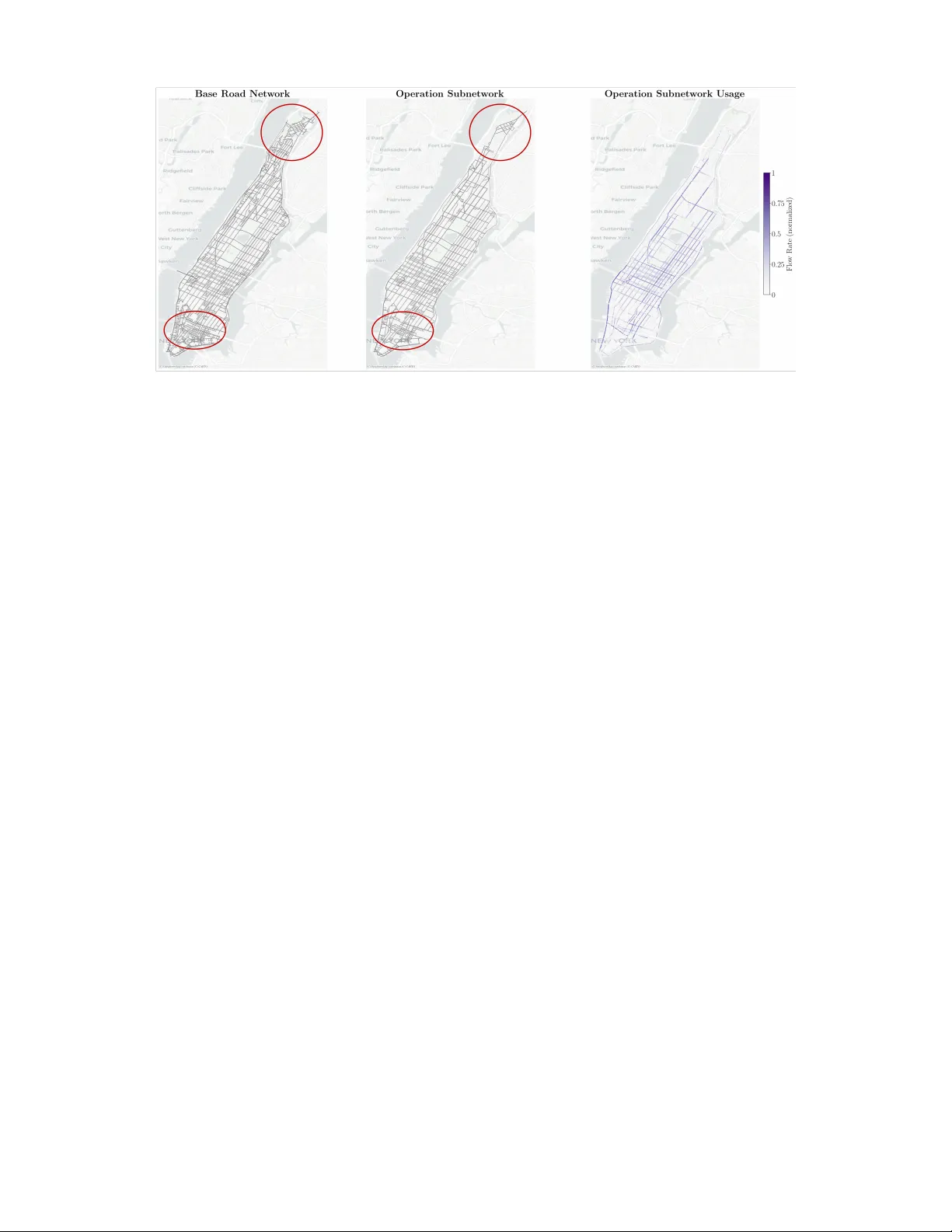
1 Where Should Robotaxis Operate? Strate gic Network Design for Autonomous Mobility-on-Demand Xinling Li, Gioele Zardini Abstract —The emergence of A utonomous Mobility-on-Demand (AMoD) services cr eates new opportunities to improv e the ef- ficiency and reliability of on-demand mobility systems. Unlike human-driven Mobility-on-Demand (MoD), AMoD enables fully centralized fleet control, but it also r equires appropriate infras- tructure, so that vehicles can operate safely only on a suitably instrumented subnetwork of the r oads. Most existing AMoD resear ch focuses on fleet control (matching, rebalancing, ride- pooling) on a fixed r oad network and does not addr ess the joint design of the service network and fleet capacity . In this paper , we formalize this strategic design problem as the A utonomous Mobility-on-Demand Network Design Problem (AMoD-NDP), in which an operator selects an operation subnetwork and routes all passengers, subject to infrastructure and fleet constraints and route-le vel quality-of-service requirements. W e propose a path- based mixed-integer formulation of the AMoD-NDP and develop a column-generation-based algorithm that scales to city-sized networks. The master problem optimizes over a restricted set of paths, while the pricing problem reduces to an elementary shortest path with resour ce constraints, solved exactly by a tailored label-correcting algorithm. The method provides an explicit certificate of the optimality gap and extends naturally to a rob ust counterpart under box uncertainty in travel times and demand. Using r eal-world data from Manhattan, New Y ork City , we show that the framework produces stable and interpr etable operation subnetworks, quantifies trade-offs between infrastruc- ture in vestment and fleet time, and accommodates additional path-level constraints, such as limits on left turns as a proxy for operational risk. These results illustrate how the proposed approach can support strategic planning and policy analysis for future AMoD deployments. I . I N T R O D U C T I O N Rapid urbanization continues to increase transportation de- mand in major cities worldwide [1]. The resulting gro wth in priv ate vehicle use has led to severe congestion, with sub- stantial losses in productive time and increased emissions [2]. According to the Intergov ernmental Panel on Climate Change, the transport sector alone accounts for roughly 15% of global greenhouse gas emissions [3]. Addressing these challenges requires not only ne w vehicle technologies, b ut also new ways of organizing and operating urban mobility systems. Over the past decade, MoD services such as Uber and L yft hav e emerged as flexible, on-demand alternati ves to pri v ate car o wnership, and hav e e xperienced rapid global growth [4]. While MoD can improv e accessibility and reduce parking de- mand, empirical e vidence indicates that, in their current form, these services can also exacerbate congestion and emissions due to high lev els of empty vehicle trav el and deadheading [5], The authors are with the Laboratory for Information and Decision Sys- tems, Massachusetts Institute of T echnology , Cambridge, MA 02139, USA, { xinli831,gzardini } @mit.edu This work was supported by the Sidara Urban Seed Grant Program at the Norman B. Lev enthal Center for Advanced Urbanism, Massachusetts Institute of T echnology , and by Xinling Li’ s Mathworks Fellowship. [6]. T o realize the potential benefits of MoD, vehicles must be coordinated efficiently so that demand is served with minimal cruising and spatial mismatch between supply and demand. In practice, achieving such coordination is challenging in human-driv en MoD systems because driv ers act autonomously and may not follo w system-optimal repositioning or routing policies. Recent studies show that decentralized driv er be- havior and self-repositioning can lead to inefficient dispatch patterns and excessi ve cruising, ev en when the platform uses sophisticated matching algorithms [7]–[9]. The recent emergence of MoD with Autonomous V ehicles (A Vs), or AMoD, fundamentally changes this landscape. In AMoD systems, vehicles are owned and operated by a central operator , enabling fully centralized fleet coordination. A grow- ing body of work has therefore focused on operational control of AMoD, including matching, rebalancing, and ridepooling algorithms [10], [11]. Howe ver , most existing models assume that the fleet operates on a fixed underlying road network, following the standard assumptions inherited from human- driv en MoD. This assumption is reasonable when drivers supply their own vehicles and operate on the existing network, which is outside of the control of the platform. For AMoD, by contrast, both the fleet and the service network are under the operator’ s control. A Vs require appro- priate physical and/or digital infrastructure for safe operation, and most deployments are initially restricted to a limited Operational Design Domain (ODD) [12], [13]. The operator must therefore decide which parts of the road network to in- strument or lev erage for autonomous operation and how larg e a fleet to deploy on the resulting operation network. These long-term design choices directly affect service profitability , operational risk, and system performance. They shape feasible routes, trav el times, and the reliability of fleet operations. In this sense, AMoD poses a new type of T ransportation Network Design Problem (TNDP), in which a centralized operator jointly designs the service network and routes vehicles and passengers on it. This paper addresses the resulting strategic design question: how should an AMoD operator jointly design its service net- work and fleet capacity , subject to infrastructur e budgets, fleet- time limits, and r oute-level quality constraints? Answering this question requires moving beyond fixed-network models and explicitly incorporating netw ork instrumentation decisions into the AMoD optimization framew ork. Statement of contribution: In this work, we make three main contributions. First, we formally define the AMoD-NDP, in which a centralized operator selects a subnetwork of the road graph for autonomous operation and jointly determines passenger routing and fleet utilization. The formulation cap- tures infrastructure in vestment, fleet-time constraints (directly linked to fleet size), and route-le vel Quality of Service (QoS) 2 and risk constraints. Second, we de velop a scalable path- based mixed-integer formulation and a Column Generation (CG)-based algorithm tailored to the AMoD-NDP. The Linear Program (LP) master problem optimizes ov er a restricted set of paths, and the pricing problem reduces to an elementary Shortest Path with Resource Constraint (SPRC) on the road network. W e design an exact label-correcting pricing algo- rithm with Origin-Destination (OD)-specific preprocessing and prov e that the overall method yields the optimal LP relaxation value together with an e xplicit optimality gap certificate for the recov ered integer solution. W e further show that, under box uncertainty in travel times and demand, the robust counterpart preserves the same decomposition structure. Finally , using real-world data from Mahattan, NYC, we demonstrate that the framework scales to city-sized instances and produces interpretable operation subnetworks. Through case studies, we quantify trade-offs between infrastructure budgets and fleet size and illustrate how additional path-lev el constraints, such as limits on left turns as a proxy for operational risk, affect profitability and service cov erage. These experiments highlight how the proposed model can serve as a decision-support tool for both operators and municipalities. Or ganization of the manuscript: The remainder of this paper is or ganized as follows. In Section II, we revie w the literature on network design for urban transportation systems and position the AMoD-NDP relativ e to road and transit network design. In Section III, we formally define the AMoD- NDP and present the model formulation. In Section IV, we introduce the CG-based algorithm and its robust extension. Case studies are presented in Section V to illustrate the flexibility of the model and the effecti veness of the proposed algorithm. Finally , Section VI concludes with a discussion of future research directions. I I . R E L AT E D W O R K The TNDP has been a central topic in transportation and infrastructure planning for decades. Broadly speaking, it seeks to design or improve a transportation network so as to opti- mize a system-le vel performance metric under demand and budget constraints. T wo classical streams of research are the r oad network design problem and the transit network design problem. In this section we briefly revie w these two areas and then highlight the key dif ferences that distinguish the proposed AMoD-NDP from both. A. Road network design The road network design problem focuses on modifying an existing road network to improve system performance, typically aiming to reduce congestion or a verage trav el time. Depending on the decision v ariables, it is usually classified into three types: 1) Continuous road network design, which adjusts the capacities of existing road segments. 2) Discr ete road network design, which decides whether to add or remove individual links. 3) Mixed road network design, which combines both ca- pacity changes and discrete link additions. Regardless of the type, road network design is mostly formulated as a bi-lev el optimization problem. On the upper lev el, a system regulator decides how to in vest in the road infrastructure subject to a limited budget. On the lower level, trav elers react to these network changes by choosing routes according to some equilibrium principle, typically a User Equilibrium (UE) or Stochastic User Equilibrium (SUE). The notion of UE originates from W ardrop’ s first prin- ciple [14], which describes a network game where driv ers selfishly route themselves to minimize their own travel cost when that cost depends on link flows. The equilibrium flow can be computed using Beckmann’ s transformation, which provides an equi v alent single-level optimization formulation whose optimal solution satisfies the UE conditions [15]. This framew ork has been extended to account for randomness in perceiv ed trav el cost, leading to SUE models [16]. Both UE and SUE form the standard lower -level models in bi-level road network design. W ith flows characterized by equilibrium conditions, the road network design problem becomes a bi-lev el optimization problem with equilibrium constraints, which is NP-hard in general. Early work such as [17] considered discrete network design with a UE lower le vel and proposed an exact branch- and-bound algorithm that explicitly accounts for phenomena such as Braess’ paradox. While exact, these methods do not scale to realistic urban networks. Subsequent research has focused on improving scalability , leading to a rich toolbox including relaxation methods [18], [19], heuristics and metaheuristics [20], [21], decomposition approaches [22], [23], and single-le vel reformulations based on variational inequalities or Karush-Kuhn-T ucker (KKT) condi- tions [24], [25]. Continuous road design, in which capacities rather than discrete links are optimized, has a similar structure and is often used as a tractable approximation of discrete problems [26], [27]. Howe ver , ev en linear bi-level problems remain NP-hard [28], and a large body of work continues to dev elop heuristics and approximation schemes for the continuous case [27], [29], [30]. Comprehensiv e surveys such as [31] revie w these models and algorithms in detail. W e emphasize that, in all of these works, responsibility for network design and route choice is split: a regulator designs the infrastructure, and self-interested driv ers route themselves, leading to the characteristic bi-lev el structure [32]. While in a broader context road network design can also encompasses the regulation of intersections, traffic signaling, and road tolling schemes, this is not the focus of this paper . B. T ransit network design T ransit network design has a long history and has grown in complexity and realism ov er time. In its basic form, the problem is to design a set of transit routes (i.e., sequences of stops) on a given road network to maximize user experience, typically measured through a verage travel time, the number of transfers, and network coverage [33]. More recently , route design is often coupled with frequency setting, since service frequency influences both waiting times and effecti ve line capacities. The combinatorial nature of transit network design stems from the need to generate candidate routes. The space of potential routes is enormous, and this has motiv ated a number 3 of heuristics for path generation and selection. Early heuristic methods [34]–[36] use demand profiles, practical design rules, and operator experience to generate an initial set of plausible routes, and then apply additional heuristics to select a subset of lines and frequencies. These methods are computationally efficient, b ut typically lack a feedback loop that iterativ ely improv es the candidate route set based on the quality of the final solution. T o address this, [37] proposed an iterativ e procedure that starts from a shortest-path-based route network and gradually trades off in-vehicle time and waiting time, using demand assignment results to update frequencies. While this methods ensures monotone improvement, it relies on shortest paths for initialization, and can therefore lead to conservati ve designs with lar ge optimality gaps, requiring many iterations to reach high-quality solutions. Another line of work formulates transit network and fre- quency designs as mathematical programs. Compared to pure heuristics, these formulations offer formal optimality guar- antees or bounds, but they are challenging to solve at city scale [38]. As a consequence, many studies decompose de- cisions into multiple phases, for instance, restricting to a predefined subset of transit routes and the solving for route selection and frequencies [39]–[41]. In such approaches, the quality of the initial route set largely determines the quality of the final design, since routes are not generated adaptiv ely during optimization. CG has been particularly successful in this context. [42] is among the first to apply CG to line planning in public transport. CG decomposes the problem into a master problem and a pricing problem, where the pricing subproblem generates new routes (columns) that can improve the objective. This yields a principled way to combine route generation with route selection and frequency design in a single framework. Follo w- up works extend this idea to jointly consider line planning and passenger routing [43]–[45], and to incorporate additional constraints and quality criteria. These CG-based approaches are less sensitive to the initial line set, provide anytime solutions with explicit optimality gaps, and have demonstrated scalability on large transit networks; see the survey [46] for a recent ov ervie w . C. AMoD network design and r esearc h gap Conceptually , the AMoD-NDP shares high-level similarities with both road and transit network design: in all three cases a network designer chooses a service network topology , and trav elers (or vehicles) are subsequently routed on that network. Howe ver , the service paradigm and behavioral assumptions underlying AMoD lead to fundamental differences along three main dimensions. Centralized contr ol vs. user equilibrium: In classical road network design, tra velers use their own vehicles and retain full autonomy ov er route choice. This motiv ates the use of UE/SUE models and leads to a bi-lev el formulation in which the upper-le vel regulator chooses infrastructure and the lower lev el captures the equilibrium response of self-interested users. In contrast, AMoD systems rely on centrally managed fleets of A Vs. A Vs are o wned and dispatched by the operator , who is responsible both for deciding which links to instrument and for routing all vehicles and passengers on the resulting operation network. Passenger routes are not the outcome of decentralized user optimization, but the result of a centralized assignment optimized to maximize the operator’ s objective. As a consequence, the AMoD-NDP does not exhibit the bilev el structure characteristic of road network design, but rather a single-lev el mixed-integer formulation in which infrastructure and routing decisions are jointly optimized. Pr ofit-driven, r oute-level quality constraints: T ransit net- work design is typically motiv ated by social welfare and public service objectives. Design criteria emphasize system- wide efficienc y , af fordability , and sustainability , often captured through aggregate metrics such as average travel time, total operating cost, or network coverage [46]. These aggregate measures can mask poor service for small subsets of trav elers; only a limited subset of works explicitly enforce route-lev el guarantees, and doing so usually requires heavy heuristics to remain tractable [36], [45]. By contrast, AMoD operators are profit-driven entities com- peting in a market with low switching costs. In such a setting, passenger-le vel service quality (e.g., door-to door trav el time, number of risky maneuvers, or reliability) is directly tied to demand retention and profitability . It is therefore natural to impose route-level QoS and risk-related constraints, ensuring that every passenger route satisfies minimum service criteria. The AMoD-NDP studied in this paper explicitly incorporates such path-lev el constraints, which substantially complicate the formulation and preclude purely link-based models. Service paradigm and modeling implications: Finally , the underlying service paradigm differs. Transit systems are based on fixed lines, schedules, and transfers: waiting times and transfers are central determinants of user experience and are key modeling elements. AMoD, in contrast, offers on- demand, door-to-door service with no transfers, so the primary lev ers are network instrumentation, vehicle routing, and fleet sizing [47]. T ransfers and waiting time play a ne gligible role in the AMoD context, but route-lev el travel time and risk metrics become central. P ositioning of this work: The abov e discussion highlights the distinctive nature of the AMoD-NDP: a centralized oper- ator jointly designs the service network and the routing of passengers and vehicles, subject to explicit route-le vel quality and risk constraints. Classical road network design assumes self-interested users and bi-lev el UE; transit network design is organized around fixed lines, schedules, and transfers, often with social-welf are objecti ves and aggregate performance mea- sures. Existing AMoD research, in turn, has focused primarily on operational control (e.g., matching and rebalancing) on a fixed road network [10]. In contrast, the problem studied in this paper combines elements of all three areas: it is a network design problem, but the decision maker is a profit-dri ven AMoD operator with centralized control and route-le vel QoS and risk constraints. This leads to a single-lev el, path-based Mixed Integer Liner Program (MILP) that dif fers structurally from bi-level road network design and from line-based transit formulations. The remainder of the paper dev elops this AMoD-NDP formulation, proposes a scalable CG-based algorithm with optimality-gap guarantees, and ev aluates the resulting framew ork on city-scale AMoD applications. 4 I I I . S Y S T E M M O D E L A N D A M O D N E T W O R K D E S I G N P RO B L E M In this section, we formalize the setting for the AMoD-NDP. W e first introduce the base road network and demand model, then define paths and path-based specifications. Building on these preliminary concepts, we formulate a general AMoD- NDP and state the structural assumptions on the objectiv e that will be used throughout the paper . W e conclude with the specific profit-maximizing AMoD-NDP instance that is the focus of the remainder of the work. A. Base Road Network and Demand The AMoD operator designs a service operation network within a given road infrastructure and centrally routes A Vs and passengers on such network. Definition 1 (Base Road Network) . The base r oad transporta- tion network is represented by a directed graph G = ( V , E ) , where V is the set of nodes and E ⊆ V × V is the set of directed edges. For each edge e ∈ E , let s ( e ) and t ( e ) denote its source and sink nodes, respectiv ely , and assume that there is at most one edge between any ordered pair of nodes. Each edge e ∈ E is associated with a vector of time-in variant attributes A ( e ) = ( A 1 ( e ) , . . . , A n ( e )) ∈ A 1 × . . . × A n , where A i : E → A i returns attribute i of edge e . In particular , T : E → R > 0 and L : E → R > 0 denote the travel time and length of edge e . Definition 2 (Demand) . For any ordered pair of distinct nodes ( i, j ) ∈ V × V with i = j , let d ij := ( i, j, α ij ) denote the trav el demand from origin i to destination j , where α ij ∈ R > 0 is the number of trav elers wishing to mov e from i to j during the planning horizon. The total demand is the set D := { d ij | i, j ∈ V , i = j, α ij > 0 } . W e write ˜ D := { ( i, j ) ∈ V × V | d ij ∈ D } for the corresponding set of OD node pairs. A Vs trav el along paths in the road network. Definition 3 (Path) . Let i, j ∈ V be distinct nodes. A path from i to j can be represented in either of the following equiv alent forms: 1) A node sequence p := ( v 1 , . . . , v ℓ ) such that v 1 = i , v ℓ = j , and ( v k , v k +1 ) ∈ E for all k = 1 , . . . , ℓ − 1 . 2) An edge sequence p := ( e 1 , . . . , e ℓ − 1 ) such that t ( e k ) = s ( e k +1 ) for all k = 1 , . . . , ℓ − 2 . Remark 1 . The node-sequence and edge-sequence represen- tations are in one-to-one correspondence: each node path uniquely determines an edge path, and vice versa. Definition 4 (Demand-satisfactory Path) . A path p is demand- satisfactory for OD pair ( i, j ) ∈ ˜ D if it starts at i and ends at j . The set of demand-satisfactory paths for ( i, j ) is denoted P ij , and we write P := [ ( i,j ) ∈ ˜ D P ij for the union of all demand-satisfactory paths. The operation network induced by a design x is a subgraph of G that contains only the edges on which the AMoD service is allowed to operate. This notion will be made precise in Definition 5. B. P aths and P ath-based Quality-of-Service Constraints Many service specifications for AMoD are naturally ex- pressed at the path le vel, e.g., bounds on end-to-end trav el time or limits on risky maneuvers. T o capture these, we associate attributes via paths. For a path p ∈ P ij , its travel time and length are T ( p ) := P e ∈ p T ( e ) and L ( p ) := P e ∈ p L ( e ) , respectiv ely . More generally , let H ( p ) = ( H 1 ( p ) , . . . , H m ( p )) be a vector of path attributes, where each H k : P → R may depend on the sequence of edges in p (e.g., number of left turns, number of intersections, or a risk score). A generic path-le vel QoS or risk constraint for OD pair ( i, j ) can then be written as H k ( p ) ≤ M k ij , ∀ p ∈ P ij , (1) for prescribed thresholds M k ij . In the simplest cast, H 1 ( p ) = T ( p ) encodes a bound on end-to-end trav el time; in Sec- tion V -E we will instantiate H k to count left turns and obtain a risk-related constraint. The path admissible set for OD ( i, j ) under a collection of constraints of the form Eq. (1) is P adm ij := { p ∈ P ij | H k ( p ) ≤ M k ij for all relev ant k } . These admissible paths will be the building blocks for the flow variables in the path-based formulation introduced later (Section IV -B). C. General AMoD Network Design Pr oblem W e now formalize the AMoD-NDP at a high lev el. The operator chooses (i) which edges to instrument for autonomous operation, and (ii) a feasible flo w assignment on the resulting operation network that serves a subset of the demand. Definition 5 (AMoD–NDP) . Given a base network G = ( V , E ) and demand profile D , the AMoD-NDP seeks to maximize a system functionality F ( x , y ) over: • a binary instrumentation v ector x = ( x e ) e ∈ E , where x e = 1 if edge e is instrumented for autonomous operation and x e = 0 otherwise; • a nonnegati ve passenger flo w vector y = ( y e ) e ∈ E , where y e is the total passenger flo w routed along edge e . The decisions ( x , y ) are constrained by: X e ∈E b e x e ≤ B (instrumentation budget) , X e ∈E r e y e ≤ R (resource / fleet-time budget) , 0 ≤ y e ≤ c e x e , ∀ e ∈ E (edge capacity) , y obeys flow conservation (flow feasibility) , y serves at most the demand D (maximum demand) , 5 where b e > 0 is the infrastructure cost of instrumenting edge e , c e > 0 is its capacity , and r e > 0 is the resource consumed per unit flow on e (e.g., vehicle time). The induced operation network is G op ( x ) = ( V , E op ( x )) , E op ( x ) := { e ∈ E | x e = 1 } . In general, the functionality F ( x , y ) may depend on both decisions. In this paper , we focus on a class of models where x affects performance only through the feasible set of ( x , y ) and the objectiv e is additi ve over edges. Assumption 1 (Link-separable functionality) . The functional- ity depends on the flows via a link-separable function F ( x , y ) = X e ∈ E F e ( y e ) , and x influences performance only by restricting the feasible set of ( x , y ) through the budget, capacity , and flo w conserva- tion constraints. Assumption 2 (Affine per-edge contribution) . For each edge e ∈ E , the per-edge function F e is affine: F e ( y e ) = β e, 0 + β e y e , where β e ∈ R is the marginal contribution of one unit of flow on edge e and β e, 0 ∈ R is a constant intercept. Assumption 2 is standard in system design phases where the performance measure is approximated by aggregated usage with a constant mar ginal benefit (or cost) per unit flo w over the operating range of interest [15], [48]. It includes, for example, total distance tra veled, time- or distance-proportional operating costs, and profit objecti ves built from edge-le vel re venue and cost components. The intercept terms in Assumption 2 play no role in the optimal solution, which allows us to simplify the notation. Lemma 1 (Irrelev ance of intercepts) . Under Assumption 1 and Assumption 2, the inter cepts β e, 0 do not affect the set of optimal solutions of the AMoD-NDP. Equivalently , any optimizer for the pr oblem with objective P e ∈E β e y e is also optimal for the problem with objective P e ∈E ( β e, 0 + β e y e ) , and vice versa. Pr oof. Let F denote the feasible set of all ( x , y ) that satisfy the budget, capacity , and flow-conserv ation constraints. Con- sider the two optimization problems max ( x , y ) ∈F X e ∈E β e y e and max ( x , y ) ∈F X e ∈E ( β e, 0 + β e y e ) . For any feasible ( x , y ) ∈ F we have X e ∈E ( β e, 0 + β e y e ) = X e ∈E β e, 0 + X e ∈E β e y e . The term P e ∈E β e, 0 is constant over F and therefore does not change the ordering of feasible solutions. Hence both problems hav e the same set of maximizers. In the remainder of the paper , we therefore drop the inter - cept terms and write F ( x , y ) = X e ∈ E β e y e without loss of generality . D. Profit-maximizing AMoD-NDP with Fleet and Infrastruc- tur e Constr aints W e now specialize the general model to the concrete instance studied in the rest of the paper . In this instance, the system functionality corresponds to the expected operator profit ov er the planning horizon. For each edge e ∈ E , let β e denote the expected net profit per unit passenger flow on e (fare minus variable operating costs). The operator chooses which edges to instrument and how to route demand so as to maximize total profit subject to: • an infrastructure budget B for constructing or enabling autonomous-driving infrastructure, • a fleet-time budget R capturing the available vehicle- hours, which is directly related to the fleet size, • link capacities c e . In this setting, and under Lemma 1, the AMoD-NDP takes the form max x , y X e ∈E β e y e s.t. X e ∈E b e x e ≤ B , X e ∈E T ( e ) y e ≤ R, 0 ≤ y e ≤ c e x e , ∀ e ∈ E , y induced by a feasible flo w assignment on G op ( x ) that serves at most the demand D , x e ∈ { 0 , 1 } , y e ≥ 0 , ∀ e ∈ E . (2) The fleet-time budget R is modeled by taking the resource consumption r e in Definition 5 equal to the edge trav el time T ( e ) . In Section IV, we refine the aggregate edge flows y into OD-specific and path-specific flows, deri ve link- and path- based formulations of (2), and de velop a CG-based algorithm that scales to real-world city networks while accommodating path-based QoS and risk constraints of the form described in Section III-B. E. Discussion In this work we focus on a static, steady-state design problem. The passenger flows represent passenger-carrying vehicle flow aggregated over a planning horizon (one day in the case study), and the fleet-time budget captures the total vehicle-hours required to provide this service. W e deliberately abstract away time-of-day variations, short-term queueing, passenger waiting times, and explicit empty-vehicle rebalanc- ing flows. These phenomena are central for operational fleet control, but incorporating them would require a time-expanded network with many more nodes and state v ariables. Here we view the AMoD-NDP as providing a medium-term infras- tructure and fleet-sizing plan, to be complemented in practice by more detailed operational policies (matching, rebalancing, charging) applied ex post on the designed operation subnet- work [10]. 6 I V . P A T H - BA S E D F O R M U L A T I O N A N D C O L U M N - G E N E R A T I O N A L G O R I T H M In this section, we instantiate the profit-maximizing AMoD- NDP introduced in Section III into explicit link- and path- based mixed-integer linear formulations. W e show that a path- based formulation is necessary to capture route-lev el QoS constraints, but leads to an e xponential number of potential paths. T o address this, we dev elop a scalable CG-based algo- rithm that dynamically generates only the relev ant paths via a pricing problem cast as a SPRC and solved exactly by a label-correcting algorithm. Throughout this section we focus on the profit-maximizing instance (2), and we assume that for each OD pair ( o, d ) ∈ ˜ D the admissible paths are those with tra vel time at most M od , i.e., P adm od := { p ∈ P od | T ( p ) ≤ M od } . Other path-le vel constraints can be handled analogously (see Section V -E for an example of left-turn risk constraint). A. Link-based F ormulation W e first present a standard link-based formulation of the profit-maximizing AMoD-NDP. Recall the set of OD node pairs ˜ D from Definition 2. For each node v ∈ V , denote its sets of outgoing and incoming edges by σ + ( v ) := { e ∈ E | s ( e ) = v } , σ − ( v ) := { e ∈ E | t ( e ) = v } . Formulation 1 (Link-based AMoD-NDP) . Define the deci- sion variables x ij = ( 1 , if edge ( i, j ) is instrumented , 0 , otherwise , f od ∈ [0 , α od ] serv ed demand from o to d, f od ij ≥ 0 flo w from o to d routed on edge ( i, j ) . The link-based formulation of the profit-maximizing AMoD- NDP is max x , y X ( o,d ) ∈ ˜ D X ( i,j ) ∈E β ij f od ij s.t. X ( i,j ) ∈ σ + ( v ) f od ij − X ( i,j ) ∈ σ − ( v ) f od ij = f od , v = o, − f od , v = d, 0 , otherwise , ∀ ( o, d ) ∈ ˜ D , ∀ v ∈ V , 0 ≤ f od ≤ α od , ∀ ( o, d ) ∈ ˜ D , X ( o,d ) ∈ ˜ D f od ij ≤ c ij x ij , ∀ ( i, j ) ∈ E , X ( i,j ) ∈E b ij x ij ≤ B , X ( i,j ) ∈E T ( i, j ) X ( o,d ) ∈ ˜ D f od ij ≤ R, x ij ∈ { 0 , 1 } , f od ij ≥ 0 . (3) The objectiv e of (3) maximizes expected profit. Constraints enforce flow conserv ation for each OD pair , demand bounds, link capacities, the infrastructure budget B , and the fleet-time budget R . Limitations of the link-based formulation: Formulation 1 is compact, but it encodes the service entirely through edge flows . This creates two fundamental limitations. First, many service guarantees for AMoD are naturally path-based, such as bounds on door-to-door trav el time or limits on risky ma- neuvers (e.g., left turns). These cannot in general be expressed solely as functions of edge flo ws { f od ij } , because they depend on the sequence of edges traversed. Second, ev en when the objectiv e is link-separable, as in Assumption 1, link-based decision variables make it difficult to inte grate additional path-dependent metrics or constraints without substantially complicating the model. These limitations motiv ate a path-based formulation in which flo ws are defined on OD-specific paths rather than on edges. B. P ath-based F ormulation and Equivalence For each ( o, d ) ∈ ˜ D , recall the set P od of demand- satisfactory paths from Definition 4, and define the admissible set P adm od := { p ∈ P od | T ( p ) ≤ M od } . Let P adm := S ( o,d ) ∈ ˜ D P adm od denote the union ov er all OD pairs. For each path p ∈ P adm od we introduce: • a path-flow variable f p od ≥ 0 representing the amount of demand ( o, d ) routed along path p ; • a binary incidence parameter z od,p ij equal to 1 if edge ( i, j ) belongs to p and 0 otherwise; • path profit and travel time β p od := X e ∈ p β e , t p := X e ∈ p T ( e ) . Formulation 2 (Path-based AMoD-NDP) . The path-based formulation of the profit-maximizing AMoD-NDP is max x , y X ( o,d ) ∈ ˜ D X p ∈ P adm od β p od f p od s.t. X p ∈ P adm od f p od ≤ α od , ∀ ( o, d ) ∈ ˜ D , X ( o,d ) ∈ ˜ D X p ∈ P adm od z od,p ij f p od ≤ c ij x ij , ∀ ( i, j ) ∈ E , X ( i,j ) ∈E b ij x ij ≤ B , X ( o,d ) ∈ ˜ D X p ∈ P adm od t p f p od ≤ R, x ij ∈ { 0 , 1 } , f p od ≥ 0 . (4) The path-based formulation naturally accommodates path- lev el QoS constraints. For instance, the tra vel-time con- straints T ( p ) ≤ M od are enforced by restricting the admissible 7 path sets P adm od . In Section V -E we will augment Formulation 2 with an additional risk-related constraint on the total number of left turns. When no explicit path-dependent constraints are present, the link- and path-based formulations are equiv alent. Lemma 2 (Equi valence without path constraints) . Suppose that P adm od = P od for all ( o, d ) ∈ ˜ D , i.e., no path-level con- straints ar e imposed. Then F ormulation 1 and F ormulation 2 ar e equivalent: there exists a bijection between their feasible solutions that pr eserves the objective value. Pr oof. Giv en a feasible solution ( x , y ) to the path-based formulation, define for each OD pair and edge ˜ f od ij := X p ∈ P od z od,p ij f p od . These flows satisfy the flow-conserv ation constraints of For- mulation 1, because for each ( o, d ) the path flows form a feasible decomposition of f od := P p ∈ P od f p od into o - d paths. Edge capacities, budgets, and fleet-time constraints coincide under the two formulations, since X ( o,d ) ∈ ˜ D ˜ f od ij = X ( o,d ) ∈ ˜ D X p ∈ P od z od,p ij f p od , and similarly for total trav el time. The objective values match: X ( o,d ) ∈ ˜ D X ( i,j ) ∈E β ij ˜ f od ij = X ( o,d ) ∈ ˜ D X p ∈ P od β p od f p od . Con versely , gi ven a feasible link-based solution ( x , ˜ y ) , fix ( o, d ) ∈ ˜ D and decompose the o - d flow induced by { ˜ f od ij } ( i,j ) ∈E into a nonne gati ve combination of o - d paths via standard flow decomposition. Assigning the corresponding path flows f p od recov ers a feasible solution to Formulation 2 with the same edge loads and total profit. This defines a bijection between feasible solutions of the two formulations that preserves the objecti ve value. In the remainder of the paper , we work with the path-based Formulation 2, which allows us to explicitly encode path- lev el constraints. Howe ver , Formulation 2 is a MILP with a potentially exponential number of path variables. Directly enu- merating all paths P adm is infeasible on city-scale networks. T o address this issue, we de velop a CG-based algorithm that generates paths only when they can improv e the objecti ve. An ov ervie w of the complete algorithm is presented in Fig. 1. In the remainder of this section, we explain each step in detail. C. LP Relaxation and Column-Generation F ramework W e start by relaxing x ij ∈ { 0 , 1 } to x ij ∈ [0 , 1] . The resulting master pr oblem in standard form is: Problem 1 (LP master problem) . max x , y X ( o,d ) ∈ ˜ D X p ∈ P adm od β p od f p od s.t. X p ∈ P adm od f p od ≤ α od , ∀ ( o, d ) ∈ ˜ D , X ( o,d ) ∈ ˜ D X p ∈ P adm od z od,p ij f p od − c ij x ij ≤ 0 , ∀ ( i, j ) ∈ E , X ( i,j ) ∈E b ij x ij ≤ B , X ( o,d ) ∈ ˜ D X p ∈ P adm od t p f p od ≤ R, 0 ≤ x ij ≤ 1 , f p od ≥ 0 . (5) Let v od , u ij , π , µ , and δ ij denote dual variables associated with the demand, capacity , budget, fleet-time, and upper -bound constraints, respectiv ely . The dual of (5) is: Problem 2 (Dual of LP master problem) . min µ,v ,π,u,δ X ( o,d ) ∈ ˜ D v od α od + B π + R µ + X ( i,j ) ∈E δ ij s.t. X ( i,j ) ∈E u ij z od,p ij + v od + µt p ≥ β p od , ∀ ( o, d ) ∈ ˜ D , ∀ p ∈ P adm od , − c ij u ij + b ij π + δ ij ≥ 0 , ∀ ( i, j ) ∈ E , u ij , v od , µ, π , δ ij ≥ 0 . (6) In a CG scheme, we do not include all paths P adm od in the master problem. Instead, we maintain a restricted sub- set P r od ⊆ P adm od and solve the r estricted master problem (Restricted Master Problem (RMP)) over P r := S ( o,d ) P r od , obtaining primal and dual optimal solutions. W e then ask whether there exists any omitted path p ∈ P adm od \ P r od with strictly positiv e reduced cost; such a path would improv e the master problem objecti ve and should be added to P r as a ne w column. For a path-flo w v ariable f p od the reduced cost is rc( p ) = β p od − X ( i,j ) ∈E u ⋆ ij z od,p ij − v ⋆ od − µ ⋆ t p , (7) where ( u ⋆ , v ⋆ , µ ⋆ , π ⋆ , δ ⋆ ) is an optimal solution to the dual problem (Problem 2) for the current RMP. A path with rc( p ) > 0 can improve the objective and is therefore a promising candidate. Identifying such paths leads to the pricing pr oblem , which we discuss next. D. Pricing as Shortest P ath with Resource Constraint For a fixed OD pair ( o, d ) , the pricing problem consists of finding a path p ∈ P adm od that maximizes the reduced cost (7). Because v ⋆ od is constant for a gi ven OD, it can be dropped from the optimization without changing the optimizer . Using β p od = P e ∈ p β e and t p = P e ∈ p T ( e ) , we can rewrite (7) as rc( p ) = X e ∈ p ( β e − u ⋆ e − µ ⋆ T ( e )) − v ⋆ od , 8 Fig. 1. CG-based algorithm to solve the AMoD-NDP based on path-based formulation. The algorithm relies on a CG-based decomposition that decomposes Formulation 2 into a master and pricing problem. The master and pricing problem is solved iteratively until the con vergence condition is satisfied. where we write u ⋆ e for u ⋆ ij when e = ( i, j ) . Dropping the constant − v ⋆ od and changing sign, the pricing problem for ( o, d ) is equiv alent to the following shortest path problem with resource constraint: min p X e ∈ p c e s.t. p ∈ P adm od , p is elementary , (8) where the edge cost c e := µ ⋆ T ( e ) + u ⋆ e − β e encodes the dual penalties associated with trav el time and capacity . Lemma 3 (Equiv alence to SPRC) . F or each OD pair ( o, d ) , the pricing pr oblem that maximizes rc( p ) over P adm od is equiv- alent to the elementary SPRC (8) on G , where edge e has cost c e and consumes r esource T ( e ) , and the total available r esource is M od . If p ⋆ is an optimal solution to (8) , then p ⋆ is also an optimal pricing path, with rc( p ⋆ ) = − X e ∈ p ⋆ c e − v ⋆ od . Pr oof. The result follows directly from the decomposition of β p od and t p into edge contrib utions and the expression (7). Dropping the constant v ⋆ od does not change the maximizer; changing the sign transforms maximization into minimization with edge costs c e . Because some c e can be negati ve, neg ativ e cycles may exist. T o prev ent ill-posedness due to infinitely improving cycles, we restrict attention to elementary paths, which is also consistent with realistic routing in road networks, as cycles incur detours that trav elers would not consider [49]. Definition 6 (Elementary path) . A path with node-sequence representation p := ( v 1 , . . . , v ℓ ) is elementary if all nodes along the path are distinct. W e therefore need an exact algorithm for the elementary SPRC. W e follow the label-correcting paradigm introduced in [50] and adapt it to le verage the structure of road networks via OD-specific preprocessing and A ⋆ -style bounds. E. Pricing Algorithm: Prepr ocessing and Label-Corr ecting Sear ch The SPRC for each OD pair ( o, d ) is solved in two steps: 1) OD-specific network preprocessing , which prunes nodes and edges that cannot lie on an y feasible path with T ( p ) ≤ M od . 2) Label-correcting sear ch on the pruned network, using the preprocessing results as admissible bounds in an A ⋆ - like selection rule. 1) OD-specific network pr epr ocessing: For a giv en ( o, d ) ∈ ˜ D , we run Dijkstra’ s algorithm forward from o and backward from d (on the rev ersed network) using trav el time T ( e ) as edge weights. Let t ov denote the shortest-path travel time from o to node v , and t v d the shortest-path time from v to d . W e then prune any node v for which t ov + t v d > M od and remov e all incident edges. Algorithm 1 Network pre-processing Require: Base network G = ( V , E ) with edge trav el times T ( e ) ; OD pair ( o, d ) ∈ ˜ D ; travel time thresholds M od Ensure: OD-specific processed graphs G od = ( V od , E od ) and bounds { b od ( v ) = t vd } v ∈V od 1: G rev ← R E V E R SE G R A P H ( G ) 2: // Forward search from o 3: Compute t o · ← D I J K S TR A ( G , o ) 4: R od F ← { v ∈ V : t ov ≤ M od } ▷ Prune after forward search 5: // Backward search to d via re versed graph 6: t · d ← D I J K S TR A ( G rev , d ) 7: Set t vd ← ˜ t dv for all v ∈ R od F 8: // Prune nodes and edges inconsistent with the time budget 9: V od ← { v ∈ R od F : t ov + t vd ≤ M od } 10: E od ← { ( u, v ) ∈ E : u, v ∈ V od } 11: b od ( v ) ← t vd for all v ∈ V od 12: return G od , b od ( · ) Lemma 4 (Preservation of feasible paths) . The pr epr ocessing step of Algorithm 1 preserves all elementary paths p fr om o to d satisfying T ( p ) ≤ M od . Pr oof. Let p be any feasible elementary path from o to d . By feasibility , we kno w that the total trav el time of the path T ( p ) ≤ M od . Let T ( o ⇝ v ) and T ( v ⇝ d ) denote the trav el time of the corresponding subpaths of p . Summing yields T ( o ⇝ v ) + T ( v ⇝ d ) = T ( p ) ≤ M od . 9 Hence v is not pruned. Since this holds for ev ery node on p , the entire path is preserved. 2) Label-correcting algorithm for SPRC: On the pro- cessed graph G od we perform a label-correcting search for the elementary SPRC. A label represents a partial path from o to some node v . Definition 7 (Label) . Fix ( o, d ) and processed graph G od = ( V od , E od ) . A label is a quadruple ℓ = ( v , c, t, V vis ) where v ∈ V od is the current node, c ∈ R is the accumulated edge cost from o to v , t ∈ R ≥ 0 is the accumulated travel time from o to v , and V vis ⊆ V od is the set of nodes visited so far along the partial path, used to enforce elementarity . Only labels at the same node are comparable. They are compared using a dominance relation. Definition 8 (Dominated label) . Fix ( o, d ) and a node v ∈ V od . Let ℓ 1 = v , c 1 , t 1 , V 1 vis and ℓ 2 = v , c 2 , t 2 , V 2 vis be two labels at v . W e say that ℓ 1 dominates ℓ 2 if c 1 ≤ c 2 , t 1 ≤ t 2 , V 1 vis ⊆ V 2 vis , with at least one inequality strict. In this case ℓ 2 is called dominated by ℓ 1 . Giv en a label ℓ = ( v , c, t, V vis ) , we extend it along an outgoing edge e = ( v , v ′ ) ∈ E od to obtain ℓ ′ = ( v ′ , c + c e , t + T ( e ) , V vis ∪ { v ′ } ) . The extended label is discarded if any of the following holds: • Non-elementary : v ′ ∈ V vis . • Resource infeasible : t + T ( e ) + t v ′ d > M od (no comple- tion to a feasible o - d path exists). • Dominated : ℓ ′ is dominated by an existing label at node v ′ . W e maintain for each node v a set B ( v ) of non-dominated labels and a priority queue Q keyed by t + b od ( v ) (an A ⋆ -like ev aluation). The algorithm terminates when no labels remain to be processed. The cheapest label at d then corresponds to an optimal solution of the SPRC. Lemma 5 (V alidity of dominance pruning) . Let ℓ 1 and ℓ 2 be two labels at the same node v for a fixed OD pair ( o, d ) , with ℓ 1 dominating ℓ 2 in the sense of Definition 8. Then discar ding ℓ 2 cannot eliminate any path that is optimal for the SPRC. Pr oof. Consider any feasible completion of ℓ 2 to a path from v to d that respects the elementarity and time constraints. Applying the same sequence of extensions to ℓ 1 yields another feasible completion, since ℓ 1 uses no more time and visits a subset of the nodes of ℓ 2 . Because c 1 ≤ c 2 , the resulting full path from ℓ 1 has cost no greater than the path from ℓ 2 . Thus ℓ 2 cannot lead to a strictly better feasible solution than ℓ 1 , and can be safely discarded. Lemma 6 (Optimality of Algorithm 2) . If ther e exists an optimal elementary path solving the SPRC (8) , Algorithm 2 r eturns one such path. Pr oof. By Lemma 4, preprocessing preserves all feasible paths. During the label-correcting procedure, labels are dis- carded only if they violate elementarity , violate the resource Algorithm 2 Pricing via RCSP: label-correcting with prepro- cessing bounds Require: Base network G ; OD pair ( o, d ) ∈ ˜ D ; travel time thresholds { M od } ( o,d ) ∈ ˜ D ; OD-specific processed graph G od = ( V od , E od ) and bounds b od ( · ) from Algorithm 1, dual-dependent edge weights w e = µT ( e ) + u e − β e , dual variable v ∗ od Ensure: Optimal path p ∗ and corresponding reduced cost rc ( p ∗ ) 1: B ( v ) ← ∅ ∀ v ∈ V od 2: Q ← ∅ 3: ℓ 0 ← ( o, 0 , 0 , { o } ) ▷ label at original node 4: B ( o ) ← { ℓ 0 } 5: Push ℓ 0 into Q with key k ( ℓ 0 ) ← 0 + t od 6: while Q = ∅ do 7: ℓ ← p op min ( Q ) 8: for each edge e = ( ℓ.v , v ′ ) ∈ E od do 9: //Prune if not elementary path 10: if v ′ ∈ ℓ. V vis then 11: continue 12: end if 13: //Prune if exceeds trav el time threshold 14: if ℓ.t + T ( e ) + t v ′ d > M od then 15: continue 16: end if 17: ℓ ′ ← v ′ , ℓ.c + w e , ℓ.t + T ( e ) , ℓ. V vis ∪ { v ′ } 18: //Prune if dominated 19: if ∃ ˜ ℓ ∈ B ( v ′ ) that dominates ℓ ′ then 20: continue 21: end if 22: Remov e from B ( v ′ ) all labels dominated by ℓ ′ 23: Insert ℓ ′ into B ( v ′ ) 24: if v ′ = d then 25: Push ℓ ′ into Q with key k ( ℓ ′ ) ← ℓ ′ .t + t v ′ d 26: end if 27: end f or 28: end while 29: //Get label with lowest cost 30: ℓ ⋆ ← arg min ℓ ∈ B ( d ) ℓ.c 31: Reconstruct the corresponding path p ⋆ from ℓ ⋆ 32: rc ( p ∗ ) = − ℓ ∗ .c − v od 33: return p ∗ , rc ( p ∗ ) bound, or are dominated by another label. The first two cases correspond to partial paths that cannot be extended into feasible solutions. By Lemma 5, dominated labels cannot yield an optimal solution. Hence at least one label corresponding to an optimal path remains in the label sets, and the algorithm selects it at termination. F . Robust extension under uncertainty The formulation and algorithm presented so far assume a deterministic setting. In practice, uncertainty is ubiquitous in transportation systems, especially in travel times and de- mand [16]. In this subsection, we show that the proposed framew ork can incorporate standard robust counterparts for these uncertainties without changing the ov erall decomposition logic, and with minimal modifications to the inputs of the pricing problem. W e adopt the framework of Robust Optimization (RO), which is one of the most widely used approaches for handling parameter uncertainty in optimization; see, e.g., [51], [52]. R O seeks decisions that remain feasible for all realizations of uncertain parameters within a prescribed uncertainty set. W e focus on box uncertainty , which is among the most common uncertainty sets in R O. W e consider uncertainty in 10 trav el times and in OD demand, and show that the robust AMoD-NDP preserv es the structure exploited by the CG-based algorithm. Definition 9 (Box uncertainty) . Let ˜ a be an uncertain scalar parameter with nominal value ¯ a . Under box uncertainty , ˜ a belongs to the set U := { ˜ a : | ˜ a − ¯ a |≤ ρ } , where ρ ≥ 0 is the maximum deviation from the nominal value. For a vector of uncertain parameters ˜ a ∈ R n with nominal value ¯ a ∈ R n and deviation ∆ ∈ R n , we write ˜ a = ¯ a + ∆ with elementwise bounds | ∆ i |≤ ρ i for i = 1 , . . . , n . When ρ i = 0 for i = 1 , . . . , n , the uncertainty counterpart recov ers the deterministic formulation. 1) Uncertainty in tr avel times: W e first consider uncertainty in link trav el times, which induces uncertainty in path tra vel times. Definition 10 (Uncertainty in link tra vel time) . Let ¯ T ( e ) denote the nominal travel time on edge e ∈ E . Collect all nomial edge travel times in a v ector ¯ T ∈ R |E | ≥ 0 . Under box uncertainty , the real edge trav el times are represented as ˜ T = ¯ T + ∆ T , | ∆ T e |≤ ρ T e , ∀ e ∈ E , where ∆ T ∈ R |E | is the uncertainty vector and ρ T ∈ R |E | ≥ 0 bounds its entries. Path travel times then inherit uncertainty through the inci- dence structure of the network. Definition 11 (Induced uncertainty in path tra vel time) . Let P adm be the set of admissible paths and ¯ t p ∈ R | P adm | ≥ 0 the associated vector of nominal path trav el times, with entries ¯ t p = P e ∈ p ¯ T ( e ) . Let A ∈ { 0 , 1 } | P adm |×|E | be the path–edge incidence matrix, where A pe = 1 if edge e lies on path p and A pe = 0 otherwise. Under Definition 10, ˜ t p = A ˜ T = A ¯ T + A ∆ T = ¯ t p + ∆ p , where ∆ p := A ∆ T is the induced path time uncertainty and each component ∆ p p satisfies | ∆ p p |≤ ρ p p := P e ∈ p ρ T e . Thus box uncertainty on link trav el times induces box uncertainty on path trav el times, with path-wise radii ρ p p obtained by summing link radii along the path. In the path-based formulation (Formulation 2), the fleet-time budget appears as X ( o,d ) ∈ ˜ D X p ∈ P adm od t p f p od ≤ R. (9) Collect all path flows into a vector f ∈ R | P adm | ≥ 0 and all path trav el times into t p . Then (9) can be written compactly as t ⊤ p f ≤ R. (10) Under box uncertainty , the true path tra vel-time vector is ˜ t p = ¯ t p + ∆ p with | ∆ p i |≤ ρ p i . Robust feasibility requires that (10) hold for all realizations ˜ t p in the box: ( ¯ t p + ∆ p ) ⊤ f ≤ R ∀ ∆ p with | ∆ p i |≤ ρ p i . This is equiv alent to max | ∆ p |≤ ρ p ( ¯ t p + ∆ p ) ⊤ f ≤ R ⇔ ¯ t ⊤ p f + max | ∆ p |≤ ρ p ( ∆ p ) ⊤ f ≤ R. (11) Since f ≥ 0 , the inner maximization separates component- wise: max | ∆ p i |≤ ρ p i ∆ p i f i = ρ p i f i , and hence max | ∆ p |≤ ρ p ( ∆ p ) ⊤ f = X i ρ p i f i = ( ρ p ) ⊤ f . Substituting into (11) yields the robust fleet-time constraint ( ¯ t p + ρ p ) ⊤ f ≤ R. (12) Thus the box-robust counterpart simply replaces each path trav el time t p by its inflated value ˜ t rob p := ¯ t p + ρ p p . When the uncertainty is induced from link travel times as in Definition 10, we can equi v alently work at the edge level: the robust constraint can be re written as X e ∈E ( ¯ T ( e ) + ρ T e ) y e ≤ R, where y e is the aggregate flow on edge e . This shows that the robust counterpart is identical to the deterministic constraint with inflated edge travel times ˜ T rob ( e ) := ¯ T ( e ) + ρ T e . Lemma 7 (Compatibility under travel-time uncertainty) . Con- sider the r ob ust AMoD-NDP with box uncertainty on link travel times as in Definition 10. The r ob ust counterpart of the fleet-time constraint is obtained by replacing each edge travel time T ( e ) by ˜ T rob ( e ) = ¯ T ( e ) + ρ T e in calculating the path travel time in F ormulation 2 and in the master pr oblem (Pr oblem 1). The LP master , its dual, and the pricing pr oblem r emain of the same form, and the pricing pr oblem is still an elementary SPRC with edge r esour ce ˜ T rob ( e ) . Pr oof. The robust counterpart of the fleet-time constraint is (12). When uncertainty is induced from link times, this constraint is equiv alent to replacing T ( e ) by ¯ T ( e ) + ρ T e in the deterministic formulation, as argued above. The dual of the robust master problem is therefore identical in structure to Problem 2, with t p replaced by ˜ t rob p . The reduced-cost expression (7) and the SPRC reformulation in Lemma 3 remain valid after this substitution, with edge resource T ( e ) replaced by ˜ T rob ( e ) throughout. Remark 2 (Path-le vel travel-time uncertainty beyond link-in- duced boxes) . The analysis above assumes that path travel time uncertainty is induced from link-level box uncertainty as in Definition 10. In this case, the path-wise inflation radii ρ p p decompose additively over the edges of a path, and the pricing problem remains an elementary SPRC with edge-additi ve costs and resources. If one instead postulates path-lev el travel-time uncertainty that is not induced from link times, the inflation terms ρ p need 11 not decompose additively over the edges of p . The reduced cost in the pricing problem then contains an additional path-le vel term, which breaks pure edge-additivity and complicates the dominance structure of the label-correcting algorithm. T o solv e the robust counterpart, we can define a maximum difference in uncertainty by ρ ∆ = max( ∆ p ) − min( ∆ p ) . In this case, the pricing represents a shortest path problem as before, with the dominance relationship in Definition 7 redefined as: c 1 ≤ c 2 , t 1 − t 2 ≤ ρ ∆ , and V vis 1 ⊆ V vis 2 . The rest of the algorithm stays the same. The rob ust counter - part exhibits higher complexity compared to the deterministic case, as the redefined dominance relationship results in weaker dominance pruning in the algorithm outlined in Algorithm 2. This increased complexity is not a flaw of the proposed algo- rithm itself, but rather a characteristic of robust optimization in general, which tends to in volve greater complexity compared to its deterministic. A detailed analysis of such general path- lev el uncertainty is beyond the scope of this paper; here we restrict attention to the structurally natural and practically relev ant case of link-induced box uncertainty in Definition 10. 2) Uncertainty in demand: W e now consider box uncer- tainty in OD demand. In the path-based formulation (Formu- lation 2), demand constraints read X p ∈ P adm od f p od ≤ α od , ∀ ( o, d ) ∈ ˜ D . (13) Let the nominal demand be ¯ α od and model uncertain demand as ˜ α od = ¯ α od + ∆ α od , | ∆ α od |≤ ρ α od . Robust feasibility requires that (13) hold for all ˜ α od in the box, i.e., X p ∈ P adm od f p od ≤ ˜ α od ∀ ∆ α od with | ∆ α od |≤ ρ α od . Since the right-hand side is uncertain and we are imposing a “ ≤ ” constraint, the most restrictive realization is the smallest possible demand: X p ∈ P adm od f p od ≤ min | ∆ α od |≤ ρ α od ( ¯ α od + ∆ α od ) = ¯ α od − ρ α od . (14) Lemma 8 (Compatibility under demand uncertainty) . Under box uncertainty in OD demand, the r obust counterpart of the demand constraints (13) is obtained by r eplacing each demand bound α od by ¯ α od − ρ α od . The resulting r ob ust AMoD-NDP has the same structur e as the deterministic formulation, and the column-generation algorithm applies without modification. Pr oof. Equation (14) sho ws that rob ust feasibility is equiv alent to tightening the right-hand side of the demand constraints. This change affects only the parameters α od in the master problem and the constant term in the dual objectiv e; it does not alter the constraints of the dual or the pricing problem. The decomposition and pricing structure are therefore unchanged. Algorithm 3 Column generation for path-based formulation Require: Base network G = ( V , E ) , OD set ˜ D , initial path P 0 ⊂ P adm ; tolerance ε > 0 Ensure: Final column set P ⋆ , LP solution ( x LP , f LP ) , and integer solution ( x IP , f IP ) on P ⋆ 1: P r ← P 0 2: while true do 3: // Solve restricted master and read duals 4: Solve RMP restricted to P r and obtain ( x , f ) 5: Obtain dual multipliers ( µ, v , u , π , δ ) 6: P new ← ∅ 7: for each ( o, d ) ∈ ˜ D in parallel do 8: // Pricing for OD: maximize reduced cost 9: Run Algorithm 2, obtain p ∗ and reduced cost rc ( p ⋆ ) 10: if rc ( p ⋆ ) > ε then 11: P new ← P new ∪ { p ⋆ } 12: end if 13: end f or 14: if P new = ∅ then 15: break ▷ No violated dual constraints 16: else 17: P r ← P r ∪ P new 18: end if 19: end while 20: P ⋆ ← P r 21: ( x LP , f LP ) ← ( x , f ) ▷ Optimal for LP relaxation over P ⋆ 22: // Re-impose integrality and solve restricted MILP 23: Solve Formulation 2 restricted to P ⋆ and obtain ( x IP , f IP ) 24: return P ⋆ , ( x LP , f LP ) , ( x IP , f IP ) 3) Summary of r obust extension: Under box uncertainty , both in link tra vel times and in OD demand, the robust AMoD- NDP is obtained by: • inflating edge trav el times from T ( e ) to ˜ T rob ( e ) = ¯ T ( e )+ ρ T e in the fleet-time constraint and in the pricing problem, and • tightening OD demand bounds from α od to ¯ α od − ρ α od . These modifications preserve the structure exploited by the proposed algorithm: the master problem remains an LP of the same form, and the pricing subproblem remains an elementary SPRC on the road network with appropriately updated edge trav el times. The robust and deterministic problems can there- fore be solved by the same CG-based frame work, differing only in parameter values. G. Overall CG Algorithm and Optimality Gap W e are now ready to present the full CG algorithm for the (deterministic or robust) path-based AMoD-NDP. Starting from an initial restricted path set P 0 ⊆ P adm , we iterate between solving the restricted LP master problem and solving a pricing problem for each OD pair in parallel using the SPRC algorithm of Section IV -E. Whenever the maximum reduced cost is strictly positive, the related path is added to the path set. The process terminates when no such path remains. The solution algorithm can be summarized in three concep- tual steps: 1) Problem relaxation : relax the MILP Formulation 2 to its LP relaxation (the master problem, Problem 1) by allowing x ij ∈ [0 , 1] . 2) CG iteration : decompose the relaxed problem into a master problem and a pricing problem. Solve them iter- ativ ely: the restricted master problem is solved o ver the 12 current path set, and the pricing problem (an elementary SPRC) is solved for each OD pair to generate new paths with positive reduced cost. This yields a path set P ⋆ and an optimal solution of the LP relaxation ov er all admissible paths. 3) Integer solution recovery : re-impose the integrality constraints on x ij and solve the resulting MILP re- stricted to the path set P ⋆ . The complete algorithm is summarized in 3. Below are sev eral notes on its implementation and properties. First, a tolerance parameter ε is introduced to terminate the CG procedure when the maximum reduced cost falls below the threshold. This is necessary to account for numerical inaccuracies in LP solvers, which may return small positiv e values for reduced costs that are theoretically zero. Addition- ally , increasing ε allo ws early termination of the process with limited computational resources. Second, in each iteration of the algorithm, the pricing problem is solved independently for each ( o, d ) ∈ ˜ D , and all paths with positive reduced cost above the tolerance are added to the restricted path set. This strategy can significantly reduce the number of CG iterations required for con vergence. Alternativ e v ariants are possible, such as adding only the top K paths with the largest positive reduced costs. The number of paths introduced per iteration reflects a tradeoff between the cost of re-solving the RMP and the total number of iterations until con vergence. There is no closed-form rule for selecting this number, and it depends on the parameters of the problem. Third, the algorithm does not, in general, guarantee global optimality for the original MILP; it optimizes the LP relaxation exactly and then finds the best integer solution on the gener - ated columns. Howe ver , it provides an explicit, computable bound on the optimality gap. Let J ⋆ LP denote the optimal objective value of the LP relaxation over the full path set P adm , and let J ⋆ IP denote the objective v alue of the integer solution obtained in Step 3 by solving the restricted MILP over P ⋆ . Theorem 1 (Correctness and optimality gap) . The CG algo- rithm (Algorithm 3) has the following pr operties: 1) It terminates in finitely many iterations and r eturns an LP solution with objective value J ⋆ LP for the (determin- istic or r obust) master pr oblem over the full admissible path set. 2) The integ er solution ( x IP , f IP ) computed on P ⋆ is feasi- ble for the original MILP (deterministic or r ob ust), and the optimality gap ϵ is upper-bounded by the r elative optimality gap bound ϵ ≤ J ⋆ LP − J ⋆ IP J ⋆ LP . Pr oof. The proof follows the standard arguments for CG. By Lemma 6, Algorithm 2 solves each pricing problem (SPRC) exactly , both in the deterministic and in the robust case (the latter after inflating edge tra vel times as in Lemma 7). When Algorithm 3 terminates, no path with positi ve reduced cost exists for any OD pair , which implies that all dual constraints in the dual master problem are satisfied and no improving column remains. The current restricted master solution is therefore optimal for the LP relaxation ov er the full admissible path set, with objectiv e v alue J ⋆ LP . The LP relaxation provides an upper bound on the mixed-inte ger optimum (deterministic or rob ust), so any fea- sible integer solution has objective v alue at most J ⋆ LP . The integer solution ( x IP , f IP ) constructed in Step 3 is feasible for the original MILP because it uses a subset P ⋆ ⊆ P adm of admissible paths and satisfies all constraints. Thus J ⋆ LP − J ⋆ IP bounds the absolute optimality gap, and dividing by J ⋆ LP yields the claimed relativ e gap. In large-scale instances, the generated path set P ⋆ is typ- ically orders of magnitude smaller than the full admissible set P adm , making the final restricted MILP tractable while retaining a rigorous upper bound on the true optimum. The algorithm exhibits an anytime property: additional CG it- erations (or a tighter reduced-cost tolerance) monotonically improv e J ⋆ LP and typically also improve the quality of the recov ered integer solution. The same guarantees hold for both the deterministic and the rob ust AMoD-NDP under box uncertainty in trav el times and demand. V . C A S E S T U DY In this section, we ev aluate the proposed formulation and algorithm using real-world data from Manhattan, New Y ork City . W e start by describing the datasets and experimental setup. W e then use the frame work to (i) characterize the struc- ture and temporal stability of optimal operation subnetworks, (ii) study the joint impact of fleet-time and infrastructure budgets on profitability , and (iii) assess the effect of a path- lev el risk constraint that limits left turns. All experiments were conducted on a HPC cluster with CPU-only nodes (96 cores, 520 GB RAM per node) with Gurobi 10.0.2. Each solve used 4 CPU threads and 16 GB RAM. A. Datasets The case study requires two primary inputs: a demand model and a base road network. Demand data: The demand data is deri ved from the NYC T axi and Limousine Commission (TLC) dataset [53], which contains detailed trip-level records and is widely used in AMoD fleet control research [11]. W e focus on trips whose origins and destinations lie within Manhattan and consider the month of May 2024, which corresponds to an av erage of approximately 200,000 trips per day . Unless otherwise stated, we treat each day as an independent demand realization over the planning horizon and solve one instance of the AMoD- NDP per day . Road network: The base road network, including the network structure, road length, e xpected trav el time, and capacity , is constructed from OpenStreetMap (OSM) [54]. The raw OSM representation of Manhattan consists of approxi- mately 4,600 nodes and 9,900 directed edges. Because this representation is designed for geographic completeness rather than optimization, it includes many intermediate nodes and minor segments that are not necessary for network design. W e therefore preprocess the network by contracting degree- 2 nodes on straight segments and retaining only arterial and local nodes that are essential for preserving connectivity . After 13 Fig. 2. Example of solution under a fixed fleet-time and infrastructure budget. From left to right: base road network, optimal operation subnetwork, and optimal vehicle flow distribution on the operation subnetwork. preprocessing, the network is reduced to approximately 4,300 nodes and 7,000 directed edges. Demand-network alignment: In the TLC dataset, Man- hattan is partitioned into 63 zones, with trip origins and destinations recorded at the zone level. T o align demand with the road network, we project each zone centroid to the nearest node in the base network and use these nodes as OD points. This yields a consistent representation in which each OD pair in ˜ D is associated with a node pair in the road graph. B. Computational efficiency Before analyzing the structure of the optimal solution, we report the computational performance of the proposed framew ork. As presented in Section IV -G, the method solves the LP relaxation via a CG-based decomposition and then enforces integrality on the edge-instrumentation decisions x in a final MILP solve. W e run the algorithm for the 31 instances of demand from the month of May with a fleet- time budget of 16,000 vehicle hours and an infrastructure budget of $600,000 US dollars. For all instances, the final MILP solve terminated with a relative optimality gap between the optimal LP-relaxation objective and the optimal integer objectiv e below 10 − 6 within 25 minutes. The results indicate that the decomposition based on the CG significantly reduces the number of path v ariables in the final MILP, from an unsolv able exponential number of v ariables to a tractable set. Howe ver , MILP problems are generally challenging to solve, and their dif ficulty is highly instance- dependent. Therefore, the resulting formulations may hav e weaker relaxations and require substantially longer branch- and-bound search. Since accelerating worst-case MILP solu- tion times is not the focus of this work, we do not claim that all instances will be solved to proven optimality within a fixed runtime. For broader experimentation, a pragmatic approach is to impose a time limit and/or a prescribed relative optimality gap for the final MILP solve, trading of f compute time against solution quality . This is standard in lar ge-scale applied MILP: modern solvers expose relativ e/absolute MIP-gap tolerances explicitly as termination criteria, and setting such a gap is a commonly recommended option when proven optimality is computationally expensi ve [55]. C. Operation subnetwork structure and temporal stability W e start analyzing the solutions by examining the structure of an optimal operation subnetwork and the associated vehicle flows. Using demand data from May 15, 2024, Fig. 2 sho ws (from left to right) the base road network, the optimal opera- tion subnetwork, and the corresponding optimal vehicle flow distribution for a fleet-time budget of 16,000 vehicle hours and an infrastructure budget of $600,000 US dollars. A few observations follow . First, as highlighted by the circled regions, not all local streets in the base network are chosen for autonomous operation. Instead, the optimal subnetwork focuses infrastructure on corridors that are most useful for serving the observed demand under the giv en resource constraints. This suggests that, ev en in a dense urban grid, a relatively sparse operation network can achiev e near- optimal performance when designed jointly with fleet capacity . Second, the flow distribution on the operation subnetwork captures the spatial pattern of vehicle activity . Edges with high flow in Fig. 2 correspond to critical corridors and carry the bulk of passenger traffic. Identifying these corridors is useful for a range of system-le vel decisions, such as depot placement, charging infrastructure, curb-space allocation, or targeted capacity upgrades. The e xample in Fig. 2 uses a single day of demand. T o assess how sensitiv e the optimal subnetwork is to day-to-day demand variability , we repeat the design computation for each day of May 2024, yielding 31 independent solutions under the same fleet-time and budget constraints. Fig. 3(a) reports, for each edge, the frequency with which it is included in the optimal operation subnetwork across these 31 days. Among all edges that appear at least once in the solutions, more than 90% are included in ov er 25 of the 31 solutions, indicating that the optimal operation subnetwork is highly stable across days. This stability reflects the regularity of urban demand patterns and suggests that an operator can design a medium-term operation network that remains near-optimal ov er many days. 14 Fig. 3. Design solutions with one month of demand data. (a) Edge instru- mentation frequency over 31 daily designs. (b) Robust operation subnetwork obtained from the robust AMoD-NDP under demand uncertainty . From an operational perspective, this temporal stability also suggests that the subnetworks designed under our static fleet- time approximation are not artifacts of one specific demand realization. Even though we do not model rebalancing ex- plicitly , the induced operation subnetwork remains essentially unchanged across 31 independent daily demand realizations, which is consistent with the idea that infrastructure decisions ev olve on a slower time scale than short-term fleet imbalances. Finally , we illustrate the rob ust extension of Section IV -F. Using the one-month demand data, we instantiate a robust AMoD-NDP in which OD demands are subject to box uncer- tainty calibrated from the observed variability . Fig. 3(b) shows the resulting robust operation subnetwork. Compared to the edge-frequency map in Fig. 3(a), the robust design highlights a core set of corridors that are consistently useful across demand realizations, pro viding a single network that hedges against day-to-day demand fluctuations. D. Sensitivity to fleet time and infrastructur e budget The previous subsection fixed the fleet-time and budget constraints. W e now study ho w service profitability responds to changes in these two design lev ers and ho w they interact. Using demand data from May 15, we first solve the AMoD- NDP without fleet-time or budget constraints, obtaining an unconstrained optimal profit F b together with the correspond- ing fleet-time usage T b and infrastructure cost C b . W e then resolve the AMoD-NDP for a grid of fleet-time limits and budget limits. F or ease of interpretation, we normalize profit, fleet time, and budget by F b , T b , and C b , respectiv ely . The resulting profit surface is shown in Fig. 4. Three distinct regimes emerge: 1) Fleet-limited r e gime: when the fleet-time budget is small, increasing the infrastructure budget yields little improv ement in profit, as vehicle av ailability is the binding constraint. 2) Budget-limited re gime: when the infrastructure budget is small, increasing fleet time alone does not significantly improv e performance because insuf ficient road instru- mentation restricts feasible operations. Fig. 4. Sensitivity of normalized profit to fleet-time and infrastructure budget limits. The circled regions highlight regimes in which performance is limited by different constraints. 3) Capacity-limited r egime: when both fleet time and bud- get are large, road capacity becomes the dominant constraint and profitability saturates, being ultimately limited by the physical capacity of the network. The first two regimes underscore the importance of jointly designing fleet size and infrastructure in vestment. In vesting in only one resource leads to diminishing returns once the other becomes binding. The third regime has direct policy implica- tions: it illustrates how municipal regulations that ef fecti vely cap the number of A Vs on the road (e.g., through fleet caps or access restrictions) can bound the maximum achiev able profit. In this sense, the proposed framew ork can also serve as a policy analysis tool, enabling municipalities to quantify the system-lev el impact of regulatory decisions. Importantly , Fig. 4 shows that the structure of the optimal operation subnetwork changes smoothly across wide ranges of R and B : there is no evidence of highly fragile designs that would collapse when the av ailable fleet time is perturben within a realistic range. This provides an indirect robustness check for the fleet-time proxy . While detailed dynamic rebal- ancing may shift the lev el of the required b udget, the relative trade-offs and the selected corridors remain stable across the tested operating regimes. E. P ath-level risk constraint: limiting left turns W e conclude the case study by illustrating how the frame- work handles additional path-level constraints, focusing on a risk-related constraint that limits left turns. In autonomous dri ving, left-turn maneuvers, especially un- protected left turns, are a prominent intersection crash mode and pose significant challenges due to occlusions, complex interactions, and conflicting traffic streams. They are often used as canonical test scenarios for A V decision-making [56]. Limiting the frequency of such maneuvers has the potential to reduce operational risk. T o capture this effect in our model, we introduce a constraint on the total number of left turns performed by the fleet during operation. Since OSM does not provide signal-phase informa- 15 Fig. 5. Ratio of served demand (left) and profit (right) with and without the left-turn constraint, for different values of the left-turn budget LT . The box plots show variability across the 31 days of May 2024. tion, we conservati vely treat all left turns as unprotected and risky , and augment F ormulation 2 with the constraint X ( o,d ) ∈ ˜ D X p ∈ P od lt p f p od ≤ LT , (15) where l t p is the number of left turns on path p and LT is the total allowed number of left turns over the planning horizon. The parameter LT can be interpreted as a system-wide risk budget: smaller values enforce safer routing at the cost of reduced flexibility . Let ω ⋆ denote the optimal dual variable associated with Eq. (15). The pricing objectiv e then becomes: β p od − X ( i,j ) ∈E u ∗ ij z od,p ij − v ∗ od − µ ∗ t p − ω ⋆ lt p , which is equiv alent to an SPRC with an additional left-turn cost ω ⋆ . Solving this problem requires only minor modification to Algorithm 2: the pricing algorithm keeps track of the predecessor node of each label to detect left turns and adds a cost ω ⋆ whenev er a left turn is taken. All other components of the formulation and algorithm remain unchanged. Using the same fleet time and budget constraints as in Section V -C, we solve the AMoD-NDP with and without the left-turn constraint for each day of May 2024 and for a range of LT values. Figure 5 reports, across the 31 days, the ratio of served demand and profit between the constrained and unconstrained solutions. W ith a tight left-turn budget (small LT ), the number of admissible paths is sev erely reduced, limiting the system’ s ability to serve demand and resulting in significant losses in served demand and profit. As LT increases, both metrics improv e and e ventually stabilize, indicating a regime in which additional left turns provide little marginal benefit. These results illustrate the substantial impact that path- lev el risk constraints can hav e on system performance and show how the proposed framew ork can be used to explore safety–performance trade-of fs. For operators, the left-turn b ud- get LT provides a tunable parameter to balance safety and profitability . For municipalities, such experiments can inform guidelines on acceptable risk levels and help assess the impact of intersection design or turn restrictions on emerging AMoD services. V I . C O N C L U S I O N A N D F U T U R E W O R K This paper studied the strategic design problem for AMoD systems, where a centralized operator must decide both where autonomous vehicles can operate and how to use a limited fleet to serve demand. W e formalized this problem as the AMoD- NDP, in which the operator selects an operation subnetwork, chooses a fleet-time b udget, and routes all passengers subject to infrastructure and fleet constraints and route-le vel QoS and risk requirements. T o address the resulting high-dimensional mixed-inte ger problem, we proposed a path-based formulation and a CG-based decomposition algorithm. The master problem solves the LP relaxation over a restricted path set, while the pricing problem reduces to an elementary SPRC solv ed exactly by a tailored label-correcting algorithm. The approach provides the exact LP optimum and an explicit certificate on the optimality gap of the recov ered integer solution, and it extends to a robust counterpart under box uncertainty in travel times and demand with only minor parameter changes. Using real-world network and demand data from Manhattan, New Y ork City , we demonstrated that the framew ork scales to city-sized instances and deliv ers high-quality solutions within practical computation times. The case study showed that the optimal operation subnetworks are structurally sparse yet highly stable across days, highlighted ho w profitability is jointly shaped by infrastructure budgets and fleet time limits, and illustrated the impact of path-level risk constraints, such as limits on left turns, on both safety and performance. These results indicate that the proposed framework can serve as a decision-support tool for operators and municipalities when planning future AMoD deployments. Sev eral open questions remain and point to promising direc- tions for future research. First, we plan to extend the robust extension beyond box uncertainty to richer uncertainty sets and alternativ e risk measures, enabling more nuanced views of demand and trav el-time variability . Second, our steady-state formulation abstracts aw ay explicit empty-vehicle rebalancing and time-of-day dynamics. While the Manhattan case study suggests that the resulting infrastructure designs are temporally stable, a more complete picture would couple network design with a dynamic AMoD control layer that models rebalancing flows explicitly , for example via a time-expanded network or fluid model. W e vie w such a multi-scale design-and-control framew ork as a key direction for future research. Third, we see potential in integrating the AMoD-NDP with public transit and other modes, co-optimizing multimodal services [47]. R E F E R E N C E S [1] United Nations Climate Change, “Cities and pollution, ” https://www .un. org/en/climatechange/climate- solutions/cities- pollution, 2023, accessed: 2026-01-26. [2] D. Schrank, T . Lomax, B. Eisele et al. , “2011 urban mobility report, ” 2011. [3] IPCC, “Summary for policymakers, ” in Climate Change 2022: Miti- gation of Climate Change. Contribution of W orking Group III to the Sixth Assessment Report of the Inter governmental P anel on Climate Change[P .R. Shukla, J. Skea, R. Slade, A. Al Khourdajie, R. van Diemen, D. McCollum, M. P athak, S. Some, P . Vyas, R. F radera, M. Belkacemi, A. Hasija, G. Lisboa, S. Luz, J. Malley , (eds.)] . Cambridge University Press, 2022, ch. 10. [4] MarketsandMarkets, “Mobility on demand market by service, type, region - global forecast to 2026, ” https://www .marketsandmarkets.com/ Market- Reports/mobility- on- demand- market- 198699113.html, 2021, accessed: 2026-01-26. 16 [5] C. V . Beojone and N. Geroliminis, “On the inefficienc y of ride-sourcing services towards urban congestion, ” T ransportation resear ch part C: emer ging technologies , vol. 124, p. 102890, 2021. [6] G. D. Erhardt, S. Roy , D. Cooper, B. Sana, M. Chen, and J. Castiglione, “Do transportation netw ork companies decrease or increase congestion?” Science advances , vol. 5, no. 5, p. eaau2670, 2019. [7] J. C. Castillo, D. Knoepfle, and E. G. W eyl, “Matching and pricing in ride hailing: W ild goose chases and how to solve them, ” Management Science , vol. 71, no. 5, pp. 4377–4395, 2025. [8] N. Buchholz, “Spatial equilibrium, search frictions and efficient regula- tion in the taxi industry , ” W orking paper , T ech. Rep. , 2015. [9] A. S. Brar , R. Su, Y . Li, and G. Zardini, “V ehicle rebalancing under adherence uncertainty , ” arXiv preprint , 2024. [10] G. Zardini, N. Lanzetti, M. Pav one, and E. Frazzoli, “ Analysis and control of autonomous mobility-on-demand systems, ” Annual Review of Contr ol, Robotics, and Autonomous Systems , vol. 5, no. 1, pp. 633–658, 2022. [11] X. Li, M. Alharbi, D. Gammelli, J. Harrison, F . Rodrigues, M. Schiffer , M. Pav one, E. Frazzoli, J. Zhao, and G. Zardini, “Reproducibility in the control of autonomous mobility-on-demand systems, ” arXiv preprint arXiv:2506.07345 , 2025. [12] T . U. Saeed, “Road infrastructure readiness for autonomous vehicles, ” Ph.D. dissertation, Purdue University , 2019. [13] K. Kockelman, S. Boyles, P . Stone, D. Fagnant, R. Patel, M. W . Levin, G. Sharon, M. Simoni, M. Albert, H. Fritz et al. , “ An assessment of autonomous vehicles: traffic impacts and infrastructure needs, ” Univ er- sity of T exas at Austin. Center for T ransportation Research, T ech. Rep., 2017. [14] J. G. W ardrop, “Road paper. some theoretical aspects of road traffic research. ” Pr oceedings of the institution of civil engineers , vol. 1, no. 3, pp. 325–362, 1952. [15] Y . Sheffi, Urban transportation networks . Prentice-Hall, Englewood Cliffs, NJ, 1985, vol. 6. [16] C. F . Daganzo and Y . Sheffi, “On stochastic models of traffic assign- ment, ” T ransportation science , vol. 11, no. 3, pp. 253–274, 1977. [17] L. J. Leblanc, “ An algorithm for the discrete network design problem, ” T ransportation science , vol. 9, no. 3, pp. 183–199, 1975. [18] H. Poorzahedy and M. A. Turnquist, “ Approximate algorithms for the discrete network design problem, ” T ransportation Resear ch P art B: Methodological , vol. 16, no. 1, pp. 45–55, 1982. [19] S. W ang, Q. Meng, and H. Y ang, “Global optimization methods for the discrete network design problem, ” Tr ansportation Research P art B: Methodological , vol. 50, pp. 42–60, 2013. [20] M. Chen and A. S. Alfa, “ A network design algorithm using a stochas- tic incremental traffic assignment approach, ” T ransportation Science , vol. 25, no. 3, pp. 215–224, 1991. [21] H. Poorzahedy and O. M. Rouhani, “Hybrid meta-heuristic algorithms for solving network design problem, ” European journal of operational r esear ch , vol. 182, no. 2, pp. 578–596, 2007. [22] Z. Gao, J. Wu, and H. Sun, “Solution algorithm for the bi-level discrete network design problem, ” T ransportation Resear ch P art B: Methodological , vol. 39, no. 6, pp. 479–495, 2005. [23] P . Fontaine and S. Minner, “Benders decomposition for discrete– continuous linear bilev el problems with application to traffic network design, ” T ransportation Researc h P art B: Methodological , vol. 70, pp. 163–172, 2014. [24] H. Farvaresh and M. M. Sepehri, “ A single-level mixed inte ger linear for- mulation for a bi-level discrete network design problem, ” Tr ansportation Resear ch P art E: Logistics and T ransportation Review , vol. 47, no. 5, pp. 623–640, 2011. [25] P . Luathep, A. Sumalee, W . H. Lam, Z.-C. Li, and H. K. Lo, “Global optimization method for mixed transportation network design problem: a mixed-integer linear programming approach, ” T ransportation Resear ch P art B: Methodological , vol. 45, no. 5, pp. 808–827, 2011. [26] G. B. Dantzig, R. P . Harvey , Z. F . Lansdo wne, D. W . Robinson, and S. F . Maier, “Formulating and solving the network design problem by decomposition, ” T ransportation Research P art B: Methodological , vol. 13, no. 1, pp. 5–17, 1979. [27] M. Abdulaal and L. J. LeBlanc, “Continuous equilibrium network design models, ” T ransportation Research P art B: Methodological , vol. 13, no. 1, pp. 19–32, 1979. [28] O. Ben-A yed and C. E. Blair, “Computational dif ficulties of bilev el linear programming, ” Operations Researc h , vol. 38, no. 3, pp. 556–560, 1990. [29] P . Marcotte, “Network design problem with congestion effects: a case of bilev el programming, ” Mathematical pr ogramming , vol. 34, no. 2, pp. 142–162, 1986. [30] S.-W . Chiou, “Bilev el programming for the continuous transport network design problem, ” Tr ansportation Researc h P art B: Methodological , vol. 39, no. 4, pp. 361–383, 2005. [31] R. Z. Farahani, E. Miandoabchi, W . Y . Szeto, and H. Rashidi, “ A revie w of urban transportation network design problems, ” European journal of operational resear ch , vol. 229, no. 2, pp. 281–302, 2013. [32] J. F . Bard and J. E. Falk, “ An explicit solution to the multi-le vel programming problem, ” Computers & Oper ations Research , vol. 9, no. 1, pp. 77–100, 1982. [33] C. E. Mandl, “Evaluation and optimization of urban public transportation networks, ” Eur opean Journal of Operational Research , vol. 5, no. 6, pp. 396–404, 1980. [34] M. H. Baaj and H. S. Mahmassani, “ An ai-based approach for transit route system planning and design, ” Journal of advanced transportation , vol. 25, no. 2, pp. 187–209, 1991. [35] E. Cipriani, S. Gori, and M. Petrelli, “Transit network design: A procedure and an application to a large urban area, ” T ransportation Resear ch P art C: Emerging T echnologies , vol. 20, no. 1, pp. 3–14, 2012. [36] M. H. Baaj and H. S. Mahmassani, “Hybrid route generation heuristic algorithm for the design of transit networks, ” T ransportation Resear ch P art C: Emerging T echnologies , vol. 3, no. 1, pp. 31–50, 1995. [37] Y .-J. Lee and V . R. V uchic, “T ransit network design with v ariable demand, ” Journal of T ransportation Engineering , vol. 131, no. 1, pp. 1–10, 2005. [38] M. Claessens, N. M. van Dijk, and P . J. Zwanev eld, “Cost optimal allocation of rail passenger lines, ” Eur opean Journal of Operational Resear ch , vol. 110, no. 3, pp. 474–489, 1998. [39] J. Guan, H. Y ang, and S. C. Wirasinghe, “Simultaneous optimization of transit line configuration and passenger line assignment, ” T ransportation Resear ch P art B: Methodological , vol. 40, no. 10, pp. 885–902, 2006. [40] J.-W . Goossens, S. V an Hoesel, and L. Kroon, “ A branch-and-cut approach for solving railway line-planning problems, ” Tr ansportation Science , vol. 38, no. 3, pp. 379–393, 2004. [41] H. Cancela, A. Mauttone, and M. E. Urquhart, “Mathematical program- ming formulations for transit network design, ” T ransportation Researc h P art B: Methodological , vol. 77, pp. 17–37, 2015. [42] R. Bornd ¨ orfer , M. Gr ¨ otschel, and M. E. Pfetsch, “ A column-generation approach to line planning in public transport, ” T ransportation Science , vol. 41, no. 1, pp. 123–132, 2007. [43] R. Bornd ¨ orfer and M. Karbstein, “ A direct connection approach to integrated line planning and passenger routing, ” in 12th W orkshop on Algorithmic Appr oaches for T ransportation Modelling, Optimization, and Systems (2012) . Schloss Dagstuhl–Leibniz-Zentrum f ¨ ur Informatik, 2012, pp. 47–57. [44] J. G. Jin, K. M. T eo, and A. R. Odoni, “Optimizing bus bridging services in response to disruptions of urban transit rail networks, ” T ransportation Science , vol. 50, no. 3, pp. 790–804, 2016. [45] D. Bertsimas, Y . S. Ng, and J. Y an, “Data-driv en transit network design at scale, ” Operations Researc h , vol. 69, no. 4, pp. 1118–1133, 2021. [46] J. Dur ´ an-Micco and P . V ansteenwegen, “ A surve y on the transit network design and frequency setting problem, ” Public transport , vol. 14, no. 1, pp. 155–190, 2022. [47] G. Zardini, N. Lanzetti, A. Censi, E. Frazzoli, and M. Pa vone, “Co- design to enable user-friendly tools to assess the impact of future mobil- ity solutions, ” IEEE T ransactions on Network Science and Engineering , vol. 10, no. 2, pp. 827–844, 2022. [48] R. K. Ahuja, T . L. Magnanti, and J. B. Orlin, “Network flows, ” 1988. [49] C. G. Prato, “Route choice modeling: past, present and future research directions, ” Journal of choice modelling , vol. 2, no. 1, pp. 65–100, 2009. [50] D. Feillet, P . Dejax, M. Gendreau, and C. Gueguen, “ An exact algorithm for the elementary shortest path problem with resource constraints: Ap- plication to some vehicle routing problems, ” Networks: An International Journal , vol. 44, no. 3, pp. 216–229, 2004. [51] D. Bertsimas, D. B. Brown, and C. Caramanis, “Theory and applications of robust optimization, ” SIAM r eview , vol. 53, no. 3, pp. 464–501, 2011. [52] A. Ben-T al and A. Nemirovski, “Robust optimization–methodology and applications, ” Mathematical pr ogramming , vol. 92, no. 3, pp. 453–480, 2002. [53] New Y ork City T axi and Limousine Commission, “Tlc trip record data, ” 2025, accessed: 2025-05-05. [Online]. A vailable: https://www . nyc.gov/site/tlc/about/tlc- trip- record- data.page [54] OpenStreetMap contributors, “Planet dump retriev ed from https://planet.osm.org , ” https://www .openstreetmap.org, 2017. [55] Gurobi Optimization, LLC, “Parameter guidelines: MIPGap (relative MIP optimality gap), ” Gurobi Optimizer Reference Manual, section “Parameter Guidelines” (MIPGap termination). Accessed 2026-02-20. [56] W aymo LLC, “W aymo safety report: On the road to fully autonomous driving, ” W aymo, T ech. Rep., 2021, accessed: 2026-01-13. [Online]. A vailable: https://waymo.com/safety/
Original Paper
Loading high-quality paper...
Comments & Academic Discussion
Loading comments...
Leave a Comment