On The Computational Complexity of Minimum Aerial Photographs for Planar Region Coverage
With the popularity of drone technologies, aerial photography has become prevalent in many daily scenarios such as environment monitoring, structure inspection, law enforcement etc. A central challenge in this domain is the efficient coverage of a ta…
Authors: Si Wei Feng
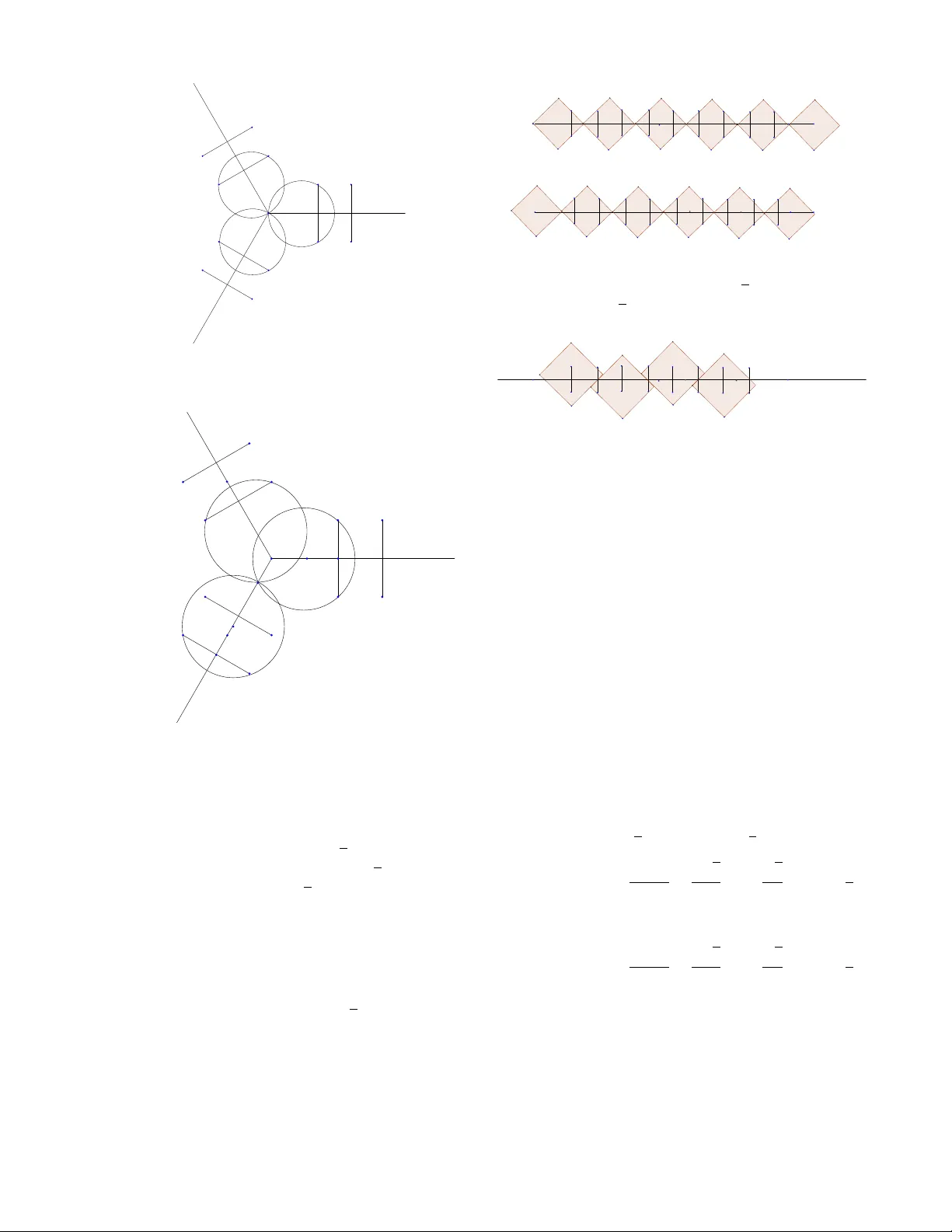
On The Computational Complexity of Minimum Aerial Photographs f or Planar Region Cov erage Si W ei F eng Autel Robotics fengsiwei@autelrobotics.com Abstract W ith the popularity of drone technologies, aerial photogra- phy has become pre valent in many daily scenarios such as en vironment monitoring, structure inspection, law enforce- ment etc. A central challenge in this domain is the ef ficient cov erage of a tar get area with photographs that can entirely capture the region, while respecting constraints such as the image resolution, and limited number of pictures that can be taken. This work in vestigates the computational complexity of cov ering a simple planar polygon using squares and circles. Specifically , it shows inapproximability gaps of 1 . 165 (for squares) and 1 . 25 (for restricted square centers) and develops a 2 . 828 -optimal approximation algorithm, demonstrating that these problems are computationally intractable to approxi- mate. The intuitions of this work can extend beyond aerial photography to broader applications such as pesticide spray- ing and strategic sensor placement. Introduction Consider the scenario when a drone is tasked to take pic- tures to capture the boundary of some cropland with a gim- bal camera attached to it. W e can change the zoom factor λ of the camera to make the image footprint larger or smaller with the same resolution, e.g. 3000 × 4000 in 4K resolu- tion. The gimbal camera usually faces downw ards when the drone flies high in the sk y to tak e pictures for terrain inspec- tion for applications like agricultural analysis or mapping. W ith a greater zoom factor of the gimbal camera, the pro- jected footprint on the ground becomes smaller , but the pic- ture taken contains more detail for each part on the ground. Unfortunately , the computing or disk resource on the drone is usually limited, so let’ s assume the drone can only take at most k pictures in one flight, where k is a parameter induced by the drone hardware. W e want to ask the ques- tion that what is the largest zoom factor λ we can give the gimbal camera such that we can still capture all parts of the region with k pictures. Figure 1 shows a coverage result for co vering the boundary or interior of a region with circles or squares, where circles can be imagined as footprints of visible regions using downwards facing fisheye cameras or radars, and squares as the specialization of rectangular im- ages taken by regular cameras. The theoretical aspects of these aerial photography prob- lems strongly relate to the area of computational geometry , Figure 1: Cov erage footprint of the re gion boundary or inte- rior with circle or square cov erage footprints. where co verage of point sets (aka. geometric pointclouds) is analyzed to a great extent. For example, the k -center prob- lem asks that given a set of points, and a number k , what is the minimum radius of k circles centered at the subset of these points to cover all the points (T oth, O’Rourke, and Goodman 2017). Similar problems include the k -median problem that asks to minimize the summation of the dis- tance from each point to the closest chosen points among the k chosen points, and the k -means problem that tries to solve the sum of squared distance from each point to the closest chosen point. These problems, especially k -means, can go to high dimensions in machine learning. Howe ver , for the real-world coverage problems for aerial photography , the point sets are associated with specific physical meanings, and are usually inside the 3 -dimensional Euclidean space in the simple case, or in 5 -dimension when normal directions are included. Notably , the majority of the interesting regions to cover in aerial coverage problems hav e some extent of continuity , for example, a complete structure, a continuous boundary or fence. Geometric shapes like 2D polygons or 3D meshes create more challenges for the usually studied point set cov- erage problems while making the problems more realistic. In robotics, the continuity characteristic is usually implied, as a robot handling the coverage or inspection tasks moves in a continuous manner, and it makes sense to assume the region to co ver is continuous instead of a scattered point set. Early studies on covering and packing (Hochbaum and Maass 1985) provide strong hardness results and approxi- mation scheme for cov ering points. Later work (Feder and Greene 1988) further showed 1 . 88 -inapproximability gap for point sets co verage using L 2 metric, and 2 -inapprox. gap for coverage using L 1 metric. For continuous regions and boundaries of a simple polygon, recent work (Feng and Y u 2020) has shown 1 . 152 -inapprox. gap with the minimum cir - cle radius using k circles. Cov erage in 2D is a simplification of the real w orld cover - age problem when the re gion scale is large. Meanwhile, cov- ering 3d surface has been a popular aerial robotics applica- tion studied extensi vely . For example, (Roberts et al. 2017) plans optimal path for capturing the surface of a structure for 3d reconstruction with the help of submodular and in- teger programming. Similarly , (Feng et al. 2021) de veloped sampling + integer programming-based method for comput- ing sensing points to place sensors for a complete coverage of the 3D structure, as well as factor 2 approximation algo- rithm to compute a 2-optimal solution in polynomial time. In this paper, the complexity analysis for covering a sim- ple planar polygon using squares is the main focus. Specif- ically , this work shows the inapproximability gap of 1 . 165 for finding the minimum side length of k squares to cover the simple 2D region (a simple polygon) and the inapproxima- bility gap of 1 . 25 when the square centers are restricted to be inside the region. This work also dev elops a 2 . 828 -optimal algorithm to solve the square coverage problem in polyno- mial time. Since most re gular cameras used by gimbals take rectangular images, the results in this work bring the com- putational complexity results shown in (Feng and Y u 2020) closer to reality for the aerial photography problems. And it can potentially be a reference for setting camera zooming factors or designing gimbal cameras for aerial surveying or mapping. Additionally , as the drone’ s position may be restricted to be only on top of the region to take pictures for the region itself, the paper also considers the variant of the problem when the positions of the square or circle centers must be inside the simply connected region or on top the region’ s perimeter . This variant gives the work in (Feng et al. 2019) an aerial photography interpretation. Problem F ormulations This section provides the mathematical formulations of the problems studied in this work. Problem 1 (Cir cle Co verage) Given a r e gion, r epr esented by a simple polygon (a planar polygonal c hain without self- intersections or holes) P , and a number k ≥ 1 . What is the minimum length ℓ such that we can put k cir cles each with radius of ℓ , suc h that P can be contained by these cir cles. Problem 2 (Squar e Co verage) Given a r e gion (a simple polygon P ), and a number k ≥ 1 . What is the minimum length ℓ suc h that we can put k squares each with side length of ℓ , such that P can be contained by these squares. Remark 1 If we only car e about covering the boundary of a simple polygon, similar to the definition of the barrier cov- erag e pr oblem (Gage 1992). This problem can be reduced to the two pr oblems afor ementioned because we can solidify the boundary by expanding the edges of a polygon to sticks with a small width δ , and leave a narrow opening on the polygon. When δ → 0 , the r esults of cover age pr oblems the solidified boundary skeleton and boundary skeleton con- ver ge to be the same. In this way , covering the expanded polygon from the original perimeter is the same as cover- ing the boundary of the original polygon. Con versely , a sim- ple polygon can be appr oximately r epr esented by a polygon whose boundary almost fills in the interior of the polygon. Hence, the computational complexity of covering the inte- rior and the boundary of a simple r e gion is at the same le vel. In many real scenarios, the sensors’ or the robots’ loca- tions (i.e. the centers of the circles or squares) must be in- side the region itself or on the perimeter , for example, the watch towers should be b uilt on the defensi ve wall itself and not outside; unmanned aerial vehicles for securities should not go outside or inside the security zone lines. When the constraint that the circle or square centers must be inside the polygon needs to be satisfied, the constrained version of Problem 2 and 1 is defined as: Problem 3 (Constrained Circle or Square Coverage) Same as Pr oblem 2 and Pr oblem 1, b ut the cir cle or squar e centers must stay inside the polygon P . Remark 2 Similarly , the case when the feasible re gion to place cir cle centers is the interior of the polygon is equiva- lent to the case when the feasible re gion is on the boundary of a polygon, because we can easily make a polygon out of the boundary of a simple polygon by solidifying the line se g- ments of the polygon and making narr ow openings for holes elimination. Preliminaries Before showing the complexity of the problems formulated in the previous section, certain preliminary results and gad- get construction steps are introduced. For a graph G ( V , E ) , it is planar when we can embed the vertices and edges onto a plane without edge crossings. Problem 4 (V ertex Cover on Planar Cubic Graph) Given a planar cubic graph G ( V , E ) , and a number n , whether there exists V ′ ⊂ V , such that, | V ′ | = n and for each e = ( u, v ) ∈ E , either u ∈ V ′ or v ∈ V ′ . This problem is shown to be computationally intractable in (Mohar 2001). Intermediate structure construction Giv en a planar cubic graph G ( V , E ) , we con vert it into a special structure through a sequence of steps. The first step embeds the graph G into the plane. Each vertex in G be- comes a vertex junction, and each edge becomes a “fence” like structure connecting two neighboring junctions which is an odd length path intersected with a set of perpendicu- lar bars with length ζ ( ζ is a parameter to be determined for proving dif ferent results), at each unit line segment. Starting from a planar cubic graph G , we construct a structure, T G , as follo ws. First, similar to (Feder and Greene 1988), to embed G into the plane, an edge uw ∈ E ( G ) is con verted to an odd length path uv 1 , v 1 v 2 , . . . , v 2 m w where m > 3 is an integer . W e note that m is different in general for dif ferent edges of G . Denote such a path as u · · · w ; each edge along u · · · w is straight and has unit edge length. W e also require that each path is nearly straight locally . For a verte x of G with degree 3 , e.g., a verte x u ∈ V ( G ) neigh- boring w , x, y ∈ V ( G ) , we choose proper configurations and lengths for paths, u · · · w , u · · · x , and u · · · y such that these paths meet at u forming pairwise angles of 120 ◦ . W e denote the resulting graph as G ′ , which becomes the back- bone of the T G . From here, the second modification is made which com- pletes the construction of T G . In each previously constructed path u · · · w = uv 1 . . . v 2 m w , for each v i v i +1 , 1 ≤ i ≤ 2 m − 1 , we add a line se gment of length ζ that is perpendic- ular to v i v i +1 such that v i v i +1 and the line segment divide each other in the middle. G ′ and the bars form the interme- diate structure T G . Hardness of approximate circle coverage The theorem in this section is proved completely in (Feng and Y u 2020), but to ease the the following deriv ations, we giv e a simplified version of the proof. The gadget structure (refer it as T ) constructed in the pre- vious section can be easily conv erted to a simple polygon by dilating the lines to a thin structure with a small width ε while leaving a narrow opening with width ε to make it a simple polygon (refer it as P ε ). Assume the minimum radius of k circles to cov er a simple polygon is ℓ ∗ , then the mini- mum radius ℓ for cov ering P ε must satisfy ℓ − ε ≤ ℓ ∗ ≤ ℓ + ε . When ε → 0 , ℓ and ℓ ∗ will con ver ge to be the same. So, we only need to sho w the comple xity of approximation to put k circles with min radius to cov er the structure T . First, we set the bar length ζ = √ 3 in the gadget structure. Clearly , for each edge link uv 1 . . . v 2 i w between junctions u and w , to co ver the link with the minimum number of circles when the circle radius is less than 1 . 155 (Feng and Y u 2020), one of the two patterns in Figure 2 should be used. Since each junction maps to a vertex in G in the transfor- mation, call the side of the edge with a circle covering only one bar the “odd-end”, and the other side of the edge the “ev en-end”. If there is a vertex cover of graph G , then it is possible to let all the vertices been chosen be the “ev en-end” or “odd-end”, and the rest of the vertices be “even-end” in the edge link coverage pattern. Since ev ery junction repre- sented verte x is either inside a vertex co ver or has a neighbor B 1 E 2 G 2 E 1 G 3 E 4 G 4 A B C 1 B 3 E 6 G 6 E 5 G 5 E 8 G 8 B 4 E 10 G 9 E 11 G 10 E 12 G 11 A 4 B 7 E 16 G 15 E 17 G 16 A 5 B 9 E 18 G 17 B 11 E 20 G 18 E 21 G 19 B 13 E 23 G 20 E 14 G 12 B 2 B 16 Figure 2: Structure within the odd length path and attached perpendicular “bars” with length ζ = √ 3 . Regarding the representation of such non-integral coordinates in the prob- lem input, we may scale the coordinates to some certain ex- tent and round them to integers so that the relativ e distance between each other is precise enough for the proof. inside the vertex cover , it is always possible to find such an “odd-end” and “ev en-end” combination for the junctions so at least no junction has all three edges as ev en ends. On the other side, for a cov erage of T with the mini- mum number of circles, select those vertices with at least one ev en-end. It is clear that these vertices form a vertex cov er . At the maximum of 1 . 152 , the situation in Figure 4 hap- pens and the cov erage pattern at the junction can change. The factor of 1 . 152 is obtained through a series of calcula- tions. At the maximum circle radius of ℓ such that the structure still needs the same number of circles to cover as using unit circles, Figure 4 shows this situation when the junction can be co vered by tw o circles cov ering one vertical bar each and another circle cov ering two vertical bars. Listing all necessary geometric constraints in Figure 4 giv es ∥ C G ∥ + ∥ F 4 G ∥ + ∥ F 4 I ∥ = 1 . 75 (1) ∥ F 4 G ∥ = ∥ F 5 G ∥ = ℓ (2) ∥ I L ∥ = ∥ GI ′ ∥ = √ 3 / 2 (3) ∥ F 4 I ∥ 2 + ∥ I L ∥ 2 = ℓ 2 (4) ∥ F 5 I ′ ∥ 2 + ∥ GI ′ ∥ 2 = ℓ 2 (5) ∥ C G ∥ 2 + ∥ C F 5 ∥ 2 + ∥ C G ∥ · ∥ C F 5 ∥ = ∥ F 5 G ∥ 2 (6) Integrating the system of equations from (1) to (6) to- gether gives ℓ = 1 . 152 , which is the extreme case when the circle cov erage pattern of T G cannot map to a verte x cover of the original verte x cover problem. Theorem 1 (F eng and Y u 2020) It is NP-har d to appr oxi- mate pr oblem 1 within a factor of 1 . 152 . C D A B E G H G 1 H 1 G ′ H ′ I J G ′ 1 H ′ 1 K L Figure 3: Circle coverage pattern at the junction crossing with unit radius. C D A B E G H G 1 H 1 G ′ H ′ I J F ′ G ′ 1 H ′ 1 K L F ′ 1 G F 4 I F 5 I ′ Figure 4: Circle cov erage pattern at the extreme circle radius at the junction crossing. Hardness of approximate square coverage In the structure gadget constructed in the previous section, let us shrink the unit length se gment to √ 2 / 2 , so the current distance between neighboring bars becomes √ 2 / 2 . And the bar length ζ here is set to be ζ = √ 2 / 2 . In this w ay , the pattern for cov ering a previous odd-length path in the structural g adget should be one of the two sho wn in Figure 5 until the rectangle side length ℓ reaches 1 . 25 , and pattern in Figure 6 may appear . At the junction of the three paths, a tri-connected crossing is made where the distance between the crossing point and the neighboring vertical bar is set to be 3 √ 2 / 4 . So, when there exists a vertex cov er for the problem with n vertices for problem 3, we can use n + M unit squares to cov er all the vertices. Then, let’ s prov e when there is n + M squares with edge D C 2 B 1 B 4 E 3 G 3 E 5 G 5 E 4 G 4 F 2 J 1 K 1 E 1 G 1 F 3 J 2 K 2 D 2 C 4 B 2 B 3 E 8 G 8 E 10 G 10 E 9 G 9 F 5 J 3 K 3 E 6 G 6 F 6 J 4 K 4 F 7 J 5 K 5 F 8 J 6 K 6 F 9 J 7 K 7 F 10 J 8 K 8 F 11 J 9 K 9 F 12 J 10 K 10 F 13 J 11 K 11 F 14 J 12 K 12 E 11 G 11 E 12 G 12 E 13 G 13 E 14 G 14 K 13 E 15 G 15 K 14 C 6 E 16 G 16 E 17 G 17 E 18 G 18 E 19 G 19 K 15 E 20 G 20 K 16 Figure 5: Structure within the odd length path, where each unit length segment is now shrunk to √ 2 / 2 , and the vertical bar length is ζ = √ 2 / 2 . D C 2 B 1 E 3 G 3 E 5 G 5 E 4 G 4 F 2 J 1 K 1 E 1 G 1 D 2 C 6 E 16 G 16 E 17 G 17 E 18 G 18 E 19 G 19 K 15 K 16 F 5 J 2 K 2 F 6 J 3 K 3 F 7 J 4 K 4 Figure 6: Possible square coverage pattern along the con- structed odd-length path until the rectangle side length ℓ reaches 1 . 25 . length less than 1 . 165 to cover the tri-net structure, there is a verte x cover of size n for the graph G . In the crossing, for 3 squares to cover all neighboring parts of T using the pattern in Figure 8, the square side length ℓ must hav e the pattern in Figure 8. At the maximum square side length of ℓ such that the structure still needs the same number of squares to cover as using unit squares, Figure 8 shows this situation when the junction can be covered with three squares, among which two squares co ver one v ertical bar each and one square co v- ers two vertical bars. Listing all necessary geometric constraints in Figure 8 giv es ∥ O Q ∥ + ∥ C Q ∥ = √ 2 ℓ + ∥ C Q ∥ = 3 √ 2 / 2 (7) ∥ QG ∥ 2 = ( ∥ C Q ∥ 2 + 3 √ 2 4 ) 2 + ( √ 3 2 ∥ C Q ∥ − ζ 2 ) 2 (8) ∥ QG ∥ 2 = ℓ 2 + ∥ F G ∥ 2 (9) ∥ QE ∥ 2 = ( ∥ C Q ∥ 2 + 3 √ 2 4 ) 2 + ( √ 3 2 ∥ C Q ∥ + ζ 2 ) 2 (10) ∥ QE ∥ 2 = ℓ 2 + ∥ J E ∥ 2 (11) ∥ I E ∥ 2 + ∥ I G ∥ 2 = ∥ E G ∥ 2 = ζ 2 = 0 . 5 (12) ∥ I G ∥ + ∥ GF ∥ = ∥ I E ∥ + ∥ E J ∥ = ℓ (13) Integrating the system of equations in (7) to (13) together C F J K E G E 1 G 1 E ′ G ′ H L E ′ 1 G ′ 1 M N Q R Figure 7: Square coverage pattern at the junction crossing with three unit squares. C F I J E G E 1 G 1 E ′ G ′ H L E ′ 1 G ′ 1 M N O P Q R Figure 8: The pattern of covering the crossing in the special structure constructed at the extreme square side length ℓ . with the help of Sympy (Meurer et al. 2017) giv es ℓ = 1 . 165 . Thus, if we are asked to place n squares to cover the boundary of a simple polygon, it is computationally in- tractable to approximate the smallest side length of the square to cov er the whole structure within a factor of 1 . 165 . Theorem 2 It is NP-hard to appr oximate problem 2 within a factor of 1 . 165 . This inapproximability factor can be interpreted as the maximum zoom factor the gimbal camera can hav e before taking pictures, or relates to the minimum Ground Sampling Distance (GSD) that k pictures can provide subject to full cov erage of the boundary of a simple re gion using a polyno- mial time algorithm unless P=NP . Hardness of approximate coverage with restricted locations inside the region In the construction and also in the problem setting in Prob- lem 1 and 2, it is assumed that the center of the circle or square can be anywhere on the plane. Ho wev er , in many robotics scenarios, the center of the circles or squares, i.e. the robot locations, has restrictions like they must be on top of the perimeter or inside the region. If those restrictions are applied, are these problems still NP-hard or they can be prov ed to hav e a higher inapproximability ratio? Since if there is a solution of k unit circle to cov er the sim- ple polygon constructed, they can be made to be centered at the skeleton structure T G constructed before until the circle radius of ℓ reaches 1 . 152 , the restricted version of the prob- lem has at least the same inapproximability ratio. So, for the restricted circle cov erage problem, we hav e Theorem 3 It is NP-hard to approximate the circle version of pr oblem 3 within a factor of 1 . 152 when r estricting the cir cle centers to the r e gion boundary . While for the restricted square cov erage problem, finer analysis of the crossing part at the junction giv es the follow- ing. C D A B F I J K E G E 1 G 1 E ′ G ′ H L E ′ 1 G ′ 1 M N O P Q R Figure 9: The pattern for covering the junction in the con- strained version of the square co verage problem. At the maximum square side length of ℓ such that the structure still needs the same number of squares to cover as using unit squares, Figure 9 shows this situation when the junction can be covered with three squares, among which two squares co ver one v ertical bar each and one square co v- ers two vertical bars. Listing all necessary geometric constraints in Figure 9 giv es ∥ C K ∥ = √ 2 ℓ − √ 2 / 2 (14) ∥ C Q ∥ sin(45 ◦ ) = ∥ C K ∥ sin(75 ◦ ) (15) ∥ O C ∥ = ∥ O Q ∥ + ∥ C Q ∥ = ∥ C Q ∥ + √ 2 ℓ (16) ∥ O C ∥ = 5 √ 2 / 4 (17) Integrating the system of equations in (14) to (17) together giv es ℓ = 1 . 289 . Considering the possible change of cov er- age pattern along the odd-length-path depicted in Figure 6 when ℓ reaches 1 . 25 . W e hav e, Theorem 4 It is NP-hard to appr oximate the square version of pr oblem 3 within a factor of 1 . 25 when restricting the squar e centers to the r e gion boundary . Compared to the unrestricted v ersion of the square co ver - age problem which has the inapproximability ratio of 1 . 165 , the inapproximability ratio for the restricted version for the square cov erage problem is higher by around 8 . 5% . Constant factor approximation algorithm Giv en the inapproximability gaps, it is unlikely that there exists an efficient algorithm that runs in polynomial time to approximately solve Problem 1, 2, and 3. In a previous work (Feng and Y u 2020), sampling fol- lowed by applying the traditional 2 -optimal farthest clus- tering algorithm (Gonzalez 1985) for the k -center problem giv es a (2 + ϵ ) -optimal result. When replacing the farthest clustering algorithm with mathematical programming, with the state-of-the-art integer programming tool (Optimization 2019), a (1 + ϵ ) -optimal result for k ≤ 100 can be obtained in 1 minute on a desktop platform with intel i7 and 16GB memory . For the square cov erage problem, which is similar to the k -center problem with L ∞ distance metric where the dis- tance between two points p 1 = ( x 1 , y 1 ) and p 2 = ( x 2 , y 2 ) is max( ∥ x 1 − x 2 ∥ , ∥ y 1 − y 2 ∥ ) . If we are using L ∞ distance metric, which means the square used for covering the target region is always axis-aligned, using the same farthest clus- tering algorithm (Gonzalez 1985) can produce a 2-optimal solution. Besides, a square with side length ℓ facing at any direction can be fully co vered by an axis-aligned square with side length √ 2 ℓ . So, squares created with regular farthest clustering algorithm for the sampled points using the L ∞ metric giv es a (2 √ 2 + ϵ ) ≈ (2 . 828 + ϵ ) -optimal algorithm. In the constrained version of the square and circle cov er- age problems, since the farthest clustering algorithm only selects points (circle or square centers) among the sam- pled points in the target region or boundary , the results of the previous algorithm automatically satisfy the constraints. Thus, the efficient algorithms for the square and circle cover - age problems still apply for approximately solving the con- strained circle and square cov erage problem within an ap- proximation factor of 2 and 2 . 828 , respectively . Discussions and future work In this work, we sho wed the inapproximability ratio of 1 . 165 for using the minimum side length of k squares to cover the boundary of a simple polygon. W e also considered the constrained cases when the center of the squares or circles should stay inside the region or boundary , which in these cases the inapproximability ratio increases to 1 . 25 for the square cov erage problem. The current gap between the 1 . 152 -inapprox. ratio and the efficient 2 -optimal algorithm for the circle coverage prob- lem, and the gap between the 1 . 165 -inapprox. ratio and the Algorithm 1: Approximate Square Coverage Data: P : a polygon to cov er , k : the number of squares that can be used to cov er the polygon Result: square length ℓ , and k squares 1 Sample N points from the polygon with sampling density ϵ 2 Run the 2 -optimal farthest clustering algorithm on the sampled points with L ∞ metric to get center points c 1 , . . . , c k and radius ℓ ′ , which means k axis-aligned squares centered at c 1 , . . . , c k with side length ℓ = 2 ℓ ′ can cov er the polygon Return : k axis aligned squares, with center points c 1 , . . . , c k and side length ℓ = 2 ℓ ′ . efficient 2 . 828 -optimal algorithm for the square coverage problem are still large. Same for the gap between the re- stricted version of the square and circle cov erage problem having 1 . 152 and 1 . 25 inapproximability ratio respectiv ely and 2 -optimal and 2 . 828 -optimal algorithms respecti vely . So, there still exists much space for improvements by prov- ing higher inapproximability ratios or by dev eloping approx- imation algorithms with better guarantees. Acknowledgements The author would like to thank the colleagues at Autel Robotics, especially Dr . Kartik Mohta, Dr . Kangli W ang, Dr . Y an Lu, and Kek e Zhang, for the help on providing opinions on the aerial robotics context of the problem studied in this paper , and for providing intuitions for this study with the high-quality and high-zoom-in-capability gimbal cameras. Prof. Jingjin Y u’ s help and brainstorming discussions at the start of this line of work are essential to the results dev eloped in this paper . References Feder , T .; and Greene, D. 1988. Optimal algorithms for ap- proximate clustering. In Pr oceedings of the twentieth annual A CM symposium on Theory of computing , 434–444. Feng, S. W .; Gao, K.; Gong, J.; and Y u, J. 2021. Sensor placement for globally optimal coverage of 3d-embedded surfaces. In 2021 IEEE International Conference on Robotics and Automation (ICRA) , 8600–8606. IEEE. Feng, S. W .; Han, S. D.; Gao, K.; and Y u, J. 2019. Ef fi- cient algorithms for optimal perimeter guarding. In 2019 Robotics: Science and Systems . Feng, S. W .; and Y u, J. 2020. Optimally Guarding Perime- ters and Regions with Mobile Range Sensors. In 2020 Robotics: Science and Systems . Gage, D. W . 1992. Command control for many-robot sys- tems. Unmanned Systems Magazine , 10(4): 28–34. Gonzalez, T . F . 1985. Clustering to minimize the maxi- mum intercluster distance. Theoretical computer science , 38: 293–306. Hochbaum, D. S.; and Maass, W . 1985. Approximation schemes for covering and packing problems in image pro- cessing and VLSI. Journal of the A CM (J A CM) , 32(1): 130– 136. Meurer , A.; Smith, C. P .; Paprocki, M.; ˇ Cert ´ ık, O.; Kir- pichev , S. B.; Rocklin, M.; Kumar , A.; Ivano v , S.; Moore, J. K.; Singh, S.; et al. 2017. SymPy: symbolic computing in Python. P eerJ Computer Science , 3: e103. Mohar , B. 2001. Face co vers and the genus problem for apex graphs. Journal of Combinatorial Theory , Series B , 82(1): 102–117. Optimization, G. 2019. Gurobi Optimizer 9.0. Gur obi: http://www .gur obi.com . Roberts, M.; Dey , D.; Truong, A.; Sinha, S.; Shah, S.; Kapoor , A.; Hanrahan, P .; and Joshi, N. 2017. Submodular trajectory optimization for aerial 3d scanning. In Pr oceed- ings of the IEEE International Conference on Computer V i- sion , 5324–5333. T oth, C. D.; O’Rourke, J.; and Goodman, J. E. 2017. Hand- book of discr ete and computational geometry . CRC press.
Original Paper
Loading high-quality paper...
Comments & Academic Discussion
Loading comments...
Leave a Comment