Resource-aware IoT Control: Saving Communication through Predictive Triggering
The Internet of Things (IoT) interconnects multiple physical devices in large-scale networks. When the 'things' coordinate decisions and act collectively on shared information, feedback is introduced between them. Multiple feedback loops are thus clo…
Authors: Sebastian Trimpe, Dominik Baumann
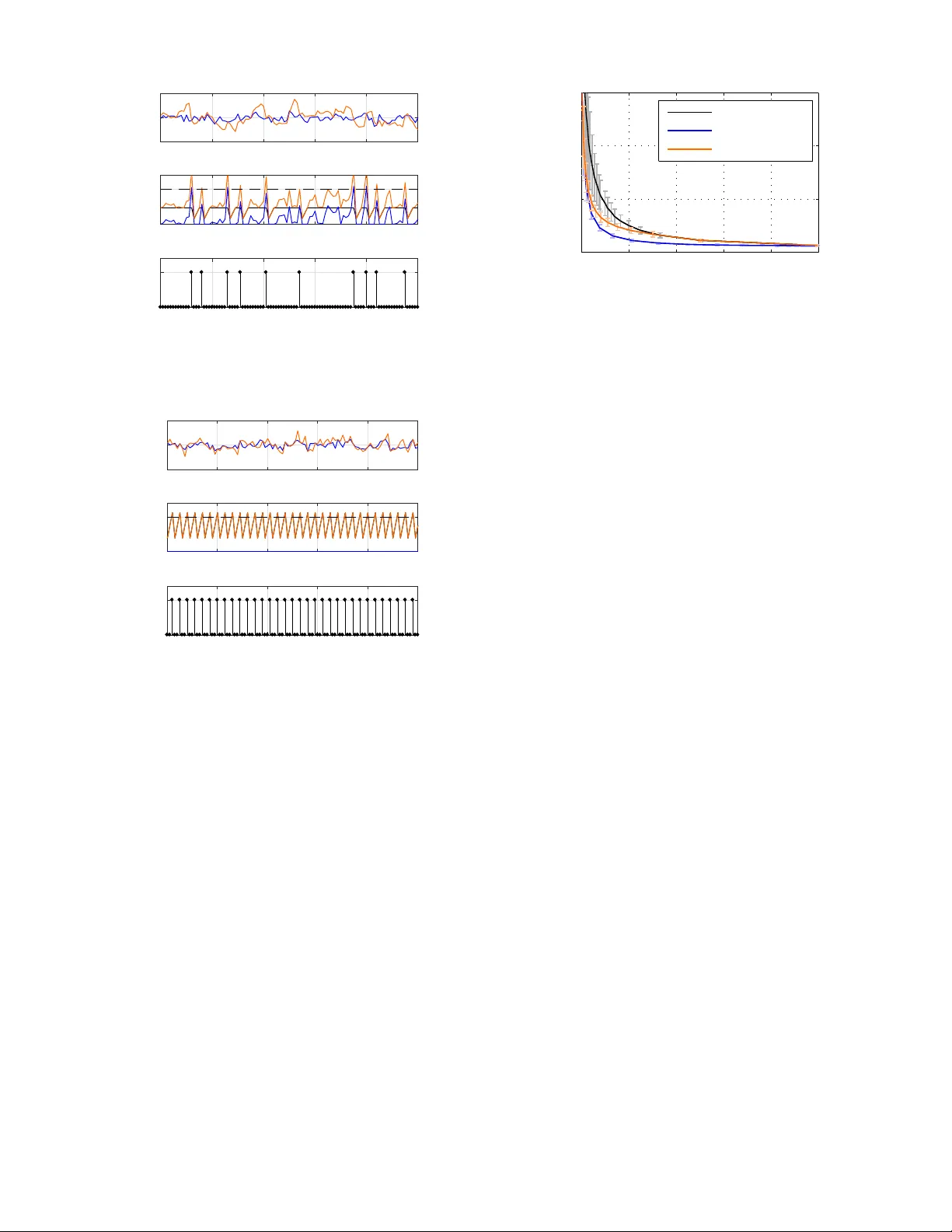
Resource-a ware IoT Control: Sa ving Communication through Predicti v e T riggering Sebastian T rimpe, Member , IEEE , and Dominik Baumann Abstract —The Internet of Things (IoT) inter connects multiple physical devices in large-scale networks. When the ‘things’ coordinate decisions and act collectively on shar ed information, feedback is introduced between them. Multiple feedback loops are thus closed ov er a shared, general-purpose network. T raditional feedback control is unsuitable for design of IoT contr ol because it relies on high-rate periodic communication and is ignorant of the shared network resource. Theref ore, recent event-based estimation methods ar e applied her ein for resource-awar e IoT control allo wing agents to decide online whether communication with other agents is needed, or not. While this can r educe network traffic significantly , a se vere limitation of typical e vent-based approaches is the need for instantaneous triggering decisions that leav e no time to reallocate freed resources (e.g., communication slots), which hence remain unused. T o address this problem, novel pr edictive and self triggering pr otocols are pr oposed herein. From a unified Bayesian decision framework, two schemes are developed: self triggers that predict, at the current triggering instant, the next one; and predictiv e triggers that check at every time step, whether communication will be needed at a given prediction horizon. The suitability of these triggers f or feedback control is demonstrated in hardware experiments on a cart-pole, and scalability is discussed with a multi-vehicle simulation. Index T erms —Internet of Things, feedback contr ol, event- based state estimation, predicti ve triggering, self triggering, distributed control, r esource-awar e contr ol. I . I N T R O D U C T I O N The Internet of Things (IoT) will connect large numbers of physical devices via local and global networks, [1], [2]. While early IoT research concentrated on problems of data collection, communication, and analysis [3], using the av ail- able data for actuation is vital for en visioned applications such as autonomous vehicles, building automation, or cooperativ e robotics. In these applications, the de vices or ‘things’ are required to act intelligently based on data from local sensors and the network. F or e xample, cars in a platoon need to react to other cars’ maneuvers to keep a desired distance; and climate control units must coordinate their action for optimal ambience in a large building. IoT contr ol thus refers to systems where data about the physical processes, collected via sensors and communicated over networks, are used to decide on actions. These actions in turn af fect the physical processes, which is the core principle of closed-loop control or feedback . Figure 1 shows an abstraction of a general IoT control system. When the available information within the IoT is used S. T rimpe and D. Baumann are with the Intelligent Control Systems Group at the Max Planck Institute for Intelligent Systems, 70569 Stuttgart, Germany . E-mail: trimpe@is.mpg.de, dbaumann@tuebingen.mpg.de. This work was supported in part by the German Research F oundation (DFG) Priority Program 1914 (grant TR 1433/1-1), the Max Planck ETH Center for Learning Systems, the Cyber V alley Initiati ve, and the Max Planck Society . Dynamics 1 S A Agent 1 Thing 1 Dynamics 2 S A Agent 2 Thing 2 Dynamics N S A Agent N Thing N Network Physical Cyber Fig. 1. Abstraction of an IoT control system. Each Thing is composed of Dynamics representing its physical entity and an Agent representing its algorithm unit. Dynamics and Agent are interconnected via sensors (S) and actuators (A). The Network connects all things to the IoT . for decision making and commanding actuators (red arrows), one introduces feedback between the cyber and the physical world, [3]. Feedback loops can be closed on the level of a local object, but, more interestingly , also across agents and networks. Coordination among agents is vital, for example, when agents seek to achie ve a global objecti ve. IoT control aims at enabling coordinated action among multiple things. In contrast to traditional feedback control systems, where feedback loops are closed ov er dedicated communication lines (typically wires), feedback loops in IoT control are realized ov er a general purpose network such as the Internet or local networks. In typical IoT applications, these netw orks are wire- less. While networked communication of fers great advantages in terms of, inter alia, reduced installation costs, unprecedented flexibility , and availability of data, control over networks in- volv es formidable challenges for system design and operation, for example, because of imperfect communication, variable network structure, and limited communication resources, [4], [5]. Because the network bandwidth is shared by multiple entities, each agent should use the communication resource only when necessary . De veloping such resource-aware control for the IoT is the focus of this work. This is in contrast to traditional feedback control, where data transmission typically happens periodically at a priori fixed update rates. Owing to the shortcomings of traditional control, event- based methods for state estimation and control ha ve emer ged since the pioneering work [6], [7]. The key idea of event- based approaches is to apply feedback only upon certain events indicating that transmission of new data is necessary (e.g., a control error passing a threshold level, or estimation uncer - tainty growing too lar ge). Core research questions concerning the design of the ev ent triggering laws, which decide when Accepted final version. Article accepted f or pub lication. T o appear in IEEE Inter net of Things Jour nal . c 2019 IEEE. Personal use of this mater ial is per mitted. P ermission from IEEE must be obtained for all other uses, in any current or future media, including reprinting/republishing this material for adver tising or promotional pur poses, creating new collectiv e w orks, f or resale or redistribution to ser vers or lists, or reuse of any copyrighted component of this wor k in other works. S State Estimation Event T rigger Prediction Thing i R A Control i Prediction Thing 1 R Prediction Thing N R Network . . . all things except i Fig. 2. Algorithmic components implemented on each agent i = 1 , . . . , N of the IoT control system in Fig. 1. Agent i ’s control decision is based on local information ( State Estimation ) and predictions of all (or a subset of) other things ( Prediction Thing 1 to N ). Each agent sends an update ( Event T rigger ) to all other agents whenever the prediction of its own state ( Pr ediction Thing i ) de viates too far from the truth, so that predictions can be reset (R). to transmit data, and the associated estimation and control algorithms with stability and performance guarantees have been solved in recent years (see [8]–[11] for ov erviews). This work b uilds on a framew ork for distributed e vent-based state estimation (DEBSE) de veloped in prior work [12]–[15], which is applied herein to resource-aware IoT control as in Fig. 1. The key idea of DEBSE is to employ model-based pre- dictions of other things to a void the need for continuous data transmission between the agents. Only when the model-based predictions become too inaccurate (e.g., due to a disturbance or accumulated error), an update is sent. Figure 2 represents one agent of the IoT control system in Fig. 1 and depicts the key components of the DEBSE architecture: • Local contr ol: Each agent makes local control decisions for its actuator; for coordinated action across the IoT , it also needs information from other agents in addition to its local sensors. • Pr ediction of other ag ents: State estimators and predictors (e.g., of Kalman filter type) are used to predict the states of all, or a subset of agents based on agents’ dynamics models; these predictions are reset (or updated) when ne w data is recei ved from the other agents. • Event trigger: Decides when an update is sent to all agents in the IoT . For this purpose, the local agent implements a copy of the predictor of its own behavior ( Pr ediction Thing i ) to replicate locally the information the other agents hav e about itself. The event trigger compares the prediction with the local state estimate: the current state estimate is transmitted to other agents only if the prediction is not sufficiently accurate. Ke y benefits of this architecture are: each agent has all rele vant information av ailable for coordinated decision making, but inter-agent communication is limited to the necessary instants (whenev er model-based predictions are not good enough). Experimental studies [12], [14] demonstrated that DEBSE can achiev e significant communication savings, which is in- line with many other studies in ev ent-based estimation and control. The research community has had remarkable success in showing that the number of samples in feedback loops can be reduced significantly as compared to traditional time- triggered designs. This can be translated into increased battery life [16] in wireless sensor systems, for example. Despite these successes, better utilization of shared communication resources has typically not been demonstrated. A fundamental problem of most event-triggered designs (incl. DEBSE) is that they make decisions about whether a communication is needed instantaneously . This means that the resource must be held av ailable at all times in case of a positi ve triggering decision. Con versely , if a triggering decision is negati ve, the reserved slot remains unused because it cannot be reallocated to other users immediately . In order to translate the reduction in a verage sampling rates to better actual resource utilization, it is vital that the ev ent- based system is able to pr edict resource usage ahead of time, rather than requesting resources instantaneously . This allows the processing or communication system to reconfigure and make unneeded resources av ailable to other users or set to sleep for saving energy . Developing such predictive triggering laws for DEBSE and their use for resource-aware IoT control are the main objecti ves of this article. Contributions: This article proposes a framew ork for resource-aware IoT control based on DEBSE. The main con- tributions are summarized as follows: 1) Proposal of a Bayesian decision framework for deri ving predictiv e triggering mechanisms, which provides a new perspectiv e on the triggering problem in estimation; 2) Deriv ation of two nov el triggers from this frame work: the self trigger , which predicts the ne xt triggering instant based on information available at a current triggering instant; and the pr edictive trigger , which predicts trig- gering for a gi ven future horizon of M steps; 3) Demonstration and comparison of the proposed triggers in experiments on an in verted pendulum testbed; and 4) Simulation study of a multi-v ehicle system. The Bayesian decision framework extends pre vious work [17] on event trigger design to the novel concept of predicting trigger instants. The proposed self trigger is related to the concept of variance-based triggering [13], albeit this concept has not been used for self triggering before. T o the best of the authors’ knowledge, predicti ve triggering is a completely ne w concept in both event-based estimation and control. Predicti ve triggering is shown to reside between the known concepts of ev ent triggering and self triggering. A preliminary version of some results herein was previously published in the conference paper [18]. This article tar gets IoT control and has been restructured and extended accordingly . New results be yond [18] include the treatment of control inputs in the theoretical analysis (Sec. V), the discussion of multiple agents (Sec. VIII), hardware experiments (Sec. VII), and a new multi-vehicle application example (Sec. IX). I I . R E L A T E D W O R K Because of the promise to achieve high-performance control on resource-limited systems, the area of e vent-based control and estimation has seen substantial growth in the last decades. For general overvie ws, see [4], [8]–[10] for control and [8], [11], [17], [19] for state estimation. This work mainly falls in the category of ev ent-based state estimation (albeit state pre- dictions and estimates are also used for feedback, cf. Fig. 2). V arious design methods have been proposed in literature for ev ent-based state estimation and, in particular , its core components, the prediction/estimation algorithms and ev ent triggers. F or the former , different types of Kalman filters [12], [13], [20], modified Luenberger-type observers [14], [15], and set-membership filters [21], [22] ha ve been used, for example. V ariants of event triggers include triggering based on the innov ation [12], [23], estimation variance [13], [24], or entire probability density functions (PDFs) [25]. Most of these event triggers make transmit decisions instantaneously , while the focus of this work is on predicting triggers. The concept of self triggering has been proposed [26] to address the problem of predicting future sampling instants. In contrast to e vent triggering, which requires the continuous monitoring of a triggering signal, self-triggered approaches predict the next triggering instant already at the previous trigger . While se veral approaches to self-triggered control ha ve been proposed in literature (e.g., [9], [27]–[29]), self triggering for state estimation has receiv ed considerably less attention. Some exceptions are discussed next. Self triggering is considered for set-v alued state estimation in [30], and for high-gain continuous-discrete observers in [31]. In [30], a new measurement is triggered when the uncertainty set about some part of the state vector becomes too large. In [31], the triggering rule is designed so as to ensure conv ergence of the observer . The recent w orks [32] and [33] propose self triggering approaches, where transmission schedules for multiple sensors are optimized at a-priori fixed periodic time instants. While the re-computation of the sched- ule happens periodically , the transmission of sensor data does generally not. In [34], a discrete-time observer is used as a component of a self-triggered output feedback control system. Therein, triggering instants are determined by the controller to ensure closed-loop stability . Alternativ es to the Bayesian decision frame work herein for dev eloping triggering schedules include dynamic program- ming approaches such as in [35]–[37]. None of the mentioned references considers the approach taken herein, where triggering is formulated as a Bayesian decision problem under different information patterns. The concept of predicti ve triggering, which is derived from this, is nov el. It is dif ferent from self triggering in that decisions are made continuously , but for a fixed prediction horizon. I I I . F U N D A M E N TA L T R I G G E R I N G P R O B L E M In this section, we formulate the predicti ve triggering prob- lem that each agent in Fig. 2 has to solv e, namely predicting when local state estimates shall be transmitted to other agents of the IoT . W e consider the setup in Fig. 3, which has been reduced to the core components required for the analysis in subsequent sections. Agent i , called sensor agent , sporadically transmits data over the network to agent j . Agent j here stands representativ e for any of the agents in the IoT that require information from agent i . Because agent j can be at a dif ferent Agent i (sensor agent) Network Agent j (remote agent) Dynamics i x i k State Estimation i Predictiv e Triggering Prediction Thing i R buf fer Prediction Thing i ˇ x i k R y i k ˆ x i k γ i k +M Fig. 3. Predictiv e triggering problem. The sensor agent i runs a local State Estimator and transmits its estimate ˆ x i k to the remote agent j in case of a positive triggering decision ( γ i k = 1 ). The predictiv e trigger computes the triggering decisions ( γ i k + M ∈ { 0 , 1 } ) M steps ahead of time. This information can be used by the network to allocate resources. Local control (cf. Fig. 2) is omitted here for clarity , but treated in the analysis. location, it is called r emote agent . W e next introduce the components of Fig. 3 and then make the predictiv e triggering problem precise. A. Pr ocess dynamics W e consider each agent i to be governed by stochastic, linear dynamics with Gaussian noise, x i k = A i x i k − 1 + B i u i k − 1 + v i k − 1 (1) y i k = H i x i k + w i k (2) with k ≥ 1 the discrete time index, x i k ∈ R n x the state, u i k ∈ R n u the input, v i k ∈ R n x process noise (e.g., capturing model uncertainty), y i k ∈ R n y the sensor measurements, and w i k ∈ R n y sensor noise. The random v ariables x i 0 , v i k , and w i k are mutually independent with PDFs N ( x i 0 ; ¯ x i , X i ) , N ( v i k ; 0 , Q i ) , and N ( w i k ; 0 , R i ) , where N ( z ; µ, Σ) denotes the PDF of a Gaussian random v ariable z with mean µ and v ariance Σ . Equations (1) and (2) represent decoupled agents’ dynamics, which we consider in this work (cf. Fig. 1). Agents will be coupled through their inputs (see Sec. III-C below). While the results are developed herein for the time-in variant dynamics (1), (2) to keep notation uncluttered, they readily extend to the linear time-v ariant case (i.e., A i , B i , H i , Q i , and R i being functions of time k ). Such a problem is discussed in Sec. IX. The sets of all measurements and inputs up to time k are denoted by Y i k := { y i 1 , y i 2 , . . . , y i k } and U i k := { u i 1 , u i 2 , . . . , u i k − 1 } , respecti vely . B. State estimation The local state estimator on agent i has access to all measurements Y i k and inputs U i k (cf. Fig. 3). The Kalman filter (KF) is the optimal Bayesian estimator in this setting, [38]; it recursiv ely computes the exact posterior PDF f ( x i k |Y i k , U i k ) . The KF recursion is ˆ x i k | k − 1 = A i ˆ x i k − 1 + B i u i k − 1 (3) P i k | k − 1 = A i P i k − 1 A T i + Q i =: V i o ( P i k − 1 ) (4) L i k = P i k | k − 1 H T i ( H i P i k | k − 1 H T i + R i ) − 1 (5) ˆ x i k = ˆ x i k | k − 1 + L i k ( y i k − H i ˆ x i k | k − 1 ) (6) P i k = ( I − L i k H i ) P i k | k − 1 . (7) where f ( x i k |Y i k − 1 , U i k ) = N ( x i k ; ˆ x i k | k − 1 , P i k | k − 1 ) , f ( x i k |Y i k , U i k ) = N ( x i k ; ˆ x i k , P i k ) , and the short-hand notation ˆ x i k = ˆ x i k | k and P i k = P i k | k is used for the posterior v ariables. In (4), we introduced the short-hand notation V i o for the open-loop variance update for later reference. W e shall also need the M -step ahead prediction of the state ( M ≥ 0 ), whose PDF is gi ven by [38, p. 111] f ( x i k + M |Y i k , U i k + M ) = N ( x i k + M ; ˆ x i k + M | k , P i k + M | k ) , (8) with mean and variance obtained by the open-loop KF iterations (3), (4), i.e., ˆ x i k + M | k = A M i ˆ x i k + P M m =1 A M − m i B u i k + m − 1 and P i k + M | k = ( V i o ◦ · · · ◦ V i o )( P i k ) , where ‘ ◦ ’ denotes composition. Finally , the error of the KF is defined as ˆ e i k := x i k − ˆ x i k . (9) C. Contr ol Because we are considering coordination of multiple things, the i ’ s control input may depend on the prediction of the other things in the IoT (cf. Fig. 2). W e thus consider a control policy u i k − 1 = F i ˆ x i k − 1 + X j ∈ N N \{ i } F j ˇ x j k − 1 (10) where the local KF estimate ˆ x i k is combined with predictions ˇ x j k of the other agents (to be made precise below), and N N denotes the set of all integers { 1 , . . . , N } . For coordination schemes where not all agents need to be coupled, some F j may be zero. Then, these states do not need to be predicted. It will be con venient to introduce the auxiliary v ariable ξ i k = P j ∈ N N \{ i } F j ˇ x j k ; (10) thus becomes u i k − 1 = F i ˆ x i k − 1 + ξ i k − 1 . (11) D. Communication network Communication between agents occurs over a bus network that connects all things with each other . In particular, we assume that data (if transmitted) can be receiv ed by all agents that care about state information from the sending agent: Assumption 1. Data transmitted by one agent can be received by all other ag ents in the IoT . Such b us-like networks are common, for e xample, in au- tomation industry in form of wired fieldb us systems [39], but hav e recently also been proposed for low-po wer multi-hop wir eless networks [40], [41]. For the purpose of de veloping the triggers, we further abstract communication to be ideal: Assumption 2. Communication between agents is without delay and pac ket loss. This assumption is dropped later in the multi-vehicle sim- ulation. E. State pr ediction The sensor agent in Fig. 3 sporadically communicates its local estimate ˆ x i k to the remote estimator , which, at ev ery step k , computes its o wn state estimate ˇ x i k from the av ailable data via state prediction. W e denote by γ i k ∈ { 0 , 1 } the decision taken by the sensor about whether an update is sent ( γ i k = 1 ) or not ( γ i k = 0 ). For later reference, we denote the set of all triggering decisions until k by Γ i k := { γ i 1 , γ i 2 , . . . , γ i k } . The state predictor on the remote agent (cf. Fig. 3) uses the following recursion to compute ˇ x i k , its remote estimate of x i k : ˇ x i k = ( A i ˇ x i k − 1 + B i ˇ u k − 1 if γ i k = 0 ˆ x i k if γ i k = 1; (12) that is, at times when no update is receiv ed from the sensor , the estimator predicts its previous estimate according to the process model (1) and prediction of the input (11) by ˇ u i k − 1 = F i ˇ x i k − 1 + ξ i k − 1 . (13) Implementing (13) thus requires the remote agent to run predictions of the form (12) for all other things m that are relev ant for computing ξ i k − 1 . This is feasible as an agent can broadcast state updates (for γ i k = 1 ) to all other things via the bus network. W e emphasize that ξ i k − 1 , the part of the input u i k − 1 that corresponds to all other agents, is kno wn e xactly on the remote estimator , since updates are sent to all agents connected to the network synchronously . Hence, the difference between the actual input (11) and predicted input (13) stems from a dif ference in ˆ x i k − 1 and ˇ x i k − 1 . W ith (13), the prediction (12) then becomes ˇ x i k = ( ¯ A i ˇ x i k − 1 + B i ξ i k − 1 if γ i k = 0 ˆ x i k if γ i k = 1; (14) where ¯ A i := A i + B i F i denotes the closed-loop state transition matrix of agent i . The estimation error at the remote agent, we denote by e i k := x i k − ˇ x i k . (15) A copy of the state predictor (14) is also implemented on the sensor agent to be used for the triggering decision (cf. Fig. 3). Finally , we comment how local estimation quality can possibly be further impro ved in certain applications. Remark 1. In (14) , agent j makes a pur e state pr ediction about agent i ’s state in case of no communication fr om a gent i ( γ i k = 0 ). If agent j has additional local sensor information about agent i ’ s state, it may employ this by combining the pr ediction step with a corr esponding measur ement update. This may help to impr ove estimation quality (e.g., obtain a lower err or variance). In such a setting, the triggers developed her ein can be interpr eted as ‘conservative’ triggers that take only pr ediction into account. Remark 2. Under the assumption of perfect communication, the event of not receiving an update ( γ i k = 0 ) may also contain information useful for state estimation (also known as negati ve information [21]). Her e, we disr e gar d this information in the inter est of a straightforwar d estimator implementation (see [17] for a mor e detailed discussion). T ABLE I S U M M A RY OF M A I N V A R I A B L E S U S E D IN T H E A RT I C L E . T H E A G E N T I N D E X ‘ i ’ I S D RO P P E D FO R AL L VAR I A B L E S IN S E C . IV T O VI . A i , B i , H i , Q i , R i Dynamic system parameters F i Control gain corresponding to agent i ’ s state x i k State of agent i , eq. (1) ˆ x i k Kalman filter (KF) estimate (6) ˇ x i k Remote state estimate (14) ˆ e i k KF estimation error (9) e i k Remote estimation error (15) γ i k Communication decision (1=communicate, 0=not) Γ i k Set of communication decisions { γ i 1 , . . . , γ i k } X | γ k =0 , X | γ k =1 Expression X ev aluated for resp. γ k = 0 , γ k = 1 Y i k Set of all measurements on agent i until time k U i k Set of all inputs on agent i until time k ˜ x k , ˜ e k , etc. Collection of corresponding v ariables for all agents C k Communication cost (‘ i ’ dropped) E k Estimation cost (‘ i ’ dropped) M Prediction horizon (‘ i ’ dropped) ` k Last triggering time (‘ i ’ dropped) κ k T ime of last nonzero elem. in Γ k + M (‘ i ’ dropped) ∆ Number of steps from κ k − 1 to k + M (cf. Lem. 2) N N Set of integers { 1 , . . . , N } E [ X 1 | X 2 ] Expected value of X 1 conditioned on X 2 f ( X 1 | X 2 ) Probability density fcn (PDF) of X 1 cond. on X 2 F . Pr oblem formulation The main objectiv e of this article is the dev elopment of principled ways for predicting future triggering decisions. In particular , we shall de velop two concepts: 1) pr edictive triggering: at ev ery step k and for a fixed horizon M > 0 , γ i k + M is predicted, i.e., whether or not communication is needed at M steps in future; and 2) self triggering: the next trigger is predicted at the time of the last trigger . In the next sections, we dev elop these triggers for agent i shown in Fig. 3, which is representati ve for any one agent in Fig. 1. Because we will thus discuss estimation, triggering, and prediction solely for agent i (cf. Fig. 3), we drop the index ‘ i ’ to simplify notation. Agent indices are re-introduced in Sec. VIII, when again multiple agents are considered. For ease of reference, key variables from this and later sections are summarized in T able I. I V . T R I G G E R I N G F R A M E W O R K T o de velop a frame work for making predictive triggering decisions, we extend the approach from [17], where triggering is formulated as a one-step optimal decision problem trading off estimation and communication cost. While this frame work was used in [17] to re-deriv e existing e vent triggers (summa- rized in Sec. IV -A), we extend the framework herein to yield predictiv e and self triggering (Sec. IV -B and IV -C). A. Decision framework for event triggering The sensor agent (cf. Fig. 3) mak es a decision between using the communication channel (and thus paying a communication cost C k ) to improv e the remote estimate, or to sav e commu- nication, b ut pay a price in terms of a deteriorated estimation performance (captured by a suitable estimation cost E k ). The communication cost C k is application specific and may be associated with the use of bandwidth or energy , for example. W e assume C k is known for all times k . The estimation cost E k is used to measure the discrepancy between the remote estimation error e k without update ( γ k = 0 ), which we write as e k | γ k =0 , and with update, e k | γ k =1 . Here, we choose E k = e T k e k | γ k =0 − e T k e k | γ k =1 (16) comparing the dif ference in quadratic errors. Formally , the triggering decision can then be written as min γ k ∈{ 0 , 1 } γ k C k + (1 − γ k ) E k . (17) Ideally , one would like to know e k | γ k =0 and e k | γ k =1 exactly when computing the estimation cost in order to determine whether it is w orth paying the cost for communication. How- ev er , e k cannot be computed since the true state is generally unknown (otherwise we would not have to bother with state estimation in the first place). As is proposed in [17], we consider instead the expectation of E k conditioned on the data D k that is a vailable by the decision making agent. Formally , min γ k ∈{ 0 , 1 } γ k C k + (1 − γ k ) E [ E k |D k ] (18) which directly yields the triggering law at time k : γ k = 1 ⇔ E [ E k |D k ] ≥ C k . (19) In [17], this framework was used to re-derive common e vent- triggering mechanisms such as innov ation-based triggers [12], [23], or variance-based triggers [13], [24], depending on whether the current measurement y k is included in D k , or not. Remark 3. The choice of quadratic err ors in (16) is only one possibility for measuring the discr epancy between e k | γ k =0 and e k | γ k =1 and quantifying estimation cost. It is motivated from the objective of keeping the squar ed estimation err or small, a common objective in estimation. The estimation cost in (16) is positive if the squar ed err or e T k e k | γ k =0 (i.e., without com- munication) is larg er than e T k e k | γ k =1 (with communication), which is to be expected on average . Mor eover , the quadratic err or is con venient for the following mathematical analysis. F inally , the scalar version of (16) was shown in [17] to yield common known event trigg ers. However , other choices than (16) ar e clearly conceivable , and the subsequent framework can be applied analogously . B. Predictive triggers This framew ork can directly be extended to derive a pre- dictiv e trigger as formulated in Sec. III-F, which makes a communication decision M steps in adv ance, where M > 0 is fixed by the designer . Hence, we consider the future decision on γ k + M and condition the future estimation cost E k + M on D k = {Y k , U k } , the data av ailable at the current time k . Introducing ¯ E k + M | k := E [ E k + M |Y k , U k ] , the optimization problem (17) then becomes min γ k + M ∈{ 0 , 1 } γ k + M C k + M + (1 − γ k + M ) ¯ E k + M | k (20) which yields the pr edictive trig ger (PT): at time k : γ k + M = 1 ⇔ ¯ E k + M | k ≥ C k + M . (21) In Sec. V, we solve ¯ E k + M | k = E [ E k + M |Y k , U k ] for the choice of error (16) to obtain an e xpression for the trigger (21) in terms of the problem parameters. C. Self triggers A self trigger computes the next triggering instant at the time when an update is sent. A self triggering law is thus obtained by solving (21) at time k = ` k for the smallest M such that γ k + M = 1 . Here, ` k ≤ k denotes the last triggering time; in the following, we drop ‘ k ’ when clear from context and simply write ` k = ` . Formally , the self trigger (ST) is then gi ven by: at time k = ` : find smallest M ≥ 1 s.t. ¯ E ` + M | ` ≥ C ` + M , set γ ` +1 = . . . = γ ` + M − 1 = 0 , γ ` + M = 1 . (22) While both the PT and the ST compute the next trigger ahead of time, they represent two different triggering concepts. The PT (21) is e valuated at ev ery time step k with a giv en prediction horizon M , whereas the ST (22) needs to be ev al- uated at k = ` only and yields (potentially varying) M . That is, M is a fixed design parameter for the PT , and computed with the ST . Which of the two should be used depends on the application (e.g., whether continuous monitoring of the error signal is desirable). The two types of triggers will be compared in simulations and e xperiments in subsequent sections. V . P R E D I C T I V E T R I G G E R A N D S E L F T R I G G E R Using the triggering frame work of the pre vious section, we deriv e concrete instances of the self and predictive trigger for the squared estimation cost (16). T o this end, we first determine the PDF of the estimation errors. A. Err or distributions In this section, we compute the conditional error PDF f ( e k + M |Y k , U k ) for the cases γ k + M = 0 and γ k + M = 1 , which characterize the distribution of the estimation cost E k + M in (16). These results are used in the next section to solve for the triggers (21) and (22). Both triggers (21) and (22) predict the communication decisions M steps ahead of the current time k . Hence, in both cases, the set of triggering decisions Γ k + M can be computed from the data Y k , U k . In the following, it will be con venient to denote the time index of the last nonzero element in Γ k + M (i.e., the last planned triggering instant) by κ k ; for e xample, for Γ 10 = { . . . , γ 8 = 1 , γ 9 = 1 , γ 10 = 0 } , k = 6 , and M = 4 , we hav e κ 6 = 9 . It follo ws that κ k ≥ ` k , with equality κ k = ` k if no trigger is planned for the next M steps. The follo wing two lemmas state the sought error PDFs. Lemma 1. F or γ k + M = 1 , the predicted err or e k + M condi- tioned on Y k , U k is normally distrib uted with 1 f ( e k + M |Y k , U k ) = N ( e k + M ; ˆ e c k + M | k , P c k + M | k ) = N ( e k + M ; 0 , P k + M ) . (23) 1 The superscripts ‘c’ and ‘nc’ denote the cases ‘communication’ ( γ = 1 ) and ‘no communication’ ( γ = 0 ). Pr oof. See Appendix A. Lemma 2. F or γ k + M = 0 , the predicted err or e k + M condi- tioned on Y k , U k is normally distrib uted 1 f ( e k + M |Y k , U k ) = N ( e k + M ; ˆ e nc k + M | k , P nc k + M | k ) (24) with mean and variance given as follows. Case (i): k > κ k − 1 (i.e., no trigg er planned within pr edic- tion horizon) ˆ e nc k + M | k = ¯ A M ˆ x k − ¯ A k − ` ˆ x ` − k − ` X m =1 ¯ A k − ` − m B ξ ` + m − 1 (25) P nc k + M | k = P k + M | k + Ξ k,M (26) wher e Ξ k,M := M − 1 X m =1 G M − m − 1 L k + m ˜ P k + m L T k + m G T M − m − 1 , (27) ˜ P k := H AP k − 1 A T H T + H QH T + R, (28) G m := AG m − 1 + B F ¯ A m , G 0 := B F , (29) L k is the KF gain (5) , and P k + M | k is the KF pr ediction variance in (8) . Case (ii): k ≤ κ k − 1 (i.e., trigger planned within horizon) ˆ e nc k + M | k = 0 (30) P nc k + M | k = P κ +∆ | κ + Ξ κ, ∆ (31) wher e κ is used as shorthand for κ k − 1 , and ∆ := k + M − κ k − 1 . Pr oof. See Appendix B. A simpler formula for Lemma 2 can be given for the case of an autonomous system (1) without input: Corollary 1. F or (1) with B i u i k − 1 = 0 , (24) holds for case (i) with ˆ e nc k + M | k = A M ( ˆ x k − A k − ` ˆ x ` ) (32) P nc k + M | k = P k + M | k (33) and for case (ii) with ˆ e nc k + M | k = 0 (34) P nc k + M | k = P κ +∆ | κ . (35) Pr oof. T aking B = 0 yields ¯ A = A and Ξ k,M = 0 and thus the result. W e thus conclude that the extra term Ξ k,M in the v ariance (26) stems from additional uncertainty about not exactly knowing future inputs. B. Self trigger The ST law (22) is stated for a general estimation error ¯ E ` + M | ` . W ith the preceding lemmas, we can now solve for ¯ E ` + M | ` and obtain the concrete self triggering rule for the quadratic error (16). Proposition 1. F or the quadratic err or (16) , the self trigger (ST) (22) becomes: find smallest M ≥ 1 s.t. trace( P ` + M | ` + Ξ `,M − P ` + M ) ≥ C ` + M ; set γ ` +1 = . . . = γ ` + M − 1 = 0 , γ ` + M = 1 . (36) Pr oof. Applying Lemma 1 and Lemma 2 (for k = ` = κ k − 1 ), we obtain ¯ E ` + M | ` = E e T ` + M e ` + M | γ ` + M =0 Y ` , U ` − E e T ` + M e ` + M | γ ` + M =1 Y ` , U ` = k ˆ e nc ` + M | ` k 2 − k ˆ e c ` + M | ` k 2 + trace( P nc ` + M | ` − P c ` + M | ` ) = trace( P ` + M | ` + Ξ `,M − P ` + M ) (37) where E [ e T e ] = k E [ e ] k 2 + trace(V ar[ e ]) with k·k the Eu- clidean norm was used. The self triggering rule is intuitive: a communication is triggered when the uncertainty of the open-loop estimator (prediction v ariance P ` + M | ` + Ξ `,M ) e xceeds the closed-loop uncertainty (KF v ariance P ` + M ) by more than the cost of communication. The estimation mean does not play a role here, since it is zero in both cases for k = κ . C. Predictive trigger Similarly , we can employ lemmas 1 and 2 to compute the predictiv e trigger (21). Proposition 2. F or the quadratic err or (16) , the pr edictive trigger (PT) (21) becomes, for k > κ k − 1 , γ k + M = 1 ⇔ k ¯ A M ( ˆ x k − ¯ A ˇ x k − 1 − B ξ k − 1 ) k 2 + trace P k + M | k + Ξ k,M − P k + M ≥ C k + M (38) and, for k ≤ κ k − 1 , γ k + M = 1 ⇔ trace P κ +∆ | κ + Ξ κ, ∆ − P κ +∆ ≥ C κ +∆ . (39) with ∆ as defined in Lemma 2. Pr oof. For k > κ k − 1 (i.e., the last scheduled trigger occurred in the past), we obtain from lemmas 1 and 2 ¯ E k + M | k = k ¯ A M ( ˆ x k − A ˇ x k − 1 − B ξ k − 1 ) k 2 + trace P k + M | k + Ξ k,M − P k + M , (40) where we used ¯ A k − ` ˆ x ` + P k − ` m =1 ¯ A k − ` − m B ξ ` + m − 1 = A ˇ x k − 1 + B ξ k − 1 , which follows from the definition of the remote estimator (14) with γ k = 0 for k > ` . Similarly , for k ≤ κ k − 1 , we obtain ¯ E k + M | k = trace P κ +∆ | κ + Ξ κ, ∆ − P κ +∆ . Similar to the ST (36), the second term in the PT (38) relates the M -step open-loop prediction v ariance P k + M | k + Ξ k,M to the closed-loop variance P k + M . Ho wev er , no w the reference time is the current time k , rather than the last transmission ` , because the PT exploits data until k . In contrast to the ST , the PT also includes a mean term (first term in (38)). When conditioning on new measurements Y k ( k > ` ), the remote estimator (which uses only data until ` ) is biased; that is, the mean (25) is non-zero. The bias term captures the difference in the mean estimates of the remote estimator ( A ˇ x k − 1 + B ξ k − 1 ) and the KF ( ˆ x k ), both predicted forward by M steps. This bias contributes to the estimation cost (38). The rule (39) corresponds to the case where a trigger is already scheduled to happen at time κ in future (within the horizon M ). Hence, it is clear that the estimation error will be reset at κ , and from that point onw ard, variance predictions are used in analogy to the ST (36) ( ` replaced with κ , and the horizon M with ∆ ). This trigger is independent of the data Y k , U k because the error at the future reset time κ is fully determined by the distrib ution (23), independent of Y k , U k . D. Discussion T o obtain insight into the deriv ed PT and ST , we next analyze and compare their structure. T o focus on the essential triggering behavior and simplify the discussion, we consider the case without inputs ( B i u i k − 1 = 0 in (1)). W e also compare to an event trigg er (ET), which is obtained from the PT (38) by setting M = 0 : γ k = 1 ⇔ ¯ E k | k = k ˆ x k − A ˇ x k − 1 k 2 ≥ C k . (41) The trigger directly compares the two options at the remote es- timator , ˆ x k and A ˇ x k − 1 . T o implement the ET , communication must be a vailable instantaneously if needed. The deriv ed rules for ST , PT , and ET have the same threshold structure γ k + M = 1 ⇔ ¯ E k + M | k ≥ C k + M (42) where the communication cost C k + M corresponds to the trig- gering threshold. The triggers differ in the expected estimation cost ¯ E k + M | k . T o shed light on this difference, we introduce ¯ E mean k,M := k A M ( ˆ x k − A ˇ x k − 1 ) k 2 (43) ¯ E var k,M := trace( P k + M | k − P k + M ) . (44) W ith this, the triggers ST (36), PT (38), (39), and ET (41) are giv en by (42) with ¯ E k +0 | k = ¯ E mean k, 0 , M = 0 (ET) (45) ¯ E k + M | k = ¯ E mean k,M + ¯ E var k,M (PT), k > κ (46) ¯ E k + M | k = ¯ E var κ, ∆ (PT), k ≤ κ (47) ¯ E ` + M | ` = ¯ E var `,M (ST) . (48) Hence, the trigger signals are generally a combination of the ‘mean’ signal (43) and the ‘variance’ signal (44). Noting that the mean signal (43) depends on real-time measurement data Y k (through ˆ x k ), while the variance signal (44) does not, we can characterize ET and PT as online trigg ers , while ST is an offline trigg er . This reflects the intended design of the different triggers. ST is designed to predict the next trigger at the time ` of the last triggering, without seeing any data beyond ` . This allo ws the sensor to go to sleep in-between triggers, for example. ET and PT , on the other hand, continuously monitor the sensor data to mak e more informed transmit decisions (as shall be seen in the following comparisons). While ET requires instantaneous communication, which is limiting for online allocation of communication resources, PT makes the transmit decision M ≥ 1 steps ahead of time. ET compares the mean estimates only (cf. (45)), while PT results in a combination of mean and v ariance signal (cf. (46)). If a transmission is already scheduled for κ k − 1 ≥ k , PT resorts to the ST mechanism for predicting beyond κ k − 1 ; that is, it relies on the v ariance signal only (cf. (47)). While ST can be understood as an open-loop trigger ((48) can be computed without any measurement data), ET clearly is a closed-loop trigger requiring real-time data Y k for the decision on γ k . PT can be regarded as an intermediate scheme exploiting real-time data and variance-based predictions. Ac- cordingly , the no vel predictive triggering concept lies between the kno wn concepts of e vent and self triggering. The ST is similar to the variance-based triggers proposed in [13]. Therein, it was shown for a slightly dif ferent scenario (transmission of measurements instead of estimates) that event triggering decisions based on the variance are independent of any measurement data and can hence be computed off- line. Similarly , when assuming that all problem parameters A , H , Q , R in (1), (2) are known a priori, (36) can be pre- computed for all times. Howe ver , if some parameters only become av ailable during operation (e.g., the sensor accuracy R k ), the ST also becomes an online trigger . For the case with inputs ( B i u i k − 1 6 = 0 in (1)), the triggering behavior is qualitativ ely similar . The mean signal (43) will include the closed-loop dynamics ¯ A and the input ξ k − 1 corresponding to other agents, and the variance signal (44) will include the additional term Ξ k,M accounting for the additional uncertainty of not kno wing the true input. V I . I L L U S T R A T I V E E X A M P L E T o illustrate the behavior of the obtained PT and ST , we present a numerical example. W e study simulations of the stable, scalar , linear time-inv ariant (L TI) system (1), (2) with: Example 1. A = 0 . 98 , B = 0 (no inputs), H = 1 , Q = 0 . 1 , R = 0 . 1 , and ¯ x 0 = X 0 = 1 . A. Self trigger W e first consider the self trigger (ST). Results of the numerical simulation of the ev ent-based estimation system (cf. Fig. 3) consisting of the local state estimator (3)–(7), the remote state estimator (14), and the ST (36) with constant cost C k = C = 0 . 6 are shown in Fig. 4. The estimation errors of the local and remote estimator are compared in the first graph. As expected, the remote estimation error e k = x k − ˆ x k (orange) is lar ger than the local estimation error ˆ e k = x k − ˆ x k (blue). Y et, the remote estimator only needs 14% of the samples. The triggering behavior is illustrated in the second graph showing the triggering signals ¯ E mean (43), ¯ E var (44), and ¯ E = ¯ E mean + ¯ E var , and the bottom graph depicting the Sample k γ k T rig. sig. Est. error 50 70 90 110 130 150 50 70 90 110 130 150 50 70 90 110 130 150 0 1 0 0 . 6 − 2 0 2 Fig. 4. Example 1 with self trigger (ST). TOP: KF estimation error ˆ e = x − ˆ x ( blue ) and remote error e = x − ˆ x ( orange ). MIDDLE: components of the triggering signal ¯ E mean (43) ( blue ), ¯ E var (44) ( black , hidden), the triggering signal ¯ E = ¯ E mean + ¯ E var ( orange ), and the threshold C k = 0 . 6 ( dashed ). BO TTOM: triggering decisions γ . triggering decision γ . Obviously , the ST entirely depends on the variance signal ¯ E var (orange, identical with ¯ E in black), while ¯ E mean = 0 (blue). This reflects the pre vious discussion about the ST being independent of online measurement data. The triggering behavior (the signal ¯ E and the decisions γ ) is actually periodic , which can be deduced as follows: the variance P k of the KF (3)–(7) conv erges exponentially to a steady-state solution ¯ P , [38]; hence, the triggering law (36) asymptotically becomes trace( V M o ( ¯ P ) − ¯ P ) ≥ C with V o ( X ) := AX A T + Q , and (36) thus has a unique solution M corresponding to the period seen in Fig. 4. Periodic transmit sequences are typical for variance-based triggering on time-in variant problems, which has also been found and formally pro ven for related scenarios in [13], [24]. B. Predictive trigger The results of simulating Example 1, now with the PT (38), (39), and prediction horizon M = 2 , are presented in Fig. 5 for the cost C k = C = 0 . 6 , and in Fig. 6 for C k = C = 0 . 25 . Albeit using the same trigger , the two simulations show fundamentally different triggering behavior: while the triggering signal ¯ E and the decisions γ in Fig. 5 are irregular , they are periodic in Fig. 6. Apparently , the choice of the cost C k determines the dif fer- ent behavior of the PT . For C k = 0 . 6 , the triggering decision depends on both, the mean signal ¯ E mean and the variance signal ¯ E var , as can be seen from Fig. 5 (middle graph). Because ¯ E mean is based on real-time measurements, which are themselves random variables (2), the triggering decision is a random variable. W e also observe in Fig. 5 that the v ariance signal ¯ E var is alone not sufficient to trigger a communication. Howe ver , when lowering the cost of communication C k enough, the variance signal alone becomes sufficient to cause triggers. Essentially , triggering then happens according to (39) only , and (38) becomes irrelev ant. Hence, the PT resorts to self triggering behavior for small enough communication cost C k . That is, the PT undergoes a phase transition for some v alue Sample k γ k T rig. sig. Est. error 50 70 90 110 130 150 50 70 90 110 130 150 50 70 90 110 130 150 0 1 0 0 . 6 − 2 0 2 Fig. 5. Example 1 with predicti ve trigger (PT) and C k = 0 . 6 . Coloring of the signals is the same as in Fig. 4. The triggering beha vior is stochastic . Sample k γ k T rig. sig. Est. error 50 70 90 110 130 150 50 70 90 110 130 150 50 70 90 110 130 150 0 1 0 0 . 25 − 2 0 2 Fig. 6. Example 1 with predictive trigger (PT) and C k = 0 . 25 . Coloring of the signals is the same as in Fig. 4. The triggering beha vior is periodic . of C k from stochastic/online triggering to deterministic/of fline triggering behavior . C. Estimation versus communication trade-of f Follo wing the approach from [17], we e valuate the effecti ve- ness of different triggers by comparing their trade-off curves of average estimation error E v ersus average communication C obtained from Monte Carlo simulations. In addition to the ST (36) and the PT (38), (39), M = 2 , we also compare against the ET (41). The latter is expected to yield the best trade-off because it mak es the triggering decision at the latest possible time (ET decides at time k about communication at time k ). The estimation error E is measured as the squared error e 2 k av eraged o ver the simulation horizon (200 samples) and 50 000 simulation runs. The average communication C is normalized such that C = 1 means γ k = 1 for all k , and C = 0 means no communication (e xcept for one enforced trigger at k = 1 ). By v arying the constant communication cost C k = C in a suitable range, an E -vs- C curve is obtained, which represents the estimation/communication trade-off for a particular trigger . The results for Example 1 are shown in Fig. 7. Predictiv e trigger Event trigger Self trigger Normalized communication C Estimation error E 0 0 . 2 0 . 4 0 . 6 0 . 8 1 0 0 . 5 1 1 . 5 Fig. 7. Trade-of f between estimation error E and av erage communication C for different triggering concepts applied to Example 1. Each point represents the a verage from 50’000 Monte Carlo simulations, and the light error bars correspond to one standard de viation. Comparing the three different triggering schemes, we see that the ET is superior, as expected, because its curve is uniformly below the others. Also expected, the ST is the least effecti ve since no real-time information is av ailable and triggers are purely based on variance predictions. The nov el concept of predictiv e triggering can be understood as an intermediate solution between these two extremes. For small communication cost C k (and thus relatively large commu- nication C ), the PT behaves like the ST , as was discussed in the previous section and is confirmed in Fig. 7 (orange and black curves essentially identical for large C ). When the triggering threshold C k is relaxed (i.e., the cost increased), the PT also exploits real-time data for the triggering decision (through (43)), similar to the ET . Y et, the PT must predict the decision M steps in advance making its E -vs- C trade-of f generally less effecti ve than the ET . In Fig. 7, the curve for PT is thus between ET and ST and approaches either one of them for small and lar ge communication C . V I I . H A R D W A R E E X P E R I M E N T S : R E M OT E E S T I M A T I O N & F E E D BA C K C O N T R O L Experimental results of applying the proposed PT and ST on an in verted pendulum platform are presented in this section. W e sho w that trade-off curv es in practice are similar to those in simulation (cf. Fig. 7), and that the triggers are suitable for feedback control (i.e., stabilizing the pendulum). A. Experimental setup The experimental platform used for the experiments of this section is the in verted pendulum system shown in Fig. 8. Through appropriate horizontal motion, the cart can stabilize the pendulum in its upright position ( θ = 0 rad ). The system state is giv en by the position and velocity of the cart, and angle and angular velocity of the pole, i.e., x = ( s, ˙ s, θ , ˙ θ ) T . The cart-pole system is widely used as a benchmark in control [42] because it has nonlinear , f ast, and unstable dynamics. The sensors and actuator of the pendulum hardware are connected through data acquisition de vices to a standard laptop running Matlab/Simulink. T wo encoders measure the angle θ k and cart position s k ev ery 1 ms; and v oltage u k is commanded to the motor with the same update interval. The full state x k θ s Fig. 8. Picture and schematic of the cart-pole system used for the e xperiments. can be constructed from the sensor measurements through finite differences. The triggers, estimators, and controllers are implemented in Simulink. The pendulum system thus represents one ‘Thing i ’ of Fig. 1. As the upright equilibrium is unstable, a stabilizing feedback controller is needed. W e employ a linear-quadratic regulator (LQR), which is a standard design for multiv ariate feedback control, [43]. Assuming linear dynamics (with a model as giv en in [44]) and perfect state measurements, a linear state- feedback controller, u k = F x k , is obtained as the optimal feedback controller that minimizes a quadratic cost function J = lim K →∞ 1 K E h X K − 1 k =0 x T k Qx k + u T k Ru k i . (49) The positi ve definite matrices Q and R are design parameters, which represent the designer’ s trade-off in achieving a fast response (lar ge Q ) or low control energy (large R ). Here, we chose Q = 30 I and R = I with I the identity matrix, which leads to stable balancing with slight motion of the cart. Despite the true system being nonlinear and state measurements not perfect, LQR leads to good balancing performance, which has also been sho wn in pre vious work on this platform [45]. Characteristics of the communication network to be inv es- tigated are implemented in the Simulink model. The round time of the network is assumed to be 10 ms. For the PT , the prediction horizon is M = 2 . Thus, the communication network has 20 ms to reconfigure, which is expected to be sufficient for fast protocols such as [40]. B. Remote estimation The first set of experiments inv estigates the remote estima- tion scenario as in Fig. 3. For this purpose, the pendulum is stabilized locally via the abov e LQR, which runs at 1 ms and directly acts on the encoder measurements and their deri v ativ es obtained from finite differences. The closed-loop system thus serves as the dynamic process in Fig. 3 (described by equation (1)), whose state is to be estimated and communicated via ET , PT , and ST to a remote location, which could represent another agent from Fig. 1. The local State Estimator in Fig. 3 is implemented as the KF (3)–(7) with properly tuned matrices and updated e very 1 ms (at ev ery sensor update). T riggering decisions are made at the round time of the network (10 ms). Accordingly , state predictions (14) are made ev ery 10 ms (in Prediction Thing i in Fig. 3). 0 0 . 2 0 . 4 0 . 6 0 . 8 1 0 0 . 01 0 . 02 Normalized Communication C Estimation Error E Self Trigger Event Trigger Predictiv e Trigger Fig. 9. Trade-of f between av eraged communication and the estimation error for a pendulum experiment with lo w sensor noise. Each marker represents the mean of 10 experiments with the same communication cost. The v ariance is negligible and thus omitted. 0 0 . 2 0 . 4 0 . 6 0 . 8 1 0 0 . 01 0 . 02 Normalized Communication C Estimation Error E Self Trigger Event Trigger Predictiv e Trigger Fig. 10. Same experiment as in Fig. 9, b ut with noisy sensors. Analogously to the numerical examples in Sec. VI, we in vestigate the estimation-versus-communication trade-off achiev ed by ET , PT , and ST . As can be seen in Fig. 9, all three triggers lead to approximately the same curves. These results are qualitativ ely different from those of the numerical example in Fig. 7, which sho wed notable dif ferences between the triggers. Presumably , the reason for this lies in the low- noise environment of this experiment. The main source of disturbances is the encoder quantization, which is negligible. Therefore, the system is almost deterministic, and predictions are very accurate. Hence, in this setting, predicting future communication needs (PT , ST) does not in volv e any significant disadvantage compared to instantaneous decisions (ET). T o confirm these results, we added zero-mean Gaussian noise with v ariance 5 × 10 −6 to the position and angle mea- surements. This emulates analog angle sensors instead of digi- tal encoders and is representative for many sensors in practice that in volv e stochastic noise. The results of this experiment are shown in Fig. 10, which sho ws the same qualitati ve difference between the triggers as was observ ed in the numerical example in Fig. 7. C. F eedbac k contr ol The estimation errors obtained in Fig. 9 are fairly small ev en with low communication. Thus, we expect the estimates obtained with PT and ST also to be suitable for feedback control, which we in vestigate here. In contrast to the setting in Sec. VII-B, the LQR controller does not use the local state measurements at the f ast update interv al of 1 ms, b ut the state predictions (14) instead. This corresponds to the controller 20 40 60 80 − 0 . 1 − 0 . 05 s (m) 20 40 60 80 − 0 . 04 − 0 . 02 0 0 . 02 0 . 04 θ (rad) 20 40 60 80 0 . 16 0 . 18 0 . 2 t (s) ¯ γ Fig. 11. Closing the feedback loop with the PT . The graphs sho w , from top to bottom, the cart position s , the pendulum angle θ , and the obtained average communication ¯ γ , computed as a moving a verage o ver 1200 samples. The communication cost was set to C k = C = 0 . 009 . being implemented on a remote agent, which is rele vant for IoT control as in Fig. 1, where feedback loops are closed ov er a resource-limited network. Figures 11 and 12 show experimental results of using PT and ST for feedback control. For these experiments, the weights of the LQR approach were chosen as those suggested by the manufacturer in [44], which leads to a slightly more robust controller . Both triggers are able to stabilize the pen- dulum well and sa ve around 80 % of communication. In addition to disturbances inherent in the system, the experiments also include impulsiv e disturbances on the input (impulse of 2 V amplitude and 500 ms duration e very 10 s), which we added to study the triggers’ behavior under deter- ministic disturbances. In addition to stochastic noise, such dis- turbances are rele v ant in many practical IoT scenarios (e.g., a car braking, a wind gust on a drone). Under these disturbances, a particular advantage of PT ov er ST becomes apparent. The ST is an offline trigger , which yields periodic communication (in this setting) and does not react to the external disturbances. The PT , on the other hand, takes the current error into account and is thus able to issue additional communication in case of disturbances. As a result, the maximum angle of the pendulum stays around 0.03 rad in magnitude for the PT , while it comes close to 0.04 rad for the ST . V I I I . I O T C O N T RO L W I T H M U LT I P L E A G E N T S In the preceding sections, we addressed the problem posed in Sec. III-F for the case of two agents. In this section, we discuss how these results can be used for the IoT scenario with multiple agents in Fig. 1. Moreover , we sketch how the resulting closed-loop dynamics can be analyzed when remote estimates are used for feedback control. Because we discuss multiple agents, we reintroduce the index ‘ i ’ to refer to an individual agent i from here onward. 20 40 60 80 − 0 . 1 − 0 . 05 0 s (m) 20 40 60 80 − 0 . 04 − 0 . 02 0 0 . 02 0 . 04 θ (rad) 20 40 60 80 0 . 16 0 . 18 0 . 2 t (s) ¯ γ Fig. 12. Closing the feedback loop with the ST . Same plots as in Fig. 11. A. Multiple agents The developments for a pair of agents as in Fig. 2 in the previous sections equally apply to the IoT scenario in Fig. 1. Each agent implements the blocks from Fig. 2: State Estimation is given by the KF (3)–(7), Prediction by (14), Contr ol by (10), and the Event T rigger is replaced by either the ST (36) or the PT (38), (39). In particular, each agent makes predictions for those other agents whose state it requires for coordination. Whenev er one agent transmits its local state estimate, it is broadcast ov er the network and recei ved by all agents that care about this information, e.g., via many-to-all communication. In the considered scenario, the dynamics of the things are decoupled according to (1), (2) (cf. Fig. 1), but their action is coupled through the cooperative control (10). In Sec. IX, a simulation study of an IoT control problem with multiple agents is discussed. B. Closed-loop analysis While the main object of study in this article are predictive and self triggering for state estimation (cf. Fig. 3), an important use of the algorithms is for feedback control as in Fig. 1 and 2. The general suitability of the algorithms for feedback control has already been demonstrated in Sec. VII-C. As for feedback control, analyzing the closed-loop dynamics (e.g., for stability) is often of importance, we briefly outline here how this can be approached. The closed-loop state dynamics of agent i are obtained from (1) and (10), and can be rewritten as x i k = A i x i k − 1 + B i F i ˆ x i k − 1 + X j ∈ N N \{ i } B i F j ˇ x j k − 1 + v i k − 1 = A i x i k − 1 + B i F i x i k − 1 + X j ∈ N N \{ i } B i F j x j k − 1 − B i F i ˆ e i k − 1 − X j ∈ N N \{ i } B i F j e j k − 1 + v i k − 1 (50) where ˆ e i k is the KF estimation error (9) and e j k the remote es- timation error (15). The combined closed-loop dynamics of N things with concatenated state ˜ x T k = [( x 1 k ) T , ( x 2 k ) T , . . . , ( x N k ) T ] can then be written as ˜ x k = ( ˜ A + ˜ B ˜ F ) ˜ x k − 1 − ˜ D ˜ ˆ e k − 1 − ( ˜ B ˜ F − ˜ D ) ˜ e k − 1 + ˜ v k − 1 (51) where ˜ A := diag ( A 1 , . . . , A N ) , ˜ B T := B T 1 . . . B T N , ˜ D := diag( B 1 F 1 , . . . , B N F N ) , ˜ F := F 1 . . . F N , diag denotes block-diagonal matrix, and ˜ ˆ e k , ˜ e k , and ˜ v k are the combined vectors of all ˆ e i k , e i k , and v i k ( i ∈ N N ), respectiv ely . The ‘tilde’ notation indicates variables that refer to the ensemble of all agents. Equation (51) describes the closed-loop dynamics of N things of Fig. 1 that implement the control architecture in Fig. 2; it can therefore be used to deduce closed-loop system properties. The e v olution of the complete state x k is gov erned by the transition matrix ˜ A + ˜ B ˜ F and driven by three input terms: the KF error ˜ ˆ e k − 1 , the remote error ˜ e k − 1 , and process noise ˜ v k − 1 . Under mild assumptions, the feedback matrix ˜ F can be designed such that a stable transition matrix ˜ A + ˜ B ˜ F results (i.e., all eigenv alues with magnitude less than 1), which implies that ˜ x k = ( ˜ A + ˜ B ˜ F ) ˜ x k − 1 is exponentially stable. Stability analysis then amounts to showing that the input terms are well behav ed and bounded in a stochastic sense (e.g., bounded moments). 2 While ˜ v k − 1 is Gaussian by assumption (cf. Sec. III-A), ˜ ˆ e k − 1 being Gaussian follo ws from standard KF analysis [38] (cf. Sec. III-B). Lemmas 1 and 2 can be instrumental to analyze the distrib ution of ˜ e k − 1 . Ho we ver , the distribution of ˜ e k − 1 depends on the chosen trigger , and its properties (e.g., bounded second moment) would have to be formally sho wn, which is beyond the goals of this article. I X . S I M U L AT I O N S T U DY : V E H I C L E P L A T O O N I N G T o illustrate the scalability of the proposed triggers for IoT control, we present a simulation study of vehicle platooning. Connected vehicles are seen as a b uilding block of the Internet of V ehicles [46]. Platooning of autonomous vehicles has been extensi vely studied in literature, e.g., for hea vy-duty freight transport [47], [48]. It has been shown that platooning leads to remarkable improv ements in terms of fuel consumption. A. Model W e consider a chain of N vehicles (see Fig. 13), which are modeled as unit point masses (cf. [15], [49]). The state of each vehicle is its absolute position s i and velocity v i , and its acceleration u i is the control input. The control objecti ves are to maintain a desired distance between the v ehicles and track a desired velocity for the platoon. For this study , we assume that e very v ehicle measures its absolute position. The architecture of the vehicle platoon is as in Fig. 1. T o control the inter-vehicle distances, communication between the vehicles is required. W e thus implement the IoT con- trol architecture given by Fig. 2 with PT and ST to save 2 For example, if, in ˜ x k = ( ˜ A + ˜ B ˜ F ) ˜ x k − 1 + ˜ z k − 1 , the input ˜ z k is uncorrelated and Gaussian with bounded variance, then stability of ˜ A + ˜ B ˜ F implies bounded state variance (see, e.g., [38, Sec. 4.3]). ∆ s i − 1 ∆ s i v i v i +1 v i − 1 Fig. 13. Schematic of vehicle platooning. communication. W e assume 100 ms as the sample time for the inter-vehicle communication. Here, we consider the case where each vehicle transmits its local state information to all other v ehicles. Alternati ve architectures, where communication is only possible with a subset of vehicles, are also conceiv able in the considered scenario (see [48]), and the PT and ST can be used for only the required communication links appropriately . For our chosen setup, where each vehicle is only able to measure its own absolute position, it is obvious that commu- nication between vehicles is necessary to control the inter- vehicle distance. Ho we ver , ev en if local sensor measurements are av ailable, e.g., if ev ery vehicle can measure the distance to the preceding v ehicle via a radar sensor, communication is required to guarantee string stability . String stability indicates whether oscillations are amplified upstream the traffic flow . In [50], it has been proven that if only local sensor mea- surements are used, string stability can only be guaranteed for velocity dependent spacing policies, i.e., the faster the cars dri ve the lar ger distances are required, and thus, the less fuel can be saved. Therefore, ev en in the presence of local measurements, communication between vehicles is crucial for fuel saving. In such a case, where additional local sensor measurements are a vailable, predicti ve and self triggering can similarly be used, as also stated in Remark 1. T o address the control objectives, we design an LQR for the linear state-space model that includes the vehicle velocities and their relative distances, i.e., x i ( t ) = [ v i ( t ) , s i ( t ) − s i − 1 ( t )] T . The complete state ˜ x is given by x 1 , x 2 , . . . , x N except for no relativ e position for the last vehicle i = N (cf. Fig. 13). For this system, an LQR is designed with Q = I and R = 1000 I . The even-numbered diagonal entries of the Q matrix specify the inter -vehicle distance tracking, while the odd ones weight the desired v elocity . T o achiev e tracking of desired v elocity and inter -vehicle distance, the desired state ˜ x des is introduced, and the LQR la w ˜ u k = ˜ F ( ˜ x k − ˜ x des ,k ) implemented. W e emphasize that the feedback gain matrix ˜ F is dense; that is, information about all states in the platoon are used to compute the optimal control input. Such controller can only be implemented in a distributed way , if complete state information is av ailable on each agent via the architecture presented in Sec. III-D with all-to-all communication. In the simulations 3 below , position measurements are corrupted by independent noise, uniformly distributed in [ − 0 . 1 m , 0 . 1 m] . Likewise, the inputs are corrupted by uni- form noise in [ − 0 . 1 m s 2 , 0 . 1 m s 2 ] . Additionally , we assume 10 % Bernoulli packet drops. 3 The Python source code for the simulations is available under https:// github .com/baumanndominik/predictiv e and self triggering. 0 0 . 2 0 . 4 0 . 6 0 . 8 1 2 2 . 5 Normalized Communication C Cost ˜ J Self Trigger Predictiv e Trigger ( M = 5 ) Predictiv e Trigger ( M = 2 ) Fig. 14. Trade-of f between normalized communication and control cost for a 10 v ehicles platoon. Ev ery marker represents the mean of 100 Monte Carlo simulations. The variance is negligible and hence omitted. The plot shows the ST (black) as well as two curves for the PT , one with a prediction horizon of 2 (orange) and one with a prediction horizon of 5 (blue). B. Platooning on changing surfaces W e in vestigate the performance versus communication trade-off achiev ed with PT and ST for platooning of 10 vehicles. Here, we are interested in the closed-loop perfor- mance that is achie ved with the proposed architecture; hence, instead of the estimation error , we use the sum of the absolute value of the error between ˜ x and ˜ x des , normalized by the state dimension and number of time steps, as performance metric ˜ J . 4 The platoon dri ves for 25 s, while keeping desired inter-v ehicle distances of 10 m and velocity of 22.2 m s . After 200 m, the dynamics change due to different road condi- tions (e.g., continue driving on a wet road after leaving a tunnel), which is modeled by altering the vehicle dynamics accordingly (vehicles mo ving 50 % faster , and the effect of braking/accelerating is reduced by 50 %). Fig. 14 shows the results from 100 Monte Carlo simulations. Both triggers achieve significant communication savings at only a mild decrease of control performance. Similar to studies in previous sections, the PT performs better than the ST for lo w communication rates, because it can react to changing conditions. For high communication rates, PT and ST are identical. If the prediction horizon is extended, the performance of the PT gets closer to that of the ST , as can be obtained from the blue curv e in Fig. 14. C. Braking If vehicles drive in close proximity , the ability to react to sudden changes, such as a braking maneuv er of the preceding car , is critical. This is inv estigated here for three vehicles (simulation with more v ehicles leads to the same insight). Figure 15 shows simulation results, where all cars start with a velocity of 22.2 m s , but after 10 s, the first car brakes. The results in Fig. 15 (left) sho w that ev en with very little communication, the PT is able to deal with this situation. The PT detects the need for more communication and is able to control inter-v ehicle distances within safety bounds. As previously pointed out, the ST (Fig. 15 right) cannot react online, which causes a crash in this example ( ∆ s 1 = 0 ). 4 LQR cost as one alternativ e performance metric leads to similar insights, but may have higher v ariance. 0 10 20 0 5 10 ∆ s (m) 0 10 20 0 1 t (s) γ k 0 5 10 15 0 5 10 0 5 10 15 0 1 t (s) Fig. 15. Three vehicles platooning with a constant velocity of 22.2 m s . After 10 s the first car starts braking. The top plot sho ws the distances ∆ s 1 (blue) and ∆ s 2 (red); the bottom plot shows the communication instants (vehicle 1 in blue, v ehicle 2 in red, and vehicle 3 in yello w). The left plots show the behavior for the PT (with communication cost C k = C = 10 ), the right plots for the ST (with communication cost C k = C = 0 . 7 ). X . C O N C L U S I O N In IoT control, feedback loops are closed between multiple things over a general-purpose network. Since the network is shared by many entities, communication is a limited resource that must be taken into account for optimal system-lev el operation when making control decisions. This work sets a foundation for such resource-aware IoT control. Distributed ev ent-based state estimation (DEBSE) provides a powerful architecture for sharing information between multiple things and their cooperative control. The developed self trigger and predictiv e trigger allow one to anticipate future communication needs, which is fundamental for efficiently (re-)allocating network resources. In order to lev erage the potential of this work and realize ac- tual resource savings on concrete IoT systems, the integration of ST and PT herein with a suitable communication system is essential. While DEBSE has successfully been implemented on wired CAN bus networks in prior works [12], [14], we target the inte gration with modern wireless network protocols such as the Low-power W ir eless Bus (L WB) [40] in ongoing work. L WB essentially abstracts a multi-hop wireless network as a common bus enabling fast [51] and reliable [52] many- to-all communication. Hence, it is ideally suited for scenarios such as in Figures 1 and 2, where multiple things require information about each other for coordination. In particular , all-to-all communication allows for the effecti ve realization of the predictors (14) on any agent that needs the corresponding state information. L WB typically runs a network manager on one of its nodes, which can use the communication require- ments signaled by ST and PT to schedule next communication rounds. The concrete dev elopment and integration of such schemes is subject of ongoing research. While the focus of this article is on saving communication bandwidth, the proposed triggers can also be instrumental for saving other resources in IoT (e.g., computation or ener gy). The predictive and self triggers are suitable for different application scenarios. The simulation and experimental studies herein clearly highlight the advantage of the predictiv e trigger: by continuously monitoring the triggering condition, it can react to unforeseeable events such as disturbances. The self trigger , on the other hand, is an offline trigger , which allows for setting devices to sleep. In contrast to commonly used ev ent triggers, both proposed triggers can pr edict resource needs rather than making instantaneous decisions. Predictiv e triggering is a nov el concept in-between the pre viously pro- posed concepts of self triggering and event triggering. Concrete instances of the predictiv e and self trigger were deriv ed herein for estimation of linear Gaussian systems. While the general idea of predicting triggers also extends to nonlinear estimation, properly formalizing this and deriving triggering laws for nonlinear problems is an interesting task for future work. Likewise, considering alternativ e optimization problems for dif ferent error choices in (16), as well as dynamic programming formulations in place of the one-step optimiza- tion in (17), may lead to interesting insights and alternati ve triggers. While the predictiv e and self triggers herein were shown to stabilize the inv erted pendulum in the reported experiments, formally analyzing stability of the closed-loop system (e.g., along the lines outlined in Sec. VIII-B) is another relev ant open research question. A P P E N D I X A P R O O F O F L E M M A 1 Because ˇ x k = ˆ x k for γ k = 1 from (14), the remote error e k is identical to the KF error ˆ e k = x k − ˆ x k . From KF theory [38, p. 41], it is known that the conditional and unconditional error distributions are identical, namely f ( ˆ e k ) = f ( ˆ e k |Y k , U k ) = N (ˆ e k ; 0 , P k ) . (52) That is, the error distribution is independent of any mea- surement data. Therefore, we also hav e f ( e k + M |Y k , U k ) = f ( ˆ e k + M |Y k , U k ) = f ( ˆ e k + M ) (see [18, Proof of Lem. 2] for a formal argument), from which the claim follows with (52). A P P E N D I X B P R O O F O F L E M M A 2 W e first establish, for an y M ≥ 0 , ˆ x k + M = ¯ A M ˆ x k + M X m =1 ¯ A M − m B ξ k + m − 1 + M X m =1 ¯ A M − m L k + m z k + m (53) ˆ x k + M | k = ¯ A M ˆ x k + M X m =1 ¯ A M − m B ξ k + m − 1 + M − 1 X m =1 G M − m − 1 L k + m z k + m (54) with z k := y k − H ˆ x k | k − 1 the KF innov ation, L k the KF gain, and G m as in (29), through proof by induction. For M = 0 , (53) and (54) hold tri vially with ˆ x k = ˆ x k and ˆ x k | k = ˆ x k , respectiv ely . Induction assumption (IA): assume (53) and (54) hold for M . Show the y are then also true for M + 1 . W e hav e from the KF iterations: ˆ x k + M +1 = A ˆ x k + M + B u k + M + L k + M +1 z k + M +1 = ¯ A ˆ x k + M + B ξ k + M + L k + M +1 z k + M +1 (by (11)) = ¯ A M +1 ˆ x k + M +1 X m =1 ¯ A M +1 − m B ξ k + m − 1 + M +1 X m =1 ¯ A M +1 − m L k + m z k + m (from IA (53)) and ˆ x k + M +1 | k = A ˆ x k + M | k + B u k + M = A ˆ x k + M | k + B F ˆ x k + M + B ξ k + M = ( A + B F ) ¯ A M ˆ x k + M X m =1 ¯ A M − m B ξ k + m − 1 + B ξ k + M + A M − 1 X m =1 G M − m − 1 L k + m z k + m + B F M X m =1 ¯ A M − m L k + m z k + m (from IA (53), (54)) = ¯ A M +1 ˆ x k + M +1 X m =1 ¯ A M +1 − m B ξ k + m − 1 + M X m =1 G M − m L k + m z k + m (by def. of G m ) . Hence, (53) and (54) are true for M + 1 , which completes the induction. Next, we analyze the error e k + M for the case γ k + M = 0 (no communication). T o ease the presentation, we introduce the auxiliary v ariable e nc k := e k | γ k =0 . Case (i): First, we note that k > κ k − 1 implies κ k − 1 = ` k because κ k − 1 , the last nonzero element of Γ k + M − 1 , is in the past, and the identity thus follows from the definition of ` k . It follows further that all triggering decisions following γ ` = 1 are 0 until γ k + M − 1 (otherwise γ ` would not be the last element in Γ k + M − 1 ). Hence, we ha ve the communication pattern γ ` = 1 and γ ` +1 = γ ` +2 = · · · = γ k + M − 1 = 0 . Let ˜ ∆ := M + k − ` . From e nc k + M = x k + M − ¯ A ˜ ∆ ˆ x ` − ˜ ∆ X m =1 ¯ A ˜ ∆ − m B ξ ` + m − 1 it follo ws that the conditional distribution (24) is Gaussian. It thus suf fices to consider mean and v ariance in the follo wing. For the conditional mean, we hav e E [ e nc k + M |Y k , U k ] = E [ x k + M |Y k , U k ] − ¯ A ˜ ∆ ˆ x ` − ˜ ∆ X m =1 ¯ A ˜ ∆ − m B ξ ` + m − 1 , (55) and E [ x k + M |Y k , U k ] = E E [ x k + M |Y k , U k + M ] Y k , U k = E [ ˆ x k + M | k |Y k , U k ] = ¯ A M ˆ x k + M X m =1 ¯ A M − m B ξ k + m − 1 (56) where we used the to wer property of conditional e xpectation, (8), and (54) with the fact that the KF innovation sequence z k is zero-mean and uncorrelated. Using (56) with (55), we obtain E [ e nc k + M |Y k , U k ] = ¯ A M ( ˆ x k − ¯ A k − ` ˆ x ` ) + M X m =1 ¯ A M − m B ξ k + m − 1 − k − ` X m =1 ¯ A ˜ ∆ − m B ξ ` + m − 1 − M + k − ` X m = k − ` +1 ¯ A M + k − ` − m B ξ ` + m − 1 (57) = ¯ A M ˆ x k − ¯ A k − ` ˆ x ` − k − ` X m =1 ¯ A k − ` − m B ξ ` + m − 1 (58) which pro ves (25). The first and third sum in (57) can be seen to be identical by substituting m with m + k − ` . Employing the tower property for the conditional v ariance, we get V ar[ e nc k + M |Y k , U k ] = E V ar[ e nc k + M |Y k , U k + M ] Y k , U k + V ar E [ e nc k + M |Y k , U k + M ] Y k , U k = E [ P k + M | k |Y k , U k ] + V ar[ ˆ x k + M | k |Y k , U k ] = P k + M | k + V ar[ ˆ x k + M | k |Y k , U k ] . Furthermore, V ar[ ˆ x k + M | k |Y k , U k ] = Ξ k,M follows from (54), z k being uncorrelated, and V ar[ z k + m |Y k , U k ] = V ar[ H A ˆ e k + m − 1 + H v k + m − 1 + w k + m |Y k , U k ] = ˜ P k + m as defined in (28). This completes the proof for Case (i) . Case (ii): W e use κ = κ k − 1 to simplify notation. By definition of κ , we hav e κ ≤ M + k − 1 , and hence k ≤ κ ≤ M + k − 1 . That is, a triggering will happen no w or before the end of the horizon M + k . At the triggering instant κ , we have from (14), e κ = x κ − ˆ x κ . Hence, the distribution of the error at time κ is kno wn irrespectiv e of past and future data. Follo wing the same arguments as in the proof of Lemma 1, we hav e f ( e κ |Y k , U k ) = f ( e κ |Y κ , U κ ) = N ( e κ ; 0 , P κ ) . From the definition of κ , we know that there is no further communication happening until M + k − 1 . Thus, we can iterate (14) with γ = 0 . Using the same reasoning as in Case (i) , we hav e e nc k + M = e nc κ +∆ = x κ +∆ − ¯ A ∆ ˆ x κ − ∆ X m =1 ¯ A ∆ − m B ξ κ + m − 1 and thus E [ e nc κ +∆ |Y κ , U κ ] = E [ x κ +∆ |Y κ , U κ ] − ¯ A ∆ ˆ x κ − ∆ X m =1 ¯ A ∆ − m B ξ κ + m − 1 = E [ ˆ x κ +∆ | κ |Y κ , U κ ] − ¯ A ∆ ˆ x κ − ∆ X m =1 ¯ A ∆ − m B ξ κ + m − 1 = 0 where the last equality follows from (54) and z k being zero- mean. Similarly , for the variance, we obtain V ar[ e nc κ +∆ |Y κ , U κ ] = E [ P κ +∆ | κ |Y κ , U κ ] + V ar[ ˆ x κ +∆ | κ |Y κ , U κ ] = P κ +∆ | κ + V ar[ ˆ x κ +∆ | κ |Y κ , U κ ] = P κ +∆ | κ + Ξ κ, ∆ . A C K N O W L E D G M E N T The authors thank their colleagues Felix Grimminger and Alonso Marco for their support with the experimental setup and Friedrich Solo wjow for insightful discussions. R E F E R E N C E S [1] L. Atzori, A. Iera, and G. Morabito, “The Internet of Things: A survey , ” Computer Networks , vol. 54, no. 15, pp. 2787–2805, 2010. [2] J. Gubbi, R. Buyya, S. Marusic, and M. P alaniswami, “Internet of Things (IoT): A vision, architectural elements, and future directions, ” Futur e Generation Computer Systems , vol. 29, no. 7, pp. 1645–1660, 2013. [3] T . Samad, “Control systems and the internet of things [technical activi- ties], ” IEEE Contr ol Systems , v ol. 36, no. 1, pp. 13–16, Feb 2016. [4] J. Lunze, Control theory of digitally networked dynamic systems . Springer , 2014. [5] J. P . Hespanha, P . Naghshtabrizi, and Y . Xu, “ A survey of recent results in networked control systems, ” Pr oceedings of the IEEE , vol. 95, no. 1, pp. 138–162, Jan. 2007. [6] K. J. ˚ Astr ¨ om and B. Bernhardsson, “Comparison of periodic and event based sampling for first-order stochastic systems, ” in Proc. of the 14th IF A C W orld Congr ess , 1999, pp. 301–306. [7] K. ˚ Arz ´ en, “ A simple e vent-based PID controller , ” in Pr oc. of the 14th IF A C W orld Congr ess , 1999, pp. 423–428. [8] M. Lemmon, “Event-triggered feedback in control, estimation, and optimization, ” in Networked Contr ol Systems , ser . Lecture Notes in Control and Information Sciences, A. Bemporad, M. Heemels, and M. Johansson, Eds. Springer , 2010, vol. 406, pp. 293–358. [9] W . P . M. H. Heemels, K. H. Johansson, and P . T ab uada, “ An introduction to e vent-triggered and self-triggered control, ” in 51st IEEE Confer ence on Decision and Control , 2012, pp. 3270–3285. [10] M. Misko wicz, Event-Based Contr ol and Signal Processing . CRC Press, 2016. [11] D. Shi, L. Shi, and T . Chen, Event-Based State Estimation . Springer, 2016. [12] S. Trimpe and R. D’Andrea, “ An experimental demonstration of a distributed and ev ent-based state estimation algorithm, ” in 18th IF A C W orld Congr ess , 2011, pp. 8811–8818. [13] ——, “Event-based state estimation with variance-based triggering, ” IEEE T ransaction on Automatic Contr ol , vol. 59, no. 12, pp. 3266–3281, 2014. [14] S. Trimpe, “Event-based state estimation: an emulation-based approach, ” IET Contr ol Theory & Applications , vol. 11, pp. 1684–1693, July 2017. [15] M. Muehlebach and S. Trimpe, “Distributed e vent-based state estimation for networked systems: An LMI-approach, ” IEEE Tr ansactions on Automatic Contr ol , vol. 63, no. 1, pp. 269–276, Jan. 2018. [16] J. Ara ´ ujo, M. Mazo Jr, A. Anta, P . T abuada, and K. H. Johansson, “System architectures, protocols and algorithms for aperiodic wireless control systems, ” IEEE T r ansactions on Industrial Informatics , vol. 10, no. 1, pp. 175–184, Feb 2014. [17] S. T rimpe and M. Campi, “On the choice of the event trigger in ev ent- based estimation, ” in International Conference on Event-based Contr ol, Communication, and Signal Processing , 2015, pp. 1–8. [18] S. T rimpe, “Predicti ve and self triggering for event-based state estima- tion, ” in 55th IEEE Conference on Decision and Contr ol , Dec. 2016, pp. 3098–3105. [19] J. Sijs, B. Noack, M. Lazar , and U. D. Hanebeck, “T ime-periodic state estimation with event-based measurement updates, ” in Event-Based Contr ol and Signal Processing . CRC Press, 2016. [20] M. Mart ´ ınez-Rey , F . Espinosa, A. Gardel, and C. Santos, “On-board ev ent-based state estimation for trajectory approaching and tracking of a vehicle, ” Sensors , vol. 15, no. 6, pp. 14 569–14 590, 2015. [21] J. Sijs, B. Noack, and U. Hanebeck, “Event-based state estimation with negati ve information, ” in 16th International Confer ence on Information Fusion , 2013, pp. 2192–2199. [22] D. Shi, T . Chen, and L. Shi, “ An event-triggered approach to state esti- mation with multiple point- and set-valued measurements, ” Automatica , vol. 50, no. 6, pp. 1641–1648, 2014. [23] J. W u, Q.-S. Jia, K. Johansson, and L. Shi, “Event-based sensor data scheduling: T rade-off between communication rate and estimation quality , ” IEEE T ransactions on Automatic Contr ol , v ol. 58, no. 4, pp. 1041–1046, 2013. [24] A. S. Leong, S. Dey , and D. E. Quev edo, “Sensor scheduling in variance based event triggered estimation with packet drops, ” IEEE T ransactions on Automatic Control , vol. 62, no. 4, pp. 1880–1895, 2017. [25] J. Marck and J. Sijs, “Rele vant sampling applied to ev ent-based state- estimation, ” in Int. Conf. on Sensor T ec hnologies and Applications , Jul. 2010, pp. 618–624. [26] M. V elasco, J. Fuertes, and P . Marti, “The self triggered task model for real-time control systems, ” in W ork-in-Pr o gress Session of the 24th IEEE Real-Time Systems Symposium , 2003. [27] X. W ang and M. Lemmon, “Self-triggered feedback control systems with finite-gain L 2 stability , ” IEEE T ransactions on Automatic Contr ol , vol. 54, no. 3, pp. 452–467, 2009. [28] M. Mazo, A. Anta, and P . T abuada, “ An ISS self-triggered implemen- tation of linear controllers, ” Automatica , vol. 46, no. 8, pp. 1310–1314, 2010. [29] A. Anta and P . T abuada, “T o sample or not to sample: Self-triggered control for nonlinear systems, ” IEEE T ransactions on A utomatic Contr ol , vol. 55, no. 9, pp. 2030–2042, 2010. [30] N. Meslem and C. Prieur, “State estimation based on self-triggered measurements, ” in 19th IF AC W orld Congr ess , 2014, pp. 86–91. [31] V . Andrieu, M. Nadri, U. Serres, and J.-C. V iv alda, “Self-triggered continuous-discrete observer with updated sampling period, ” Automat- ica , vol. 62, pp. 106–113, 2015. [32] F . D. Brunner , T . M. P . Gommans, W . P . M. H. Heemels, and F . Allg ¨ ower , “Resource-aware set-valued estimation for discrete-time linear systems, ” in IEEE Confer ence on Decision and Contr ol , 2015, pp. 5480–5486. [33] M. K ¨ ogel and R. Findeisen, “Robust output feedback predictive control with self-triggered measurements, ” in IEEE Conference on Decision and Contr ol , 2015, pp. 5487–5493. [34] J. Almeida, C. Silvestre, and A. M. Pascoal, “Observer based self- triggered control of linear plants with unknown disturbances, ” in Amer- ican Control Confer ence , 2012, pp. 5688–5693. [35] W . Wu and A. Arapostathis, “Optimal sensor querying: General marko- vian and LQG models with controlled observations, ” IEEE T ransactions on Automatic Control , vol. 53, no. 6, pp. 1392–1405, July 2008. [36] Y . Xu and J. P . Hespanha, “Optimal communication logics in networked control systems, ” in IEEE Confer ence on Decision and Contr ol , vol. 4, Dec 2004, pp. 3527–3532 V ol.4. [37] G. M. Lipsa and N. C. Martins, “Remote state estimation with communi- cation costs for first-order lti systems, ” IEEE T ransactions on Automatic Contr ol , vol. 56, no. 9, pp. 2013–2025, 2011. [38] B. D. O. Anderson and J. B. Moore, Optimal Filtering . Mineola, New Y ork: Dover Publications, 2005. [39] J.-P . Thomesse, “Fieldbus technology in industrial automation, ” Pro- ceedings of the IEEE , v ol. 93, no. 6, pp. 1073–1101, June 2005. [40] F . Ferrari, M. Zimmerling, L. Mottola, and L. Thiele, “Low-po wer wire- less bus, ” in A CM Conference on Embedded Network Sensor Systems , T oronto, Ontario, Canada, No v . 2012, pp. 1–14. [41] F . Mager, D. Baumann, R. Jacob, L. Thiele, S. Trimpe, and M. Zim- merling, “Feedback control goes wireless: Guaranteed stability o ver lo w- power multi-hop networks, ” in ACM/IEEE International Confer ence on Cyber-Physical Systems , 2019, accepted , preprint: arXi v:1804.08986. [42] O. Boubaker, “The in verted pendulum benchmark in nonlinear control theory: A survey , ” International J ournal of Advanced Robotic Systems , vol. 10, no. 5, p. 233, 2013. [43] B. Anderson and J. Moore, Optimal Control: Linear Quadr atic Methods , ser . Dover Books on Engineering. Dover Publications, 2007. [44] Quanser Inc., “IP02 - self-erecting single in v erted pendulum (SESIP) - linear experiment #6: PV and LQR control - instructor manual. ” [45] A. Marco et al. , “V irtual vs. real: T rading off simulations and physical experiments in reinforcement learning with bayesian optimization, ” in IEEE International Conference on Robotics and Automation , May 2017. [46] N. Lu, N. Cheng, N. Zhang, X. Shen, and J. W . Mark, “Connected vehicles: Solutions and challenges, ” IEEE Internet of Things Journal , vol. 1, no. 4, pp. 289–299, May 2014. [47] B. Besselink, V . T urri, S. H. van de Hoef, K. Y . Liang, A. Alam, J. M ˚ artensson, and K. H. Johansson, “Cyber-physical control of road freight transport, ” Pr oceedings of the IEEE , vol. 104, no. 5, pp. 1128– 1141, May 2016. [48] A. Alam, J. M ˚ artensson, and K. H. Johansson, “Experimental ev alua- tion of decentralized cooperative cruise control for heavy-duty vehicle platooning, ” Control Engineering Pr actice , vol. 38, pp. 11 – 25, 2015. [49] W . Levine and M. Athans, “On the optimal error regulation of a string of moving vehicles, ” IEEE T ransactions on A utomatic Contr ol , vol. 11, no. 3, pp. 355–361, Jul 1966. [50] G. J. Naus, R. P . V ugts, J. Ploeg, M. J. van de Molengraft, and M. Steinb uch, “String-stable cacc design and experimental validation: A frequency-domain approach, ” IEEE Tr ansactions on vehicular tech- nology , vol. 59, no. 9, pp. 4268–4279, 2010. [51] M. Zimmerling, L. Mottola, P . Kumar , F . Ferrari, and L. Thiele, “ Adap- tiv e real-time communication for wireless cyber-physical systems, ” ACM T ransaction on Cyber-Physical Systems , vol. 1, no. 2, 2017. [52] F . Ferrari, M. Zimmerling, L. Thiele, and O. Saukh, “Efficient network flooding and time synchronization with Glossy, ” in ACM/IEEE Int. Conf. on Information Pr ocessing in Sensor Networks , 2011. Sebastian T rimpe (M’12) receiv ed the B.Sc. degree in general engineering science and the M.Sc. degree (Dipl.-Ing.) in electrical engineering from Hamburg Univ ersity of T echnology , Hamburg, Germany , in 2005 and 2007, respectiv ely , and the Ph.D. de- gree (Dr . sc.) in mechanical engineering from ETH Zurich, Zurich, Switzerland, in 2013. He is currently a Research Group Leader at the Max Planck Institute for Intelligent Systems, Stuttgart, Germany , where he leads the independent Max Planck Research Group on Intelligent Control Systems. His main research interests are in systems and control theory , machine learning, networked and autonomous systems. Dr . Trimpe is a recipient of the General Engineering A w ard for the best under graduate de gree (2005), a scholarship from the German National Academic Foundation (2002 to 2007), the triennial IF AC W orld Congress Interactiv e Paper Prize (2011), and the Klaus Tschira A ward for public understanding of science (2014). Dominik Baumann received the Dipl.-Ing. degree in electrical engineering from TU Dresden, Ger - many , in 2016. He is currently a PhD student in the Intelligent Control Systems Group at the Max Planck Institute for Intelligent Systems, T ¨ ubingen, Germany . His research interests include control theory , robotics, distributed and cooperative control, learn- ing and networked control systems.
Original Paper
Loading high-quality paper...
Comments & Academic Discussion
Loading comments...
Leave a Comment