Abstractions of linear dynamic networks for input selection in local module identification
In abstractions of linear dynamic networks, selected node signals are removed from the network, while keeping the remaining node signals invariant. The topology and link dynamics, or modules, of an abstracted network will generally be changed compare…
Authors: Harm H.M. Weerts, Jonas Linder, Martin Enqvist
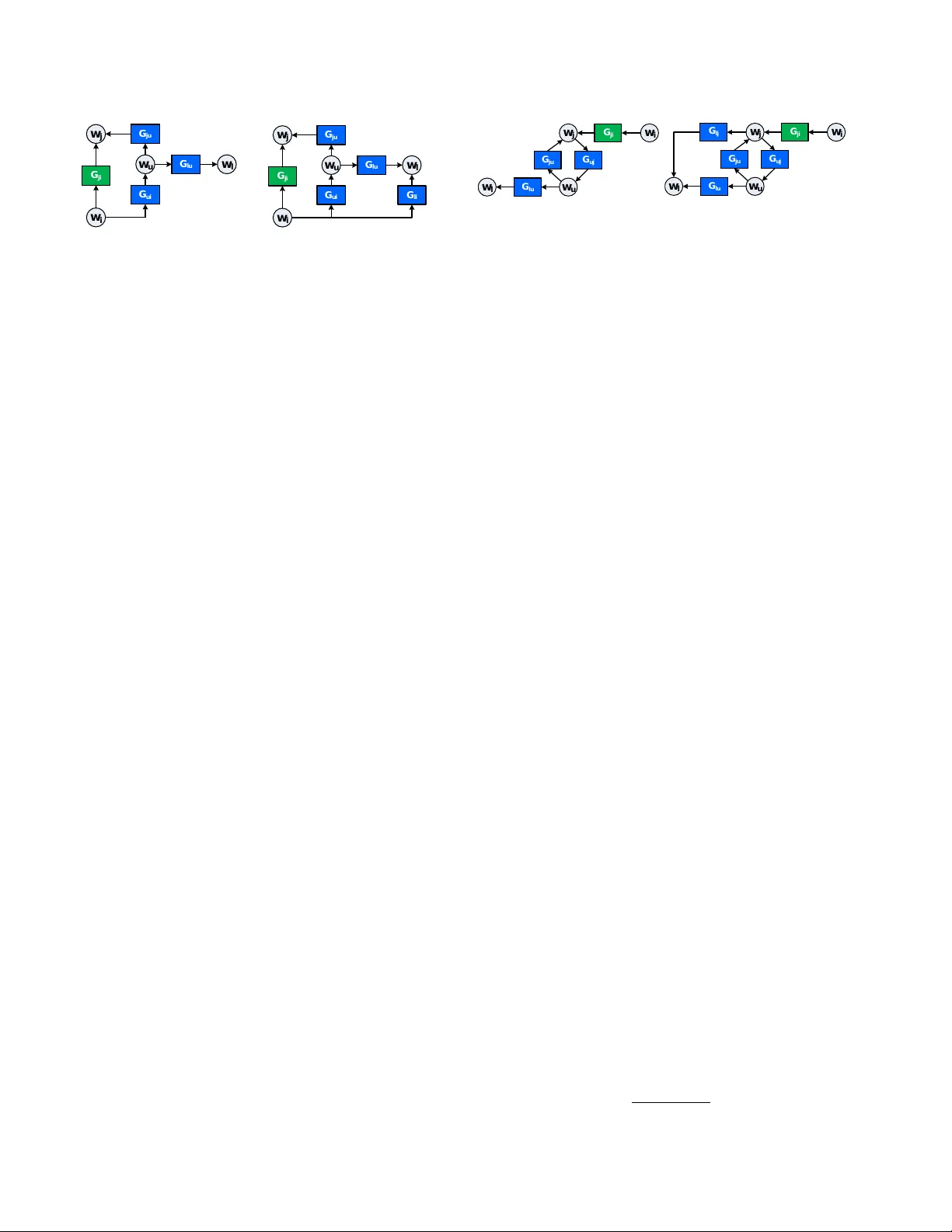
Abstractions of linear dynamic net w orks for input selection in lo cal mo dule iden tification ? Harm H.M. W eerts a , Jonas Linder b , Martin Enqvist c and P aul M.J. V an den Hof a a Contr ol Systems Gr oup, Dep artment of Ele ctrical Engine ering, Eindhoven University of T e chnolo gy, The Netherlands (email: harmwe erts@gmail.c om, p.m.j.vandenhof@tue.nl) b ABB Corp or ate R ese ar ch, V¨ aster ˚ as, Swe den (e-mail: jonas.x.linder@se.abb.c om) c Division of A utomatic Contr ol, Link¨ oping University, Swe den (e-mail: martin.enqvist@liu.se) Abstract In abstractions of linear dynamic netw orks, selected no de signals are remov ed from the netw ork, while k eeping the remaining no de signals inv arian t. The top ology and link dynamics, or mo dules, of an abstracted netw ork will generally b e changed compared to the original netw ork. Abstractions of dynamic netw orks can b e used to select an appropriate set of no de signals that are to be measured, on the basis of whic h a particular local mo dule can b e estimated. A method is introduced for net w ork abstraction that generalizes previously in tro duced algorithms, as e.g. immersion and the metho d of indirect inputs. F or this abstraction metho d it is shown under which conditions on the selected signals a particular mo dule will remain inv arian t. This leads to sets of conditions on selected measured no de v ariables that allow identification of the target mo dule. Key wor ds: Dynamic net w orks, system iden tification, closed-lo op iden tification, graph theory . 1 In tro duction In current and future engineering systems, as well as in man y biological and biomedical systems, large scale in- terconnected dynamical systems become a prime mo d- elling target for analysis and control. The resulting dy- namic net w orks that represen t these in terconnected sys- tems, are studied from man y differen t p ersp ectiv es. In this pap er our main motiv ation is directed to w ards meth- o ds and to ols for data-driven modelling of (parts of ) a dynamic net work, extending identification metho ds to b e able to deal with linear dynamic netw orks. In net work iden tification literature, t ypically three main ob jectiv es can be distinguished. One ob jective is to per- form iden tification of b oth the top ology and dynamics, see for example Sananda ji et al. (2011); Chiuso and Pil- ? P ap er accepted for publication in Automatica. Submit- ted 2 January 2019, revised 12 September 2019, final ver- sion 16 March 2020. This pro ject has received funding from the Europ ean Research Council (ERC), Adv anced Researc h Gran t SYSDYNET, under the Europ ean Union’s Horizon 2020 researc h and inno v ation programme (Gran t Agreement No. 694504), and the Vinnov a Industry Excellence Cen ter LINK-SIC pro ject num ber 2007-02224. lonetto (2012); Materassi and Salapak a (2012); Zorzi and Chiuso (2017). In situations where there is prior knowl- edge of the top ology , the ob jective can be to identify all dynamic mo dules, as is done for example in Gon¸ calves and W arnic k (2008); Y uan et al. (2011); W eerts et al. (2018c), including addressing the asp ect of netw ork iden- tifiabilit y , (W eerts et al., 2018b; Hendric kx et al., 2019). A third p ossible ob jective is the identification of the dynamics of a single lo cal element, or mo dule, in the net w ork, when the top ology of the netw ork is known. This has b een addressed in V an den Hof et al. (2013), b y extending classical closed-lo op prediction error meth- o ds, known as the direct method, t wo-stage metho d and join t-io metho d, to the situation of dynamic netw orks. The reasoning has b een extended in Dankers et al. (2015) to deal with signal measuremen ts that are affected b y sensor noise. Additional extensions concern identifiabil- it y aspects of lo cal mo dules (Bazanella et al., 2017; Hen- dric kx et al., 2019; Gevers et al., 2018; W eerts et al., 2018a), and combination of the prediction error method with Ba yesian estimation in Everitt et al. (2018); Ra- masw am y et al. (2018). In this pap er w e will elab orate on this lo cal module iden- tification problem, and fo cus on the selection of signals to b e measured in the netw ork, to allow a particular Preprin t submitted to Automatica 20 Decem b er 2024 mo dule to b e iden tified. While in general it may b e at- tractiv e to hav e all no de signals in a net w ork a v ailable from measuremen ts, in practice it ma y b e costly or ev en imp ossible to measure some of the no des. Then, a rel- ev an t question is which set of measured no de signals is sufficien t for single module identification. This problem has b een addressed in several different wa ys. • In Dank ers et al. (2016) the mo dule of interest is iden- tified in a multi-input -single-output setting with ei- ther a direct method or a t w o-stage metho d. Signals are selected by removing non-selected signals from the net w ork through an elimination pro cedure called im- mersion , while requiring that the target mo dule re- mains inv ariant. This allows a consistent identifica- tion of the target mo dule dynamics under appropri- ate excitation and disturbance conditions. A system- atic wa y of selecting the measured no de signals is pro- vided. The selection metho d is extended in Dank ers et al. (2017) to handle situations of confounding v ari- ables b eing caused b y disturbances that are spatially correlated o v er the different node signals. This is par- ticularly of interest when applying the direct metho d, aiming at maximum likelihoo d results. • The approach in Linder (2017); Linder and Enqvist (2017b,a) is also in a multi-input-single-output set- ting, but with an instrumen tal v ariable iden tification metho d. It follo ws the same philosophy as the one in Dank ers et al. (2016), but applies a different elimi- nation pro cedure, referred to as the indir e ct inputs metho d , and thus results in a different set of conditions on selected measured no de signals. • In Materassi and Salapak a (2015, 2019), selection of no de signals is b eing done on the basis of graphical mo dels, while Wiener filters are b eing used for dy- namic mo del reconstruction, and no reference excita- tions are presen t. This approach can be c haracterized as an indirect approach where several dynamic ob jects are identified from data, after whic h the target mod- ule is reconstructed. • The approac h in Bazanella et al. (2017); Hendrickx et al. (2019) is also based on indirect identification for the situation that all no des are excited by external excitations. Here an iden tifiabilit y analysis is made in order to verify whether the mo dule of interest can b e reco v ered uniquely from a set of estimated transfer functions from reference signals to a set of selected no de signals. Since all algorithms provide only sufficien t conditions for arriving at a set of to-b e-measured no de signals, it is attractiv e to obtain results that fully c haracterize the degrees of freedom that are av ailable in selecting no de signals that allow appropriate mo dule estimates. In this pap er w e are going to adopt the strategy of the first tw o approac hes, eliminating no de v ariables to ar- riv e at a so-called abstr acte d network , while keeping the dynamics of the target mo dule inv ariant. After abstrac- tion, the target mo dule can be estimated on the basis of the no de v ariables that are retained in the abstraction. While b oth Dankers et al. (2016) and Linder and Enqvist (2017b) ha v e emplo yed a particular w ay of abstracting net w orks, e.g. through net work immersion (Kron reduc- tion) or through the so-called indirect inputs metho d, here w e dev elop a more general notion of abstraction that generalizes the tw o earlier approaches, and pro vides a higher flexibility in the selection mechanism of choos- ing whic h nodes to measure/retain and whic h no des to discard/abstract in a multi-input single-output identifi- cation setup for estimating the target mo dule. In order to develop this generalized abstraction algo- rithm, we use the fundamental prop erty that the net- w ork representation is not a unique represen tation of the b ehavior of the net w ork. When manipulating the net w ork equations, different representations can be ob- tained leading to different identification setups for esti- mating the target mo dule. This freedom will b e exploited for developing generalized conditions for selecting the no de signals that are used as inputs in an identification setup for estimating the target mo dule. The paper is organized as follows. After defining the ba- sis netw ork setup in Section 2, in Section 3 the non- uniqueness of the net work representations is character- ized. This is exploited in Section 4 to arrive at a gen- eralized abstraction algorithm, which is illustrated by examples in Section 5. In Section 6 it is sp ecified under whic h conditions the target mo dule remains in v ariant, and consequences for the identification setup and the se- lection of no de signals are presen ted in Section 7. The pro ofs of all results are collected in the App endix. 2 Dynamic net w ork definition In this section a dynamic netw ork mo del is formulated on the basis of the setup in V an den Hof et al. (2013). A dynamic net work consists of L scalar internal variables or no des w j , j = 1 , . . . , L , and K external variables r k , k = 1 , . . . , K . Eac h no de is a basic building blo ck of the net w ork and is describ ed as: w j ( t ) = L X l =1 l 6 = j G j l ( q ) w l ( t ) + u j ( t ) + v j ( t ) (1) where q − 1 is the dela y operator, i.e. q − 1 w j ( t ) = w j ( t − 1); • G j l are prop er rational transfer functions that are re- ferred to as mo dules in the netw ork; • There are no self-loops in the netw ork, i.e. no des are not directly connected to themselves G j j = 0; 1 1 Since G j j are rational transfer functions, this do es not limit the dynamical description of w j ( t ). 2 • u j ( t ) are generated b y the external variables r k ( t ) via u j ( t ) = K X k =1 R j k ( q ) r k ( t ) , (2) where r k can directly be manipulated by the user, and R j k are prop er rational transfer functions; • v j is pr o c ess noise , where the vector pro cess v = [ v 1 · · · v L ] T is mo deled as a stationary sto chastic pro cess with rational spectral densit y , such that there exists an L -dimensional white noise pro cess e := [ e 1 · · · e L ] T , with cov ariance matrix Λ > 0 such that v ( t ) = H ( q ) e ( t ) , with H ( q ) a prop er rational transfer function. By combining the L no de signals, the netw ork expression w 1 w 2 . . . w L = 0 G 12 · · · G 1 L G 21 0 . . . . . . . . . . . . . . . G L − 1 L G L 1 · · · G L L − 1 0 w 1 w 2 . . . w L + u 1 u 2 . . . u L + v 1 v 2 . . . v L (3) is obtained, where the zeros are due to absence of self- lo ops. In matrix notation the dynamic net w ork is repre- sen ted as w ( t ) = G ( q ) w ( t ) + R ( q ) r ( t ) + H ( q ) e ( t ) . (4) A set notation is introduced for notational conv enience. Let the sets S and Z eac h contain a num b er of no de in- dices, then w S denotes the vector of no de signals consist- ing of all w j , j ∈ S . Similarly , G S Z is the matrix of trans- fer functions that con tains all mo dules G j i , j ∈ S , i ∈ Z . The transfer function that maps the external signals r and e into the no de signals w is denoted by: T ( q ) = h T wr ( q ) T we ( q ) i , (5) with T wr ( q ) := ( I − G ( q )) − 1 R ( q ) , and (6) T we ( q ) := ( I − G ( q )) − 1 H ( q ) . (7) This is also known as the open-lo op resp onse of the net- w ork corresp onding with w ( t ) = T wr r ( t ) + ¯ v ( t ) , (8) where noise comp onent ¯ v ( t ) is defined by ¯ v ( t ) := T we ( q ) e ( t ) , (9) with p ow er sp ectral density Φ ¯ v ( ω ) := T we ( e iω )Λ T T we ( e − iω ) . (10) Some notions from graph theory will b e used in the dynamic netw ork. Mo dules form the in terconnections / links b etw een no des. A node w k is said to be an in- neighb or of no de w j if G j k 6 = 0, and then w j is said to b e an out-neighb or of no de w k . A p ath in a net w ork is a sequence of interconnected nodes, more precisely there exists a path through no des w n 1 , . . . , w n k if G n 1 n 2 G n 2 n 3 · · · G n ( k − 1) n k 6 = 0 . A lo op is a path where n 1 = n k . A dynamic net w ork model is then formally defined in the following wa y . Definition 1 (dynamic net work mo del) A network mo del of a network with L no des, and K external excita- tion signals, with a noise pr o c ess of r ank L is define d by the quadruple: M = ( G, R , H , Λ) with • G ∈ R L × L ( z ) , diagonal entries 0; • R ∈ R L × K ( z ) ; • H ∈ R L × L ( z ) , monic, pr op er, stable, with a stable inverse; • Λ ∈ R L × L , Λ > 0 ; • The network is wel l-p ose d (Dankers, 2014), implying that ( I − G ) − 1 exists. A dditional ly we r e quir e that ( I − G ) − 1 R is pr op er and stable. 2 Remark 2 In Definition 1 we do not r e quir e mo dules to b e pr op er, while in (1) we do r e quir e pr op erness. R e al systems in pr actic e ar e r efle cte d by (1) , and these wil l typic al ly have pr op er mo dules. In this p ap er we wil l use the fr e e dom to al low network mo dels to have non-pr op er mo dules. F or this r e ason we define a r epr esentation of these networks that al lows mo dules to b e non-pr op er in Definition 1. Note that for a network mo del r epr esenta- tion as in Definition 1, we r e quir e T wr to b e pr op er and stable, while the noise tr ansfer T we is al lowe d to b e non- pr op er, r epr esenting a non-c ausal mapping. This al lows us to maintain a monic, pr op er, stable and stably invert- ible noise filter H , which is attr active fr om an identific a- tion p ersp e ctive. Remark 3 With the analysis pr ovide d in We erts et al. (2018c), it is p ossible to extend the r esults in the curr ent p ap er to the situation of a noise pr o c ess having r ank p smal ler than L , implying that H ∈ R L × p ( z ) , and Λ ∈ R p × p . 3 3 Equiv alent netw ork represen tations The freedom that is presen t in dynamic net work repre- sen tations allows for differen t selections of node signals to be used for iden tification of a mo dule. This freedom is formally characterized in this section. Moreov er, the general concept of remo ving a no de from a netw ork is defined as abstraction, suc h that in later sections w e can consider abstractions that are relev an t for iden tification. 3.1 T r ansformation of the glob al network F undamen tally , we need to define when tw o netw orks are equiv alent descriptions of b ehavior, and what free- dom is av ailable to transform the netw ork to an equiv- alen t represen tation. In the netw ork mo del definition, it has b een stated that the external v ariables r and no des w are kno wn, and it is reasonable to state that equiv a- len t net works must describ e the same relation b etw een r and w . The dynamic influence of r on w is describ ed by the open-lo op transfer function matrix T wr , and so the equiv alence of t w o net works additionally requires equal- it y of the t w o related op en-lo op transfer function matri- ces from r to w . The op en-lo op resp onse of the netw ork is describ ed b y (8), i.e. w ( t ) = T wr r ( t ) + ¯ v ( t ). If w , r and T wr are the same for tw o netw orks, then also ¯ v m ust b e the same. Definition 4 L et the network mo del M ( i ) c orr esp ond to op en-lo op tr ansfer T ( i ) wr and noise sp e ctrum Φ ( i ) ¯ v for i = { 1 , 2 } . Network mo dels M (1) and M (2) ar e said to b e e quivalent if T (1) wr = T (2) wr and Φ (1) ¯ v = Φ (2) ¯ v . (11) 2 In the ab ov e definition, T ( i ) wr and Φ ( i ) ¯ v are associated with w and r for i = { 1 , 2 } . There is an implicit assumption in the definition that the w and r are the same for b oth i = { 1 , 2 } . The full freedom that is a v ailable for transformation of a net w ork mo del to an equiv alent netw ork model is c har- acterized b y op erations applied to the netw ork equa- tion. These transformations can be represen ted by pre- m ultiplying with a matrix. Consider a square rational transfer function matrix P , then pre-m ultiplication of net w ork equation (4) results in P ( q ) w ( t ) = P ( q ) G ( q ) w ( t ) + u ( t ) + v ( t ) . (12) The ab ov e pre-multiplication t ypically leads to a left- hand side unequal to w ( t ), in which case we need to mov e terms to the right-hand side un til w e hav e w ( t ) on the left-hand side, i.e. w ( t ) = ( I − P ( q )) w ( t ) + P ( q ) G ( q ) w ( t ) + u ( t ) + v ( t ) , (13) whic h is denoted as w ( t ) = G (2) ( q ) w ( t ) + u (2) ( t ) + v (2) ( t ) (14) where G (2) = I − P ( I − G ) , u (2) = P u, v (2) = P v. (15) The transfer function matrix R is then transformed as R (2) = P R. (16) A transformation of the noise mo del is defined in the follo wing w ay . When w e describe the noise mo del as v = H e , a pre-multiplication with P does not necessarily lead to a proper, monic, stable and stably in vertible filter P H . F or that reason H (2) and Λ (2) are obtained through sp ectral factorization of the transformed noise spectrum P ( e iω )Φ v ( ω ) P T ( e − iω ) = H (2) ( e iω )Λ (2) ( H (2) ( e − iω )) T . (17) A transformation P that leads to an appropriate netw ork represen tation must satisfy some conditions. Prop osition 5 L et network mo del M (1) satisfy Defini- tion 1. The tr ansformation P op er ating on M (1) as de- fine d in (15) , (16) , and (17) le ads to a network mo del M (2) that satisfies Definition 1 and that is e quivalent to M (1) if and only if: (1) P is ful l r ank, and (2) diag I − P ( I − G (1) ) = 0 . Pro of: Collected in the app endix. 2 An interesting feature of the netw ork transformations is that the resp onse from external v ariables and pro- cess noises to internal v ariables remains the same. A pre-m ultiplication P as defined ab ov e leav es the transfer function matrix T wr in v arian t, since T wr = ( P ( I − G )) − 1 P R, (18) where the identit y P − 1 P = I is used. A pre-m ultiplication P that leads to a non-hollow G (2) can b e used to transform a net w ork. How ever, in that situation additional manipulations would b e necessary to arrive at a hollo w representation. Without loss of gen- eralit y we will restrict to transformations P that imme- diately result in a netw ork represen tation that satisfies (1). There are some restrictions on P , but a large free- dom in the choice of transformation P is left. 4 Prop osition 6 The e quivalenc e tr ansformation pr e- sente d in (15) , (16) , and (17) c an tr ansform a network mo del M (1) with c orr esp onding mo dules G (1) into a net- work mo del M (2) with c orr esp onding mo dules G (2) using the tr ansformation P = ( I − G (2) )( I − G (1) ) − 1 . (19) Pro of: Collected in the app endix. 2 The proposition allows for G (1) to be transformed into an arbitrary G (2) as long as it is part of a v alid netw ork description. The consequence of transforming G (1) to an arbitrary G (2) is that the corresponding R (2) will ha ve a complex structure R (2) = P R (1) = ( I − G (2) )( I − G (1) ) − 1 R (1) . (20) The implication is that when G (1) is transformed, R (2) will comp ensate the c hanges to k eep the no de behavior in v arian t. This also holds for the noise mo del, which will con tain additional correlations. Without an y further re- strictions on the choice of R and H , the mo dules repre- sen ted in G contain no information on the dynamic net- w ork. It is the combination of G, R, H that determines the dynamic netw ork. 3.2 Abstr action The next step is to extend net w ork equiv alence with the option to remov e nodes from the represen tation. T o this end the concept of network abstr action is defined next. This definition is related to the notions of abstraction in P appas and Sastry; W o o dbury et al. (2017). Definition 7 L et network mo del M (1) b e asso ciate d with no des w (1) ∈ R L 1 , external variables r ∈ R K , op en- lo op tr ansfer T (1) wr ∈ R L 1 × K , and noise sp e ctrum Φ (1) ¯ v ∈ R L 1 × L 1 . L et network mo del M (2) b e asso ciate d with no des w (2) ∈ R L 2 , external variables r ∈ R K , op en-lo op tr ans- fer T (2) wr ∈ R L 2 × K , and noise sp e ctrum Φ (2) ¯ v ∈ R L 2 × L 2 . L et L 2 < L 1 and let C b e the matrix that sele cts w (2) fr om w (1) , so define C with one 1 p er r ow, zer os everywher e else, ful l r ow r ank, and such that w (2) = C w (1) . Network mo del M (2) is said to b e an abstr action of M (1) if T (2) wr = C T (1) wr , Φ (2) ¯ v = C Φ (1) ¯ v C T . (21) The no des that ar e in w (1) , but not in w (2) ar e said to b e abstr acte d fr om the network. 2 Constructing an abstraction of a netw ork implies that some no des are remov ed from the net work represen ta- tion, while the remaining no des stay in v arian t, in the sense that for the same external signal r , the second or- der statistical prop erties of the remaining no de signals are inv ariant. The next step is to determine ho w to obtain an abstrac- tion of a netw ork. In certain cases, abstracting no des ¯ w from a net work can be done b y simply pre-m ultiplying the netw ork equation (4) with the selection matrix C , i.e. C w ( t ) = C G ( q ) w ( t ) + R ( q ) r ( t ) + v ( t ) . (22) Ho w ev er, this only is an abstraction if the abstracted no des ¯ w no longer app ear on the right-hand side of the equation. If ¯ w appears on the right-hand side of (22) then the abstracted nodes hav e an influence on the behavior of the no des in C w , such that (21) cannot hold. It has to be determined ho w to define a transformation P such that an abstraction can b e obtained by selecting ro ws from the equation, as in (22). A node w i influences other nodes through its out- neigh b ors, and these corresponding modules are lo cated in a column in G . If a no de has no influence on the rest of the netw ork, then it has no out-neighbors, and the corresp onding column is 0. Abstracting no de w i requires us to transform the netw ork suc h that a 0-column is formed by transformation, after which the node can b e remo v ed. By Proposition 6 w e know that such a trans- formation alw a ys exists. The abstraction satisfies the relations G (2) = C ( I − P ( I − G )) C T , R (2) = C P R. (23) A noise mo del constructed as C P H (1) is a non-square matrix, which is difficult to handle in an iden tification setting. Therefore the transformed noise mo del H (2) , Λ (2) will b e obtained through sp ectral factorization C P ( e − j ω )Φ v ( ω ) P T ( e j ω ) C T = H (2) ( e − j ω )Λ (2) ( H (2) ( e j ω )) T . (24) 3.3 Discussion on Identifiability In Prop osition 6 we hav e seen that G (1) can b e trans- formed into an arbitrary G (2) as long as it is part of a v alid netw ork description. This may give rise to the question whether w e are not dealing with an unnecessar- ily ov erparameterized situation, inv olving G , R and H to describ e a dynamic net w ork. Ho w ev er w e particularly include the situation that measured external excitation signals en ter into physical subsystems of a net work, and th us our mo dules in G can hav e an intrinsic interpreta- tion in the physical w orld. The price of abstracting no des in a netw ork is that H and R can b ecome complex, whic h 5 ma y b e impossible to identify . In the identifiabilit y anal- ysis pro vided in W eerts et al. (2018b) the following nec- essary condition for net work identifiabilit y can be found: F or a netw ork model set { G ( θ ) , R ( θ ) , H ( θ ) , θ ∈ Θ } to b e netw ork iden tifiable it is necessary that at least L en- tries on each row of [ G ( q , θ ) R ( q , θ ) H ( q , θ )] are fixed and non-parameterized. If only the top ology is known, then the absent links in the netw ork reflected by zeros in the matrices G, R, H are the only known en tries. In case H and R b ecome to o complex, then the n umber of zeros is to o small for the mo del to b e embedded in a netw ork iden tifiable mo del set. This implies that it is imp ossible to find a unique estimate for the mo del structure on the basis of the data. The approac h in the next section is to define a particular abstraction metho d, that leads to abstracted netw orks that can b e embedded in netw ork iden tifiable mo del sets. 4 Abstraction of netw orks W e will no w form ulate and analyze an abstraction algo- rithm for dynamic netw orks that generalizes the pro ce- dure of immersion Dank ers et al. (2016) and the indirect inputs metho d Linder and Enqvist (2017a). It starts by dividing the netw ork nodes in to a set of nodes w S that are retained after abstraction and a set of no des w Z that will b e remo ved. The abstracted net work will then allow us to analyze the prop erties of estimated mo dels when the retained/measured no de signals are emplo yed in an iden tification pro cedure. 4.1 Gener alize d algorithm It app ears that the action of abstracting nodes in a net- w ork is not unique. This is particularly due to the de- grees of freedom that exist in transforming net work rep- resen tations to equiv alen t forms, b y premultiplying the system’s equations by appropriate transformation ma- trices. In order to incorp orate this freedom in the ab- straction, we decomp ose eac h set of no de signals S and Z into t w o disjunct parts: S = L ∪ ˜ S (25) Z = V ∪ ˜ Z . (26) The no de signals w ˜ Z will b e abstracted directly by sub- stituting the equation for w ˜ Z in to the equations for the other no de signals. The no de signals w V ha v e the prop- ert y that they can b e indir e ctly observe d by the no de signals w L , and therefore they can b e eliminated from the net work b y utilizing the equation for nodes w L . The notion of indir e ct observation will b e sp ecified after the next step. Based on these sets, the netw ork can b e represented by w ˜ S w L w V w ˜ Z = G ˜ S ˜ S G ˜ S L G ˜ S V G ˜ S ˜ Z G L ˜ S G LL G LV G L ˜ Z G V ˜ S G V L G V V G V ˜ Z G ˜ Z ˜ S G ˜ Z L G ˜ Z V G ˜ Z ˜ Z w ˜ S w L w V w ˜ Z + u ˜ S u L u V u ˜ Z + v ˜ S v L v V v ˜ Z , (27) where w ˜ Z and w ˜ S are defined according to ˜ S = S \L and ˜ Z = Z \V . The no de signals w L and w V are chosen in suc h a wa y that the signals w L serv e as indirect observ ations of the no de signals w V , meaning that the signals w L con tain sufficien t information of the indirectly observ ed signals w V , so as to replace them in an elimination pro cedure. This is formulated in the following definition. Definition 8 (indirect observ ations) The no de sig- nals w L serve as indir e ct observations of the no de signals w V if the tr ansfer function G LV + G L ˜ Z ( I − G ˜ Z ˜ Z ) − 1 G ˜ Z V has ful l c olumn r ank. 2 The prop erty is satisfied if in the netw ork there exists a sufficien t n umber of paths from no des w V to nodes w L that run through nonmeasured nodes only . An illustra- tion of indirect observ ations is pro vided in Section 4.3. In the remainder of this pap er it will b e assumed that w L and w V are selected to satisfy the full column rank prop ert y of the ab ov e definition. Note that this assump- tion is not restrictiv e because L and V are chosen by the user suc h that the assumption is satisfied. W e can al- w a ys c ho ose L and V as empt y sets, so the assumption do es not preven t us from constructing an abstracted net- w ork. How ever, the use of non-empty sets L and V will allo w us to use more degrees of freedom in constructing abstracted netw orks. No w we can form ulate the generalized abstraction algo- rithm, as follows. Algorithm 1 Consider a network r epr esentation as in (27) . Then the fol lowing algorithm le ads to a network in which no des w Z ar e abstr acte d and no des w S ar e r etaine d: a Solve the fourth e quation of (27) for w ˜ Z , and then substitute the r esult into the other e quations, and r emove the fourth e quation fr om the network. b Solve the se c ond e quation of (27) for w V , and sub- stitute the r esult into the first e quation. c Solve the thir d e quation of (27) for w V , and substi- tute the r esult into the se c ond e quation, and r emove the thir d e quation fr om the network. d R emove p ossible self-lo ops in the r esulting network r epr esentation by shifting self-lo op terms to the left hand side of the e quations and sc aling the e quations such that an identity matrix r emains at the left hand side. 2 6 The algorithm sho ws that the essential difference b e- t w een the no des in w ˜ S and w L is ho w w V is remo v ed from their equation. After application of the algorithm, the abstracted netw ork will b e represented by " w ˜ S w L # = " ˇ G ˜ S ˜ S ˇ G ˜ S L ˇ G L ˜ S ˇ G LL # " w ˜ S w L # + " ˇ u ˜ S ˇ u L # + " ˇ v ˜ S ˇ v L # . (28) Note that the particular type and ordering of v ariable substitution in Algorithm 1 essentially influences the re- sult. This will b e illustrated with examples in Section 5. 4.2 Sp e cific ation thr ough tr ansformations Algorithm 1 can b e specified by denoting the algebraic manipulations that generate the substitution and elimi- nation op erations in the different steps of the algorithm. W e will first describe the substitution op erations on the set of equations, and at the end of the pro cedure address the remov al of equations. In step (a) the elimination of w Z is p erformed, which corresp onds to applying the transformation matrix P (1) = I 0 0 G ˜ S ˜ Z ( I − G ˜ Z ˜ Z ) − 1 0 I 0 G L ˜ Z ( I − G ˜ Z ˜ Z ) − 1 0 0 I G V ˜ Z ( I − G ˜ Z ˜ Z ) − 1 0 0 0 ( I − G ˜ Z ˜ Z ) − 1 , (29) to the netw ork representation (27). This leads to a new G -matrix given by G (1) = I − P (1) ( I − G ) , (30) where G is partitioned as defined in (27), and G (1) is partitioned in the same wa y . In steps (b)-(c) , we first obtain a new expression for w V b y rev erting the expression for w L , and w e substitute the original expression for w V in to the expressions for w L . This corresp onds to applying the transformation matrix P (2) = I 0 0 0 0 I G (1) LV ( I − G (1) V V ) − 1 0 0 ( G (1) LV ) † 0 0 0 0 0 I , (31) with ( G (1) LV ) = G LV + G L ˜ Z ( I − G ˜ Z ˜ Z ) − 1 G ˜ Z V , and ( G (1) LV ) † denoting its left-in verse, and ( G (1) V V ) = G V V + G V ˜ Z ( I − G ˜ Z ˜ Z ) − 1 G ˜ Z V , leading to G (2) = I − P (2) ( I − G (1) ) , (32) where G (2) has the same partitioning as G (1) . Note that the left-inv erse exists due to the indirect observ ations prop ert y of w L , as formulated in Definition 8. The remaining part of steps (b)-(c) is now to substitute the new expression for w V in the first equation for w S , thereb y eliminating the dep endency of this expression on w V . This is achiev ed by applying the transformation matrix P (3) = I 0 G (2) ˜ S V 0 0 I 0 0 0 0 I 0 0 0 G (2) ˜ Z V I , (33) suc h that G (3) = I − P (3) ( I − G (2) ) , (34) where G (3) has the same partitioning as G (2) . The ad- ditional term G (2) ˜ Z V that is added in the fourth row of P (3) ensures that in the transformed net w ork all columns that corresp ond to w Z are zero in G (4) , including for the equations that will b e remov ed. Step (d) of the Algorithm is addressed b y remo ving self- lo ops in the resulting netw ork representation, b y apply- ing a diagonal transformation matrix P (4) with diagonal elemen ts P (4) j j = 1 1 − G (3) j j (35) and b eing 0 elsewhere. The total transformation that is applied to the netw ork represen tation is now given by P ( abs ) = P (4) P (3) P (2) P (1) , (36) whic h leads to a G -matrix of the transformed netw ork represen tation that is structured according to G (4) := ( I − P ( abs ) ( I − G )) = ˇ G ˜ S ˜ S ˇ G ˜ S L 0 0 ˇ G L ˜ S ˇ G LL 0 0 ˇ G V ˜ S ˇ G V L 0 0 ˇ G ˜ Z ˜ S ˇ G ˜ Z L 0 0 (37) The abstracted netw ork now results by selecting the first t w o block ro ws and columns in the matrix G (4) , thereb y remo ving the equations for the unmeasured/abstracted no de v ariables w V and w ˜ Z . Prop osition 9 When applying the abstr action pr o c e- dur e of Algorithm 1 to a dynamic network given by (27), 7 the obtaine d abstr acte d network is the same as the ab- str acte d network given by (28) with " ˇ G ˜ S ˜ S ˇ G ˜ S L ˇ G L ˜ S ˇ G LL # = " I 0 0 0 0 I 0 0 # ( I − P ( abs ) ( I − G )) I 0 0 I 0 0 0 0 " ˇ u ˜ S ˇ u L # = " I 0 0 0 0 I 0 0 # P ( abs ) u ˜ S u L u V u ˜ Z " ˇ v ˜ S ˇ v L # = " I 0 0 0 0 I 0 0 # P ( abs ) v ˜ S v L v V v ˜ Z . Pro of: Collected in the app endix. 2 4.3 Interpr etations and discussion Compared to selecting a set of no des w Z , the particular c hoice of the sets of nodes w L and w V creates additional degrees of freedom in the problem of constructing an abstracted netw ork, in which the no des w Z (including w V ) are remo v ed. The mec hanism that is used is that the net work equation for the no de signals w L is in verted to b ecome an equation that describ es the no de signals w V . This equation is then subsequently used to substi- tute and eliminate the w V signals from the abstracted net w ork. In order to b e able to use the net work equation for w L in this w ay , it needs to capture full information on the node signals w V . This is reflected in the property of indir e ct observations , and the required full column rank property of G LV + G L ˜ Z ( I − G ˜ Z ˜ Z ) − 1 G ˜ Z V , as for- m ulated in Definition 8. This full rank prop ert y implies that dim ( w L ) ≥ dim ( w V ). It is generically satisfied if there are dim( w V ) vertex-disjoin t paths present from w V to w L that run through nonmeasured/abstracted no des only (v an der W oude, 1991; Hendrickx et al., 2019). An example of the full rank assumption is sho wn in Figure 1. In the figure there are the tw o vertex-disjoin t paths w v 1 → w l 1 and w v 2 → w z → w l 3 for tw o no des that are indirectly observ ed. In this case actually any selection of t w o nodes from { w l 1 , w l 2 , w l 3 } would be sufficien t to act as indirect observ ations of { w v 1 , w v 2 } . The netw ork abstraction introduced here, generalizes t w o earlier introduced abstraction algorithms. F or the particular c hoice, L = ∅ and V = ∅ , Algorithm 1 de- scrib es the method of netw ork immersion, as in tro duced w l 1 w l 2 w l 3 w v 1 w v 2 w z Fig. 1. Example netw ork with V = { v 1 , v 2 } , ˜ Z = { z } , L = { l 1 , l 2 , l 3 } , where the full rank condition is satisfied. in Dankers et al. (2016), and developed for the situa- tion R = I . In that case steps (2)-(3) of the algorithm b ecome obsolete. If w L is restricted to consist of no des that are out- neigh b ors of w V , and w V do es not con tain in-neigh b ors of w ˜ Z , and G LV has full column rank, then Algorithm 1 describ es the indirect inputs method as defined in Lin- der and Enqvist (2017b), whic h has b een dev elop ed for the situation R = I . If L = ∅ , then the indirect inputs metho d is equiv alent to the immersion metho d. Because of well-posedness of the original net work, all terms in the transformation matrices P (1) · · · P (4) are prop er, except p ossibly for the term ( G (1) LV ) † whic h may b e non-proper. This implies that the in tro duction of the sets L and V may lead to a final abstracted net work rep- resen tation that is non-proper. Properness of the result- ing netw ork representation is guaranteed if L = ∅ . 4.4 Identifiability analysis As discussed in Section 3.3, it is impossible to form ulate an identifiable mo del set for net work representations of high complexit y . The underlying ob jective of the partic- ular abstraction algorithm is to limit the complexity of the abstracted netw ork. An ev aluation of the structure of net w ork representations obtained with the abstraction algorithm is made. In this wa y w e can guaran tee that an iden tifiable mo del set can be defined for the abstracted net w ork. A sufficient condition for netw ork iden tifiabilit y that can easily b e verified is that every node has an indep enden t external excitation. This is ac hieved when the columns of ˇ R in ˇ u ( t ) = ˇ R ( q ) r (38) can be permuted to arriv e at a matrix with a leading di- agonal (W eerts et al., 2018b). In order to v erify whether this can b e achiev ed w e need to ev aluate the structure of ˇ R . The abstracted netw ork generated b y Algorithm 1 corresp onds to the transformation P ( abs ) , such that ˇ R = h I 0 i P ( abs ) R. (39) 8 Since P ( abs ) and R are formulated in terms of the orig- inal netw ork, we can formulate conditions for netw ork iden tifiabilit y based on the original top ology . This is for- mally done in the next prop osition. Prop osition 10 Consider the abstr acte d network (28) obtaine d by abstr acting the original network (4) with Al- gorithm 1 by using the sets of no des ˜ S , L , V , ˜ Z . The r ep- r esentation of the external excitations is ˇ u ( t ) = ˇ R ( q ) r . The matrix ˇ R ( q ) c an b e given a le ading diagonal by c ol- umn op er ations if the original network is such that (1) R ˜ S ˜ S is diagonal, and r ˜ S is not an in-neighb or of no des other than w ˜ S , (2) R V V is diagonal, and r V is not an in-neighb or of no des other than w V , and (3) G LV is diagonal, G L ˜ Z = 0 , G V V = 0 , and G V ˜ Z = 0 . Pro of: Collected in the app endix. 2 The prop osition implies that abstracted netw orks that are obtained by Algorithm 1 can b e embedded in netw ork iden tifiable mo del sets, under some restrictions on the original net work. Here we ha ve analyzed netw ork iden- tifiabilit y of all mo dules in the abstracted net work using sufficien t conditions. The result ma y be extended b y us- ing less restrictive conditions that mak e use of the top ol- ogy presen t in G W eerts et al. (2018b). Moreov er, for consistency of the module of in terest only netw ork iden- tifiabilit y of that particular mo dule is neces sary . Condi- tions for netw ork identifiabilit y of a particular mo dule are less restrictiv e than conditions for net w ork iden tifia- bilit y of all mo dules (W eerts et al., 2018a), which could further reduce the imposed conditions on the structure of the netw ork. 5 Abstraction applied to an example net work In this section w e will provide an example to illustrate some of the options that are av ailable in netw ork ab- straction. Consider the netw ork in Figure 2 where the no des are describ ed by the following equations w 1 = G 12 w 2 + G 13 w 3 + G 14 w 4 + r 1 + v 1 (40) w 2 = G 24 w 4 + r 2 + v 2 (41) w 3 = r 3 + v 3 (42) w 4 = G 41 w 1 + r 4 + v 4 (43) If we w ould like to abstract no de w 4 , e.g. b ecause this no de signal cannot b e measured, then we hav e different options for doing so. The set of retained no des is S = { 1 , 2 , 3 } and the set of remov ed no des is Z = { 4 } . W e ha ve to make a c hoice on whether no des are used as indirect observ ations. If we choose that there are no indirect observ ations, then L = V = ∅ , such that w 4 w 3 G 13 G 14 G 41 w 1 G 24 w 2 v 1 + r 1 G 12 v 3 + r 3 v 4 + r 4 v 2 + r 2 Fig. 2. Example net w ork to illustrate abstraction. ˜ S = { 1 , 2 , 3 } and ˜ Z = { 4 } . W e eliminate w 4 from the system equations b y substituting its expression (43) in the expressions of the no des that are retained (40)-(42). This leads to a new set of equations given by w 1 = G 14 G 41 w 1 + G 12 w 2 + G 13 w 3 + r 1 + v 1 + G 14 ( r 4 + v 4 ) w 2 = G 24 G 41 w 1 + r 2 + v 2 + G 24 ( r 4 + v 4 ) w 3 = r 3 + v 3 whic h induces a self-lo op around w 1 . This can b e com- p ensated for by moving the w 1 -dep enden t term to the left hand side, and rewriting the equation for w 1 as w 1 = S [ G 12 w 2 + G 13 w 3 + r 1 + v 1 + G 14 ( r 4 + v 4 )] with S := (1 − G 14 G 41 ) − 1 . As a result the abstracted net w ork is obtained and sk etc hed in Figure 3. This w a y of eliminating no de w 4 is referred to as immersion (Dank ers et al., 2016), and comes down to lifting each path in the original netw ork that contains the no de sig- nal that is eliminated. After removing the abstracted no de signals, the remaining no de signals are inv ariant. w 3 SG 13 w 1 G 2 4 G 41 w 2 S ( v 1 + r 1 ) SG 12 v 3 + r 3 v 4 + r 4 v 2 + r 2 G 24 SG 14 Fig. 3. Netw ork obtained after abstracting no de w 4 through immersion. As an alternative for the chosen abstraction, we can c ho ose w 2 as an indirect observ ation of w 4 , such that L = { 2 } , V = { 4 } , ˜ S = { 1 , 3 } , and ˜ Z = ∅ . In this situ- ation, no de signal w 4 is abstracted by utilizing the ex- 9 pression for w 2 . W e rewrite equation (41) as w 4 = G − 1 24 ( w 2 − v 2 − r 2 ) and substitute this in to (40) to obtain the expression for w 1 w 1 = G 12 w 2 + G 13 w 3 + G 14 G − 1 24 ( w 2 − r 2 − v 2 ) | {z } w 4 + r 1 + v 1 . In order to obtain the new expression for w 2 w e directly substitute the expression for w 4 (43) in to the expression for w 2 (41). The abstracted netw ork is sk etc hed in Figure 4, and given by the following equations: w 1 =( G 12 + G 14 G − 1 24 ) w 2 + G 13 w 3 + r 1 + v 1 − G 14 G − 1 24 ( r 2 + v 2 ) w 2 = G 24 G 41 w 1 + r 2 + v 2 + G 24 ( r 4 + v 4 ) w 3 = r 3 + v 3 This alternativ e metho d of eliminating no de v ariable w 4 is referred to as the indir e ct inputs metho d introduced in Linder and Enqvist (2017a). The principle idea is that the out-neigh b or of a node that needs to be abstracted con tains information ab out that no de. Then the equa- tion of the out-neighbor is manipulated in order to ob- tain an explicit expression for the node to b e abstracted, whic h is then used to eliminate the node from the net- w ork. A ma jor difference with the method of immersion is that the inv erse of mo dules may app ear in the result- ing netw ork representation. It can b e observ ed that the net w ork top ology and mo dule dynamics can c hange when no des are abstracted from the netw ork. In particular the mo dule G 13 has changed to S G 13 when the immersion metho d is applied, while it remains inv ariant when the indirect inputs metho d is applied. This is going to b e important when considering the problem of identifying a lo cal mo dule on the basis of a restricted set of measured no de signals, as will b e discussed in the next section. w 3 G 13 w 1 w 2 v 1 + r 1 G 12 + G 14 ( G 24 ) - 1 v 3 + r 3 v 4 + r 4 v 2 + r 2 G 24 - ( G 24 ) - 1 G 14 G 24 G 41 Fig. 4. Mo dification of the netw ork depicted in Figure 2, obtained after remov al of no de w 4 b y the indirect inputs metho d. 6 Iden tification setting for inv arian t modules W e ha v e in tro duced an algorithm to p erform netw ork abstraction. The remaining question to answer is how this will help to select nodes for the identification of the mo dule of in terest. A cen tral p oin t in our reasoning will b e the in v ariance of the target mo dule in the abstracted net w ork. Although for consisten t identification of the target mo dule it is not strictly necessary to hav e target mo dule inv ariance, cf. e.g. the indirect t yp e iden tifica- tion metho ds of Bazanella et al. (2017); Gevers et al. (2018); Hendrickx et al. (2019) or the Wiener-filter based metho d of Materassi and Salapak a (2015, 2019), inv ari- an t target mo dules are very attractive in tw o-stage meth- o ds (Dankers et al., 2016; Linder and Enqvist, 2017a), and they are indisp ensable in direct metho ds (Dank ers et al., 2016) that hav e the p otential to provide consis- ten t and maximum likelihoo d (and thus minimum v ari- ance) results. In Dankers et al. (2016) and Linder and Enqvist (2017a) t wo differen t abstraction metho ds ha ve b een used to select no de signals to be measured for iden- tification of a target mo dule, based on the inv ariant mo d- ule principle. The prime reasoning and the formulation of generalized results are presented next. 6.1 Dir e ct identific ation setup If the target mo dule to b e identified is G j i ( q ), then a MISO iden tification setup on the basis of the abstracted net w ork can b e formulated in the following wa y . No de w j is used as output, and the following nodes are inputs: w ˜ S \ j with i ∈ S , w L , and p ossibly additional external excitations. In this w ay an identification algorithm can pro vide us with a consistent estimate of the modules of the abstracted net w ork ˘ G j k for all k ∈ S , pro vided that some regularit y conditions are satisfied, among which sufficien t excitation prop erties of the measured signals. W e hav e seen in the examples of the previous section that a mo dule may remain unchanged after abstraction for particular choices of the sets ˜ S , L , V , ˜ Z , i.e. G j i ( q ) = ˘ G j i ( q ) . (44) If the modules of the abstracted net work are estimated consisten tly , and the mo dule of in terest has remained in v arian t in the abstracted netw ork, then the mo dule of in terest is estimated consistently . In the remainder of this section we will address the problem under which conditions the abstracted net w ork has the mentioned in v ariance prop erty (44) of G j i . 6.2 Invarianc e of the mo dule G j i When applying immersion as a sp ecific abstraction algo- rithm, it has b een analyzed in Dankers et al. (2016) un- der whic h conditions on the set of retained node signals, a particular mo dule in the netw ork will remain inv arian t. 10 w i G ji w j w u w l G ju G ui G lu w i G ji w j w u w l G ju G ui G lu G li Fig. 5. Netw orks to illustrate issues with parallel paths when abstracting. Prop osition 11 (Dankers et al. (2016)) Consider a dynamic network as define d in (4) , and let G j i ( q ) b e the mo dule of inter est. Denote with ˘ G j i ( q , ˜ S , L , V , ˜ Z ) the mo dule ˘ G j i in the network that is abstr acte d using A lgorithm 1 with the sets ˜ S , L , V , ˜ Z . L et the network abstr action b e p erforme d thr ough immersion, i.e. with L = V = ∅ . Define the set D j = ˜ S \ j . Then ˘ G j i ( q , ˜ S , L , V , ˜ Z ) = G j i ( q ) (45) if D j satisfies the fol lowing c onditions: (1) i ∈ D j , j / ∈ D j , (2) every p ath fr om w i to w j , excluding the p ath G j i , go es thr ough a no de w k , k ∈ D j , (3) every lo op fr om w j to w j go es thr ough a no de w k , k ∈ D j . 2 According to this prop osition, there are tw o situations that need to be c heck ed for guaran teeing mo dule in v ari- ance: parallel paths and loops around the output. Ev ery path that connects input and output parallel to the tar- get mo dule, and ev ery lo op around the output should b e “block ed” b y another no de that is retained in the ab- stracted netw ork. 6.3 Gener alization of invarianc e c onditions The follo wing t w o examples illustrate the parallel paths and lo ops around the outputs, leading to a generalization of Prop osition 11 that extends the applicability from the immersion abstraction algorithm to the generalized abstraction algorithm. In the next examples, noise-free net w orks are used in order to stic k to the core reasoning. Example 12 (Parallel paths) Consider the left net- work in Figur e 5 and the mo dule of inter est G j i . Paths that run in p ar al lel to this mo dule, i.e. p aths fr om w i to w j , may le ad to changes in the mo dule of inter est dur- ing abstr action. If w u is r emove d using immersion, with L = ∅ , V = ∅ , then w u = G ui w i is substitute d into the e quation for w j , such that the dynamics of mo dules G j u and G ui ar e mer ge d with mo dule of inter est w i → w j , i.e. w j = ( G j i + G j u G ui ) w i . (46) w i G ji w j w u w l G uj G ju G lu w i G ji w j w u w l G uj G ju G lu G lj Fig. 6. Net works to indicate issues with self-loops when mak- ing abstractions. As state d in Pr op osition 11, a way to pr event these p ar- al lel p aths fr om changing the mo dule of inter est is by in- cluding a no de in every p ar al lel p ath in the abstr acte d network, for example by me asuring w u . A n alternative way of r emoving w u is to include w l as an indir e ct observation of w u , i.e. by cho osing w L = w l , w V = w u . In this c ase the no de w u is substitute d with w u = G − 1 lu w l such that w j = G j i w i + G j u G − 1 lu w l . (47) The substitution uses an e quation that do es not c ontain w i , such that G j i r emains invariant. App ar ently, it is not strictly ne c essary to include a no de in every p ar al lel p ath in the abstr acte d network. An indir e ct observation of a no de in the p ar al lel p ath may b e use d to blo ck this p ath. When an additional p ath w i → w l exists as in the right network in Figur e 5, the situation changes. Now the e qua- tion for no de w l dep ends on w i , and if the unknown no de w u is eliminate d using the indir e ct observation w l , then an additional c ontribution fr om w i app e ars such that the mo dule of inter est is change d, i.e. w j = ( G j i − G j u G − 1 lu G li ) w i + G j u G − 1 lu w l , (48) wher e w u = G − 1 lu ( w l − G li w i ) is use d. If in the left network of Figur e 5 ther e is no p ath fr om w u to w l , then w l c annot b e use d as an indir e ct observation. F rom the example it can b e observ ed that the no des used as indirect observ ations, i.e. w L , should not hav e w i as an in-neighbor. Example 13 (Self-lo ops) Consider the left network in Figur e 6 and supp ose the mo dule of inter est is G j i . Paths that run as a lo op ar ound th e output of this mo dule, i.e. p aths fr om w j to w j , may le ad to changes in the mo dule of inter est during abstr action. If the no de w u of the left network in Figur e 6 is eliminate d by immersion, using L = ∅ and V = ∅ , then abstr action le ads to the fol lowing. The e quation w u = G uj w j is substitute d into the e quation for w j , after which a self-lo op ar ound w j is r esolve d. This le ads to the fol lowing change in the mo dule of inter est w j = G j i 1 − G j u G uj w i . (49) 11 As state d in Pr op osition 11, a way to pr event these lo ops ar ound the output fr om changing the mo dule of inter est is by including a no de in every such lo op ar ound w j in the abstr acte d network, for example by me asuring w u . A n alternative way of r emoving w u is to include w l as an indir e ct observation of w u , i.e. by cho osing w L = w l and w V = w u . In this c ase the w u is substitute d for w u = G − 1 lu w l such that w j = G j i w i + G j u G − 1 lu w l . (50) The substitution uses an e quation that do es not c ontain w j , such that no self-lo op has to b e r esolve d, and G j i r e- mains invariant. It is thus not strictly ne c essary to in- clude a no de in every lo op ar ound w j in the abstr acte d net- work. An indir e ct observation of a no de in a lo op ar ound w j may b e use d to blo ck this p ath. If inste ad ther e is a dir e ct link w j → w l like in the right network of Figur e 6, then w l dep ends dir e ctly on w j , and using this e quation for elimination of w u would again le ad to a dep endenc e of w j on itself in the abstr acte d network, i.e. w j = G j i w i + G j u G − 1 lu ( w l − G lj w j ) , (51) wher e w u is substitute d for w u = G − 1 lu ( w l − G lj w j ) . The self-lo op should b e r esolve d, le ading to w j = G j i 1 + G j u G − 1 lu G lj w i + G j u G − 1 lu 1 + G j u G − 1 lu G lj w l (52) wher e it is obvious that the mo dule of inter est has change d. In conclusion, for verifying mo dule inv ariance in ab- stracted net w orks obtained by Algorithm 1 w e hav e to consider the following. It is not sufficient to only con- sider parallel paths from w i to w j and lo ops from w j to w j that app ear in the data generating system. W e ha ve to also consider indirect observ ations of the no des that are part of parallel paths and lo ops around the output. P aths from w i and w j to the indirect observ ations w L also ha ve to be considered to av oid merging of paths and to keep G j i in v arian t under the transformation. These observ ations lead to the following formal result. Theorem 14 Consider a dynamic network as define d in (4) , and let G j i ( q ) b e the mo dule of inter est. De- note with ˘ G j i ( q , ˜ S , L , V , ˜ Z ) the mo dule ˘ G j i in the ab- str acte d network that is obtaine d using Algorithm 1 with the sets ˜ S , L , V , ˜ Z . Assume that no des w L act as indi- r e ct observations of no des w V ac c or ding to Definition 8, and that { i, j } ⊂ ˜ S . Define the sets J = { j } ∪ L and K = V ∪ ˜ S \ { j } . Then ˘ G j i ( q , ˜ S , L , V , ˜ Z ) = G ij ( q ) (53) if the fol lowing c onditions on the sets ˜ S , L and V ar e satisfie d: (a) Al l p aths fr om w i to w J , excluding the dir e ct p ath G j i , p ass thr ough a no de w k , k ∈ K \ { i } , (b) Al l p aths fr om w j to w J p ass thr ough a no de w k , k ∈ K . Pro of: Collected in the app endix. 2 In condition (a) the index i is excluded fr om the set K since every path that starts in w i con tains a node in K . Conditions (a) and (b) imply that there cannot be an y direct paths from w i and w j to indirect observ ations w L , i.e. G L i = 0, and G L j = 0. The set K is the set of, either directly retained signals in ˜ S , except for no de j , or indirectly observed no des in V . The result of the theorem implies that all parallel paths from w i to w J and all lo ops around the ’output’, i.e. all paths from w j to w J , must pass through a no de in this set. Remark 15 The c onditions in The or em 14 ar e a gener- alization of the c onditions for immersion. F or the choic e L = ∅ and V = ∅ , Algorithm 1 is e quivalent to the im- mersion algorithm, and the r esults of The or em 14 ar e e quivalent to the c onditions of Pr op osition 11, (Dankers et al., 2016). In the gener alize d situation, p ar al lel p aths w i → w j and lo ops ar ound the output w j → w j c an also b e blo cke d by indir e ctly observe d no des, pr esent in V , in- ste ad of just by dir e ctly observe d no des in ˜ S . Remark 16 The c onditions in The or em 14 ar e a gener- alization of the c onditions for the indir e ct inputs metho d, as formulate d in Linder and Enqvist (2017a). This latter metho d r esults if we c onsider the p articular situation that indir e ct observations ar e no in-neighb ors of the output no de, i.e. G j L = 0 , and that al l in-neighb ors of indir e ct observations ar e in S ∪ V , i.e. G L ˜ Z = 0 . In the gener- alize d situation pr esente d her e, indir e ct observations w L ar e al lowe d to b e in-neighb ors of w j , and they ar e al lowe d to have abstr acte d no des w Z as in-neighb ors. 7 No de selection strategy Theorem 14 allows us to chec k whether a mo dule remains in v arian t under abstraction if the netw ork top ology is kno wn and we hav e divided the no des into four groups. The next question is ho w to choose the sets of no des, based on the netw ork top ology , such that the module of in terest remains inv ariant. 7.1 Sele cting the sets of no des The strategy to obtaining a set of measured no des in Dank ers et al. (2016) is as follo ws. First the input and 12 output no des of the mo dule of interest are required to b e measured. Then ev ery parallel path from the input to the output node must be blo c k ed b y a measured no de. This means that nodes are added such that each of those paths contains a measured no de. Similarly every lo op around the output no de m ust b e blo c k ed b y a measured no de, so no des are added suc h that each of those lo ops con tains a measured node. Differen t no des on a path can b e chosen to block the path, so the choice of whic h no des to measure is not unique. No w, the metho d of choosing no des is adapted with the p ossibilit y of using indirectly observed no des. A paral- lel path or a loop can no w b e block ed b y either a mea- sured or an indirectly observed no de. Ho w ev er, when w e use an indirect observ ation to blo ck a path, additional conditions must b e satisfied. Paths from either input or output of the mo dule of interest to the indirect obser- v ation must also b e blo ck ed by either a measured or an indirectly observ ed no de. F or each indirect observ ation that is added, this condition on blo cking the paths is ap- plied recursiv ely . This selection method is demonstrated in the following example. w i G ji w j w u w l w 2 w 3 Fig. 7. Netw ork where measured no des and indirectly ob- serv ed no des are to b e selected. Example 17 (Selecting nodes) F or an il lustr ation of how to sele ct no des, c onsider the network in Figur e 7. The mo dule of inter est is G j i , so we sele ct w j as output, and w i is include d as a pr e dictor input. A p ar al lel p ath thr ough no de w u exists and must b e blo cke d if G j i is to r emain invariant. We c an either include w u as a pr e dictor input, or we c an cho ose to indir e ctly observe it using w l . When w l is chosen as indir e ct input me asur ement, l ∈ L , and the p ar al lel p ath fr om w i to w l thr ough w 2 should b e blo cke d, so either w 2 should then b e include d as a pr e dictor input, or w 3 c an b e include d as the indir e ct observation of w 2 . 7.2 External excitation In an estimation setting, b oth the no des w k , k ∈ ˜ S \ j and w l , l ∈ L are used as predictor inputs to parame- terized modules. The question can then be raised what the effect is on the iden tification setup for no des b eing presen t in one of these sets. The external v ariables that are in-neigh b ors of the no de w j in the abstracted net- w ork need to be included as input. Dep ending on the c hosen no des in ˜ S and L different external v ariables are in-neigh b ors of the no de w j , so different external v ari- ables need to b e chosen in the experimental setup. W e ha v e seen that placing a no de in either L or ˜ S leads to a different transformation matrix P ( abs ) . This leads to differen t lo cations of zeros in the transformed ˇ R . The structure of ˇ R can b e describ ed as follows. Let D de- note the structure of a matrix that is diagonal, and let ∗ denote a matrix of arbitrary structure, then ˇ u S = " D ∗ 0 ∗ 0 ∗ D G (1) LV ∗ # R r ˜ S r L r V r ˜ Z , (54) where G (1) LV = G LV + G L ˜ Z ( I − G ˜ Z ˜ Z ) − 1 G ˜ Z V . (55) If w e consider situation that the conditions of Proposi- tion 10 are satisfied, e.g. where R and G LV are diagonal, where G L ˜ Z = 0, G V V = 0, and G V ˜ Z = 0, and consider- ing that D is diagonal, then the external excitations r j , r L , and r ˜ Z ma y b e in-neighbor of w j . In terms of choosing a netw ork mo del set for the abstracted netw ork, the structure of (54) sp ecifies how to c hoose the zero-structure of the parameterized ˇ R ( q , θ ) that is to b e used for estimation of the abstracted netw ork. 7.3 The noise mo del Due to the abstraction, the noise process is mo dified in a w a y that is the same as the mo dification of the external excitations. The follo wing expression is obtained for the disturbances ˇ v S = " D ∗ 0 ∗ 0 ∗ D G (1) LV ∗ # H e ˜ S e L e V e ˜ Z . (56) with G (1) LV sp ecified in (55). The obtained noise filter ab o v e is not square, which is problematic in terms of iden tification. This noise mo del relates to a square noise filter ˇ H and white noise ˇ e that can be used in an iden tifi- cation setting. It is likely that the ob tained ˇ H is then no 13 longer diagonal. The zero-structure of the obtained noise filter can b e used as the zero-structure when parame- terizing the netw ork mo del set. Under particular condi- tions sp ecial noise structures can b e obtained that can b e exploited. If no particular structure is obtained for the noise mo del, then all pro cess noises are correlated. 7.4 Identific ation metho ds F or a particular net w ork, and a c hoice of target mo d- ule G j i , the c hoice of the node sets ˜ S , L , V , ˜ Z will deter- mine whether the target mo dule will remain in v arian t in the abstracted netw ork. This result can b e applied in the problem of iden tifying the target mo dule G j i on the basis of measured no de signals. In the abstracted net- w ork we hav e the no de signals w S , which we assume to b e a v ailable from observ ations. W e can now construct an identification setup in line with the metho ds dev el- op ed in V an den Hof et al. (2013). Determine the set of input predictors as those node signals in w S that are in- neigh b ors of the output w j in the abstracted net work. If G j i has remained inv ariant in the abstracted netw ork, i.e. when the conditions of Theorem 14 are satisfied, he iden tification problem of estimating the transfer func- tions from inputs in w S to output w j will now estimate the mo dule from input w i to output w j that is equal to the module G j i in the original net work. Consistent iden- tification of this mo dule is then p ossible under the typi- cal regularity conditions of the prediction error metho ds, as form ulated in V an den Hof et al. (2013). This implies that: • F or the tw o-stage iden tification metho d, consis - tency of the estimate ˆ G j i is achiev able if there is a sufficien t excitation by external excitation signals in the netw ork; • F or the direct iden tification metho d, consistency of the estimate ˆ G j i is ac hiev able, if b esides sufficien t excitation b y external excitation and disturbance signals, correlated noises b etw een inputs and out- puts are taken care of. This can be done b y either c ho osing the no de sets ˜ S , L , V , ˜ Z such that these correlated noises (or confounding v ariables) do not o ccur, (Dankers et al., 2017), or by mo deling this noise correlation correctly in the mo del, leading to the so-called join t-direct metho d (W eerts et al., 2018c; V an den Hof et al., 2019). When applied to the abstracted net work, the prediction error asso ciated with the joint-direct metho d is ε ( θ ) = ˇ H − 1 ( θ ) ( I − ˇ G ( θ )) w S − ˇ R ( θ ) r , (57) where the ˇ G ( θ ) , ˇ R ( θ ) , ˇ H − 1 ( θ ) are structured according to the top ology obtained by netw ork abstraction, the w S are all retained no des, and r are all a v ailable external excitations. Then ε T ε is minimized ov er the parameters to obtain the estimated model. A further analysis of the particular identification results is b eyond the scop e of this pap er. 8 Conclusions The question to b e answ ered is whic h set of measured no des can lead to consistent estimates of a target mo d- ule. As a w a y to answ er this question the concept of ab- straction has been in tro duced as a wa y to remo v e un- measured no des from a netw ork representation, as a gen- eralization of metho ds present in literature. A system- atic method has b een introduced to select no des such that the mo dule of interest remains in v ariant in the ab- stracted netw ork. Under some assumptions on external excitations and the netw ork top ology the abstracted net- w ork can b e parameterized with a netw ork identifiable mo del set. If the mo dule of interest remains inv ariant, and the mo del set is iden tifiable, then conditions for con- sisten t estimation can b e obtained for v arious iden tifica- tion metho ds. A requirement that has b een imp osed is that the mo dule of interest remains inv ariant in the abstracted netw ork, but this is not necessary for consistency . It may be that the mo dule of in terest can b e iden tified in an indirect w a y by combining the knowledge of tw o or more mo dules presen t in the abstracted net w ork. It is also p ossible that there are multiple sets of measured nodes that eac h lead to consistent estimates of a mo dule of interest. Selecting the set of no des that leads to the smallest v ariance is another question for future consideration. Ac knowledgemen ts The authors are grateful for the discussions with Arne Dank ers on the topic of the pap er. 9 App endix 9.1 Pr o of of Pr op osition 5 Sufficiency: By (15) the diagonal of G (2) is diag G (2) = diag I − P ( I − G (1) ) , (58) whic h is 0 b y condition (2) , sho wing that G (2) is hollo w. Moreo v er if Condition (1) is satisfied, then with (15), (16): ( I − G (2) ) − 1 R (2) = ( I − G (1) ) − 1 R (1) (59) whic h is prop er and stable by Definition (1). A monic, prop er, stable, and inv ersely stable H (2) and full rank 14 Λ (2) are obtained through the sp ectral factorization in (17). Necessit y: In order for ( I − G (2) ) − 1 R (2) to b e prop er and be stable, it is required that P − 1 exists. Therefore P has to hav e full rank. In order for G (2) to be hollo w, it is required that diag ( I − P ( I − G (1) )) = 0. 2 9.2 Pr o of of Pr op osition 6 Substituting P = ( I − G (2) )( I − G (1) ) − 1 in to the defini- tion of the transformation (15) gives G (2) = I − ( I − G (2) )( I − G (1) ) − 1 ( I − G (1) ) , (60) whic h shows that G (2) is obtained by applying this trans- formation. Moreo v er the diagonal of ( I − P ( I − G (1) )) is 0, so P = ( I − G (2) )( I − G (1) ) − 1 is an appropriate transformation. 2 9.3 Pr o of of Pr op osition 9 In order to prov e the prop osition w e ev aluate the expres- sions for each step of Algorithm 1. Step a: The fourth equation of (27) is solved for w ˜ Z w ˜ Z =( I − G ˜ Z ˜ Z ) − 1 ( G ˜ Z ˜ S w ˜ S + G ˜ Z L w L + G ˜ Z V w V + u ˜ Z + v ˜ Z ) . (61) Substituting the ab ov e equation in to the remainder of the netw ork results for w ˜ S in w ˜ S = G (1) ˜ S ˜ S w ˜ S + G (1) ˜ S L w L + G (1) ˜ S V w V + u (1) ˜ S + v (1) ˜ S , (62) with G (1) ˜ S ˜ S = G ˜ S ˜ S + G ˜ S ˜ Z ( I − G ˜ Z ˜ Z ) − 1 G ˜ Z ˜ S G (1) ˜ S L = G ˜ S L + G ˜ S ˜ Z ( I − G ˜ Z ˜ Z ) − 1 G ˜ Z L G (1) ˜ S V = G ˜ S V + G ˜ S ˜ Z ( I − G ˜ Z ˜ Z ) − 1 G ˜ Z V u (1) ˜ S = u ˜ S + G ˜ S ˜ Z ( I − G ˜ Z ˜ Z ) − 1 u ˜ Z v (1) ˜ S = v ˜ S + G ˜ S ˜ Z ( I − G ˜ Z ˜ Z ) − 1 v ˜ Z . F or w L w e obtain w L = G (1) L ˜ S w ˜ S + G (1) LL w L + G (1) LV w V + u (1) L + v (1) L , (63) with G (1) L ˜ S = G L ˜ S + G L ˜ Z ( I − G ˜ Z ˜ Z ) − 1 G ˜ Z ˜ S G (1) LL = G LL + G L ˜ Z ( I − G ˜ Z ˜ Z ) − 1 G ˜ Z L G (1) LV = G LV + G L ˜ Z ( I − G ˜ Z ˜ Z ) − 1 G ˜ Z V u (1) L = u L + G L ˜ Z ( I − G ˜ Z ˜ Z ) − 1 u ˜ Z v (1) L = v L + G L ˜ Z ( I − G ˜ Z ˜ Z ) − 1 v ˜ Z . F or w V w e obtain w V = G (1) V ˜ S w ˜ S + G (1) V L w L + G (1) V V w V + u (1) V + v (1) V , (64) with G (1) V ˜ S = G V ˜ S + G V ˜ Z ( I − G ˜ Z ˜ Z ) − 1 G ˜ Z ˜ S G (1) V L = G V L + G V ˜ Z ( I − G ˜ Z ˜ Z ) − 1 G ˜ Z L G (1) V V = G V V + G V ˜ Z ( I − G ˜ Z ˜ Z ) − 1 G ˜ Z V u (1) V = u V + G V ˜ Z ( I − G ˜ Z ˜ Z ) − 1 u ˜ Z v (1) V = v V + G V ˜ Z ( I − G ˜ Z ˜ Z ) − 1 v ˜ Z . It is straightforw ard to verify that the transformation G (1) = I − P (1) ( I − G ), u (1) = P (1) u , and v (1) = P (1) v results in the same expressions as the algorithm. Steps b and c: The tw o equations that are solv ed for w V result in w V = ( G (1) LV ) † − G (1) L ˜ S w ˜ S + ( I − G (1) LL ) w L − u (1) L − v (1) L , (65) and w V = ( I − G (1) V V ) − 1 G (1) V ˜ S w ˜ S + G (1) V L w L + u (1) V + v (1) V . (66) Substituting (65) into (62) results in w ˜ S = G (3) ˜ S ˜ S w ˜ S + G (3) ˜ S L w L + u (3) ˜ S + v (3) ˜ S , (67) with G (3) ˜ S ˜ S = G (1) ˜ S ˜ S − G (1) ˜ S V ( G (1) LV ) † G (1) L ˜ S G (3) ˜ S L = G (1) ˜ S L + G (1) ˜ S V ( G (1) LV ) † ( I − G (1) LL ) u (3) ˜ S = u (1) ˜ S + G (1) ˜ S V ( G (1) LV ) † u (1) L v (3) ˜ S = v (1) ˜ S + G (1) ˜ S V ( G (1) LV ) † v (1) L . Substituting (65) into (63) results in w L = G (3) L ˜ S w ˜ S + G (3) LL w L + u (3) L + v (3) L , (68) 15 with G (3) L ˜ S = G (1) L ˜ S + G (1) LV ( I − G (1) V V ) − 1 G (1) V ˜ S G (3) LL = G (1) LL + G (1) LV ( I − G (1) V V ) − 1 G (1) V L u (3) L = u (1) L + G (1) LV ( I − G (1) V V ) − 1 u (1) V v (3) L = v (1) L + G (1) LV ( I − G (1) V V ) − 1 v (1) V . The combination of the transformations P (3) P (2) is de- noted by P (3 , 2) := I G (2) ˜ S V ( G (1) LV ) † 0 0 0 I G (1) LV ( I − G (1) V V ) − 1 0 0 ( G (1) LV ) † 0 0 0 G (2) ˜ Z V ( G (1) LV ) † 0 I , and it is straightforw ard to verify that this transforma- tion G (3) = I − P (3 , 2) ( I − G (1) ), u (3) = P (3 , 2) u (1) , and v (3) = P (3 , 2) v (1) results in the same expressions as the algorithm. Step d: Remo v al of a self-lo op in the equation for no de w j is p erformed by subtracting the righ t-hand term for w j from b oth sides, and then dividing b oth sides by 1 mi- n us the term. This is precisely the operation p erformed b y the transformation P (4) . 2 9.4 Pr o of of Pr op osition 10 T ransfer function matrix ˇ R is ˇ R = h I 0 i P (4) P (3) P (2) P (1) R, (69) where the transformations are defined in Section 4.2. The structural prop erties of the matrices will b e ev aluated. Let ∗ indicate an unstructured matrix, and let D indicate a diagonal matrix structure. Then the structure of the first part of the transformation matrix is h I 0 i P (4) P (3) = h I 0 i " D 0 0 D # " D ∗ 0 ∗ # = h D ∗ i , (70) where the matrices are partitioned corresponding to the blo c ks S = ˜ S ∪ L and Z = ˜ Z ∪ V . The transformation P (2) P (1) has the follo wing structure P (2) P (1) = D 0 0 0 0 D X 0 0 ∗ 0 0 0 0 0 D D 0 0 ∗ 0 D 0 ∗ 0 0 D ∗ 0 0 0 ∗ = D 0 0 ∗ 0 D X ∗ 0 ∗ 0 ∗ 0 0 0 ∗ , (71) where the matrices are partitioned corresponding to the blo c ks ˜ S , L , V , ˜ Z , and where X = G (1) LV ( I − G (1) V V ) − 1 . F rom the relations in (63) and (64) we obtain that G (1) LV = G LV + G L ˜ Z ( I − G ˜ Z ˜ Z ) − 1 G ˜ Z V and G (1) V V = G V V + G V ˜ Z ( I − G ˜ Z ˜ Z ) − 1 G ˜ Z V . Then from condition 3 we obtain that X is diagonal. Under conditions 1 and 2, matrix R has the structure R = D ∗ 0 ∗ 0 ∗ 0 ∗ 0 ∗ D ∗ 0 ∗ 0 ∗ , (72) suc h that the following is obtained P (2) P (1) R = D ∗ 0 ∗ 0 ∗ D ∗ 0 ∗ 0 ∗ 0 ∗ 0 ∗ . (73) Then the final structure is ˇ R = " D 0 ∗ ∗ 0 D ∗ ∗ # D ∗ 0 ∗ 0 ∗ D ∗ 0 ∗ 0 ∗ 0 ∗ 0 ∗ = " D ∗ 0 ∗ 0 ∗ D ∗ # . (74) It is then ob vious that a leading diagonal can b e obtained b y column op erations. 2 9.5 Pr o of of The or em 14 In order to pro v e the theorem, the conditions must b e in terpreted in terms of G . Conditions (a) and (b) imply that there are no direct paths from w i and w j to indirect observ ations w L , i.e. (i) G L i = 0, (ii) G L j = 0. The conditions also imply that there are no paths from w i and w j to indirect observ ations w L and j that only go through unmeasured no des w ˜ Z , i.e. (iii) G L ˜ Z ( I − G ˜ Z ˜ Z ) − 1 G ˜ Z i = 0, 16 (iv) G L ˜ Z ( I − G ˜ Z ˜ Z ) − 1 G ˜ Z j = 0, (v) G j ˜ Z ( I − G ˜ Z ˜ Z ) − 1 G ˜ Z i = 0, (vi) G j ˜ Z ( I − G ˜ Z ˜ Z ) − 1 G ˜ Z j = 0. The mo dule of interest is a part of G (4) in (37) which can b e obtained as G (4) = I − P (4) ( I − G (3) ) . (75) Explicit expressions can b e found in the pro of of Prop osi- tion 9 such that using (i)-(vi) w e can see that G (4) j i = G j i . First it is sho wn that G (3) j i = G j i . F rom (67) w e obtain that G (3) j i = G (1) j i − G (1) j V ( G (1) LV ) † G (1) L i . (76) Then it can b e observed that G (1) L i = G L i + G L ˜ Z ( I − G ˜ Z ˜ Z ) − 1 G ˜ Z i = 0 (77) if w e use the expression from (63) and the obtained con- ditions (i) and (iii) . No w G (3) j i = G (1) j i is ev aluated using the expression in (62) G (3) j i = G j i + G j ˜ Z ( I − G ˜ Z ˜ Z ) − 1 G ˜ Z i . (78) Then by condition (v) w e hav e G (3) j i = G j i . Since P (4) is diagonal, all that is left to show is that its j j -th entry is 1. Using the expression (35) we then need to show that G (3) j j = 0. F rom (67) we obtain that G (3) j j = G (1) j j − G (1) j V ( G (1) LV ) † G (1) L j . (79) Then it can b e observed that G (1) L j = G L j + G L ˜ Z ( I − G ˜ Z ˜ Z ) − 1 G ˜ Z j = 0 (80) if w e use the expression from (63) and the obtained con- ditions (ii) and (iv) . Now G (1) j j is ev aluated using the expression in (62) G (1) j j = G j j + G j ˜ Z ( I − G ˜ Z ˜ Z ) − 1 G ˜ Z j . (81) Since there are no self lo ops in G , the G j j = 0. Then by condition (vi) we hav e G (3) j j = 0, suc h that P (4) j j = 1 and G (4) j i = G j i . 2 References A.S. Bazanella, M. Gev ers, J. Hendrickx, and A. Par- raga. Iden tifiabilit y of dynamical netw orks: which no des need b e measured? In Pr o c. 56th IEEE Conf. De cision and Contr ol (CDC 2017) , pages 5870–5875, 2017. A. Chiuso and G. Pillonetto. A Bay esian approach to sparse dynamic netw ork identification. Automatic a , 48(8):1553–1565, 2012. A. G. Dankers. System identific ation in dynamic net- works . PhD thesis, Delft Univ ersit y of T echnology , 2014. A. G. Dankers, P . M. J. V an den Hof, X. Bombois, and P . S. C. Heub erger. Errors-in-v ariables identifi- cation in dynamic net w orksconsistency results for an instrumen tal v ariable approach. Automatic a , 62:39– 50, 2015. A. G. Dankers, P . M. J. V an den Hof, P . S. C. Heub erger, and X. Bombois. Iden tification of dynamic mo dels in complex netw orks with prediction error methods: Predictor input selection. IEEE T r ans. on Automatic Contr ol , 61(4):937–952, 2016. A. G. Dankers, P . M. J. V an den Hof, D. Materassi, and H. H. M. W eerts. Conditions for handling confounding v ariables in dynamic netw orks. IF A C- Pap ersOnLine , 50-1:3983–3988, 2017. Pro c. 20th IF AC W orld Congress. N. Everitt, G. Bottegal, and H. Hjalmarsson. An em- pirical Bay es approach to iden tification of mo dules in dynamic netw orks. Automatic a , 91:144 – 151, 2018. M. Gev ers, A.S. Bazanella, and G. Vian da Silv a. A practical metho d for the consistent iden tification of a mo dule in a dynamical netw ork. IF AC-Pap ersOnLine , 51-15:862–867, 2018. Pro c. 18th IF A C Symp. System Iden tif. (SYSID2018). J. Gon¸ calves and S. W arnick. Necessary and sufficient conditions for dynamical structure reconstruction of L TI netw orks. IEEE T r ans. Automatic Contr ol , 53(7): 1670–1674, August 2008. J.M. Hendric kx, M. Gev ers, and A.S. Bazanella. Identi- fiabilit y of dynamical netw orks with partial no de mea- suremen ts. IEEE T r ans. A utom. Contr ol , 64(6):2240– 2253, 2019. J. Linder. Indir e ct system identific ation for unknown in- put pr oblems with applic ations to ships . PhD disserta- tion, Link¨ oping Univ ersit y , 2017. J. Linder and M. Enqvist. Identification of systems with unkno wn inputs using indirect input measuremen ts. Int. J. Contr ol , 90(4):729–745, 2017a. J. Linder and M. Enqvist. Iden tification and prediction in dynamic net w orks with unobserv able nodes. IF A C- Pap ersOnLine , 50(1):10574–10579, 2017b. D. Materassi and M. Salapak a. On the problem of re- constructing an unknown top ology via locality prop- erties of the Wiener filter. IEEE T r ans. on Automatic Contr ol , 57(7):1765–1777, 2012. D. Materassi and M. V. Salapak a. Identification of net- w ork comp onents in presence of unobserved no des. In Pr o c. 54th IEEE Confer enc e on De cision and Contr ol (CDC) , pages 1563–1568. IEEE, 2015. D. Materassi and M. V. Salapak a. Signal selection for estimation and iden tification in netw orks of dynamic systems: a graphical mo del approach. A rXiv pr eprint arXiv:1905.12132 , 2019. G. J. Pappas and S. Sastry . Hybrid Systems IV. HS 1996 , 17 c hapter T o w ards con tin uous abstractions of dynami- cal and control systems. Lecture Notes in Computer Science, vol. 1273. K. R. Ramasw amy , G. Bottegal, and P . M. J. V an den Hof. Lo cal mo dule identification in dynamic net works using regularized kernel-based metho ds. In Pr o c. 57th IEEE Conf. De cision and Contr ol (CDC) , pages 4714– 4719. IEEE, 2018. B. M. Sananda ji, T. L. Vincent, and M. B. W akin. Exact top ology iden tification of large-scale in terconnected dynamical systems from compressive observ ations. In Pr o c. Americ an Contr ol Confer enc e , pages 649–656, San F rancisco, CA, USA, 2011. P . M. J. V an den Hof, A. G. Dankers, P . S. C. Heub erger, and X. Bombois. Identification of dynamic mo dels in complex net works with prediction error metho ds - ba- sic metho ds for consisten t mo dule estimates. Auto- matic a , 49(10):2994–3006, 2013. P . M. J. V an den Hof, K. R. Ramasw amy , A. G. Dankers, and G. Bottegal. Lo cal mo dule iden tification in dy- namic net w orks with correlated noise: the full input case. In Pr o c. 57th IEEE Conf. De cision and Contr ol (CDC) , pages 5494–5499, 2019. J.W v an der W oude. A graph-theoreric c haracterization for the rank of the transfer matrix of a structured sys- tem. Mathematics of Contr ol, Signals, and Systems , 4:33–40, 1991. H. H. M. W eerts, P . M. J. V an den Hof, and A. G. Dank ers. Single mo dule identifiabilit y in linear dy- namic net w orks. In Pr o c. 57th IEEE Conf. De cision and Contr ol (CDC) , pages 4725–4730. IEEE, 2018a. H. H. M. W eerts, P . M. J. V an den Hof, and A. G. Dank ers. Identifiabilit y of linear dynamic netw orks. A utomatic a , 89:247–258, 2018b. H. H. M. W eerts, P . M. J. V an den Hof, and A. G. Dank ers. Iden tification of linear dynamic netw orks with rank-reduced noise. A utomatic a , 98:256–268, De- cem b er 2018c. doi: 10.1016/j.automatica.2018.09.033. N. W o o dbury , A. Dank ers, and S. W arnic k. On the w ell- p osedness of lti net works. In Pr o c. 56th IEEE Conf. De cision and Contr ol (CDC 2017) , pages 4813–4818. IEEE, 2017. Y. Y uan, G. B. Stan, S. W arnick, and J. Gon¸ calv es. Ro- bust dynamical netw ork structure reconstruction. A u- tomatic a , 47(6):1230–1235, 2011. M. Zorzi and A. Chiuso. Sparse plus low rank net work iden tification: a nonparametric approac h. A utomat- ic a , 76:355–366, 2017. 18
Original Paper
Loading high-quality paper...
Comments & Academic Discussion
Loading comments...
Leave a Comment