Prediction and Communication Co-design for Ultra-Reliable and Low-Latency Communications
Ultra-reliable and low-latency communications (URLLC) are considered as one of three new application scenarios in the fifth generation cellular networks. In this work, we aim to reduce the user experienced delay through prediction and communication c…
Authors: Zhanwei Hou, Changyang She, Yonghui Li
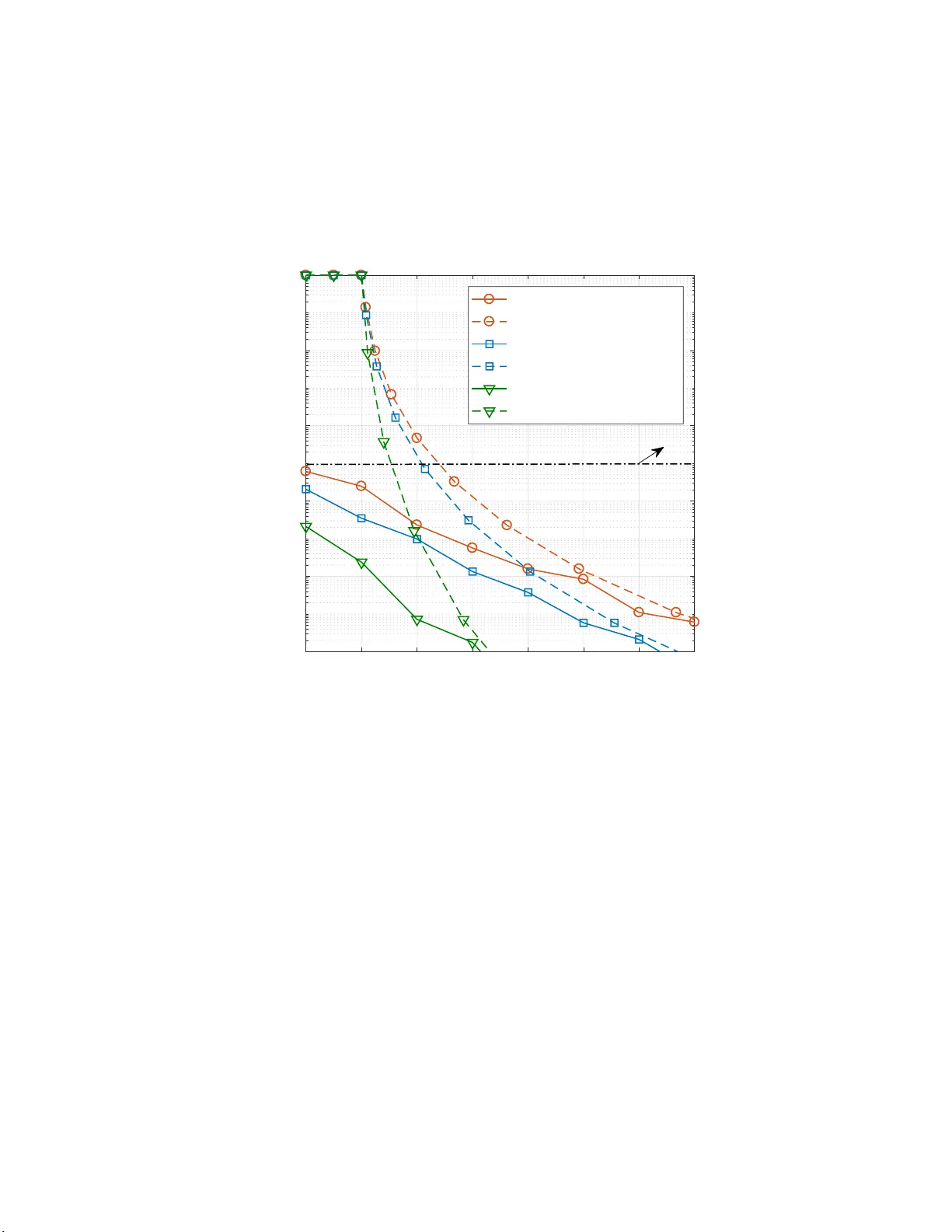
1 Prediction and Communication Co-design for Ultra-Re liable and Lo w-Latenc y Communications Zhanwei Hou, Changyang She, Y onghui Li, Zhuo Li, a nd Branka V ucetic Abstract Ultra-reliable and lo w-latency communication s (URLLC) are considered as one of three new a p- plication scen a rios in the fifth genera tio n cellular networks. In this work, we aim to reduce the user experienced delay thro ugh prediction and com munication co-design, wher e each mobile device predicts its future states and sends them to a d ata center in advance. Since prediction s are not error-free, we co nsider pred iction errors and packet losses in commu n ications when ev alu ating the reliability of th e system. Then, we for mulate an o p timization pr oblem that m aximizes the num b er o f URLLC services supported by the system by op timizing time and frequency resources and the prediction horizon. Simulation results verify the effecti veness of the pr oposed m ethod, and sho w that the tradeoff between user experienced delay and reliability can be improved significan tly via prediction and commun ic a tion co-design . Furthermore, we carried out an experime n t on the remote control in a virtual factory , and validated o ur conce p t on predictio n a n d commu nication co -design with the practical mobility data generated by a real tactile device. Index T erms Ultra-reliable and low-latency co mmunica tions, p rediction and comm unication co-d esign, delay - reliability tradeoff Part of the w ork has been presented in IEEE international communications con ference (ICC) 2019 [1]. Z. Hou, C. She, Y . Li an d B. V ucetic are with the School of Electrical and Information Engineering, Univ ersity of Sydne y , Sydney , NSW 2006, Australia (email: { zh anwei.hou, changyang.she, yonghui.li, branka.vucetic } @sydn ey .ed u.au). Z. Li is with Beijing Univ ersity of T echno logy , B eijing, China (email: zhuoli@bjut.edu .cn). Nov ember 27, 2024 DRAFT 2 I . I N T R O D U C T I O N S A. Back gr ounds and Mo tivations Ultra-reliable and l ow-latenc y communi cations (URLLC) are one of t he new appli cation scenarios in 5G communicatio ns [2]. By achie ving ult ra-hig h reliabili ty (e.g., 10 − 5 to 10 − 8 packet loss probabil i ty) and ultra-low end-to-end (E2E) delay (e.g, 1 m s ), URLLC l ays the foun d at i on for severa l mission-critical applications, such as industrial automation, T ac tile Internet, remot e driving, virtual reality (VR), and tele-surgery [3 – 5]. Ho w to achiev e two conflicting requirements on delay and reli abi lity remains an open problem. T o imp rove reliability , s everal technologi es have been proposed in the existing literature and specifications, s uch as K-repetition [6], frequency hopp i ng [7], large-scale antenna sy s tems [8], and multi-connectivity [9]. W ith these technologies, diff erent kinds of diversities are exploited to improve reliabil i ty at the cost of more radio resources. On the oth er hand, to reduce latency in the air interface , the sho rt fra me structure was proposed in 5G New Radio (NR) [10], and fast upli nk grant schemes were proposed to reduce access delay [11, 12]. Howe ver , there are som e o ther delay components in the networks, such as delays in buf fers of devices, com puting systems , backhauls, and core networks. As a result, the user experienced delay can hardly m eet the requirements of URLLC. Nov el concepts and technolog ies that can reduce the user experienced delay and i m prove overall reliability (i.e., total packet losses and errors in di f ferent parts of th e system) are in ur gent need. T o tackle these challenges, we aim to m eet the requirements o f URLLC by jointly opt i mizing prediction and communi cation. Th e basic idea is to p redict t he future system st ates at th e transmitter , such as l ocations and force feedback, and then send them t o the recei ver in advance. In this way , the user experienced delay can b e reduced significantly . For example, if the E2E delay i s 1 0 ms and the prediction h o rizon i s 9 ms , then the u s er experienced delay is 1 ms. Howe ver , predictions are not error -free, and long prediction horizon will lead to a large prediction error probability . Intuitively , there is a trade-off between the user experienced d el ay and the overa ll reliability . T o satisfy the two conflicting requirements of URLLC, we need to j ointly optimize the prediction and com m unication systems. Specifically , in this paper , we w i ll address the foll owing questions: 1) how to characterize the tradeoff betwee n user -experienced delay an d overall r eliabil ity with p r ediction a nd communication co-design? 2) Is it possible to satisfy the r equir ements of URLLC by pr edi ction and communication co-design? 3) If yes, h ow to maximize Nov ember 27, 2024 DRAFT 3 the number of URLLC services tha t can be supported by the system? The above questions are challenging to answer since multiple components of delay and er rors are inv olved in prediction and communicati o n systems. As such, we need a prediction and communication co-design framew ork which takes different delay component s and errors int o account. Moreover , the complicated constraints on the user experienced delay and t he ove rall reliability are non-con vex in general, and hence it is very difficult to find the optimal s o lution. B. Our Contr ibutions The main con t ributions of thi s paper are sum m arized as follows: • W e establish a framework for predi ct i on and communication co-design , where the t i me and frequency resource allocation in the communicati on system and the predicti on horizon in the prediction system are j o intly optimized to maximize the nu m ber of de vices that can be supported in th e system . • W e deriv e the closed-form expressions of t he decoding error probability , the queueing delay violation probability , prediction error prob ability , and analyzed their properties. From these results, the tradeof f between user e xperienced delay and ov erall reliability can be obtained. • W e propose an algorit hm to find a near op t imal solu t ion of the opt i mization probl em. The performance loss of the n ear optimal solutio n is stud i ed and furth er va lidated via numerical results. Besides, we analyze the comple xity of the al g orithm, which linearly increa ses with the num ber of devices. Furthermore, to ev aluate t he performance of t he proposed method, we comp ared it wit h a benchmark solutio n without prediction. Simulat i on resul t s show that the tradeoff can be improved remarkably with predicti on and com munication co-design. In addition, an experiment is carried out t o validate the accuracy of m o bility predict i on in practical remote-control scenarios. The rest of thi s paper is organized as follows: In Section II, we revie w the related li t erature. The s ystem model is presented in Section III. The co-design of prediction and commu n ication is proposed in Section IV . Numerical and experimental results are presented in Section V , and conclusions are drawn in Section VI. Nov ember 27, 2024 DRAFT 4 I I . R E L A T E D W O R K A. Communications i n URLLC There are some existing solu t ions to reduce latency in communi cati on systems for URLLC [10 – 14]. W ith the 5G New Radio (NR) [10], t he notion of “mini-slot ” i s introduced to s u pport transmissio n s with the delay as low as t h e d uration o f a fe w symbols. Th e queueing d elay is analyzed and optimized in [13], where the tradeof f among throughput , delay and reliabili ty w as studied. T o reduce the access delay in uplin k transmissi o n s, a semi -persistent scheduli ng (SPS) scheme was developed in [11 ]. A grant-free protocol was propos ed in [12] to furth er av oid t h e delay caused by scheduling requests and transm ission g rant s . W ith the p reemp t iv e scheduling scheme in [14], t he sho rt p ackets wit h h igh priority can preempt an ongoing long packet transmissio n without waiting for the next scheduling period. W ith this scheme, the schedu l ing delay of short packets is reduced. T o im prove the reli ability for the low latency comm unications, differ ent kinds of diversities were introduced [6 – 9]. In [6], K-repetition was proposed to a void re transmission feedback. The basic idea is t o send mult iple copi es of each packet with o ut waiting for the acknowledgment feedback. Considering t hat the r equired delay is sh orter than channel coherence time, frequenc y hopping was adopted in [7 ] to im prove reliabi lity . In [8], a L yapunov opti mization problem was formulated to im prove the reli ability wit h guaranteed latency , where spatial diversity was used to improve reliabilit y . In [9], interface diversity was propos ed to achiev e URLLC wi thout modifications in the baseband designs by providing m ultiple communi cation interfaces. Ho we ver , by introducing diversities, the reliabili ty is improved at th e cost of low resource utilization ef ficiency . This tradeoff bet ween delay and reliability has been exhaustive ly stu d ied in comm unication systems [15 – 18]. T o reduce t h e transmi s sion delay , the blocklength of channel codes is sh ort, and the decoding error probabili ty is nonzero for arbitrary signal-to-noi s e ratio (SNR). The fundamental tradeof f between transmi ssion delay and decodi ng error probabili ty in the sh o rt blocklength regime was derive d in [15]. The tradeoff between the queuein g delay and the delay bound v i olation probability was studied in [16]. T o achieve a lower delay bound , the violation probability increases. Moreo ver , grant-free schemes can help reduce latenc y , but i ntroduce e xtra packet losses due to t ransm ission collisions. How t o achie ve ultra-high reliability wit h grant-free schemes was studied in [18]and it is shown that the proposed stop-and-wait protocol can achieve Nov ember 27, 2024 DRAFT 5 10 − 5 outage probabi lity . B. Pr ediction s in URLLC T o achieve satisfactory delay and reliability i n URLLC, d iff erent kinds of predictions hav e been studied in th e existi n g literature [19 – 24]. In [19], the predicted control commands were sent to th e receiv er and waiting in t he buffe r . When a control command i s lost in com munications, predicted comm ands in the recei ver’ s buf fer will be executed. The length of p redictiv e control commands was optimized to min i mize the resource cons u mption. Th e i dea of m o del-mediated tele-operation approach was mentioned in [20]. By predicting t h e movement or the force feedback, the user experienced delay can be reduced. In bo t h [19] and [20], prediction errors were n o t considered, and whether we can achie ve ultra-high reliability i n the sy s tems rem ai n s unclear . Diffe rent from comm and or mobi l ity predicti ons in control system s , predicting some other features of t raf fic or performance o f com munications is als o helpful. In [21], based on t he predicted traffi c s tate, a bandwid th reserv at i on scheme was proposed to i m prove the spectral ef ficiency of URLLC. By exploiting the correlation among different no d es, the behavior of diffe rent users can be predicted [22]. Then, by reserving resources according to the predicted beha vior , the access delay can be reduced. A fast hybrid autom at i c repeat request (HARQ) protocol was proposed in [23], prediction is used to omit some HARQ feedback signals and successiv e message decodings, so that the expected delay can be improved by 27% to 60% compared wit h standard HARQ. In [24], the out com e of the decoding was p redicted before the end of the transm i ssion. W ith the predicted result, there is no need to wait for t h e acknowledgment feedback, and t hus th e E 2 E delay can be reduced. I I I . S Y S T E M M O D E L As shown in Fig . 1, we consider a joint prediction and com m unication system, where N mobile de vices s end packets to a receiv er , which cou ld be data center , controller , or tactile device. The function of the receiv er depends on specific applicati o ns. In remot e d riving [3], a hu man dri ver can remotely control a vehicle based on the feedback from various s ens ors installed on the vehicle. In factory automation [4], sensors update informat i on to the controller to perform better closed-loop con t rol, or to a data center for m onitoring or fault detection. In T actile Internet [5], force and torques are sent to a tactile device to render the sense of touch, Nov ember 27, 2024 DRAFT 6 Prediction System Queuing in Buffer 1 ( ) X k 1 1 ˆ ( ) p X k T Prediction 瀖 ( ) n X k ˆ ( ) p n n X k T Prediction 瀖 ( ) N X k 1 ˆ ( ) p N X k T Prediction 瀖 瀖 瀖 AP 1 1 ( ) c Y k D ( ) c n n Y k D ( ) c N N Y k D W irele ss T ransmission Backhaul and Core Network Receiver (Data Center/ Controller/T actile Device) q n D t d n n D D r n D c q t d r n n n n n D D D D D Mobile Devices Fig. 1. Illustrati on of netwo rk structure. and thus can enable haptic comm unications. The pack ets generated by each de vice may include diffe rent features, such as t he l ocation, velocity and acceleration of a device in remote driving or industrial aut o m ation, or the force and torques in T actile Internet. The receive r can be depl oyed at a mobile edge com p uting (MEC) server or a cloud center . In our frame work, we consider a general wireless communication syst em, where mobile de vices send packets to a cloud center via wireless l inks, backhauls, a nd core networks. The framew ork is also suitable for an MEC system , where the delays and packet losses in backhauls and core networks are set to be zero [25]. A. User Experienced Delay T i me is discretized int o slots. The duration of each slot is d enoted as T s . Let X n ( k ) = [ x 1 n ( k ) , x 2 n ( k ) , ..., x F n ( k )] T be the state of the n th device in the k t h slo t , where F i s the number of fe atures. The st ate of the n th de vice that is receiv ed by the recei ver in the k th slot is denot ed as Y n ( k ) . In traditio n al communicatio n systems, ea ch de vice sends its curr ent stat e X n ( k ) to the data center . Let D c n (slots) be the n th device’ s end-to-end (E2E) delay in the comm u nication system. If th e packet that con veys X n ( k ) is decoded successfull y in the ( k + D c n ) th slot, then Y n ( k + D c n ) = X n ( k ) , and the user experienced delay is D c n . For clarification, the key notations are listed in T able I . where B n is the bandwidt h, P t n represents the transmit power , N 0 denotes the nois e power spectral densi ty , γ n = a n g n P t n ϑN 0 B n represents the receive d SNR, a n denotes t he large-scale channel Nov ember 27, 2024 DRAFT 7 T ABLE I I N D E X O F K E Y N OTA T I O N S Notation Description N number of m obile d e vices F number of features in a st ate K n number of copi es transm i tted i n K -Repetition T s duration of each ti me slo t D c n end-to-end(E2E) delay i n comm unication sys t em D c n end-to-end(E2E) delay i n comm unication sys t em T p n prediction horizon of t h e n th device D e n delay experienced by the n th de vice D q n queueing d elay of the n th device D t n transmissio n delay of the n th device D d n decoding d elay of the n th device D r n delay in b ackhaul s and core networks o f th e n t h device D τ n transmissio n duratio n of each copy in K -Repetition of the n th device D max delay requirement ε p n prediction error probabi lity of the n th device ε q n queueing d elay bound violation prob abi lity of the n th device ε t n packet loss probabil i ty of the n th device ε τ n decoding error probabil ity of the n th device ¯ ε τ n expected decoding error probability of the n th device ε o n overa ll reliabilit y of the n th device ε max reliability requirem ent X n ( k ) state of th e n th device in the k t h slo t ˆ X n ( k ) predicted stat e of th e n th device in the k th sl ot Y n ( k ) recei ved state of the n th de vice in the k th s lot W n ( k ) transition no ise of the n th device in the k t h slo t E n ( k ) diffe rence between real state and predicted state of the n th de vice in th e k th slot Φ n state transi tion matrix o f the n th device E B n ef fecti ve bandwidth of th e n th device λ n a verage packet arriv al rate of the n th device B n bandwidth of th e n th device η fraction o f tim e and frequency resources for data transm ission P t n transmit power o f t h e n th device N 0 noise p ower spectral densit y γ n SNR of the n th d evice a n lar ge-scale channel g ain of the n th device g n small-scale chann el g ain of the n th device ϑ SNR loss due to i naccurate channel estimati on f − 1 Q ( · ) in verse function of the Q-function N r number of ant enn as at the AP Nov ember 27, 2024 DRAFT 8 gain, g n is the s mall-scale channel gain, ϑ > 1 is t h e SNR loss due to inaccurate channel estimation, V n = 1 − [1 + γ n ] − 2 [15], f − 1 Q ( · ) is the i n verse function of the Q-function, and ε τ n is the decoding error probabi lity . The blocklengt h of channel codes is η D τ n T s B n . Wh en the blocklength i s lar ge, (2) approaches th e Shannon capacity . T ransmitte r Buffer AP Receiver q n D t d n n D D r n D c n D ( ) n X k ˆ ( ) p n n X k T p n T e n D ˆ ( ) c n n Y k D Prediction Fig. 2. Illustrati on of prediction and commu nication co-d esign. As shown in Fig. 2, to improve the user experienced delay , each de vice predicts its future state. T p n is deno t ed as the prediction h o rizon. In the k th slot, the device generates a p acket b ased on the predicted s tate ˆ X n ( k + T p n ) . After D c n slots, the packet is receiv ed by the data center . Then, we have Y n ( k + D c n ) = ˆ X n ( k + T p n ) , which is equiv alent to Y n ( k ) = ˆ X n [ k − ( D c n − T p n )] , ∀ k . Therefore, the del ay experienced by the u ser is D e n = D c n − T p n . 1 Remark 1. It is worth notin g that the states of adjacent slots cou ld be correlated. Thus, so u rce coding schemes that comp ress the i n formation in m ultiple slots can ac hiev e hi gher compression ratio. On t he o t her hand , channel coding schemes that encode th e packets to be transm itted in multiple slot s int o one block, can achiev e higher reliability . Ho w ever , both of them will lead to a lo nger decoding delay . T o achiev e ult ra-low latency , in this paper we assume that the sou rce coding and channel codi n g in the k th slot s only depend on ˆ X n ( k + T p n ) and the data t o be transmitted i n this slo t . 1 If D c n is smaller than T p n , D e n is ne gative. This means that the receiv er can predict the stat es of de vices. In this pape r , we only consider the scenario that D e n ≥ 0 . Nov ember 27, 2024 DRAFT 9 B. Delay and Reli ability Requi r ements The delay and reliability requirements are characterized by a maximum delay bound and a maximum tolerable error probability , D max and ε max . It means that X n ( k ) should be recei ved by th e data center before t h e ( k + D max ) th s l ot wi t h probabi l ity 1 − ε max . T o satisfy t he delay requirement, the user experienced delay s hould not exceed a maximal delay bound, i.e., D e n = D c n − T p n ≤ D max . (1) In the considered communi cation system, the E2E comm unication delay D c n includes queueing delay D q n , transmissi on delay D t n , decoding delay D d n , and delay in bac khauls and core netw orks D r n . Thus, t he constraint in (1) can be re-expressed as follows, D q n + D t n + D d n + D r n − T p n ≤ D max , (2) where D d n = κD t n , κ > 0 . The overall reliabil ity depends on prediction errors and packet losses in communicatio ns. In the control system, if t he diffe rence between th e actual s tate of the device and the received state does not exceed a required threshold, the user cannot notice the difference. For example, in T actile Internet, the mini mum difference o f the force stimulus intensity that our hands can percept is referred to as j ust n oticeable dif ference (JND) [26]. W e define the dif ference between ˆ X n ( k ) and X n ( k ) as E n ( k ) = [ e 1 n ( k ) , e 2 n ( k ) , ..., e F n ( k )] T , where e j n ( k ) = ˆ x j n ( k + D e n ) − x j n ( k ) . The JND of this system is denoted as ∆ = [ δ 1 , δ 2 , ..., δ N ] T . Then, the prediction error probabilit y is given by ε p n = 1 − N Y j =1 Pr {| e j n ( k ) | ≤ δ j } , (3) Even if ˆ X n ( k ) is accurate enough, it wi l l be u seless if it is not receiv ed by th e data center before the ( k + D max ) th slot. Denot e the q ueueing delay bound violation probabil i ty and t he packet loss probability of the n th device as ε q n and ε t n , respectively . Then, th e overa ll reliabilit y of the device can be expressed as foll ows, ε o n = 1 − (1 − ε q n )(1 − ε t n )(1 − ε p n ) . (4) Nov ember 27, 2024 DRAFT 10 T o achie ve ultra-hig h reliability , all of ε q n , ε t n and ε p n should be small (i.e., less than 10 − 5 ). Thus, (4) can be accurately approximated by ε o n ≈ ε q n + ε t n + ε p n , and the reliabili ty requirement can be satisfied if ε q n + ε t n + ε p n ≤ ε max . (5) I V . T R A D E O FF S I N P R E D I C T I O N A N D C O M M U N I C A T I O N S Y S T E M S In this sectio n, we first cons ider a general linear prediction framework, and deriv e the relation between the predicti o n error probabilit y and the p redi ct i on horizon in a closed form. Then, we characterize the tradeoff between communicati o n reliability and E2E delay for short packet transmissio n s in a closed form. Based on the analysis, we further study how to maximize the number of URLLC services that can be suppo rt ed by the system. A. State T ransiti on Function W e assum e that the st ate of the n th de vice, X n ( k ) , changes according to the following state transition funct i on [27] X n ( k + 1) = Φ n X n ( k ) + W n ( k ) , (6) where Φ n = [ φ i,j n ] F × F , i, j = 1 , 2 , · · · , F , is the state transi t ion matrix and W n ( k ) = [ w i n ( k )] F × 1 , i = 1 , 2 , · · · , F , is the transiti o n noi se. W e assume that Φ n is constant, and thus it can be obt ai n ed from measurements or physical laws. The elements of W n ( k ) are independent random v ariables that fol l ow Gaussian dis tributions with zero mean and variances σ 2 1 , σ 2 2 , · · · , σ 2 F , respectiv ely . Remark 2. Th i s m odel is widely adopted in kinematics systems or control sys tems [27, 28]. Here we consider a general prediction method for a linear system . This is because for non-linear system, the relati on between t he prediction horizon and the prediction error probability can hardly be derived in a closed-form expression. T o im p lement our framew ork in n o n-linear syst em s, data- driv en prediction m ethods su ch as neural networks should be applied. These method s do not rely on sy s tem m odels, and will be considered in our future work. According to (6), the state in the ( k + T p n ) th s l ot i s given by X n ( k + T p n ) = (Φ n ) T p n X n ( k ) + T p n X i =1 (Φ n ) T p n − i W n ( k + i − 1) . (7) Nov ember 27, 2024 DRAFT 11 B. Pr ediction Horizon and Pr ediction Err or Pr ob ability Inspired by Kalman filter , we consider a general linear prediction meth od [27]. Based on the system state in the k th slot , we can predict the state in t he ( k + 1) th slot ac cording to follo w i ng expression, ˆ X n ( k + 1) = Φ n X n ( k ) . (8) From (8), we can further predict the state in the ( k + T p n ) th s l ot, ˆ X n ( k + T p n ) = (Φ n ) T p n X n ( k ) . (9) After T p n steps of prediction, the difference between X n ( k + T p n ) and ˆ X n ( k + T p n ) can be derived as follows, E n ( k + T p n ) , X n ( k + T p n ) − ˆ X n ( k + T p n ) = W n ( k + T p n − 1) + T p n − 1 X i =1 (Φ n ) T p n − i W n ( k + i − 1) . (10) The j th element of E n ( k + T p n ) is given by e j n ( k + T p n ) = w j n ( k + T p n − 1) + T p n − 1 X i =1 F X m =1 φ n,j,m,T p n − i w m n ( k + i − 1) , (11) where φ n,j,m,T p n − i is the elem ent of (Φ n ) T p n − i at the j th row and the m th column. Since the state transition noises follow independent Gaussian distrib utions, and e j n ( k + T p n ) is a linear combinati on of th em , e j n ( k + T p n ) follows a Gaussian d i stribution with zero m ean. Th e var iance o f e j n ( k + T p n ) is denoted as ρ 2 n,j ( T p n ) , which i s giv en by ρ 2 n,j ( T p n ) = σ 2 j + T p n − 1 X i =1 F X m =1 ( φ n,j,m,T p n − i ) 2 σ 2 m . (12) Therefore, Pr {| e j n ( k + T p n ) | ≤ δ j } can be d eri ved as foll ows, Pr {| e j n ( k + T p n ) | ≤ δ j } =1 − Pr {| e j n ( k + T p n ) | > δ j } =1 − ψ T p n ,j ( − δ j ) =1 − ψ − δ j ρ n,j ( T p n ) , (13) where ψ T p n ,j ( · ) i s the cumulativ e distribution function (CDF) of e j n ( k + T p n ) , and ψ ( · ) is the CDF of standard Gauss ian dis t ribution with zero mean and unit variance. Nov ember 27, 2024 DRAFT 12 By s ubstituti ng (13) i n to (3), ε p n can b e expressed as follows, ε p n = 1 − F Y j =1 1 − ψ − δ j ρ n,j ( T p n ) . (14) From the expression in (14), we can obtai n the following property of ε p n . Lemma 1. ε p n strictly incre ases with t he pr ediction horiz on T p n . Pr oof. Please see Ap p endix A. Lemma 1 indicates that a long er prediction horizon leads t o a lar ger prediction error probability . This is in accordance with the intuiti on. For example, predicting the mobility of a de vi ce in the next 100 ms will be much h arder than predictin g the mobil i ty in the next 10 ms. C. Queuein g Delay Boun d V iolation Pr obability T o deriv e th e q u eueing delay bound violation probability , ε q n , we can use the concept of ef fecti ve bandwidth [17]. Effecti ve bandwid t h is defined as the m inimal constant service rate of the queueing syst em that is required to ensure the maxim um queueing delay bound and the delay bound violation p robability [29]. 2 The number o f p ackets generated i n each s lot d epend s on t he mobilit y of the device and the random e vents detected by t he device. Accordin g to the observation in [31], packet arriv al processes in T actile Internet are very bursty . T o capture the b urstiness of the p acket arriv al process, a switched Poisson process (SPP) can be applied [21] 3 . A SPP incl u des two traf fic states. In each state, th e packet arriv al process follows a Poisson process. The av erage packet arri va l rates are di f ferent in the two states, and the SPP switches between the two states according to a Markov chain. W ith the traffic state classification methods in [21 ], the AP knows the a verage packet arriv al rate in th e current state, λ n (packets/slot). According to [17], the ef fective bandwidth of th e Poiss on process i s given by E B n = ln (1 /ε q n ) D q n ln h ln (1 /ε q n ) λ n D q n + 1 i packets/slot , (15) 2 T o analyz e the upper bound of the delay bound violation prob ability , a widely used tool is network calculus [30]. Howe ver , with netwo rk calculus, one can hardly obtain a closed-form e xpression of the delay bound violation probab ility . Since we are interested in the asymptotic scenarios that ε q n is very small, ef fective bandwidth can be used [29]. 3 In standardizations of 3GPP , In standardizations of 3GP P , queu eing models are not specified si nce the y depend on specific applications. Nov ember 27, 2024 DRAFT 13 which is the minimal constant service rate required to ensure D q n and ε q n . Since the transmission delay of each packet is fixed as D t n , t o guarantee the q u eueing delay vi olation probabil ity , t h e following constraint should be satis fied, 1 D t n = E B n . (16) Then, th e qu euein g delay vio lation probabil i ty can be deriv ed as ε q n = e D q n φ ( λ n ,E B n ) , (17) where φ ( λ n , E B n ) = E B n W − 1 − λ n E B n e − λ n E B n + λ n , (18) where W − 1 ( · ) is the “ − 1 ” branch of the Lam b ert W -function, whi ch is defined as the in verse function of f ( x ) = xe x . The deriv ations of (17) and (18) are give n in Appendix B. W ith the expressions in (17) and (18), we can obt ai n the following property of ε q n . Lemma 2. ε q n strictly decr eases wit h the queuein g delay D q n when λ n and E B n ar e given. Pr oof. Please see Ap p endix C. Lemma 2 indi cates t h at with the same packet arri val process and service process, the queueing system with a s maller qu euein g delay boun d requirement has a larger qu euei n g delay vio lation probability . The intuition is that for a gi ven CDF of the steady st ate qu eueing delay , the queueing delay violation probability decreases with the queueing delay bound. D. P ack et Loss Pr obability i n T ransmission s W ith predict i ons, the communi cation delay can be longer than the required delay bound D max (e.g., 1 m s). As such, retransmissio n s or repetitions becomes possi b le. T o av oid feedback delay caused by retransmission s , we apply K -Repetitions to reduce the packet l oss p ro b abi lity in the communication system, i.e., the d e vice sends K copies of each coding block no matter whether the first fe w copies are successfully decoded or not [6]. The trans m ission duration of each copy is denoted as D τ n . Then, we ha ve D τ n = D t n /K n . Some ti me and frequency resources are reserved for channel estimatio n at t h e AP . T h e fraction of ti me and frequency resources for data transmission is denoted as η < 1 . T o avoid overhead and extra delay caused b y channel estimation at the device, we ass ume the d e vice does not h a ve channel state inform ation (CSI). The im pacts of Nov ember 27, 2024 DRAFT 14 CSI and traini ng pi lots on t he a chiev able rate have been studied in t h e s hort blocklength regime [32 – 35]. If more resource blocks are occupied by pilot s, the accuracy of the estimated CSI can be improved. Howe ver , the remaini ng resource b l ocks for data transmis sion reduces. How to allocate radio resources for pilo t s and data transmissions is a compli cated problem and deserves further study . By assuming CSI is not av ailable at the transm itters, our approach can serve as a benchmark for future research. For t h e transm ission of each copy , we assume that the transm ission durati o n is sm aller than the channel coherence time and th e b andwidth is sm aller than th e coherence bandwi d th. Th i s assumption is reasonable for short packet transmissions in URLLC. Then, th e achieva ble rate in the sho rt blockleng th regime over a quasi-static SIMO channel can be accurately approxim ated by th e foll owing normal approxim ation [15] 4 , b n ≈ η D τ n T s B n ln 2 " ln (1 + γ n ) − s V n η D τ n T s B n f − 1 Q ( ε τ n ) # (bits / blo c k) , (19) where B n is the bandwidth, γ n represents the recei ved SNR, V n = 1 − [1 + γ n ] − 2 [15], f − 1 Q ( · ) i s the in verse function o f the Q-function, and ε τ n is t h e d ecoding error probability . The blocklength of channel codes is η D τ n T s B n . When the bl o cklength is large, (19) approaches t h e Shannon capacity 5 . According to (19), the expected decoding error probability of each transmiss i on over the SIMO channel is g iven by [15] ¯ ε τ n = Z ∞ 0 f Q ( r η D τ n T s B n V n ln 1 + a n g n P t n ϑN 0 B n − b n ln 2 η D τ n T s B n ) · f g ( x ) dx, (20) where γ n = a n g n P t n ϑN 0 B n is applied, a n denotes the large-sca le channel gain, g n is the small -scale channel gain, P t n represents the t ransmit power , ϑ > 1 is the SNR loss due t o inaccurate channel estimation, N 0 denotes t h e n o ise power spectral density , and f g ( x ) is the distri bution of the instantaneous channel g ain. For Rayleigh fading channel, we hav e f g ( x ) = 1 ( N r − 1)! x N r − 1 e − x , 4 The bounds of the decoding error probability can be obtained by using sad dlepoint method [36], which is very accurate but has no closed-form expression. Since t he gap between the normal approximation and practical coding schemes is around 0 . 1 dB [37], it is accurate enough for our framew ork. 5 The resu lts in [38] indicate that if Shannon cap acity is use d in t he analyses, the delay bo und and delay bound vio lation probability will be underestimated. Thus, the requirements of URLLC cannot be satisfied. Nov ember 27, 2024 DRAFT 15 where N r is the numb er of antennas at t he AP . From the approximatio n i n [39] 6 , ¯ ε τ n can be accurately approx imated b y ¯ ε τ n = ω n a n P t n p η D τ n T s B n ϑN 0 B n " ( g U n − g L n ) − N r X i =0 ( N r − i ) A i n # , (21) where ω n = 1 2 π √ 2 2 r c n − 1 , r c n = b n ηD τ n T s B n is the number bits in each coding block, g U n = ϑN 0 B n ξ n a n P t n , g L n = ϑN 0 B n ζ n a n P t n , A i n = ( g L n ) i i ! e − g L n − ( g U n ) i i ! e − g U n , ξ n = θ n + 1 2 ω n √ ηD τ n T s B n , ζ n = θ n − 1 2 ω n √ ηD τ n T s B n , and θ n = 2 r c n − 1 . After K repetitio ns, the packet loss p robability in the comm unication system is give n by ε t n = ( ¯ ε τ n ) K n . (22) From (22), we can obtain the following property of ε t n . Lemma 3. When D τ n is gi ven, ε t n strictly decr eases with the r epetit ion time K n . Pr oof. Wh en D τ n is given, ¯ ε τ n is fixed. According to (22), ε t n decreases wit h K n since ¯ ε τ n < 1 . Lemma 3 i ndicates that there is a tradeoff between the transm i ssion delay and the reliability in communications. K -Repetition can be used to improve the transmission reliabili t y at the cost of increasing th e t ransmission delay . V . P R E D I C T I O N A N D C O M M U N I C A T I O N C O - D E S I G N In the above tradeoff analy ses, we ob t ained closed-form relation s between each delay com - ponent (or prediction horizon) and it s corresponding p acket loss factor in terms of prediction, queueing and wireless transmissio n, respecti vely . Based on t he above analyses, the tradeoff between the overall reliabi lity and prediction horizon is rev ealed. As s uch, we cou l d formulate the optimizati o n problem in the following subsectio n. A. Pr oblem F ormula tion T o maximize the number of devices that can be su p ported by the system, we optimize the delay components, prediction horizon, and bandwidth allocation of wireless networks. The opt i mization problem can be form u lated as foll ows, 6 As v alidated in [39], the approximation in (21) i s accurate, especially when the numb er of antennas is large or the packet loss probability is small. Nov ember 27, 2024 DRAFT 16 max D q n ,D t n ,T p n ,B n , n =1 ,..., N , N (23) s.t. N X n =1 B n ≤ B max , (23a) D q n + D t n + D d n + D r n − T p n ≤ D max , (23b) ε q n + ε t n + ε p n ≤ ε max , (23c) ε q n = ex p ( D q n " W − 1 ( − λ n D t n e − λ n D t n ) D t n + λ n #) , (23d) ε t n = ( ω n a n P t n p η D τ n T s B n ϑN 0 B n " ( g U n − g L n ) − N r X i =0 ( N r − i ) A i n #) K n , K n D τ n = D t n (23e) ε p n = 1 − F Y j =1 1 − ψ − δ j s σ 2 j + T p n − 1 P i =1 F P m =1 ( φ n,j,m,T p n − i ) 2 σ 2 m , (23f) n = 1 , 2 , 3 , · · · , N , (23g) where (23a) is the constraint on total bandwidt h , (23b) is the constrain t on user experienced delay , (23c) i s the cons traint on reli abi lity . (23d) is obtained by substit uting (18) and (16) in t o (17), (23e) is obt ained from (21) and (22), and (23f) is obtained by substit uting (12) in to (14). Problem (23) is not a deterministic optimization p roblem si nce th e numb ers of optimization var iables and constraints depend on the num b er of u sers, which is not giv en. In addit i on, some optimizatio n variables are integers and the constraints in (23 c), (23d), and (23e) are non -conv ex. Thus, i t is very challenging to sol ve this problem. B. Algorithm for So lving Pr oblem (23) T o solve the probl em (23), we first find t h e mini mal bandwidth B n required for each us er to ensure its delay and reliabilit y requirement s , i.e., ( D max , ε max ) . By minim i zing the bandwidth allocated to each user , the to t al number of us ers t h at can be sup ported with a given amount of Nov ember 27, 2024 DRAFT 17 total bandwidth can be maximized. W ithout the constraint on total bandwidth, the probl em (23) can b e decom p osed in t o mu l tiple sing l e-user problems: min D q n ,D t n ,T p n B n (24) s.t. (23b) , (23c) , (23d) , (23e) and (23f) . (25) T o solve the above problem, we need the m i nimal bandwidth t hat is required to ens u re a certain overa ll reliabilit y . W e denote it as B min n ( ε o n ) . Howe ver , deriving the expression of B min n ( ε o n ) is very difficult. T o overcome this difficulty , we first mi n i mize ε o n for a give n B n . Then, we find the minimal required bandwid th th at can satisfy ε o n ≤ ε max via bin ary search. When B n is gi ven, the m inimal ov erall error probability can be obtained by optimizing T p n in solving t h e fol lowing problem, ε o , min n ( B n ) = min D q n ,D t n ,T p n ε q n + ε t n + ε p n (26) s.t. (23b) , (23d) , (23e) and (23f) , For mathematical tractability, we s et ε q n = ε t n . According to [17], thi s s implification leads to negligible performance loss. W e will first prov e ε q n and ε t n decreases with T p n in the Proposition 1 when ε q n = ε t n . Pr oposition 1. ε q n and ε t n decr ease with T p n when ε q n = ε t n . Pr oof. Please see Ap p endix D. Proposition 1 reve als the relation between the reliability of the queueing system (or the reliability of the wireless link) and the prediction hori zon. W ith t his relation, the number of independent optimizatio n variables can be reduced. It can be recalled that ε p n increases with T p n . Thus , together wi t h Proposition 1, the o p timal solution is obt ained when th e equali ty in (27) hold s , which is D q n + D t n + D r n − T p n = D max . (27) Moreover , for a gi ven v alu e of T p n , the values of D q n and D t n that satisfies ε q n = ε t n and (27) can be obtained via binary search. Therefore, we only need to optimize T p n in problem (26). The Nov ember 27, 2024 DRAFT 18 optimal solu t ion and the minim al overa ll reliabili ty in thi s simp l ified scenario are denoted as T p ∗ n and ε o , min ∗ n ( B n ) , respectiv ely . Unfortunately , the simplified p roblem i s still non-con vex. As such, we will propose an approx- imated soluti on as follows. According to Lemma 1, ε p n increases with T p n , and we hav e proved ε q n and ε t n decreases wit h T p n in Proposi tion 1. A near optim al soluti o n can be obtain ed when ε q n + ε t n = ε p n . Since the optimization variables are not integers, ε q n + ε t n = ε p n may not h old strictly . T o address t his issue, w e can use bi nary search to find ˜ T p n that satisfies ε p n ≤ 2 ε t n when T p n ≤ ˜ T p n , and ε p n > 2 ε t n when T p n > ˜ T p n . The corresponding reliabili t y is d enoted as ˆ ε o , min n ( B n ) . The overa ll reliabilit y achieved by this near optimal solut ion is denoted as ˆ ε o , min n ( B n ) . The performance gap between the near optimal solut i on and op timal one is analyzed in the following Proposition 2. Pr oposition 2. The gap b etween ˆ ε o , min n ( B n ) and ε o , min ∗ n ( B n ) is l ess than ε o , min ∗ n ( B n ) , wher e ε o , min ∗ n ( B n ) is t he r eliability achieved by the optimal solution . Pr oof. Please see Ap p endix E. Proposition 2 shows that the gap between the near opti mal over all reliability and the optimal one is b ounded by the value of the o p timal o verall reliability . Since the optimal overall reli ability is i n the order of 10 − 5 , the gap is very sm al l . The required minimal bandwidth to guara ntee the ove rall reliability ca n be obtained from the following optimization problem , min B n B n (28) s.t. ˆ ε o , min n ( B n ) ≤ ε max . (28a) Since the packet loss i n the com munication system decreases with bandwidth, the optimal solution of probl em (28) i s achieved when the equality in (28a) holds. Thus, t h e minim al bandwidth can be obtained via binary search. The algorithm to solve problem (24) is summarized in T able II. C. Di scussions on Imp lementation Complexity and Opt imality The origin al opti m ization problem is decomp o sed int o N singl e-user problems. T o solve each single-user probl em, we search t he requi red bandw i dth and opti m al prediction horizon in Nov ember 27, 2024 DRAFT 19 the regions [0 , B ] and [0 , T p ] , respecti vely , where B and T p are the upper bounds of band- width and prediction hori zon . Therefore, the complexity of the proposed algorithm i s aroun d O N lo g 2 ( ¯ B ) log 2 ( ¯ T p ) . The performance loss of t he near optim al solu t ion relati ve to the gl obal optimal solution results from si m plification ε q n = ε t n and the di f ferences between ˆ ε o , min n ( B n ) and ε o , min ∗ n ( B n ) . According to t h e analysis in [17] and Propositio n 2, t he performance loss is minor . W e will further validate the performance l oss wi th nu merical results . T ABLE II A L G O R I T H M T O S O LV E (24) Input: User-experienced delay requir ement D max , reliability req uiremen t ε max , user nu m ber N , average packet arriv a l rate λ n , each p acket d uration D τ , slot d uration T s , bandwidth of each subcarrier B 0 , upper b ound of bandwidth B , upper bound of predictio n horizon T p , transmit power P t , user loca tion d n transition noise σ j , initial noise σ j , thresho ld δ j , j = 1 , 2 , · · · , F . Output: Th e minimal bandwid th B ∗ n to ensure URLLC fo r the n th user . 1: B L = B 0 , B R = B . 2: B b = 1 2 ( B L + B R ) . 3: Binar y sear c h T p n in a ran g e of (0 , T p ] and obtain ˆ ε o, min n ( B b ) . 4: while ˆ ε o, min n ( B b ) − ε max < ε max do 5: if ˆ ε o, min n ( B b ) > ε max then 6: B L = B b . 7: e lse 8: B R = B b . 9: e nd if 10: B b = 1 2 ( B L + B R ) . 11: Binar y search T p n in a range of (0 , T p ] and obtain ˆ ε o, min n ( B b ) . 12: end while 13: return B ∗ n = B b . V I . P E R F O R M A N C E E V A L U A T I O N In this section, we ev aluate the ef fecti veness of the proposed co-design method via sim ulations and experiments. A. Simulation s In the si mulations, we consi der a one-dim ensional movement as an example to ev aluate the propo s ed co-design method. W ith thi s example, we show how the propos ed method helps improving the tradeoffs among latency , reliability and resource uti l izations (i.e., bandwidth and antenna). For comparison, the performance achiev ed by t he traditional transmission scheme with Nov ember 27, 2024 DRAFT 20 no predictio n is provided. The sim ulation parameters are l isted i n T able III. In all simulat i ons, SNRs are com puted according to γ n = a n g n P t n ϑN 0 B n . The path loss model is 10 log 10 ( a n ) = 35 . 3 + 37 . 6 lo g 10 ( d n ) + S n , where d n is th e di stance from the n th device to t he AP and S n is the shadowing. The shadowing S n follows log normal dist ribution with a zero mean and a standard deviation of 8 . T o ensure the reliabilit y and latency requirements, we consider the worst case of shadowing S w = − 34 . 1 dB (i.e., Pr { S n ≤ S w } = 1 0 − 5 ), which is defined as t he probabili t y that t h e d elay and reliabili t y of a device can be satisfied [39]. For the one-dim ensional movement, the state t ransition functi on in (6) can be sim p lified as follows [27], r ( k + 1 ) v ( k + 1) a ( k + 1) = 1 T s T 2 s 2 0 1 T s 0 0 1 r ( k ) v ( k ) a ( k ) + 0 0 w ( k ) . where r ( k ) , v ( k ) , and a ( k ) represent the location, velocity and acceleration i n the k th slot, respectiv ely , w ( k ) is t he Gaussian n oise on acceleration, and Φ is given by Φ = 1 T s T 2 s 2 0 1 T s 0 0 1 , (29) which foll ows Ne wton ’ s laws of m otion. In predicti ons, the standard deviation of the transit ion noise of acceleration is σ w = 0 . 01 m/ s 2 , and t he required th resho ld is δ l = 0 . 1 m . The standard deriv atives of the initial errors of location, velocity and accelera tion are set to be 0 . 01 m, 0 . 2 m / s, and 0 . 1 m/s 2 , respectively . In practice, the values of initial errors depend on t he accuracy of observation and resid u al filter errors [27]. 1) Singl e-user scenarios: In sing le-user scenarios, th e distance between t he user and the A P is set to be 200 m . T o ev aluate the p roposed co-design method, the prediction horizon T p n is optimized to obtain th e mini mal overall error p robability . Under the give n del ay requirement (i.e., D max = 0 m s), the p acket loss prob ability i n communication s ε c n , the prediction error p rob ability ε p n , and the overall error probability ε o n are shown in Fig. 3 . T o achieve target reliabil ity , the bandwidth B is set as B = 4 40 KHz and the number of antennas at the AP is set to be N r = 32 . It sho uld be noted that the reli ability depends on the amount of bandwidth and the number of ant ennas, but t h e trend of the overall reliability do es n ot change. Nov ember 27, 2024 DRAFT 21 T ABLE III S I M U L AT I O N P A R A M E T E R S [ 2 ] Parameters V alues Maximal transmit power of a us er P t 23 dBm Single-sided noise sp ectral dens ity N 0 − 174 dBm/Hz Information load per block b 160 bits A verage packet arriv al rate λ 100 packets/second Slot duration T s 0 . 1 ms T ransm ission du ration D τ 0 . 5 ms Delay of core network and backhaul D r 10 ms 0 50 150 200 100 3 rediction KRUL]RQ T p T s (ms) 10 -15 10 -10 10 -5 10 0 Error probability error probability in communications error probability in predictions overall error probability 20 25 30 35 10 -6 10 -5 10 -4 Fig. 3. Joint optimization of predictions and communications: the packet loss probability ε c in communications, the prediction error probability ε p , and the ov er error probab ility ε o are drawn as functions of prediction ho rizon T p T s . In Fig. 3, the communication delay and p rediction horizon are set to be equal, i.e., D q n + D t n = T p n . In this case, user experienced delay is zero. The results in Fig. 3 show that when the E2E communication delay D q n + D t n = T p n < 10 ms, i.e., less than the delays in the core network and the backhaul D r n , it is impossible to achiev e zero l at ency without prediction. When D q n + D t n = T p n > 1 0 ms , t h e required transm ission duration K D τ n increases with prediction horizon T p n . As a result, the overall error p rob ability , ε o n , i s first domi n ated by ε c n and then by Nov ember 27, 2024 DRAFT 22 ε p n . As such, ε o n first decr eases and then increa ses wit h T p n . The results i n Fig. 3 indi cate that the reliability achiev ed by the proposed method is 6 . 52 × 10 − 6 with T p n = 26 . 8 ms, D t ∗ n = 12 . 5 ms, D q ∗ n = 14 . 3 m s and K ∗ n = 5 . The optimal solution obt ai n ed by exhausti ve search i s 6 . 15 × 10 − 6 . The gap between above two sol utions is 3 . 7 × 10 − 7 , which i s very small. 0 10 20 30 40 50 60 70 Experienced delay(ms) 10 -10 10 -8 10 -6 10 -4 10 -2 10 0 Reliability N r =32,B=440KHz,co-design N r =32,B=440KHz,no prediction N r =32,B=550KHz,co-design N r =32,B=550KHz,no prediction N r =40,B=440KHz,co-design N r =40,B=440KHz,no prediction 10 -5 Fig. 4. Comparison of reliability-delay tradeof f curv es between co-design and no predictions with different band width B an d numbers of recei ved antennas N r . In Fig. 4, the proposed co-desi gn method i s compared w i th a b aseli ne meth o d without predic- tion. When there is no predicti on, the us er experienced delay equals to communication delay . The results in Fig. 4 show that when the requi rement on u s er experienced delay i s less than 10 ms, it cannot be satisfied wi thout prediction. When the required user experienced delay is larger than 10 ms, the reliabili ty achiev ed by t he co-design method is much better than the basel i ne method. In other words, by prediction and comm unication co-design, the tradeoff between user experienced delay and overall reliability can be i mproved remarkably . Particularly , in the case N r = 32 and B = 440 KHz, to ensure the same reliability 10 − 5 , the user experienced delay can be reduced by 23 ms and zero-latency can be achieved by the propo sed co-design method . 2) Multi ple-user s cenarios: In multiple-user scenarios, we will consid er two scenarios: the Nov ember 27, 2024 DRAFT 23 distribution of l ar ge-scale fading of the m obile devices is av ailable/unav aibale. In the first scenario, the distances from de v i ces to the AP are uniformly distri buted i n the region [50 , 200] m. In the second scenario, the worst case is considered in the opt imization, i.e., the distances from all th e devices to th e AP are 200 m. 0 5 10 15 20 Supported number of devices N 10 -7 10 -6 10 -5 10 -4 10 -3 10 -2 10 -1 10 0 N r =32,B max =1MHz N r =32,B max =2MHz N r =32,B max =3MHz N r =64,B max =1MHz N r =96,B max =1MHz N r =128,B max =1MHz Fig. 5. Pr { P N n =1 B n > B max } v .s. the number of de vices when the distribution of large -scale fading of de vices is kno wn. Since t h e l ar ge-scale fading o f devices are random variables in the first scenario, the sum of the required bandwidth is also a random variable. In Fig. 5, we illustrated the probabi lity that the sum of the required bandwidth is smaller than B max . For URLLC services, we need to guarantee the delay and reliability requirements with high probabil ity , e.g., 99 . 99 9 %. The resul t s in Fig. 5 s h ow that when B max = 1 MHz and N r = 32 , the system can only support 2 de vices. By doubling th e num ber of antennas (or the total bandwid th), 10 (or 7 ) devices can be s upported. This implies that increasing the number of antennas at the AP is an efficient way to increase the number of devices th at ca n be sup ported by the system. This is beca use SNR i ncreases with the number of antenn as due to array gain. T o achie ve the same reliability , i.e., packet loss probabilit y , higher order modulation s chemes can be used if more antennas are deployed at the AP . Since the Nov ember 27, 2024 DRAFT 24 spectrum efficienc y increases with the order of the modulation scheme, more URLLC devices can b e su pported wi th a given amount of bandwi dth. 0 5 10 15 20 Supported number of devices N 0 1 2 3 4 5 6 7 8 9 Total bandwidth B max (MHz) N r =32 N r =64 N r =96 N r =128 Fig. 6. Required total bandwidth v .s. numb er of de vices when the distri bution of large-scale fading of de vices is unkno wn. If th e distribution of large-scale fading of devices i s unknown, the worst case is considered. Then, the total bandwidth t hat is required to support a giv en number of devices is deterministi c. The results in Fig. 6 show that the required total b andwidth lin early increases with t h e n u mber of devices. Thi s is because the required bandwidt h for different devices are t he same since the worst case is considered for all the de vices. In addition , b y increasing the number of antennas from 32 to 64 , we can save 75 % of bandwidth. This imp lies that i ncreasing the number of antennas is an efficient way to improve spectrum effic iency of URLLC. B. Experiments T o validate wheth er mobil i ty prediction works for URLLC in practice, we record the real movement data from the experiment shown in Fig . 7. In this experiment, a typical applicati o n of T ac tile Int ernet is implemented in a virtual en vi ron ment, where a box of haz ardous chemicals Nov ember 27, 2024 DRAFT 25 Slave device (Virtual envir onment) Master de vice (3D s yst em T ouch) Fig. 7. Experiment to obtain real mo vement data in T actile Internet. or radioactive substances is dragged t o move on t he floor by a virtual slave device. A tactile hardware device named 3D System T ouch (pre viously named Phantom Omni , or Geomagic) is used as a master d evice, which sends real tim e location information to the virtual slav e device. A cable is used t o connect t he master de vice t o the virtual sla ve device in a virtual en vironment. The slave de vice in the virtual en vi ronment recei ves the locations from the m aster device, so i t can m ove synchronously with the master device. Human operators are in vited t o drag th e v irtual box from one corner to another corner o f the floor in the virtual en vironm ent . In this experiment, we mainly interested in the mo t ion prediction, so t he location information on the x-axi s produced by the tactil e hardware device is recorded and used to verify the predictions. A genera l linear p rediction method in (9) is u sed to predict the future state system . Since only locati on inform ation i s av ailable from the hardware, the velocity and acceleration are obtained from th e first and the second o rder differences of locations [40]. Moreover , due to the l imitation of the hardware, the duration of each slot is T s = 1 ms. The predictio n error p rob abilities, ε p n , with differe nt th resho lds, δ , are shown in T able IV, where the prediction horizon , nT s , i s fixed. The results in T able IV show that for t he con s tant prediction horizon nT s = 5 ms or nT s = 20 ms, ε p n decreases wit h the required th resho ld δ . The relation between t he prediction error prob abi lity and the predict i on horizon is s h own in T able V , where the required threshold is fixed. The results indicate that ε p n increases wi th nT s . This observation consists wi th Lem m a 1. Nov ember 27, 2024 DRAFT 26 T ABLE IV P R E D I C T I O N E R R O R P RO BA B I L I T Y W I T H FI X E D nT s δ (m) ε p n ( nT s = 5 ms ) ε p n ( nT s = 20 ms ) 0 . 002 2 . 95 × 10 − 4 0.45 0 . 01 1 . 62 × 10 − 5 0.42 0 . 02 6 . 61 × 10 − 6 3 . 2 × 10 − 3 0 . 1 2 . 40 × 10 − 6 2 . 40 × 10 − 5 0 . 2 1 . 80 × 10 − 6 7 . 82 × 10 − 6 T ABLE V P R E D I C T I O N E R R O R P RO BA B I L I T Y W I T H G I V E N δ nT s (ms) ε p n ( δ = 0 . 002 m ) nT s (ms) ε p n ( δ = 0 . 2 m ) 1 3 . 00 × 10 − 6 10 1 . 80 × 10 − 6 2 1 . 62 × 10 − 5 20 7 . 82 × 10 − 6 3 3 . 49 × 10 − 5 30 2 . 71 × 10 − 5 4 5 . 77 × 10 − 5 40 4 . 45 × 10 − 5 5 2 . 95 × 10 − 4 50 1 . 69 × 10 − 4 The results in T ables IV and V imply that prediction and communicatio n co-design has the potential t o achiev e zero-latency in practice. It sh o uld be noted t h at the results from the experiment are generally worse than t h ose of th e simul ations. Th i s is because we only have the locati o n inform at i on of the device, and extra esti mation errors are in troduced during the estimations of the velocity and acceleration. V I I . C O N C L U S I O N S In this paper , we studied how to achie ve URLLC by prediction and communication co-design. W e first der iv ed the decoding error probability , the queueing delay violation probability , and the prediction error probabili t y in clos ed-form expressions. Then, we establ ished an optimizatio n frame work for maximizin g the number of de vices that can be supported in a system by optimizing time and frequency resou rces in the com munication system and the predicti on horizon in th e prediction system. Simu lation resul ts show that by prediction and com munication co-design the tradeoff between delay and reliabil ity can be i mproved remarkably, or we can improve the spectrum effi ciency subject to t h e d elay and reliability constraints. In addition, an experiment was carried out to validate the accurac y of prediction i n a remo te-control s y stem. The resul ts Nov ember 27, 2024 DRAFT 27 showed th at the prop osed concept on predict i on and comm u n ication co-design works well in the practical remote-control system. A P P E N D I X A P R O O F O F L E M M A 1 Pr oof. T o prove this lemm a, we n eed to prove that for any T p, 1 n < T p, 2 n , ε p n ( T p, 1 n ) < ε p n ( T p, 2 n ) holds. From (12), we have σ 2 j ( T p n + 1) − σ 2 j ( T p n ) = F X m =1 φ n,j,m,n σ 2 m > 0 . As such, we can conclude t h at σ j ( T p n ) , j = 1 , 2 , · · · , N , in creases with T p n . Moreover , from (14), we can see that ε p n increases with σ j ( T p n ) , j = 1 , 2 , · · · , N . Therefore, ε p n increases with t he prediction horizon T p n . This compl etes the proof. A P P E N D I X B D E R I V A T I O N S O F (17) A N D (18 ) The equation (15) can be re-expressed as ln(1 /ε q n ) + λ n D q n λ n D q n = ex p ln(1 /ε q n ) + λ n D q n D q n E B n − λ n E B n , (30) and − λ n E B n exp − λ n E B n = ln(1 /ε q n ) + λ n D q n − D q n E B n exp ln(1 /ε q n ) + λ n D q n − D q n E B n . (31) According to the definition of Lambert function, (31) can be written as ln(1 /ε q n ) + λ n D q n − D q n E B n = W − λ n E B n exp − λ n E B n . (32) It shou l d b e no ted that when − λ n E B n exp − λ n E B n < 0 , the Lambert function h as two branches according to t h e range of ln(1 /ε q n )+ λ n D q n D q n E B n . Specifically , we have ln(1 /ε q n ) + λ n D q n − D q n E B n = W 0 − λ n E B n exp − λ n E B n , − 1 < ln(1 /ε q n ) + λ n D q n − D q n E B n < 0 W − 1 − λ n E B n exp − λ n E B n , ln(1 /ε q n ) + λ n D q n − D q n E B n ≥ 0 (33) Nov ember 27, 2024 DRAFT 28 In th e first case in (33), W 0 h − λ n E B n exp − λ n E B n i = − λ n E B n = ln(1 /ε q n )+ λ n D q n − D q n E B n . W e can obtain that ε q n = 1 , which does not satis fy the reliability requirement. Thus, the first case in (33) can be removed. As such, we hav e ln(1 /ε q n ) + λ n D q n − D q n E B n = W − 1 − λ n E B n exp − λ n E B n , (34) and ε q n = exp D q n E B n W − 1 − λ n E B n exp − λ n E B n + D q n λ n . (35) A P P E N D I X C P R O O F O F L E M M A 2 Pr oof. A ccordin g to (17), we have ln ( ε q n ) = D q n φ ( λ n , E B n ) . (36) Since ε q n is in t he order of 10 − 5 to 10 − 8 and D q n > 0 , ln ( ε q n ) < 0 , and thus φ ( λ n , E B n ) < 0 . As such, ε q n decreases wit h D q n in (17) when φ ( λ n , E B n ) is given. The proof follows. A P P E N D I X D P R O O F O F P RO P O S I T I O N 1 Pr oof. A ccordin g to (27), we hav e D q n + D t n = D max + T p n − D r n . T o pro ve this proposition, we need to prove that ε q n or ε t n decreases with D q n + D t n . Next, we will prove D q n increases with D t n , and th us D q n + D t n increases with D t n . According to (17) and (18), we have D q n = ln ( ε q n ) φ ( λ n , E B n ) , where φ ( λ n , E B n ) = W − 1 − λ n D t n e − λ n D t n D t n + λ n . T o check the monotonicity of D q n in terms of ε q n and D t n , we ha ve the following partial d eri vati ves, ∂ D q n ∂ ε q n = 1 ε q n φ ( λ n , E B n ) < 0 , (37) and ∂ D q n ∂ D t n = ln ( ε q n ) W − 1 ( − λ n D t n e − λ n D t n ) [ W − 1 ( − λ n D t n e − λ n D t n ) + 1] [ W − 1 ( − λ n D t n e − λ n D t n ) + λ n D t n ] > 0 . (38) Nov ember 27, 2024 DRAFT 29 As such, we p rove D q n increases with D t n when ε q n is given. According to Lemma 3, ε t n strictly decreases w i th the transmiss ion delay D t n . Since ε q n = ε t n , ε q n also strictl y decreases with t he transmissio n delay D t n . According to (37), D q n increases with a sm al l er ε q n . So D q n increases with D t n when ε q n is determ i ned by D t n . In su m mary , ε q n or ε t n decreases w i th D t n and D q n + D t n , and thus decreases with T p n . Th i s completes the proof. A P P E N D I X E P R O O F O F P RO P O S I T I O N 2 Pr oof. In th is appendix, we use the notati on ε o n ( T p n , B n ) , (or ε t n ( T p n , B n ) o r ε p n ( T p n , B n ) ) to represent the relationship between the predicti on horizon and the overall reli abi lity (or the decoding error probability or the prediction error probability ). For not ational simplicit y , we first omit B n . T o prove this proposit ion, we first introdu ce an upper b ound o f ε o n ( T p n ) = 2 ε t n ( T p n + D max ) + ε p n ( T p n ) , i.e., ε ub o , n ( T p n ) = 2 max { 2 ε t n ( T p n + D max ) , ε p n ( T p n ) } . Suppose ˜ T p n is t h e m aximal predictio n horizon that satisfies 2 ε t n ( T p n + D max ) − ε p n ( T p n ) > 0 for all 0 ≤ T p n ≤ ˜ T p n , and hence ε o , ub n ( T p n ) = 4 ε t n ( T p n + D max ) , which strictly decreases wi t h T p n . On the oth er h and , when T p n > ˜ T p n , 2 ε t n ( T p n + D max ) − ε p n ( T p n ) < 0 , and hence ε o , ub n ( T p n ) = 2 ε p n ( T p n ) , which strictly i ncreases with T p n . In other words, ε o , ub n ( T p n ) strictly decreases w i th T p n when T p n ≤ ˜ T p n and strictly increases with T p n when T p n > ˜ T p n . Therefore, the upper bound ε o , ub n ( T p n ) is minimized at ˆ T p n = ˜ T p n or ˆ T p n = ˜ T p n + 1 . Let 2 ε t n ( ˆ T p n + D max ) − ε p n ( ˆ T p n ) = ∆ , wh ere ∆ is th e small gap between 2 ε t n and ε p n at ˆ T p n , which is e very closed to zero. W e hav e ε o n ( ˆ T p n ) ≈ ε o , ub n ( ˆ T p n ) , (39) Besides, ε o , ub n ( ˆ T p n ) is t he minimum of ε o , ub n ( T p n ) , ∀ n ∈ [0 , ∞ ) , and hence ε o , ub n ( ˆ T p n ) ≤ ε o , ub n ( T p ∗ n ) , (40) where T p ∗ n is the optimal prediction h orizon that mi nimizes ε o n ( T p n ) . According to the definition Nov ember 27, 2024 DRAFT 30 of ε o , ub n ( T p n ) , we hav e ε o , ub n ( T p ∗ n ) = 2 max { 2 ε t n ( T p ∗ n + D max ) , ε p n ( T p ∗ n ) } < 2 2 ε t n ( T p ∗ n + D max ) + ε p n ( T p ∗ n ) = 2 ε o n ( T p ∗ n ) . (41) From (39), (40) and (41), we have ε o n ( ˆ T p n ) < 2 ε o n ( T p ∗ n ) , i.e., ε o n ( ˆ T p n ) − ε o n ( T p ∗ n ) < ε o n ( T p ∗ n ) . Since ε o n ( ˆ T p n ) and ε o n ( T p ∗ n ) are defined as ˆ ε o , min n ( ˆ T p n , B n ) and ε min ∗ o , n ( T p ∗ n , B n ) , respective ly . So we h a ve ˆ ε o , min n ( ˆ T p n , B n ) − ε o , min ∗ n ( T p ∗ n , B n ) < ε o , min ∗ n ( T p ∗ n , B n ) . The proof foll ows. R E F E R E N C E S [1] Z . Hou, C. She, Y . Li, and B. V ucetic, “Ultra-reliable and lo w-latency communications: prediction and com munication co-design, ” in Pr oc. IEE E ICC , 2019. [2] 3GP P T S G RAN TR38 .913 R14, “Study o n scenarios and requ irements for next ge neration access techno logies, ” Jun. 2017. [3] L . Kang, W . Zhao, B. Qi, and S. Banerjee, “ Augmenting self-dri ving with remote control: Challenges and directions, ” in Pr oc. A CM Mobile Computing Systems & Applications , 20 18, pp. 19–24 . [4] G. Z hao, M. A. Imran, Z. Pang, Z . Chen, and L. L i, “T oward real-time control in future wireless networks: comm unication- control co-design, ” IE EE Commun. Ma g. , vo l. 57, no . 2, pp. 138–144 , 2019. [5] G. P . F ettweis, “The Tactile Internet: application s & challenges, ” IEEE V eh. T ec hnol. Mag. , vol. 9, no. 1, pp. 64–70, Mar . 2014. [6] 3GP P TR 38.802 V2.0.0, “Study on ne w radio (NR) access techn ology; physical layer aspects (release 14), ” 2017. [7] C . She, C. Y ang , an d T . Q. S. Que k, “Rad io res ource man agement f or ultr a-reliable and lo w-latency communications, ” IEEE Commun. Ma g. , vol. 55, no. 6, pp. 72–78, 2017 . [8] T . K. V u, C.-F . Liu, M. Bennis et al. , “Ult ra-reliable and low lat ency commu nication in mmwav e-enabled massiv e MIMO networks, ” IEEE Commun. Letters , vol. 21, no. 9, pp. 2041–20 44, Sep. 2017. [9] J. J. Nielsen, R. Liu, and P . Popovski, “Ultra-reliable low latency commu nication using interfac e di versity , ” IEEE Tr ans. on Commun. , v ol. 66, no. 3, pp. 1322–133 4, Mar . 2018. [10] X. Lin, J. L i , R. Baldemair et al. , “5G New Radio: un veiling the essentials of the next generation wireless access technology , ” 2018. [Online]. A v ailable: https://arxiv .org/abs/1806.0689 8 [11] P . Schulz, M. Matthe, H. Klessig et al. , “Latency critical IoT applications in 5G: Perspectiv e on the design of radio interface and network arch itecture, ” IE EE Commun. Mag. , vol. 55, no. 2, pp. 70 –78, 2017. [12] T . Jacobsen , R. Ab reu, G. Berardinelli et al. , “System le vel analysis of up link grant-free transmission for URLL C, ” in Pr oc. IEEE Globecom W orksh ops , 201 7, pp. 1–6. [13] B. Soret, P . Mogensen, K. I . Pedersen, an d M. C. Aguayo-T orres, “Fundamental tradeo ffs amo ng reliability , latency and throughpu t in cellular netw orks, ” in P r oc. IEEE Globecom W ork shops , 20 14, pp. 1391– 1396. [14] J. Sachs, G. Wikstrom, T . Dudda et al. , “5G radio netw ork design for ultra-reliable low-latenc y communication , ” IEEE Network , vol. 32, no. 2, pp. 24 –31, 20 18. Nov ember 27, 2024 DRAFT 31 [15] W . Y ang, G. Durisi, T . K och, and Y . Polyanskiy , “Quasi-static multiple-antenna f ading channels at finite block length, ” IEEE T rans. Inf. Theory , vol. 60, no . 7, pp. 4232–42 65, Jul. 2014. [16] M. Bennis, M. Debbah, and H. V . Poor , “Ultra-reliable and low-latency wireless communication: T ail, risk and scale, ” arXiv pr eprint arXiv:180 1.01270 , 2018. [17] C. She, C. Y ang, and T . Q. S. Quek , “Cross-laye r op timization for ultra-reliable and low-latenc y radio access networks, ” IEEE W ireless Commun. , vol. 17, no. 1, pp. 127– 141, 20 18. [18] G. Berardinelli, N. H. Mahmood, R. Abreu, T . Jacobsen, K. Pedersen, I. Z. Ko v ´ acs, and P . Mog ensen, “Reliability analys is of uplink grant-free transmission over shared resources, ” IEEE Access , vol. 6, pp. 23 602–23 611, 20 18. [19] X. T on g, G. Zhao, M. A. Imran et al. , “Min imizing wi reless resource co nsumption for pack etized predictive control i n real-time cyber physical systems, ” in Proc . IEEE ICC W orkshops , May 2018. [20] M. S imsek, A. Aij az, M. Dohler , J. S achs, and G. Fettweis, “5G-enab led tactile internet, ” IEEE J . Sel. Are as Commun. , vol. 34, no. 3, pp. 460–473, M ar . 2016. [21] Z. Hou, C. She, Y . Li et al. , “Burstiness aware bandwidth reserv ation for ultra-reliable an d lo w-latency communications (URLLC) in Tactile Internet, ” IEEE J. Sel. Ar eas C ommun. , vol. 36, no . 11, pp. 2401–2410 , 2018. [22] M. Li, X. Guan, C. Hua, C. Chen, and L. L yu, “Predicti ve pre-allocation for low-latency uplink access in industrial wireless networks, ” in P r oc. IE EE INFOCOM , 2018, pp. 306–314. [23] B. Makki, T . Sv ensson, G. Caire, and M. Zorzi, “Fast HARQ over finite block length codes: A techniqu e for low-latenc y reliable communication, ” I EEE W ireless Commun. , vol. 18, no. 1, pp. 194 –209, 2018. [24] N. Strodtho ff, B . G ¨ oktepe, T . Schierl et al. , “Enhan ced machine learning techniq ues for early HARQ feedback prediction in 5G, ” arXiv pr eprint arXiv:1807 .10495 , 2018 . [25] C. She, Y . Duan, G. Zhao, T . Q. S. Quek , Y . Li, and B. V ucetic, “Cross-layer design for mission-critical IoT in mobile edge computing systems, ” IEEE Internet of Things J., early access , 2019 . [26] S . Feyzab adi, S. Straube, M. Folgheraiter et al. , “Human force discrimination during acti ve arm motion for force feedback design, ” IEEE T ran s. Haptics , v ol. 6, no. 3, pp. 309–319, 2013. [27] S . M. Kay , Fundamentals of statistical signal pr ocessing, volume I: estimation theory . Prentice Hall, 1993 . [28] G. Klan ˇ car and I. ˇ Skrjanc, “T racking-error mode l-based predictiv e control for mobile robo ts in real time, ” Robotics and autonomou s systems , vol. 55, no. 6, pp. 460 –469, 2007. [29] C. - S. Chang and J. A. Thomas, “Ef fectiv e bandwidth in high-sp eed digital networks, ” IEEE J. Sel. Ar eas Commun. , vol. 13, no. 6, pp. 1091–110 0, 1995. [30] H. Al-Zubaidy , J. Liebeherr , and A. B urchard, “Network-layer performance analysis of multihop fading channels, ” IEEE/ACM T rans. Netw . , vol. 24, no. 1, pp. 204–217, Feb . 2016. [31] M. Condoluci, T . Mahmoodi, E. Steinbach, and M. Dohler , “S oft resource r eserv ati on for lo w-delayed teleoperation o ver mobile networks, ” IEE E Access , vol. 5, pp. 10 445– 10 455, May 20 17. [32] S . Schiessl, H. Al-Zubaidy , M. S kog lund, and J. Gross, “Delay performance of wireless commu nications with imperfect CSI and finite-length coding, ” IEEE Tr ans. Commun. , vol. 66, no. 12, pp. 6527–6541, 201 8. [33] J. ¨ Ostman, G. Durisi, E. G. Str ¨ om, M. C. Cos ¸ kun, and G. Liv a, “Short packets o ver block-memoryless fading ch annels: Pilot-assisted or no ncoherent transmission? ” IE EE T rans. Commun. , v ol. 67, no. 2, pp. 15 21–153 6, 2018. [34] M. Mousaei and B. Smida, “Optimizing pilot ov erhead for ultra-reliable short-packet transmission, ” in Pr oc. IEEE ICC , 2017, pp. 1–5 . [35] B. Hassibi and B. M. Hochwald, “Ho w much training is needed in multiple-antenn a wireless links?” I EEE T rans. Inf. Theory , vol. 49, no . 4, pp. 951–963 , 2003. Nov ember 27, 2024 DRAFT 32 [36] A. Lancho, J. Ostman, G. Durisi et al. , “S addlepoint approximations for Rayleigh block-f ading channels, ” 2019. [Online]. A v ailable: https://arxi v .org/ab s/1904.104 42 [37] M. Shirvanimo ghaddam, M. S. Mohammadi, R. Abbas et al. , “Short block-length codes for ultra-reliable low latency communications, ” IEEE Commun . Ma g. , vol. 57, no. 2, pp. 130–1 37, 201 8. [38] S . Schiessl, J. Gross, and H. Al-Zubaidy , “Delay analysis for wireless fading chan nels with finite block length channel coding, ” in Pr oc. ACM MSW iM , 20 15, pp. 13–22 . [39] C. She, Z . Chen , C. Y an g et al. , “Improv ing network av ailability of ultra-reliable and lo w-latency communication s with multi-connecti vity , ” IEEE T ran s. Commun. , vo l. 66, no . 11 , pp. 5482 –5496, No v . 2018. [40] J. Mathe ws and K. F ink, Numerical methods using MATLAB . Pearson Pr entice Hall, NJ, 2004. Nov ember 27, 2024 DRAFT
Original Paper
Loading high-quality paper...
Comments & Academic Discussion
Loading comments...
Leave a Comment