Simultaneous state estimation and control for nonlinear systems subject to bounded disturbances
In this work, we address the output--feedback control problem for nonlinear systems under bounded disturbances using a moving horizon approach. The controller is posed as an optimization-based problem that simultaneously estimates the state trajector…
Authors: Nestor N. Deniz, Guido Sanchez, Marina H. Murillo
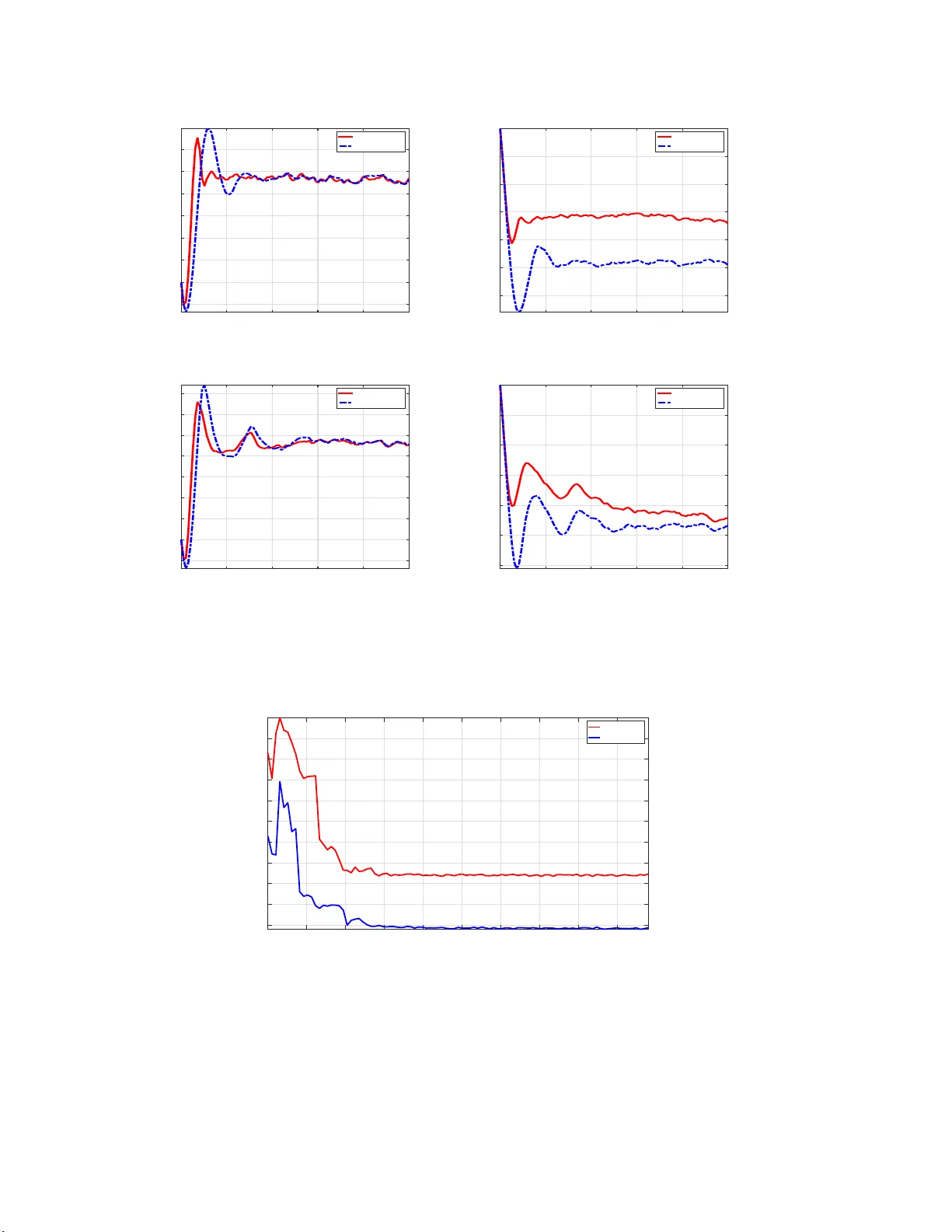
Sim ultaneous state estimation and con trol for nonline ar systems sub ject to b ounded disturb anc es ⋆ Nestor Deniz a , Guido Sanc hez a , Marina Murillo a , Leonardo Giov anini a a Instituto de Investigacion en Senales, Sistemas e Inteligencia Computacional , sinc(i), UNL, CONICE T, Ciudad Universitaria UNL, 4to piso FICH, (S3000) Santa F e, Ar gentina Abstract In this w ork, we address the output–feedbac k con trol p roblem for nonlinear sys- tems under b ounded disturbances using a mo ving horizon approac h. Th e con troller is p osed as an optimization-based p roblem that simultaneo u sly estimates th e state tra jectory and computes fu ture con trol inputs. It minimizes a criterion that inv olv es finite f orw ard and backw ard h orizon with resp ect the unknown initial state, mea- surement noises and control in p ut v ariables an d it is maximiz ed with resp ect the unknown future d istu rbances. Although simultaneous state estimation and con trol approac hes are already a v ailable in the literature, the no v elt y of this w ork relies on linking the lengths of the forward and bac kward windows with the closed-loop stabilit y , assuming detectabilit y and deco din g sufficien t conditions to assure system stabilizabilit y . Simulati on examples are carried out to compare the p erformance of sim ultaneous and ind ep endent estimatio n and con trol app roac hes as wel l as to sh o w the effects of simulta neously solving the cont rol and estimation problems. Key wor ds: Receding h orizon con trol and estimation, Outp ut feedbac k, Rob u st stabilit y, Nonlinear systems. ⋆ The material in this pap er was not presented at any conference. Email addr esses: ndeniz@sinc .unl.edu .ar (Nestor Deniz), gsanchez @sinc.un l.edu.ar (Guido San chez), mmurill o@sinc.un l.edu.ar (Marina Mur illo), lg iovanini @sinc.un l.edu.ar (Leonardo Gio v anini). Preprint su bmitted to Elsevier 27 No vem b er 2024 1 In tro duction One of the most p opular control tec hnique in b oth academia a nd industry is mo del predictiv e con trol ( MPC ) due to its a bilit y to explicitly accommo date hard state a nd input constrain ts (Bempor a d & Morari 19 99, Camac ho & Alba 2004, R awlings & Ma yne 2009, Ma yne 2014, among others). Thereon, m uch effort has b een de voted to dev eloping a stability t heory for MPC (see i.e. Ra wlings & Ma yne 20 09, Gr ¨ une & Pannek 2011, Ma yne 2 016). An ov erview of recen t dev elopmen ts can b e found in Ma yne (20 14). MPC in v olv es the solution of an open–lo op optimal con trol problem at each sampling t ime with the curren t state as the initial condition. Eac h of these optimizations prov ides the sequence s o f future control actions and states. The first elemen t of the control action sequence is applied to the system and, then the optimization problem is solv ed again at the next sampling time after up dating the initial condition with the s ystem state. MPC k eeps cons ta nt the computatio na l burde n by optimizing the system b ehav iour within a finite length windo w. The system b eha viour b ey ond the windo w is summarized in a term known as c ost–to–go . MPC is often form ulated assuming that the sys tem state can be measured. Ho w ev er, in many practical cases, the only info rmation av aila ble is noisy mea- suremen ts of syste m output, so the use of indep endent algo r ithms for state estimation (including observ ers, filters and estimators) b ecomes necessary (see Ra wlings & Bakshi 2 0 06). O f all these metho ds, mo ving ho rizon es timatio n ( MHE ) is esp ecially engaging for use with MPC b ecause it can b e form ulated as a similar online optimization problem. Solving the MHE pr o blem pro duces an es timated state that is c ompatible with a set of past measuremen ts that recedes as current time a dv ances (Sc h w epp e 197 3, Ra o et al. 2001, 2003). This estimate is optimal in the sense that it maximizes a criterion that captures the lik eliho o d of the measuremen ts. Along the same time that relev an t results on MPC w ere dev elop ed, researc h works on MHE b egun. The w orks of Rao et al. (2001) a nd (2003) pro vide o v erviews of linear and no nlinear MH E . Recen t results regarding MH E for nonlinear sy stems are giv en for robust stabilit y and estimate con ve rgence prop erties (see Alessandri et al. 2005, 2008, 201 2, Garcia-Tirado et al. 2016, S´ anc hez et al. 2017, among ot hers). In recen t ye ars sev eral results ha ve b een obtained for different MHE form ulatio ns, adv ancing from idealistic assumptions, like observ abilit y and v anishing disturbances, to realistic situations like detectabilit y and b ounded disturbances (se e Ji et al. 2015, M ¨ uller 2 0 17, Allan & Ra wlings 20 19, Deniz et a l. 2 019). When disturbances, mo del uncertain ty and system constraints can b e ne- glected, state and control sequences can b e indep enden tly computed (see Duncan & V araiya 1971, Bensoussan 2004, ˚ Astr¨ om 2 0 12, Georgiou & Lindquist 2013). How ev er, in practical a pplicatio ns, these conditions are very difficult to fulfil, i.e., pr o cess disturbances and measuremen t noise are usually presen t, as 2 w ell as mo del unce rta in t y . In this con text, it b ecomes necessary approaches that include this information into the con troller design. State-feedbac k MPC is a mature field with results that considers mo del uncertain t y , input distur- bances, and noises (Magni et al. 2 0 03, Bemp orad et al. 2003, Raimondo et a l. 2009, a mong others). Ho w ev er, these w orks did not consider robustness with resp ect to errors in state estimation. F ewe r results a re a v ailable for output- feedbac k MPC . An o v erview of nonlinear output-feedbac k MPC is give n by Findeisen et al. ( 2 003) and the references therein. Many o f these appro a c hes in v olve designing s eparate estimator and con troller, using differen t es tima- tion algorithm (Ro set et al. 2006, Magni et al. 2009, P atw ardhan et al. 2012, Zhang & Liu 2013, Ellis et a l. 201 7). Results on robust output- feedbac k MPC for constrained, linear, discrete-time systems with b ounded disturbances a nd measuremen t noise can b e f o und in Ma yne et al. (2006, 20 0 9) and V o elk er et al. (2010, 2013). These appro a c hes first solv e the estimation problem and prov e the con v ergence of the estimated s ta t e to a bo unded set, and then take the uncertain t y of the estimation in to account when solving the MPC problem. The approac h of solving simultaneous ly MHE–MPC w as originally in tro duced b y Copp & Hespanha (2014) and lat er dev elop ed in sev eral pap ers (Copp & Hespanha 2016 a , b , 2017). In the first pap er, Copp & Hespanha (2014) prop osed an out- put feedbac k con troller that com bines state estimation and control into a single min − max optimization pr o blem that , under observ a bilit y and con trollability assumptions (Copp & Hespanha 2016 a ), guaran tees the b oundedness of state and tracking errors. Finally , in t he last w ork rep o rted b y Copp & Hespanha (2017), the autho r s established the conditions f o r guaran teeing the b ounded- ness o f error for tra jectory tra c king problems. They also in tro duced a primal– dual interior po in t metho d tha t can b e used to efficien tly solve the min − max optimization pro blem. The criterion used in these works in v olv es finite forw ard and bac kw ard horizons that are minimiz ed with resp ect to feedbac k con trol p olicies a nd maximized with respect to the unknown parameters in order t o guaran ty robustness in the worst-case scenario. In the presen t w ork, w e in tro duce an output–feedbac k con troller for nonlin- ear systems sub ject to b ounded disturbances using sim ultaneous MHE–MPC approac h. Th e resulting optimization problem minimizes a criterion that in- v olv es finite fo rw ard a nd bac kw ard horizons with resp ect the unkno wn initial state, measuremen t noise and con trol input v ariables while it is maximiz ed with respect the unkno wn future disturbance v a r iables. W e sho w that t he prop osed con troller results in closed–lo o p tra jectories a lo ng which the states remain b ounded. These results rely o n tw o assum ptions: The first assump- tion requires that the optimization criterion inclu de an adaptiv e arriv al cos t (S´ anc hez et a l. 2017). This assumption allows to ensure the bo undedness of the state estimate and to obtain a b ound for the estimation error se t if the parameters o f the estimation problem are prop erly c hosen (Deniz et al. 2019). The second assumption requires that the back ward (estimation) and fo rw ard 3 (con trol) horizons a r e sufficien tly large so that enough information is obtained in order to find state estimates and con trol inputs compatible with dynamics, noises and constraints. This assumption is satisfied if the system is detectable, stabilizable and the parameters in the cost function (w eigh ts and horizons) are c hosen appropriately . The rest of the pap er is organized as follows: Section 2 introduces the notation, definitions and pro p erties tha t will be used through t he pap er. In Section 3 w e form ulate the estimation and con tro l problem, a nd in Section 4 w e ana lyze its closed-lo op stabilit y . Section 5 discusses t wo examp les to illustrate the concepts presen ted in this w ork. The first example uses a simp le nonlinear mo del to analyse the conseque nces of sim ultaneously solving the es timatio n and control problems. The second example compares the p erformance obta ined b y the simultaneous and indep enden t a pproac hes applied to the regulatio n of the state of a v an der P ol oscillator for tw o op erational conditions. Finally , conclusion and f ut ure work is discussed in Section 6. 2 Preliminaries an d setup 2.1 Notation Let Z denotes the in teger n um b ers, Z [ a,b ] denotes the set of in tegers in the in terv al [ a, b ], with b > a and Z ≥ a denotes the set of in tegers gr eat er or equal to a . Boldface sym b ols denote sequences of finite ( w : = { w 1 , . . . , w 2 } ) or infinite ( w : = { w 1 , . . . , w 2 , . . . } ) length. W e denote ˆ x j | k as the state at time j estimated at time k . By | x | we denote the euclidean norm of a v ector x ∈ R n x . Let k x k : = sup k ∈ Z ≥ 0 | x k | denote the supreme norm of the sequence x and k x k [ a,b ] : = sup k ∈ Z [ a,b ] | x k | . A function γ : R ≥ 0 → R ≥ 0 is of class K if γ is con tin uous, strictly increasing and γ (0) = 0 . If γ is also unbounded, it is of class K ∞ . A function ζ : R ≥ 0 → R ≥ 0 is of class L if ζ is contin uous, non increasing and lim t →∞ ζ ( t ) = 0. A function β : R ≥ 0 × Z ≥ 0 → R ≥ 0 is of class K L if β ( · , k ) is of class K for e ach fixed k ∈ Z ≥ 0 , and β ( r , · ) of class L for each fixed r ∈ R ≥ 0 . Let us consider now tw o sets A and B , the Mink ows ki addition is defined as A ⊕ B : = { a + b | a ∈ A, b ∈ B } . On the ot her hand, the Mink o wski difference 1 is defined as A ⊖ B : = { d | d + b ∈ A } . In the following sections, w e w ill use the notation Ψ p,t,l to reference the cost incurred solv ing the problem p at time t with a horizon length l , while Ψ p,t,l ( x ) will b e used to indicate the cost at the solution x , with x b elonging to a consisten t domain with t he cost function Ψ p,t,l . When necessary , we will use the notation x (1) i,k and x (2) i,k to differen tiate i –th comp onen t of the state v ector of t w o discre te-time 1 Also kn o wn as the Po ntry agin difference. 4 tra jectories of the system, with i ∈ Z [1 ,n ] . Moreo v er, x (1) k ( x (1) 0 , w (1) ) will denote a tra jectory with initial condition x (1) 0 and p erturb ed by the sequence w (1) . A similar notat io n is used for the case of con tin uous time systems , where t is used instead k to denote con tin uous time. 2.2 Pr oblem statement Let us consider a discrete-time nonlinear system whose b ehaviour is giv en x k +1 = f ( x k , u k ) + w k ∀ k ∈ Z ≥ 0 , y k = h ( x k ) + v k , (1) where x ∈ X ⊆ R n x is t he system state, u ∈ U ⊆ R n u is t he system’s input and w ∈ W ⊆ R n w is the unmeasured pro cess disturbance p osed as a n additiv e input. The output of the system is y ∈ Y ⊆ R n y and v ∈ V ⊆ R n v is the measuremen t noise. The function f ( · , · ) is assumed to b e at least lo cally Lipsc hitz in its argumen ts, and the function h ( · ) is know n to b e a con tinuous function. The sets X , U , W , V and Y are assumed to b e conv ex, containing the origin in its in terior. The estimation and con trol problem attempts to sim ultaneously find the optimal state ˆ x k | k and the optimal sequence of control inputs ˆ u whic h will steer the system to the desired op eration zone. It is in an infinite-horizon optimization problem giv en by min ˆ x 0 | k , ˆ w , ˆ u Ψ EC,k, ∞ : = k X j =0 ℓ e ˆ w j | k , ˆ v j | k + ∞ X j = k ℓ c ˆ x j | k , ˆ u j | k − ℓ w c ˆ w j | k s.t. ˆ x j +1 | k = f ˆ x j | k , ˆ u j | k + ˆ w j | k , y j = h ˆ x j | k + ˆ v j | k , ˆ x j | k ∈ X , ˆ u j | k ∈ U , ˆ w j | k ∈ W , ˆ v j | k ∈ V . (2) F unctions ℓ e ( ˆ w j | k , ˆ v j | k ) p enalize large v alues of ˆ w j | k and ˆ v j | k , whereas ℓ c ( ˆ x j | k , ˆ u j | k ) p enalize large v alues of the predicted state ˆ x j | k and con trol inputs ˆ u j | k . T he function ℓ w c ( ˆ w j | k ) is assumed to tak e non–negative v alues and since it is sub- tracting in the ob jectiv e function, pro cess disturbances will tend t o be max- imized within the con trol window . When nece ssary , w e will decompose the function ℓ e ( · , · ) in to ℓ w e ( · ) and ℓ v e ( · ) whic h p enalizes ˆ w j | k and ˆ v j | k , resp ectiv ely . Problem (2) is v aluable from a theoretical p o in t of view since it guara ntees the b oundedness of the estimates ˆ x j | k and con trol actions ˆ u j | k pro vided the 5 cost function is b ounded, i.e., Ψ EC,k, ∞ ≤ γ , ∀ k ∈ Z ≥ 0 , with γ ∈ R ≥ 0 . If f unc- tions ℓ e ( · , · ), ℓ c ( · , · ) and ℓ w c ( · ) are defined using a norm– ℓ p , problem ( 2) would guaran tee that the state x k and u k are ℓ p , provide d that no ises w k and v k are also ℓ p . This w ould mean that the closed-lo op system ha s a finite ℓ p –induced gain. The infinite–horizon problem (2) lacks practical in terest since it is in tracta ble from a computatio na l p oin t o f view. Then, it is refo r m ulated in to a receding finite–horizon pr o blem min ˆ x k − N e | k , ˆ w , ˆ u Ψ EC,k, N e + N c : = Γ k − N e ( χ ) + k X j = k − N e ℓ e ˆ w j | k , ˆ v j | k + k + N c − 1 X j = k ℓ c ˆ x j | k , ˆ u j | k − ℓ w c ˆ w j | k + Υ k + N c (Ξ) s.t. χ = ˆ x k − N e | k − ¯ x k − N e , Ξ = ˆ x k + N c | k , ˆ x j +1 | k = f ˆ x j | k , ˆ u j | k + ˆ w j | k , y j = h ˆ x j | k + ˆ v j | k , ˆ x j | k ∈ X , Ξ ∈ X f ⊆ X , ˆ u j | k ∈ U , ˆ w j | k ∈ W , ˆ v j | k ∈ V . (3) F or computation tractability , the infinite summations of Ψ EC,k, ∞ ha v e b een re- placed b y bac kw ard a nd forw ard windows of finite length, correspo nding to the estimation Ψ E,k, N e and con trol Ψ C,k, N c problems of criterion Ψ EC,k, N e + N c , resp ec- tiv ely . Ψ E,k, N e includes N e terms bac kw ard in time from sample k corresp onding to the estimator stage-c ost , ℓ e ˆ w j | k , ˆ v j | k , and the extra term Γ k − N e ( χ ), known as arrival-c ost , t hat summarizes information left behind the estimation win- do w b y p enalizing the uncertaint y in the initial state ˆ x k − N e | k (Rao et al. 2001, 2003). On the other hand, Ψ C,k, N c includes N c terms forw ar d in time from sam- ple k corresp onding to the c ontr ol ler stage-c ost , ℓ c ( ˆ x j | k , ˆ u j | k ) − ℓ w c ( ˆ w j | k ), a nd an extra term Υ k + N c (Ξ), know n as c ost-to-go , that summarizes the b eha viour of the system b eyond the con trol window b y penalizing the deviation of the final state Ξ = ˆ x k + N c | k . Moreov er, the set X f represen t the set of terminal constrain ts, as common in MPC (Rawlings et al. 2017). The goal of problem (3) is to estimate the initial state ˆ x k − N e | k and disturbances ˆ w j | k j ∈ Z [ k − N e ,k − 1] suc h that an estimate ˆ x k | k is obtained to compute the con trol inputs u j | k j ∈ Z [ k ,k + N c − 1] that driv e the system states to the desired region. Therefore, there is no p o int on p enalizing the control cost ℓ c ( · , · ) along the estimation windo w. The v ariables ˆ v j | k are not indep enden t v ariables since they are uniquely determined b y the remaining optimization v ariables and the 6 output equation ˆ v j | k = y j − h ( ˆ x j | k ) , j ∈ Z [ k − N e ,k ] . (4) Since there is no measuremen t o f future system output, ˆ v j | k will not b e con- sidered along the con trol window . Ho w ev er, the disturbances ˆ w j | k needs to b e considered along b o th w indows Ψ E,k, N e and Ψ C,k, N c b ecause they affec t all the states, starting from j = k − N e − 1 . As will be sho wn later, the ratio b et w een disturbances w j and con trol a ctio ns u j , for j ∈ Z [ k ,k + N c − 1] , enco des the con tro llabilit y pro p ert y of the sy stem, imposing a b ound on the relation b et w een w j and u j in order to a v oid to lose system con trollabilit y . Ho w ev er, in practical implemen tations, the pro cess disturbance v ariables ˆ w j | k along the con trol horizon can b e o mitt ed to a v oid increase the computationa l burden of the optimizatio n pro blem. Remark 1 The se quenc e of pr o c ess disturb anc es ˆ w j | k is minim ize d within the estimator window, i.e., j ∈ [ k − N e − 1 , k − 1] , and it i s maximize d within the c ontr ol ler window, j ∈ [ k , k + N c − 1] . 2.3 R elationship with MHE and MPC The criterion Ψ EC,k, N e + N c can b e rewritten as fo llo ws Ψ EC,k, N e + N c : = ϕ Ψ E,k, N e + (1 − ϕ )Ψ C,k, N c , ϕ ∈ [0 , 1 ] , (5) where Ψ E,k, N e is the criterion implemen ted by a MHE es timato r and Ψ C,k, N c is to the criterion implemen ted b y a r obust MPC con troller, g iv en b y Ψ E,k, N e : = Γ k − N e ( χ ) + k X j = k − N e ℓ e ˆ w j | k , ˆ v j | k , Ψ C,k, N c : = Υ k + N c (Ξ) + k + N c − 1 X j = k ℓ c ˆ x j | k , ˆ u j | k − ℓ w c ˆ w j | k . (6) Equation (5) corresp onds to a we ighted sum multi-ob jective f orm ulation of criterion (3), where ϕ controls the influence of Ψ E,k, N e on Ψ C,k, N c . When ϕ = 0, Ψ EC,k, N e + N c : = Ψ C,k, N c and problem (3) b ecomes a r obust mo del pr e d i c tive c on- tr ol problem with terminal cost considered by Chen & Allg¨ ower (1998), g iv en that x k is measurable or it is provided b y an estimator. On the other case, when ϕ = 1, Ψ EC,k, N e + N c : = Ψ E,k, N e and problem (3) becomes a moving hori - zon estimation problem considered b y Ji et al. (2016), G a rcia-Tirado et al. 7 (2016), M¨ uller (2017), Deniz et al. (2019), give n that the con trol inputs u j | k are computed by a con troller. In these cases, the optimization problem (3 ) has only one o b jectiv e and the separation principle needs to b e applied since the estimator a nd the controller are implemen ted indep enden tly . When 0 < ϕ < 1, Ψ E,k, N e and Ψ C,k, N c are simu lta neously considered b y Ψ EC,k, N e + N c and the optimization problem (3) b ecomes multi-ob jectiv e. The imp o rtance of Ψ E,k, N e , and therefore the one of Ψ C,k, N c , is defined by ϕ emphasizing or deem- phasizing the influence of the estimation problem on the solution. In the case of ϕ = 0 . 5, Ψ E,k, N e and Ψ C,k, N c ha v e similar influence on the solutio n of (3) and it b ecomes the problem prop o sed by Copp & Hespanha (201 7). Definition 1 L et assume p oin ts z E ∈ R n w N e × R n v ( N e +1) × R n x ( N e +1) = : Z E and z C ∈ R n w N c × R n u N c × R n x ( N c +1) = : Z C such that z ∈ Z E × Z C = : Z . A p oint z o ∈ Z , is Par eto o ptimal iff ther e do es not exist an other p oint z ∈ Z such that Ψ EC, N e + N c ,k ( z ) ≤ Ψ EC, N e + N c ,k ( z o ) and Ψ E, N e ,k ( z E ) < Ψ E, N e ,k ( z o E ) , Ψ C, N c ,k ( z C ) < Ψ C, N c ,k ( z o C ) (Miettinen 2012). According to this concept, problem (3) lo oks for solutions that neither Ψ E, N e ,k nor Ψ C, N c ,k can b e impro v ed without deteriorate one of them. An y optimal solution of problem ( 3) with 0 < ϕ < 1 is P areto optimal (Miettinen 2012), therefore it has a n optimal tra de- o ff b et we en Ψ E, N e ,k and Ψ C, N c ,k . On the other cases, ϕ = 0 or ϕ = 1 the solutions of problem (3) are optimal in t he sense of the selected ob jectiv e (Ψ E, N e ,k or Ψ C, N c ,k , respectiv ely). In these cases, the solutions obtained are not P areto optimal and, therefore the o v erall system p erformance can b e p o orer than the one pro vided b y the m ulti-ob jectiv e prob- lem. F rom a practical p oin t of view, ϕ can b e used to impro v e t he n umerical pro p- erties of the optimization problem (3 ) . This fact allo ws to improv e t he conv er- gence prop erties of the num erical algorithms emplo ye d to solv e it (see Exam- ple 4.2). F or example, if N e ≪ N c and the stage costs ℓ e ( · ) , ℓ c ( · ) and ℓ w c ( · ) ha v e s imilar v alues, the optimization problem w ill improv e Ψ C, N c ,k at the ex- p ense of Ψ E, N e ,k (b ecause Ψ C, N c ,k ≫ Ψ E, N e ,k ), deteriorating the estimation of ˆ x k | k and pro ducing p oten tially ill conditioned Jacobian and Hessian matrices of Ψ EC,k, N e + N c . This numerical problems can lead to an incremen t of the com- putational t imes o f the optimization problem. A similar situation can happ en when N e ≫ N c . 3 Robust stability under bounded disturbances In this section, w e intro duce the results regarding f easibilit y and robust s ta- bilit y of the prop osed algorithm. Firstly , the prop erties of MHE and MPC 8 are analyzed and then the results for the simu lta neous MHE–MPC are giv en. Besides, feasibility conditions f o r the ex istence of a solution to ( 3 ) and min- im um horizon lengths required to achiev e the desired estimation and con trol p erformances are ana lyzed. 3.1 Backwar d window The simultaneous state estimation a nd con trol problem relies on a bac kw ard windo w of fixed length N e to compute the optimal state estimate ˆ x k | k . Then, the con troller ta kes the es timate ˆ x k | k as initial condition and predicts the system b eha viour. T o tak e adv an tage of the bac kw ard window and reconstruct the state of the system, there hav e to exists an observ er for it, i.e., the system has to b e detectable. A definition of detectabilit y for nonlinear sy stems is incr emental input-output-to-state stabili ty - i-IOSS - ( Son tag & W ang 1995), and it en tails that t he differenc e b etw ee n any tw o tra jectories o f the s ystem can b e b ounded b y | x k ( x (1) 0 , w (1) ) − x k ( x (2) 0 , w (2) ) | ≤ β | x (1) 0 − x (2) 0 | , k + γ 1 k w (1) − w (2) k + γ 2 k h x (1) − h x (2) k , (7) with β ( · , · ) ∈ K L , γ 1 ( · ) , γ 2 ( · ) ∈ K . In the follo wing, w e assume that the system is i-IOSS , i.e., an y t wo tra jectories ev en tually b ecome indistinguishable one of ano t her. No t e that inequality (7) only includes t he pro cess disturbance as input to the system. F or the case of non-autonomous system, as in the presen t work, control inputs also ha ve to b e taken in to account. Since control inputs and pro cess disturbances hav e the same nature in our contex t, consid- ering both is straig h tforward. Moreo ve r, as will be sho wn la ter in Example 4.1, the con trol la w c hosen ha v e not only effects in the forw ard windo w but also in the bac kw ard windo w influencing on the estimation pro cess. Previous results on robust output-f eedbac k MPC with b o unded disturbances firstly solve the estimation problem and show the conv ergence of estimated states to a b ounded set, then take t he uncertain ty of estimation into accoun t when solving the MPC problem (Ma yne et al. 2006, 2009). The k ey idea in these w orks w as to consider the estim at io n error as an additional, unk nown but b o unded uncertain t y that must b e accoun ted for guaran teeing stability and feasibilit y o f the resulting closed–lo op sy stem. Let us define the r obust estimable set E N e ˆ x k | k , ε e ( k ) : = n x : | x − ˆ x k | k | ≤ ε e ( k ) , ∀ ˆ x k | k o (8) 9 where ˆ x k | k is the b est estimate a v ailable and ε e is the estimation error at time k b ounded b y (Deniz et a l. 2 019) ε e ( k ) ≤ ¯ Φ ( | x 0 − ¯ x 0 | , k ) + π w ( k w k ) + π v ( k v k ) . (9) F unctions ¯ Φ, π w and π v are defined in term of MHE parameters as follows ¯ Φ ( | x 0 − ¯ x 0 | , k ) : = θ i | x 0 − ¯ x 0 | ζ N e N e λ P − 1 λ P − 1 ! ρ ( c β 18 p + λ α 1 P − 1 P − 1 k − N e ( c 1 3 α 1 + c 2 3 α 2 ) + c β 2 p , (10) π w ( k w k ) : = 2 (1 + µ ) c β 18 p λ P − 1 ¯ γ p a w ( k w k ) + c 2 3 α 2 ¯ γ α 2 w ( k w k ) + γ 1 (6 k w k ) + γ 1 6 γ − 1 w (3 ¯ γ w ( k w k )) , ( 1 1) π v ( k v k ) : = 2 (1 + µ ) c β 18 p λ P − 1 ¯ γ p a v ( k v k ) + c 1 3 α 1 ¯ γ α 1 v ( k v k ) + γ 2 (6 k v k ) + γ 2 6 γ − 1 v (3 ¯ γ v ( k v k )) , (12) where θ = 2+ µ 2(1+ µ ) < 1, µ ∈ R ≥ 0 , i = ⌊ k N e ⌋ , λ P − 1 and λ P − 1 are the minimal and maximal eigen v alues of the arriv al-cost w eigh t ma t rix P , resp ectiv ely . Moreo v er, the matrix P is up dated at eac h sampling time applying the algo- rithm dev elop ed in S´ anc hez et al. (2017). As in the case of the stage cost, the arriv al–cost is lo we r and upp er b o unded by λ P − 1 | χ | 2 ≤ Γ k − N e ( χ ) ≤ λ P − 1 | χ | 2 . (13) On the other hand, ζ , ρ , c β , p , a , c 1 , c 2 , α 1 and α 2 are p ositiv e real con- stan ts whose v alue dep end on the s ystem and pa r a meters of the estimator (Deniz et al. 2 019). The functions γ 1 and γ 2 are related w ith the system de- tectabilit y (equation (7 ) ), whereas the functions γ w and γ v are b ounds of the stage-cost o f the estimator, whose relationship is giv en b y γ w | ˆ w j | k | ≤ ℓ w e ˆ w j | k ≤ γ w | ˆ w j | k | , γ v | ˆ v j | k | ≤ ℓ v e ˆ v j | k ≤ γ v | ˆ v j | k | , (14) and N e is the length o f the back ward window. N e is the minim um length of the bac kw ard window required to guara n tee the b oundness of t he estimation error, whic h is giv en b y 10 N e = 2 ζ e ζ − 1 max ¯ c β 1 η , (15) where e max denotes the maximal error on the prior es timate o f the initial condition and η ∈ R ≥ 0 is a constant. Henceforth, w e will assume that N e ≥ N e . A t each sampling time, the measuremen ts av ailable along the bac kw ard win- do w are used to obtain ˆ x k | k . Whenev er N e ≥ N e , the es timat io n error will decrease until it reache s an in v arian t space whose volume dep ends o n the pro- cess and measuremen t noises as w ell as the stage- cost and the system itself. The b ehaviour of the system is forecast from the estimate ˆ x k | k , whereas x k remains within E N e . 3.2 F orwar d win d ow The fo rw ard windo w corresp onds to the MPC pro blem, whic h computes the optimal control inputs ˆ u using ˆ x k | k as initial condition. Its feasibilit y dep ends on the f a ct that its initial conditio n x k m ust b elong to the r obust c ontr ol lable set R N c (Ω , T ) (Kerrig a n & Maciejo wski 2000) , whic h is defined as follo ws R N c (Ω , T ) : = n x 0 ∈ Ω |∃ u j ∈ U : { x j ∈ Ω , x N c ∈ T } ∀ j ∈ Z [0 ,N c − 1] o . (16) Since x k ∈ E N e ˆ x k | k , ε e the feasibilit y of the con trol problem is guara nteed if E N e ˆ x k | k , ε e ⊆ R N (Ω , T ) ∀ k ≥ 0, whic h implies X f ⊆ T . Note that this feasibilit y condition is not only necessary fo r the sim ultaneous MHE–MPC , but also for independen t MHE a nd M PC (Ma yne et al. 2006, 20 09). Let us state this condition in the follo wing assumption Assumption 1 The r obust estimable set E N e b elong to the r obust c ontr ol lable set R N (Ω , T ) in N c steps f o r al l times k ≥ 0 E N e ⊆ Ω , X f ⊆ T → R N c ( E N e , X f ) ∀ k ≥ 0 . (17) This assumption states that despite the sequenc e of control is computed from a n estimate ˆ x k | k , pro vided tha t x k b elong to R N c ( E N e , X f ), x k +1 ∈ R N c ( E N e , X f ). Moreov er, the v olume of the robust estimable set decrease faster w ith longer back ward windows and the size of the ro bust controllable 11 set can b e enlarg ed by mean of la r ger forw ard windo w and with the appropri- ate design of the set U . Regarding stability along the fo rw ard w indow, a common a ppro ac h t o guar- an tee t he s tability of MPC is by mean of the inclusion of a terminal con- strain t set, whic h is g enerally a lev el set o f a con tro l Ly apuno v function (Ma yne et al. 2000). This set is an artificial constraint set but guarantees stabilit y (T una et al. 2006). In this w ork w e will analyse the stabilit y of the con troller follow ing a similar approac h as in T una et al. (2006), where the anal- ysis is carried out as a f unction of the length o f the f o rw ard windo w, taking in to a ccoun t t he effect of the pro cess disturbances and the estimation errors. A pseudo measure of the system con trollability prop erty will b e in tro duced and the minim um forward windo w length whic h g ua ran tees the stability of the sim ultaneous MHE–MPC is giv en, without imp osing extra terminal con- strain ts nor app eal fo r the cost-to- go to b e a closed–lo op Lyapuno v function ( CLF ). In this sense, let us stat e the following assumption. Assumption 2 Ther e ex i s t a c onstant δ ∈ R ≥ 0 such that the c ost-to-go and the stage c ost satisfy the fo l lowing r elation: Υ k + N c ( f ( x, u )) − Υ k + N c ( x ) ≤ − ℓ c ( x, u ) + Υ k + N c ( x ) δ + ℓ w c ( w ) . (18) A similar assumption was a lready used in T una et al. (2006), where the con- stan t δ is in tro duced in order to relax the requiremen t on func tio n Υ k + N c ( · ) to b e a C LF fo r the nominal case. Despite we use a differen t notation for the cost-to-go term Υ k + N c (Ξ), this function can tak e the same behav iour as the stage-cost, i.e., Υ k + N c (Ξ) = ℓ c (Ξ , 0). Here w e exte nd it t o the more general case where pro ces s disturbances are affecting the system, and it will lead, a s will be sho wn later, in longer con tro l windo ws. Ho w ev er, in practical imple- men tation, one can omit pro cess disturbance optimization v ariables to a void increasing the computational burden but setting the length of the forward windo w to the v a lue computed with the pro cess disturbance take n in to ac- coun t. Regarding the elemen ts of the optimizatio n problem corresp onding to the con trol problem, w e will assume that the stag e- cost is low er b ounded. Assumption 3 The stage c ost ℓ c ( x, u ) is lower b ounde d by a function σ ( x ) ∈ K ∞ , such that σ ( x ) ≤ ℓ c ( x, u ) ∀ x ∈ X , u ∈ U . Note that for a quadratic stage-cost, i.e., ℓ c ( x, u ) = x T Qx + u T Ru , with Q and R p ositiv e definite matrices, one can c ho ose σ ( x ) = λ Q | x | 2 , where λ Q denotes the minimal eigen v alue of matrix Q . Moreo v er, w e will ass ume that 12 there exist an increasing sequence that r elat es the function σ ( x ) with the cost of the control problem Ψ C,k,i , where i r epresen ts differen t lengths o f the fo rw ard windo w. Assumption 4 Ther e exi s ts a se quenc e L : = [ L 0 , L 1 , . . . , L j ] , L i ∈ R , 1 ≤ L i ≤ L , i ∈ Z ≥ 0 that verifie s Ψ C,k,i ≤ L i σ ( x ) . (19) Cho osing L i = Ψ C,k,i σ ( x ) , (20) satisfies inequality (19) ev en for L 0 = 1, since Ψ C,k,0 = Υ k (Ξ) = σ ( x ). Finally , let us define the follow ing quantit y ∆ w c : = max min: ˆ u k | k ℓ w c ˆ w k | k ℓ c ˆ x k | k , ˆ u k | k , ∀ ˆ x k | k ∈ X , ∀ ˆ w k | k ∈ W . (21) It enco des a ps eudo–measure of the system controllabilit y relating the c apa- bilit y o f con trol actions to comp ensate the pro cess disturbances. The term pseudo–measure is used here b ecause the relatio n ∆ w c is giv en via the p enal- ization functions ℓ w c ( · ) and ℓ c ( · , · ). In the following, w e will assume that the system is controllable from this p oint of view. Assumption 5 The c ontr ol ler of the system c an b e designe d such that t he fol lowing r elation c an al w ays b e verifi e d ∆ w c < 1 (22) With the prop erties established for the ba c kw ard and forw ard windo ws in mind, next w e will study the ov erall stabilit y of the sim ultaneous MHE–MPC . 3.3 Backwar d and forwar d windows With all the elemen ts in tro duced in the previous section, w e are re ady to deriv e the main result: the stability o f the resulting closed-lo op system of the 13 prop osed output-feedbac k con troller with es timatio n horizon N e and con trol horizon N c for nonlinear de tectable and con trolla ble sys tems under b ounded disturbances. Theorem 1 Given the i- IOSS nonline ar system (1) with a prior estimate ¯ x 0 ∈ X 0 of its unknown i n itial c ond i tion x 0 and b ounde d disturb anc es w ∈ W ( w max ) , v ∈ V ( v max ) , Assumptions 1 to 5 ar e fulfil le d, the estimation win- dow verifie s N e ≥ N e and the c ontr ol horizon N c verifies N c = 1 + ln δ ( L − 1) 1 − ∆ w c ln L L − 1 , (23) then ther e wil l exist at e ach sampling time k a fe asible estimate ˆ x k − N e | k and fe asible se quenc es ˆ w and ˆ u such that ∆Ψ ≤ − ℓ c ˆ x k | k , ˆ u k | k (1 − δ ω ) + π E , (24) wher e ω : = Υ k + N c (Ξ) ℓ c ˆ x k | k , ˆ u k | k + 1 δ ∆ w c , 0 ≤ δ ω < 1 π E : = γ w γ − 1 w γ p ( χ ) N e + γ w ( k w k ) + γ v ( k v k ) . (25) Pro of. See App endix A. 4 Examples In this s ection, w e dis cuss t w o examples to illustrate the results pres ented previously a nd compare the p erfor mance of the framew ork discussed formerly . The first example applies the ideas introduced in previous sections to a non- linear s calar system. The emphasis is placed in the effect of constraints and disturbances o n closed-lo op stability and p erformance. The second example discusse s the sim ulations results f or a v an der P ol oscillator using the fr a me- w ork discussed in previous sections. The discussion is f o cused on the effect of N e and N c on the p erformance and computational time. 14 4.1 Example 1 Let us consider the con tinuous –time nonlinear scalar system ˙ x = ax 3 t + w t + u t , a ∈ R > 0 y t = x t + v t . (26) Firstly , w e sho w its detectabilit y , i.e., the existence of an estimate with a structure lik e equation (7). Let assume t w o arbitrary and feasible tra jectories x (1) t and x (2) t suc h that ∆ x : = x (1) t − x (2) t and p t : = | ∆ x | ; then ˙ p t can b e written as fo llo ws ˙ p t = ∆ x | ∆ x | ˙ x (1) t − ˙ x (2) t . (27) Assuming a L TV con trol law u t = − K t x t , w e obt a in ˙ p t = ∆ x | ∆ x | a ∆ x x (1) 2 t + x (1) t x (2) t + x (2) 2 t − K t ∆ x + ∆ w t , (28) whic h is upp er b ounded b y ˙ p t ≤ − K t p t + a g | ∆ h t | + | ∆ w t | , (29) where g : = h 2 x (1) 0 + h x (1) 0 h x (2) 0 + h 2 x (2) 0 . (30) Solving p t for initial condition p 0 = | x (1) 0 − x (2) 0 | we obtain | x (1) t − x (2) t | ≤ | x (1) 0 − x (2) 0 | e − K t t + k ∆ w 0: t k K t + ag k ∆ y 0: t k K t , (31) it follows the fact that system (26) is i - IOSS (for all details, the reader can refer to app endix B). In the case of MHE–MPC con trollers with quadratic costs 15 ℓ e : = ˆ w 2 j | k Q e + ˆ v 2 j | k R e , Γ k − N e : = P − 1 k − N e χ 2 , ℓ c : = ˆ x 2 j | k Q c + ˆ u 2 j | k R c , Υ k + N c : = S c Ξ 2 , (32) analysed in this w ork, the b ound (31) can b e written as follows | x k − ˆ x k | k | ≤ | x 0 − ¯ x 0 | θ N e 2 N e i 2 + ( P − 1 k − N e R e ) 1 / 2 + ( P − 1 k − N e Q e ) 1 / 2 a g ( Q e R e ) 1 / 2 K c 1 | k ! +2 (1 + µ ) k w k 2 K c 1 | k + ( Q e R e ) 1 / 2 K c 1 | k + ( P − 1 k − N e Q e ) 1 / 2 a g ( P − 1 k − N e Q e ) 1 / 2 K c 1 | k ! +2 (1 + µ ) k v k 2 g K c 1 | k + ( R e Q e ) 1 / 2 K c 1 | k + ( P − 1 k − N e R e ) 1 / 2 ( P − 1 k − N e Q e ) 1 / 2 K c 1 | k ! , (33) with N e giv en b y N e = 4 2 + P − 1 k − N e R e 1 / 2 + P − 1 k − N e Q e 1 / 2 a g ( Q e R e ) 1 / 2 K c 1 | k 2 , (34) and K c 1 | k is the equiv alen t con troller g ain resulting from applying ˆ u 1 | k . Equations (33) and (34) sho w the influence of the con tro ller on the state es- timation. L a rger con troller gains improv e estimation error and s horten the con v ergence time. Ho w ev er, con troller gains are b ounded b y robust stabilit y conditions a nd input constrain ts, whic h are limiting f actors in this p oten tial impro v emen t. This ex ample highligh ts the relev ance of sim ultaneously solv - ing the estimation and control problems, or at least to take into accoun t the solution o f con trol problem on the estimation one. Since MPC gains K c 1 | k are time-v arying b ecause they are recomputed a t eve ry sampling time, a conser- v ativ e a pproac h can employ its lo w est v alue. In order to compare the p erformances of independent and sim ultaneous MHE– MPC , b oth output–feedbac k con trollers ha ve the same parameters P 0 = 10 5 , Q e = 15 , R e = 10 3 , Q c = 5 , R c = 5 , S c = Q c , µ = 0 . 05 , (35) with constraints sets 16 X : = { x : | x | ≤ 0 . 8 } and U : = { u : | u | ≤ 2 . 5 } , (36) w t ∼ U (0 , 0 . 01), v t ∼ N (0 , 0 . 02 2 ), a = 1, g = 3 x 3 0 max and ϕ = 0 . 5 suc h that b oth controllers implemen t the same optimization criterion. The control problems of b o th controllers are configured without terminal con- strain ts. The pro ces s disturbance is not tak en in to acc ount to compute ˆ u j | k , but it will b e considered in the computatio n of N c . It can b e computed directly from equation (23) once the v alues of δ , L and ∆ w c had b een established. An- other approac h, emplo y ed in this example, consists of computing ω through sim ulations. In this example, we set the initial condition that maximizes the con troller costs and then computes the v alues of L and ω . The pro cess is rep eated un til reach the maximal v alue of N c . (a) (b) Fig. 1. ω ( N c ) f or δ = 1 , ∆ w c = 10 − 1 and constraints sets (36) (1a) and (37 ) (1b) for indep end en t (red) and sim ultaneous (blue) appr oac hes. Figure 1 sho ws the computed v alues of ω a funtion of N c ( ω ( N c )) fo r the same ∆ w c and different set of constrain ts and distributions for pro cess and mea- suremen t noises. In this fig ure the effect of constrain ts on ω ( N c ) can b e seen: They increase ω ( N c ), for the same N c , depending ho w the con troller is im- plemen ted. This c hange is smaller for the sim ultaneous MHE–MPC approac h than the indep enden t one. When constrain ts are no relev an t (constraints set (36)), b oth controllers ha v e similar v alues (see Figure 1a), and the control problem o f b oth con trollers can use the same N c . How ev er when constrain ts are tigh ten (constrain ts set (37)), the w ay of solving the estimation and con trol problems has a direct effect on ω ( N c ) (see Figure 1b), and the control problem of both con trollers m ust use differen t N c in order to ensure robust stability , affecting the computational requiremen ts of the implemen tation. Since w e are using constrain ts set (36) we c ho ose N c = 10 for b oth controllers (Figure 1a). 17 Finally , the minimum estimation horizon N e is computed from (15) using the parameters listed in (35 ) , leading to N e = 27 for b oth con trollers. W e c ho o se N e = 30 for b oth controllers. t [ S eg . ] 0 5 10 15 20 25 30 x -0.6 -0.4 -0.2 0 0.2 0.4 0.6 x (1) t mhe + mpc x (2) t mhe + mpc x (1) t mhempc x (2) t mhempc (a) t [ S eg . ] 0 10 20 30 0 0.2 0.4 0.6 0.8 1 1.2 1.4 1.6 1.8 i-IOSS bo und mhe + mp c | x (1) t − x (2) t | mhe + mp c i-IOSS bo und mhempc | x (1) t − x (2) t | mhempc (b) Fig. 2. Ev olution of system output for d ifferent initial cond itions, difference b et w een tra jectories and i - IO SS b ound. Figure 2 sho ws the system resp onses and the corresp onding i - IO SS b ound for the regulation problem. Fig ure 2a shows tw o tra jectories generated by both con trollers fr om differen t initial condition ( x (1) 0 = 0 . 766 and x (2) 0 = − 0 . 766 ) with t he same prior guess ( ¯ x 0 = − 2 . 5). Figure 2 b sho ws the difference b et w een the tra jectories and its i - I OSS b ound, for the minimu m controller ga in a long the sim ulation ( K c 1 | k = 0 . 73 26). One can see in this figure the decreasing b eha viour of the estimation error b ound, as expected from equation (9) fo r the general case and (33) for this particular example. D espite the small v alue of µ ( µ = 0 . 05), the b o und (3 3) is quite conserv ative. In t hese figures, we can also see that b oth con trollers prov ide a similar resp onse, since constraints and disturbances ha v e not relev an t effect on the system b ehav iour, a nd therefore the separation principle can b e applied. No w let us compare t he p erformance in a more challenging setup. In the follo wing, w e will assume the next constraints set U : = { u : | u | ≤ 0 . 6 } , W : = { w : | w | ≤ 0 . 4 } and V : = { v : | v | ≤ 0 . 8 } . (37) The con trols ˆ u j | k ha v e b een tigh tened and the es timates ˆ w a nd ˆ v hav e been constrained to the sets W and V , respective ly . Disturbances w t and v t are no w giv en by w t ∼ U (0 , 0 . 1 ) and v t ∼ N (0 , 0 . 2 2 ), resp ective ly . 18 t [ S eg . ] 0 0.5 1 1.5 2 2.5 x 0 0.2 0.4 0.6 0.8 1 1.2 1.4 (a) t [ S eg . ] 0 0.5 1 1.5 2 2.5 x 0 0.2 0.4 0.6 0.8 1 1.2 1.4 (b) Fig. 3. Ev olution o f system ou tp ut for N c = 20 ( 3a) and N c = 70 ( 3b), with N e = 30 for in dep end en t M HE and MP C (red line) and sim ultaneous MHE–MPC (blue dotted line). Under this new op erational conditions N e is recomputed, obtaining N e = 9 8 for the indep enden t MHE and MPC , and N e = 52 for the sim ultaneous MHE– MPC . This is the e ffect of constraints set (37) on the estimator parameters, while the effect on the controller is sho wn in F igure 1b. This figure sho ws that the indep enden t MHE and MPC a ppro ac h is more sensitiv e to disturbances, requiring conserv a tiv e v alues o f N c to guara n tee the closed–lo op stabilit y . Finally , Figures 3 sho w the s ystem resp onses for regulation problem for dif- feren t realizations of w t and v t and differen t N c , for N e = 30 < N e . The indep enden t MHE and MPC strategy fails to regulate the sys tem states for some noise realizations, ev en though it regulates f ew of the m. On the other hand, the sim ultaneous MH E–MPC c ontroller manages to regulate the sys- tem states for all noise realizations. This problem is caus ed b y the failure of the indep enden t MHE and MPC to satisfy Assumption 1. In fact, its design pro cedure applies the sep ar a tion principle , whic h en tails t he automatic satis- faction o f Assumption 1 and it do es not include the constrain ts information in the selection of N e and N c . On the other hand, the simultaneous MHE–MPC con troller do es. 4.2 Example 2 Let us consider the v an der Pol oscillator whose dynamic is describ ed by 19 ˙ x t = ǫ 1 − x 2 2 ,t x 1 ,t − 2 x 2 ,t + u t + w 1 ,t 2 x 1 ,t + w 2 ,t ǫ ∈ R ≥ 0 , y t = 1 2 ( x 1 ,t + x 2 ,t ) + v 1 ,t . (38) It is kno wn to b e i - IOSS , and a pro o f of this prop erty can b e made using the a v eraging lemma (P ogromsky & Matvee v 2015). In this example w e w ill fo cus the analysis on the s ystem p erformance un der differen t set of parameters. The independen t and sim ultaneous MHE–MPC con trollers hav e the same parameters to allo w a direct comparison of t heir p erformances. All the stage costs hav e a quadratic structure (equation (32 )) and their para meters are P 0 = 10 5 , Q e = 50 0 0 50 , R e = 150 , Q c = 200 0 0 200 , S = Q c , R u = 10 − 2 , with constraints sets giv en by X : = { x : | x 1 | ≤ 5 , | x 2 | ≤ 5 } , U : = { u : | u | ≤ 5 , | ∆ u k | ≤ 2 } , (39) w t ∼ U (0 , 0 . 25) and v t ∼ U (0 , 0 . 025), instead of zero mean normal distribu- tion, as it is common in the literature. The effec t of N e and N c on close d- lo op p erformance is b e analysed for the follo wing v alues N e : = { 2 , 5 , 10 , 2 0 } , N c : = { 5 , 10 , 35 } . (40) Since the difference betw een N e and N c can lead to unbalanced cost func- tions (emphasizing the con trol cost ov er the es timation one), whic h can de- teriorate the ov erall closed-lo op p erformance. T o av oid this pr o blem, ϕ is used to impro v e the c losed-lo op p erformance. It take s the f o llo wing v alues ϕ : = { 0 . 9 5 , 0 . 95 , 0 . 85 , 0 . 65 } for the corresp o nding N e v alue. Figures 4 summarize the mean sq uare error ( MSE ) obtained b y b oth c on- trollers along 1 0 0 sim ulations fo r ǫ = 0 . 1 and ǫ = 3 resp ectiv ely . These figures sho w the sup erior p erformance of the sim ultaneous MHE–MPC for any com- bination of N e − N c and scenario. In general, there are no meaningful changes 20 of MSE with N c , how ev er closed-lo op p erfo r ma nce v aries with N e . Figure 4a sho ws the results for ǫ = 0 . 1. In this case the indep enden t MHE and MPC p er- formance impro v es with N e , while the sim ultaneous MHE–MPC ones remains similar (a deviation lo w er tha n 8% f r om the av erage) for any comb inatio n of N e − N c . F or this v alue of ǫ , the system (38) b eha v es lik e a harmonic oscil- lator, therefore the closed-lo op p erfor ma nce dep ends o n the estimation error (see Figure 5 ) , whic h decreases for larg er v alues of N e . Figure 4b sho ws the results for ǫ = 3. In this condition, the p erformance of b oth controllers de- teriorates with N e , b ecause for this v alue of ǫ the system (38) b ehav es lik e a non-linear da mp ened oscillator and the state estimates tak e longer to con v erge to the estimation inv ariant set (see Fig ur es 5a and 5b). Figures 5 sho w the sim ulations resulting from tw o noise realizations for N c = 35, N e = 2 and N e = 20 , resp ectiv ely . They sho w that the sim ultaneous MHE– MPC manages to regulat e b oth states and it ac hiev es a b etter p erformance than the indep enden t one. While Figures 5a and 5c show that independen t MHE and MPC ac hiev es a b etter p erfo rmance than the sim ultaneous one for state x 1 , Figures 5b and 5 d sho w ho w it fails to regula te state x 2 for short estimation horizons. Under this condition, x 2 has a n o ffset that it is not com- p ensated b y t he con troller. Only lar g e v alues of N e allo w the indep enden t MHE and MPC to regulate x 2 (Figure 5d). On the o ther hand, the sim ulta- neous MH E–MPC regulates b o th states and it tak es shorter times than the indep enden t o ne to regulate b oth states. The computational burden of the sim ultaneous MHE–MPC is low er than the indep enden t one, as can b e seen in F igure 6. The execution times were a veraged o v er 1 0 0 trials. The lo w er time, in the b eginning, is due to the bac kw ard windo w corresp onding to the estimation has not achiev ed y et its full length. N e = 2 N e = 5 N e = 10 N e = 20 q P N i =1 | x i | 2 N 0 0.01 0.02 0.03 0.04 0.05 0.06 0.07 mhe + mpc mhempc (a) N e = 2 N e = 5 N e = 10 N e = 20 q P N i =1 | x i | 2 N 0 0.05 0.1 0.15 mhe + mpc mhempc (b) Fig. 4. MSE of 100 simulatio n s for different v alues of N e , N c and ǫ 21 t [ S eg . ] 0 2 4 6 8 10 x 1 -1.2 -1 -0.8 -0.6 -0.4 -0.2 0 0.2 mhe + mpc mhempc (a) t [ S eg . ] 0 2 4 6 8 10 x 2 -0.2 0 0.2 0.4 0.6 0.8 1 mhe + mpc mhempc (b) t [ S eg . ] 0 2 4 6 8 10 x 1 -1.2 -1 -0.8 -0.6 -0.4 -0.2 0 0.2 0.4 mhe + mpc mhempc (c) t [ S eg . ] 0 2 4 6 8 10 x 2 -0.2 0 0.2 0.4 0.6 0.8 1 mhe + mpc mhempc (d) Fig. 5. Two realizatio ns o f x 1 and x 2 for ǫ = 0 . 1, N e = 2 (5a - 5b), N e = 20 (5c - 5d) an d N c = 35. t [ S eg . ] 0 1 2 3 4 5 6 7 8 9 0.5 0.55 0.6 0.65 0.7 0.75 0.8 0.85 0.9 0.95 1 mhe + mp c mhempc Fig. 6. Av erage execution o ver 100 trials for N e = N c = 10. 5 Conclusions W e presen ted an output-feedbac k approach for no nlinear systems s ub ject to b ounded disturbance s using MHE–M PC . The pro p osed approa c h com bines 22 the state estimation and control problems in to a single optimization, whic h is solv ed at eac h sampling time. Theorem 1 states the necessary conditions to guaran ty the feasibilit y and stabilit y of the optimizatio n problem, and there- fore the b oundedness of system states, as a function of the windo ws lengths N e and N c . This result re quires the compatibilit y b et w een the robust estimated and con trollable sets (Assumption 1) a nd the existence of a relaxed closed–lo op Ly apuno v function for the disturbed system (Assumption 1 8). The se condi- tions imply fo r ward ( N c ) and bac kw ard ( N e ) horizons to find state estimates and control actions tha t are consisten t with the system dynamics, constrain ts and disturbances. F uture w ork may inv olv e the design of the forw ard window with prop erties that allow the improv emen t of t he estimation pro cess and the design of an adaptiv e law to compute ϕ suc h that t he estimation and control problems k eep balanced and the o v erall system p erformance and nume rical prop erties are improv ed. Ac knowled gemen t s The authors wish to thank the Consejo Nacional de In v estigaciones Cien tificas y T ecnicas (CONICET) from Argen tina, for their supp o r t . 23 References Alessandri, A., Bag lietto, M. & Battistelli, G . (2 0 05), ‘Robust receding-horizon state estimation for uncertain discrete-time linear systems ’, Systems & Con- tr ol L etters 54 (7), 627–643 . Alessandri, A., Bag lietto, M. & Battistelli, G. (2008), ‘M oving-horizon state estimation for nonlinear discrete-time sys tems: New stabilit y results and appro ximation sc hemes’, Automatic a 44 (7 ), 1753 –1765. Alessandri, A., Baglietto, M. & Battistelli, G. (20 1 2), ‘Min-max mo ving- horizon estimation fo r uncertain discrete-time linear systems’, SIAM Jour- nal on Contr ol and Optimization 50 (3 ), 1439 –1465. Allan, D. A. & R awlings, J. B. (2019), A ly apunov-lik e function for full infor- mation es timatio n, in ‘2019 American Control Conference (A CC)’, IEE E, pp. 4 4 97–4502. ˚ Astr¨ om, K. J. (2012 ), Intr o duction to sto c h a stic c ontr ol the ory , Courier Cor- p oration. Bemp orad, A., Borrelli, F. & Morari, M. (2003), ‘Min-max con tro l of con- strained uncertain discrete-time linear systems’, IEEE T r ansactions on au- tomatic c ontr ol 48 (9), 1600–16 06. Bemp orad, A. & Morari, M. (199 9), Robust mo del predictiv e con trol: A surv ey , in ‘Robustness in iden tification and control’, Springer, pp. 207–226 . Bensoussan, A. (2004), Sto c h astic c ontr ol of p artial ly obs ervable systems , Cam- bridge Univers ity Press. Camac ho, E. & Alba, B. (2004), ‘Mo del predictiv e control’. Chen, H. & Allg¨ ow er, F. (19 9 8), ‘A quasi-infinite horizon nonlinear mo del pre- dictiv e control sc heme with guaran teed stabilit y’, Au tomatic a 34 (10), 1205– 1217. Copp, D. A. & Hespanha, J. P . (2014) , Nonlinear output- f eedbac k mo del pr e- dictiv e con trol with mo ving horizon estimation, in ‘53rd IEEE conference on decision and con trol’, IEEE, pp. 3511– 3 517. Copp, D . A. & Hespanha, J. P . (2016 a ), Conditions for saddle-p oint equilibria in output-feedbac k mp c with mhe, in ‘2016 American Con trol Conference (A CC)’, IEEE, pp. 13–1 9. Copp, D . A. & Hespanha, J. P . (2017), ‘Sim ultaneous nonlinear mo del predic- tiv e con trol and state estimation’, Automatic a 77 , 143–15 4 . Copp, D. & Hespanha, J. (2016 b ) , Addressing adaptation and learning in the con text of mo del predictiv e control with mov ing- horizon estimation, in ‘Con trol of Complex Systems’, Elsevier, pp. 187 –209. Deniz, N. N., Murillo, M. H., Sanc hez, G ., Genzelis, L. M. & Giov anini, L. (2019), ‘Robust stabilit y of moving horizon estimation for nonlinear sys - tems with b ounded disturbances using a daptiv e arr iv al cost’, arXiv pr eprint arXiv:1906.01060 . Duncan, T. & V araiy a, P . (1971), ‘On the solutions of a sto c hastic con trol system’, SIAM Journal on Contr ol 9 (3), 35 4–371. Ellis, M., Liu, J. & Christofides, P . D. (2017), State estimation a nd emp c, in 24 ‘Economic Mo del Predictiv e Con trol’, Springer, pp. 135–1 70. Findeisen, R., Imsland, L., Allgow er, F. & F oss, B. A. (2003), ‘State and output feedbac k nonlinear mo del predictiv e control: An o verv iew’, Eur op e an journal of c ontr ol 9 (2-3), 190–206 . Garcia-Tirado, J., Botero, H. & Angulo , F . (2 0 16), ‘A new approac h to state estimation f o r uncertain linear systems in a moving horizon estimation set- ting’, In ternational Journal of Automation and Computing 13 (6), 653–664. Georgiou, T. T. & L indquist, A. (2 0 13), ‘The separation principle in sto c hastic con trol, redux’, IEEE T r ansactions on A utomatic Contr ol 58 (10 ) , 2481– 2494. Gr ¨ une, L. & P annek, J. (2011) , ‘Nonlinear mo del predictiv e control. commu- nications and control engineering’, Springe r. doi 10 , 978–0. Ji, L., R awlings, J. B., Hu, W., Wynn, A. & D iehl, M. (2015 ), ‘Robust stabilit y of mo ving horizon estimation under b ounded disturbances’, IEEE T r ansac- tions on Aut oma tic Contr ol 61 (11 ), 3509 –3514. Ji, L., R awlings, J. B., Hu, W., Wynn, A. & D iehl, M. (2016 ), ‘Robust stabilit y of mo ving horizon estimation under b ounded disturbances’, IEEE T r ansac- tions on Aut oma tic Contr ol 61 (11 ), 3509 –3514. Kerrigan, E. C. & Maciejo wski, J. M. (2000), In v arian t sets for constrained nonlinear discrete-time systems with application to feasibilit y in mo del pre- dictiv e con tro l, in ‘Pro ceedings of the 39th IEEE Conference on Decision and Con tro l ( Cat. No. 00CH37187) ’, V ol. 5, IEEE, pp. 4951 – 4956. Magni, L., De Nicolao, G., Scattolini, R. & Allg¨ ow er, F . (2003), ‘Robust mo del predictiv e con trol for nonlinear discrete-time systems’, International Jou r- nal of R obust and Nonlin e ar Con tr ol: IF AC-Affiliate d Journal 13 ( 3 -4), 229– 246. Magni, L., Raimondo, D. M. & Allg¨ ow er, F. (2 009), ‘Nonlinear mo del predic- tiv e con trol’, L e ctur e Notes in Con tr ol and I nformation Scienc es (3 84). Ma yne, D. (2016), ‘Robust and sto c hastic model predictiv e control: Are we going in the right direction?’, Annual R eviews in Contr ol 41 , 184–1 92. Ma yne, D. Q. (2014), ‘Model predictiv e control: Recen t dev elopmen ts and future pro mise’, Automatic a 50 (12) , 2967 – 2986. Ma yne, D. Q., Rak ovi ´ c, S., Findeisen, R. & Allg¨ ow er, F. (2006 ), ‘Robust out- put feedbac k mo del predictiv e control of constrained linear systems’, Au to- matic a 42 (7), 1 217–1222 . Ma yne, D. Q., Rak ovi ´ c, S., Findeisen, R. & Allg¨ ow er, F. (2009 ), ‘Robust out- put feedbac k model predictiv e con trol of constrained linear systems: Tim e v arying case’, Automatic a 45 (9), 20 82–2087. Ma yne, D. Q ., Rawlings, J. B., Rao, C. V. & Scok aert, P . O. (2000 ), ‘Con- strained mo del predictiv e con trol: Stabilit y and optimality ’, Automatic a 36 (6), 78 9 –814. Miettinen, K. (2012), Nonline ar multiobje ctive optimization , V o l. 12, Springer Science & Business Media. M ¨ uller, M. A. (2017), ‘Nonlinear mo ving horizon estimation in the presence of b ounded disturbances’, Aut oma tic a 79 , 3 06–314. 25 P atw ardhan, S. C., Narasimhan, S., Jagadeesan, P ., G o paluni, B. & Shah, S. L. (2012), ‘Nonlinear ba ye sian state estimation: A review of recen t dev el- opmen ts’, Contr ol Engine ering Pr actic e 20 (10), 933–95 3. P ogromsky , A. Y. & Matv eev, A. S. (2015), ‘Stabilit y analysis via a v eraging functions’, I EEE T r ansactions on Automatic Contr ol 61 (4), 1081–1 0 86. Raimondo, D . M., Limon, D., Lazar, M., M ag ni, L . & ndez Camac ho, E. F. (2009), ‘Min-max mo del predictiv e con trol of nonlinear systems: A unifying o v erview o n stabilit y’, Eur op e an Journal of Contr ol 15 (1 ) , 5–21. Rao, C. V., Rawlings, J. B. & Lee, J. H. (200 1), ‘Constrained linear state estimation—a moving horizon approach’, Aut oma tic a 37 ( 1 0), 161 9–1628. Rao, C. V., Ra wlings, J. B. & May ne, D. Q. (2 0 03), ‘Constrained state es- timation for nonlinear discrete-time systems: Stabilit y and mo ving horizon appro ximations’, I EEE tr ansactions on automatic c ontr ol 48 (2), 246–258 . Ra wlings, J. B. & Bakshi, B. R. (200 6 ), ‘P article filtering and movin g horizon estimation’, Co mputers & chemic al engin e ering 30 (10 -12), 152 9 –1541. Ra wlings, J. B. & Ma yne, D. Q. (20 09), Mo del pr e dictive c ontr ol: The ory and design , Nob Hill Pub. Madison, Wisconsin. Ra wlings, J. B., Ma yne, D. Q. & Diehl, M. (2017) , Mo del Pr e dictive Contr ol: The ory, Computation, and Design , Nob Hill Publishing. Roset, B., Lazar, M., Nijmeijer, H. & Heemels, W. (2006), Stabilizing out- put feedbac k nonlinear mo del predictiv e con trol: An extended observ er ap- proac h, in ‘17th Symp osium on Mathematical Theory for Netw orks and Systems. Kyoto, Japan’, Citeseer. S´ anc hez, G., Murillo, M. & Gio v anini, L. (2017), ‘Adaptiv e arriv al cost up da t e for improv ing movin g horizon estimation p erfo rmance’, I SA tr ansactions 68 , 54–6 2 . Sc h w epp e, F. C. (1973), Unc ertain dynamic systems , Pren tice Hall. Son tag, E. D . & W a ng, Y. (1995 ) , ‘On c hara cterizations of the input-to-state stabilit y prop erty ’, Systems & Contr ol L etters 24 (5 ), 351– 359. T una, S. E., Messina, M. J. & T eel, A. R. (2006), Shorter horizons for mo del predictiv e control, in ‘2006 American Control Conference’, IEEE, pp. 6–pp. V o elk er, A., Kouramas, K. & Pistik op oulos, E. N. (2010) , ‘Unconstrained mov - ing horizon estimation and sim ultaneous mo del predictiv e control by multi- parametric pro gramming’. V o elk er, A., Kouramas, K. & Pistik op oulos, E. N. (2013), ‘Mo ving horizon estimation: Error dynamics and b ounding error sets fo r robust con tro l’, A utomatic a 49 (4), 943–9 4 8. Zhang, J. & Liu, J. (2 013), ‘Ly apunov -ba sed mp c with robust moving horizon estimation and its trig gered implemen tation’, AIC h E Journal 59 (11), 4273 – 4286. 26 A P ro of The orem 1 In the follo wing w e will analyse the stability of the sim ultaneous MHE–MPC algorithm b y means of the difference in costs at t w o consecutiv e sampling time ∆Ψ = Ψ EC,k+1, N e + N c − Ψ EC,k, N e + N c . (A.1) Ev a luating Ψ EC,k+1, N e + N c with the tail o f the solution computed at time k , with ˆ u k + N c = 0 and ˆ x k + N c +1 = f (Ξ , ˆ u k + N c ), w e o btain ∆Ψ = Γ k − N e +1 ( χ k − N e +1 ) + k X j = k − N e +1 ℓ w e ˆ w j | k +1 + k +1 X j = k − N e +1 ℓ v e ˆ v j | k +1 + k + N c X j = k +1 ℓ c ˆ x j | k +1 , ˆ u j | k +1 − ℓ w c ˆ w j | k +1 + Υ k + N c +1 ( f (Ξ , ˆ u k + N c )) − Γ k − N e ( χ ) + k − 1 X j = k − N e ℓ w e ˆ w j | k + k X j = k − N e ℓ v e ˆ v j | k + k + N c − 1 X j = k ℓ c ˆ x j | k , ˆ u j | k − ℓ w c ˆ w j | k + Υ k + N c (Ξ) . (A.2) Since χ k − N e +1 = ˆ x k − N e +1 | k +1 − ¯ x k − N e +1 and ¯ x k − N e +1 = ˆ x k − N e +1 | k , ˆ x k − N e +1 | k +1 = ˆ x k − N e +1 | k , (A.3) then Γ k − N e +1 ( χ k − N e +1 ) = 0 . Using inequalit y (18) and Assumption 5, ∆Ψ can b e rewritten as follows ∆Ψ ≤ − ℓ c ˆ x k | k , ˆ u k | k 1 − δ Υ k + N c (Ξ) ℓ c ˆ x k | k , ˆ u k | k + 1 δ ℓ w c ˆ w k | k ℓ c ˆ x k | k , ˆ u k | k − Γ k − N e ( χ ) + ℓ w e ˆ w k | k +1 − ℓ w e ˆ w k − N e | k − ℓ v e ˆ v k − N e | k , ≤ − ℓ c ˆ x k | k , ˆ u k | k 1 − δ Υ k + N c (Ξ) ℓ c ˆ x k | k , ˆ u k | k + 1 δ ∆ w c − Γ k − N e ( χ ) + ℓ w e ˆ w k | k − ℓ e ˆ w k − N e | k , ˆ v k − N e | k . (A.4) 27 for δ ∈ R ≥ 0 . D efining f unctions ω and π E as fo llo ws ω : = Υ k + N c (Ξ) ℓ c ˆ x k | k , ˆ u k | k + 1 δ ∆ w c , π E : = − Γ k − N e ( χ ) + ℓ w e ˆ w k | k − ℓ e ˆ w k − N e | k , ˆ v k − N e | k , (A.5) the equation (A.4) can b e written in a compact w ay ∆Ψ ≤ − ℓ c ˆ x k | k , ˆ u k | k (1 − δ ω ) + π E . (A.6) The term ω quantifies the impro v emen ts in the control cost (through t he ratio b et w een the c ost-to-go Υ k + N c ( · ) and the con trol s tag e cost ℓ c ( · , · ) at time k ) and the disturbance controllabilit y (t he ratio b etw een the con trol stag e costs ℓ w c ( · ) and ℓ c ( · , · ) a t time k ). The term π E quan tifies t he changes in the estimation cost by measuring the amoun t of infor ma t ion left b ehind the estim at io n windo w ( the arrival–c ost Γ k − N e ( · )). Since ˆ w k | k w as computed within the control window (maximized), it tends to tak e larger v alues than ˆ w k − N e | k whic h w as computed within the estimation windo w (minimized). The refor e, when state estimation is precise (i.e., Γ k − N e ( χ ) remains lo w), the term π E will tend to tak e positive v alues, whereas if a ma jor corr ection is made o n the initial condition ˆ x k − N e | k (i.e., Γ k − N e ( χ ) will take big v alues), the improv emen t in the estimated tra jectory will lead a decreasing cost with sharp er slop e. Since π E = − Γ k − N e ( χ ) + ℓ w e ˆ w k | k − ℓ e ˆ w k − N e | k , ˆ v k − N e | k , ≤ ℓ w e ˆ w k | k , ≤ γ w e | ˆ w k | k | , ≤ γ w e ( k ˆ w k ) , (A.7) whic h can b e written in term of K f unctions as follows (D eniz et al. 2019) π E ≤ γ w ( k ˆ w k ) ≤ π E : = γ w γ − 1 w γ p ( χ ) N e + γ w ( k w k ) + γ v ( k v k ) , (A.8) Restating (A.6) with π E , ∆Ψ can b e p osed as 28 ∆Ψ ≤ − ℓ c ˆ x k | k , ˆ u k | k (1 − δ ω ) + π E , (A.9) F rom the first term in the right hand side of (A.9), one can see that if 0 ≤ δ ω < 1 (A.10) then, fo r large v alues of ℓ c ˆ x k | k , ˆ u k | k so t ha t it b ecomes dominating in (A.9), the sequence of cost will presen t a contractiv e b eha viour un til ℓ c ˆ x k | k , ˆ u k | k (1 − δ ω ) reaches the v alue of π E . T herefore, w e are looking for a con trol horizon large enough such that Υ k + N c (Ξ) ℓ c ˆ x k | k , ˆ u k | k < 1 − ∆ w c δ (A.11) Since ∆ w c < 1 b y assumption 5, righ t hand side of inequalit y (A.11) will b e p ositiv e. The problem consists no w in to find a v alue of N c suc h that (A.11) b e v erified. In order t o relate (A.11) with N c , let us note that Ψ C,k, N c = P k + N c − 1 j = k ℓ c ˆ x j | k , ˆ u j | k − ℓ w c ˆ w j | k + Υ k + N c (Ξ) , = ℓ c ˆ x k | k , ˆ u k | k P k + N c − 1 j = k ( ℓ c ( ˆ x j | k , ˆ u j | k ) − ℓ w c ( ˆ w j | k )) ℓ c ( ˆ x k | k , ˆ u k | k ) + Υ k + N c (Ξ) ℓ c ( ˆ x k | k , ˆ u k | k ) , ≤ ℓ c ˆ x k | k , ˆ u k | k P k + N c − 1 j = k ( ℓ c ˆ x j | k , ˆ u j | k ) ℓ c ( ˆ x k | k , ˆ u k | k ) + Υ k + N c (Ξ) ℓ c ( ˆ x k | k , ˆ u k | k ) . (A.12) The term Υ k + N c (Ξ) ℓ c ( ˆ x k | k , ˆ u k | k ) is upp er b ounded as (T una et al. 2006) Υ k + N c (Ξ) ℓ c ˆ x k | k , ˆ u k | k ≤ N c Y i =1 L i − 1 L i − 1 ≤ ( L − 1) L − 1 L N c (A.13) where L i is the term of the seq uence from assumption 4 and L = max { L i } . Then 29 δ ω = δ Υ k + N c (Ξ) ℓ c ˆ x k | k , ˆ u k | k + ∆ w c , ≤ δ ( L − 1) L − 1 L N c + ∆ w c . (A.14) If o ne c ho o se the length of the con trol windo w with the follow ing criterion N c = ln δ ( L − 1) 1 − ¯ ∆ w c ln L L − 1 + 1 . (A.15) the fo llo wing inequalit y holds δ ω < 1 . (A.16) B Der iv ation of ˙ p t ˙ p t = ∆ x | ∆ x | ˙ x (1) t − ˙ x (2) t , = ∆ x | ∆ x | ax (1) 3 t + w (1) t + u (1) t − ax (2) 3 t − w (2) t − u (2) t , = ∆ x | ∆ x | a x (1) 3 t − x (2) 3 t − K ∆ x + ∆ w t , = ∆ x | ∆ x | a ∆ x x (1) 2 t + x (1) t x (2) t + x (2) 2 t − K ∆ x + ∆ w t , ≤ − K | ∆ x | + | ∆ x | a x (1) 2 t + x (1) t x (2) t + x (2) 2 t + | ∆ w t | , ≤ − K | ∆ x | + | ∆ x | a x (1) 3 − x (2) 3 ∆ x + | ∆ w t | , ≤ − K p t + a y (1) t − v (1) t 3 − y (2) t − v (2) t 3 + | ∆ w t | , ≤ − K p t + a | h 3 x (1) t − h 3 x (2) t | + | ∆ w t | , ≤ − K p t + ag | ∆ h t | + | ∆ w t | . 30
Original Paper
Loading high-quality paper...
Comments & Academic Discussion
Loading comments...
Leave a Comment