Using anomaly detection to support classification of fast running (packaging) processes
In this paper we propose a new method to assist in labeling data arriving from fast running processes using anomaly detection. A result is the possibility to manually classify data arriving at a high rates to train machine learning models. To circumv…
Authors: Tilman Klaeger, Andre Schult, Lukas Oehm
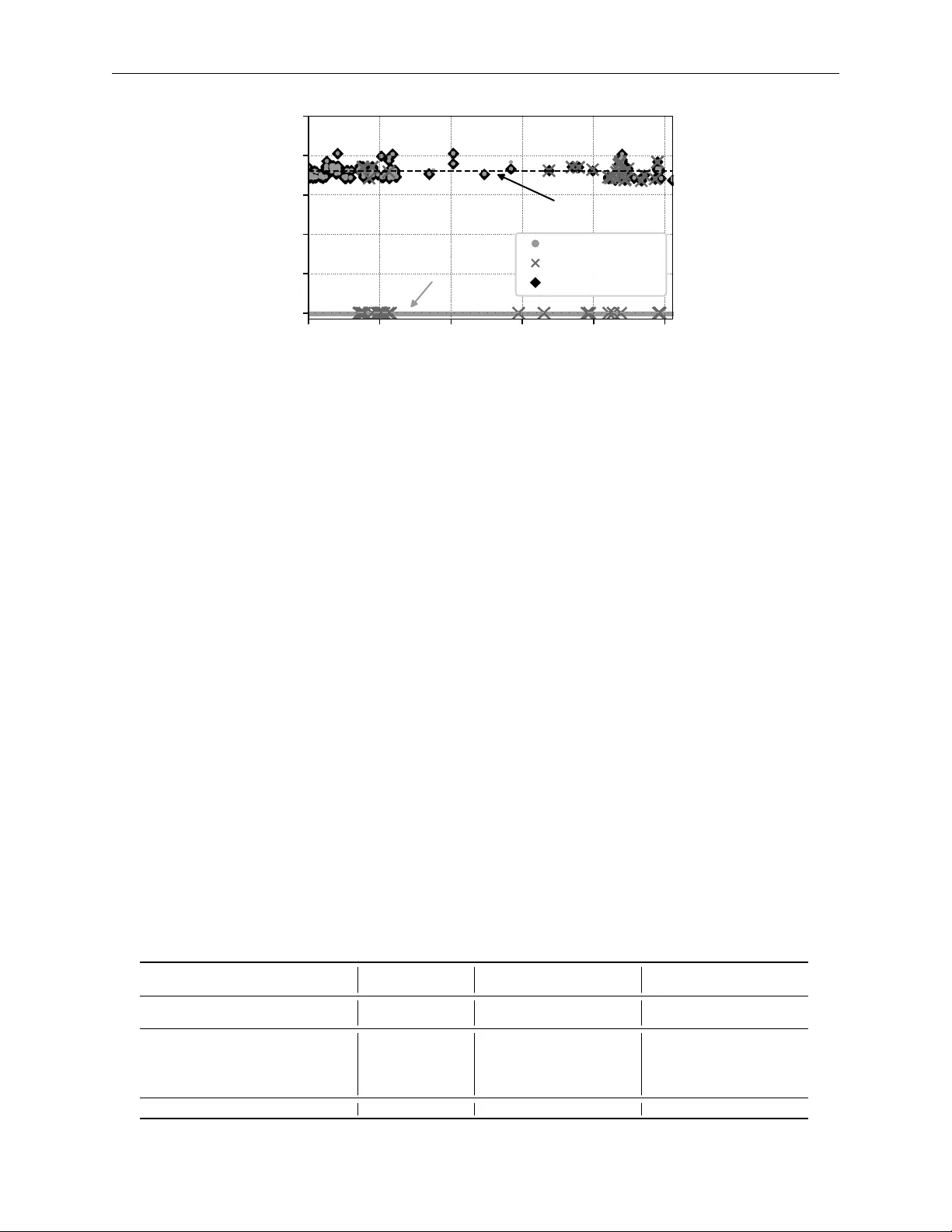
U S I N G A N O M A L Y D E T E C T I O N T O S U P P O R T C L A S S I FI C A T I O N O F FA S T R U N N I N G ( P A C K A G I N G ) P R O C E S S E S A P R E P R I N T Tilman Klaeger , Andre Schult, Lukas Oehm ∗ Fraunhofer Institute for Process Engineering and Packaging (IVV) Division Machinery and Processes Dresden, Germany tilman.klaeger@i vv-dresden.fraunhofer .de September 23, 2024 A B S T R AC T In this paper we propose a new method to assist in labeling data arriving from fast running processes using anomaly detection. A result is the possibility to manually classify data arriving at a high rates to train machine learning models. T o circumvent the problem of not having a real ground truth we propose specific metrics for model selection and validation of the results. The use case is taken from the food packaging industry , where processes are affected by re gular but short breakdo wns causing interruptions in the production process. Fast production rates make it hard for machine operators to identify the source and thus the cause of the breakdown. Self learning assistance systems can help them finding the root cause of the problem and assist the machine operator in applying lasting solutions. These learning systems need to be trained to identify reoccurring problems using data analytics. Training is not easy as the process is too fast to be manually monitored to add specific classifications on the single data points. K eywords Machine Learning · Packaging Machine · Anomaly Detection · Classification · Operator Assistance System 1 Introduction Self learning systems lik e operator assistance need valid training data. For slow running processes it is possible to manually label failed production steps or poorly manufactured products. For fast running discrete processes this is much harder as it is difficult to manually distinguish the single products. Packaging processes are one of those f ast running discrete processes. Packing sweets runs at up to 2 000 pieces per minute, filling tubes at a rate of 600 per minute [ 1 ]. The processing of materials with v olatile properties like plastic foil and cardboard or treating of biogene products, e.g. foods, causes frequent interruptions in the production process [ 2 , 3 ]. Research at the Fraunhofer IVV using data gained in 7 000 hours of manual machine observ ation has shown an a verage production time frame between errors being less than 15 minutes (Mean time between failure, MTBF). But it has also to be mentioned that in 66% of the interruptions the fix needs less than two minutes (Mean time to repair , MTTR) [4]. The ov erall equipment efficienc y (OEE) is not only af fected by interruptions but also by producing with less quality than required. This will cause rejects or , in the worst case, food safety issues due to incorrect packaging. T o refer to both breakdowns and non-quality production the term ”defect” is used in this paper . A major cause of the frequent interruptions is the missing ability of operators to understand the problem and fix the problem’ s root cause. Building assistance systems can help operators to find lasting solutions for the problem [ 5 , 6 ]. T o ∗ 2019 IEEE. Personal use of this material is permitted. Permission from IEEE must be obtained for all other uses, in any current or future media, including reprinting/republishing this material for advertising or promotional purposes, creating new collecti ve works, for resale or redistribution to servers or lists, or reuse of any copyrighted component of this work in other works. Final version published under DOI 10.1109/INDIN41052.2019.8972081 Using anomaly detection to support classification of fast running (packaging) processes A P R E P R I N T build more sophisticated vie ws of the current f ailure situation an analysis of all available PLC signals is used to b uild a self learning assistance system [7]. For first e xperiments lasting malfunctions hav e been prov ocated over a period of a couple minutes to create training data collected from the PLC for machine learning algorithms [ 7 ]. This is a simplified approach not matching up with real production scenarios where often only a single product or cardboard sheet may hav e a problem and either results in non-quality products or causes a machine stop. So there is a need to identify situations for ev ery single product being produced. And more challenging, a possibility to classify the correct data point after manually reporting some kind of malfunction needs to be implemented. In this paper we propose a way using anomaly detection to identify and assist in manual labeling the data points arriving at a high rate. W e prov e the performance by using a ne w kind of metric helping to find the best combination of feature selection, anomaly detection and a final classification. 2 Related work 2.1 Data classification for machine state detection on packaging machines Many researches are working in the field of predicti ve maintenance to tackle down-times before an important machine component f ails. The focus is on preventing longer machine stops. A major research in this area is the analysis of different kind of rotating machine parts like motors, bearings and pumps [ 8 , 9 ]. Most analysis is done in the frequenc y domain, ev en though some have tried w orking in the time domain [10]. Due to intermittent motions in man y parts of the packaging machine analysis in the frequenc y domain is not al ways possible and thus a inspection of the time domain has to be done [11, 12]. For continuous mov ements in packaging machines there ha ve been successful analysis in the frequenc y domain. Brecher et al. are using the vibration measurements to detect deterioration of dri ve belts [ 13 ]. The experimental setup allo wed for longer running experiments using dri ve belts at different wear le vels. Carino et al. perform analysis in the frequency domain working with motor currents for a camshaft of a packaging machine to detect dif ferent production states [ 14 ]. Deactiv ating sections of the machine to create dif ferent states of operation eases the creation of a classification. The same setup is also used by Zurita et al. [ 15 ] to identify states using artificial neural networks. W ithout the application of machine learning Ostyn et al. were able to detect the quality of pouch sealings using statistical analyses of multi v ariate accelerometer data measured at the sealing ja w [ 16 ]. Running at about 30 bags per minute a manual inspection of the seal integrity was possible. Opposed to most research our focus is to tackle short but frequent defects in discrete processes ha ving summarized a major share on unplanned machine stops. The method has to be able to detect defects in single products or machine cycles. 2.2 Anomaly detection, model selection and evaluation of anomaly detectors Instead of combining anomaly detection and classification one could look completely separated at those methods. Classification of PLC data is possible as shown in [7]. For anomaly detection there is a v ariety of established algorithms. Having classified nominal data at hand a semi- supervised approach is possible, sometimes refereed to as nov elty detection. A v ailable methods can basically be di vided in dif ferent categories [ 17 ]. Global neighbor based algorithms based on k -Nearest Neighbor ( k -NN) are some what related to other density-based algorithms like the Local Outlier Factor [ 18 ]. There are algorithms av ailable based on subspace methods like Principal Component Analysis (PCA) or based on statistics like Histogram Based Outlier Detection (HBOS) [ 19 ] or Gaussian Mixture Models. Further algorithms include Isolation F orests based on decision tree methods and others based on the Minimum Cov ariance Distance (MCD) [ 20 ]. All of those can be used with feature bagging methods, that are well established for classification tasks b ut are also suitable for outlier analysis [ 21 ]. Except for Gaussian Mixture all those algorithms are av ailable in the open library ”PyOD” [22]. Performance ev aluation is the crucial point when selecting appropriate algorithms for anomaly detection. Common metrics for bench-marking anomaly detection are the receiv er operating characteristic (R OC), the area under the curv e (A UC) or simple metrics like precision and recall. Those metrics are often used, especially for comparison of different models [ 23 , 17 ]. But these metrics always need a ground truth to work [ 21 , 24 ]. If no ground truth is av ailable characterizing the performance of anomaly detection is difficult and often internal metrics are used [21]. 2 Using anomaly detection to support classification of fast running (packaging) processes A P R E P R I N T Mov ement of buck et chain Erecting of cardboards Placing products on buck et chain (not analyzed) Slipping product in cardbord box Height check Gluing cardboard Print best-before date T ransport to next machine Figure 1: Illustration of the analyzed packaging process. 3 Proposed Method 3.1 Machine used for experiments and data collection The data was collected at a cartoner in a liv e production environment. The machine is b uilt to pack up to 120 products per minute. W orking at variable speeds the machine can adjust to the filling lev el at the preceding production line. The machine is an off-the-shelf cartoner retrofitted at the food producers’ site. The camshaft and other parts of the machine are now equipped with independent serv o driv es and new PLC. F or a visualization of the process see figure 1. Incoming products are placed in one of three collators and then dropped on the next free spot on the bucket chain. F or further research only the processes running alongside the b ucket chain ha ve been analyzed. Products in the b ucket chain are subject to different handling and checks: 1. Checking for product height, unintended stacking of products and correct placement in b ucket. 2. Detracting and erecting of cardboard box es with two open sites. 3. Slipping product into cardboard box. 4. Gluing the open sites of the box. 5. Printing best-before date and checking the print image. Data from the b uilt in sensor system w as collected on the PLC’ s field bus using the PLC’ s cycle time of 1 ms in li ve production. A total of 40 sensors w as av ailable for analysis including rotary encoders b ut e xcluding those of the safety circuit. T o train the machine learning models the cartoner was observ ed at three shifts lasting se ven hours each. In this time periods of time were logged without an y error . Defects, especially those not causing a machine stop, were logged b ut hav e to be treated with some uncertainty in observation time. The most common defect observ ed in production w as products not positioned correctly in the buck et chain. Most of those were detected by the machine and only rarely caused machine stops by ripped cardboards when trying to package the product. In some cases the detracting of the cardboard f ailed. This has to occur multiple times as the machine is programmed to retry on missed detraction. Another reasons for do wn times were stops at the machine follo wing in the packaging line. A list of observed states is sho wn in table 1. T able 1: Observ ed states in the cartoner . State / Defect Num. of obser vations Known Nominal data without reported defect 2.850 Product not placed correctly in buck et chain 37 Interruption caused by next machine in line 7 Cardboard Detraction error 6 Failed to slip product in box 2 Error depositing product in buck et chain 1 Sum of observed defects 53 3 Using anomaly detection to support classification of fast running (packaging) processes A P R E P R I N T For e valuation all defects including those detected by the machine were used. As some defects do ha ve only one or two occurrences in the data set all defects were classified as ”defect” for e valuation. Splitting between dif ferent failures prev ents the use of cross validation techniques. After having installed the equipment for data collection only very fe w breakdowns could be observed while w atching the machine in production. This does not match prior observ ations at various other packaging machines [ 2 , 4 ]. Despite this fact the data is of major interest as data from packaging machines in real production is still rare and the general format of data will not change with a more error prone machine. In addition to data collected while watching the machine personally , data w as collected remotely and thus has no classifications. Using machine stops as ground truth for defects is not feasible since stops may be caused by defects as well as by manual stops due to missing packaging goods or other planed down times (e. g. cleaning, maintenance). 3.2 Featur e extraction There are two basic options to produce equal length data sets: Looking at the machine for a defined amount of time, usually one cycle respecti vely one turn of the camshaft. Defects caused by anomalous products may then be visible more than once at ev ery sensor having contact with the product. But these impacts may be very minor . T o track errors on the product a digital twin was built collecting the sensor data virtually on the product. As result a data set for ev ery product passing through the machine is av ailable. T o o vercome different length caused by v arying machine speeds a scaling was applied to the collected data sets. T o be able to analyze data sets in case of machine stops a timeout is implemented for early finishing of digital twins. Missing data in those data sets is filled using median value imputation. T o e xtract features from these data sets common figures of time series are calculated [ 25 ]. Using process kno wledge about the type of sensors the features are selected resulting at an av erage of fi ve features per sensor and a total of 200. The resulting high dimension can triviall y be reduced to 120 by setting a low v ariance threshold. For a further reduction of the dimension transformation-methods like Principal Component Analysis (PCA) and F actor Analysis (F A) are applied. 3.3 Building pipelines with anomaly detection and classification The most important part in classifying fast running processes is to add the user reported classification to the correct data point. For the classification of a single data point we propose a method consisting of anomaly detection and classification: T o classify a single data point the anomaly score in a reported time range is used and the data point with the highest score within this time range is labeled with the reported defect. Assuming a good anomaly detection the classified data set can be used as training data for the classifier . The approach and the resulting pipeline is visualized in figure 2. Looking at the av ailable data not only unsupervised methods for anomaly detection can be considered but also methods for nov elty detection using a semi-supervised approach with kno wn nominal training data. F or the current research a variety of detectors including HBOS, Isolation F orest, k -NN, LOF , MCD and approaches based on PCA and Gaussian Mixtures were used. As feature bagging methods hav e shown good results for classification on similar data sets random subspace sampling was added [ 7 ]. The anomaly detectors were provided with 50% and 70% of the features using an ensemble size of 80 detectors. For comparison a detector without random subspace sampling was also present for each anomaly detection method. Combined with dif ferent sorts of scaling the data and feature reduction methods and a random subspace sampling for anomaly detectors a total of about 10 000 variants were built and (semi)-automatically examined in a typical grid search. 3.4 Proposed and used metrics As a simple ev aluation of anomaly detectors is not tri vial, especially if there is no ground truth av ailable [ 21 ]. In consequence often internal criteria need to be used. Having a complete pipeline the proposed feature can be called semi-internal: W e propose the consensus of anomaly score and classification as metric to validate the performance of a combination. The metric m therefore is based on calculating the multiple of a verage anomaly score for detected defects y defect compared to the av erage of all anomaly scores y . In the total average anomly-score detected defects are included. This works particularly well for data sets with a small fraction of errors, where a couple defects hardly affect the total av erage. In other cases a comparison between defects and kno wn nominal data is more suitable. 4 Using anomaly detection to support classification of fast running (packaging) processes A P R E P R I N T Raw features X Labeling most anomalous data in time frame X preproc X preproc y anomaly Anomaly detection (nov elty detection) Preprocessing X preproc y classified T ime frame with defect T raining classifier labels for quality production time 1. T raining pipeline T rained classifier Raw features X X preproc y anomaly Anomaly detection Preprocessing 2. Pr ediction Pipeline y classified Comparing y anomaly with y anomaly (classified defect) 3. Ev aluation Classification T rained anomaly detector Figure 2: Construction of the pipeline for with anomaly detection and classification for training and prediction. m = y defect y An important remark is that one assumption has to be made at this point: The data point marked using the anomaly detection is identified correctly . Going one step further the assumption should prov e wrong if the anomaly detection returns worst case random values. A classifier trained with random v alues will also return random values and thus perform poor in a cross validation test. Having observ ed nominal values av ailable and best guesses on data for defects it is further possible to use well-known and prov en metrics for data science: Precision, Recall and F1-score. It is possible to calculate the precision for nominal production. Using the assumption from the pre vious paragraph, that anomaly detection is working correctly and identified the correct data points, it is possible to do a cross validation on the classifier . W ith these metrics a plausibility check of the first proposed metric is made. Other metrics analyzed include the v ariance of the anomaly detection. As the data set contains a ske wed distribution with only very fe w anomalies, a low v ariance in the anomaly score is expected. So this may be a metric to determine the quality of anomaly detection. F or better comparison between different methods all anomaly scores are scaled to be in range 0 to 100. Another expectation is an e ven distrib ution of defects over time. Thus performing a χ 2 -test ov er the detected defects is yet another metric for determining performance of the model. 4 Results Out of the 10 000 v ariations analyzed three were extraordinary . They all used a PCA for feature reduction with the number of components automatically determined with the method by Minka [ 26 ]. For anomaly detection MCD with random subspace sampling of 70% of the features was used. The final classification w as done using Random Forests without weighting the classes. In different metrics other combinations scored slightly higher . The best precision for defects was as high as 100% and a recall up to 53% could be achiev ed using another combination. The maximum needs to be interpreted carefully as it is known that a recall for defects of 100% is easy to reach by classifying all data points as defect. W ith the best combination e xamined the av erage anomaly score for detected defects is 155 times as high as the a verage anomaly score off all sampled data. This results in a precision of 87% and a recall of 49%, both being v ery close to the maximum achiev ed results. Poor performance was only measured for the criterion of an e ven spread of detected defects ov er time. All results are summarized in table 2. A visualization of the detection is displayed in figure 3. Only very few data points with high anomaly score are not detected as defect, b ut some manually reported defects (marked with × ) are not anomaly according to the detector . A recall of 50% is visible. First results seam reasonable for the detected metric b ut do not ensure a transferability to other combinations examined. A common measure is the Pearson correlation f actor between the different metrics. Here only ne gative correlations 5 Using anomaly detection to support classification of fast running (packaging) processes A P R E P R I N T 0 10000 20000 30000 40000 50000 Datapoint No. 0 2 4 6 8 10 Anomaly Score A vg. score detected defect A vg. score Data point Reported defect Detected defect Figure 3: V isualization of calculated anomaly scores with mark ers for manually reported defects and automatically detected ones. can be observed which may be suitable for anomaly v ariance since an overall lo w anomaly score should result in high model performance. These results need further discussion. The new metrics are not adoptable to prior experiments (s. [ 7 ]) as defects were acquired continuous. Thus selecting the most anomalous data set close to reported will (nearly) always succeed as neighboring data points contain to the same prov ocated defect. Until ne w data sets for different machines are generated there is no w further validation possible. 5 Discussion For all metrics the key concern is that our ground truth can not be considered a real ground truth. By quantifying the dif ference between classifier -detected defects and the av erage anomaly score for all data points in the set a good common understanding of the situation by anomaly and classification models can be assumed. A precision of close to 87% may not always be enough for automatic controls and adaptive systems b ut it is more than con venient for operator assistance systems. T o many false alarms will reduce the benefit and the acceptance of such systems which should not be the case with accomplished performance. A recall at close to 50% is still moti vation for improv ement but on the other side does not do too much harm to the systems. For a fully automated system this may not be enough but is beyond the goal as the intention is to pro vide operator assistance as good as possible and not automatically interfere with the machine. Having a negati ve correlation between well-kno wn metrics and the proposed one may reduce the v alidity of the ne w approach. Looking at the ov erall performance of the best performing models the ne w approach may also be seen as a different metric independent of well-kno wn ones. Using a combination of those metrics it is possible to get a similar result as with the new metric. An automatic model selection is thus easier since only one metric has to be e valuated. T able 2: Realized performance with the best combination of anomaly score and classifier compared to ov erall performance. Anomalies Defects Unweighted A verage Rel. Score V ariance χ 2 stats F1-score Pr ecision Recall F1-score Precision Recall Best performing Combination 155.4 0.884 611.4 0.627 0.867 0.491 0.811 0.929 0.745 Relativ e to best of each 1.00 0.999 0.020 0.906 0.867 0.928 0.960 0.932 0.974 Mean 10.42 177.28 2391.4 0.367 0.865 0.254 0.680 0.926 0.626 Standard Deriv ation 16.02 320.58 5905.4 0.192 0.170 0.152 0.097 0.085 0.076 Minimum 0.00 0.62 0.0 0.000 0.000 0.000 0.495 0.490 0.499 75% Quantile 10.54 190.92 1007.5 0.538 1.000 0.396 0.766 0.991 0.697 Maximum 155.36 1617.87 30494.4 0.691 1.000 0.528 0.843 0.995 0.764 Correlation to Rel. Score 1.00 -0.218 -0.035 - 0.219 -0.011 -0.201 -0.218 -0.014 -0.201 6 Using anomaly detection to support classification of fast running (packaging) processes A P R E P R I N T By use of cross v alidation the metrics for Precision, Recall and F1-score should not be prone to an o ver fitted model. But having a poor performance on the e ven distribution of the detected defects is still a slight e vidence for ov er fitting. This issue has to be carefully watched once more data is a v ailable. As of now it is hard to tell how well the new approach adopts to different data sets. The assumptions made for the selection of the metrics do apply for many discrete processes where only fe w anomal data points are observed. 6 Conclusion W e proposed a way to classify data originating from f ast running discrete processes using a combination of anomaly detection and classification. W ith a ne w metric model selection was reduced to e v aluate one v alue. The search of over 10 000 model combinations was successful in a way , that it is now possible to detect anomalies and use those for classification of processes where the specific data point can not be manually selected for classification. For self learning assistance systems the initial training is thus possible without provocation of lasting errors. The solution thus adds to the economical factor of bringing up such systems at a new machine. But it also helps in working closer on practical data as an y kind of prov ocation has to be seen as simulation specific machine states which may or may not be the same as in real production. Acknowledgment This research was made possible by funding from the European Regional De velopment Fund (ERDF) for Saxon y , Germany in the project ”Lernf ¨ ahiges Bediener-Assistenzsystem fr V erarbeitungsmaschinen”. 7 Using anomaly detection to support classification of fast running (packaging) processes A P R E P R I N T References [1] J.-P . Majschak, “Anwendung f ¨ ur Maschinensysteme der Stof fverarbeitung, ” in Dubbel , K.-H. Grote, B. Bender , and D. G ¨ ohlich, Eds. Berlin, Heidelberg: Springer Berlin Heidelber g, 2018, pp. 412–422. [2] A. Schult, E. Beck, and J.-P . Majschak, “Steigerung der Effizienz v on V erarbeitungs- und V erpackungsanlagen durch W irkungsgradanalysen, ” Pharma + F ood , vol. 18, no. 7, pp. 66–68, 2015. [3] P . Tsarouhas, “Reliability , av ailability and maintainability analysis in food production lines: A re view , ” International Journal of F ood Science & T echnolo gy , vol. 47, no. 11, pp. 2243–2251, July 2012. [4] L. Dziuba-Kaiser, “Ermittlung der W iederholcharakteristik von im Produktionsbetrieb von V erarbeitungsanlagen auftretenden St ¨ orungen, ” Großer Bele g, TU Dresden, Dresden, Nov . 2017. [5] J. Rahm, M. Graube, R. M ¨ uller , T . Klaeger , L. Schegner , A. Schult, R. B ¨ onsel, S. Carsch, L. Oehm, and L. Urbas, “K oMMDia: Dialogue-Driven Assistance System for F ault Diagnosis and Correction in Cyber-Physical Production Systems, ” in 2018 IEEE 23r d International Conference on Emer ging T echnologies and F actory Automation (ETF A) , vol. 1, Sept. 2018, pp. 999–1006. [6] R. M ¨ uller and L. Oehm, “Process industries v ersus discrete processing: How system characteristics af fect operator tasks, ” Cognition, T echnolo gy & W ork , July 2018. [7] T . Klae ger , A. Schult, and J.-P . Majschak, “Lernf ¨ ahige Bedienerassistenz f ¨ ur V erarbeitungsmaschinen, ” Industrie 4.0 Management , v ol. 33, pp. 25–28, Aug. 2017. [8] Y . Lei, F . Jia, J. Lin, S. Xing, and S. X. Ding, “ An Intelligent Fault Diagnosis Method Using Unsupervised Feature Learning T o wards Mechanical Big Data, ” IEEE T ransactions on Industrial Electr onics , vol. 63, no. 5, pp. 3137–3147, May 2016. [9] C. H. Lauro, L. C. Brand ˜ ao, D. Baldo, R. A. Reis, and J. P . Davim, “Monitoring and processing signal applied in machining processes – A revie w , ” Measur ement , vol. 58, pp. 73–86, Dec. 2014. [10] J. S. Rapur and R. T iwari, “Experimental T ime-Domain V ibration-Based Fault Diagnosis of Centrifugal Pumps Using Support V ector Machine, ” ASCE-ASME J ournal of Risk and Uncertainty in Engineering Systems, P art B: Mechanical Engineering , v ol. 3, no. 4, pp. 044 501–044 501–7, June 2017. [11] A. Lotze, “Steuerungsintegrierte V organgsdiagnose in V erarbeitungsmaschinen am Beispiel einer Quersiegelein- heit, ” Dissertation, T echnische Uni versit ¨ at Dresden, Dresden, 2008. [12] A. Behrendt, “ Antriebsbasierte Zustands ¨ uberwachung am Beispiel einer Quersie geleinheit, ” in T agung V erar- beitungsmaschinen und V erpackungstechnik 19./20. M ¨ arz 2009 , T echnische Uni versit ¨ at Dresden and Fraunhofer- Anwendungszentrum f ¨ ur V erarbeitungsmaschinen und V erpackungstechnik, Eds. Dresden: T echnische Univ er- sit ¨ at, Mar . 2009, pp. 123–139. [13] C. Brecher , M. Obdenbusch, and M. Buchsbaum, “Optimized state estimation by application of machine learning, ” Pr oduction Engineering , vol. 11, no. 2, pp. 133–143, Apr . 2017. [14] J. A. Carino, D. Zurita, A. Picot, M. Delgado, J. A. Orte ga, and R. J. Romero-Troncoso, “Nov elty detection methodology based on multi-modal one-class support vector machine, ” in 2015 IEEE 10th International Sym- posium on Diagnostics for Electrical Machines, P ower Electr onics and Drives (SDEMPED) , Sept. 2015, pp. 184–190. [15] D. Zurita, J. A. Carino, A. Picot, M. Delgado, and J. A. Ortega, “Diagnosis method based on topology codification and neural network applied to an industrial camshaft, ” in 2015 IEEE 10th International Symposium on Dia gnostics for Electrical Machines, P ower Electr onics and Drives (SDEMPED) , Sept. 2015, pp. 124–130. [16] B. Ostyn, P . Darius, J. D. Baerdemaek er , and B. D. K etelaere, “Statistical Monitoring of a Sealing Process by Means of Multiv ariate Accelerometer Data, ” Quality Engineering , vol. 19, no. 4, pp. 299–310, Oct. 2007. [17] M. Goldstein and S. Uchida, “A Comparativ e Ev aluation of Unsupervised Anomaly Detection Algorithms for Multiv ariate Data, ” PLOS ONE , vol. 11, no. 4, p. e0152173, Apr . 2016. [18] M. M. Breunig, H.-P . Krie gel, R. T . Ng, and J. Sander , “LOF: Identifying Density-based Local Outliers, ” in Pr oceedings of the 2000 A CM SIGMOD International Confer ence on Manag ement of Data , ser . SIGMOD ’00. New Y ork, NY , USA: A CM, 2000, pp. 93–104. [19] M. Goldstein and A. Dengel, “Histogram-based Outlier Score (HBOS): A fast Unsupervised Anomaly Detection Algorithm, ” in 35th German Confer ence on Artificial Intelligence , 2012, pp. 59–63. [20] J. Hardin and D. M. Rocke, “Outlier detection in the multiple cluster setting using the minimum cov ariance determinant estimator , ” Computational Statistics & Data Analysis , vol. 44, no. 4, pp. 625–638, Jan. 2004. 8 Using anomaly detection to support classification of fast running (packaging) processes A P R E P R I N T [21] C. C. Aggarwal, Outlier Analysis , 2nd ed. Cham: Springer International Publishing, 2017. [22] Y . Zhao, Z. Nasrullah, and Z. Li, “PyOD: A Python T oolbox for Scalable Outlier Detection, ” [cs, stat] , Jan. 2019. [23] V . Chandola, V . Mithal, and V . Kumar , “Comparati ve Ev aluation of Anomaly Detection T echniques for Sequence Data, ” in 2008 Eighth IEEE International Confer ence on Data Mining , Dec. 2008, pp. 743–748. [24] K. Xu, M. Xia, X. Mu, Y . W ang, and N. Cao, “EnsembleLens: Ensemble-based V isual Exploration of Anomaly Detection Algorithms with Multidimensional Data, ” IEEE T ransactions on V isualization and Computer Graphics , vol. 25, no. 1, pp. 109–119, Jan. 2019. [25] P . Esling and C. Agon, “T ime-series data mining, ” A CM Computing Surveys , v ol. 45, no. 1, pp. 1–34, Nov . 2012. [26] T . P . Minka, “ Automatic Choice of Dimensionality for PCA, ” in Advances in Neural Information Pr ocessing Systems 13 , T . K. Leen, T . G. Dietterich, and V . T resp, Eds. MIT Press, 2001, pp. 598–604. Dipl.-Ing. Tilman Klaeger studied mechatronics at the T echnische Uni versit ¨ at Dresden and is working at the Fraunhofer IVV since 2016. His major topic in research is machine learning on industrial data collected from packaging machines and processes. Dipl.-Ing. Andre Schult studied mechanical engineering with focus on processing and packaging machines at the T echnische Univ ersit ¨ at Dresden. He has been doing research on machine and ov erall line performance and is no w leading the dev elopment of user assistance systems. He is currently also founding a company to market assistance systems. Dr .-Ing. Lukas Oehm graduated in mechanical engineering in 2010 and recei ved his PhD in 2017 from T echnische Uni versit ¨ at Dresden entitled Joining of Polymeric Packaging Materials with High Intensity Focused Ultrasound. He has been working as research assistant at Fraunhofer Institute for Process Engineering and P ackaging IVV since May 2017. Since October 2018, he is group leader for Digitization and Assistance Systems. His research interests are in the field of product safety issues and process efficienc y in food production as well as assistance systems for machine operators. 9
Original Paper
Loading high-quality paper...
Comments & Academic Discussion
Loading comments...
Leave a Comment