Stabilizing Traffic via Autonomous Vehicles: A Continuum Mean Field Game Approach
This paper presents scalable traffic stability analysis for both pure autonomous vehicle (AV) traffic and mixed traffic based on continuum traffic flow models. Human vehicles are modeled by a non-equilibrium traffic flow model, i.e., Aw-Rascle-Zhang …
Authors: Kuang Huang, Xuan Di, Qiang Du
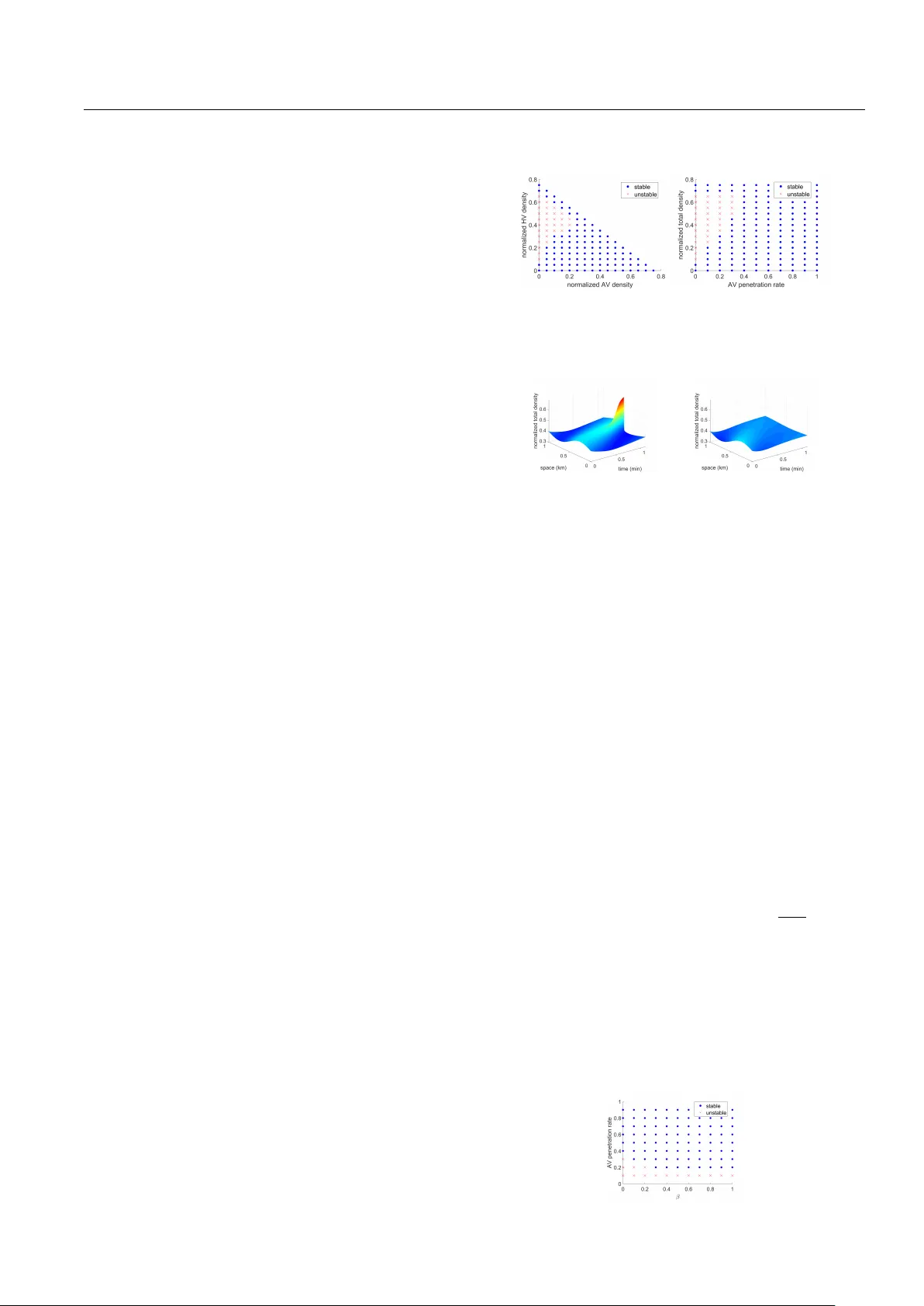
Published in: 2019 IEEE Intelligent T ransportation Systems Conference (ITSC), pp. 3269-3274. IEEE, 2019. Please cite this paper as: “Huang, K., Di, X., Du, Q., Chen, X., 2019. Stabilizing T raffic via Autonomous V ehicles: A Continuum Mean Field Game Approach, the 22nd IEEE International Confer ence on Intelligent T ransportation Systems (ITSC) , DOI: 10.1109/ITSC.2019.8917021. ” Stabilizing T raffic via A utonomous V ehicles: A Continuum Mean Field Game A ppr oach Kuang Huang 1 , Xuan Di 2 , 3 , Qiang Du 1 , 3 and Xi Chen 4 Abstract — This paper presents scalable traffic stability anal- ysis for both pure autonomous vehicle (A V) traffic and mixed traffic based on continuum traffic flow models. Human vehicles are modeled by a non-equilibrium traffic flow model, i.e., A w- Rascle-Zhang (ARZ), which is unstable. A Vs are modeled by the mean field game which assumes A Vs are rational agents with anticipation capacities. It is shown from linear stability analysis and numerical experiments that A Vs help stabilize the traffic. Further , we quantify the impact of A V’s penetration rate and controller design on the traffic stability . The results may pr ovide insights f or A V manufacturers and city planners. I . I N T RO D U C T I O N Autonomous vehicles (A Vs) are believed to be the foun- dation of the next-decade transportation system and are ex- pected to improve the traffic flow that is presently dominated by human vehicles (HVs). Modeling A V’ s driving behavior and quantifying different penetration rates of A Vs’ impact on the traffic is of great significance. This paper focuses on traffic stability , which is one of the most substantial traf fic features. T raf fic stability refers to a traffic system’ s asymptotic stability around uniform flows. HV traf fic is observed to be an unstable system in which a small perturbation (caused by dri ving errors or delays) to the uniform flow will gro w up with time and de velop traffic congestion. By removing human errors, it is expected that A Vs will help stabilize the traffic system. A field experiment [1] showed that one A V is able to stabilize the traffic with approximately twenty vehicles on a ring road. A V’ s capability of stabilizing traf fic is v alidated using microscopic models for mixed A V -HV traffic. In microscopic models, the traffic system is described by ordinary differen- tial equations. One can carry out standard linear stability analysis to characterize such a traffic system’ s stability , built upon connected cruise controllers [2] or generic car- following models [3], [4]. [2], [3] considered only one A V with multiple HVs; [4] studied multiple A Vs and multiple HVs but only focused on the head-to-tail stability . Howe ver , in the general case, the mixed traffic stability analysis relies on the topology of mixed vehicles and the vehicle-to-vehicle communication network, which suffers from scalability is- sues. One alternative approach to address the scalability issues is the PDE approximation [5]. This approach suggests to 1 Department of Applied Physics and Applied Mathematics, Columbia Univ ersity 2 Department of Civil Engineering and Engineering Mechanics, Columbia Univ ersity 3 Data Science Institute, Columbia Univ ersity 4 Department of Computer Science, Columbia University study the stability of continuum traf fic flow models which are the limits of microscopic models. The approach is well suited for the mix ed traffic since one needs only to concern about the density distributions of different classes. In continuum traf fic flow models, the traf fic system is described by partial differential equations (PDEs) of traffic density and velocity . For single class traffic, the Lighthill- Whitham-Richards (L WR) model [6] is the most extensiv ely used continuum model. As a generalization, the multiclass L WR is widely used to model the interaction between two types of vehicles. [7] is among a few studies that applied multi-class L WR models to A V -HV mix ed traffic and proposed networked traffic controls in the presence of A Vs. Based on gas-kinetic theory , [8] proposed a multiclass macroscopic model to capture the effect of communication and information sharing on traffic flow and analyzed the model’ s stability with respect to the connected vehicle’ s penetration rate; [9], [10], [11] modeled the macroscopic traffic flow of mixed Adaptive Cruise Control (A CC) and Cooperativ e Adaptiv e Cruise Control (CA CC) vehicles and analyzed how the A CC vehicle’ s penetration rate influences the traffic stability . This paper models A Vs using the mean field game fol- lowing the authors’ work [12]. In this frame work, A Vs are assumed to be rational, utility-optimizing agents with anticipation capabilities and play a non-cooperative game by selecting their driving speeds. A Vs’ utility-optimizing and anticipation behaviors are distinctiv e characteristics from the aforementioned continuum models. By extending [12], this paper aims to build continuum traffic flo w models for both pure A V traffic and mixed A V -HV traffic based on mean field games and analyze the models’ traf fic stability . The remainder of the paper is organized as follows. Section II pro vides an ov erview of the mean field game and the A w-Rascle-Zhang model, used for modeling A Vs and HVs, respectiv ely . Section III formulates models for both pure A V traf fic and mixed A V -HV traffic. Based on the proposed models, Section IV sho ws the linear stability analysis for the pure A V traffic and Section V demonstrates the mixed traf fic’ s stability through numerical experiments. I I . P R E L I M I NA R I E S A. Mean Field Game Mean field game (MFG) is a game-theoretic frame work to model complex multi-agent dynamic systems [13]. In the MFG frame work, a population of N rational utility- optimizing agents are modeled by a dynamic system. The Published in: 2019 IEEE Intelligent T ransportation Systems Conference (ITSC), pp. 3269-3274. IEEE, 2019. Please cite this paper as: “Huang, K., Di, X., Du, Q., Chen, X., 2019. Stabilizing T raffic via Autonomous V ehicles: A Continuum Mean Field Game Approach, the 22nd IEEE International Confer ence on Intelligent T ransportation Systems (ITSC) , DOI: 10.1109/ITSC.2019.8917021. ” agents interact with each other through their utilities. Assum- ing those agents optimize their utilities in a non-cooperati ve way , they form a differ ential game . Exact Nash equilibria to the dif ferential game are generally hard to solve when N is lar ge. Alternatively , MFG considers the continuum problem as N → ∞ . By exploiting the “smoothing” effect of a large number of interacting indi- viduals, MFG assumes that each agent only responds to and contributes to the density distribution of the whole popula- tion. Then the equilibria are characterized by a set of two PDEs: a backward Hamilton-Jacobi-Bellman (HJB) equation describing a generic agent’ s optimal control provided the density distribution and a forward Fokker -Planck equation describing the population’ s density ev olution provided indi- vidual controls. In this paper we shall formulate A V traf fic as a mean field game. A Vs are modeled as rational agents with predefined driving costs. Their density distribution is exactly the traffic density and the Fokker -Planck equation is the same as the continuity equation (CE) that is widely used in continuum traffic flow models. B. A w-Rascle-Zhang Model The following A w-Rascle-Zhang (ARZ) model: (CE) ρ t + ( ρu ) x = 0 , (1) (ME) [ u + h ( ρ )] t + u [ u + h ( ρ )] x = 1 τ [ U ( ρ ) − u ] , (2) is a non-equilibrium continuum traffic flow model describing human driving behaviors [14], [15], where, ρ ( x, t ) , u ( x, t ) : the traf fic density and speed; U ( · ) : the desired speed function; h ( · ) : the hesitation function that is an increasing function of the density; τ : the relaxation time quantifying how fast dri vers adapt their current speeds to desired speeds. Equation (1) is the continuity equation describing the flow conservation and (2) is a momentum equation (ME) prescribing human driv er’ s dynamic behavior . The ARZ model is able to predict important human dri ving features such as stop-and-go wa ves and traf fic instability [16]. Traf fic stability is defined around uniform flows. In continuum models, uniform flo ws are described by constant solutions ρ ( x, t ) ≡ ¯ ρ , u ( x, t ) ≡ ¯ u . The constant solutions of the ARZ model is giv en by ¯ u = U ( ¯ ρ ) . Then the traffic stability for the ARZ model is defined as follows: Definition 2.1: The ARZ model (1)(2) is stable around the uniform flo w ( ¯ ρ, ¯ u ) where ¯ u = U ( ¯ ρ ) if for any ε > 0 , there exists δ > 0 such that for any solution ρ ( x, t ) , u ( x, t ) to the system: sup 0 ≤ t< ∞ {k ρ ( · , t ) − ¯ ρ k + k u ( · , t ) − ¯ u k} ≤ ε, (3) whenev er k ρ ( · , 0) − ¯ ρ k + k u ( · , 0) − ¯ u k ≤ δ . Here k·k is a giv en norm. The system is linearly stable if its linearized system at ( ¯ ρ, ¯ u ) is stable around the zero solution. The ARZ model has a simple linear stability criterion [16]: Theor em 2.1: The ARZ model (1)(2) is linearly stable around the uniform flow ( ¯ ρ, ¯ u ) where ¯ u = U ( ¯ ρ ) if and only if h 0 ( ¯ ρ ) > − U 0 ( ¯ ρ ) . Because of its capability of producing traf fic instability , we shall use the ARZ model (1)(2) to characterize HV’ s driving behavior . I I I . M O D E L F O R M U L A T I O N A. Pure A V T raf fic: Mean F ield Game In this section, we will b uild a pure A V continuum traffic flow model based on a mean field game following [12]. Assume that a large population of homogeneous A Vs are driving on a closed highway without any entrance nor exit. Those A Vs anticipate others’ behaviors and the e volution of the traffic density ρ ( x, t ) on a predefined time horizon [0 , T ] . A Vs control their speeds and aim to minimize their driving costs on the horizon [0 , T ] . Then the A Vs’ optimal cost V ( x, t ) and optimal velocity field u ( x, t ) can be described by a set of HJB equations [12]: (HJB) V t + uV x + f ( u, ρ ) = 0 , (4) u = argmin α { αV x + f ( α, ρ ) } , (5) where f ( · , · ) is the cost function [12]. When all A Vs follow their optimal velocity controls, the system’ s density evolution is described by the continuity equation: (CE) ρ t + ( ρu ) x = 0 . (6) The mean field game is described by the coupled system (4)(5)(6). • The initial condition for the forward continuity equation (6) is giv en by the initial density ρ ( x, 0) = ρ 0 ( x ) . • The terminal condition for the backward HJB equations (4)(5) is given by the terminal cost V ( x, T ) = V T ( x ) . W e will always set V T ( x ) = 0 meaning that the cars hav e no preference on their destinations. • The choice of the spatial boundary condition depends on the traffic scenario. In this paper we assume that the highway is a ring road of fixed length L and specify the periodic boundary condition ρ (0 , t ) = ρ ( L, t ) , V (0 , t ) = V ( L, t ) . The cost function represents certain dri ving objecti ves. The choice of the cost function determines A V’ s driving behavior . In this paper we shall follow [12] and take the following cost function: f ( u, ρ ) = 1 2 u u max 2 | {z } kinetic energy − u u max | {z } efficienc y + uρ u max ρ jam | {z } safety , (7) where, u max and ρ jam are the free flow speed and the jam density; 1 2 ( u/u max ) 2 models the car’ s kinetic energy; − u/u max models the car’ s efficienc y , minimizing this term means that the car should driv e as fast as possible; uρ/u max ρ jam models the safety , it is a penalty term that restricts the car’ s speed in traffic congestion; Published in: 2019 IEEE Intelligent T ransportation Systems Conference (ITSC), pp. 3269-3274. IEEE, 2019. Please cite this paper as: “Huang, K., Di, X., Du, Q., Chen, X., 2019. Stabilizing T raffic via Autonomous V ehicles: A Continuum Mean Field Game Approach, the 22nd IEEE International Confer ence on Intelligent T ransportation Systems (ITSC) , DOI: 10.1109/ITSC.2019.8917021. ” The MFG system corresponding to the cost function (7) is [12]: ρ t + ( ρu ) x = 0 , (8a) V t + uV x + 1 2 u u max 2 − u u max + uρ u max ρ jam = 0 , (8b) u = g [0 ,u max ] u max 1 − ρ ρ jam − u max V x , (8c) where g [0 ,u max ] ( u ) = max { min { u, u max } , 0 } is a cut-off function which ensures the cars’ speeds satisfy the constraint 0 ≤ u ≤ u max . [12] provides theoretical and numerical analysis on the MFG system (8a)(8b)(8c). The uniform flows of the MFG system (8a)(8b)(8c) are giv en by ¯ u = u max 1 − ¯ ρ ρ jam . Note that Definition 2.1 does not apply to the MFG system since the system is defined and solved on a fix ed time horizon [0 , T ] . In this case, we define traffic stability as follows: Definition 3.1: The MFG system (8a)(8b)(8c) is stable around the uniform flow ( ¯ ρ, ¯ u ) where ¯ u = u max (1 − ¯ ρ/ρ jam ) if for an y ε > 0 , there exists δ > 0 such that for any T > 0 and for any solution ρ ( T ) ( x, t ) , u ( T ) ( x, t ) to the system with V T ( x ) = 0 on the time horizon [0 , T ] : sup 0 ≤ t ≤ T n ρ ( T ) ( · , t ) − ¯ ρ + u ( T ) ( · , t ) − ¯ u o ≤ ε, (9) whenev er k ρ ( · , 0) − ¯ ρ k ≤ δ . The system is linearly stable if its linearized system at ( ¯ ρ, ¯ u ) is stable around the zero solution. B. Mixed T raf fic: Coupled MFG-ARZ System This section aims to dev elop a continuum mixed A V - HV traf fic flo w model. W e denote ρ A V ( x, t ) the A V density , ρ HV ( x, t ) the HV density and ρ TO T ( x, t ) = ρ A V ( x, t ) + ρ HV ( x, t ) , (10) the total density . Denote u A V ( x, t ) and u HV ( x, t ) the v eloci- ties of A Vs and HVs, respectiv ely . W e model HVs by the ARZ model and A Vs by the MFG, respectively . The next step is to model the interactions between A Vs and HVs. The interactions include the flo w interaction and the dynamic interaction. Flow interaction . The flow interaction relates to ho w the multiclass flows are computed and assigned. W e follo w the framew ork from [17] and suppose that the multiclass flows are described by the follo wing continuity equations for both A Vs and HVs: (CE-A V) ρ A V t + ( ρ A V u A V ) x = 0 , (11) (CE-HV) ρ HV t + ( ρ HV u HV ) x = 0 . (12) Dynamic interaction . Each of the velocities u A V and u HV should depend on both A V density ρ A V and HV density ρ HV . The way of defining the velocities over multiclass densities characterizes the dynamic interaction. [17] summarized some possible formulations of the dynamic interaction. In this paper we model an asymmetric dynamic interaction between A Vs and HVs by introducing multiclass densities into the HJB equations and the momentum equation of the system. For HVs, we assume that HVs only observe the total density ρ TO T to adapt their speeds. The momentum equation (2) in the ARZ model then becomes: u HV + h ( ρ TO T )] t + u HV [ u HV + h ( ρ TO T ) x = 1 τ U ( ρ TO T ) − u HV . (13) W e take the Greenshields desired speed function U ( ρ ) = u max (1 − ρ/ρ jam ) . For A Vs, we assume that A Vs observe both A V and HV densities. W e model A Vs’ reaction to multiclass densities by introducing an extra term into the A V’ s cost function. The A V’ s modified cost function for mixed traf fic is: f ( u A V , ρ A V , ρ HV ) = 1 2 u A V u max 2 | {z } kinetic energy − u A V u max | {z } efficienc y + u A V ρ TO T u max ρ jam + β ρ HV ρ jam | {z } safety , (14) where the safety is modeled by two penalty terms: one is similar to the penalty term in (7) but the congestion is modeled by the total density ρ TO T , the other quantifies HV’ s impact on A V’ s speed selection and the parameter β represents A V’ s sensitivity to HV’ s density . From (14) we can deriv e the corresponding HJB equations. Summarizing all above, we obtain the following coupled MFG-ARZ system: ρ A V t + ( ρ A V u A V ) x = 0 , (15a) V t + u A V V x + 1 2 u A V u max 2 − u A V u max + u A V ρ TO T u max ρ jam + β ρ HV ρ jam = 0 , (15b) u A V = g [0 ,u max ] u max 1 − ρ TO T ρ jam − u max V x , (15c) ρ HV t + ( ρ HV u HV ) x = 0 , (15d) u HV + h ( ρ TO T )] t + u HV [ u HV + h ( ρ TO T ) x = 1 τ u max 1 − ρ TO T ρ jam − u HV , (15e) ρ TO T = ρ A V + ρ HV . (15f) • The initial conditions are given by the initial densities ρ A V ( x, 0) = ρ A V 0 ( x ) , ρ HV ( x, 0) = ρ HV 0 ( x ) and the initial velocity u HV ( x, 0) = u HV 0 ( x ) . • The terminal condition is giv en by the terminal cost V ( x, T ) = V T ( x ) . W e will always set V T ( x ) = 0 . • W e specify the periodic boundary conditions for all of ρ A V , ρ HV , u HV and V . Published in: 2019 IEEE Intelligent T ransportation Systems Conference (ITSC), pp. 3269-3274. IEEE, 2019. Please cite this paper as: “Huang, K., Di, X., Du, Q., Chen, X., 2019. Stabilizing T raffic via Autonomous V ehicles: A Continuum Mean Field Game Approach, the 22nd IEEE International Confer ence on Intelligent T ransportation Systems (ITSC) , DOI: 10.1109/ITSC.2019.8917021. ” The mixed traffic’ s uniform flows are defined as the sys- tem’ s constant solutions ρ A V ( x, t ) ≡ ¯ ρ A V , ρ HV ( x, t ) ≡ ¯ ρ HV , ρ TO T ( x, t ) ≡ ¯ ρ TO T = ¯ ρ A V + ¯ ρ HV , (16) and u A V ( x, t ) ≡ u HV ( x, t ) ≡ ¯ u = u max 1 − ¯ ρ TO T ρ jam . (17) Since A Vs are modeled by a mean field game, the mixed traffic system (15a-15f) is defined and solved on a predefined time horizon [0 , T ] . Similar to Definition 3.1, the mix ed traffic system’ s stability is defined as: Definition 3.2: The system (15a-15f) is stable around the uniform flo w ( ¯ ρ A V , ¯ ρ HV , ¯ u ) which satisfies (17) if for any ε > 0 , there exists δ > 0 such that for any T > 0 and for any solution ρ A V , ( T ) ( x, t ) , u A V , ( T ) ( x, t ) , ρ HV , ( T ) ( x, t ) , u HV , ( T ) ( x, t ) to the system with V T ( x ) = 0 on the time horizon [0 , T ] : sup 0 ≤ t ≤ T X i = A V , HV ρ i, ( T ) ( · , t ) − ¯ ρ i + u i, ( T ) ( · , t ) − ¯ u ≤ ε, (18) whenev er X i = A V , HV ρ i, ( T ) ( · , 0) − ¯ ρ i + u HV , ( T ) ( · , 0) − ¯ u ≤ δ. (19) The system is linearly stable if its linearized system at ( ¯ ρ A V , ¯ ρ HV , ¯ u ) is stable around the zero solution. I V . P U R E A V T R A FFI C : L I N E A R S T A B I L I T Y A NA LY S I S In this section we will carry out the standard linear stability analysis for the MFG system (8a)(8b)(8c). By scaling to dimensionless quantities we assume u max = 1 and ρ jam = 1 . In addition we remove the speed constraint 0 ≤ u ≤ u max since the existence of the constraint does not change the system’ s stability when 0 < ¯ u < u max . Then we eliminate V from the system (8a)(8b)(8c) and obtain a simpler system of ρ and u : ( ρ t + ( ρu ) x = 0 , u t + uu x − ( ρu ) x = 0 . (20) Fix a uniform flo w ( ¯ ρ, ¯ u ) where ¯ u = 1 − ¯ ρ . Suppose that the system (20) has the initial condition ρ ( x, 0) = ¯ ρ + ˜ ρ 0 ( x ) and the terminal condition V T ( x ) = 0 . Here ˜ ρ 0 ( x ) is any small perturbation. Then we linearize the system (20) near the uniform flo w ( ¯ ρ, ¯ u ) . Suppose ρ ( x, t ) = ¯ ρ + ˜ ρ ( x, t ) , u ( x, t ) = ¯ u + ˜ u ( x, t ) . Note that ¯ u = 1 − ¯ ρ , we get the follo wing linearized system: ( ˜ ρ t + (1 − ¯ ρ ) ˜ ρ x + ¯ ρ ˜ u x = 0 , ˜ u t + ( ¯ ρ − 1) ˜ ρ x + (1 − 2 ¯ ρ ) ˜ u x = 0 . (21) (21) is also a forward-backw ard system with the initial con- dition ˜ ρ ( x, 0) = ˜ ρ 0 ( x ) and the terminal condition ˜ ρ ( x, T ) + ˜ u ( x, T ) = 0 . Pr oposition 4.1: The linearized system (21) is stable near the zero solution for all 0 < ¯ ρ < 1 . W e provide a computer-assisted proof for Proposition 4.1 in the Appendix. The analytical proof is left for future research. As a corollary of Proposition 4.1 we ha ve the following results on the MFG system’ s stability: Cor ollary 4.2: The MFG system (20) is linearly stable around the uniform flow ( ¯ ρ, ¯ u ) where ¯ u = 1 − ¯ ρ for all 0 < ¯ ρ < 1 . Our analysis sho ws that the proposed MFG system for A Vs is always stable ev en if each A V only aims to optimize his own utility . Then we turn our attention to the mixed traffic and study whether the existence of A Vs can stabilize the unstable HV traffic. V . M I X E D T R A FFI C : N U M E R I C A L E X P E R I M E N T S In this section, we will demonstrate the stability of the mixed traffic system (15a-15f) by numerical experiments. W e will run numerical simulations in different scenarios and check the stability in those simulations automatically with a stability criterion. Then we discuss ho w A Vs’ different penetration rates and different controller designs influence the stabilizing effect. A. Experimental Settings T ake vehicles’ free flow speed u max = 30 m / s and the jam density ρ jam = 1 / 7 . 5 m . Choose the hesitation function h ( ρ ) in the ARZ model to be: h ( ρ ) = 9 m / s · ρ/ρ jam 1 − ρ/ρ jam 1 / 2 , (22) which has the same form as the one used in [16]. For all of the numerical experiments, the length of the ring road L = 1 km and the length of the time horizon T = 2 L/u max . For the system (15a-15f) and its arbitrary uniform flo w solution ( ¯ ρ A V , ¯ ρ HV , ¯ u ) , the initial densities are set to be: ρ i 0 ( x ) = ¯ ρ i + 0 . 1 × ¯ ρ i sin(2 π x/L ) , (23) for i = A V , HV so that the initial perturbations on both A V and HV densities are sine wa ves whose magnitudes are 10% of the respecti ve uniform states. The HV’ s initial velocity is set to be: u HV 0 ( x ) ≡ ¯ u = u max 1 − ¯ ρ TO T ρ jam , (24) where ¯ ρ TO T = ¯ ρ A V + ¯ ρ HV so that there is no initial perturba- tion on HV’ s velocity . The A V’ s terminal cost is always set to be V T ( x ) = 0 . It is not easy to check the conditions (18)(19) directly . Al- ternativ ely we shall use a simplified stability criterion. Sup- pose ρ A V , ( T ) ( x, t ) , u A V , ( T ) ( x, t ) , ρ HV , ( T ) ( x, t ) , u HV , ( T ) ( x, t ) is any solution to the system, we define an err or function : E ( t ) = X i = A V , HV ρ i, ( T ) ( · , t ) − ¯ ρ i + u i, ( T ) ( · , t ) − ¯ u , (25) for 0 ≤ t ≤ T and the system is said to be unstable if: max 0 ≤ t ≤ T E ( t ) ≥ 2 E (0) , (26) Published in: 2019 IEEE Intelligent T ransportation Systems Conference (ITSC), pp. 3269-3274. IEEE, 2019. Please cite this paper as: “Huang, K., Di, X., Du, Q., Chen, X., 2019. Stabilizing T raffic via Autonomous V ehicles: A Continuum Mean Field Game Approach, the 22nd IEEE International Confer ence on Intelligent T ransportation Systems (ITSC) , DOI: 10.1109/ITSC.2019.8917021. ” otherwise it is said to be stable. The stability criterion (26) is checked automatically in the numerical e xperiments. It is validated in the e xperiments with no presence of A Vs that the criterion (26) predicts the same stability as the ARZ model’ s analytical stability criterion. B. Numerical Method T o solve the coupled MFG-ARZ system (15a-15f) numer- ically , we apply a finite dif ference method (FDM) on the spatial-temporal grids. W e discretize the continuity equations (15a)(15d) by the Lax-Friedrichs scheme. W e discretize the HJB equations (15b)(15c) of the MFG by an upwind scheme [12]. The momentum equation (15e) of the ARZ model is transformed into its conserv ativ e form with a relaxation term. Then we apply a hybrid scheme with an explicit Lax- Friedrichs scheme for the conservation part and an implicit Euler scheme for the relaxation part. Finally we compress all equations into a large nonlinear system and solve the system by Newton’ s method [12]. C. Numerical Results In the first group of experiments we fix β = 0 and try different pairs of ¯ ρ A V and ¯ ρ HV . W e restrict the values to be under ¯ ρ A V + ¯ ρ HV ≤ 0 . 75 ρ jam to avoid the total density exceeding the jam density . W e check the system’ s stability from each numerical experiment and plot the results in the phase diagram between the normalized A V and HV density , see Figure 1a. W e observe that when the HV density is fixed, adding A Vs can stabilize the traffic. when the A V density is large enough, the mix ed traffic is always stable. In the second group of experiments we still keep β = 0 but try dif ferent total densities ¯ ρ TO T and dif ferent A V’ s pen- etration rates. Then we plot the results in the phase diagram between the A V’ s penetration rate and the normalized total density , see Figure 1b. W e observ e that when the total density is fixed, traf fic becomes more stable with a higher portion of A Vs. In addition, the minimal A V’ s penetration rate to make the traf fic stable increases as the total density increases. W e also observe that when the A V’ s penetration rate is large enough, the mixed traf fic is always stable. Figure 2 compares the total density ev olution between a stable example and an unstable example. When the total density is ¯ ρ TO T = 0 . 4 ρ jam , the pure HV traffic is unstable while 30% A Vs can stabilize the mixed traffic. In the former case, the initial perturbation on the total density grows up and dev elops a shock; In the latter case, the same initial perturbation decays and the total density conv erges to a uniform flow . In the third group of e xperiments we fix the total density ¯ ρ TO T = 0 . 5 ρ jam and vary the A V’ s penetration rate and the parameter β . Then we plot the results in the phase diagram between β and the A V’ s penetration rate, see Figure 3. W e observe that for any fixed β , increasing A V’ s penetration rate makes the traf fic more stable. When the A V’ s penetration rate is fixed but higher than 20%, increasing β makes the traffic more stable. This means that when A V is more sensitiv e to HV , the traffic becomes more stable. (a) First group (b) Second group Fig. 1: Stability regions for the first and second groups of experiments Fig. 2: Evolution of normalized total density when β = 0 , ¯ ρ TO T = 0 . 4 ρ jam , 0% A V (left) and 30% A Vs (right) V I . C O N C L U S I O N This paper presents continuum traffic flo w models for both pure A V traffic and mixed A V -HV traffic. The pure A V traffic is modeled by a mean field game and the linear stability analysis sho ws the traffic is always stable. The mixed A V - HV traffic is modeled by a coupled MFG-ARZ system. T o demonstrate the mixed traffic stability analysis, three groups of numerical experiments are performed. In particular, we characterize the stability regions over A V density and HV density as well as over total density and A V’ s penetration rate in the mixed traf fic. W e also quantify the impact of the A V controller parameter on traffic stability . In future work, we plan to develop analytical stability analysis for mixed traffic and discuss the relation between more general A V controller designs and stability under different types of A V - HV interactions. A P P E N D I X Apply Fourier analysis to (21), denote ˆ ρ ( ξ , t ) and ˆ u ( ξ , t ) the F ourier modes of ˜ ρ ( x, t ) and ˜ u ( x, t ) , ξ = 2 kπ x L ( k ∈ Z ). For an y frequency ξ : ( ˆ ρ t + iξ (1 − ¯ ρ ) ˆ ρ + iξ ¯ ρ ˆ u = 0 , ˆ u t + iξ ( ¯ ρ − 1) ˆ ρ + iξ (1 − 2 ¯ ρ ) ˆ u = 0 . (27) It is an ODE system with the initial condition ˆ ρ ( ξ , 0) = ˆ ρ 0 ( ξ ) where ˆ ρ 0 ( ξ ) is the F ourier transform of ˜ ρ 0 ( x ) and the terminal condition ˆ ρ ( ξ , T ) + ˆ u ( ξ , T ) = 0 . The linear PDE Fig. 3: Stability region for the third group of e xperiments Published in: 2019 IEEE Intelligent T ransportation Systems Conference (ITSC), pp. 3269-3274. IEEE, 2019. Please cite this paper as: “Huang, K., Di, X., Du, Q., Chen, X., 2019. Stabilizing T raffic via Autonomous V ehicles: A Continuum Mean Field Game Approach, the 22nd IEEE International Confer ence on Intelligent T ransportation Systems (ITSC) , DOI: 10.1109/ITSC.2019.8917021. ” system (21) is stable in L 2 norm if and only if there exists a universal constant C > 0 such that for any T > 0 and ξ , the solution of the ODE system (27) on [0 , T ] satisfies: | ˆ ρ ( ξ , t ) | 2 + | ˆ u ( ξ , t ) | 2 ≤ C | ˆ ρ 0 ( ξ ) | 2 , ∀ t ∈ [0 , T ] . (28) The ODE system (27) is homogeneous. W e can assume without loss of generality that ˆ ρ 0 ( ξ ) = 1 . T o check the condition (28) we directly solve this boundary value problem of the ODE system (27). Denote r = p ¯ ρ (5 ¯ ρ − 4) , η = ξ t , λ = ξ T and S = exp − 1 2 iη ( r − 3 ¯ ρ + 2) , the solution is: ˆ ρ ( ξ , t ) = S ( r + ¯ ρ ) e irη + ( r − ¯ ρ ) e irλ r + ¯ ρ + ( r − ¯ ρ ) e irλ , (29) ˆ u ( ξ , t ) = − S ( r + 3 ¯ ρ − 2) e irη + ( r − 3 ¯ ρ + 2) e irλ r + ¯ ρ + ( r − ¯ ρ ) e irλ , (30) when ¯ ρ 6 = 4 5 or ˆ ρ ( ξ , t ) = e 1 5 iη 5 i − 2 η +2 λ 5 i +2 λ and ˆ u ( ξ , t ) = − e 1 5 iη 5 i − η + λ 5 i +2 λ when ¯ ρ = 4 5 . Define: E ¯ ρ ( λ ) = max 0 ≤ η ≤ λ or λ ≤ η ≤ 0 | ˆ ρ ( ξ , t ) | 2 + | ˆ u ( ξ , t ) | 2 . (31) Then to check (28) it suf fices to check the boundedness of the function E ¯ ρ ( λ ) for all 0 < ¯ ρ < 1 . W e do this by computing the values of E ¯ ρ ( λ ) from discrete values of ¯ ρ and λ . The computation sho ws that for any ¯ ρ , E ¯ ρ ( λ ) is bounded when | λ | → ∞ . AC K N OW L E D G M E N T The authors would like to thank Data Science Institute from Columbia Uni versity for providing a seed grant for this research. R E F E R E N C E S [1] R. E. Stern, S. Cui, M. L. Delle Monache, R. Bhadani, M. Bunting, M. Churchill, N. Hamilton, H. Pohlmann, F . Wu, B. Piccoli et al. , “Dissipation of stop-and-go waves via control of autonomous vehi- cles: Field experiments, ” T ransportation Researc h P art C: Emer ging T echnologies , vol. 89, pp. 205–221, 2018. [2] I. G. Jin and G. Orosz, “Connected cruise control among human- driv en vehicles: Experiment-based parameter estimation and optimal control design, ” T ransportation r esear ch part C: emer ging technolo- gies , vol. 95, pp. 445–459, 2018. [3] S. Cui, B. Seibold, R. Stern, and D. B. W ork, “Stabilizing traffic flow via a single autonomous vehicle: Possibilities and limitations, ” in 2017 IEEE Intelligent V ehicles Symposium (IV) . IEEE, 2017, pp. 1336– 1341. [4] C. Wu, A. M. Bayen, and A. Mehta, “Stabilizing traffic with autonomous vehicles, ” in 2018 IEEE International Confer ence on Robotics and Automation (ICRA) . IEEE, 2018, pp. 1–7. [5] Y . Zheng, S. E. Li, K. Li, and L.-Y . W ang, “Stability margin improvement of vehicular platoon considering undirected topology and asymmetric control, ” IEEE T ransactions on Control Systems T echnology , vol. 24, no. 4, pp. 1253–1265, 2016. [6] M. J. Lighthill and G. B. Whitham, “On kinematic wa ves II. A theory of traf fic flow on long cro wded roads, ” Pr oc. R. Soc. Lond. A , vol. 229, no. 1178, pp. 317–345, 1955. [7] M. W . Levin and S. D. Boyles, “ A multiclass cell transmission model for shared human and autonomous vehicle roads, ” T ransportation Resear ch P art C: Emer ging T echnologies , vol. 62, pp. 103–116, 2016. [8] D. Ngoduy , S. Hoogendoorn, and R. Liu, “Continuum modeling of cooperativ e traffic flow dynamics, ” Physica A: Statistical Mec hanics and its Applications , vol. 388, no. 13, pp. 2705–2716, 2009. [9] K. Porfyri, I. Nikolos, A. Delis, and M. Papageor giou, “Stability analysis of a macroscopic traffic flow model for adaptiv e cruise control systems, ” in ASME 2015 International Mechanical Engineer- ing Congress and Exposition . American Society of Mechanical Engineers, 2015, pp. V012T15A002–V012T15A002. [10] A. I. Delis, I. K. Nikolos, and M. Papageorgiou, “Simulation of the penetration rate effects of A CC and CACC on macroscopic traffic dynamics, ” in 2016 IEEE 19th International Conference on Intelligent T ransportation Systems (ITSC) . IEEE, 2016, pp. 336–341. [11] ——, “ A macroscopic multi-lane traffic flow model for A CC/CA CC traffic dynamics, ” T ransportation Research Record , vol. 2672, no. 20, pp. 178–192, 2018. [12] K. Huang, X. Di, Q. Du, and X. Chen, “ A game-theoretic framework for autonomous vehicles velocity control: Bridging microscopic dif- ferential games and macroscopic mean field games, ” arXiv pr eprint arXiv:1903.06053 , 2019. [13] J.-M. Lasry and P .-L. Lions, “Mean field games, ” J apanese J ournal of Mathematics , vol. 2, no. 1, pp. 229–260, 2007. [14] A. A w and M. Rascle, “Resurrection of ”second order” models of traffic flow , ” SIAM Journal on Applied Mathematics , vol. 60, no. 3, pp. 916–938, 2000. [15] H. M. Zhang, “ A non-equilibrium traffic model devoid of gas-like behavior , ” T ransportation Resear ch P art B: Methodological , vol. 36, no. 3, pp. 275–290, 2002. [16] B. Seibold, M. R. Flynn, A. R. Kasimov , and R. R. Rosales, “Con- structing set-valued fundamental diagrams from jamiton solutions in second order traffic models, ” arXiv pr eprint arXiv:1204.5510 , 2012. [17] S. Fan and D. B. W ork, “ A heterogeneous multiclass traffic flo w model with creeping, ” SIAM J ournal on Applied Mathematics , v ol. 75, no. 2, pp. 813–835, 2015.
Original Paper
Loading high-quality paper...
Comments & Academic Discussion
Loading comments...
Leave a Comment