Using Nonlinear Normal Modes for Execution of Efficient Cyclic Motions in Articulated Soft Robots
Inspired by the vertebrate branch of the animal kingdom, articulated soft robots are robotic systems embedding elastic elements into a classic rigid (skeleton-like) structure. Leveraging on their bodies elasticity, soft robots promise to push their l…
Authors: Cosimo Della Santina, Dominic Lakatos, Antonio Bicchi
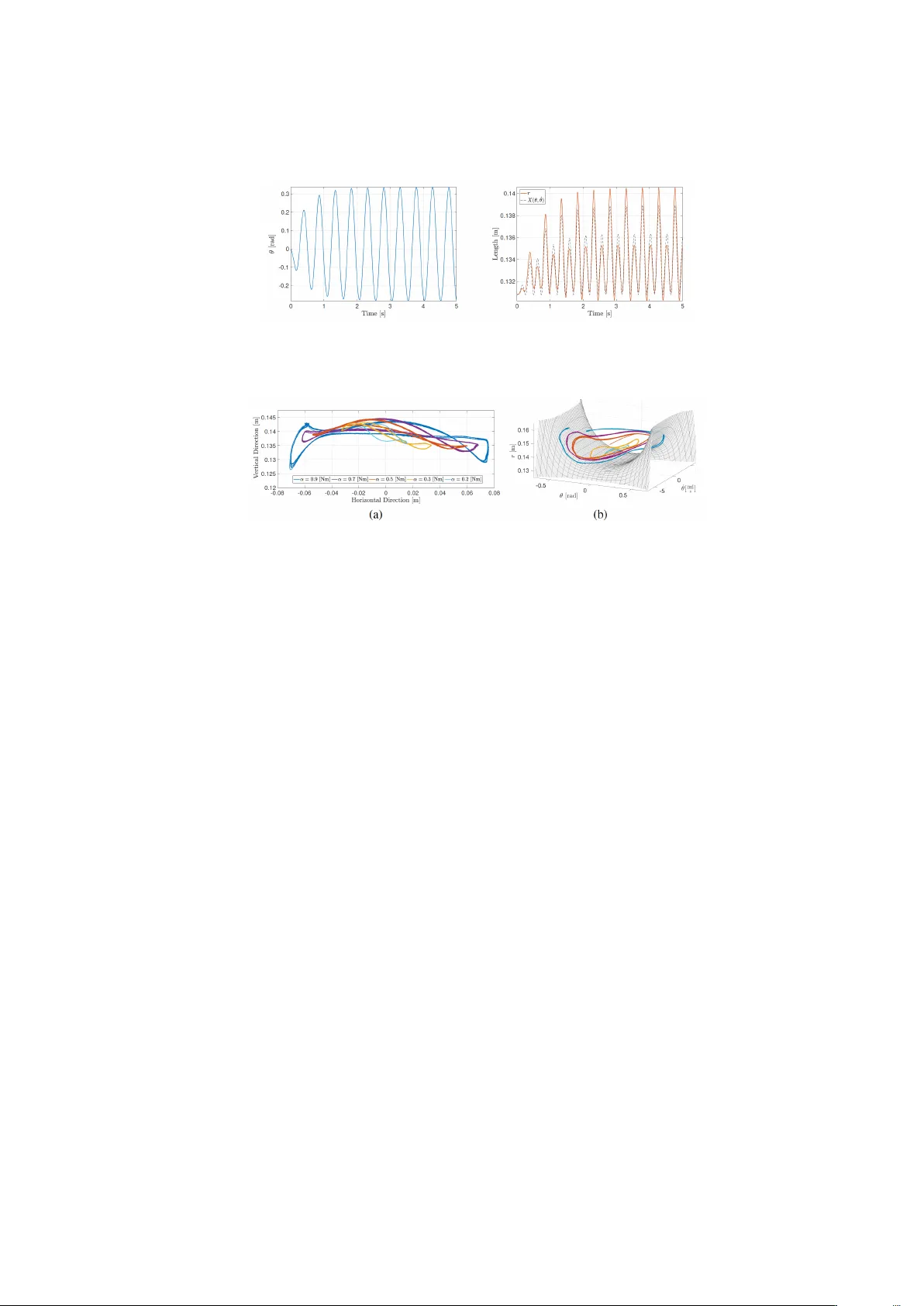
Using Nonlinear Normal Modes f or Execution of Efficient Cyclic Motions in Articulated Soft Robots Cosimo Della Santina 1 , Dominic Lakatos 1 , Antonio Bicchi 2 , Alin Albu-Schaef fer 1 1 Institute of Robotics and Mechatronics, German Aerospace Center (DLR), Oberpfaf fenhofen 82234, Germany , and T echnical Univ ersity of Munich cosimodellasantina@gmail.com, alin.Albu-Schaeffer@dlr.de 2 “Enrico Piaggio”, University of Pisa, Lar go Lucio Lazzarino 1, 56126 Pisa, Italy , and Department of Advanced Robotics, Istituto Italiano di T ecnologia, via More go, 30, 16163 Genov a, Italy What follows is an old v ersion of the manuscript. Y ou can find the final one at the following link: https://www.dropbox.com/s/x9a09gf38icu8sf/Using_ nonlinear_normal_modes_ISER.pdf?dl=0 Feel free to get in touch via c.dellasantina@tudelft.nl if you cannot get access. 1 Motivation, Pr oblem Statement, Related W ork Inspired by the vertebrate branch of the animal kingdom, articulated soft robots are robotic systems embedding elastic elements into a classic rigid (sk eleton-like) structure [6]. Lev eraging on their bodies elasticity , soft robots promise to push their limits far beyond the barriers that af fect their rigid counterparts. Ho wever , existing control strate- gies aiming at achieving this goal are either tailored on specific e xamples [7], or rely on model cancellations - thus defeating the purpose of introducing elasticity in the first place [3,5]. In a series of recent works, we proposed to implement efficient oscillatory motions in robots subject to a potential field, aimed at solving these issues. A main component of this theory are Eigenmanifolds, that we defined in [1] as nonlinear continuations of the classic linear eigenspaces. When the soft robot is initialized on one of these mani- folds, it ev olves autonomously while presenting regular - and thus practically useful - ev olutions, called normal modes. In addition to that, we proposed in [4] a control strat- egy making modal manifolds attractors for the system, and acting on the total energy of the soft robot to mov e from a modal ev olution to the other . In this way , a large class of autonomous behaviors can be excited, which are direct expression of the embodied intelligence of the soft robot. Despite the fact that the idea behind our work comes from physical intuition and preliminary experimental validations [8], the formulation that we have provided so far is ho we ver rather theoretical, and very much in need of an experimental validation. The aim of this paper is to provide such an experimental validation using as testbed the articulated soft leg in Fig. 1. W e will introduce a simplified control strategy , and we will test its effecti veness on this system, to implement swing-like oscillations. W e plan to extend this v alidation with a soft quadruped. 2 Della Santina et al. Fig. 1. Experimental setup: a 2-DoF (the upper part is constrained to stay vertical) segmented leg. The left panel sho ws also a sketch of the robot scheme with main quantities highlighted. The right panel shows the pole system constraining the upper part of the le g. 2 T echnical A pproach 2.1 Eigenmanifold: a v ery concise definition Building upon a theory laid down by more than one century of research in mathe- matics, physics, and engineering, in [1] we propose an extension of linear modes to robotics, which is then summarized in a coordinate dependent framew ork in [4]. W e must give those definitions for granted here, due to space limitations, and only pro- vide an intuitiv e introduction to the concept. Consider a mechanical system in the standard form M ( x ) ¨ x + C ( x , ˙ x ) ˙ x + G ( x ) = τ , where x ∈ R n are the configuration co- ordinates of the robot. M ( x ) , C ( x , ˙ x ) ∈ R n × n are the usual inertia and Coriolis matrices, and G ( x ) ∈ R n is the potential field. τ ∈ R n are the control inputs. The total energy is E ( x , ˙ x ) = x T M ( x ) x / 2 + V ( x ) , where V ( x ) is the potential associated to G ( x ) . An Eigenmanifold is a direct extension of an Eigenspace to this kind of nonlinear mechanical systems. It is defined by imposing to a curved surface many of the properties that define an eigenspace in the linear case. It is a two dimensional inv ariant subman- ifold of the configuration space ( x , ˙ x ) , which contains an equilibrium configuration of the robot. Also, it is such that any ev olution contained in it is periodic, it has a trajectory which is line-shaped, and it is unequiv ocally identified by its energy lev el. Consider an eigenspace of the linearized system at an equilibrium E S = Span { ( c , 0 ) , ( 0 , c ) } , with c ∈ R n . In [1] we show that we can always describe the Eigenmanifold prolonging this linear eigenspace as the set of states such that X ( x m , ˙ x m ) = x , ˙ X ( x m , ˙ x m ) = ˙ x , (1) where X and ˙ X are two functions from E S to R n describing the manifold geometry - called coordinate embedding - and ( x m , ˙ x m ) = ( c T x , c T ˙ x ) . In [1] we discuss ho w extract- ing ( X , ˙ X ) from E S . T itle Suppressed Due to Excessiv e Length 3 2.2 Exciting nonlinear oscillations with a simple feedback Let ( X , ˙ X ) be a coordinate embedding of an eigenmanifold. In [4] we proposed the fol- lowing feedback control to e xcite nonlinear oscillations in a robot subject to a potential field τ ( x , ˙ x ) = M ( x ) κ p ( X ( x m , ˙ x m ) − x ) + κ d ˙ X ( x m , ˙ x m ) − ˙ x + α τ E ( x , ˙ x , ¯ E ) . (2) The idea is to make the modal manifold an attractor by means of a PD-like action (first two terms), and then pick the right oscillation among all the av ailable ones through energy regulation (implemented by τ E ). The control gains are κ p , κ d , α ∈ R . The PD regulation is quite simple to implement, since X and ˙ X are just polynomial functions. Due to this simplicity , we experienced an high level of robustness when testing it in simulation. W e want to double-check this intuition e xperimentally here. The possibility of injecting or removing energy from the system allo ws to select the desired mode within the modal manifold, therefore increasing or decreasing the amplitude of oscillation. In [4], τ E ( x , ˙ x , ¯ E ) realizes energy regulation through the feed- back loop ˙ x ( ¯ E − E ( x , ˙ x )) . This is a more complex component to implement since the energy is a transcendental function of the state, and fundamentally realizes a form of strongly model dependent feedback. Since we want to bring this abstract theory on an experimental ground, we consider here an ev en simpler and more robust strategy . This is ef fecti vely the energy re gulation introduced in [4], reduced to its most essential com- ponents τ E = 0 if x m / ∈ [ x − m , x + m ] ∨ E ( X , ˙ X ) ∈ [ E − , E + ] 1 if x m ∈ [ x − m , x + m ] ∧ (( E ( X , ˙ X ) < E − ∧ ˙ x m > 0 ) ∨ ( E ( X , ˙ X ) > E + ∧ ˙ x m < 0 )) − 1 otherwise , (3) where E + > E − > 0, and x + m > 0 > x − m are scalar constants. This controller idea is shown in Fig. 2. Similar to a swing which is kept in persistent oscillations by an occasion push in the right direction, the idea is to inject or remove energy in small chunks until E ( x ( t )) reaches [ E − , E + ] . Note indeed that the conditions selecting the sign of the torque are such that the change of energy ˙ E = ˙ x T τ E is always positi ve when E ( X , ˙ X ) < E − and negati ve viceversa. Note that this strategy is akin to the well-kno wn swing up controller proposed in [2]. Although b uilt with the goal of being intuiti ve and robust, this control action mak es the closed loop system hybrid. Therefore the actual proof of con ver gence will require some effort which is beyond the scope of the present paper . Our aim here is instead to giv e experimental substantiation to the whole idea of exciting complex nonlinear oscillations by means of simple feedback control actions stabilizing Eigenmanifolds, and see which kind of lessons we can learn from this validation. 3 Experimental validation 3.1 Experimental setup As a first experimental validation of the proposed strategy , we consider here the soft segmented leg in Fig. 1. It is made of two links with same length b - considered here 4 Della Santina et al. Fig. 2. The state ev olves under the control action (3). When the system is in a neighborhood of equilibrium configuration x m = 0 (i.e. when it crosses the gray area), energy is injected by the controller , moving the system to another of its autonomous orbits. Eventually this brings the robot in the region of state space with the desired amount of ener gy . massless - and a main body - with mass m . Linear re volute springs act on both joints (mechanism not sho wn in figure). Please refer to [8] for more details on this system. The leg is mechanically constrained to evolv e on the Sagittal plane and the main body to remain v ertical, by the pole shown in the right part of Fig. 1. W e hypothesize infinite friction between the foot and the environment, so that the ground contact behavior is approximated with a rev olute joint. 3.2 The model, the mode, and the control algorithm W e are interested here in generating swing oscillations. W e describe the system config- uration through polar coordinates of the center of mass expressed w .r .t. the foot frame θ = x 1 / 2 + x 2 / 2, r = b p 2 ( 1 + cos ( x 1 − x 2 )) . The resulting dynamics has the following form ¨ θ = − 2 ˙ r ˙ θ / r + g sin ( θ ) / r − 2 γ θ / r 2 + τ θ / m , and ¨ r = r ˙ θ 2 − g cos ( θ ) − γ ( ϒ ( r ) − ϒ ( r 0 )) / √ 4 b 2 − r 2 + τ r / m where ϒ ( r ) = arccos 1 − r 2 / ( 2 b 2 ) , γ is the stif fness of both springs divided by the mass m , τ θ and τ r are the control actions, g is the gravity ac- celeartion, and r 0 is the unloaded length of the equiv alent spring. The system has an equilibrium in θ = 0 and ϒ ( r ) = ϒ ( r 0 ) − g / γ . Its linearized dynamics is ∆ ¨ θ ≃ k θ ∆ θ , and ∆ ¨ r ≃ k r ∆ r , with k θ , k r ∈ R being two constant v alues. The normal modes of the lin- earized system are therefore tw o decoupled ev olutions: an angular oscillation with fixed radius, and a radial oscillation with fixed angle. The nonlinear extension of the latter is trivial, since for θ ≡ 0 and ˙ θ ≡ 0 the dynamics collapses into a quasi-linear one, that we studied in [8]. The other mode instead turns into a more complex oscillation, that we in vestigate here. In this case c = ( 1 , 0 ) , i.e. x m = θ . W e approximate ( X , ˙ X ) as fourth order polynomials, solving in the Galerkin sense the tangency constraints introduced in [4]. T itle Suppressed Due to Excessiv e Length 5 Fig. 3. Nonlinear oscillations induced by the proposed algorithm on a segmented soft leg. Panels (a-e) present one oscillation for α = 0 . 3Nm, while panels (f-j) show the case of α = 0 . 9Nm. Quality of the figure reduced for the ArXiv v ersion 3.3 Experiments completed W e performed experiments for five dif ferent values of the orbit excitation gain α ; 0 . 2Nm, 0 . 3Nm, 0 . 5Nm, 0 . 7Nm, 0 . 9Nm. T ar get energy le vels are E − = 21J, E + = 22J. Due to dissipation, the desired level of energy could not be reached. Instead energy in- jected through τ E is compensated by dissipation. A different equilibrium is reached for each value of α . Fig. 3 sho ws oscillations resulting from two of the considered gains. Fig. 4 sho ws the e volution of θ and r for α = 0 . 5Nm. Control action is turned on at 0s. After a short transient lasting for about 2s, in which the algorithm pumps ener gy into the system, the segmented leg starts to evolv e according to a stable nonlinear oscillation. Actual and ideal trajectories - i.e. ( θ , ˙ θ , r , ˙ r ) and ( θ , ˙ θ , X ( θ , ˙ θ ) , ˙ X ( θ , ˙ θ )) respectiv ely - are quite close to each other , as shown by the right panel. Fig. 5 shows the evolutions of the center of mass in Cartesian coordinates, for all the considered v alues of α , and for a period of 15s. The bigger is the gain, the lar ger are the oscillations, and the higher is the energy level reached. The resulting oscillations and highly repeatable. Fig. 5 il- lustrates the evolutions superimposed to the ideal modal manifold, i.e. to the surface ( θ , r ) = X ( θ , ˙ θ ) . 3.4 Experiments scheduled W e plan to test the behavior of the system under external disturbances, to see if the algorithm is robust e ven to these conditions. Finally , we plan to test the algorithm on a quadruped b uilt using four of the abo ve discussed soft segmented legs, to see if the pro- posed control strategy can excite stable oscillations also in this more complex system. W e will also consider of preliminarily inv estigating if such oscillations can be used to implement locomotion patterns. 6 Della Santina et al. Fig. 4. Experimental ev olutions of ( θ , r ) , for α = 0 . 5Nm. The right panel reports also the ideal ev olution on the manifold X ( θ , ˙ θ ) for the measured e volution of θ , as a dashed gray line. Quality of the figure reduced for the ArXiv v ersion Fig. 5. Experimental trajectories Panel (a) sho ws the e volutions in Cartesian coordinates of the leg’ s center of mass. Panel (b) presents the same ev olutions in the space ( θ , ˙ θ , r ) . 15s of oscil- lations are considered. The ideal modal manifold r = X ( θ , ˙ θ ) is superimposed. Quality of the figure reduced for the ArXiv v ersion 4 Experimental Insights The experiments exhibit a quite dif ferent scenario than the one we could ha ve expected by looking at the problem from the pure lenses of theory . For a start, they suggest that the proposed strate gy can be used in practice to excite the normal modes of soft robots, generating stable and repeatable nonlinear oscillations also in the presence of many uncertainties and unmodeled dynamics in the controlled system - e.g. the actuators dy- namics, the moving contact with the ground, the non zero weight of the legs, inexact identification of system parameters, neglected friction effects. Moreov er , ˙ x 1 , ˙ x 1 is not being directly measured, but estimated through a high pass filter . Finally , the physical system is serially actuated, and the parallel elastic behavior needs to be implemented through an opportune input mapping. First, we map τ θ and τ r to torques acting on x 1 and x 2 via pre-multiplication for the transpose Jacobian of the change of variables. These torques are then realized by commanding to motors a displacement equal to the torques divided by the stiffness γ . These experiments also taught us some very important lessons on where to look for improvements. First and foremost, the final energy resulted as an equilibrium between α and dissipativ e effects, rather than due to some stopping condi- tion connected to the energy lev el E − that could never be reached. This is because the energy re gulator was built with a conservati ve system in mind. So experiments suggest that rather than improving the Eigenmanifold (e.g. to make it more global), it is prob- ably more practically meaningful to put some effort in dev eloping adaptive algorithms which can dynamically adjust the value of α so to reach a desired amplitude of oscil- T itle Suppressed Due to Excessiv e Length 7 lations. For what concerns the specific leg e xperiment instead, we sa w that mismatches from the manifold start to increase with high velocities, and that the oscillations are typically not perfectly symmetric (higher errors for positi ve v alues of δ ). This suggests that a model taking into account the le gs mass should be considered, therefore breaking the symmetry of ( X , ˙ X ) . Finally , we expect the scheduled experiments to provide fur - ther insights in how to make the controller even more robust, and on how to scale it up to very high dimensional conditions. References 1. Albu Schaef fer , A., Della Santina, C.: A tutorial on nonlinear modes in conservati ve mechan- ical systems. IF A C Annual Revie ws in Contorl Theory (2020 (under re view)) 2. ˚ Astr ¨ om, K.J., Furuta, K.: Swinging up a pendulum by energy control. Automatica 36 (2), 287– 295 (2000) 3. Buondonno, G., De Luca, A.: A recursiv e newton-euler algorithm for robots with elastic joints and its application to control. In: Intelligent Robots and Systems (IR OS), 2015 IEEE/RSJ International Conference on. pp. 5526–5532. IEEE (2015) 4. Della Santina, C., Alb u Schaef fer , A.: Combining eigenmanifold stabilization and ener gy re g- ulation for effici ent oscillations in nonlinear mechanical systems. CSS letters (2020 (under revie w)) 5. Della Santina, C., Bianchi, M., Grioli, G., Angelini, F ., Catalano, M.G., Garabini, M., Bicchi, A.: Controlling soft robots: Balancing feedback and feedforward elements. IEEE Robotics & Automation Magazine (2017) 6. Della Santina, C., Catalano, M.G., Bicchi, A.: Soft Robots. Springer Berlin Heidelberg, Berlin, Heidelberg (2020) 7. Hutter , M., Remy , C.D., H ¨ opflinger , M.A., Siegwart, R.: Slip running with an articulated robotic leg. In: Intelligent Robots and Systems (IROS), 2010 IEEE/RSJ International Con- ference on. pp. 4934–4939. IEEE (2010) 8. Lakatos, D., Friedl, W ., Albu-Sch ¨ affer , A.: Eigenmodes of nonlinear dynamics: Definition, existence, and embodiment into legged robots with elastic elements. IEEE Robotics and Au- tomation Letters 2 (2), 1062–1069 (2017)
Original Paper
Loading high-quality paper...
Comments & Academic Discussion
Loading comments...
Leave a Comment