Computation of the Distance-based Bound on Strong Structural Controllability in Networks
In this paper, we study the problem of computing a tight lower bound on the dimension of the strong structurally controllable subspace (SSCS) in networks with Laplacian dynamics. The bound is based on a sequence of vectors containing the distances be…
Authors: Mudassir Shabbir, Waseem Abbas, A. Yasin Yazicioglu
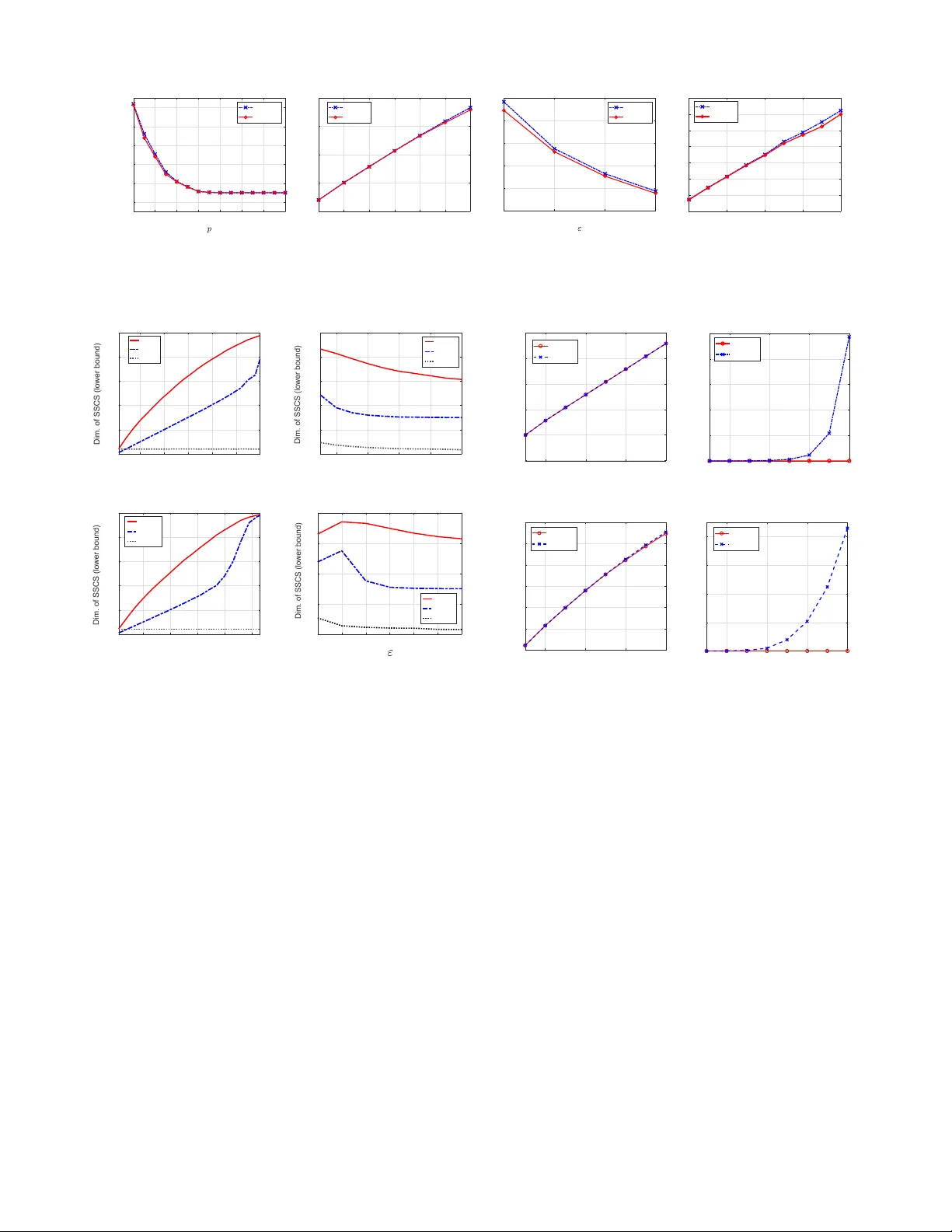
1 Computation of the Distance-based Bound on Str ong Structural Contr ollability in Networks Mudassir Shabbir , W aseem Abbas, Member , IEEE , A. Y asin Y azıcıo ˘ glu, Member , IEEE , Xenofon K outsoukos, F ellow , IEEE Abstract —In this paper , we study the problem of computing a tight lower bound on the dimension of the strong structurally controllable subspace (SSCS) in networks with Laplacian dy- namics. The bound is based on a sequence of vectors containing the distances between leaders (nodes with external inputs) and follo wers (r emaining nodes) in the underlying network graph. Such vectors are referred to as the distance-to-leaders vectors. W e give exact and appr oximate algorithms to compute the longest sequences of distance-to-leaders vectors, which directly pro vide distance-based bounds on the dimension of SSCS. The distance- based bound is known to outperf orm the other kno wn bounds (f or instance, based on zero-for cing sets), especially when the network is partially strong structurally controllable. Using these results, we discuss an application of the distance-based bound in solving the leader selection problem for strong structural controllability . Further , we characterize strong structural controllability in path and cycle graphs with a given set of leader nodes using sequences of distance-to-leaders vectors. Finally , we numerically e valuate our results on various graphs. Index T erms —Strong structural controllability , network topol- ogy , graph algorithms, dynamic programming. I . I N T RO D U C T I O N Network controllability has been an important research topic in network science and control. The notion of strong structural controllability accounts for the controllability of all such networks that have the same structure of an underlying network graph, that is, networks having the same vertex and edge sets b ut possibly dif ferent (non-zero) edge weights. A network is strong structurally controllable (SSC) with a gi ven set of input (leader) nodes if it is controllable for any choice of (non-zero) edge weights in the underlying network graph. There exist efficient algorithms to verify the strong structural controllability of networks [2]–[5]. If a netw ork is not SSC with a giv en set of leader nodes, it is of interest to determine how far the network is from becoming SSC, or roughly speaking, how much of the network is always controllable. More formally , this issue is concerned with computing the dimension of the str ong structur ally contr ollable subspace (SSCS) (defined in Section II-A), which is related to an NP- M. Shabbir is with the Electrical Engineering and Computer Science at the V anderbilt University , Nashville, TN, USA. E-mail: mudassir@vanderbilt.edu . W . Abbas is with the Department of Systems Engineering at the University of T exas at Dallas, Richardson, TX, USA. E-mail: waseem.abbas@utdallas.edu . X. Koutsoukos is with the Electrical Engineering and Computer Science Department at the V anderbilt Uni versity , Nashville, TN, USA. E-mail: xenofon.koutsoukos@vanderbilt.edu . A. Y . Y azıcıo ˘ glu is with the Department of Electrical and Computer Engineering at the Univ ersity of Minnesota, Minneapolis, MN, USA. E-mail: ayasin@umn.edu Some preliminary results appeared in [1]. hard problem of finding the minimum rank of a structure (or pattern) matrix [6]–[8]. In this paper , we study the problem of computing a tight lower bound on the dimension of SSCS of networks with Laplacian dynamics. Since the exact computation of is challenging, various bounds hav e been proposed in the literature [5], [9]–[12]. Here, we consider a tight lo wer bound proposed in [10], which relates the notion of strong structural controllability to the distances between nodes in the underlying network graph. In [13], we compare this distance-based bound with another widely used bound based on the notion of zero-forcing sets [5], [12], [14], [15]. Our analysis in [13] shows that the distance-based bound is typically better than the zero-forcing-based bound, especially when the network is not completely strong structurally controllable. Additionally , the distance-based bound can be applied in e xploring the trade-off between controllability and robustness in networks with Laplacian dynamics [16], edge augmentation in networks while preserving their strong structural controllability [17] and designing a leader selection algorithm [10]. It also has applications for target controllability in linear networks, where the goal is to control a subset of agents (targets) instead of the entire network by injecting input through leader nodes [11], [14]. Despite advantages, ef ficient computation of the distance- based bound has been an issue, especially in large networks. T o compute the distance-based bound on the dimension of SSCS, an algorithm has been presented in [10] that takes O ( m n ) time, where n is the total number of nodes in the network and m is the number of leader nodes. Here, we present an algorithm that takes O ( m ( n log n + n m )) time to compute the distance-based bound, which is a significant improvement. W e note that for a fixed number of leaders, the algorithm is polynomial in the number of nodes. For instance, in the case of two leaders, our algorithm takes O ( n 2 ) time as compared to the O (2 n ) runtime of the algorithm in [10]. When the number of leaders is on the order of n , the algorithm will take exponential time. F or such cases, we also present a gr eedy algorithm that approximates the distance-based bound and runs in O ( mn log n ) time. In our experiments, we observe that the bound returned by the greedy algorithm is very close to the optimal in almost all cases. The main idea of the distance-based bound is to obtain distances between leaders and other nodes, arrange them in vectors called distance-to-leaders vectors , and then construct a sequence of such vectors, called as Pseudo-monotonically incr easing (PMI) sequence , which satisfies some monotonicity conditions (as explained in Section II-B). Computing distances between nodes is straightforward; ho wev er , constructing an 2 appropriate PMI sequence, whose length provides a bound on the dimension of SSCS, is computationally challenging. W e provide ef ficient algorithms with performance guarantees to compute such sequences. Contributions: W e provide dynamic programming-based exact algorithm that runs in O ( m ( n log n + n m )) time to com- pute an optimal PMI sequence of distance-to-leaders vectors consisting of distances between leaders and other nodes. Here m and n denotes the number of leaders and nodes, respec- tiv ely . The length of the sequence directly giv es a tight lower bound on the dimension of SSCS of networks with Laplacian dynamics. W e also propose an approximation algorithm that computes a near-optimal PMI sequence of distance-to-leaders vectors in practice and takes O ( mn log n ) time. If there exists a PMI sequence of distance-to-leaders vectors of length n , then the network is strong structurally controllable and the greedy algorithm always returns such a sequence. Further , W e analyze PMI sequences of distance-to-leaders v ectors in paths and c ycles with arbitrary leaders. W e also discuss the application of distance-based bound in solving the leader selection problem for strong structural controllability and also provide a numerical ev aluation of results. A. Related W ork The notion of strong structural controllability was intro- duced in [18], and the first graph-theoretic condition for single-input systems was presented. For multi-input systems, [19] provided a condition to check strong structural controlla- bility in O ( n 3 ) time, where n is the number of nodes. Authors in [3] refined previous results and further provided a char- acterization of strong structural controllability . An algorithm based on constrained matching in bipartite graphs with time complexity O ( n 2 ) was giv en in [2] to check if the system is strong structurally controllable with given inputs. In [4], an algorithm with a runtime linear in the number of nodes and edges was presented to verify whether a system is strong structurally controllable. The relationship of strong structural controllability and zero forcing sets (ZFS) was explored in [5], [20], and it was established that checking if a system is strong structurally controllable with given input nodes is equiv alent to checking if the set of input nodes is a ZFS in the underlying graph. If a network is not strong structurally controllable, then the notion of strong structurally controllable subspace (SSCS) [11], [14], which is an extension of the ordinary controllable subspace, is particularly useful to quantify controllability . In fact, the dimension of such a subspace (formally described in Section II-A) quantifies how much of the network is con- trollable in the strong structural sense (that is, independently of edge weights) with a giv en set of inputs. Some lower bounds on the dimension of SSCS hav e been proposed in the literature. In [14], a lower bound based on the deriv ed set of input nodes (leaders) was presented, which was further studied in [12], [15]. With a single input node, the dimension of SSCS can be at least the diameter of the underlying network graph [9]. In [10], a tight lower bound on the dimension of SSCS was proposed that was based on the distances between leaders and other nodes in the graph. The bound was used to explore the trade-off between strong structural controllability and netw ork rob ustness in [16]. Further studies in this direction include enumerating and counting strong structurally control- lable graphs for a given set of network parameters (leaders and nodes) [21], [22], leader selection to achiev e desired structural controllability (e.g., [23]–[31]), and network topology design for a desired control performance (e.g., [32]–[36]). The rest of the paper is organized as follo ws: Section II introduces notations and preliminary concepts. Section III provides dynamic programming-based exact algorithm to com- pute a distance-based bound on the dimension of SSCS. Section IV presents and analyzes a greedy approximation algorithm. Section V discusses application of the bound to the leader selection problem. Section VI discusses cases of path and cycle graphs. Section VII provides a numerical ev aluation of results, and Section VIII concludes the paper . I I . P R E L I M I NA R I E S W e consider a network of n dynamical agents represented by a simple (loop-free) undirected graph G = ( V , E ) where the node set V = { v 1 , v 2 , . . . , v n } represents agents, and the edge set E represents interconnections between agents. 1 An edge between v i , v j ∈ V is denoted by e ij . The neighborhood of node v i is N i , { v j ∈ V : e ij ∈ E } . The distance between v i and v j , denoted by d ( v i , v j ) , is simply the number of edges on the shortest path between v i and v j . R + is the set of positi ve real numbers. The weight function w : E → R + (1) assigns positi ve weight w ( e ij ) to the edge e ij . These weights define the coupling strength between nodes. Each agent v i ∈ V has a state x i ( t ) ∈ R at time t and the ov erall state of the system is x ( t ) = x 1 ( t ) x 2 ( t ) · · · x n ( t ) T ∈ R n . The agents up- date states following the Laplacian dynamics, ˙ x ( t ) = − L w x ( t ) + B u ( t ) , (2) where L w ∈ R n × n is the weighted Laplacian matrix of G and is defined as L w = ∆ − A w . Here, A w ∈ R n × n is the weighted adjacency matrix defined as [ A w ] ij = w ( e ij ) if e ij ∈ E , 0 otherwise, (3) and ∆ ∈ R n × n is the de gr ee matrix whose entries are [∆] ij = P n k =1 [ A w ] ik if i = j 0 otherwise. (4) The matrix B ∈ R n × m in (2) is an input matrix , where m is the number of leaders (inputs), which are the nodes to which external control signals are applied. Let V ` = { 1 , 2 , · · · , m } ⊆ V be the set of leaders , then [ B ] ij = 1 if v i = j 0 otherwise. (5) 1 The results presented can be extended to directed networks in a straight- forward manner as the distance-based bound on the dimension of SSCS holds true for directed networks also [10, Remark 3.1]. 3 A. Str ong Structural Contr ollability A state x f ∈ R n is a r eachable state if there e xists an input u that can drive the network in (2) from any initial state x i to x f in a finite amount of time. A netw ork G = ( V , E ) in which edges are assigned weights according to the weight function w in (1), and contains V ` ⊆ V leaders is called completely contr ollable if e very point in R n is reachable. Complete controllability can be checked by computing the rank of the contr ollability matrix , Γ( L w , B ) = [ B ( − L w ) B ( − L w ) 2 B · · · ( − L w ) n − 1 B ] . The network is completely controllable if and only if the rank of Γ( L w , B ) is n , and in such case ( L w , B ) is called a contr ollable pair . The range space of Γ( L w , B ) describes the set of all reachable states, also called the controllable subspace. Thus, the rank of Γ( L w , B ) is the dimesnion of the controllable subspace. Note that edges in G define the structure —location of zero and non- zero entries in the Laplacian matrix—of the underlying graph, for instance, see Figure 1. The rank of resulting controllability matrix depends on the weights assigned to edges. For a giv en graph G = ( V , E ) and leaders V ` , rank (Γ( L w , B )) could be different from rank (Γ( L w 0 , B )) , where w and w 0 are two different choices of weight functions. v 1 v 2 v 3 v 4 v 5 v 6 × × × 0 0 0 × × × × 0 0 × × × 0 × 0 0 × 0 × × 0 0 0 × × × × 0 0 0 0 × × Fig. 1: A graph and its structured Laplacian matrix. A network G = ( V , E ) with V ` leaders is str ong structurally contr ollable if and only if ( L w , B ) is a controllable pair for an y choice of weight function w , or in other words, rank (Γ( L w , B )) = n for all weight functions w . At the same time, the dimension of str ong structur ally controllable subspace (SSCS) , denoted by γ ( G, V ` ) , is γ ( G, V ` ) = min w ( rank Γ( L w , B )) . (6) The minimum is taken over all weight functions w in (1). Thus, γ ( G, V ` ) is the minimum dimension of the controllable subspace that can be attained from G with V ` leaders and any choice of feasible edge weights. B. Distance-based Lower Bound on the dimension of SSCS W e use a tight lower bound on the dimension of SSCS as proposed in [10]. The bound is based on the distances between nodes in a graph. Assuming m leaders V ` = { 1 , · · · , m } , we define a vector of non-negati ve integers called as the distance- to-leaders vector for a node v i ∈ V as D i = d ( 1 , v i ) d ( 2 , v i ) · · · d ( m , v i ) T . The j th component of D i , denoted by [ D i ] j , is d ( j , v i ) , the distance between leader j and the node v i . Next, we define a sequence of distance-to-leaders vectors, called as pseudo- monotonically increasing sequence below . Definition ( Pseudo-monotonically Incr easing (PMI) Sequence) Let D be a sequence of distance-to-leaders vectors and D i be the i th vector in the sequence. W e denote the j th component of the vector D i by [ D i ] j . Then, D is PMI if for every D i in the sequence, there exists some π ( i ) ∈ { 1 , 2 , · · · , m } such that [ D i ] π ( i ) < [ D j ] π ( i ) , ∀ j > i, (7) i.e., the above condition needs to be satisfied for all the subsequent distance-to-leader vectors D j appearing after D i in the sequence. Here, m is the number of leaders. W e say that D i satisfies the PMI pr operty at coordinate π ( i ) whene ver [ D i ] π ( i ) < [ D j ] π ( i ) , ∀ j > i . An example of distance-to-leaders v ectors is illustrated in Figure 2. A PMI sequence of length five is D = 3 0 , 2 1 , 0 3 , 2 2 , 1 3 . (8) Indices of circled v alues in (8) are the coordinates at which the corresponding distance-to-leaders vectors are satisfying the PMI property . The length of the longest PMI sequence of distance-to-leaders vectors is related to the dimension of SSCS as stated in the following result. 0 3 1 3 v 1 v 2 v 3 v 4 v 5 v 6 1 2 2 2 2 1 3 0 v 6 Fig. 2: A network with two leaders V ` = { 1 , 2 } = { v 1 , v 6 } , along with the distance-to-leaders v ectors of nodes. A PMI sequence of length fi ve is D = [ D 1 D 2 · · · D 5 ] = [ D 6 D 5 D 1 D 4 D 2 ] . Theorem 2.1: [10] If δ ( G, V ` ) is the length of the longest PMI sequence of distance-to-leaders vectors in a network G = ( V , E ) with leaders V ` , then δ ( G, V ` ) ≤ γ ( G, V ` ) . (9) W e note that for a given graph G = ( V , E ) and leader nodes V ` ⊆ V , the length of the longest PMI sequence describes the minimum dimension of the controllable subspace for any feasible edge weights. In other words, if the length of the longest PMI is k ≤ n , then the dimension of the controllable subspace of the system is at least k , regardless of the edge weights. Moreover , the bound in (9) is tight, as discussed in [10]. For instance, for path graphs in which one of the end nodes is a leader , and for cycle graphs in which two adjacent nodes are leaders, we have δ ( G, V ` ) = γ ( G, V ` ) . the dimension of SSCS and the length of the longest PMI sequence of distance-to-leaders vectors are equal, and hence δ ( G, V ` ) = γ ( G, V ` ) . W e discuss the length of the longest 4 PMI sequences of distance-to-leaders vectors in path and cycle graphs with arbitrary leaders in Section VI. Our main goal is to compute a PMI sequence of maximum length, and consequently , a lower bound on the dimension of SSCS. W e provide an exact algorithm in Section III and a greedy approximation algorithm in Section IV. I I I . E X AC T A L G O R I T H M F O R T H E D I S TA N C E B O U N D In this section, we provide a dynamic programming-based exact algorithm to compute a longest PMI sequence of distance-to-leaders vectors and, as a result, a distance-based lower bound on the dimension of SSCS. W e note that each distance-to-leaders vector D i can be viewed as a point in Z m , and without loss of generality , we may assume that points D i are distinct . Otherwise, we can throw away multiple copies of the same point since duplicate points can not satisfy the PMI property on any coordinate. The following observ ation is crucial to our algorithms. Observation 3.1: Giv en a set of points D 1 , D 2 , . . . , D n , if there exists a point D i and an index j such that [ D i ] j < [ D i 0 ] j for all D i 6 = D i 0 , then D i is a unique minimum point in the direction (coordinate) j and there is a longest PMI sequence which starts with D i . Howe v er , it is possible that there is no unique minimum in any direction. This leads us to the definition of a conflict and conflict-partition . Definition (Conflict-partition) A conflict is a set of points X that can be partitioned into X 1 , X 2 , . . . , X m such that all points D p ∈ X j hav e [ D p ] j = [ D q ] j if D q ∈ X j , and [ D p ] j ≤ [ D q ] j if D q / ∈ X j . Further , |X j | > 1 for all j . Such a partition is called conflict-partition or c-partition for short. 2 An example of conflict is illustrated in Figure 3. ` i ` j v 1 v 3 v 2 v 6 v 9 v 8 v 7 v 4 i j D 3 D 4 D 2 D 1 v 5 D 5 Fig. 3: A graph with two leaders and a plot of distance- to-leaders vectors as points in a plane. Point set X = { D 1 , D 2 , D 3 , D 4 , D 5 } constitutes a conflict, where X i = { D 3 , D 4 , D 5 } and X j = { D 1 , D 2 } . It is easy to see that a PMI sequence can not contain all points in a conflict. In fact, we can strictly bound the number of points from a conflict that can be included in a PMI sequence. Lemma 3.2: Let X 1 , X 2 , . . . , X m be a c-partition of a conflict X for a giv en set of points. Then any PMI sequence contains at most |X | − min( |X 1 | , |X 2 | , . . . , |X m | ) + 1 points from X . Pr oof: Let k j = |X j | for all 1 ≤ j ≤ m for the partition defined in the statement, then for the sake of contradiction, 2 In general, parts of a partition do not intersect. For the lack of a better term, we are slightly abusing this term in the sense that parts ( X i ) intersect at most one element. let’ s assume that there is a sequence D 0 that contains more points from X . Let D p ∈ X j be a point that appears first in D 0 . If D p satisfies PMI property on j th coordinate then the remaining k j − 1 points with the same minimum j th coordinate in X j can not be included in D 0 . So D p must satisfy PMI property on some j 0 th coordinate for the following points in the sequence, where j 0 6 = j . But then D 0 must miss at least k j 0 points that ha ve smaller or equal j 0 coordinate by the definition of conflict, which is a contradiction. Thus, the claim follows. As an e xample, consider a set of points X = { D 1 , D 2 , D 3 , D 4 , D 5 } in Figure 3. There are two points with the minimum j th coordinate and three points with the minimum j 0 th coordinate (where j 0 = i ). If D 1 is picked as first point (among this set), we must either drop D 2 or all D 3 , D 4 , D 5 for future consideration in the PMI sequence. Similarly if D 3 is picked before e v eryone else, we can not pick either of D 4 , D 5 , or any of D 1 , D 2 for future consideration re- gardless of the other points. Note that the bound in Lemma 3.2 is tight: if we remo ve |X j | − 1 points from the smallest part of a c-partition, all remaining points can satisfy the PMI property on coordinate j unless some of these remaining points are included in any other conflict. In the following, we use the following notations: • Ł j denotes a list of points ordered by the non-decreasing j th coordinate. • Ł j i denotes the i th point in the list Ł j , and • Ł j i,k is the (integer) value of k th coordinate of Ł j i . 3 Let D be a set of n points in Z m . W e can sort all points with respect to all coordinates beforehand, so our algorithm will get m lists { Ł 1 , Ł 2 , . . . , Ł m } of n points each as input. Next, we design an algorithm that is based on dynamic programming to compute the lower bound δ ( G, V ` ) in polynomial runtime when the number of leaders is fixed. Let { c 1 , c 2 , . . . , c m } be a set of non-negativ e integers and D [ c 1 ,c 2 ,...,c m ] be a longest PMI sequence in which the value at j th coordinate of any point is at least c j . Let α [ c 1 ,c 2 ,...,c m ] be the length of such a sequence. Our algorithm will memoize on α [ c 1 ,c 2 ,...,c m ] . In the absence of conflict, Observation 3.1 guarantees that we can start our sequence with any point with the unique min- imum value in some fixed coordinate. Howe ver , as suggested by Lemma 3.2, in case of a conflict, we cannot include all points to PMI. Thus, we need to include some of the points and exclude others. The longest PMI sequence can be found by computing m subsequences corresponding to m coordinates and taking the maximum. W e conclude that α [ c 1 ,c 2 ,...,c m ] can be obtained by the following recurrence: α [ c 1 ,c 2 ,...,c m ] = max 1 ≤ j ≤ m ( α [ c 1 ,c 2 ,...,c j +1 ,...,c m ] + 1 c j ) , (10) where 1 c j = 1 if ∃ D p s.t. [ D p ] j = c j and [ D p ] 0 j ≥ c j 0 , ∀ j 0 6 = j. 0 otherwise. (11) 3 W e recommend to use linked priority queues or similar data structure for these lists so that one could easily delete a point from lists while maintaining respectiv e orders in logarithmic time. 5 (a) (b) (c) (d) (e) Fig. 4: The figure illustrates possible scenarios for PMI recurrence as used in the dynamic program with two leaders. Assume the origin of these figures to be (0 , 0) . In the case (a) there are separate points along both coordinates, so we hav e A 0 , 0 = max( A 0 , 1 + 1 , A 1 , 0 + 1) . In the case (b) there are two points along x and one point along y , so we have A 1 , 1 = max( A 1 , 2 + 1 , A 2 , 1 + 1) . Note that point (1 , 1) is minimum along both x and y coordinates. In the case (c) there are two points along y and one point along x , so A 3 , 1 = max( A 3 , 2 + 1 , A 4 , 1 + 1) . In Figure (d), there is a point along x and a point along y (same point in this case), so we have A 3 , 2 = max( A 3 , 3 + 1 , A 4 , 2 + 1) . In case (e) there is a point in x coordinate but no point along y , so A 1 , 3 = max( A 1 , 4 + 1 , A 3 , 3 + 0) . W e plan to pre-compute and memoize all requir ed values of α [ c 1 ,...c d ] in a table. Clearly there are infinitely many possible values for c j ; howe ver , we observe the following: Observation 3.3: Let Ł j i,j and Ł j i,j +1 be the j th coordinate values of two consecutive points in Ł j , then α [ c 1 ,c 2 ,...,x,...,c m ] = α [ c 1 ,c 2 ,..., Ł j i,j +1 ,...,c m ] , for all x , such that Ł j i,j < x ≤ Ł j i,j +1 . Observation 3.3 implies that there are at most n different values for each v ariable c j , which gives at most n unique values for α [ c 1 ,c 2 ,...,c m ] . Thus, we only keep a table of size n m for computation and storage of solutions to all sub-problems. For some intuition on the working of dynamic program in Algorithm 1, we refer the reader to Figure 4. W e now state and prove the main result of this section: Theorem 3.4: Given a graph G on n vertices, and m leaders, Algorithm 1 returns a longest PMI sequence of distance-to-leaders vectors in O ( m ( n log n + n m )) time. Pr oof: The correctness of Algorithm 1 follows from Obser - vation 3.1, Observation 3.3, and Lemma 3.2 so all that remains is to prove the time complexity . Computing sorted lists Ł 1 , Ł 2 , . . . , Ł m takes O ( mn log n ) time. Each value of A c 1 ,c 2 ,...,c m can be computed by taking the maximum of m known values pre viously computed, and saved in multi- dimensional array A . The v alue of 1 c j can be computed in constant time by checking whether element at the last index of Ł j has j th coordinate equal to c j as defined in (11). The multi-dimensional array A contains at most n m values at the completion each of which takes constant amount of time to Algorithm 1 PMI - Dynamic Program 1: procedur e PMI-DP (Ł 1 , Ł 2 , . . . , Ł m ) 2: z j be number of unique v alues of j th coordinate among all points. 3: z = max( z 1 , z 2 , . . . , z m ) 4: Define a m -dimensional array A with dimensions ( z + 1) × ( z + 1) × . . . ( z + 1) 5: Let A c 1 ,c 2 ,...,c m , i.e. v alue of A at index set c 1 , c 2 , . . . , c m represents α [ c 1 ,c 2 ,...,c m ] as in (10). 6: for k from 1 to m do 7: A c 1 ,c 2 ,...,c m ← 0 for c k = z , c k 0 ≤ z , k 0 6 = k . 8: end for 9: for j from z − 1 to 0 do 10: for k from 1 to m do 11: Compute A c 1 ,c 2 ,...,c m for c k = j, c k 0 ≤ j, k 0 6 = k using (10). 12: end for 13: end for 14: retur n A 0 , 0 ,..., 0 15: end procedur e compute. Therefore running time of this algorithm is bounded by O ( m ( n log n + n m )) . Appendix illustrates the algorithm through an example. Remark 3.5: W e note that an exact algorithm to compute the longest PMI sequence in O ( m n ) w as proposed in [10]. Since m is much smaller than n typically , the dynamic programming solution in Algorithm 1 computes the longest PMI sequence in a much lesser O ( m ( n log n + n m )) time. I V . L I N E A R I T H M I C T I M E A P P ROX I M AT I O N A L G O R I T H M F O R T H E D I S TA N C E - BA S E D B O U N D In this section, we discuss a greedy algorithm that takes linearithmic time to approximate the lo wer bound δ ( G, V ` ) . The algorithm giv es very close approximations in practice, as illustrated numerically in Section VII. W e also discuss the approximation guarantees of the algorithm. The main idea behind the greedy algorithm is to make locally optimal choices when faced with the situation in Lemma 3.2, that is, when including a point in PMI results in discarding a subset of points from possible future consider - ation. In this case, the best thing to do locally is to pick a point that results in the loss of the minimum number of other points. The details are provided in Algorithm 2. W e also provide an illustration of this algorithm in the Appendix. Proposition 4.1: Algorithm 2 computes a PMI sequence in O ( mn log n ) time. The length of the PMI sequence returned by the algorithm is a min( m, n m ) -approximation to the optimal length, where m is the number of leaders and n is the total number of nodes. Further , the approximation ratio of PMI lengths is log n if m ≤ log n or m ≥ n log n . Pr oof: Regarding the time complexity , computing sorted lists Ł 1 , Ł 2 , . . . , Ł m takes O ( m × n log n ) time. Once we have m sorted lists, we can keep the indices and count of points with the minimum coordinate v alue in ( m + 1 ) Min-Priority queues ( m queues to maintain lists Ł 1 , Ł 2 , . . . , Ł m and one queue for 6 Algorithm 2 PMI-Greedy Algorithm 1: procedur e PMI-G R E E D Y (Ł 1 , Ł 2 , . . . , Ł m ) 2: D ← ∅ Initially empty sequence 3: while Ł 1 6 = ∅ do 4: X j ← { Ł j i : Ł j i,j = L j 1 ,j } for all j . 5: if ∃ j such that | X j | = 1 then Unique min. 6: D ← [ D X j ] 7: Remov e X j from all lists. 8: else 9: Let j 0 ← arg min j | X j | Get smallest X j 10: D ← [ D Ł j 0 1 ] 11: Remov e all points in X j 0 from all lists. 12: end if 13: end while 14: retur n D 15: end procedur e X 1 , X 2 , . . . , X m ). Cost of one update , or delete operation is O (log n ) in a Priority queue. Since we will update and/or delete at most n points from m queues. In total we will perform at most m × n deletions and m × n updates, thus, the overall time complexity is O ( mn log n ) . Regarding the m -approximation ratio, we observe that there are at least n m different values in at least one coordinate. Otherwise, we may assume that we hav e at most n m − 1 unique values in each coordinate. This would imply that there are at most ( n m − 1) × m distinct points by the pigeonhole principle, which contradicts that we hav e n unique points. As Algorithm 2 picks all distinct values in any coordinate, the returned PMI sequence has a size of at least n m . Note that there is at least one unique minimum point (corresponding to the leader itself) in each of m directions, so the algorithm is ( n m ) -approximation as well. It is e vident that when m is at most log n , there are at least n log n different values in at least one coordinate by the same argument. T o see why log n -approximation ratio holds when m is large, note that there is at least one unique minimum point (corresponding to the leader itself) in each of m directions so when m ≥ n log n , the algorithm will include all of those unique points in the returned PMI sequence. Thus, the approximation ratio follows. If there exists a PMI sequence of length n , then the network is strong structurally controllable with a giv en set of leaders. The greedy algorithm presented above always returns a PMI sequence of length n if there exists one. Lemma 4.2: If there exists a PMI sequence of length n , then Algorithm 2 always returns an optimal PMI. Pr oof: W e observe that if there exists a PMI sequence of length n , then by Lemma 3.2, we can not have a conflict as defined in Section III. In the absence of any conflict, we can always find a unique minimum point along some coordinate. Consequently , in Algorithm 2, statements in else will never be executed and algorithm will return a PMI sequence of length n . Remark 4.3: While in many cases, Algorithm 2 achieves a solution close to optimum, we observe that examples can be constructed for which a greedy solution may not be globally optimal. In the example outlined in Figure 5, we ha ve two leaders and points are placed at S = { (2 , 2) , (2 , 3) , (3 , 3) , (3 , 4) , (4 , 4) , . . . , ( k + 1 , k + 1) , ( k + 1 , k + 2) , ( k + 2 , k + 2) } and at T = { (1 , 2) , (1 , 3) , (1 , 4) , . . . , (1 , k + 2) } . An optimal PMI has all 2 k points while Algorithm 2 abov e may only pick k + 3 points. 4 2 k + 2 3 1 . . . k + 1 1 2 3 · · · k k + 1 k + 2 . . . 4 Fig. 5: Example discussed in Remark 4.3. V . A P P L I C AT I O N : L E A D E R S E L E C T I O N F O R S T R O N G S T RU C T U R A L C O N T R O L L A B I L I T Y In this section, we briefly discuss an application of com- puting the distance-based bound in approximately solving a leader selection problem for strong structural controllability , which is intractable to solve e xactly [2], [8], [11]. The problem of finding the minimum number of leaders to make a network strong structurally controllable is kno wn to be NP-complete [2], [11]. Here, we consider the problem of finding a set V ` of m leaders that maximizes the dimension of SSCS, i.e., maximize V ` ⊆ V γ ( G, V ` ); subject to | V ` | = m. (12) In light of (9), the distance-based bound δ ( G, V ` ) can be used to obtain an approximate solution to such a leader selection problem by solving maximize V ` ⊆ V δ ( G, V ` ); subject to | V ` | = m. (13) Any solution to the problem in (13), V ∗ ` , ensures that the resulting dimension of SSCS is at least δ ( G, V ∗ ` ) . While the problem in (13) is still hard to solve due to its combinatorial nature, an approximate solution can be obtained by utilizing an algorithm for computing δ ( G, V ` ) . W e present a simple greedy heuristic for leader selection for strong structural controllablity using PMI sequences of distance-to-leaders vectors in a graph. Giv en a network G and the number of leaders m as inputs, the main idea is to iterativ ely select leaders that maximally increase the length of resulting PMI sequences. The outline of the heuristic is in Algorithm 3. The time complexity of Algorithm 3 depends on the com- plexity of computing a PMI sequence with a giv en set of lead- ers. Using the algorithm in [10] to compute PMI sequences, the complexity of Algorithm 3 is O ( n × m n ) , which means the algorithm is practically infeasible ev en for m = 2 . Using Al- gorithm 1 (dynamic programming) to compute PMI sequences, the time complexity of Algorithm 3 is O ( n 2 log n + m × n m +1 ) , which is a significant improv ement. The first term in this expression is the cost of sorting the distance lists and the 7 Algorithm 3 Greedy Leader Selection Algorithm 1: procedur e L E A D E R -S E L E C T ( G, m ) 2: V ` ← ∅ , V 0 ← V 3: for i ← 1 to m do 4: for each v ∈ V 0 do 5: Compute PMI sequence with V ` ∪ { v } leaders. 6: end for 7: Choose v 0 ∈ V 0 that giv es a PMI sequence of maximum length with V ` ∪ { v 0 } leaders. 8: V ` ← V ` ∪ { v 0 } . 9: V 0 ← V 0 \ { v 0 } . 10: end for 11: end procedur e second term is the cost of computing n PMI sequences when the leader set includes m nodes (the iteration when i = m ) as this dominates the cost of all previous iterations. Howe ver , leader selection in Algorithm 3 can be achiev ed in O ( m 2 n 2 log n ) time if we use Algorithm 2 to compute PMI sequences. Section VII-C provides numerical ev aluation of the leader selection algorithm (Algorithm 3) that uses exact/greedy algorithm to compute δ ( G, V ` ) to approximately solve (13). V I . B O U N D S I N P A T H S A N D C Y C L E S In this section, we explore connections between graph- theoretic properties and the length of the longest PMI in path and cycle graphs. As a result, we show interesting topological bounds on the dimension of SSCS in such graphs with a giv en set of leader nodes. W e note that our results differ from previous works in this direction in tw o aspects: first, we specif- ically study the strong structural controllability of such graphs; second, instead of focusing on complete controllability , we provide tight bounds on the dimension of SSCS e ven when the graph is not strong structurally controllable with a giv en set of leaders (e.g., [37], [38]). Recall that a node with a single neighbor is called leaf . Moreov er , given G = ( V , E ) and V 0 ⊂ V , then the subgraph of G induced on V 0 is the graph whose vertex set is V 0 , and the edge set consists of all of the edges in E that hav e both endpoints in V 0 . W e start with the following obvious fact. F act 6.1: A path graph in which a leaf is a leader has a PMI sequence of length n . Theorem 6.2: Let G be a path graph on n nodes, let V ` be a set of m ≤ n leader nodes, and let G − V ` denote the subgraph of G induced on vertices V \ V ` . Then the following holds: (i) If the number of connected components in G − V ` is less than m + 1 , then the longest PMI sequence induced by V ` has length n . (ii) If the number of connected components in G − V ` is m + 1 , then V ` induces a PMI sequence of length n − a , where a is the size of the smallest connected component in G − V ` . Pr oof: (i) Removal of a node from a path results in at most tw o connected components. Hence, G − V ` has at most m + 1 such components. If the number of components is less than m + 1 , either one of the leader nodes is a leaf, or at least two leaders are adjacent. If a leaf x is chosen as a leader, then by Fact 6.1, we can get a PMI sequence of length n . Assuming none of the leaders is a leaf node, let v i and v i +1 be adjacent leader nodes; further assume that i < n/ 2 without loss of generality . W e will construct a PMI sequence of length n based on these two leaders as follows. 0 1 , 1 0 , 1 2 , 2 1 , · · · , i − 1 i , i i − 1 , i + 1 i , i + 2 i + 1 , · · · , n − i n − i − 1 (ii) If the smallest connected component X contains either of the leaf nodes, then G − X has a leaf leader node and thus has a PMI sequence of length n − | X | by Fact 6.1. If X doesn’t contain leaf nodes, then there exist two leader nodes v i , v j are adjacent to some nodes in X . Also, assume that v i is not farther away from a leaf node than v j is. Then, the following sequence of distance-to-leaders vectors defines a PMI sequence of claimed length. 0 a + 1 , a + 1 0 , 1 a + 2 , a + 2 1 , · · · , i − 1 a + i , a + i i − 1 , a + i + 1 i , a + i + 2 i + 1 , · · · , n − i n − i − a − 1 Theorem 6.3: Let G be a cycle on n nodes, let V ` be a set of 2 ≤ m ≤ n leader nodes, and let G − V ` denote the subgraph of G induced on vertices V \ V ` . Then, the following holds: (i) If the number of connected components in G − V ` is less than m , then the longest PMI sequence induced by V ` has length n . (ii) If the number of connected components in G − V ` is exactly m , then V ` induces a PMI sequence of length n − a , where a is the size of the smallest connected component in G − V ` . Pr oof: (i) Removing a single node from a cycle does not affect the number of connected components. Howe ver , the remov al of every subsequent node will result in at most one extra component. Thus, the total number of connected components is at most m after the removal of m nodes. If the number of components is less than m in G − V ` , then at least two nodes in V ` are neighbors in G . Let v 1 and v 2 be an arbitrary adjacent pair in V ` . W e will construct a PMI sequence of length n based on these two leaders. Consider the nodes in G with the following distance-to-leaders vectors: h 0 1 , 1 0 , 1 2 , 2 1 , · · · , n 2 − 1 n 2 , n 2 n 2 − 1 i when n is ev en, and h 0 1 , 1 0 , 1 2 , 2 1 , · · · , b n 2 c b n 2 c i when n is odd. This defines a PMI sequence of length n . (ii) An argument identical to proof of Theorem 6.2(ii) can be used here to prove (ii) as well. Theorems 6.2 and 6.3 imply graph-theoretic bounds on the dimension of SSCS for path and cycle graphs. A path (cycle) graph is strong structurally controllable with V ` leaders if 8 G − V ` has m + 1 components ( m components in a cycle). Another direct implication of the above results is as follows. Corollary 6.4: Let G be a path or cycle graph and let V ` be a set of leaders, then the dimension of SSCS is at least n − a , where a is the smallest distance between an y two leader nodes. V I I . N U M E R I C A L E V A L U A T I O N In this section, we numerically ev aluate our results on Erd ¨ os-R ´ enyi (ER) and Barab ´ asi-Albert (BA) graphs. In ER graphs, any two nodes are adjacent with a probability p . BA graphs are obtained by adding nodes to an existing graph one at a time. Each new node is connected to ε existing nodes with probabilities proportional to the degrees of those nodes. A. Comparison of Algorithms First, we compare the performance of the exact dynamic programming algorithm (Algorithm 1) and the approximate greedy algorithm (Algorithm 2) for computing the maximum- length PMI sequences. F or simulations, we consider graphs with n = 200 nodes. For ER graphs, we first plot the length of PMI sequences computed by using Algorithms 1 and 2 as a function of p while fixing the number of leaders (selected randomly) to be eight (Figure 6(a)). Second, we fix p = 0 . 075 , and plot the length of PMI sequences as a function of the number of leaders selected randomly (Figure 6(b)). W e repeat similar plots for BA graphs in Figures 6(c) and 6(d). W e fix the number of leaders to be eight in Figure 6(c) and set ε = 2 in Figure 6(d). Each point in the plots in Figure 6 corresponds to the average of 50 randomly generated instances. From the plots, it is clear that the greedy algorithm, which is much faster than the DP algorithm, performs almost as good as the DP algorithm. The length of PMI sequences returned by the greedy algorithm is very close to the length of the longest PMI sequences. B. Comparison of Bounds Next, we numerically compare our distance-based bound with another well kno wn bound on the dimension of SSCS based on the notion of zero-forcing sets (ZFS) [5], [14]. First, we explain the notion of ZFS. Giv en a graph G = ( V , E ) in which each node is colored either white or blac k , we repeatedly apply the following coloring rule: If v ∈ V is colored black and has one white neighbor u , then the color of u is chang ed to black. Now , given an initial set of black nodes (called input set ) in G , derived set V 0 ⊆ V is the set of all black nodes obtained after repeated application of the coloring rule until no color changes are possible. It is easy to see that for a giv en input set, the resulting derived set is unique. The input set is called a ZFS if the corresponding derived set contains all nodes in V . It is sho wn in [5], [14] that for a giv en set of leader nodes as input set, the size of the corresponding deriv ed set is a lower bound on the dimension of SSCS. In our simulations in Figure 7, for both ER and B A models, we consider graphs with n = 100 nodes. In Figure 7(a), we plot these bounds for ER graphs as a function of the number of leaders, which are selected randomly , while fixing p = 0 . 1 . Next, we fix the number of leaders to be 30 in Figure 7(b) and plot bounds as a function of p . As pre viously , each point in the plots is an average of 50 randomly generated instances. It is obvious that distance-based bound significantly outperforms the ZFS-based bound in all the cases. Similar results are obtained in the case of BA graphs, where we fix ε = 4 in Figure 7(c), and select the number of leaders to be 30 in Figure 7(d). In all the plots, for a giv en set of leaders, lengths of PMI sequences are always greater than the derived sets; thus, distance-based bound on the dimension of SSCS is better than the one based on the derived sets. C. Leader Selection W e implement Algorithm 3 to illustrate the application of proposed algorithms to the leader selection problem giv en in (13). Again, the networks were generated for both ER and B A models with n = 60 nodes. In order to compute the length of the longest PMI sequence, we use the bounds returned by the dynamic programming solution and the greedy algo- rithm. W e compare the respecti ve bounds on the dimension of SSCS and the computation times of the two algorithms. The results of our experiments are sho wn in Figure 8. The resulting bounds are plotted against the number of leaders in Figures 8(a) and 8(c), and the running times are plotted in Figures 8(b) and 8(d). Each point in the plots corresponds to the average of 20 runs. For both graph families, the bounds computed by the two algorithms are almost identical, but the greedy algorithm has the advantage of superior runtime that becomes more pronounced as the number of leaders increases. V I I I . C O N C L U S I O N W e studied the computational aspects of a lower bound on the dimension of SSCS in networks with Laplacian dynamics. The bound is based on a sequence of distance-to-leaders vectors and has se veral applications. W e proposed an algorithm that runs in O ( n m ) time (compared to O ( m n ) runtime of the algorithm in [10]) to compute the bound. W e also presented a linearithmic approximation algorithm to compute the bound, which provided near-optimal solutions in practice. Further , we explored connections between the graph-theoretic properties and the distance-based bound in path and cycle graphs using the results. W e plan to use these results to explore further the trade-offs between controllability and other desirable network properties, such as robustness and resilience to perturbations. W e also believ e that finding the longest PMI sequence of a giv en set of vectors is an interesting problem in its own respect as it naturally generalizes Erd ¨ os-Szekeres type sequences to higher dimensions [39]–[41]. A P P E N D I X Illustration of Dynamic Pr ogramming Algorithm (Algorithm 1) For illustration, we consider the same graph as in Figure 1 of the paper, where V ` = { v 1 , v 6 } . The example run is described in Figure 9. The values of j and k denote the loop variables in lines 9 and 10 of the Algorithm 1 respectively . In each iteration of j , one column and one row of the memoization 9 0.05 0.1 0.15 0.2 0.25 0.3 0.35 0.4 16 18 20 22 24 26 PMI seq. length DP Greedy (a) ER 2 3 4 5 6 7 8 No. of leaders 5 10 15 20 25 PMI seq. length DP Greedy (b) ER 2 3 4 5 20 22 24 26 28 30 PMI seq. length DP Greedy (c) BA 2 4 6 8 10 No. of leaders 5 10 15 20 25 30 35 40 PMI seq. length DP Greedy (d) BA Fig. 6: Comparison of Algorithm 1 (dynamic programming) and Algorithm 2 (greedy) for computing the distance-based bound. 10 20 30 40 50 60 No. of leaders 0 20 40 60 80 100 SSC lower bound PMI ZFS Diam (a) ER ( p = 0 . 1 ) 0.04 0.06 0.08 0.1 0.12 p 0 20 40 60 80 100 SSC lower bound PMI ZFS Diam (b) ER ( | V ` | = 30 ) 10 20 30 40 50 No. of leaders 0 20 40 60 80 100 SSC lower bound PMI ZFS Diam (c) BA ( ε = 4) 1 2 3 4 5 6 7 m 0 20 40 60 80 SSC lower bound PMI ZFS Diam (d) BA ( | V ` | = 30 ) Fig. 7: Comparison of the distance-based and ZFS-based lo wer bounds on the dimension of SSCS in ER and B A graphs. The total number of nodes in all graphs is 100. The diameters of graphs (denoted by Diam) are also plotted. variable A is updated as shown in matrices in Figure 9. In fact, the value of each cell in the matrix is computed from values in the neighboring cells to the right and belo w using (10). For instance, A 1 , 0 is computed from A 1 , 1 (neighboring cell on the right) and A 2 , 0 (neighboring cell belo w). The first entry of the matrix, that is, A 0 , 0 , returns the length of the longest PMI sequence. Illustration of Greedy Algorithm (Algorithm 2) W e illustrate it on the same graph as in Figure 1 of the paper . Note that Ł j is a list of points (distance-to-leaders vectors) that are sorted in a non-decreasing order with respect to the j th coordinate. In our example, such lists are giv en below . Ł 1 = 0 3 , 1 2 , 1 3 , 2 1 , 2 2 , 3 0 ; Ł 2 = 3 0 , 2 1 , 1 2 , 2 2 , 0 3 , 1 3 . 2 4 6 8 No. of leaders 0 4 8 12 16 Dim. of SSCS (lower bound) Greedy DP (a) ER ( p = 0 . 3 ) 2 4 6 8 No. of leaders 0 25 50 75 100 125 Time (seconds) Greedy DP (b) ER ( p = 0 . 3 ) 2 4 6 8 No. of leaders 5 10 15 20 25 30 35 Dim. of SSCS (lower bound) Greedy DP (c) BA ( ε = 2 ) 2 4 6 8 No. of leaders 0 50 100 150 200 Time (seconds) Greedy DP (d) BA ( ε = 2 ) Fig. 8: Comparison of the leader selection algorithm with the greedy computation and the exact computation (dynamic programming (DP)) of the distance-based bound. The total number of nodes in all graphs is 60. The sets X 1 and X 2 (line 4 of the algorithm) are nh 0 3 io and nh 3 0 io respectiv ely , as also shown in Figure 10(b). Since both sets contain a unique minimum, the algorithm arbi- trarily includes one of these two points in the sequence, that is, h 3 0 i in this case. In the next two steps, the points h 2 1 i and h 0 3 i are included in the sequence. In the next step illustrated in Figure 10(e), the sets X 1 and X 2 are nh 1 2 i , h 2 2 io and nh 1 2 i , h 1 3 io respectiv ely . Since there is no unique minimum, cardinalities of X 1 and X 2 are compared (line 9 in the Algorithm 2) and a point from a smaller set will be chosen. In this example, h 2 2 i is chosen. The sequence returned by the algorithm is as follows: D = 3 0 , 2 1 , 0 3 , 2 2 , 1 3 . 10 j 3 2 1 0 k 1 2 1 2 1 2 1 2 c 1 = 3 c 2 = 3 c 1 = 2 c 2 = 2 c 1 = 1 c 2 = 1 c 1 = 0 c 2 = 0 c 2 ∈ { 0 , 1 , 2 , 3 } c 1 ∈ { 0 , 1 , 2 , 3 } c 2 ∈ { 0 , 1 , 2 } c 1 ∈ { 0 , 1 , 2 } c 2 ∈ { 0 , 1 } c 1 ∈ { 0 , 1 } c 2 = 0 c 1 = 0 A 3 , 3 = 0 A 3 , 3 = 0 A 2 , 2 = 1 A 2 , 2 = 1 A 1 , 1 = 3 A 1 , 1 = 3 A 0 , 0 = 5 A 0 , 0 = 5 A 3 , 2 = 0 A 2 , 3 = 0 A 2 , 1 = 2 A 1 , 2 = 2 A 1 , 0 = 4 A 0 , 1 = 4 A 3 , 1 = 0 A 1 , 3 = 1 A 2 , 0 = 3 A 0 , 2 = 3 A 3 , 0 = 1 A 0 , 3 = 2 4 3 2 1 0 0 0 0 0 0 0 1 2 3 4 0 0 0 0 1 0 0 0 0 1 2 4 3 2 1 0 0 0 0 0 0 0 1 2 3 4 0 0 0 0 1 0 0 0 0 1 2 1 2 3 3 2 4 3 2 1 0 0 0 0 0 0 0 1 2 3 4 0 0 0 0 1 0 0 0 0 1 2 1 2 3 3 2 4 4 3 4 3 2 1 0 0 0 0 0 0 0 1 2 3 4 0 0 0 0 1 0 0 0 0 1 2 1 2 3 3 2 4 4 3 5 Fig. 9: Illustration of the run of Algorithm 1 for the graph in Figure 1 with leaders V ` = { v 1 , v 6 } . ` 1 ` 2 0 1 2 3 1 2 3 1 ` 2 ` 1 (a) (b) (c) ` 1 ` 2 (d) ` 2 ` 1 (e) ` 1 ` 2 (f ) Fig. 10: Illustration of the greedy algorithm (Algorithm 2). R E F E R E N C E S [1] M. Shabbir, W . Abbas, and A. Y azıcıo ˘ glu, “On the computation of a lower bound on strong structural controllability in networks, ” in 58th IEEE Conference on Decision and Contr ol , 2019, pp. 5468–5473. [2] A. Chapman and M. Mesbahi, “On strong structural controllability of networked systems: A constrained matching approach. ” in American Contr ol Conference (A CC) , 2013, pp. 6126–6131. [3] J. C. Jarczyk, F . Svaricek, and B. Alt, “Strong structural controllability of linear systems revisited, ” in 50th IEEE Confer ence on Decision and Contr ol and European Contr ol Conference (CDC-ECC) , 2011. [4] A. W eber , G. Reissig, and F . Svaricek, “ A linear time algorithm to verify strong structural controllability , ” in 53rd IEEE Conference on Decision and Control (CDC) , 2014, pp. 5574–5580. [5] N. Monshizadeh, S. Zhang, and M. K. Camlibel, “Zero forcing sets and controllability of dynamical systems defined on graphs, ” IEEE T r ansactions on Automatic Contr ol , vol. 59, pp. 2562–2567, 2014. [6] M. Fazel, H. Hindi, and S. Boyd, “Rank minimization and applications in system theory , ” in Pr oceedings of the American control conference (ACC) , v ol. 4, 2004, pp. 3273–3278. [7] S. M. Fallat and L. Hogben, “The minimum rank of symmetric matrices described by a graph: a surve y , ” Linear Algebra and its Applications , vol. 426, no. 2-3, pp. 558–582, 2007. [8] A. Bhangale and S. Kopparty , “The complexity of computing the minimum rank of a sign pattern matrix, ” , 2015. [9] S. Zhang, M. Cao, and M. K. Camlibel, “Upper and lower bounds for controllable subspaces of networks of diffusiv ely coupled agents, ” IEEE T r ansactions on Automatic contr ol , vol. 59, pp. 745–750, 2014. [10] A. Y azıcıo ˘ glu, W . Abbas, and M. Egerstedt, “Graph distances and controllability of networks, ” IEEE T ransactions on Automatic Control , vol. 61, no. 12, pp. 4125–4130, 2016. [11] H. J. V an W aarde, M. K. Camlibel, and H. L. T rentelman, “ A distance- based approach to strong target control of dynamical networks, ” IEEE T r ansactions on Automatic Contr ol , vol. 62, pp. 6266–6277, 2017. [12] S. S. Mousavi, M. Haeri, and M. Mesbahi, “On the structural and strong structural controllability of undirected networks, ” IEEE Tr ansactions on Automatic Contr ol , vol. 63, no. 7, pp. 2234–2241, 2018. [13] Y . Y azıcıo ˘ glu, M. Shabbir, W . Abbas, and X. K outsoukos, “Strong structural controllability of diffusiv ely coupled networks: Comparison of bounds based on distances and zero forcing, ” in IEEE Confer ence on Decision and Contr ol (CDC) , 2020, pp. 566–571. [14] N. Monshizadeh, K. Camlibel, and H. Trentelman, “Strong targeted controllability of dynamical networks, ” in 54th IEEE Conference on Decision and Contr ol (CDC) , 2015, pp. 4782–4787. [15] S. S. Mousa vi and M. Haeri, “Controllability analysis of networks through their topologies, ” in 55th IEEE Confer ence on Decision and Contr ol (CDC) , 2016, pp. 4346–4351. [16] W . Abbas, M. Shabbir, A. Y . Y azıcıo ˘ glu, and A. Akber , “Trade-of f between controllability and robustness in dif fusiv ely coupled networks, ” IEEE T ransactions on Control of Network Systems , 2020. [17] W . Abbas, M. Shabbir, H. Jaleel, and X. Koutsouk os, “Improving network robustness through edge augmentation while preserving strong structural controllability , ” in Annual American Contr ol Conference (ACC) , 2020, pp. 2544–2549. [18] H. Mayeda and T . Y amada, “Strong structural controllability , ” SIAM Journal on Contr ol and Optimization , vol. 17, pp. 123–138, 1979. [19] K. Reinschke, F . Svaricek, and H.-D. W end, “On strong structural controllability of linear systems, ” in 31st IEEE Confer ence on Decision and Control (CDC) , 1992, pp. 203–208. [20] M. Trefois and J.-C. Delvenne, “Zero forcing number , constrained matchings and strong structural controllability , ” Linear Algebra and its Applications , vol. 484, pp. 199–218, 2015. [21] S. O’Rourke and B. T ouri, “On a conjecture of godsil concerning con- trollable random graphs, ” SIAM Journal on Contr ol and Optimization , vol. 54, no. 6, pp. 3347–3378, 2016. [22] T . Menara, G. Bianchin, M. Innocenti, and F . P asqualetti, “On the number of strongly structurally controllable networks, ” in American Contr ol Conference (A CC), 2017 , 2017, pp. 340–345. [23] A. Y . Y azıcıo ˘ glu and M. Egerstedt, “Leader selection and network assembly for controllability of leader-follo wer networks, ” in American Contr ol Conference (A CC) , 2013, pp. 3802–3807. [24] A. Olshevsky , “Minimum input selection for structural controllability , ” in American Contr ol Conference (A CC) , 2015, pp. 2218–2223. [25] K. Fitch and N. E. Leonard, “Optimal leader selection for controllability and robustness in multi-agent networks, ” in European Control Confer- ence (ECC) , 2016, pp. 1550–1555. 11 [26] V . Tzoumas, M. A. Rahimian, G. J. Pappas, and A. Jadbabaie, “Minimal actuator placement with bounds on control ef fort, ” IEEE T ransactions on Control of Network Systems , vol. 3, pp. 67–78, 2016. [27] C. Commault and J.-M. Dion, “Input addition and leader selection for the controllability of graph-based systems, ” Automatica , vol. 49, no. 11, pp. 3322–3328, 2013. [28] A. Clark, B. Alomair, L. Bushnell, and R. Poo vendran, “Submodularity in input node selection for networked linear systems: Efficient algorithms for performance and controllability , ” IEEE Contr ol Systems Magazine , vol. 37, no. 6, pp. 52–74, 2017. [29] S. Pequito, S. Kar, and A. P . Aguiar, “On the complexity of the constrained input selection problem for structural linear systems, ” Au- tomatica , vol. 62, pp. 193–199, 2015. [30] C. Commault, J. V an der W oude, and P . Frasca, “Functional tar get con- trollability of networks: structural properties and ef ficient algorithms, ” IEEE T ransactions on Network Science and Engineering , 2019. [31] G. Li, X. Chen, P . T ang, G. Xiao, C. W en, and L. Shi, “T arget control of directed networks based on network flo w problems, ” IEEE T ransactions on Control of Network Systems , 2019. [32] C. O. Aguilar and B. Gharesifard, “Graph controllability classes for the laplacian leader-follo wer dynamics, ” IEEE transactions on automatic contr ol , vol. 60, no. 6, pp. 1611–1623, 2015. [33] S. Pequito, G. Ramos, S. Kar, A. P . Aguiar , and J. Ramos, “The robust minimal controllability problem, ” Automatica , vol. 82, 2017. [34] S. S. Mousavi, M. Haeri, and M. Mesbahi, “Robust strong structural controllability of networks with respect to edge additions and deletions, ” in American Contr ol Conference (A CC) , 2017. [35] M. Xue and S. Roy , “Input-output properties of linearly-coupled dynami- cal systems: Interplay between local dynamics and network interactions, ” in 56th IEEE Confer ence on Decision and Control , 2017, pp. 487–492. [36] C. Commault, “Structural controllability of networks with dynamical structured nodes, ” IEEE T ransactions on Automatic Control , vol. 65, no. 6, 2020. [37] G. Parlangeli and G. Notarstef ano, “On the reachability and observability of path and cycle graphs, ” IEEE T ransactions on Automatic Contr ol , vol. 57, no. 3, pp. 743–748, 2012. [38] X. Liu and Z. Ji, “Controllability of multiagent systems based on path and cycle graphs, ” International Journal of Robust and Nonlinear Contr ol , vol. 28, no. 1, pp. 296–309, 2018. [39] P . Erd ¨ os and G. Szekeres, “ A combinatorial problem in geometry , ” Compositio Mathematica , vol. 2, pp. 463–470, 1935. [40] W . Samotij and B. Sudakov , “On the number of monotone sequences, ” Journal of Combinatorial Theory , Series B , vol. 115, pp. 132–163, 2015. [41] N. Linial and M. Simkin, “Monotone subsequences in high-dimensional permutations, ” Combinatorics, Probability and Computing , vol. 27, no. 1, pp. 69–83, 2018.
Original Paper
Loading high-quality paper...
Comments & Academic Discussion
Loading comments...
Leave a Comment