Computation of the phase step between two-step fringe patterns based on Gram--Schmidt algorithm
We present the evaluation of a closed form formula for the calculation of the original step between two randomly shifted fringe patterns. Our proposal extends the Gram--Schmidt orthonormalization algorithm for fringe pattern. Experimentally, the phas…
Authors: Victor H. Flores, Mariano Rivera
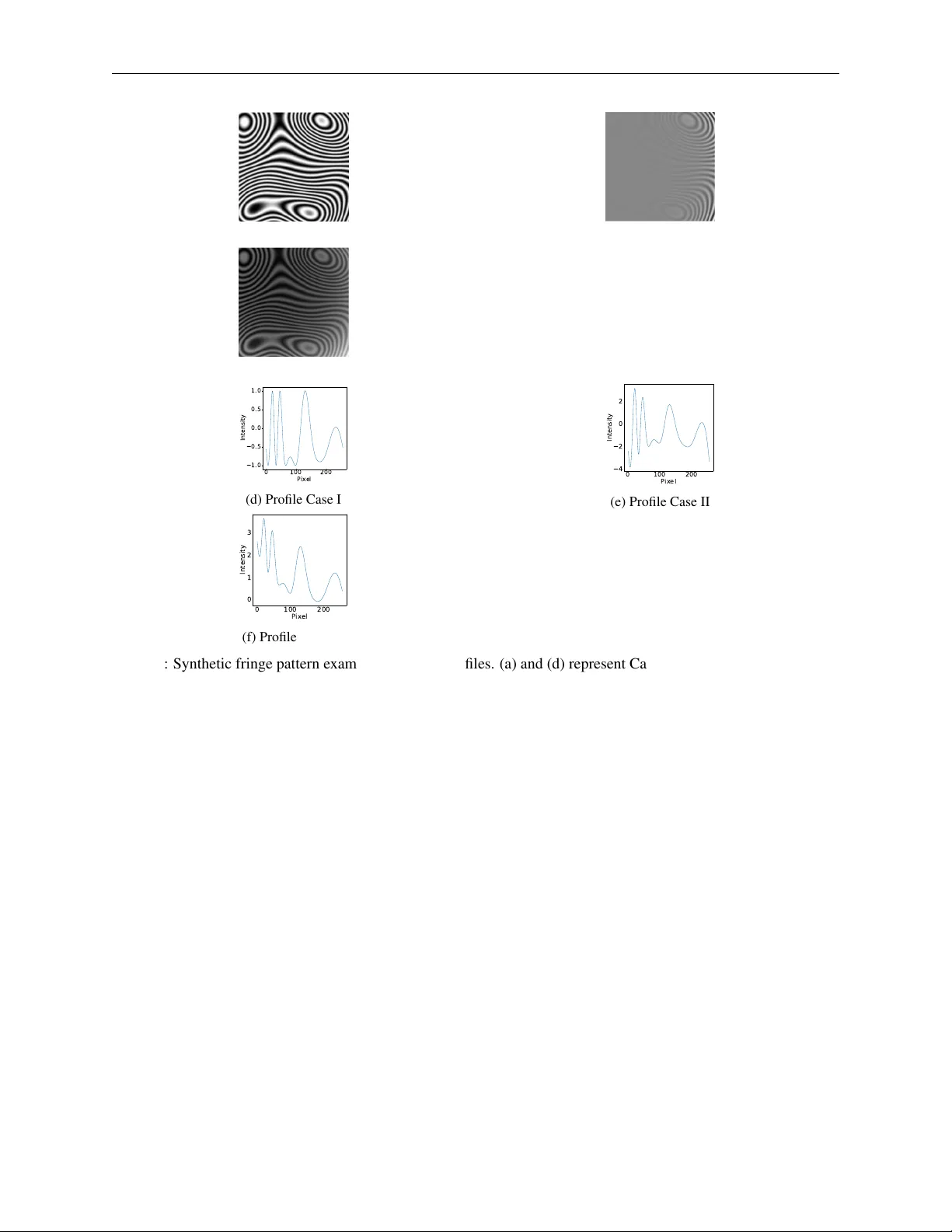
C O M P U T A T I O N O F T H E P H A S E S T E P B E T W E E N T W O - S T E P F R I N G E PA T T E R N S B A S E D O N G R A M – S C H M I D T A L G O R I T H M A P R E P R I N T Víctor H. Flores ∗ Department of Computer Science Centro de In vestigación en Matemáticas A C Guanajuato, MX 36023 victor.flores@cimat.mx Mariano Rivera Department of Computer Science Centro de In vestigación en Matemáticas A C Guanajuato, MX 36023 mrivera@cimat.mx March 13, 2019 A B S T R AC T W e present the ev aluation of a closed form formula for the calculation of the original step between two randomly shifted fringe patterns. Our proposal e xtends the Gram–Schmidt orthonormalization algorithm for fringe pattern. Experimentally , the phase shift is introduced by a electro–mechanical devices (such as piezoelectric or moving mounts).The estimation of the actual phase step allo ws us to improv e the phase shifting device calibration. The ev aluation consists of three cases that represent different pre-normalization processes: First, we ev aluate the accuracy of the method in the orthonormalization process by estimating the test step using synthetic normalized fringe patterns with no background, constant amplitude and dif ferent noise levels. Second, we e valuate the formula with a variable amplitude function on the fringe patterns b ut with no background. Third, we e valuate non-normalized noisy fringe patterns including the comparison of pre-filtering processes such as the Gabor filter banks and the isotropic normalization process, in order to emphasize how the y affect in the calculation of the phase step K eywords T wo-Step · Phase Shifting · Gram–Schmidt 1 Introduction The phase shifting method is a well-known technique for the retrie val of the phase from interferometric images [ 1 , 2 ]. Experimentally , these phase shifts are induced using methods such as mirror displacement using a piezoelectric. Mathematically , the intensity model of n phase–shifted interferograms is giv en by I k ( x ) = a ( x ) + b ( x ) cos[ φ ( x ) + δ k ] + η k ( x ) , (1) where k ∈ 1 , 2 , . . . , n is the interferogram index, x = ( x 1 , x 2 ) is the vector of the pixel coordinates, a and b are the background and the amplitude functions of the interferograms respecti vely , φ is the phase to be recovered, δ k is the phase step and η k is the noise function. For the case of two–step algorithms we can assume that δ 1 = 0 and δ 2 = δ . The main issue is the calibration of this components by creating the relation between the applied v oltage and the induced phase shift, for this reason, the Gram-Schmidt (GS )orthonormalization algorithm [ 3 ] is widely used. This algorithm does not require to kno w the original phase step between the two interferograms since the patterns are orthogonalized in order to compute two interferograms in quadrature (with a phase shift of π / 2 between them). Nev ertheless, the GS algorithm relies on the normalization of the fringes through a pre-filtering process [ 4 ], which makes it sensitiv e to error if the fringes are not correctly normalized. ∗ viktorhfm@gmail.com Computation of the phase step between two-step fringe patterns based on Gram–Schmidt algorithm A P R E P R I N T In this paper we propose a method for estimating the arbitrary phase step between tw o phase shifted fringe patterns. Our method is based on the Gram–Schmidt algorithm and calculates the arbitrary step with a closed form formula. The proposal consists on e valuating the effects of the v ariation of background and the amplitude functions as well as the adv antages of using the Gabor filter banks[ 5 ] as pre-filtering process. The computation of the original phase step allo ws us to improving the phase shifting de vice calibration (in general, a piezoelectric). 2 Brief re view of Gram–Schmidt orthonormalization for inducing quadratur e The GS orthonormalization based method, proposed by V argas et al. , calculates the phase between tw o interferograms with unknown step. In this work, we simplify the FP normalization preprocess and assume that just the background intensity variations and noise are remov ed [5, 4, 6]. So we start with the process the normalized interferograms: u 1 = b cos( φ ) (2) u 2 = b cos( φ + δ ) , (3) where we omitted the spatial dependency for the vectors u 1 , u 2 , b and φ in order to simplify our notation. According to Ref. [3], the orthonormalization process consists on 3 steps. First, u 1 is normalized as: ˜ u 1 = b cos φ k b cos φ k . (4) Then, u 2 is orthogonalized with respect to ˜ u 1 obtaining its projection as ˆ u 2 : ˆ u 2 = u 2 − h u 2 , ˜ u 1 i ˜ u 1 = − b sin δ [sin φ − κ ] (5) where h· , ·i represents the inner product and we define κ def = cos φ h b cos φ, b sin φ i h b cos φ, b cos φ i . (6) Since, it is expected that h b cos φ, b sin φ i << h b cos φ, b cos φ i , then κ can be neglected and one has ˆ u 2 ≈ − b sin δ sin φ. (7) Afterwards, ˆ u 2 is normalized: ˜ u 2 = − b sin φ k b sin φ k . (8) Finally , by assuming k b cos φ k ≈ k b sin φ k (because the fringes are just shifted but the contribution of v alleys and hills remains almost constant), the wrapped phase is computed with ˆ φ = arctan 2 − ˜ u 2 ˜ u 1 . (9) 3 Calculation of the step Herein we introduce the extension to GS algorithm to estimate the actual phase step. For this purpose, we consider that the amplitud term b ( x ) remains spatially dependent and we estimate the b v alue using the computed phase ˆ φ as: b ( x ) = u 1 ( x ) cos[ ˆ φ ( x )] . (10) Now , we substitute (10) in (7), resulting in: ˆ u 2 ( x ) = − u 1 ( x ) sin δ tan[ ˆ φ ( x )] + . (11) Afterwards, we use (9) and obtain ˜ u 1 ( x ) ˆ u 2 ( x ) = u 1 ( x ) ˜ u 2 ( x ) sin δ + ˜ u 1 ( x ) . (12) 2 Computation of the phase step between two-step fringe patterns based on Gram–Schmidt algorithm A P R E P R I N T Component Case I Case II Case III A 0 0 a ( x ) B 1 b ( x ) b ( x ) η ( x ) X X X T able 1: Cases of study for the step calculation Thus, a δ –map can be computed with sin[ δ ( x )] = ˜ u 1 ( x ) u 1 ( x ) ˜ u 2 ( x ) [ ˆ u 2 ( x ) + ] (13) Then, the phase step δ can be estimated by taking the e xpectation: δ = arcsin ( E x { m ( x ) } ) (14) where we defined m ( x ) def = ˜ u 1 ( x ) ˆ u 2 ( x ) u 1 ( x ) ˜ u 2 ( x ) (15) and we used E { r s } = E { r } E { s } for independent x and y ; and E { } = 0 by assumption. In the practice, one can implement the expectation in (14) with the mean or , a more robust estimator , the median. It is also noticeable that the estimation of ˆ φ ( x ) is not necessary for the calculation of m ( x ) . If the pre-filtering process remov es the amplitude spatial v ariation, b = 1 , then from the least-squares solution to (7) , we obtain the closed form formula for δ is δ = arcsin − h ˆ u 2 ( x ) , sin ˆ φ ( x ) i h sin ˆ φ ( x ) , sin ˆ φ ( x ) i ! . (16) 4 Experiments and results For the e valuation of the proposed formula (14) we will generate 10 sets of synthetic fringe patterns with dif ferent noise lev els applied to three different cases according to T able 1. For each case, the actual phase step between the patterns is π / 3 and the noise le vel v ariates from σ = 0 . 0 to σ = 1 . 0 . The sets of images to be used in each case are sho wn in Figure 1 where Figure 1a is a sample of the patterns used in Case I, 1b for Case II and 1c corresponds to Case III. Figures 1d, 1e and 1f are the profiles of the images of each case. Case I In order to prov e the accuracy of the formula, we estimated the phase step using (14) and and its v ariation (16) where the amplitude term is constant. The estimation of the step was done using the set of images sho wn in Figure 1a with ten different noise le vels without applying an y preprocessing (filter). Figure 2 shows the results of the estimation where the GS-sin bars correspond to the calculation of the phase step using equation (16) and GS-tan bars correspond to the results of equation (14). Since the pattern is normalized and the equation (16) is modeled for this special case, it is evident the accurac y on the step calculation. On the other hand, we can observ e that the calculation presents stability at certain le vel of noise, which is acceptable if the goal is to calculate the step. Case II For this case we did the estimation of the step using the set of images shown in Figure 1b where the amplitude term has spatial dependency . Again, the test was done with ten dif ferent noise levels without applying any filter . In Figure 3, the results fa vors to the general formula in (14) because of its robustness to v ariations in amplitude. In the case of formula in (16), there are some le vels of noise where it is not obtained a solution since it does not consider the v ariation of the values of the amplitude function. 3 Computation of the phase step between two-step fringe patterns based on Gram–Schmidt algorithm A P R E P R I N T (a) Case I (b) Case II (c) Case III 0 1 0 0 2 0 0 P i x e l − 1 . 0 − 0 . 5 0 . 0 0 . 5 1 . 0 I n t e n si t y (d) Profile Case I 0 1 0 0 2 0 0 P i x e l − 4 − 2 0 2 I n t e n si t y (e) Profile Case II 0 1 0 0 2 0 0 P i x e l 0 1 2 3 I n t e n si t y (f) Profile Case III Figure 1: Synthetic fringe pattern examples and their profiles. (a) and (d) represent Case I, (b) and (e) are Case II and (c) and (f) are for Case III. Case III Finally , the third case consist on using sets of images with v ariable background and amplitude functions, as well as noise. For this experiment, we compare two dif ferent pre-filtering processes: the Gabor Filter Banks (GFB) [ 5 ] and the isotropic normalization process [ 4 ]; this last one is the originatelly used in the GS algorithm. Figure 4 shows the error distribution of the phase step estimation. The calculation was done using (16) since the pre-filtering process delivers normalized images with constant amplitude. It can be seen that the use of GFB reduces significantly the error in the estimation of the phase step. 5 Discussions & Conclusions The main contribution of our proposal is that it is possible to calculate the step between tw o interferograms by using the Gram-Schmidt algorithm. This application is focused on calibrating a phase stepping system based on a piezoelectric in real time. W e presented two alternati ves for the calculation of the step, a rob ust one [formula in (14) ] that only requires to eliminate the background function and the other one [formula in (16) ] that considers a normalized pattern with constant amplitude. For the case of noisy images with variable background and amplitude, the best option is a pre-filtering process. W e presented the comparativ e of using the Isotropic normalization process, as used in the original algorithm, and the use of GFB. W e concluded that the GFB process increased the accuracy of the estimation, ne vertheless it is computationally expensi ve. 4 Computation of the phase step between two-step fringe patterns based on Gram–Schmidt algorithm A P R E P R I N T Figure 2: MAE distribution of the phase step estimation using normalized images Figure 3: MAE distribution of the phase step estimation using v ariable amplitude function W ith the obtained results we note that the use of a f ast pre-filtering process based on the elimination of the background and using the formula in (14) , is enough to estimate the step in real time in order to calibrate the phase shifting system. Acknowledgements VHFM thanks Consejo Nacional de Ciencia y T ecnología (Conacyt) for the provided postdoctoral grant. This research was supported in part by Conacyt, Me xico (Grant A1-S-43858) and the NVIDIA Academic program. References [1] Daniel Malacara. Optical shop testing . John W iley & Sons, 2007. 1 [2] Manuel Servín, J Antonio Quiroga, and Moises Padilla. F ringe pattern analysis for optical metr ology: theory , algorithms, and applications . John Wile y & Sons, 2014. 1 [3] J V argas, J Antonio Quiroga, COS Sorzano, JC Estrada, and JM Carazo. T wo-step demodulation based on the Gram–Schmidt orthonormalization method. Optics letters , 37(3):443–445, 2012. 1, 2 [4] Juan Antonio Quiroga and Manuel Servin. Isotropic n-dimensional fringe pattern normalization. Optics communi- cations , 224(4-6):221–227, 2003. 1, 2, 4 [5] Mariano Rivera, Oscar Dalmau, Adonai Gonzalez, and Francisco Hernandez-Lopez. T wo-step fringe pattern analysis with a Gabor filter bank. Optics and Lasers in Engineering , 85:29–37, 2016. 2, 4 5 Computation of the phase step between two-step fringe patterns based on Gram–Schmidt algorithm A P R E P R I N T Figure 4: MAE distribution of the phase step estimation using pre-filtered images [6] Maciej T rusiak and Krzysztof Patorski. T wo-shot fringe pattern phase-amplitude demodulation using Gram-Schmidt orthonormalization with Hilbert-Huang pre-filtering. Optics expr ess , 23(4):4672–4690, 2015. 2 6
Original Paper
Loading high-quality paper...
Comments & Academic Discussion
Loading comments...
Leave a Comment