The $mathcal{H}_{infty,p}$ norm as the differential $mathcal{L}_{2,p}$ gain of a $p$-dominant system
The differential $\mathcal{L}_{2,p}$ gain of a linear, time-invariant, $p$-dominant system is shown to coincide with the $\mathcal{H}_{\infty,p}$ norm of its transfer function $G$, defined as the essential supremum of the absolute value of $G$ over a…
Authors: Alberto Padoan, Fulvio Forni, Rodolphe Sepulchre
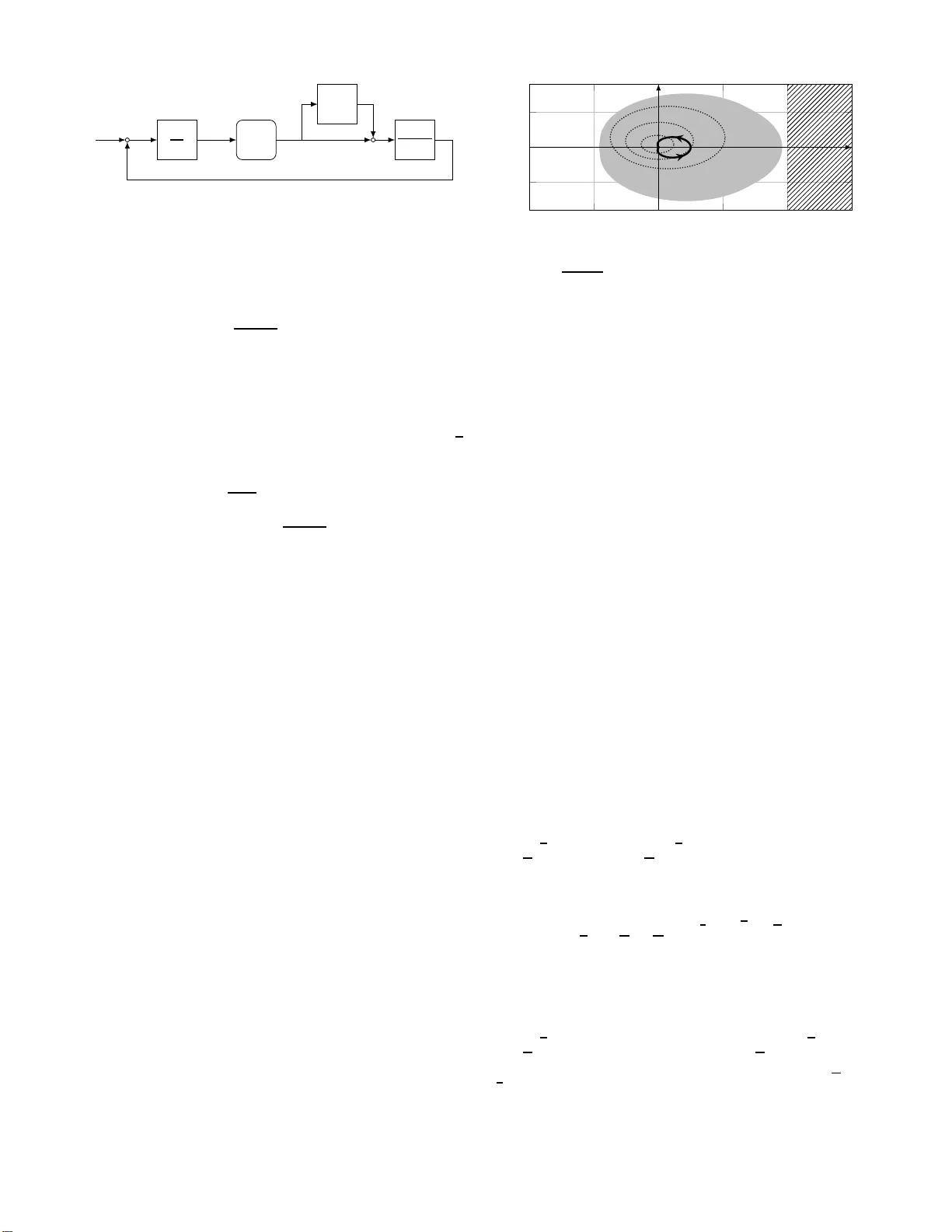
The H ∞ ,p norm as the dif ferential L 2 ,p gain of a p -dominan t system Alberto Padoan, Fulvio For ni, Rodolphe Sepulchre Abstract — The differential L 2 ,p gain of a linear , time- in variant, p -dominant system is shown to coincide with th e H ∞ ,p norm of its transfer function G , defined as the essential supremum of th e absolute value of G ov er a vertical strip in the complex plane such that p poles of G lie to right of the strip. Th e close analogy between the H ∞ ,p norm and th e classical H ∞ norm suggests that robust dominance of linear systems can be studi ed along the same lin es as robust stability . This p roperty can b e exploited in the analysis and design of nonlinear un certain systems that can be decomposed as the feedback interconnection of a linear , time-inv ariant system with bounded gain uncertainties or nonl inearities. I . I N T RO D U C T I O N The rec e nt paper [1] p roposes p -dissipativity as a gen eral- ization of the classical notion of dissipativity , with the aim of developing an interconnec tion theory for open p -dom inant systems. T he pro perty of p -dominan ce for malizes the id ea that the asymptotic be havior of a system is p -d imensional. The significance o f this pro p erty for n onlinear systems analy- sis is appar e nt for small values of p , as the po ssible attractors are se verely co nstrained in low dimension al system s. A p - dominan t system has a uniqu e equilibrium poin t if p = 0 , one or se veral equilibrium points if p = 1 , and the simple attractors of Poincar ´ e-Bendixson th eorem if p = 2 . In this context, p -dissipativity theory reform ulates classical intercon - nection theor ems of line ar quad ratic dissipati v ity theor y , thu s inheriting its mod us op erandi and its c o mputation al tools. The key p oint is that the quadratic form that ch aracterizes the L yapunov fun ction or storage is n o longer r equired to be positive definite. Instead , it is req uired to have a fixed inertia, with p negati ve eigen values and n − p p o siti ve eigen values, where n is th e dime nsion of the system. A no tion of L 2 ,p -gain can be defined for a p -d ominant sys- tem with rate λ using the differential d issipation in equality δ ˙ x δ x T 0 P P 2 λP + ε I δ ˙ x δ x ≤ δ y δ u T − I 0 0 γ 2 I δ y δ u , (1 ) with P ∈ R n × n a symm e tric matrix with p negativ e eigen- values and n − p positive eigenv alues. F o r p = 0 , the differential dissipatio n ine q uality (1) simply mean s that the classical L 2 gain of the system does n ot exceed γ . By the KYP lemma [ 2 ]–[4], γ also co incides with the classical H ∞ norm of th e tr ansfer functio n of th e system . Similarly , the A. Padoan, F . Forni, R. Sepulchre are with Department of Engineeri ng, Uni versity of Cambridge, Cambridge, CB2 1PZ, UK (e-mail: { a.padoa n | f.forni | r.sepulchre } @eng.cam.ac.u k ). The research leading to the s e results has recei ved funding from the European Research Council under the Advance d ERC Grant Agreement S witchlet n. 670645 and from the Royal Society Researc h Grant RGS \ R1 \ 191308 . L 2 ,p -gain of a finite-dimen sio n al, linear, time-inv ariant, p - dominan t system with rate λ with transfer f u nction G can be expressed as ess s up ω ∈ R | G ( iω − λ ) | , (2) where G ( s − λ ) h as p po les in the ope n right h alf-plane and n − p po les in the o pen left half -plane. This raises the question of computing the L 2 ,p -gain of a system th r ough ( 2) as a gener a liza tion of the classical H ∞ norm. The g oal o f the paper is to ou tline an H ∞ ,p theory g eared tow ar ds p -dominan ce that closely par allels classical H ∞ theory . Th e H ∞ ,p norm for fun ctions de fined on a vertical strip is shown to be th e system nor m induced b y the uniqu e bound ed oper ator defined b y a tran sfer func tio n with p poles to th e rig h t of its region of convergence a n d n − p p o les to the lef t o f its region of convergence. The p aper emp hasizes that most usual prop erties of the cla ssical H ∞ norm car ry over to the H ∞ ,p norm. The motiv atio n is to u se the H ∞ ,p norm for robustness and perfo rmance analysis of p -dom inant systems in the sam e way as one u ses the H ∞ norm for stable systems. The paper is organized as fo llows. Section II intro duces Hardy spac es on a vertical strip. Section III shows that th e H ∞ norm for Hard y spaces on a vertical strip can be inter- preted as a n orm indu ced by a multiplication op erator and by a convolution o perator on the who le r eal line. Section IV illustrates some con nections be twe e n Hardy spaces o n a verti- cal strip and p - dominan c e theory [1], [5 ] , [6]. Sectio n V p r o- vides an illustrative example of robust p -d o minance analysis. Section VI concludes the p aper with some final rem arks an d future research directions. The append ix provides ad ditional backgr o und material on the b ilater al Laplace transfor m. Th e proof s are omitted fo r reasons o f space. Notation : R and C d enote the set o f real number s and the set of co mplex n umbers, respectively . Z + and R + denote the set of non- n egati ve integer numb ers and the set of non - negativ e real nu mbers, respectively . i deno tes the imagin ary unit an d i R denotes the set of co mplex numb ers with zero real part. ∂ S deno te s the bo undary o f the set S . I denotes the identity matrix. σ ( A ) den otes the sp ectrum of the matrix A ∈ C n × n . M T and M ∗ denote th e tran spose and the conjuga te transpo se o f the m atrix M ∈ C l × m , respectively . | · | deno tes the standard Euclide a n n orm on C n . I I . H A R DY S PAC E S O N A V E RT I C A L S T R I P This section intr o duces Hardy spaces o f func tio ns o n a vertical strip. Let q ∈ Z + , with q ≥ 1 , let Λ = ( λ , λ ) be an open interval, with −∞ ≤ λ < λ ≤ ∞ , and let S Λ = { s ∈ C : Re( s ) ∈ − Λ } , with − Λ = { − λ : λ ∈ Λ } . Definition 1 . H q ( S Λ ) is the set of all analytic fun ctions 1 f : S Λ → C n such that ess s up λ ∈ Λ Z ∞ −∞ | f ( − λ + iω ) | q dω 2 π < ∞ . (3) H ∞ ( S Λ ) is the set of all an alytic fun ctions f : S Λ → C n such that ess s up s ∈ S Λ | f ( s ) | < ∞ . (4) The H q ( S Λ ) norm of a fu nction f ∈ H q ( S Λ ) is defined as k f k H q ( S Λ ) = ess sup λ ∈ Λ Z ∞ −∞ | f ( − λ + iω ) | q dω 2 π 1 q , for 1 ≤ q < ∞ , ess sup s ∈ S Λ | f ( s ) | , for q = ∞ . (5) H q ( S Λ ) is a lin e a r space, with scalar pr o duct an d sum defined in the stan dard fashion . It is therefo re referred to as a Har dy space o n the vertical strip S Λ , as it possesses many of th e nice pr operties of classical Hard y spaces. Theor e m 1 . H q ( S Λ ) is a Banach space for 1 ≤ q ≤ ∞ . Theor e m 2 . Let f ∈ H ∞ ( S Λ ) . Assume f is contin uous and bound ed on ∂ S Λ . Th en k f k H ∞ ( S Λ ) = sup s ∈ ∂ S Λ | f ( s ) | . (6) Theorem 2 establishes a maxim um m odulus theorem for function s in H ∞ ( S Λ ) : th e norm of a fun c tio n f ∈ H ∞ ( S Λ ) can be co mputed by only consider ing the behavior of f on the b ounda ry of the strip S Λ , pr ovided that f is co ntinuou s and bo unded therein. T h us the f ollowing stand ing assumptio n is made in o rder to apply Theo rem 2 th rough out the p aper . Standin g assumption. Every function f ∈ H ∞ ( S Λ ) is con- tinuous an d b ounde d on ∂ S Λ . ⋄ The classical H ∞ norm of a fu n ction is tightly co nnected to the L ∞ norm of the corresp onding boun dary f unction defined on the imagin ary axis [ 7, p.7] . W e now show that a similar prop erty holds for th e H ∞ ( S Λ ) norm. Giv en λ ∈ R let L λ = { s ∈ C : Re( s ) = − λ } . Definition 2 . L q ( L λ ) is the set of all mea surable function s f : C → C n such that Z ∞ −∞ | f ( − λ + i ω ) | q dω 2 π < ∞ . (7) L ∞ ( L λ ) is the set of all measur a b le fu n ctions f : C → C n such that ess s up ω ∈ R | f ( − λ + i ω ) | < ∞ . (8) The L q ( L λ ) norm of a fu nction f ∈ L q ( L λ ) is d efined as k f k L q ( L λ ) = Z ∞ −∞ | f ( − λ + i ω ) | q dω 2 π 1 q , for 1 ≤ q < ∞ , ess s up ω ∈ R | f ( − λ + iω ) | , for q = ∞ , (9) 1 Lebesgue integr ation is used throughout this work. Functions that are equal excep t for a set of measure zero are identified . Condition s imposed on a functio n are understood in the sense of being vali d for all points of the domain of the function exc ept for a set of measure zero. The no rm ( 9) induces a Banach space struc ture on the set L q ( L λ ) for 1 ≤ q ≤ ∞ [8, p.19 ]. For q = 2 , it coincid es with the n orm induced b y the inn er prod uct h f , g i L 2 ( L λ ) = 1 2 π Z ∞ −∞ f ( − λ + ω ) ∗ g ( − λ + ω ) dω . (10) L 2 ( L λ ) is th erefore as a Hilbert space , which admits the (ortho g onal d ir ect sum) de composition L 2 ( L λ ) = H 2 ( S Λ − ) ⊕ H 2 ( S Λ + ) , (11) with Λ − = ( λ, ∞ ) and Λ + = ( −∞ , λ ) , in wh ich the orthog onality condition h f , g i L 2 ( L λ ) = 0 hold s for e very f ∈ H 2 ( S Λ − ) and g ∈ H 2 ( S Λ + ) . W e a r e no w ready to connect H ∞ ( S Λ ) and L ∞ ( L λ ) norms. Theor e m 3 . Under th e assumption of Th eorem 2, k f k H ∞ ( S Λ ) = max {k f k L ∞ ( L λ ) , k f k L ∞ ( L λ ) } . ( 12) Theorem 3 is consistent with th e classical “limit” cases. For Λ = R + ( − Λ = R + ) the strip S Λ is the op e n half -plane to the right ( left) of the im aginary axis i R and the H ∞ ( S Λ ) norm redu ces to th e norm k f k H ∞ ( S Λ ) = es s sup s ∈ S Λ | f ( s ) | = k f k L ∞ ( i R ) . (13) For Λ = ( λ , λ ) , with λ → λ − and λ → λ + , the strip S Λ tends to the vertical line L λ and the H ∞ ( S Λ ) norm reduces to th e norm k f k H ∞ ( S Λ ) = es s sup s ∈ L λ | f ( s ) | = k f k L ∞ ( L λ ) . (14) I I I . T H E H ∞ ( S Λ ) N O R M A S A N I N D U C E D N O R M A classical result of H ∞ theory is that th e no r m in duced by the multiplication operator associated with a functio n G ∈ L ∞ ( i R ) coin c ides with the L ∞ norm of G [9 , p.10 0 ]. W e now show th at a similar result hold s if G ∈ H ∞ ( S Λ ) . Definition 3 . Th e multiplica tion op erator associated with the function G ∈ H ∞ ( S Λ ) is defined as M G : H 2 ( S Λ ) → H 2 ( S Λ ) , U 7→ GU, (15) and the correspo nding H 2 ( S Λ ) indu ced norm is defined as k M G k H 2 ( S Λ ) = sup U ∈H 2 ( S Λ ) k U k H 2 ( S Λ ) =1 k GU k H 2 ( S Λ ) . (16) Theor e m 4 . Let G ∈ H ∞ ( S Λ ) and con sider the mu ltiplica- tion op e rator (15). Th en k M G k H 2 ( S Λ ) = k G k H ∞ ( S Λ ) . The H ∞ ( S Λ ) no rm can be also characterized as the norm induced b y the conv olu tion operator associated with a continuo us-time, single-in put, sing le-outpu t, linear, tim e - in variant system describ ed by the equa tio ns ˙ x = Ax + B u, y = C x + D u, (17) with x ( t ) ∈ R n , u ( t ) ∈ R , y ( t ) ∈ R , A ∈ R n × n , B ∈ R n , C ∈ R 1 × n and D ∈ R constant matrices, an d transfer func- tion G ( s ) = C ( sI − A ) − 1 B + D . If system (17) has no eigenv alues in S Λ , then a ( u nique) bound ed conv o lution op e rator can be associated with the system b y defining its impulse r e sp onse as g ( t ) = ( C + e A + t B + , for t > 0 , C − e A − t B − , for t ≤ 0 , (18) in wh ich, upon a possible coord inates chan g e, A = A + 0 0 A − , B = B + B − , C T = C T + C T − , (19) with σ ( A + ) ⊂ S Λ + and σ ( A − ) ⊂ S Λ − for Λ + = ( − ∞ , λ ) and Λ − = ( λ, ∞ ) , respectively . The impulse response ( 18) is uniquely de fined by the in verse (b ilater al) Laplace tr a n sform of G in its region of convergence S Λ . Con versely , the tran sfer function o f system (17) coinc ides with the Laplace transform of its impu lse r esponse, i.e. G ( s ) = L{ g } ( s ) . Definition 4 . L q ( R Λ ) is defined as the set of all m easurable function s f : R → C n such that ess s up λ ∈ Λ Z ∞ −∞ e qλt | f ( t ) | q dt < ∞ . (20) The L q ( R Λ ) norm of a fu nction f ∈ L q ( R Λ ) is d efined as k f k L q ( R Λ ) = ess sup λ ∈ Λ Z ∞ −∞ e qλt | f ( t ) | q dt 1 q . (21) Definition 5 . The co n vo lution op erator associated with sys- tem ( 1 7) is defin e d as 2 G : L 2 ( R Λ ) → L 2 ( R Λ ) , u 7→ Z ∞ −∞ g ( t − τ ) u ( τ ) dτ + D u ( t ) , (22) and the correspo nding ind uced L 2 ( R Λ ) no r m is d e fined as k G k L 2 ( R Λ ) = sup u ∈L 2 ( R Λ ) k u k L 2 ( R Λ ) =1 k Gu k L 2 ( R Λ ) . (23) Theor e m 5 . Consider system (17) a nd the associated co n vo- lution op erator (22). T hen k G k L 2 ( R Λ ) = k G k H ∞ ( S Λ ) . Theorem 5 establishes that the L 2 ( R Λ ) nor m induce d b y the con volution operato r associated with system (17) coin- cides with the H ∞ ( S Λ ) nor m o f the transfer f unction of system (1 7). Th us the H ∞ ( S Λ ) norm o f a transfer functio n can b e interpreted as the gain o f the corre sponding system, in an alogy with classical H ∞ theory [9] . I V . T H E H ∞ ( S Λ ) S PAC E A N D D O M I N A N T S Y S T E M S A. Th e differ en tial L 2 ,p gain of a p -d ominant system The d iscu ssion above is o f in te r est because of its ap - plications to p -d ominance theor y [1]. In wh at fo llows we summarize r elev ant definition s a nd p roperties. Con sider a continuo us-time, n o nlinear, time-inv arian t system and its linearization descr ib ed by the equa tio ns ˙ x = f ( x ) + B u, y = C x + D u , (24 a) δ ˙ x = ∂ f ( x ) δ x + B δ u, δ y = C δ y + D δ u , (24b) 2 The same symbol is used for the con volu tion operator associated with a system and the correspond ing transfer function. Conte xt determines which is meant. in which x ( t ) ∈ R n , u ( t ) ∈ R m , y ( t ) ∈ R m , f : R n → R n is a con tinuously d ifferentiable 3 vector field, B ∈ R m × n , C ∈ R m × n and D ∈ R m × m are constant matrices, δ x ( t ) ∈ R n , δ u ( t ) ∈ R m , δ y ( t ) ∈ R m (identified with the respective tangent spaces), and ∂ f is the Jacobian of the vector field f . Definition 6 . [1] For u = 0 , system (24 a) is p -do minant with rate λ ∈ R + if ther e exist ε ∈ R + and a symm etric matr ix P ∈ R n × n , with inertia 4 ( p, 0 , n − p ) , such that the conic constraint δ ˙ x δ x T 0 P P 2 λP + εI δ ˙ x δ x ≤ 0 (25) holds alo ng the solutions o f th e pr olonged system (24). The proper ty is strict if ε > 0 . Definition 7 . The system (24a) is said to h a ve (finite d if- fer ential) L 2 ,p -gain (fr om u to y ) less than γ ∈ R + with rate λ ∈ R + if ther e exist ε ∈ R + and a symm etric matrix P ∈ R n × n , with inertia ( p, 0 , n − p ) , su c h that the conic constraint δ ˙ x δ x T 0 P P 2 λP + εI δ ˙ x δ x ≤ δ y δ u T − I 0 0 γ 2 I δ y δ u (26) holds alo ng the solutions o f th e pr olonged system (24). The (differ ential) L 2 ,p -gain of system ( 2 4a) (fr o m u to y ) with rate λ is defined as γ λ = inf { γ ∈ R + : (26) holds } . Th e proper ties are strict if ε > 0 . The pr operty of p -dom inance stron gly constrains the asymp - totic b ehavior of a system , as clar ified by the next th eorem. Theor e m 6 . [1] Assume system (24a) is strictly p -d ominant with rate λ ∈ R + and let u = 0 . Then every bounded solution of (24 a) c on verges asy mptotically to • the uniq ue e quilibrium point if p = 0 , • a (possibly non- u nique) eq u ilibrium p oint if p = 1 , • an e quilibrium po int, a set of eq uilibrium po ints and their connected ar cs or a limit cycle if p = 2 . The L 2 ,p -gain can be used to establish p -d ominance of an interconn ected system, thus extending classical small- gain condition s [10 ]. Theor e m 7 (Small-g ain theor em for p -do minance) . L et Σ i be a system with inp ut u i ∈ R m i , outp ut y i ∈ R m i , and (differential) L 2 ,p i -gain less tha n γ i ∈ R + with rate λ ∈ R + , with i ∈ { 1 , 2 } . Th en the c losed-loop system Σ defin ed by the negative f eedback intercon nection e quations u 1 = − y 2 and u 2 = y 1 is ( p 1 + p 2 ) -dominan t with rate λ if γ 1 γ 2 < 1 . B. Th e H ∞ ,p ( S Λ ) no rm as the differ en tial L 2 ,p gain For a linear, time-inv ariant system (1 7) the con ic c o n- straint (2 6) holds along the solu tions of the system if and o nly if th ere exist ε ∈ R + and a symm e tric matrix P ∈ R n × n , 3 This assumption simplifies the exp osition. Analogous considerati ons can be performed requiring only L ipschitz continuity . 4 The inerti a of the m atrix A ∈ R n × n is defined as ( ν, δ, π ) , where ν is the number of eigen v alues of A in the open left half-plane, δ is the number of eigen val ues of A on the imaginary axis, and π is the number of eigen v alues of A in the open right half-pl ane, respect ive ly . with in ertia ( p, 0 , n − p ) , which solve th e linea r matrix inequality A T P + P A + 2 λP + εI + C T C P B + C T D B T P + D T C − γ 2 I + D T D ≤ 0 . (2 7) In par ticu lar , system (17) is p -dom inant if and only if ther e exist ε ∈ R + and a sym metric m atrix P ∈ R n × n , with inertia ( p, 0 , n − p ) , such that A T P + P A + 2 λP + εI ≤ 0 . (28) The iner tia constraint in (27) an d (28) en tails that th e transfer function G h as p poles to th e rig ht of the line L λ and n − p poles to the left of the line L λ . If G satisfies this proper ty for every λ ∈ Λ , then G ∈ H ∞ ( S Λ ) . The converse is also true: if G ∈ H ∞ ( S Λ ) is ration a l, then G can be realized by a p -d ominant system with rate λ ∈ Λ . The Hard y spac e H ∞ ( S Λ ) an d p - dominan t systems are stron gly related. Thu s, it is convenient to introd uce the notation H ∞ ,p ( S Λ ) for the subspace of all function s in H ∞ ( S Λ ) with p poles in the ope n half-plan e to the right of S Λ . The next result clarifies the interplay b etween the H ∞ ,p ( S Λ ) n orm of a tr ansfer fun ction the L 2 ,p ( R Λ ) -gain of the co rrespond ing system, defined as γ Λ = sup λ ∈ Λ γ λ , (29) with γ λ ∈ R + the L 2 ,p -gain o f system (1 7) with rate λ ∈ Λ . Theor e m 8 . Let γ Λ ∈ R + be the L 2 ,p ( R Λ ) -gain of sys- tem ( 1 7). Then γ Λ = k G k H ∞ ,p ( S Λ ) . Theorem 8 co nnects the state-space n otion of L 2 ,p ( R Λ ) -gain of a system to the frequ ency-domain notion of H ∞ ,p ( S Λ ) norm of the corr e sponding transfer fun ction. This open s the way to ro bust p -dominan ce analysis an d de sign throu gh standard state-space and f requency-d omain tools, including linear matrix in e q ualities, Riccati eq uations, Bod e diag rams and Nyq uist diagram s. C. Computation of the H ∞ ( S Λ ) no rm By Theor em 3, the norm o f a function G ∈ H ∞ ( S Λ ) can be computed as the maximum between the L ∞ ( L λ ) norm and the L ∞ ( L λ ) nor m o f G . T hese norm s, in turn , co in- cide with L ∞ ( i R ) n orm o f the λ -shifted transfer f unction G λ : s 7→ G ( s − λ ) f or λ = λ and λ = λ , re sp ecti vely . As a result, the H ∞ ( S Λ ) no rm of G can be computed by first considerin g th e λ -shifted transfer function G λ for λ = λ and λ = λ , then comp uting their L ∞ ( i R ) no rm, and finally taking th e maximum b etween the two values. If G is ration al, these com p utations can be efficiently perfor med using establish e d state-space metho d s [9]. For example, the L ∞ ( L λ ) nor m of the transfer functio n G can be computed via a bisection algorithm based on testing if the co ndition k G k L ∞ ( L λ ) < γ (30) holds for a given constant γ ∈ R + . The test can be perfor m ed by solvin g th e linear matrix inequality ( 27) based on the fact that th e line ar , time-inv ariant system (17) has L 2 ,p -gain less than γ if and on ly if the linea r matrix in equality (27) admits a solutio n. By Theor em 8, this mean s th at if system (17) is a realization of th e transfer functio n G , th e n the condition (30) holds if and only if the linear matrix in e quality (27) admits a solutio n. A similar bisection algorithm can be devised by chec k ing iterativ ely if the Hamilton ian matrix H γ = A + λI − B R − 1 D T C − γ B R − 1 B T − γ C T S − 1 C − A T − λI − C T D R − 1 B T , (31) with γ ∈ R + , R = D T D − γ 2 I an d S = D D T − γ 2 I , has eigenv alues on the imaginary a x is. This is a co nsequence of [11 , Th eorem 1], wh ich we recall below for comp leteness. Theor e m 9 . Consider system (1 7). Assume σ ( A ) ∩ i R = ∅ , γ ∈ R + is not a singular value of D , an d ω 0 ∈ R . Then γ is a singu lar value of G ( iω 0 ) if and only if ( H γ − iω 0 I ) is singular . An estima te of the L ∞ ( L λ ) norm can be also ob tained as k G k L ∞ ( L λ ) ≈ max 1 ≤ k ≤ ν | G λ ( iω k ) | , (32) provided th at th e g rid of frequ ency points { ω 1 , . . . , ω ν } is sufficiently fin e. In p rinciple, the L ∞ ( L λ ) n orm of a tr a nsfer fun ction G can be also obtained g raphically , as the distance in the complex plane f rom the o rigin to the farthest po int on the Nyquist diagram o f th e λ -shifted tran sfer fun ction G λ or as th e peak value of th e Bode diag ram of the mag nitude of the λ -shifted transfer fu nction G λ . Finally , the L ∞ ( L λ ) no rm also coincides with the essential supremu m of the restric tio n of a transfer function alo ng the ax is L λ . V . A N I L L U S T R AT I V E E X A M P L E Consider a o ne-degree-o f-freed om mech anical system sub- ject to saturated integra l control describ ed by the equa tio ns ¨ y + d ˙ y = u, ˙ ξ = k i ( r − y ) , u = sat ( ξ ) , (33) in wh ich y ( t ) ∈ R is th e po sition of the p o int mass, ξ ( t ) ∈ R is the integrator variable, u ( t ) ∈ R is the contro l inp ut, r ( t ) ∈ R is th e refer ence signal, d ∈ R + is the d amping coefficient, k i ∈ R is the integral gain , and sat : R → R is defined as sat ( y ) = min(max( y , − 1) , 1) for every y ∈ R , respectively . Th e setup is illustrated in Fig . 1. ξ 1 s ( s + d ) k i s sat ( · ) u y + − r Fig. 1. The system (33). The dominan ce p roperties of the closed-loo p system (33) can be modu la ted throu gh the in tegral gain k i . By the circle criterio n for p - dominan ce [5 ], for r = 0 an d for k i sufficiently small the system is strictly 2 -do minant with r a te λ ∈ Λ for ev ery Λ ⊂ (0 , d ) . By T h eorem 6, the behavior of the clo sed-loop system is th erefore oscillatory , since its solutions are boun ded and the uniq ue eq uilibrium at the origin is unstable. w z ∆( s ) ξ k i s sat ( · ) 1 s ( s + d ) y + + + − r Fig. 2. The perturbe d system associated with (33). These conclusion s have been d rawn by n eglectin g a c tu ator dynamics, which can b e modeled in first appro ximation as a first ord er la g with tran sf e r fu nction H ( s ) = 1 1 + sτ , τ ∈ R + . (34) Actuator dynam ics are in d eed n egligible provided th ey are sufficiently fast. This is well-known in the case of stability . The theory developed in the p resent p aper allows one to extend this pr inciple to switchin g and oscillatory regimes. For illustration, assume τ is sufficiently small (so that − 1 τ is to the left of the strip S Λ ). Rewrite the perturb ed d ynamics as in Fig. 2 by consider in g a multiplicative un certainty ∆ such that 1 + ∆( s ) = 1 1+ sτ , i.e. ∆( s ) = − sτ 1 + sτ . (35 ) By The orem 7, stric t 2 - dominan c e of the nomin a l system (33) is p reserved if the p roduct of th e L 2 , 0 -gain of the pertur bation ∆ and the L 2 , 2 -gain o f th e no minal system (33) is less than one. By Theo r em 8, the fo r mer can be co mputed as th e H ∞ , 0 ( S Λ ) o f the tran sfer functio n ∆ in any strip S Λ with Λ ⊂ (0 , d ) ; the latter c a n be comp uted as the sup remum over all solu tions of the LM I (27) f or λ ∈ Λ . For example, let d = 5 , k i = − 1 , Λ = (1 , 2) and τ = 0 . 1 . Th en k ∆ k H ∞ , 0 ( S Λ ) = max {k ∆ k L ∞ ( L 1 ) , k ∆ k L ∞ ( L 2 ) } = max { 1 . 11 11 , 1 . 0526 } = 1 . 1 111 and, b y Theor em 8, the L 2 , 2 -gain of system (3 3) is γ Λ = sup λ ∈ (1 , 2) γ λ = max { 0 . 3528 , 0 . 141 4 } = 0 . 3528 . W e conclu de th at the perturbe d closed -loop system re - mains strictly 2 -dom inant with any rate λ ∈ (1 , 2) and, th us, oscillatory , as the pertur bation ∆ p reserves the u nstable equilibriu m at th e origin. Note that the perturbed closed- loop system can actually to lerate a pertur bation ∆ with k ∆ k H ∞ , 0 ( S Λ ) ≈ 2 . 83 4 5 an d still p r eserve strict 2 -domin ance (since γ Λ = 0 . 35 2 8 ) , as illustrated in Fig. 3. V I . C O N C L U S I O N The pape r has shown that the differential L 2 ,p gain of a linear, time-inv ar iant, p -dominan t system is the H ∞ ,p norm of its transfer function. Several p a r allels ha ve been drawn between the classical H ∞ norm an d the H ∞ ,p norm. T his suggests that robust stability and ro bust p -d o minance can be studied along the same lines for linear systems. Future research shou ld foc u s o n the analysis and d esign of multi- stable a n d oscillatory nonlinear uncertain systems that ca n − 1 − 0 . 5 0 0 . 5 1 1 . 5 − 0 . 5 0 0 . 5 Fig. 3. The Nyquist diagra m of the λ -shifted transfer functi on associated with G ( s ) = k i s 2 ( s + d ) (solid) lies to the right of the disk D ( − 1 , 0) (diagona l lines) for d = 5 , k i = − 1 , λ = 1 . Robust strict 2 -dominanc e is guarant eed when the uncertain Nyquist diagram (shaded) gi ven by the en- vel ope of all circle s of cente r G λ ( iω ) and radius k ∆ k H ∞ , 0 ( S Λ ) | G λ ( iω ) | (dotted ) lies outside the disk D ( − 1 , 0) . be decom posed as the feedb ack interco n nection o f a linear, time-inv ariant system with bo unded gain un certainties or non- linearities. A pro mising research direction is that of ro bust p - dominan ce ana ly sis using integral qu adratic constraints [1 2 ]. A P P E N D I X A. Th e bila te ral Laplace transform This section rec alls, f or comp leteness, basic definitions and resu lts related to the Laplace tr ansform [13 ]–[15] . Definition 8 . [15, p .17] Let f : R → C be a me a su rable function . The (bilateral) Lapla ce transform o f f at s ∈ C is defined as F ( s ) = L{ f } ( s ) = Z ∞ −∞ f ( τ ) e − sτ dτ (36) for tho se s = λ + iω such that R ∞ −∞ | f ( τ ) | e − λτ dτ < ∞ . A co mplete character ization o f the L aplace tran sform o f a function f req uires the spe c ifica tio n of a r egion of conver - gence , i. e. a set of values s ∈ C for whic h the integral ( 36) conv erges [ 14, p.662 ]. In general, ther e may be m ultiple regions o f convergence and th ese a re always vertical strips in the complex p lane, as a consequ ence of the fo llowing result [ 13, p.238 ]. Lemma 1 . Let f : R → C be a m easurable func tio n and let Λ = ( λ , λ ) , with − ∞ ≤ λ < λ ≤ ∞ . If the integral Z ∞ −∞ f ( τ ) e − sτ dτ (37) conv erges for s = − λ + iω an d s = − λ + iω , then it con- verges in the strip S Λ . Thus the region of co n vergence o f a Laplace transform is in ge neral a vertical strip, wh ich ma y becom e a half plane, the entire plane or even (par ts of) a single vertical line [13, p.238 ]. If the La place transform conver g es fo r s ∈ S Λ , with Λ = ( λ , λ ) , and di verges elsewhere, then − λ an d − λ a re said to be abscissae of conver gence and th e vertical lines L λ and L λ are said to be the corre sponding axes of conver gence . It is clear that if th e integral (3 7) conver g es in a strip S Λ , th en it conv erges un if ormly in any closed bou nded region in side the strip wh ich d o es not intersect the b oundar y of the strip [13, p.240 ]. More over, if the in tegral (37) con verges along the line L λ then th e region o f convergence will be a strip that includes the line L λ [14, p .666]. The rep resentation induced by th e Laplace tran sform is unique, as detailed b y the following statemen t [13 , p. 243]. Lemma 2 . I f f : R → C and g : R → C are me a su rable fun c- tions in any bound ed interval and such that L{ f } = L{ g } in a comm on region o f conv ergen ce, then f ( t ) = g ( t ) for almost every t ∈ R . Lemma 2 implies that the region of co n vergence of the Laplace tran sform of a functio n f ∈ L 2 ( R ) is given by the intersection of the regions of co n vergence of its 5 causal par t f + and its anticausal p a r t f − . If the intersection is no n-empty , then F ( s ) = F + ( s ) + F − ( s ) . By c o ntrast, whe n th e region s of co n vergence of f + and f − do n ot inter sect the Laplace transform of f is not defined, even if the Lap lace tran sforms of f + and f − are in dividually well-d efined. This is well illustrated by the fo llowing exam p le taken from [14 , p. 668]. Example 1 . Let α ∈ R and let f : t 7→ e − α | t | . The cau sal p art of f is f + : t 7→ e − αt δ − 1 ( t ) an d th e anticausal part of f is f − : t 7→ e αt δ − 1 ( − t ) , where δ − 1 denotes the Heaviside unit step fu nction. The Laplace tran sform of f + is F + ( s ) = 1 s + α , with region o f convergence S Λ + , with Λ + = ( − ∞ , α ) , and the La p lace tran sform of f − is F − ( s ) = − 1 s − α , with re- gion of conver g ence S Λ − , with Λ − = ( − α, ∞ ) . While the Laplace tran sform of both the causal part a n d anticausal part of f individually exist, the cor r esponding regions o f conv ergen ce d o not in tersect if α ≤ 0 , in wh ich case th e Laplace transfo rm o f f is n ot defined. By con trast, if α > 0 , then the Laplac e tran sform of f is F ( s ) = F + ( s ) + F − ( s ) = 1 s + α − 1 s − α = − 2 α s 2 − α 2 , with regio n o f conver g ence S Λ , with Λ = ( − α, α ) . N The inverse bilateral L aplace tr ansform ca n be define d using the following r esult [13 , p .241]. Lemma 3 . Let f : R → C b e a measura b le function in any bound ed interval. Assume that th e in tegral (37) con verges absolutely o n the vertical line L λ and that f is of bou nded variation in a neighb ourho od of t ∈ R . Th e n 6 f ( t ) = lim ω →∞ 1 2 π i Z − λ + iω − λ − iω F ( s ) e st ds. ( 38) In genera l, compu ting inverse Laplace transform s via (3 8) requires co mplex contour integration . I n pr actice, this is often perfor med using the residu e theorem [ 1 6, p.1 08]. W e co n clude this dig ression o n th e b ilateral Lap lace transform with a few words abou t function s with a rational Laplace transfo rm. Definition 8 implies tha t the region of conv ergen ce ca nnot con tain any pole. As a result, if the 5 Every f ∈ L 2 ( R ) admits a unique additi ve decomposition of the form f = f + + f − , with f + ( t ) = 0 for almost all t > 0 and f − ( t ) = 0 for almost all t < 0 . The functions f + and f − are referred to as the causal part of f and anticausal part of f , respecti vely . 6 The conv ention f ( t ) = 1 2 lim τ → t + f ( τ ) + 1 2 lim τ → t − f ( τ ) is used if t ∈ R is a point of discont inuity of f . Laplace tran sform F of a function f is rational, its region of conv ergen ce is boun ded by poles or extends to infinity [1 4 , p.669 ]. In p articular, the region of conver gence is the half plane to the right (left) of th e rightm ost (leftmo st) p ole if the an ticausal (causal) par t of f is ze ro almost everywhere. As a consequ e nce of the residu e theor e m, the inv er se Laplace transfo rm of a rational fun c tion can be co m- puted by ev aluatin g (38) via partial f raction expansion and then b y in verting each individual term [14, p.671] . For example, c o nsider the rational function F ( s ) = n ( s ) d ( s ) , where n ( s ) = P m k =0 n k s k and d ( s ) = P n k =0 d k s k , with d n = 1 a nd n > m . If the roots α 1 , . . . , α n of th e d e- nominato r d are distinct then F ( s ) = P n k =0 f k ( s − α k ) , with f k = n ( α k ) d ′ ( α k )( s − α k ) . T h e inv e r se Laplace transform o f each term F k ( s ) = f k ( s − α k ) is th en determ ined as follows: if the region o f co nvergence is to th e r ight of th e pole s = − α k , then L − 1 { F k } ( t ) = f k e − α k t δ − 1 ( t ) ; if the r egion of c o n vergence is to the left o f the pole s = − α k , then L − 1 { F k } ( t ) = − f k e α k t δ − 1 ( − t ) . A similar argum e nt can be used to find the in verse Lap lace transform o f a ra tio nal function with multiple p oles [17 , p .22]. R E F E R E N C E S [1] F . Forni and R. Sepulchre, “Dif ferential dissipati vity theory for domi- nance analysis, ” IE EE T rans. Autom. Contr ol , vol. 64, no. 6, pp. 2340– 2351, 2019. [2] V . A. Y akubovich , “Solution of certain matrix inequ alities in the stabili ty theory of nonline ar control systems, ” Dokl. Akad. Nauk. SSSR , vol. 143, no. 6, pp. 1304–1307, 1962. [3] R. E. Kalman, “L yapuno v functions for the problem of Lur’e in automati c control, ” Proc Nat. Acad. Sci. , vol. 49, no. 2, pp. 201–205, 1963. [4] B. Brogliato, R. Lozano, B. Maschke , and O. Egeland, Dissipative systems analysis and contr ol - Theory and applications (2nd edition) . London, U.K.: Springer -V erla g, 2007. [5] F . A. Miranda -V illat oro, F . Forni, and R. Sepulchre , “Analysis of Lure dominant systems in the frequenc y domain, ” Automati ca , vol. 98, pp. 76–85, 2018. [6] A. Padoan, F . Forni , and R. Sepulchre, “Dominanc e m argins for feedbac k systems, ” in 11th IF AC Symp. Nonline ar Contr ol Syst. , V ienna, Austria, 2019, pp. 1176–1181. [7] J. R. Parti ngton, Linear operato rs and linear systems: an analytical appr oach to contr ol theory . Cambridge, U.K.: Cambridge Univ . Press, 2004. [8] R. A . DeV ore and G. G. Lorentz, Constructiv e appr oximation . Berlin, Germany : Springer-V erlag, 1993. [9] K. Zhou, J. C. Doyle, and K. Glove r, Robust and optimal contr ol . Ne w Jersey , NJ, USA: Prentice Hall, 1996. [10] C. A. Desoer and M. V idyasaga r, F eedback systems: input-out put pr operties . Philadelp hia, P A, US A : SIAM, 1975. [11] S. Boyd, V . Balakri shnan, and P . Kabamba, “ A bisection method for computing the H ∞ norm of a transfer matrix and relat ed problems, ” Math. Contr ol, Sign. Syst. , vol. 2, no. 3, pp. 207–219, 1989. [12] A. Megretski and A. Rantze r, “System analysis via integra l quadrat ic constrai nts, ” IEEE T rans. Autom. Contr ol , vol. 42, no. 6, pp. 819–830, 1997. [13] D. V . Wi dder , Laplace transform . Princet on, N J , USA: Princeton Uni v . Press, 1946. [14] A. V . Oppenheim, A. S. Wil lsky , and H. S. Naw ab, Signal s and Systems (2nd edition) . Upper Saddle Riv er, NJ, USA: Prentice Hall, 1996. [15] J. R. Partin gton, Interpolation , identifica tion, and sampling . Oxford, U.K.: Oxford Univ . Press, 1997. [16] J. B. Conway , Functions of one comple x variable . Ne w Y ork, NY , USA: Springer-V erla g, 1973. [17] B. Davies, Inte gral transf orms and their applicati ons . Ne w Y ork, NY , USA: Springer-V erla g, 1978.
Original Paper
Loading high-quality paper...
Comments & Academic Discussion
Loading comments...
Leave a Comment