Multi-object Tracking in Unknown Detection Probability with the PMBM Filter
This paper focuses on the joint multi-object tracking (MOT) and the estimate of detection probability with the \emph{Poisson multi-Bernoulli mixture} (PMBM) filter. In a majority of multi-object scenarios, the knowledge of detection probability is us…
Authors: Guchong Li
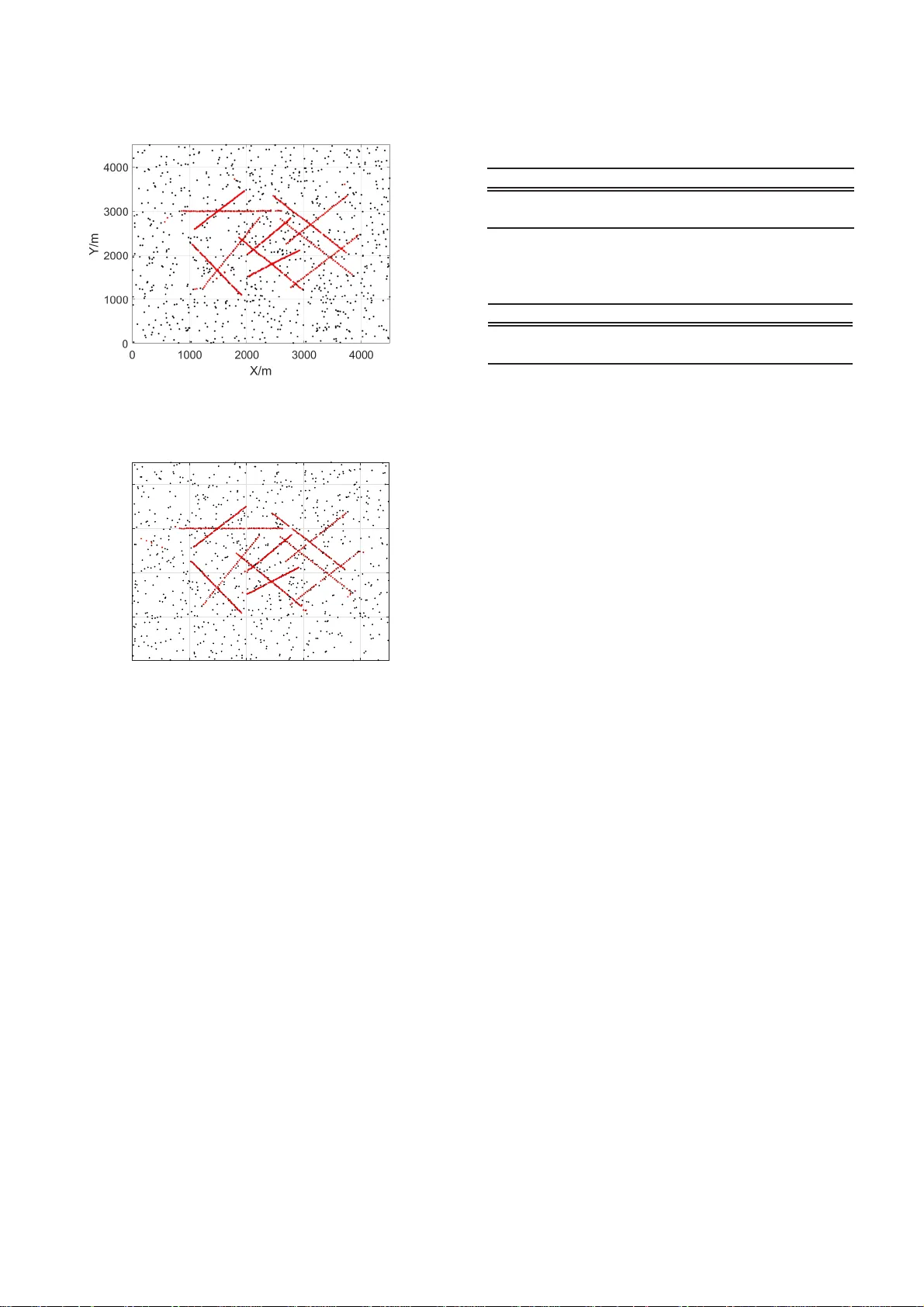
Robust Poisson Multi-Bernoulli Mixture Filter with Unkno wn Detection Prob ab ility Guchon g Li , Lingjian g K ong ∗ , T ao Zhou , T uanwei T ian , W ei Y i Scho ol of Information and Communication Engineering, Universit y of Elec tr onic Scienc e and T ec hnol ogy of China, Chengdu, 611731, China Abstract This p aper proposes a robust P oisson multi- B ernoulli mixtur e (R-PMBM) filter immune to the unknown detection prob ablity . In a majority of multi-object scenarios, the prior knowledge of detection probab il ity is usually un certain, which is often estimated o ffl ine from the tr aining d ata. In such cases, o n line filt ering is al ways unfeasible or unrealistic, othe r wis e, significate parameter mismatch will result in biased estimates (e.g. , state and cardinality of objects). As a consequenc e, the ability of adap tively estimating the detection prob ability for a sensor is essential in practice . Based on the an alysis, we detail how the d e tection probab ilit y can be estimated accompanie d with the state estimates. Besides, the closed-for m solutions to the proposed meth od are deriv ed by means of app roximating the intensity of Poisson random finite set (RFS) to a Beta-Gaussian mixtu re (B-GM) for m and density of Ber n oulli RFS to a single Beta-Gau ssian fo rm. Simulation results demonstrate the e ff ecti veness and robustness of th e pr oposed meth od. K e ywor ds: Detection prob ability , Poisson multi-Bern oulli mix t ure, Beta-Gaussian mixture. 1. Introduction Multi-object tracking (MOT) has been an increasingly ho t topic b oth in military and civilian areas in the last few years. The aim o f MOT is to jointly estimate th e state an d car d inal- ity of o bjects synchrono usly fro m the mon itored scenario. So far , MO T has been widely adopted in many fields, such as en - viromen tal monitoring, battlefield surveillance and distributed sensor network [1 – 6]. Howe ver , a c ommon di ffi cu lty for MO T is the association problem b etween objects an d observations. Amongst cur rently studied algorithms, Joint Pro babilistic Data Association (JPD A) [1], Multiple Hypoth es es T racking (MHT) [2], an d Random Fi- nite Set (RFS) [7, 8] are th e main solutions to MO T . In partic- ular , RFS approach es recei ve a high degree of attention d ue to the e ff ective solutions to the association prob lem. Under the FInite Set ST atistics (FISST) framew ork, so m e filters based on the RFS theo r y are developed main ly co m prised by two types: unlabeled and labeled filters. The forme r (u nlabeled RFS-based filters) mainly consists o f Probab ilit y Hypo th esis Density (PHD) [8], Cardinality-PHD (CPHD) [ 9 ] and mu lt i- Bernoulli (MB) [1 0 , 11], as well as the recently developed Pois- son MB mixture (PM BM) [12 – 1 4 ] filters, w h ile the latter ( l a- beled RFS-based filters) includes lab eled MB (LMB) [15], g en- eralized LMB (GLMB) [ 1 6 , 17], labeled MBM (L MB M)[18], and marginalized δ -GLMB (M δ -GLMB) [19] filters. Moreover , all of the mentioned filters ca n be e ff ecti vely implemented by resorting to either Gaussian mix tu re (GM) [20 – 23] or seque n- tial Monte Carlo ( SMC ) [24 – 26] techn ologies. Com paring to ∗ Correspondi ng author Email addr ess: lingjia ng.kong@ gmail.com (Lingjiang Kong ) 1 This work was supported in part by th e National Natural Scien ce Foun- dation of China unde r Grant 6177111 0, in part by the Chang Jiang Scho lars Program, in part by the 111 Project No. B17008. the SMC m ethod, the GM method can pr o vide a closed-f orm solution. Comparing to the other u nlabeled RFS-based filters (PHD, CPHD, an d MB), a unique an d important cha racteristic of the PMBM filter [13, 14] is the conjugacy property , which m eans that the p osterior distribution has the same function al fo rm as the prior . It is also proofed that the labeled RFS-based GL MB [16] an d LMBM [1 8 ] filters are co njugated. The reaso n why conjuga cy property is imp ortant is that it allows th e posterior to be written in terms of some single-object pred ictions an d up - dates, which pr o vides a co nvenient computation metho d co m- pared with the direct caculation of multi-object predictio ns and updates. Fu rther , the PMBM filter also shows advantages in low-detection scenario s [13, 14, 2 7 , 28]. As a consequence, the PMBM filter has received a lo t of attention since it was pro- posed. and has been increasing l y adopted in many applications [29 – 32]. It is worth noting th at when pro cess ing the real w orld data there is a sign ifi cant sou rce of certainly , d etection model, in addition to the dyn amic model, i.e., the d e te c t ion proba b ility in radar tracking is always related to th e detection distance, weather and so on, mak in g it di ffi c ult to mo del accurately . In general, the detection mo del is usually assumed to be k no wn b y the o ffl ine estimate fr om the training data in mo st algorithms. In such cases, online filtering proc e ss for the filters mention ed above is not fea s ible, oth e r wis e, significan t mismatch in detec - tion model will cause err oneous e stima t es of both state an d car- dinality of objec ts . In ord e r to m ak e the filters mo re adapt- able to the environment, Mahler et al. have pr oposed a robust CPHD (R-CPHD) filter by online estimating the unknown de- tection probab ili ty [ 33 , 34] in which object state is augmen ted with a paramete r of detection mo del an d the augmen ted state model is p ropagated and estimated along with the R-CPHD re- Prep rint submitted to Signal Pr ocessing Septembe r 24, 2019 cursion. The prop osed R-CP HD filter in [34] has been ap plied to track cell m ic r oscopy data with unknown back ground param- eters [35]. After w ards, the similar idea has also been success- fully app lied to the MB filter [36] and the labeled RFS-based filter [37]. Both of them sho w the e ff ecti veness of the proposed strategy in [3 4 ]. Recen tly , anoth er method by exploiting the In verse Gamma Gaussian mixture (IGGM) distribution to im- plement the PHD / C PHD filters is also p roposed in [3 8 ], and a GLMB-ba sed method for multistatic Doppler radar with un- known d etection proba bility is studied in [39]. T o th e best of our knowledge, the research o n the PMBM filter with unk no wn detection pro bability hasn’t been realized yet. Considering the a ttr acti ve characteristics o f the PMBM fil- ter suc h as conjugacy property and low detection toleranc e , we explore a robust PMBM (R-PMBM) recursion sub je c t to an un- known detection pr obability join tly estimating the state of o b- ject and detec tio n probability . The main con trib utions of the paper are describ ed as fo llo ws: 1. In Section 3, we pr opose an e ff ective R-PMBM r ecursi on immune to the unkn own detection model for . Firstly , the state of object is coupled w ith a variable representing the detection pr obability so that the stand ard PMBM filter- ing process is evolved into a R-PMBM filter which can jointly estimate the state of o bjects and detecion proba- bility . Next, the expressions of the p roposed R-PMBM filter recur sio n are given. 2. In Section 4, we pr esent a co mputationally feasible im- plementation of the pr o posed R- PMBM fi lter by r esorting to a Be ta function to dep ict the detection pr obability . Ex- cept for the state of objects, the dete c tio n model is also needed to co nsider during the p roposed robust PMBM fil- tering pro cess. T o mo del the detection prob ability , Beta distribution is selected, wher e d etection prob abilty can be e a s ily extracted by seeking the expectation o f the Beta distribution. Mor eo ver , th e Gaussian d is tribution is still used to model the kinema t ic state, which is the sam e as the standard PMB M filter . As a consequence, the closed - form Beta-Gaussian mixtu re is constructed as a menas o f implementatio n. 3. In Section 5, fo ur simulation experiments a re g iven to verify the e ff ectiven ess and r obustness of th e pr oposed method. I n order to better verify th e low detection tol- erance of the prop osed method , two cases with di ff er e nt detection pr obabilities are co nsidered. Further, for each case, two groups of simulation experiments betwee n R- CPHD and R-PMBM filters ar e provided to compar e the covariance of observation noise and clutter rate re sp ec- ti vely . The outline of the rest of the paper is as f ollo ws. Sectio n 2 introdu c es the backgroun d k no wledge, and Section 3 describes the PMBM filter with unk no wn detectio n pr obability , and its correspo n ding detailed imp lementation is provided in Section 4. Simulation resu lt s are provided in Section 5, and con clusions are drawn in Section 6. 2. Background 2.1. Notations In this p a per , lower case letters (e.g . , x and z ) den o te state and obser v ation of single-object while u pper ca s e letters ( e.g., X and Z ) denote state and ob ser v ation of m ulti-object, respec- ti vely . Sup p ose th ere are N objects a nd M observations at time k , and then the multi- object state an d multi-o b ject observatio n are modelled as RFSs given by X k = x k , 1 , · · · , x k , N ⊂ X , (1) Z k = z k , 1 , · · · , z k , M ⊂ Z , (2) where X and Z deno te the state space and o bserv ation space respectively . Each single-object state x k , i = [ x i k , p , x i k , v ] ⊤ com- prises th e position x i k , p and velocity x i k , v , wh ere ‘ ⊤ ′ denotes th e transpose. For a set X and a fu nction f ( x ), [ f ( · )] X = Y x ∈ X f ( x ) . (3) The cardin ality of a set X is den oted | X | . ⊎ is den oted as th e disjoint set uinon. Given X u ⊎ X d = X , X u and X d satisfy X u ∪ X d = X and X u ∩ X d = ∅ . 2.2. Multi-object Bayes F ilter Giv en multi-ob ject transition fu nction f k | k − 1 ( ·|· ) an d the m ulti- object state f k − 1 ( X | Z 1: k − 1 ) atC time k − 1, where Z 1: k − 1 is a n ar - ray of finite sets of observations recei ved up to time k − 1 and denoted as Z 1: k − 1 = ( Z 1 , · · · , Z k − 1 ) , the multi-ob je c t p r ediction to time k can be giv en a ccording to the Chapm an-K olmogorov equation f k | k − 1 ( X k | Z 1: k − 1 ) = Z f k | k − 1 ( X k | ξ ) f k − 1 ( ξ | Z 1: k − 1 ) δξ . (4) When a n e w set of ob ser v ations Z k is received at time k , which is mo deled as a multi-object o bservation likelihood g k ( Z k | X k ), the multi-object update at time k is giv en based on mu lti-object Bayes rule f k ( X k | Z 1: k ) = g k ( Z k | X k ) f k | k − 1 ( X k | Z 1: k − 1 ) R g k ( Z k | ξ ) f k | k − 1 ( ξ | Z 1: k − 1 ) δξ , (5) where th e in volved integral is the set integral [4] which is de- fined by Z f ( X ) δ X = ∞ X n = 0 1 n ! Z X n f ( { x 1 , · · · , x n } ) d x 1 · · · d x n . Further, for the con venience of representation , we lea ve out the co ndition on the ob s ervation set Z 1: k and abbreviate f k ( X k | Z 1: k ) as f k ( X ). 2.3. PMBM RFS Before the PMBM den sity is intro duced, two neccessary definitions are presen t to help und e rstand the PMBM RFS. 2 Definition 1. Und etected o b jects ar e those objects that e xist at the curr ent time but have never been detected a n d denoted b y X u k . Definition 2. A new observation may be a new object for the first d e t ection and can a ls o corr espond to ano ther pr e viously detected object or clutter . Considering that it may exist or no t, we r efer to it as a po tentially detec ted objec t den oted by X d k . Conditioned on th e observation set Z 1: k , the m u lti-object state RFS X k is modeled as th e union of independ ent RFS X u k (undetec te d objects) and X d k (potentially detected objects), re- spectiv ely . Hen ce, the posterior d ensity of the PMBM RFS can be den oted by the FISST convolution as f k ( X ) = X Y ⊆ X f p k ( Y ) f mbm k ( X − Y ) . (6) f p k ( · ) is a Poisson den s ity giv en b y f p k ( X ) = e λ n Y i = 1 λ f k ( x i ) = e − R µ k ( x ) d x µ k ( · ) X , (7) where µ k ( x ) = λ f k ( x ) is the intensity functio n an d λ the Poisson rate as well as f k ( x ) a pro bability density functio n (pdf ) of a single obje c t. Mo reov er , f mbm k ( · ) is a MBM de n sit y gi ven by f mbm k ( X ) ∝ X j ∈ I X X 1 ⊎···⊎ X n = X n Y i = 1 ω j , i f j , i ( X i ) , (8) where ‘ ∝ ′ denotes the pro p ortional symbol. It can be seen that the MBM RFS is th e n ormalized and weigh t ed sum of multi- object densities of MBs, which is pa r ameterized by n w j , i , n r j , i , f j , i ( x ) o i ∈ I j o j ∈ I , where I is the index set of the MBs (also called global hypoth es is set). Particularly , the MBM RFS de- generates into the MB RFS f mb k ( X ) ∝ X X 1 ⊎···⊎ X n = X n Y i = 1 ω j , i f j , i ( X i ) (9) when there is on ly one glo bal hyp othesis with | I | = 1 . 2.4. PMBM Recursion Here, a review of the recu rsi ve pro cess es (predictio n an d update) of the PMBM filter is g i ven. 2.4.1. Pr ediction Pr o cess Poisson density f p k − 1 ( · ) and the MBM d ensity f mbm k − 1 ( · ) are predicted separately . (a) Suppose the inten sity function of Poisson density at tim e k − 1 is µ k − 1 ( x ), and then the pr e dicted intensity at time k is µ k | k − 1 ( x ) = γ k ( x ) + Z f k | k − 1 ( x | ξ ) p S , k ( ξ ) µ k − 1 ( ξ ) d ξ (10) where γ k ( x ) is the intensity of b irth mo del at time k and f k | k − 1 ( x | ξ ) and p S , k ( · ) den ote the state transition fu nction o f single object and surv i val probability , respectiv ely . (b) Gi ven the i -th object in the j -th glob al hypothesis at time k − 1 with ω j , i k − 1 , r j , i k − 1 , p j , i k − 1 ( x ), and then the prediction process of MBM compo nents is given by ω j , i k | k − 1 = ω j , i k − 1 , (11) r j , i k | k − 1 = r j , i k − 1 Z p j , i k − 1 ( ξ ) p S , k ( ξ ) d ξ , (12) p j , i k | k − 1 ( x ) ∝ Z f k | k − 1 ( x | ξ ) p S , k ( ξ ) p j , i k − 1 ( ξ ) d ξ , (13) where ω j , i k | k − 1 , r j , i k | k − 1 , p j , i k | k − 1 ( x ) denote the predicted hypothe- sis weight, existence prob ability , and p df of the i -th Bernoulli compon ent in the j -th g lobal hy pothesis, re sp ecti vely . 2.4.2. Update Pr ocess The update proc e s s mainly consists of the f o llo wing fo ur parts: • update for undetected objects; • update for potential objects detected for the first time; • misdetection for previous potentially detected objects; • update for previous po t entially detected objects using re- ceiv ed observation set. The specific expressions are gi ven in (a)-(d), respectiv ely . (a) Up date for u ndetected objects: µ k ( x ) = (1 − p D , k ( x )) µ k | k − 1 ( x ) , (14) where p D , k ( · ) is the detection prob ability . (b) Update for potential objects detected for the first time: r p k ( z ) = e k ( z ) / ρ p k ( z ) , (15) p p k ( x | z ) = p D , k ( x ) g k ( z | x ) µ k | k − 1 ( x ) / e k ( z ) , (16) and ρ p k ( z ) = e k ( z ) + c ( z ) , (17) e k ( z ) = Z g k ( z | ξ ) p D , k ( ξ ) µ k | k − 1 ( ξ ) d ξ (18) where ρ p k ( z ) in (17) is the hypothesis weight of the potential object related to the obser vation z . (c) Misd e te c t ion for previous potentially detected objects: ω j , i k ( ∅ ) = ω j , i k | k − 1 (1 − p D , k ( x ) r j , i k | k − 1 ) , (19) r j , i k ( ∅ ) = r j , i k | k − 1 (1 − p D , k ( x )) / (1 − p D , k ( x ) r j , i k | k − 1 ) , (20) p j , i k ( ∅ ) = p j , i k | k − 1 ( x ) . (21) 3 (d) Update for pr e vious poten tially detected objects using re- ceiv ed observation set: ω j , i k ( z ) = ω j , i k | k − 1 r j , i k | k − 1 Z p D , k ( ξ ) g k ( z | ξ ) p j , i k | k − 1 ( ξ ) d ξ , (22) r j , i k ( z ) = 1 , (23) p j , i k ( x , z ) ∝ p D , k ( x ) g k ( z | x ) p j , i k | k − 1 ( x ) . (24) It can b e seen that the up date process is also separ ate where the un d etected objects are ju st preserved by m ultiplying the weight with a misdetectio n prob ability shown in (14) an d the potential detected targets are update d con sis ting o f three parts (parts (b)-( d)). After upd ating sing le-object density , ano ther factor to be considered is to g enerate global hypothesis set. Essen tially , the global hy pothesis sho u ld un d er go all possible data association based on all single-object hypo theses. T o settle the comp u ta- tion bo t tleneck, Murty’s alg orithm [40] is selected as an achiev- able sk il l in which a cost m atrix is construc te d b y th e calcu lated weight in (16), (20) and (24) (see (4 7) in Section III-B for the construction meth od). The detailed implementatio n steps can be refer red to [14]. 3. The proposed R-PMBM Filter In this section, the joint estimates of state of ob jects and d e- tection probability a r e provided. Firstly , the basic construction method is introdu ced b y augmen ti ng a variable deno ting th e unknown d etection probab ility to each state of object. Here- after , the proposed R-PMBM recursion f or the augme n ted state model is d eri ved. Mor eo ver , a comparison of filtering frame- work betwee n the standard filter and the p r oposed filter is de- scribed in Fig. 1. Prior state State prediction State update Prior state State prediction State update Detection model prediction Detection model update | 1 k k - | k k Standard Filter Filter with estimate of detection model | 1 k k - | k k Figure 1: The compari son between the standard filter and proposed filter with estimate of detect ion mode l. 3.1. Augmented State Model Follo wing the a pproach in [34], a variable a ∈ [0 , 1] rep- resenting the detection p robability is augmented to th e state of object x , ˆ x = ( x , a ) . (25) The integral of the augmented state ˆ x is adjusted in to a double integral, Z f ( ˆ x ) d ˆ x = Z Z 1 0 f ( x , a ) d ad x . (26) Meanwhile, the state transition a nd observation models are the same as th e conventional case, except that we focu s on the augmen te d state model, which are given b y f k | k − 1 ( ˆ x | ˆ ζ ) = f k | k − 1 ( x , a | ζ , α ) = f k | k − 1 ( x | ζ ) f k | k − 1 ( a | α ) , (27) g k ( z | ˆ x ) = g k ( z | x , a ) = g k ( z | x ) , (28) p S , k ( ˆ x ) = p S , k ( x , a ) = p S , k ( x ) , (29) p D , k ( ˆ x ) = p D , k ( x , a ) = a . (30) Furthermo re, the bir th model with the augme n ted model is de- noted as an intensity func ti on λ b k ( x , a ). 3.2. Recursion The deriv ation of the R-PMBM filter recursion for the aug - mented state mod el featur ing the unk no wn detection pro babil- ity is straightforward by sub s tituting the sugmented state model into the standard PMBM filter r ecursion. Next, the direct con- sequences of derivion are gi ven by Pro positions 1 and 2. Proposition 1. If at time k − 1 , the intensity of P oisson RFS µ k − 1 ( ˆ x ) and MB RFS with { ω j , i k − 1 , r j , i k − 1 , p j , i k − 1 ( ˆ x ) } ar e given, which denote th e undetected o bjects and p o tential objects respectively , then th e p r edicted intensity o f P oisson pr ocess an d den sit y of MBM pr ocess can be given by (a) P oisson Pr ocess: µ k | k − 1 ( x , a ) = γ k ( x , a ) + Z Z 1 0 f k | k − 1 ( x | ζ ) f k | k − 1 ( a | α ) p S , k ( ζ ) µ k − 1 ( ζ , α ) d α d ζ . (31 ) (b) MBM Pr o cess : ω j , i k | k − 1 = ω j , i k − 1 , (32) r j , i k | k − 1 = r j , i k − 1 Z Z 1 0 p S , k ( ζ ) p j , i k − 1 ( ζ , α ) d α d ζ , (33) p j , i k | k − 1 ( x , a ) ∝ Z Z 1 0 p S , k ( ζ ) f k | k − 1 ( x | ζ ) f k | k − 1 ( a | α ) p j , i k − 1 ( ζ , α ) d α d ζ . (34) Proposition 2. If at time k , th e pr edicted R-PMBM filter with parameters { µ k | k − 1 ( ˆ x ) , ω j , i k | k − 1 , r j , i k | k − 1 , p j , i k | k − 1 ( ˆ x ) } is given, th en fo r a given observation set Z k , the up dated inten s ity of P o i sson pr o- cess an d density of MBM pr o cess can be given fr om four as- pects. (a) Up date for undetected objects: µ k | k ( x , a ) = ( 1 − a ) µ k | k − 1 ( x , a ) . (35) 4 (b) Update for poten tial objec t s for the firs t time: r p k ( z ) = e k ( z ) /ρ p k ( z ) , (36) p p k ( x , a | z ) = ag k ( z | x ) µ k | k − 1 ( x , a ) / e k ( z ) , (37) wher e ρ p k ( z ) = e k ( z ) + c ( z ) , (38) e k ( z ) = Z Z 1 0 α g k ( z | ζ ) µ k | k − 1 ( ζ , α ) d α d ζ . (39) (c) Misdetection for potentially detected objects: ω j , i k ( ∅ ) = ω j , i k | k − 1 × (1 − r j , i k | k − 1 + ς j , i ) , (40) r j , i k ( ∅ ) = r j , i k | k − 1 R R 1 0 p j , i k | k − 1 ( ζ , α )( 1 − α ) d α d ζ 1 − r j , i k | k − 1 + ς j , i , (41) p j , i k ( ∅ , a ) = p j , i k | k − 1 ( x , a )(1 − a ) R R 1 0 p j , i k | k − 1 ( ζ , α )( 1 − α ) d α d ζ , (42) ς j , i = r j , i k | k − 1 Z Z 1 0 p j , i k | k − 1 ( ζ , α )( 1 − α ) d α d ζ . (4 3) (d) Update for pr evious poten tially detected objects using r e- ceived observation set: ω j , i k ( z ) = ω j , i k | k − 1 r j , i k | k − 1 × Z Z 1 0 α g k ( z | ζ ) p j , i k | k − 1 ( ζ , α ) d α d ζ , (44) r j , i k ( z ) = 1 , (45) p j , i k ( x , a | z ) = ag k ( z | x ) p j , i k | k − 1 ( x , a ) R R 1 0 α g k ( z | ζ ) p j , i k | k − 1 ( ζ , α ) d α d ζ . (46) The global hypoth eses are returned by selecting some new single-objec t h ypotheses f or the n e xt r ecursion. In order to av oid all possible data hy potheses for each p re vious global hy- pothesis, we still ad opt the construction strategy based upon the Murty’ s algorithm [4 0 ]. A ssum e there are n o old tracks in the global hyp othesis j and M observations { z 1 , · · · , z M } , which in- dicates that there are M poten tial detected ob jects. Then the cost matrix at time k can be formed as follows. C j = − ln h p o i M × ( M + n o ) (47) with p = ν 1 , 1 j ν 1 , 2 j · · · ν 1 , n o j . . . . . . . . . . . . ν M , 1 j ν M , 2 j · · · ν M , n o j M × n o o = ν 1 , 1 p · · · 0 . . . . . . . . . 0 · · · ν M , M p M × M where ν m , m p ( m ∈ { 1 , · · · , M } ) denotes the weight of the m - th potential detecte d object giv en by (38) and ν m , n j is the weight correspo n ding to the m -th observation updated by th e n -th old track in the j -th g lobal hy pothesis, which is den oted as ν m , n j = ω j , i k | k − 1 ρ j , i k ( z ) /ρ j , i k ( ∅ ) (48) with ρ j , i k ( z ) giv en by ρ j , i k ( z ) = r j , i k | k − 1 Z Z α g k ( z | ζ ) p j , i k | k − 1 ( ζ , α ) d α d ζ , (49) and ρ j , i k ( ∅ ) given by ( 40 ). It is worth noting the weights of g lobal hypothe ses n eed to be norm alized once the construction process abo ut global hy- pothesis set is finished. A sum mati ve descrip tion of the pro- posed algorithm steps is provided in Algorithm 1. Fur ther , the global hyp othesis with the largest weight is selected d uring the state estimate. Remark 1. The pr o posed method has a similar but sightlying higher co mple xity compared to the standar d PMBM r ecursion. This is b ecause the filter framework is unchanged but an addi- tional va r iable / funcc tio n needs to be p r opagated corr esponding to many mor e componen ts to be maintained . Algorithm 1: Description of the proposed R-PMBM fil- ter . 1 I N P UT : µ k − 1 ( ˆ x ), { ω j , i k − 1 , r j , i k − 1 , p j , i k − 1 ( ˆ x ) } , γ k ( ˆ x ). 2 - Perform Prediction: 3 –P oisson Process: µ k − 1 ( ˆ x ) → µ k | k − 1 ( ˆ x ) ⊲ (31) 4 –MB Process: 5 { ω j , i k − 1 , r j , i k − 1 , p j , i k − 1 ( ˆ x ) } → { ω j , i k | k − 1 , r j , i k | k − 1 , p j , i k | k − 1 ( ˆ x ) } 6 ⊲ (32)-(34) 7 - Perform Update: 8 –Update for undetected objects: µ k | k − 1 ( ˆ x ) → µ k ( ˆ x ) ⊲ (3 5) 9 –Update for potential objects d etected for the first time: { r p k ( z ) , p p k ( ˆ x | z ) , ρ p k ( z ) } ⊲ (36)-(39) 10 –Misdetection for prev ious poten tially detected objects: { ω j , i k ( ∅ ) , r j , i k ( ∅ ) , p j , i k ( ∅ , a ) } ⊲ (40)-(43) 11 –Update for pre vious po tentially detected objects: { ω j , i k ( z ) , r j , i k ( z ) , p j , i k ( ˆ x , z ) } ⊲ (44)-(45) 12 -Construct Global hypotheses: 13 –Form cost matrix: C j ⊲ (47)-(49) 14 -Run Mu rty’ s algorithm; 15 -Normalize the weight of global hy potheses set. 16 OUPUT : µ k ( ˆ x ), { ω j , i k , r j , i k , p j , i k ( ˆ x ) } . 4. Beta-Gaussian Mixture Implementation In this section , a closed- form implemen tation for the pro- posed R-PMBM r ecursion immun e to the unk no wn detection probab ility is derived based on the Beta-Gaussian mixture. The Gaussian d istrib ution is used to m odel the state of object same as the standard PMBM filter while the Beta fu n ction is used to model the detection probability . Befo re the implem entation is 5 giv en, the definitio n and so me proper ties about the Beta d is tri- bution are first provided as follo ws. Definition 3 . F or 0 ≤ a ≤ 1 , the shape parameter s s > 1 , t > 1 , ar e a power function of variab le a an d of its r efl ection ( 1 − a) as follows. β ( a ; s , t ) = a s − 1 (1 − a ) t − 1 R 1 0 α s − 1 (1 − α ) t − 1 d α = a s − 1 (1 − a ) t − 1 B ( s , t ) (50) with mean µ β = s s + t and covariance σ 2 β = st ( s + t ) 2 ( s + t + 1) . β ( a ; s , t ) and B ( s , t ) ar e na med Beta distrib ution and Beta fu nction r e- spectively . For th e Beta distrib ution β ( a ; s , t ) , som e of its properties ar e summarized which will be used in the fo llo wing deri viation. (1 − a ) β ( a ; s , t ) = B ( s , t + 1) B ( s , t ) β ( a ; s , t + 1) , (51) a β ( a ; s , t ) = B ( s + 1 , t ) B ( s , t ) β ( a ; s + 1 , t ) , (52) s s + t = B ( s + 1 , t ) B ( s , t ) , (53) t s + t = B ( s , t + 1) B ( s , t ) . (54) Moreover , the pr ediction of the Beta d istribution satisfies β ( a + ; s + , t + ) = Z β ( a ; s , t ) f + ( a + | a ) d a (55) with s + = µ β, + (1 − µ β, + ) σ 2 β, + µ β, + , t + = µ β, + (1 − µ β, + ) σ 2 β, + (1 − µ β, + ) , σ 2 β, + = k β σ 2 β , k β ≥ 1 . For the considered standard linear Gaussian mod el, some assumptions are given as follo ws. • Each object follows a linear Gau s sian dynamical m odel, i.e, f k | k − 1 ( x | ζ ) = N ( x ; F k − 1 ζ , Q k − 1 ) , (56) g k ( z | x ) = N ( z ; H k x , R k ) , (57) where F k − 1 and Q k − 1 denote the state transition matr ix and process noise c o variance, and H k and R k are the ob- servation ma tr ix and ob ser v ation noise covariance, re- spectiv ely . • The surv i v al probab ility fo r each object is state in depen- dent, i.e, p S , k ( x ) = p S , k . (58) • The intensity of n e wborn model is a Beta-Gau ss ian mix- ture form γ k ( x , a ) = J γ k X i = 1 η i r , k β ( a ; s i r , k , t i r , k ) N ( x ; m i r , k , P i r , k ) , (59) where J γ k , η i r , k , s i r , k , t i r , k , m i r , k , P i r , k , i = 1 , · · · , J γ k are g i ven model parameters. Then, the analytic so lu tion to the R-PMBM filter with un- known detec ti on probability can be represented in Propositions 3 and 4. Proposition 3 . If at time k − 1 , the intensity of P oisson pr ocess µ k − 1 ( ˆ x ) is a Beta-Gaussian mixtur e form µ k − 1 ( x , a ) = J u k − 1 X i = 1 η i , u k − 1 β ( a ; s i , u k − 1 , t i , u k − 1 ) N ( x ; m i , u k − 1 , P i , u k − 1 ) , (60) and th e denisty o f i-th Be rn oulli component in the j-th hypoth- esis is a single Beta- Gaussian form p j , i k − 1 ( x , a ) = β ( a ; s j , i k − 1 , t j , i k − 1 ) N ( x ; m j , i k − 1 , P j , i k − 1 ) , (61) then, the pr edicted in tensity of P o iss on p r ocess and density o f MBM pr ocess ar e given by (a) P oisson Pr ocess: µ k | k − 1 ( x , a ) = γ k ( x , a ) + J u k − 1 X i = 1 η i , u k | k − 1 β ( a ; s i , u k | k − 1 , t i , u k | k − 1 ) N ( x ; m i , u k | k − 1 , P i , u k | k − 1 ) (62 ) wher e s i , u k | k − 1 = µ i , u β, k | k − 1 (1 − µ i , u β, k | k − 1 ) [ σ i , u β, k | k − 1 ] 2 − 1 µ i , u β, k | k − 1 , t i , u k | k − 1 = µ i , u β, k | k − 1 (1 − µ i , u β, k | k − 1 ) [ σ i , u β, k | k − 1 ] 2 − 1 (1 − µ i , u β, k | k − 1 ) , η i , u k | k − 1 = p S , k η i , u k − 1 , m i , u k | k − 1 = F k − 1 m i , u k − 1 , P i , u k | k − 1 = Q k − 1 + F k − 1 P i , u k − 1 F ⊤ k − 1 , µ i , u β, k | k − 1 = µ i , u β, k − 1 = s i , u k − 1 s i , u k − 1 + t i , u k − 1 , [ σ i , u β, k | k − 1 ] 2 = k β [ σ i , u β, k − 1 ] 2 , = s i , u k − 1 t i , u k − 1 ( s i , u k − 1 + t i , u k − 1 ) 2 ( s i , u k − 1 + t i , u k − 1 + 1) . 6 (b) MBM Pr ocess: ω j , i k | k − 1 = ω j , i k − 1 , (63) r j , i k | k − 1 = p S , k r j , i k − 1 , (64) p j , i k | k − 1 ( x , a ) = β ( a ; s j , i k | k − 1 , t j , i k | k − 1 ) N ( x ; m j , i k | k − 1 , P j , i k | k − 1 ) , ( 65) wher e s j , i k | k − 1 = µ j , i β, k | k − 1 (1 − µ j , i β, k | k − 1 ) [ σ j , i β, k | k − 1 ] 2 − 1 µ j , i β, k | k − 1 , t j , i k | k − 1 = µ j , i β, k | k − 1 (1 − µ j , i β, k | k − 1 ) [ σ j , i β, k | k − 1 ] 2 − 1 (1 − µ j , i β, k | k − 1 ) , m j , i k | k − 1 = F k − 1 m j , i k − 1 , P j , i k | k − 1 = Q k − 1 + F k − 1 P j , i k − 1 F ⊤ k − 1 , µ j , i β, k | k − 1 = µ j , i β, k − 1 = s j , i k − 1 s j , i k − 1 + t j , i k − 1 , [ σ j , i β, k | k − 1 ] 2 = k β [ σ j , i β, k − 1 ] 2 = s j , i k − 1 t j , i k − 1 ( s j , i k − 1 + t j , i k − 1 ) 2 ( s j , i k − 1 + t j , i k − 1 + 1) . Remark 2. The p r oof is straightforwar d b y substituting the Beta-Gau s sian mixtu r e form into the pr ediction equ ations in Pr o position 1 . The r esultant expr essions are a ls o the Beta - Gaussian mixtur e form wher e the intensity of P oisson d ensity is a Beta-Gau s sian mixtur e form and the density of Bernoulli compon e nt is a single B e ta-Gaussian form. The pr ediction o f Gaussian d is tribution is the same as pr ediction in the sta n dar d GM-PMBM filter while that of B eta distribution is based on th e pr operty (55) of the Beta distribution. Proposition 4. If at time k, the pr edicted intensity of P oisson density µ k | k − 1 ( x , a ) is given by the follo w ing Beta-Gau ss ian mix- tur e form µ k | k − 1 ( x , a ) = J u k | k − 1 X i = 1 η i , u k | k − 1 β ( a ; s i , u k | k − 1 , t i , u k | k − 1 ) N ( x ; m i , u k | k − 1 , P i , u k | k − 1 ) , (66) wher e J u k | k − 1 = J u k − 1 + | γ k | , and the pr edicted d ensity of i-th Bernoulli compon ent in the j-th hypoth esis is given by a Beta- Gaussian form p j , i k | k − 1 ( x , a ) = β ( a ; s j , i k | k − 1 , t j , i k | k − 1 ) N ( x ; m j , i k | k − 1 , P j , i k | k − 1 ) , (67) then, given an observation set Z k , the upda te of P oisson pr oc e ss and MBM pr ocess is given fr o m four following parts. (a) Update for und e tected objects: µ k ( x , a ) = J u k | k − 1 X i = 1 η i , u k , 1 β ( a ; s i , u k , 1 , t i , u k , 1 ) N ( x ; m i , u k , 1 , P i , u k , 1 ) , (68) wher e η i , u k , 1 = η i , u k | k − 1 B ( s i , u k | k − 1 , t i , u k | k − 1 + 1) B ( s i , u k | k − 1 , t i , u k | k − 1 ) , s i , u k , 1 = s i , u k | k − 1 , t i , u k , 1 = t i , u k | k − 1 + 1 , m i , u k , 1 = m i , u k | k − 1 , P i , u k , 1 = P i , u k | k − 1 . (b) Update for potential objects for the first time: r p k ( z ) = e k ( z ) /ρ p k ( z ) , (69) p p k ( x , a | z ) = 1 e k ( z ) J u k | k − 1 X i = 1 η i , u k | k − 1 B ( s i , u k | k − 1 + 1 , t i , u k | k − 1 ) B ( s i , u k | k − 1 , t i k | k − 1 ) × β ( a ; s i , u k , 2 , t i , u k , 2 ) q k , 2 ( z ) N ( x ; m i , u k , 2 , P i , u k , 2 ) , (70) wher e ρ p k ( z ) = e k ( z ) + c ( z ) , ( 71) e k ( z ) = J u k | k − 1 X i = 1 η i , u k | k − 1 s i , u k | k − 1 s i , u k | k − 1 + t i , u k | k − 1 q k , 2 ( z ) , q k , 2 ( z ) = N ( z ; H k m i , u k | k − 1 , H k P i , u k | k − 1 H ⊤ k + R k ) , m i , u k , 2 = m i , u k | k − 1 + K ( z − H k m i , u k | k − 1 ) , P i , u k , 2 = ( I − K H k ) P i , u k | k − 1 , K = P i , u k | k − 1 H ⊤ k ( H k P i , u k | k − 1 H ⊤ k + R k ) − 1 , s i , u k , 2 = s i , u k | k − 1 + 1 , t i , u k , 2 = t i , u k | k − 1 . (c) Misdetec tio n fo r potentially detected objects: ω j , i k ( ∅ ) = ω j , i k | k − 1 (1 − r j , i k | k − 1 + r j , i k | k − 1 t j , i k | k − 1 s j , i k | k − 1 + t j , i k | k − 1 ) , (72) r j , i k ( ∅ ) = r j , i k | k − 1 t j , i k | k − 1 s j , i k | k − 1 + t j , i k | k − 1 1 − r j , i k | k − 1 + r j , i k | k − 1 t j , i k | k − 1 s j , i k | k − 1 + t j , i k | k − 1 , (73) p j , i k ( ∅ , a ) = β ( a ; s j , i k , 3 , t j , i k , 3 ) N ( x ; m j , i k , 3 , P j , i k , 3 ) , (74) wher e s j , i k , 3 = s j , i k | k − 1 , t j , i k , 3 = t j , i k | k − 1 + 1 , m j , i k , 3 = m j , i k | k − 1 , P j , i k , 3 = P j , i k | k − 1 . (d) Update for pr evious poten tially detected objects using r e - 7 ceived observation set: ω j , i k ( z ) = ω j , i k | k − 1 r j , i k | k − 1 s j , i k | k − 1 s j , i k | k − 1 + t j , i k | k − 1 q k , 4 ( z ) , (75) r j , i k ( z ) = 1 , (76) p j , i k ( x , a | z ) = β ( a ; s j , i k , 4 , t j , i k , 4 ) N ( x ; m j , i k , 4 , P j , i k , 4 ) , (77 ) wher e q k , 4 ( z ) = N ( z ; H k m j , i k | k − 1 , H k P j , i k | k − 1 H ⊤ k + R k ) , m j , i k , 4 = m j , i k | k − 1 + K ( z − H k m j , i k | k − 1 ) , P j , i k , 4 = ( I − K H k ) P j , i k | k − 1 , K = P j , i k | k − 1 H ⊤ k ( H k P j , i k | k − 1 H ⊤ k + R k ) − 1 , s j , i k , 4 = s j , i k | k − 1 + 1 , t j , i k , 4 = t j , i k | k − 1 . Remark 3. Some pr o p erties of th e Beta distribution ar e u s ed during the derivatio n of u pdate pr o cess, e.g., (51) is u s ed in both pa r ts (a) and (c ), and (52) is used in both p arts (b) a nd (d), in add ition, (53) a nd (54) a r e used in parts ( c) and ( d) r espectively . In terms of the update fo r p otential objects fo r the first time, to m ak e the form of the Bernoulli compo nent consistent, we ap- proxim a te the Beta-Gaussian mixture to a single Beta- Gaussian form by perfo rming mom ent match ing as follows. p p k ( x , a | z ) = β ( a ; s j , i k , 2 , t j , i k , 2 ) N ( x ; m j , i k , 2 , P j , i k , 2 ) . (78) Hereafter, the glob al hypoth eses are constructed based on the obtained single-object h ypotheses. As a co nsequence, the single- object de n sit ies from the i -th target of the j -th glo bal hyp othesis at time k are gi ven by p j , i k ( x , a ) = β ( a , s j , i k , t j , i k ) N ( x ; m j , i k , P j , i k ) . (79) Further, af ter each u pdate is fin ish e d, compone nt m er ging is p e rformed by using the Hellinger d i stance f o r the Poisson process, meanwhile, componen t prunin g is perfor med by a pre- determined thresho ld for bo th Poisson p rocess and MB process. The detailed appr oximation techno logy can be fo und in [3 4 ]. In the pr o cess o f state estimates, the global h ypothesis of the MBM process with th e h ig hest weight is seletced ˜ j = arg max j Y i ω j , i k . (80) Then, those Ber noulli componen ts whose weights are above a pre-set thresho ld Γ , ˜ i = { i : r ˜ j , i k > Γ } (81) are selected as the estimated state of objects, and th e estimate for the numb er of ob jects is ˜ N k = P ˜ i r ˜ j , ˜ i k . Moreover , the estimate of detection p robability can b e ex- tracted from the mean of Beta distributions of the selected Bernoulli compon ents, ˜ a = 1 | ˜ N k | X ˜ i s ˜ j , ˜ i k s ˜ j , ˜ i k + t ˜ j , ˜ i k . (82) 5. Perf ormance assessment In th is section, we test th e prop o sed R-PMBM filter and compare it with the R-CPHD filter [34] in terms of the Optim al SubPattern Assignment (OSP A) err o r [41] with c = 1 00 m an d p = 1 . Consider a tw o-dimension al scenario space 4500 m × 4500 m in which twelve objects move at the nea rly constant velocity (NCV) model in the surveillance area. Each object state con- sists of 2- dimensional position and velocity , i.e., x = [ p x , p y , v x , v y ] ⊤ and each observation polluted by noise is a vector of pla n ar po - sition z = [ z x , z y ] ⊤ . M oreover , the parameter s of the model (in - cluding the dynamic model an d observation mod el) are g i ven by F k = " I 2 ∆ I 2 0 2 I 2 # , Q k = σ 2 v " ∆ 4 4 I 2 ∆ 3 2 I 2 ∆ 3 2 I 2 ∆ 2 I 2 # , H k = h I 2 0 2 i , R k = σ 2 ε I 2 , where I n and 0 n denote the n × n id entity and zero matrices respectively . σ v = 5 m s − 2 and σ ε = 10 m ar e the standard d e- viations of process noise an d ob ser v ation noise. The sampling rate is ∆ = 1 s . Th e pro bability of su rvi v al for each ob ject is p S , k = 0 . 97. Besides, the mo nitored time of the surveillance area is T = 80 s . The threshold of Po is son compone nt pruning is T P = 10 − 5 and th at of Bernoulli c omponent pruning is T B = 10 − 5 . The parameter setting of the R-CPHD filter is the same as th ose in [34]. Moreover, the thresho ld when extracting object state is set to Γ = 0 . 5 5. The birth mode l is a Beta-Gaussian m ixtures form with eleven Beta-Gaussian compo nents γ k ( x , a ) = 11 X i = 1 η b β ( a ; s b , t b ) N ( x ; m i γ, k , P b ) . (83) All Beta- G a ssua in compo nents share the same prob ability of existence o f η b = 0 . 03 and same paramete r s of Beta distrib u- tion of s b = t b = 1, but h a ve the di ff eren t Gaussian densi- ties. All the Gaussian compo nents h a ve th e same covariance matrix o f P b = diag([6 0 , 60 , 60 , 6 0] ⊤ ) 2 but d i ff erent mean s, m (1) γ, k = [1000 , 2 300 , 0 , 0] ⊤ , m (2) γ, k = [3000 , 1 200 , 0 , 0] ⊤ , m (3) γ, k = [2000 , 2 000 , 0 , 0] ⊤ , m (4) γ, k = [2000 , 3 500 , 0 , 0] ⊤ , m (5) γ, k = [800 , 30 00 , 0 , 0] ⊤ , m (6) γ, k = [2500 , 1 500 , 0 , 0] ⊤ , m (7) γ, k = [3800 , 2 000 , 0 , 0] ⊤ , m (8) γ, k = [3800 , 3 400 , 0 , 0] ⊤ , m (9) γ, k = [4000 , 2 500 , 0 , 0] ⊤ , m (10) γ, k = [3900 , 1 500 , 0 , 0] ⊤ , m (11) γ, k = [1200 , 1 200 , 0 , 0] ⊤ . Furthermo re, clutter is mode le d as a Poisson RFS with clut- ter rate λ c = 10 , wh ich mea ns th ere are 10 points per scan. 8 Object-orig inated o b serv ations are gen erated according to a con- stant detection p robability p D , which is un kno wn in all simula- tion exper iments. The o bserv ation region and tr ajectories ar e presented in Fig. 2. 0 1000 2000 3000 4000 X/m 0 1000 2000 3000 4000 Y/m Figure 2: The observ ed regio n contain ing ele ve n objects, where “ × ” denot es the start point of the trajec tory . Next, two cases with di ff erent detection pr obabilities, p D = 0 . 95 an d p D = 0 . 65 respectively , are studied and compared from bo th OSP A errors and car dinality estimate as well as es- timate of detection prob ability . B esides, th e compar i sons of di ff erent o bserv ation noise are also p r o vided. All of the results are averaged over 200 independ ent Monte Carlo (MC) runs. 5.1. Case 1 In this scenario, the actual but unkn o wn detection probabil- ity is set to p D = 0 . 95. Fig . 4 shows the superpo sit ion of the generated observations during the whole mo nitored period. The compariso n s of OSP A e r rors an d cardinality estimate betwee n the R-CPHD and R-PMBM filters are shown in Fig. 3. From Fig. 3 (a) , the perform ance of the R-PMBM filter is much better than that o f the R-CPHD filter even thou gh the er rors are a lit- tle relati vely large at time 2 0 s and 40 s . A possible explanation here is tha t the R-PMBM filter has a relatively slow respon se to new objects appear, and so, on a verage, incurs a high er pen alty T able 1: The c omparison of OSP A errors be tween R-CPHD and R-PMBM fil- ters with λ c = 10 and di ff erent σ ε for case 1. σ ε ( p D = 0 . 95 ) 5 10 15 20 25 R-CPHD 22 .02 2 4.76 27. 81 31 .62 34.3 6 R-PMBM 8.18 12 .79 15.8 4 17.6 4 21.25 in this respect. But the R-PMBM filter h as lower OSP A errors when th e number of objects is steady . Moreover, th e compar- ison of card i nality e stima te is shown in Fig . 3 (b), wh ere th e overall cardinality estimate of the R-PMBM filter is much b et- ter than that o f th e R-CPHD filter . Furthermo re, from Fig. 3 (c) , it can be seen that the estimate of p D for the R-PMBM filter is more precise than the R-CPHD filter and approaches to the true value. In add iti on, we ca n also find that the estimate of p D for the R-PMBM filter suddenly drops when the targets disappea r at time 60 s and then it will co n verge to the tru e value again. Moreover , changing the cov ariance of observation noise, we compare the OSP A errors g i ven in T ab le 1. It sh o ws that the OSP A error s increase as the covariance of obser vation noise increases for both filters, which is co nsist ent with expectations. It is worth noting that the p erformance of th e R-PMBM filter is alw ays better than that of the R-CPHD filter u nder the same parameters. In addition, the comp arison of d i ff erent clutter rates is also considered , and the results sho w given in T able 2. Results show that both OSP A e r rors of two filter s increase as λ c increases, meanwhile, th e per f ormance of the R-PMBM filter is alw ays better than that of the R-CPHD filter fo r the sam e clu t te rate. T able 2: The comparisons of OSP A errors between R-CPHD and R-PMBM filters with σ ε = 10 m and di ff erent λ c for case 1. λ c ( p D = 0 . 95 ) 5 10 15 20 25 R-CPHD 30.89 33.23 33.54 34.41 34.7 7 R-PMBM 7.66 9.85 1 0.07 10 .18 10 .61 10 20 30 40 50 60 70 80 Time/s 0 20 40 60 80 100 OSPA/m R-CPHD R-PMBM (a) 0 20 40 60 80 Time/s 0 2 4 6 8 10 12 14 Cardinality True R-CPHD Std of R-CPHD R-PMBM Std of R-PMBM (b) 0 20 40 60 80 Time/s 0.5 0.6 0.7 0.8 0.9 1 Detection Probability True R-CPHD R-PMBM (c) Figure 3: The comparisons between the R-CPHD and R-PMBM filters with p D = 0 . 95: (a) OSP A errors; (b) cardinalit y estimate ; (c) detection probability . 9 Figure 4: The superposi tion of the ge nerate d observ ation s ( black do ts) and es- timates of objects ( red dots) in one MC for case 1. 0 1000 2000 3000 4000 X/m 0 1000 2000 3000 4000 Y/m Figure 5: The superposi tion of the ge nerate d observ ation s ( black do ts) and es- timates of objects ( red dots) in one MC for case 2. 5.2. Case 2 Di ff erent from case 1, the lower d etection p robability with p D = 0 . 65 is considered . Fig. 5 sho ws the superposition of th e observations d uring the whole monitored p eriod. Th e comp ar - isons of OSP A errors and cardinality are shown in Fig. 6 (a) and (b). Results show th at both OSP A err ors and cardina li ty estimate o f the R-PMBM filter are much better than that of the R-CPHD filter , and m eanwhile, the g ap between two filters is greater comp ared with case 1. This is because the R-CPHD fil- ter is less able to withstand lo w detec tio n probability . Besides, the comparison od estimate of p D is g i ven in Fig. 6 (c) , which shows the R-PMBM filter is capab le of accur a te ly estimating the p D whereas the R-CPHD filter almost co mpletely breaks down. The co mparisons of a veraged OSP A errors u n der di ff er - ent σ ε and λ c are also provided in T ables 3 and 4, re sp ecti v ely . 6. Conclusions In th is paper, we main ly research the m ulti-object track- ing ( M O T) in u nknown detection p robability with the Poisson T able 3: The comparisons of OSP A errors between R-CPHD and R-PMBM filters with λ c = 10 and di ff erent σ ε for case 2 σ ε ( p D = 0 . 65 ) 5 10 15 20 2 5 R-CPHD 57.09 59.20 60.55 62.49 64.3 5 R-PMBM 15.35 19.91 22.82 26.09 31.3 4 T able 4: The comparisons of OSP A errors between R-CPHD and R-PMBM filters with σ ε = 10 m and di ff erent λ c for case 2 λ c ( p D = 0 . 65 ) 5 10 15 20 25 R-CPHD 58.75 59.20 59.72 59.86 60.37 R-PMBM 16.21 19.91 22.18 26.78 30.24 multi-Berno u lli mixture (PMBM) filter . Firstly , a construction strategy by augmentin g the state of object with a par ameter of detection pr obability is presented. Then, the recur s iv e e xpres- sions are pr o vided including predictio n and update pro cess es. Moreover , the detailed implementation b y r esorting to th e Beta- Gaussian mixtu re techno logy , whe r e the Beta distribution is used to r epresent the detection model resulting in Poisson in- tensity and Bernoulli density fu nctions to be charac te r ized by Beta-Gaussian m ixtures and a single Beta- Gaussian form re- spectiv ely , is provided . T wo cases with di ff erent detection prob- abilities are provided to verify th e e ff ectiveness o f the proposed R-PMBM filter, and also the robustness (covariance of observa- tion noise and clutter rate) h a s been verified b y m eans o f simu - lation experim ents. For the futur e work, th e verification of real data for the pro p osed method may be a worthwhile topic. References [1] Y . Bar-Shalom, and T . Fortmann, T racking and Data Associat ion . New Y ork, NY , USA: Acade mic, 198 8. [2] S. S. Blackman, and R. Popoli, Design and Anal ysis of Mode rn T rac king Systems . Norwood, MA, USA: Artech House, 1999. [3] Y . Bar-Shal om, X. R. Li, and T . Kirubara jan, Estimate ion with appli ca- tions to T racking and Navigat ion . Ne w Y ork: W ile y , USA, 2001. [4] R. Mahler , Advances in Statistic al Mult isour ce-Mul titar g et Information Fusion . Norwell, MA, USA: AR TECH HOUSE , 2014. [5] G . Li, W . Y i, S. Li, B. W ang, and L. Kong, “ Asynchr onous multi-r ate mutli-sensor fusion based on random finite set, ” Signal Pr ocess. , vol. 160, pp. 113–126, 2019. [6] D. Y . Kim, B. N. V o, B. T . V o, and M. Jeon, “ A labe led ra ndom finite set online multi-o bject tracker for vide o data, ” P att ern Recog nit. , vol. 90, pp. 377–389, 2019. [7] F . S. Catti ve lli, C. G. Lopes, and A. H. S ayed, “Maximum likeliho od method for probabi listic multi-hy pothesis trac king, ” in Pr oc. 2002 MSS National Symp. on Sensor and Data Fusion , vol. 1, 2000, pp. 99–117. [8] R. Mahl er , “Multi-ta rget Bayes filtering via first-order multi-ta rget mo- ments, ” IEEE T rans. Aer osp. Electr on. Syst. , vol. 39, no. 4, pp. 1152– 1178, 2003. [9] R. Mahler , “PHD filters of high er order in target number , ” IEEE T rans. Aer osp. Electr on. Syst. , vol. 43, no. 3, pp. 1523–1543 , 2007. [10] B. T . V o, B. N. V o, and A. Cantoni, “The cardinali ty balance d multi- targ et multi-Berno ulli filter and its implement ations, ” IEEE T rans. Signal Pr ocess. , vol. 57, no. 2, pp. 409–423, 2009. [11] B. T . V o, B. N. V o, and D. Suter , “Joint detec tion and estimati on of multiple objects from image observat ion, ” IEEE T rans. Signal Pro cess. , vol. 58, no . 10, pp. 5129–514 1, 2010. [12] J. L. W illia ms, “Hybrid Poisson and multi-Be rnoulli filters, ” in Pr oc. 15th Int. Conf . Inf. Fusion , 2012, pp. 1103–1110. 10 10 20 30 40 50 60 70 80 Time/s 0 20 40 60 80 100 OSPA/m R-CPHD R-PMBM (a) (b) 0 20 40 60 80 Time/s 0.3 0.4 0.5 0.6 0.7 0.8 Detection Probability True R-CPHD R-PMBM (c) Figure 6: The comparisons between the R-CPHD and R-PMBM filters with p D = 0 . 65: (a) OSP A errors; (b) cardinalit y estimate ; (c) detection probability . [13] J. L. W illia ms, “Mar ginal multi-Bernoul li filters: RFS deri vation of MHT , JPD A, and association-ba sed member, ” IEEE Tr ans. Aer osp. E l ectr on. Syst. , vol. 51, no. 3, pp. 1664–1687, 2016. [14] Á. F . Gar cía-Fern ández, J. L. W i lliams, K. Gran ström, and L. Svensson, “Poisson mul ti-Berno ulli mixture filter: direct deri vatio n and implemen- tatio n, ” IEEE Tr ans. Aer osp. Electr on. Syst. , vol . 54, no. 4, pp. 1883– 1901, 2018. [15] S. Reuter , B. T . V o, B. N. V o, and K. Diet mayer , “The label ed multi- Bernoull i filter , ” IEEE T rans. Signal Pr ocess. , vol. 62, no. 12, pp. 3240– 3246, 2014. [16] B. T . V o, and B. N. V o, “Labeled random finite sets and multi-objec t conjuga te priors, ” IEEE T rans. Signal Process. , vol. 61, no. 13, pp. 3460– 3475, 2013. [17] B. N. V o, B. T . V o, and D. Phung, “Labeled random finite sets and the Bayes multi-objec t tra cking filt er , ” IEEE T rans. Signal Pr ocess. , vol. 62, no. 24, pp. 6554–6567, 2014. [18] R. Mahler , “Integra l-transform der i v ations of exact closed-form multitar- get trackers, ” in P r oc. 19th Int. Conf. Inf. F usi on , 2016. [19] C. F anta cci, and F . Pa pi, “Scalable multi -sensor mult i-tar get tracki ng us- ing the margi naliz ed δ -glmb density , ” IEEE Signal Proce ss. Lett. , vol. 23, no. 6, pp. 863–867 , 2016. [20] B. N. V o, and W . K. Ma, “The Gaussia n mixt ure probabili ty hypoth esis density filte r , ” IEEE T rans. Signal Pr ocess. , vol. 54, no. 11, pp. 4091– 4104, 2006. [21] B. N. V o, B. N. V o, and A. Cant oni, “ Analytic implementat ions of the cardina lity probabi lity hypothesi s density , ” IEEE T rans. Signal Proce ss. , vol. 55, no. 7, pp. 3553–3567, 2007. [22] B. N. V o, B. N. V o, and A. Cantoni, “The cardi nality balan ced multi- targ et multi-B ernoulli filter and its implementa tion, ” IEEE T rans. Signal Pr ocess. , vol. 57, no. 2, pp. 409–423, 2009. [23] Á. F . Garcí a-Fernánd ez, Y . X ia, K. Granstrom, L. Svensson, and J. L. W illi ams, “Gaussian impleme ntatio n of the multi-B ernoulli mixture fil- ter , ” arXiv: 1908.08819v1 [eess.SP] , 2019. [24] B. N. V o, S. Singh, and A. Doucet, “Seq uentia l m o nte carlo method s for multita rget filtering with random finite set s, ” IEEE T rans. Aerosp. Ele c- tr on. Syst. , vol. 41, no. 4, pp. 1224–1245, 2005. [25] H. Sidenbladh, “Mult i-tar get partic le filtering for the probabilit y hypoth- esis density , ” i n Proc. 6th Int. Conf. Inf. F u sion , 2003, pp. 800–806. [26] T . Krofreit er , F . Mey er , and F . Hlaw atsch , “Sequential monte carlo imple- mentati on of the track-orie nted margina l mult i-Bernoul li / Poisson filter , ” in Pr oc. 18th Int. Conf. Inf. Fusion , 2016. [27] Y . Xia, K. Granström, L . Svensson, and Á. F . García-Fe rnández , “Per- formance e v alua tion of multi-Be rnoulli con jugate priors for multi-tar get filterin g, ” in P r oc. 19th Int. Conf. Inf. Fusion , 2017. [28] G. Li, “Multiple mode l Poisson multi-B ernoulli m i xture filter for maneu- veri ng target s, ” axV iv: 1904.03716v1 [cs.SY] , 2019. [29] K. Granström, M. Fatemi, and L. Sve nsson, “Poisson multi-Bernoull i mixture conjugat e prior for multiple exte nded target filtering, ” IEEE T r ans. Aer osp. Elect r on. Syst. , 2019. [30] S. Scheide gger , J. Benjaminsson, E. Rosenberg, A. Krishnan, and K. Granström, “Mono-camera 3d multi -object tracking using deep learn- ing detect ions and PMBM filterin g, ” arXiv: 1802.09975v1 [cs.CV] , 2018. [31] M. Fate mi, K. Granström, L. Svensson, F . J . R. Ruiz, and L. Ham- marstrand, “Poisson multi-Bernoul li mapping using Gibbs sampling, ” IEEE T ra ns. Signal Pro cess. , vol . 65, no. 11, pp. 2814–2827, 2017. [32] M. Fröhle, C. Linderg, K. Granst röm, and H. W ymeersc h, “Multisensor Poisson multi-Be rnoulli filter for joint tar get-sen sor sta te tracking , ” IEEE T r ans. Intel. V eh., 2019. [33] R. Mahle r , and A. El-F alla h, “CPHD filtering with unkno wn probabi lity of detection, ” in I. Kadar , Sign. Pr oc., Sensor Fusion, and T ar g. R e cogn. XIX, SPIE Pro c. , vol . 7697, 2010. [34] R. Mahler , B. T . V o, and B. N. V o, “CPHD fi ltering with unknown clutter rate and detec tion profile, ” IEEE T r ans. Signal Pr ocess. , vol. 59, no. 8, pp. 3497–3513, 2011. [35] S. Rezatofighi, S. Gould, B. T . V o, B. N. V o, K. Mele, and R. Hartley , “Multi -targ et tracking with time-v arying clutter rate and dete ction profile: Applica tion to time-la pse cell mic roscopy sequences, ” IEEE T rans. Med. Imag . , vol. 34, no. 6, pp. 133 6–1348, 2015. [36] B. T . V o, B. N. V o, R. Hoseinnez had, and R. Mahle r , “Robust m u lti- Bernoull i filte ring, ” IEEE J . Sel. T opics Signal P r ocess. , vol. 7, no. 3, pp. 399–409, 2013. [37] Y . G. Punchihe w a, B. T . V o, B. N. V o, and D. Y . Kim, “Mul tiple object tracki ng in unknown backgrounds with labeled random finite sets, ” IEEE T r ans. Signal Pr ocess. , vol. 66, no. 11, pp. 3040–3055, 2018. [38] C. Li, W . W ang, T . Kirubaraja n, J. Sun, and P . Lei, “PHD and CPHD fil- tering with unknown detec tion probabilit y , ” IEEE T rans. Signal Pro cess. , vol. 66, no . 14, pp. 3784–379 8, 2018. [39] C. T . Do, and H. V . Nguyen, “Trac king multipl e tar gets from multi static doppler radar with unkno wn probab ility of detect ion, ” Sensor s , vol. 19, no. 1672, 2019. [40] K. G. Murty , “ An algorith m for ran king all the assig nments in order of increa sing cost , ” Ope r . R e s. , vol. 16, no. 3, pp. 682–687, 1968. [41] D. Sch umacher , B. T . V o, an d B. N. V o, “ A consistent met ric for pe rfor- mance ev aluation of multi-object filter s, ” IEEE T r ans. Signal Proce ss. , vol. 56, no . 8, pp. 3447–3457 , 2008. 11
Original Paper
Loading high-quality paper...
Comments & Academic Discussion
Loading comments...
Leave a Comment