Real Time Control and Performance Analysis of A Smart Multi-Machine System through Hardware-in-the-Loop Simulation
This paper presents an implementation of a smart power system using inter-device communication and supervisory control through Simulink integrated with the physical system. This control includes features of real-time control, load management, fault d…
Authors: Muhammad Sarwar, Anas Ramzan, Muhammad Usman Naseer
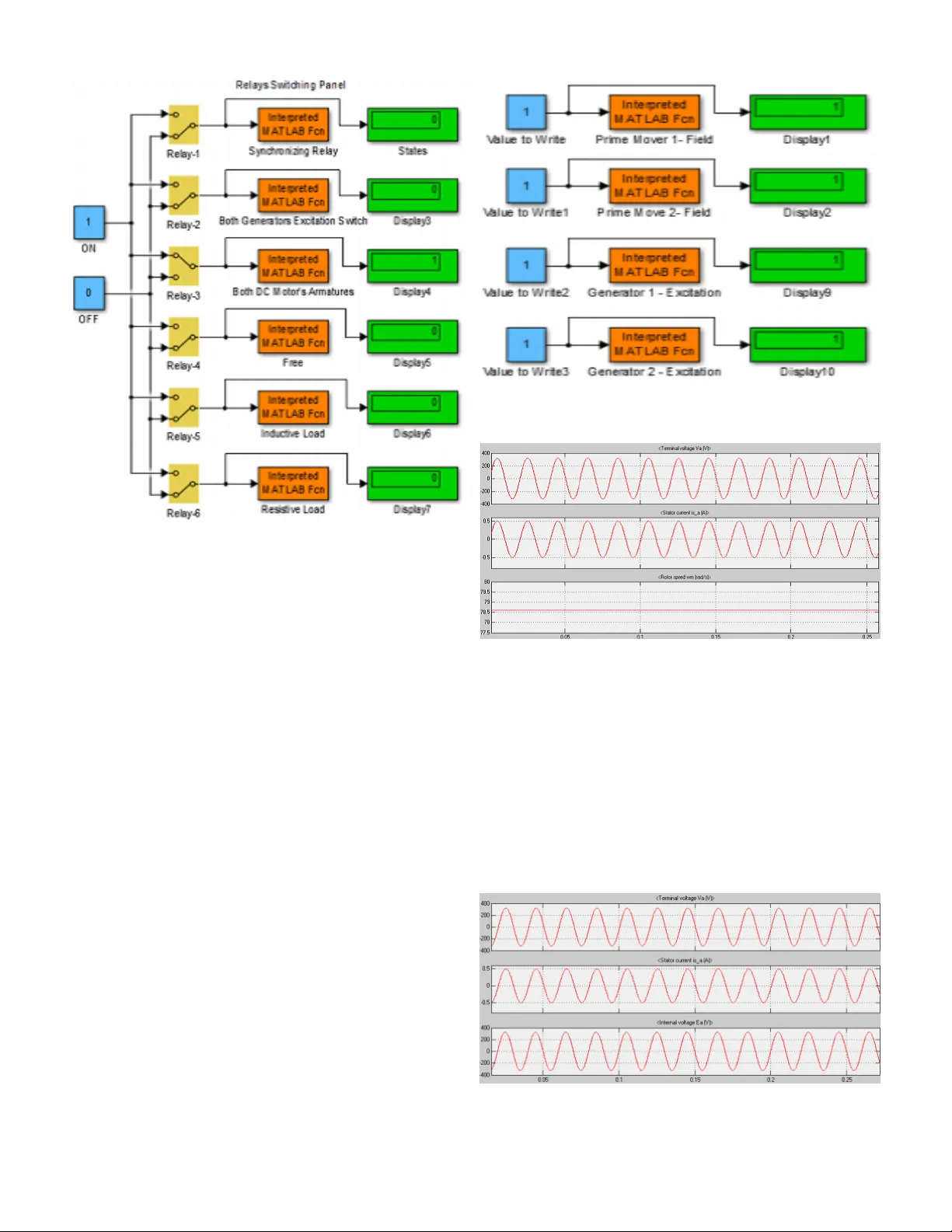
Real T ime Control and Performance Analysis of A Smart Multi-Machine System through Hardware-in-the-Loop Simulation Muhammad Sarwar 1 , Anas Ramzan 2 , Muhammad Usman Naseer 3 , Bilal Asad 4 1 − 4 Dept. of Electrical Engineering 1 P akistan Institute of Engineering & Applied Sciences , Islamabad, Pakistan 2 − 4 The Islamia University of Bahwalpur , Bahaw alpur , Pakistan 1 msarwar@pieas.edu.pk, 2 m.anas13@ymail.com, 3 usman.naseer@iub .edu.pk, 4 bilal.asad@iub .edu.pk Abstract —This paper presents an implementation of a smart power system using inter-de vice communication and supervisory control through Simulink integrated with the physical system. This control includes features of real-time control, load manage- ment, fault detection and self-healing. The prototype is designed in hardware which takes in required parameter via sensors to PC via RS-232 power meter interface and actuator interfaced with Arduino microcontr oller board which is integrated with Simulink. Simulink simulates the model and predict contr ol signals depending upon input parameters and it sends control signal back to Arduino which then control the hard ware through hardwar e in the loop (HIL) simulation. In the case of a severe fault, these control techniques detect system variation and com- pensate f or this variation or remove the faulty part by using relays, which represents the self-healing nature of the developed model. Index T erms — Smart grid (SG), HIL, Simulink, P ower system, Micro grid, Smart control I . I N T RO D U C T I O N Electricity is the best form of energy that can be utilized to cope with the modern needs of a progressi ve civilization. Electrical energy generated at power stations is transferred to consumers through a complex transmission and distribution network known as power grid. Currently , electric power is produced in a centralized manner , in which it is transmitted from generating stations to load centers in a uni-directional hierarchical flow [1]. This unidirectional, uncontrolled flow of electric power poses a number of challenges to grid operators, thus jeopardizing the security , quality and reliability of the electric power being supplied at the consumers end [2]. The future grid that features bidirectional transfer of power from central generation centers to consumers by deploying information and communication technologies and also from Distributed Generators (DGs) to other consumers and controls all the processes in a pervasi ve and smart manner can be termed as Smart Grid (SG) [3]. Furnished with state-of-the- art communication and smart control infrastructure, the future Smart Grid will successfully be able to cope with increasing demand of the bulk loads and will prev ail the power industry market with economic and en vironmental advantages [4]. A thorough revie w of the challenges and technologies for the future smart grid is giv en in [5] for interested readers. Fig. 1. A Conceptual Model for Future Smart Grid T o materialize dream of such an adv anced grid, con ventional power system needs to be reinv ented at all levels. Its aging infrastructure and less ef ficient networks need to be replaced by fle xible and digitally smart equipment. Such a netw ork le vel ov erhaul requires an industrious effort of technical research and huge inv estments in modern state-of-the-art technologies to ev olve them into the grid of future. An effort has been made in this survey to uncov er modern research being carried out in this field, its benefits, in vestors and companies interested in re vamping the traditional grid to serve humanity in a much better way . The con ventional grid is prone to structural weaknesses and raises hazardous environmental concerns. Theses weaknesses and concerns hav e severe impact on reliability and quality of the power provided by con v entional grid. Hence, there is a great need of adv ance and sustainable grid that uses modern information technologies for secure, reliable dispatch of electricity both from bulk generating stations and from Distributed Energy Resources (DERs) in a multi-directional and flexible manner with exchange of information in real time [6]. Efficienc y of a power system decreases due to the losses in it. Similarly , the instability of multi-machine depends upon the transients produced during its operation. T o overcome these losses a micro grid model should be assembled in such a way that all the controlled parameters should apply on it [7]. The results of these parameters should have the ability to apply on macro grids and with the help of these parameters control on the losses is possible. In our proposed model, we use two motor generator set as a generating station and 3 buses for load. A LabVIEW based test-bed system has been designed by authors of [8] where they designed and test an automatic syn- chronizing and protection relay for the distribution generator (DG). A smart micro-grid system is designed by the authors of [9] in which different protection and automation techniques and algorithms have been implemented to enhance the security and reliability of the designed micro-grid. Objectiv e of this paper is to simulate and dev elop the model in such a way that all the controlled parameters i.e. po wer flow analysis, damping of transients, improvements in power factor , smart load sharing, and system stability are applicable on it. And also capable of smart power generation and distrib ution including automatic load shedding, forecasting and multi-agent system for inter-de vice communication. A working model of SG is presented in this paper that com- prises of adv anced technologies, networks and subsystems. The model describes SG as a system of systems through a systematic approach from modern technologies and innov ati ve engineering practices tow ards the grid of future. W e also implement future grid concept to make grid automated and self-healing under the widespread control of ultra-smart man- agement and control systems providing a number of benefits to both utilities and consumers. Being a ware of huge landscape of the SG, future grid will be comprised of smart infrastructure, smart information, communication, management and protec- tion [10]. In Section II, the prototype implementation is described and its working according to different load condition for the system. In Section III, discussion and implementation of prototype in SIMULINK are explained while results and analysis are discussed in the Section IV . In Section V , a conclusion about more stabilized and automated future power system by using more advance technologies is highlighted. I I . P RO TO T Y P E I M P L E M E N T A T I O N Prototype is implemented in two ways: A. Software Implementation For the control and monitoring of the power system, input and output interfaces and control algorithms are de veloped in Simulink which takes inputs from system in real time and control the system parameters through its output interface. Arduino is also integrated with MA TLAB for faster and precise numerical computations of the load forecasting and reliability assessment of the system. B. Hardwar e Implementation Smart Generation and distribution system is dev eloped and interfaced with software model. Hardware model consists of generators with control equipment and smart distribution system. Distribution system consists of resisti ve and inductiv e loads, solid state control circuits which are used to distribute and control power in a smart manner . Follo wing steps should be followed, first of all make a motor-generator set. F or this purpose, connect the synchronous machine with tachometer . Also connect the av ailable D.C motor of suitable rating with same tachometer . Here we use D.C motor as a prime-mover . Purpose of connection of D.C motor as well as synchronous machine with tachometer is to determine the speed, torque and po wer of these machines at any instant of time T achometer has two parts, one is called Sensor Unit while second is called Display Unit. Sensor Unit is connected with motor and generator shaft for sake of sensing and determining the change in speed and torque of the motor and generator . These determined values will display on Display Unit with the help of serial cable connected with Sensor Unit. Output of generator is connected with 3-phase A.C power meter to determine the output voltages of generator . And Block diagram is gi ven in fig 3. The aim is to automate the same system and control it with computer or by any other type of software based device. Use Buck Conv erter in- place of rheostat. T o control all these circuits such as Buck Con verter , Current Sensor and V oltage Sensor, use software based Arduino which is connected to operating system such as computer via its software driver . Arduino is a programmable device which has number of I.Cs. The limiting values of parameters i.e. maximum and minimum values of current, voltage of motor-generator set is pre-programmed in Arduino. So that the maximum and min- imum range of parameters of motor-generator system should not exceed. If there is any change in v alues occur , Arduino gets signal of that change and it corrects that undesirable change and stable the output value to its pre-programmed value. Basic purpose of buck Con v erter is to regulate the D.C source supply so that the input to field could be controlled and varied. Buck Con verter get pulse with modulated signal through Arduino. I I I . B L O C K D I AG R A M A N D C O M P O N E N T S P E C I FI C AT I O N T o monitor and its stable operation, our prototype follo ws following control structure in hardware and software imple- mentation. Both generator feed power to the load through Bus1 and Bus 2 to common load bus and generator change its speed and other parameter according to load on the common load bus. Control structure sense v ariation in load current and voltage through current and v oltage sensors respecti vely and different protection devices i.e. relay and breaker to common load bus. These variation feed directly to Arduino and in the same way , model de veloped in MA TLAB also working on the same specifications. Sho wn in Fig. 3. Arduino work as a communication channel between hardw are and softw are model and integrate them in such a way that they respond each other in any variation. Arduino Compare the MA TLAB values and hardware model and generate signal to make system stable. Lik e, in case of fail- Fig. 2. Hardware implemented model ure of any generating station load shift on healthy generating station, Arduino sense the change and increase/decrease the excitation of generator to meet the load demand and remove faulty generator through circuit breaker . And similarly load variation cause different abnormal beha viors, current sensor measure and communicate with Arduino to check the current limit. If it is in permissible range then it will generate the signal and change the excitation of generator by changing the duty cycle of buck con verter to meet load v ariation. If current variation is not in permissible range then it will generate signal to remov e the extra load to make it stable. In this way , both hardware and software interlink with each other and communicate to make the system self-healing and whole system performance can be consider as a hardware in the loop (HIL) simulation. I V . S I M U L I N K M O D E L In software implementation observer can observe the effects of change in v alues of parameters while output of motor- generator set remains same. V oltage Sensor and Current Sensor controls and limits the value of applied voltage and current, to av oid the excessiv e flow of current in the field winding of motor . V oltage Sensor and Current Sensor measures the input line current and limit this v alue to a definite ratio or some pre- determined ratio and gives signal to Arduino device. Arduino compare these receiving values with its pre-programmed value and perform the necessary change in value so as to keep the T ABLE I R A T IN G O F D I FFE R E N T C O MP O N E NT I N H I L M O D EL Component Name Ratings Arduino Due 3.3V Generating station 1.2kW , 1400 RPM Power pack 3.5A, 220V ,230V , 10A(3-phase) T orque power meter 3000 RPM, +/- 5.5kW , +/-17.5Nm Compound motor 1kW , 220V Excitation(0.55 A) Load switch 3-pole, 16A,250V DC/440V A C V oltage Sensor 3.3 V stable output value. Real-time output value is displayed on the screen of software based device such as computer etc. Graphical representation of change in values can be displayed on screen for graphical analysis [11]. W e basically integrate hardware model with software model which takes the input from hardware model and compare it with Simulink design model which is working under the ideal condition and error signal is generate by the Arduino then feed into prime mover to change the system performance. When system undergoes from the sev ere fault then this part can automatically remov e or try to move it towards its stable state. Rating of different component is shown in T able I. Prototype is designed in hardware which takes in required parameter via sensors to PC via RS-232 po wer meter interface and actuator interfaced with Arduino microcontroller board Fig. 3. Block diagram for Control of HIL Model Fig. 4. Simulink Model of the physical system which is integrated with MA TLAB Simulink shown in Fig. 5. W e observe our system under different condition like, timing variation, frequency variation, and many more. W e can estimate timing behavior because under this observ ation we are able to observe the system stability and also system response under various condition by using MA TLAB Simulink. The main purpose of hardware in the loop is that we run the prototype simultaneously in software and hardware at a time and do the analysis by observing the results showing in graph and time response is about 1ms. W e can improve it Fig. 5. Power meter RS-232 communication protocol through Simulink Fig. 6. System input v oltage sensor model by introducing more sensitiv e de vices. System voltage variation is actuated by MA TLAB Simulink model shown in Fig. 6. V . A NA LY S I S A N D R E S U LT S The system when completely synchronized with the Simulink model, all the inputs from physical systems are passed on the virtual system using actuators and sensors. A C power meter is used to transfer Electrical parameters of the generators and loads to the virtual model. DC voltage and current sensors pass on the DC voltage and current values to the system running in the Simulink. T orque and tachometer Fig. 7. Relay Control P anel unit displays the v alues of shaft torque, RPM and po wer produced by each prime mover thus keeping a check on each prime mov ers real power input to the generator . The system controls the hardware parameters as well. Switching relays switch on and off the load and shed the load when high fault currents are passed through the system. DC voltage regulators (buck con verter) control the excitation of each alternator and field voltage of each prime mover (DC motor) which is connected as separately excited motor . The system in up and running condition control the speed of each prime mov er , voltage of each generator , automatically syn- chronize the two alternators when commanded from Simulink model, reads the electrical parameters of all the generators, motors and loads attached. From system performance, we can observe that terminal voltage, stator current and rotor speed is constant at 78.7. But when load on a generator 1 increase then rotor speed also fluctuates and this ef fect also shifts tow ards generator 2. But after comparing it with our MA TLAB model, it will try to mov e generator speed to wards a constant rpm, internal voltage, stator current and all other parameter start to stabilize. And load current and voltage is also constant. Fig9-10 represents system performance and behavior under stable condition. V I . C O N C L U S I O N Future grid is an ineludible technological innovation that would help us to build an environmental friendly and sus- tainable future for energy demands. This paper revie ws major pilot projects initiated by v arious utilities, organizations and Fig. 8. Buck con verter duty cycle control Fig. 9. Outputs of Generator -1 institutions. And tried to present a self-automated system, which under goes dif ferent system v ariations and then stabilizes according to the system needs. The risks introduced due to deployment of adv anced technologies were also assessed and solutions proposed by various researchers were presented. The system can be extended to a more adv anced and reliable system that would incorporate a 3 machine 9 bus system with IEEE standard bus data. For the same prototype, the Fig. 10. T erminal Outputs of Generator-2 Fig. 11. V oltage & Current wav eforms at Load T erminals Simulink model can be extended into a GUI control panel which displays all the values of input parameters, provided controls for all variable parameters and provides options for system analysis and control. R E F E R E N C E S [1] H. Farhangi, “The path of the smart grid, ” IEEE power and ener gy magazine , v ol. 8, no. 1, 2010. [2] P . Kundur , N. J. Balu, and M. G. Lauby , P ower system stability and contr ol . McGraw-hill Ne w Y ork, 1994, vol. 7. [3] R. E. Brown and L. A. Freeman, “ Analyzing the reliability impact of distributed generation, ” in P ower Engineering Society Summer Meeting , 2001 , vol. 2. IEEE, 2001, pp. 1013–1018. [4] A. Ipakchi and F . Albuyeh, “Grid of the future, ” IEEE power and energy magazine , v ol. 7, no. 2, pp. 52–62, 2009. [5] M. Sarwar and B. Asad, “ A revie w on future power systems; technolo- gies and research for smart grids, ” in 2016 International Conference on Emer ging T echnologies (ICET) . IEEE, October 2016, pp. 1–6. [6] R. Hassan and G. Radman, “Surve y on smart grid, ” in IEEE South- eastCon 2010 (SoutheastCon), Pr oceedings of the . IEEE, 2010, pp. 210–213. [7] S. M. Amin and B. F . W ollenber g, “T o ward a smart grid: power deliv ery for the 21st century , ” IEEE power and energy magazine , v ol. 3, no. 5, pp. 34–41, 2005. [8] M. Mahmood, M. Azam, K.-u.-N. Fatima, M. Sarwar , M. Abubakar , and B. Hussain, “Design and implementation of an automatic synchro- nizing and protection relay through power-hardw are-in-the-loop (phil) simulation, ” arXiv preprint , 2019. [9] M. Abubakar, M. Sarwar , T . H. Khan, M. Sarmad, and B. Hussain, “Real-time implementation of directional over -current protection coor- dination in a microgrid, ” in 2018 International Symposium on Recent Advances in Electrical Engineering (RAEE) , Oct 2018, pp. 1–6. [10] M. Hashmi, S. H ¨ anninen, and K. M ¨ aki, “Survey of smart grid concepts, architectures, and technological demonstrations worldwide, ” in Innova- tive Smart Grid T echnologies (ISGT Latin America), 2011 IEEE PES Confer ence on . IEEE, 2011, pp. 1–7. [11] D. Cirio, E. Gaglioti, S. Massucco, A. Pitto, and F . Silvestro, “ An extensi ve dynamic security assessment analysis on a large realistic electric power system, ” in P ower T ec h, 2007 IEEE Lausanne . IEEE, 2007, pp. 285–292.
Original Paper
Loading high-quality paper...
Comments & Academic Discussion
Loading comments...
Leave a Comment