Toward Real-Time Wireless Control of Mobile Platforms for Future Industrial Systems
The use of mobile platforms (MPs) is particularly attractive for various industrial applications. This demonstration highlights the importance of remote control of MPs and shows its viability over a high-performance wireless solution designed for clo…
Authors: Adnan Aijaz, Aleks, ar Stanoev
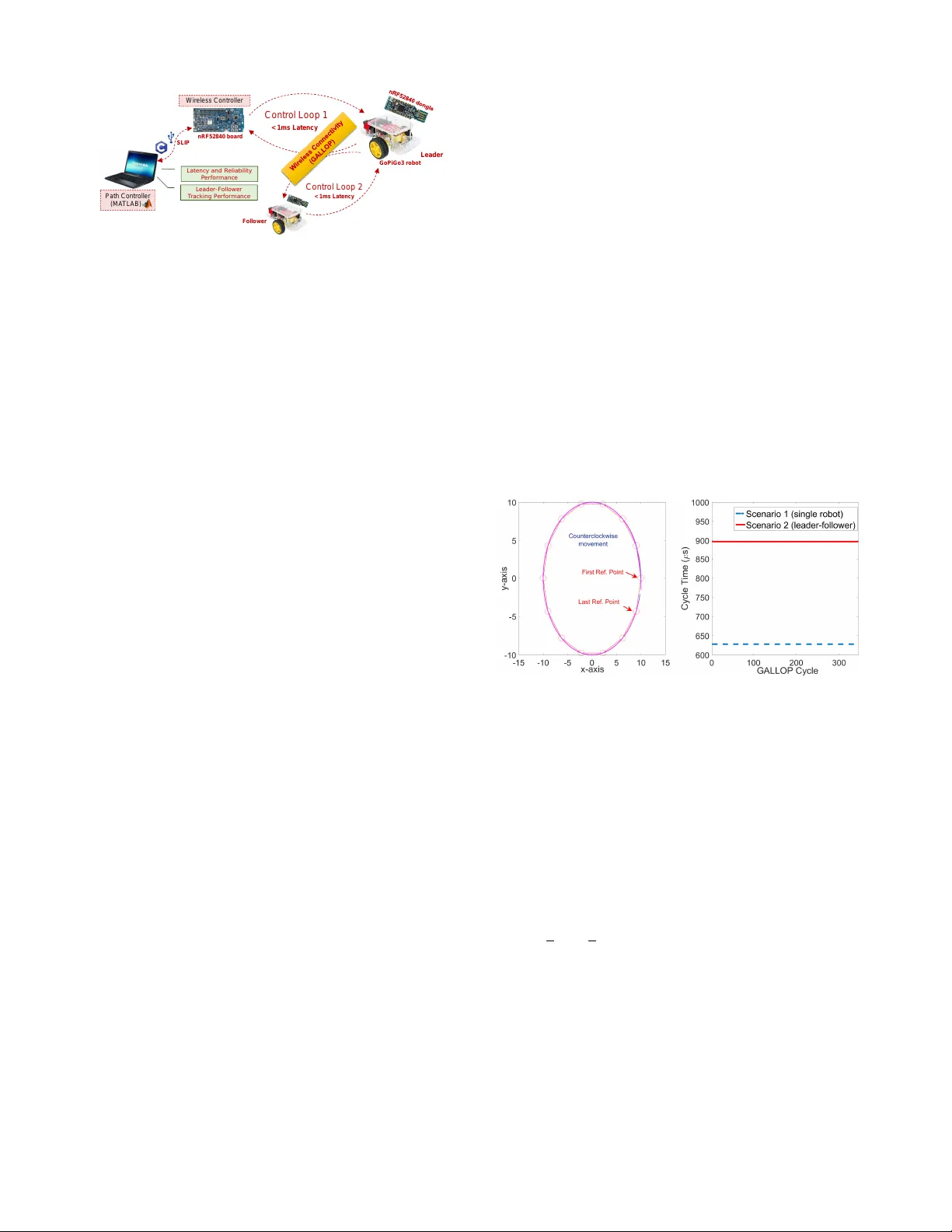
IEEE INTERNA TIONAL CONFERENCE ON COMPUTER COMMUNICA TIONS (INFOCOM) 2019 – DEMO P APER 1 T o ward Real-T ime W ireless Control of Mobile Platforms for Future Industrial Systems Adnan Aijaz, Aleksandar Stanoe v and Mahesh Sooriyabandara Abstract —The use of mobile platforms (MPs) is particularly attractive for various industrial applications. This demonstration highlights the importance of remote control of MPs and shows its viability over a high-perf ormance wireless solution designed for closed-loop contr ol. Further , it shows the viability of formation control of a network of MPs through a leader -follower approach underpinned by high-performance wireless. Index T erms —A GV , closed-loop, Industry 4.0, mobile robot. I . I N T RO D U C T I O N R ECENT technological advances hav e led to the realiza- tion of mobile platforms (MPs) like automated guided vehicles (AGVs), aerial drones and mobile robots. These MPs would likely change the con ventional role of industrial ma- chines, ultimately paving the way tow ard beyond 4.0 industrial systems [1]. The logistic sector is already employing AGVs and mobile robots, particularly in warehouses and container terminals. Current industrial applications are mostly focused on a single MP . The use of a network of MPs, acting in a collaborativ e manner, impro ves efficiency and performance of industrial operations. Moreover , it also creates new opportu- nities for automation processes targeting complex tasks. State-of-the-art MPs are autonomous in nature and use different guidance control techniques like wire-guidance, mag- netic tape, laser and camera-based imaging [2]. Such tech- niques not only require sophisticated sensing and localization capabilities at MPs but also need modifications to logistic facilities. Remote control 1 of MPs is a disruptiv e paradigm that offers a low-cost alternative while providing v arious advantages. It is viable e ven with MPs equipped with no or minimal sensory capabilities. It of fers higher flexibility as MPs can be deployed without any pre-configuration of the logistic facility . It also pro vides instant reconfigurability in case of layout changes to facilities. Remote control of a MP creates a closed-loop control sce- nario wherein command and feedback signals are exchanged between an external controller and a MP over a wireless network. Such closed-loop control demands connecti vity with very highly reliability and very low latency [1]. This is to ensure stability of the control loop for accurate path tracking under the imperfections of wireless medium. Closed-loop control also exhibits a cyclic traffic pattern that requires high determinism. The connecti vity requirements become more stringent when multiple MPs are executing a collaborati ve task as this entails tight synchronization among MPs while maintaining a certain formation [1]. The authors are with the Bristol Research and Innov ation Laboratory , T oshiba Research Europe Ltd., Bristol, BS1 4ND, U.K. Contact e-mail: adnan.aijaz@toshiba-trel.com 1 Remote control of real and virtual objects and processes is also the vision of the emerging T actile Internet . T o this end, the main focus of this ( live ) demonstration is real-time wireless control of an industrial system comprising multiple MPs. It has two main objectiv es. First, it demonstrates the viability of real-time closed-loop control of MPs through a high-performance wireless solution, known as GALLOP 2 , which has been dev eloped in authors’ previous work [3]. Second, it demonstrates the viability of collaborative robotics ov er high-performance wireless through a leader-follo wer for- mation control architecture comprising multiple MPs. P at h C on t r o l l e r (M A T L AB) W i r e l e s s C on t r ol l e r S LI P P a t h T r a c k i ng P e rf orm a n c e R e lia b ility P e rf orm a n c e L at e n cy P e rf orm a n c e G oP i G o3 r obot C ont r ol Loop < 1 m s L a t e n c y n R F 52840 b o ar d S LI P G oP i G o3 Conne c t i v i t y n R F 52840 R asp b er r y P i 3 G oP i G o3 boa r d Fig. 1. The remote control scenario and configuration. I I . D E M O N S T R A T I O N O V E RV I E W The demonstration consists of two different scenarios. Both scenarios mimic an industrial en vironment wherein MPs are used for logistic applications e.g., a mobile robot or an AGV transporting goods in a warehouse or moving containers in a port terminal. The first scenario, which is sho wn in Fig. 1, demonstrates wireless control of a mobile robot by an external controller which remotely drives it on a pre-defined path. In this case, the robot has no knowledge regarding the path. The second scenario (Fig. 2) demonstrates collaborative robotics wherein two mobile robots are required to maintain a certain formation, which is achiev ed through a leader -follo wer approach wherein the leader is responsible for guiding the follower such that both maintain a desired formation. This results in a platooning scenario wherein the follo wer robot is remotely driven by the leader robot. In both scenarios, the control loops are closed over a wireless medium and create extremely stringent latenc y and reliability requirements for accurate real-time path tracking. I I I . D E S I G N A N D I M P L E M E N TA T I O N A. Mobile Robot W e use the GoPiGo3 (https://www .dexterindustries.com/ gopigo3/) robotic car which runs on a Raspberry Pi. The GoPiGo3 robot is a differential dri ve system with two dri ving wheels (driv en by motors ha ving magnetic encoders) and one caster wheel. The motor control is performed by an 2 GenerAlized cLosed-Loop cOntrol of Processes IEEE INTERNA TIONAL CONFERENCE ON COMPUTER COMMUNICA TIONS (INFOCOM) 2019 – DEMO P APER 2 P at h C on t r o l l e r (M A T L AB) C ont r ol Loop 1 < 1 m s L a t e n c y C ont r ol Loop 2 < 1m s L at en cy Fol l ow e r L ea d e r L ea d er - F ol l ow e r T r a c k i ng P e r f o r ma nc e L a te n c y a n d R e lia b ility P e rf orm a n c e W i r e l e s s C on t r ol l e r S LI P n R F 52840 b o ar d G oP i G o3 r obot Fig. 2. The leader -follower formation control scenario and configuration. A TMEGA328 microcontroller on the GoPiGo3 board which is stacked on top of the Raspberry Pi. The microcontroller sends, receives and e xecutes commands sent by the Raspberry Pi. B. W ir eless System Design The proposed demonstration employs GALLOP as the un- derlying wireless technology . GALLOP has been specifically designed to provide high-performance connectivity for realiz- ing closed-loop control. GALLOP is agnostic to the Physical (PHY) layer and can be implemented on any off-the-shelf wireless chipset. The medium access control (MAC) layer is based on time division multiple access (TDMA), frequency division duple xing (FDD) and frequency hopping. GALLOP caters for the peculiarities of closed-loop operation through a control-aware bi-directional distributed scheduling algorithm. It is capable of operating in both single-hop and multi-hop topologies. GALLOP implements novel cooperativ e diversity and efficient retransmission techniques for achieving very high reliability . Detailed description of GALLOP is av ailable in [3]. W e ha ve implemented GALLOP on Nordic Semiconduc- tor nRF52840 platform (https://www .nordicsemi.com/eng/ Products/nRF52840) which is built around a 32-bit ARM Cortex-M4F CPU with 1 MB flash and 256 kB RAM on chip. The embedded 2.4 GHz transcei ver supports multiple protocols including Bluetooth 5, Bluetooth lo w energy , and IEEE 802.15.4. GALLOP has been implemented on the un- coded 2 Mbps Bluetooth 5 PHY layer . GALLOP adopts a flooding-based protocol [4] for time synchronization. The transmit po wer is set to 8 dBm and the net MA C payload is 16 bytes. The wireless controller has been implemented on the nRF52840 board whereas the GoPiGo3 robotic cars are equipped with the nRF52840 dongles. C. P ath Contr oller Design and Interfacing The objecti ve of the path controller (PC) is to remotely driv e the GoPiGo3 robot along a pre-defined route by controlling the speed of the driving wheels. The PC has route information as a set of reference points. It periodically receiv es motor encoder values for left and right wheel as feedback from the robot. It reads the first reference point and calculates the deviation error from the current position of the robot which is obtained using the feedback. It estimates the required speed of the wheels based on a quadratic curve approach and a kinematic model characterizing the robot’ s mov ement [5]. This information is sent as the control command on the forward path. The algorithm continues until the robot reaches the reference point. The procedure is repeated for subsequent reference points until the robot reaches its destination. The path control functionality for platooning scenario follo ws a similar approach. Ho wev er, in this case the PC logically resides in the leader GoPiGo3 robot and the set of reference points for the follower GoPiGo3 robot is populated on-the-fly using leader’ s position. A few results from the demonstration are shown in Fig. 3. The PC also handles an emergency stop function which shows GALLOP ’ s ability to support timely deliv ery of e vent- driv en information. The GoPiGo3 robots are equipped with an infrared distance sensor and the distance feedback is piggybacked ov er the encoder feedback. Emergenc y stop func- tionality is triggered if either of the robots detect an obstacle on the route. On apprehending a collision, the PC sends a control message to stop the robotic system. The nRF52840 board communicates with a C application ov er a USB interface through a serial line Internet protocol (SLIP). The C application communicates with the PC which has been implemented in MA TLAB. On the GoPiGo3 car , the nRF52840 dongle communicates with Raspberry Pi ov er the aforementioned USB interface. Fig. 3. Performance ev aluation: (a) leader-follo wer path tracking (small circles denote reference points of the path); (b) cycle time (latenc y) of GALLOP . I V . R E M A R K S This demonstration shows the ef fectiveness of GAL- LOP in handling different closed-loop control scenarios. V ertical applications of GALLOP and the proposed sys- tem design include formation control of an aerial drone fleet, nuclear decommissioning, highway platooning, vir- tually coupled train systems, and collaborativ e operation of multiple robots. A short video of the demonstration is av ailable at [https://www .dropbox.com/s/roctb3pac5o8y53/ GALLOP demo final.mp4?dl=0]. R E F E R E N C E S [1] A. Aijaz and M. Sooriyabandara, “The T actile Internet for Industries: A Revie w, ” Pr oc. IEEE , vol. 107, no. 2, pp. 414–435, 2018. [2] L. K. Rogers, “Automatic Guided V ehicles, ” Modern Materials Handling , Sept. 2011. [3] A. Aijaz, “Method for Scheduling Closed-Loop Information in W ireless Networks, ” 2017, US Patent App. 15487079. [Online]. A vailable: https://patents.google.com/patent/US20180302908A1 [4] F . Ferrari, M. Zimmerling, L. Thiele, and O. Saukh, “Efficient Network Flooding and Time Synchronization with Glossy, ” in ACM/IEEE Intl. Conf. on Information Processing in Sensor Networks (IPSN) , April 2011. [5] R.Siegwart and I. R. Nourbakhsh, Introduction to Autonomous Mobile Robots . MIT Press, 2004.
Original Paper
Loading high-quality paper...
Comments & Academic Discussion
Loading comments...
Leave a Comment