Attention model for articulatory features detection
Articulatory distinctive features, as well as phonetic transcription, play important role in speech-related tasks: computer-assisted pronunciation training, text-to-speech conversion (TTS), studying speech production mechanisms, speech recognition fo…
Authors: Ievgen Karaulov, Dmytro Tkanov
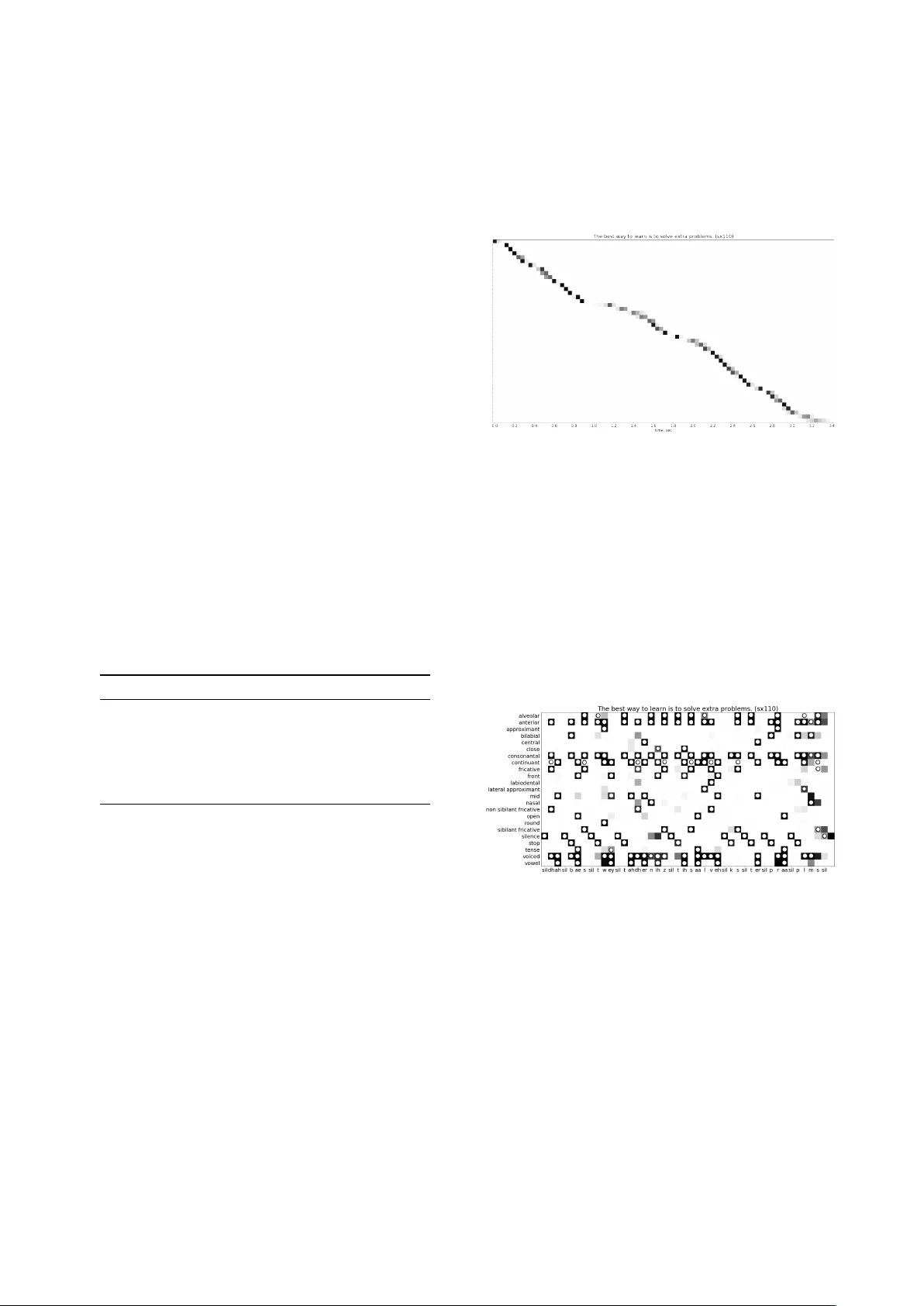
Attention model f or articulatory featur es detection Ievg en Karaulov 1 , Dmytr o Tkano v 1 1 Sciforce, Ukraine ekaraulov@sciforce.solutions, dtkanov@sciforce.solutions Abstract Articulatory distinctiv e features, as well as phonetic transcrip- tion, play important role in speech-related tasks: computer- assisted pronunciation training, text-to-speech con v ersion (TTS), studying speech production mechanisms, speech recog- nition for low-resourced languages. End-to-end approaches to speech-related tasks got a lot of traction in recent years. W e ap- ply Listen, Attend and Spell (LAS) [1] architecture to phones recognition on a small small training set, like TIMIT [2]. Also, we introduce a novel decoding technique that allows to train manners and places of articulation detectors end-to-end using attention models. W e also explore joint phones recognition and articulatory features detection in multitask learning setting. Index T erms : manners of articulation, places of articulation, sequence-to-sequence model, multitask learning, lo w-resource speech recognition, phones recognition 1. Introduction End-to-end approaches emerged in neural translation and later significantly changed automatic speech recognition (ASR) and TTS. While con ventional pipelines still pro vide decent re- sults, especially on smaller datasets, end-to-end models quickly catchup and are already state-of-the-art on some tasks [3]. End- to-end models are typically sequence-to-sequence models that output words, subword units, graphemes or phonemes directly . Articulatory features [4] play an important role in describ- ing speech production mechanisms. They can be di vided in voicing, manners and places of articulation. A combination of a manner , a place and voicing defines any sound that human can produce in a unique way . For example, by con vention “s” in the word “sea” is a voiceless alveolar sibilant which contrasts it to other phones. By their nature, articulatory features are language agnostic and open many research oportunities in crosslingual and multi- lingual speech recognition, as linguistic features in speech syn- thesis etc. Particularly , Interspeech 2017 paper by Abraham [5] explores these features for ASR in lo w-resource setting. Au- tomatic Speech Attribute Transcription (ASA T) system [6], [7] also works on producing speech-to-text model based on indi- cators detection (subset of these indicators are articulatory fea- tures; hereafter both terms are used with the same meaning). Another application of phones recognition and articulatory features estimation is Computer-Assisted Pronunciation Train- ing. Some of the approaches are described in [8] and [9]. This paper dwells on applications of attention-based mod- els to articulatory features detection. W e introduce a novel de- coding technique that allo ws training manners and places of ar- ticulation detectors end-to-end with the help of attention-based models. W e also explore joint phones recognition and articula- tory features detection in a multitask learning setting. Contrary to other works in this domain, we focus on producing sequences of features instead of frame- or segment-le vel labels. Sequence- lev el data is simpler to work with in applications where precise alignment with original wav eform is not important. It also may serve as input for the encoder in sequence-to-sequence-based speech synthesis. Besides, articulatory features are language- independent, and our approach can potentially be applied to zero-resource speech recognition. 2. Pre vious w ork The con ventional approach to estimation of phonological fea- tures is akin to the standard ASR pipeline. It requires forced alignment of phones to utterances. As a result, training is usually done either on fine-labeled data with alignments or on data that have good acoustic models a vailable. This limits re- search to well-studied mainstream languages or enforces usage of cross-language models. Reasearch on detection of places and manners of articula- tion is spread across dif ferent languages and it is challenging to select a single baseline. W e decided to use TIMIT in our e xper- iments as it is an overall well-studied corpus with well-known published results for phones recognition [10] and articulatory features detection [11]. While we focus on detection, there is still a noteworthy se- ries of recent works on manners discrimination using zero-time windowing, e.g. [12], which might be used in feature engineer- ing for encoder inputs. For non-English baselines, a good starting point is work by Merkx and Scharenborg [13] that describes positive impact of CNNs on ariculatory features classification in Dutch. Another end-to-end approach to articulatory features detec- tion is described in [14], where authors focus on connectionist temporal networks (CTC) [15]. 3. Model description 3.1. Attention-based models T ypical end-to-end models in speech domain are based on se- quence to sequence neural networks. Most common archi- tectures are CTC, recurrent neural network transducer (RNN- T) [10] and encoder-decoder with attention [16]. In this work we will focus on attention-based models. One of important fea- tures of attention-based models is that they provide a link be- tween the encoder (acoustic data) and the decoder (textual data or indicators) steps. For training this link results in faster con- ver gence to lower loss values. Besides, during inference, atten- tions enables b uilding a distribution that can relate the sound data and the textual data, essentially providing fuzzy alignment between the decoder outputs and the encoder inputs. 3.2. Articulatory features Articulatory features describe production of sounds via the in- teraction of different components within a human v ocal tract. Our approach rests largely on the seminal paper by Simon King [11] that used so-called Spok en P atterns of English (SPE [4]) features and manners as targets instead of phones for training a neural network. W e used a combination of SPE, manners and places of ar- ticulation in our experiments. 3.3. Multi-task learning Multi-task learning (MTL) [17] improves learning efficiency and model generalization for the task-specific models by learn- ing se veral related tasks at the same time. All tasks usually share a part of representation. Each new task contributes to the model learning by adding information and transferring knowl- edge. MTL approach is applied to neural networks by sharing some of the hidden layers between different tasks. In our work, we share encoder parameters between two tasks: articulatory features classification and phonemes classi- fication. 3.4. Decoder for indicators In this work we train a LAS model on phone and indicator tar- gets. For phone targets, the setup is rather straightforward: de- coder outputs ARP ABET symbols directly at each step. W e do not use any language model, so the decoder outputs are passed for the error rate calculation as is. For indicators detection, we modified the decoder . W e use a sigmoid activ ation function for the projection layer, since these features are not mutually exclusi ve. At each step, the decoder outputs posteriograms for places and manners of articulation. Our approach has two options for the indicators decoder . The first option outputs samples from posteriors of indicators. Al- ternativ ely , the indicators posteriors are transformed to phones posteriors via the mapping matrix M = { m ij } , i = 1 ..M , j = 1 ..N , where m ij is a binary indicator of presence or ab- sence of the corresponding feature f i ∈ F in the phone s j ∈ S ; M is a phones count in the lexicon, N is an indicators count. Let’ s describe the second approach in detail. For clarity , we are describing all the operations during inference. Let Φ be a set of posterior probabilities φ i of all indicators at encoder’ s out- put and decoder’ s time step t . Assuming binary features’ inde- pendence, we can obtain log probabilities of observing phones P = { log p i } using the following equation: P = log Φ · M + log (1 − Φ) · (1 − M ) (1) After obtaining log posteriors of phones P , we then find one with the highest probability ˆ f = f ˆ j , ˆ j = ar gmax P , and perform its rev erse mapping on articulatory features vector by just getting column ˆ j from M . This new vector of refined in- dicators is passed to the decoder’ s input for calculating output at decoder’ s next time step t + 1 . Thus, binary features pos- teriors are rounded to the values corresponding to the closest phone, filtering out in valid combinations which nev er occur in the language (for example, front and back, stop and continuant, etc.). It is important to note that the set S of all possible phones is not constrained by phonetic inv entory of training language and thus can be used in cross-lingual low resource speech recogni- tion. So, by specifying a mapping matrix for a different lan- guage than used at training time, we can perform cross-lingual phones recognition. Finally , we apply MTL for both phone targets and indica- tors. Both tasks share the encoder, howe ver , the attention and the decoder are distinct for them. Losses of both tasks con- tribute equally to the overall loss on each step. In our exper- iments, the joint model needs 20% less steps for con ver gence than separate models. A possible explanation is that a loss for indicators tar gets of similar phones (e.g. target “n” and network output “ng”) will have lower value than a loss for distant phones (e.g. “n” and “o w”), due to matching articulatory features, ev en at early training steps. At the same time, for phone targets, net- work outputs that are closer to targets will hav e a higher loss, at least at early stages of training. 4. Experiments 4.1. Dataset and features All experiments were performed on the TIMIT corpus. For training we used the standard 462-speaker set without SA records. T est results in tables below correspond to the core test set of 192 utterances. A dev elopment set was collected from the remaining part of the test set, i.e. the non-core part. W e explicitly checked that the train, dev elopment and test sets had non-ov erlapping speakers. Also, the test core set does not share either speakers, or phrases with the train and de velopment sets. There are 61 phone types in the corpus, yet a common practice is to report results on a reduced 39-phone set with al- lophones mapped to a common phonetic label following [18]. Also most papers perform training on the full phone set and do 61 to 39 mapping for e valuation. In our experiments we did not find any benefits of this approach against direct training on the reduced phones set. Both ways (the full set with mapping and the plain reduced set) yielded near identical results. For features extraction we tried several approaches. W e followed [10]: 20 ms window and 10 ms step mel-scale fil- terbanks plus log-energy feature. Also we experimented with mel-frequency cepstral coefficients (MFCC) and L yon’ s audi- tory model [19]. In each case of base acoustic features we computed deltas and double-deltas. All inputs were globally normalized to hav e zero mean and unit variance for each input feature. T able 1: Phone err or rate (PER) comparison for differ ent fea- tur e sets on TIMIT corpus. Featur e PER Melfilterbanks 21.7% MFCC 21.8% L yon 21.2% T able 1 compares three models with around 6.5 million weights and identical architectures: 3 layers of 256 units in en- coder , 1 layer of 256 units in decoder , Luong attention, 20% dropout and 10% scheduled sampling probabilities. W e do not do any forced alignment and do not use temporal alignments for phones provided with TIMIT , thus phone error rates (PER) reported in this paper are essentially edit distances normalized by ground truth length. After conducting experiments we con- cluded that with other parameters fixed, MFCC and melfilter- banks perform similar in terms of phone error rate while L yon’ s cochleogram provides a slightly better accuracy . Still, to make comparison with other baselines more fair , we conducted fur- ther training on MFCC features. 4.2. T raining W e performed training on a single NVIDIA GTX1080 GPU. On average, one training run takes up 3-5 hours depending on model size. W e tried to keep a batch size of 32, yet occasion- ally had to lower it for some experiments to 16 due to memory limitations. In all experiments we used a decoder with a sin- gle layer . As to the encoder-decoder connection, we noticed that attention provides enough information to the decoder and passing the final encoder state to the decoder does not yield any performance improv ements. TIMIT is a small dataset with a few hours of speech in all sets combined. Thus, deep learning models overfit easily and regularization plays a crucial role. W e relied on dropout and L2 weight decay for regularization. W e used drop probability in 20 – 40% range and decay constant between 10 − 5 and 10 − 3 . 4.3. Results In our experiments, we did not use external language models or speaker adaptation. W e used LSTMs in the encoder without any initial con volution layers. Adding any of this impro vements should positiv ely impact accuracy of the resulting model. 4.3.1. Phone r ecognition W e used the results from [10] and [16] as baselines to compare our results against them. Their phone error rates for pretrained transducer and attention-based models are among the lo west re- ported for sequence-to-sequence models that do not rely on ex- ternal language models. T able 2: Phones r ecognition on TIMIT corpus. LAS – a model trained on phone tar gets. LAS-F – a model trained on artic- ulatory features tar gets. LAS-MTL-S – a multitask model with sampling fr om the decoder outputs. LAS-MTL-M –a multitask model with the decoder inputs con verted using a mapping ma- trix. Paper Model Parameters PER Baseline [10] T ransducer 4.3M 17.7% Baseline [16] ARSG around 6M 18.7% Ours LAS 5.6M 20.2% Ours LAS-F 5.6M 23.4% Ours LAS-MTL-S 7.1M 20.4% Ours LAS-MTL-M 7.1M 20.8% T able 2 sho ws the comparison of our models against baselines. At first glance, our implementation of a multi- task attention-based model (LAS-MTL-S and LAS-MTL-M) for joint articulatory features and phones recognition performs worse than baselines. W e attribute this to a suboptimal choice of hyperparameters, because the non-multitask model (LAS) trained on just phone recognition yields results comparable to the multitask model. Therefore, adding indicators as an addi- tional target doesn’t decrease the phone recognition accuracy . Another interesting observation is that the model LAS-F trained directly on articulatory features without complementary phone targets results in a higher error rate than LAS-MTL models. In this case, PER serves as integral accuracy for all indicators to- gether . A revie w of individual features accuracy also showed that the multitask learning approach yields higher accuracy than just using articulatory features targets. Besides, our experiments show that sampling from indica- tors posteriors (LAS-MTL-S) performs better than using a map- ping matrix (LAS-MTL-M). A possible explanation is that ar- ticulatory features can express minor variations in phones pro- nunciation (such as assimilation or coarticulation) that are not reflected in the phonetic alphabet. An important takeaw ay from this experiment is that a sequence-to-sequence articulatory features detection model, be- sides actual speech indicators, also yields phone recognition re- sults close to strong baselines. Figure 1: Attention output for phr ase SX100 fr om test set: “The best way to learn is to solve extr a pr oblems”. Figure 1 shows the output of attention for phrase SX100 “The best way to learn is to solve e xtra problems” from the test set. The model learned to align indicators with acoustic data. Mapping articulatory features to phones yields the following transcription: [sil dh ah sil b ae s sil t w ey sil t ah dh er n ih z sil t ih s aa l v eh sil k s sil t er sil p r aa sil p l m s sil]. 4.3.2. Manners and places of articulation detection In figure 2 we can see outputs of the multitask model decoder for indicators on SX100 utterance. These are raw values with- out “rounding” to the closest phones. Figure 2: Articulatory features posteriors for phrase SX100 fr om the test set: “The best way to learn is to solve extr a prob- lems”. Ground truth featur es ar e marked with white cir cles. T o the best of our knowledge, there is no previously pub- lished results for sequence-lev el articulatory features detection on TIMIT . In [14] the authors report articulatory features de- tection results on W all Street Journal (WSJ) corpus [20]. The accuracy is in 91–96% range, yet to do a proper comparison, we might need to train a model on WSJ. Having no other options, we compare to frame-lev el base- lines available. For King and T aylor paper [11], we provide results from experiment 2 which has a broader features set that is closer to what we used. ASA T [6] paper mentions only a fe w accuracy values and some of them are suboptimal, for exam- ple, 75% for close and 68% for mid places. The reported phone error rate for ASA T is 29.4%. Using alignments from attention, it is possible to map sequence-lev el posteriors to acoustic frames from the original wa veform. It is important to understand that a direct projection of sequence outputs to frames is not precise. Still, we provided accuracy of a frame-lev el projection to show that even without direct training on frame targets, alignment makes sense in spite of pyramidal stacks of recurrent layers in the encoder . T able 3: Manner and places of articulation on T imit corpus. Ours – LAS-MTL-M model, KT – King and T aylor paper [11]. Accuracy rates ar e r eported at frame and sequence levels. F or frames level, our model accuracy is computed with a dir ect pr o- jection to frames and with a pr ojection to markup segments. Ours KT symbols markup Featur e sequence frames frames frames alveolar 94% 95% 77% anterior 94% 90% 69% 90% approximant 98% 98% 94% 68% bilabial 98% 98% 93% central 98% 99% 91% close 96% 97% 88% 86% consonantal 94% 88% 64% 90% continuant 97% 89% 68% 86% fricativ e 96% 95% 83% 88% front 96% 95% 89% 84% glottal 99% 99% 98% labiodental 99% 99% 96% lateral approx. 98% 99% 96% mid 93% 97% 82% nasal 98% 99% 93% 84% non-sibilant fric. 97% 97% 94% open 98% 98% 91% 93% palatal 99% 99% 99% postalveolar 99% 99% 97% round 98% 98% 91% 92% sibilant affric. 99% 99% 99% sibilant fric. 98% 98% 90% silence 97% 80% 63% 89% stop 97% 97% 85% 96% tense 96% 97% 81% 87% velar 99% 99% 95% voiced 95% 84% 72% 93% vo wel 97% 92% 70% 92% PER 20.8% 24.8% 40% T able 3 shows detection accuracy for manners and places of articulation. Our attention-based model for articulatory features provides accurate sequence-level estimates with most manners and places being in 95%+ range. PER and indicators accuracy imply that even if the decoder yields a wrong phone, most of articulatory features inferred would align with ground truth. T o calculate frame accuracies presented in the “Ours frames” column, we used the following phone-to-frame map- ping algorithm. Soft attention was conv erted to hard attention using the dynamic time warping algorithm (DTW) [21]. Am- biguities in phone-to-frame mapping were resolved by leaving points with higher attention weights on the alignment path. Inaccuracies on the frame le vel (“Ours frames” column) are almost exclusiv ely caused by boundary frames: attention out- puts a peak at the prominent acoustic part of a phone sound and the projection for the remaining part becomes ambiguous. This effect is especially clear for long phones, e.g. vo wels, and for long silences where a single “sil” symbol is mapped to 1 or 2 starting frames from the final encoder layer . It is possible to do a more precise projection by using at- tention peaks as a phone nuclei estimator and combining them with other wa veform segmentation methods. In this manner, the frame-lev el accuracy would be much closer to the sequence lev el. T o illustrate this point, we projected predicted indica- tors to wa veform se gments from TIMIT markup using attention peaks (the “Ours markup frames” column in table 3). As a re- sult, accuracy for all features increased significantly . For some features, e.g. v o wels, accuracy went up by 20 percent points. Theregore, a combination of a LAS-based model with an ex- ternal wav eform segmentation model may lead to more precise alignments of detected features with the acoustic signal. 5. Discussion A LAS encoder is a stack of pyramidal layers. As a result, the top-most layer has a typical windo w step of 40 – 80 ms depend- ing on the number of encoders layers. This interval determines inaccuracy that would be e ven in case of the ideal projection of sequence symbols to frames through attention. One w ay to infer more accurate phone boundaries within 80ms superframes is to use con ventional methods for speech se gmentation. An interesting side note is that independent from input fea- tures or model hyperparameters, a single most c ommon mistak e made by our models was “ah” – “ih” substitution. It accounted for more than 0.5 percent point of all mistakes. It is worth noting that TIMIT has explicit phone sequences for each utterance, yet it is possible to perform training on corpuses with just textual transcript by applying grapheme-to- phoneme conv ersion. One way to do this is to use the “espeak- ng 1 ” software that has v arious models for conv ersion from graphemes to International Phonetic Alphabet. As a result, it is possible even to train a multilingual model on several corpuses for different languages. 6. Conclusions The paper proposes a novel approach to end-to-end articulatory features detection. The resulting model yields posteriorgrams for articulatory features, rough alignments with acoustic data and competitiv e phone error rates even in lo w-resource settings. In future, we would like to study the possibilities of ap- plying our approach to recognition of phones and articulatory features on a zero-resource language using the model trained on a higher-resource language(s). Besides, we would like to study more carefully the ways to improv e time alignment of the model outputs with the wa veform. The code we used to train and evaluate our model is av ail- able at https://github .com/scifor ce/phones-las . 7. Acknowledgments W e would like to thank Tzu-W ei Sung from National T aiwan Univ ersity for his implementation of “Listen, Attend and Spell” model 2 that we used as a starting point for our experiments. Also we w ould like to thank Olg a Zvyeryev a for preparing map- pings from phones to articulatory features. 1 https://github .com/espeak-ng/espeak-ng 2 https://github .com/W indQA Q/listen-attend-and-spell 8. References [1] W . Chan, N. Jaitly , Q. V . Le, and O. V inyals, “Listen, Attend and Spell: A neural network for lar ge v ocabulary con versational speech recognition., ” in 2016 IEEE International Confer ence on Acoustics, Speech and Signal Pr ocessing (ICASSP), pp. 4960-4964 , 2016. [2] J. Garofolo, L. Lamel, W . Fisher , J. Fiscus, D. Pallett, N. Dahlgren, V . Zue, “TIMIT Acoustic-phonetic Continuous Speech Corpus, ” in LDC93S1, Linguistic Data Consortium, 1992. [3] A. Zeyer, K. Irie, R. Schl ¨ uter , and H. Ney “Improved training of end-to-end attention models for speech recognition, ” in Interspeec h 2018 – 19 th Annual Conference of the International Speech Com- munication Association, Hyderabad, India, Pr oceedings , 2018. [4] N. Chomsky , M. Halle, “The Sound Pattern of English, ” MIT Pr ess , 1968. [5] B. Abraham, S. Umesh, N. M. Joy , “Joint Estimation of Articula- tory Features and Acoustic models for Low-Resource Languages, ” in Interspeec h 2017 – 18 th Annual Confer ence of the Interna- tional Speech Communication Association, August 20–24, Stock- holm, Sweden, Pr oceedings , 2017. [6] I. Bromber g et al., “Detection-Based ASR in the Automatic Speech Attribute T ranscription Project, ” in Interspeech 2007 , 2007. [7] S. M. Siniscalchi, C. Lee, “ An attribute detection based approach to automatic speech processing, ” in Loquens, 1(1), e005 , 2014. [8] M. Eskenazi, “ An overvie w of spoken language technology for ed- ucation, ” Speech Communication, vol. 51, no. 10, pp. 832–844 , 2009. [9] H. Ryu, M. Chung, “Mispronunciation Diagnosis of L2 English at Articulatory Lev el Using Articulatory Goodness-Of-Pronunciation Features, ” in Proc. 7 th ISCA W orkshop on Speech and Language T echnology in Education , 2017. [10] A. Graves, A. Mohamed, G. Hinton, “Speech recognition with Deep Recurrent Neural Networks, ” in 2013 IEEE International Confer ence on Acoustics, Speech and Signal Pr ocessing (ICASSP) , 2013. [11] S. King, P . T aylor , “Detection of Phonological Features in Con- tinuous Speech using Neural Netw orks, ” Computer Speec h & Lan- guage, V .14, 4, p.333–353 , 2000. [12] R. Prasad et al., “Discriminating Nasals and Approximants in En- glish Language Using Zero T ime W indowing, ” in Interspeec h 2018 – 19 th Annual Confer ence of the International Speech Communica- tion Association, Hyderabad, India, Pr oceedings , 2018. [13] D. Merkx, O. Scharenborg, “ Articulatory Feature Classification Using Con v olutional Neural Networks, ” in Interspeec h 2018 – 19 th Annual Confer ence of the International Speec h Communication As- sociation, Hyderabad, India, Pr oceedings , 2018. [14] L. Qu et al. “Combining Articulatory Features with End-to-end Learning in Speech Recognition, ” in Pr oc. 27th International Con- fer ence on Artificial Neural Networks (ICANN) , 2018. [15] A. Graves, S. Fern ´ andez, F . Gomez, J. Schmidhuber, “Connec- tionist T emporal Classification: Labeling Unsegmented Sequence Data with Recurrent Neural Networks, ” in Proceedings of the 23 rd International Confer ence on Machine Learning , 2006. [16] J. Chorowski et al., “ Attention-Based Models for Speech Recog- nition, ” in NIPS 2015 , 2015. [17] R. Caruana, “Multitask learning, ” in Learning to learn. Springer, 1998, pp. 95–133 [18] K.-F . Lee and H.-W . Hon. “Speaker-independent phone recog- nition using hid- den Marko v models, ” in IEEE Tr ansactions on Acoustics, Speech, and Signal Pr ocessing, 37(11):1641–1648 , November 1989. [19] R. L yon, “ A Computational Model of Filtering, Detection, and Compression in the Cochlea, ” in Proceedings, 1982 IEEE ICASSP , P aris , 1982. [20] D. B. Paul, J. M. Baker , “The design for the W all Street Journal- based CSR corpus, ” in Pr oceedings of the workshop on Speech and Natural Languag e. pp. 357-362 , 1992. [21] S. Salvador , P . Chan. “FastDTW : T o ward accurate dynamic time warping in linear time and space. ” Intelligent Data Analysis 11.5 (2007): 561-580.
Original Paper
Loading high-quality paper...
Comments & Academic Discussion
Loading comments...
Leave a Comment