Generating User-friendly Explanations for Loan Denials using GANs
Financial decisions impact our lives, and thus everyone from the regulator to the consumer is interested in fair, sound, and explainable decisions. There is increasing competitive desire and regulatory incentive to deploy AI mindfully within financia…
Authors: Ramya Srinivasan, Ajay Ch, er
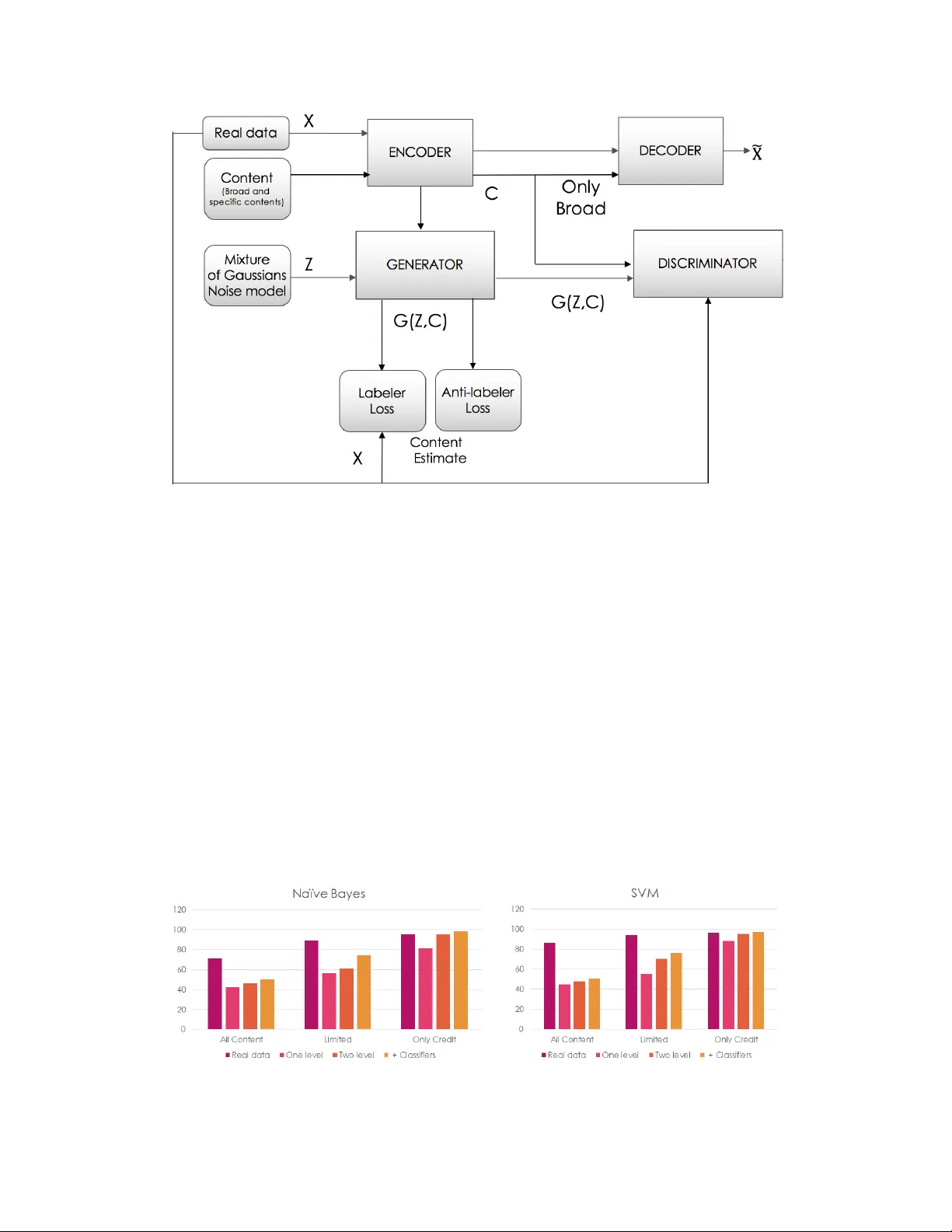
Generating User -friendly Explanations f or Loan Denials using GANs Ramya Srinivasan ∗ Fujitsu Laboratories of America ramya@us.fujitsu.com Ajay Chander ∗ Fujitsu Laboratories of America ajayc@us.fujitsu.com Pouya P ezeshkpour ∗ Univ ersity of California, Irvine pezeshkp@uci.edu Abstract Financial decisions impact our li ves, and thus e veryone from the regulator to the consumer is interested in fair , sound, and explainable decisions. There is increasing competiti ve desire and regulatory incenti ve to deploy AI mindfully within financial services. An important mechanism towards that end is to explain AI decisions to various stakeholders. State-of-the-art explainable AI systems mostly serve AI engineers and of fer little to no value to business decision makers, customers, and other stakeholders. T o wards addressing this gap, in this work we consider the scenario of explaining loan denials. W e b uild the first-of-its-kind dataset that is representativ e of loan-applicant friendly explanations. W e design a nov el Generativ e Adversarial Network (GAN) that can accommodate smaller datasets, to generate user-friendly textual explanations. W e demonstrate ho w our system can also generate explanations serving dif ferent purposes: those that help educate the loan applicants, or help them take appropriate action towards a future approv al. W e hope that our contrib utions will aid the deployment of AI in financial services by serving the needs of the wider community of users seeking explanations. 1 Introduction From customer beha vior prediction and identity v erification to fraud detection and intelligent chatbots that can answer customer queries, AI is being deployed within a wide v ariety of Fintech applications. The total funding for AI-based Fintech projects worldwide reached USD 8.2 billion in the third quarter of 2017 DigitalNe wsAsia [2017]. With massi ve funding and extensi ve e xperimentation, it’ s crucial for financial companies to use AI mindfully within their services to stay competitiv e. Amidst this wide-spread business adoption of AI, customers, policymakers and technologists are getting increasingly concerned about AI being a blackbox technology . For relati vely benign high volume AI decisions, such as those in online recommendation systems, an opaque yet accurate algorithm provides commercial value with few immediate downsides. Howe ver in more critical domains such as healthcare, finance, and law and order , a blackbox AI is unacceptable. Consider , for example, an AI-based credit scoring system. In markets where credit risk scoring models are regulated and scrutinized, there is a strong requirement for the models and the credit ∗ The authors contributed equally to the w ork NIPS 2018 W orkshop on Challenges and Opportunities for AI in Financial Services: the Impact of Fairness, Explainability , Accuracy , and Pri vac y , Montréal, Canada. This is a non-archiv al publication - the authors may submit revisions and e xtensions of this paper to other publication venues. decisions deri ved from them, to be explainable. The impact each variable has on the credit score must be clearly explained to, and be acceptable to lenders, re gulators, and consumers FICO [2018]. As a result, there have been several initiati ves both from the government Gunning [2017] and a di verse set of industries K yndi [2018], PWC [2018] to make AI e xplainable. Y et, most state-of-the-art methods provide explanations that mostly tar get the needs of AI engineers Selvaraju et al. [2017], Park et al. [2018]. In other words, explanations assume some domain kno wledge or are generated for people with domain expertise. As the use of AI becomes widespread, there is an increasing need for creating AI systems that can explain their decisions to a lar ge community of users who are not necessarily domain experts. These users could include software engineers, b usiness o wners, and end-users. As an instance, consider the use case of AI-based loan decisions. From bank managers, inv estors, and loan applicants, to credit b ureaus and regulatory agencies, a v ariety of stakeholders participate in or hav e interest in this financial service. The nature of explanation sought dif fers based on the role of the human-in-the-loop requiring the explanation. For example, while an explanation like “Person A was denied this loan as their credit score was similar to Person B" might be helpful to an AI engineer , it offers little to no v alue to a loan applicant. By considering the ov erall context in which an explanation is presented, including the role played by the human-in-the-loop, we can hope to craft effecti ve explanations. Effecti ve explanations le verage the cognitiv e and social processes by which people create meaning, build trust, and make decisions. In addition to addressing issues such as regulation, and aiding in adopting good practices around accountability and ethics, ef fecti ve e xplanations serve a v ariety of purposes. These include building trust – using explainable AI (XAI) systems provides greater visibility ov er unkno wn vulnerabilities and can assure stakeholders that the system is operating as desired. Explanations can also aid in understanding why and how a model works the way it does and help in debugging and designing it for better rob ustness. Explanations can also help in educating about business dri vers such as re venue, cost, customer behaviour , and employee turnover , to improve strategy and to take appropriate actions . The focus of this w ork is on crafting ef fectiv e explanations that are suitable for end-users. W e consider the use case of AI-based loan decisions, in particular , loan denials. W e study what sort of explanations are acceptable to loan applicants and design a machine learning system that can generate end-user friendly explanations. Further , the system can generate explanations serving different purposes such as those that help in educating the loan applicant, and those that help the applicant in taking appropriate action tow ards a future approv al. The contributions are elaborated belo w . 1.1 Contributions Our goal is to help bridge the gap between research and practice in the financial industry by serving the needs of the wider community of users seeking explanations and by generating explanations that serve different purposes (e.g. in educating, help in taking an action, etc.). There are at least three important contributions associated with this w ork: 1) W e collect and b uild a (first-of-its-kind) dataset that is repr esentative of user-friendly explanations: Giv en that existing explainable AI methods mostly of fer value to AI engineers, there is a need to understand the kind of e xplanations sought by end-users (e.g., loan applicants). Thus, we ran a surv ey on Amazon Mechanical T urk (AMT) and gathered the first-of-its-kind dataset to understand the nature of acceptable e xplanations for loan applicants. Surprisingly , we observed that most of the reasons provided by end-users seldom appeared as features in datasets used to train machine learning models. This, in turn, prompted us to explore this explainability problem using data provided by end-users. 2) W e design a novel GAN ar chitectur e to generate e xplanations using very limited training data: Next, we designed a no vel conditional generati ve adversarial network (GAN) to generate user -friendly textual explanations based on the reasons mentioned in the collected dataset, which consisted of about 2432 sentences. Unlike existing GAN based text generation architectures that require lar ge datasets for training, the proposed model is capable of generating text from as little as a thousand sentences, a good three orders of magnitude less than existing architectures. W e address the challenge of limited training data by means of three architectural modifications to Zhao et al. [2017] listed below: 2 a) W e incorporate a Gaussian mixture model for the noise input of the generator as proposed in Gurumurthy et al. [2017]. b) W e embed multiple conditional information in a hierarchical manner . c) Motiv ated by the idea proposed in Kocaoglu et al. [2017], we introduce two ne w loss functions to classify sentences based on the reasons for loan denials. 3) W e generate e xplanations serving differ ent purposes: to educate and to help take action: As described earlier , based on the needs of the task and the human-in-the-loop seeking the explanation, an explanation has dif ferent functions: to educate, to help b uild trust, to design, to help take action, etc. The proposed model is capable of generating e xplanations for dif ferent purposes: to educate loan applicants and to help them in taking appr opriate actions . It is to be noted that the proposed system can be combined with existing e xplainable AI systems so as to render a user -friendly explanation gi ven an AI-engineer friendly e xplanation such as Ribeiro et al. [2016]. Howe ver , as mentioned earlier , the reasons provided by end-users seldom appeared as features in datasets that were used to train models. For this reason, we did not consider the task of building this pipeline and instead focused on the challenging problem of generating user-friendly explanations. The rest of the paper is organized as follows: Section 2 provides a re view of related work. The dataset is described in Section 3. Details of the proposed system are pro vided in Section 4. Section 5 provides an account of the e xperiments and summarizes the results. W e of fer our conclusions in Section 6. 2 Related W ork W e revie w related efforts, with emphasis on the finance industry . W e then re view related w orks in explainability from AI engineer and end-user perspecti ves. 2.1 XAI Efforts in Financial Industry The new European General Data Protection Regulation (GDPR and ISO/IEC 27001) and the U.S. Defense Advanced Research Projects Agenc y’ s XAI program Gunning [2017] are some note-worthy gov ernmental initiativ es to wards explainable AI. In parallel, se veral industry groups are looking to address issues concerning AI explainability . Within the financial sector , leading institutions such as Capital One, JC Morgan and FICO are in vesting hea vily in AI. For example, Adam W enchel, vice president of machine learning and data innov ation at Capital One, said that the company w ould like to use deep learning for all sort s of functions, including deciding who is granted a credit card. Capital One also created a research team, led by W enchel, dedicated to finding ways of making AI more explainable. FICO recently released an XAI toolkit Flint et al. [2018] to outline some of the explainability support for their machine learning. The momentum for e xplainable AI is only e xpected to grow in the times to come. 2.2 Explanations for the AI Engineer A nice summary concerning e xplainability from an AI engineer’ s perspectiv e is provided in Lipton [2016] and Doran [2017]. In Selv araju et al. [2017], the authors highlight the re gions in an image that were most important to the model in classifying the image. Howe ver , such e xplanations are not useful to an end-user in either understanding the AI’ s decision or in debugging the model Chandrasekaran et al. [2018]. In Doshi-V elez and K ortz [2017], the authors discuss the main factors used by the AI system in arriving at a certain decision and also discuss ho w changing a factor changes the decision. This kind of explanation helps in debugging for the AI engineers. While impressiv e in helping an AI engineer , these works are not accessible to a wider set of users. 2.3 Explanations for the End-User More recently , there have been ef forts in understanding the human interpretability of AI systems. The authors in Doshi-V elez and Kim [2017] provide a taxonomy for human interpretability of AI systems. A non-AI engineer perspectiv e regarding e xplanations of AI system is provided in Millers 3 [2017]. A nice perspectiv e of user-centered explanations is provided in Herman [2017], wherein the author emphasizes the need for persuasive explanations. The authors in Amershi et al. [2017] explore the notion of interacti vity from the lens of the user . In Narayanan et al. [2018], the authors discuss ho w humans understand explanations from machine learning systems through a user study . The metrics used to measure human interpretability are those concerning explanation length, number of concepts used in the explanation, and the number of repeated terms. Interpretability is measured in terms of the time to response and the accuracy of the response. While these efforts are significant in quantifying human interpretability , they fall short of generating user -friendly explanations, which is the focus of this work. 3 Dataset Due to the non-availability of any dataset that is representativ e of user-friendly explanations, we collected a first-of-its-kind dataset in this regard. W e refer the dataset as “ X-Net ”. In order to build X-Net, we ran a surv ey on Amazon Mechanical T urk (AMT) wherein we provided the AMT workers with a loan application scenario and asked them to imagine that they were the loan applicants. These workers pro vided textual descriptions highlighting reasons for loan denials. These descriptions were then edited for syntactic and semantic correctness. Further , linguists also provided annotations for each description with a corresponding broad and specific reason for loan denial. For example, a broad reason could be “job" and specific reasons could be “no job", “unstable job", “limited job history", "no job history", and "unstable job history". This resulted in a curated dataset of 2432 sentences with their corresponding broad and specific reasons. The number of unique reasons turned out to be less than a hundred. Thus, we observed that the space of user -friendly explanations is rather a small set. Furthermore, we observ ed that the reasons pro vided by workers seldom appeared as features in the machine learning datasets. The most frequent set of broad reasons included credit, job, income, and debt. There were a few others that were mentioned in small numbers such as failed background check, incomplete applications, etc. Next, in order to generate explanations serving different purposes such as those that educate and those that help in taking appropriate actions, we curated a dataset consisting of 2432 sentence pairs corresponding to two different purposes of action and education. This was done in collaboration with a linguist (Ph.D Rhetoric). W e refer this dataset as the “ Extended X-Net ”. A sample education-action explanation pair from Extended X-Net is pro vided below: The r ecor d of finances associated with this application suggests that ther e is a r ecor d of outstanding loan payments (educates) Please complete all r emaining loan payments befor e applying for a new loan (suggests action). 4 Method Our first goal is to be able to automatically generate user -friendly explanations such as in X-Net. Further , in order to ensure that explanations can be generated in a controlled manner , we want conditional generation, i.e., the rendered explanation should match with a specified reason for loan denial. Our second goal is to be able to generate explanations serving different purposes, such as those that educate and those that help in taking an action. Motiv ated by the recent success of generative adv ersarial networks, we design a conditional GAN in order to address the aforementioned goal. W e also incorporate the GAN model with a style transfer mechanism so as to be able to generate explanations serving different purposes. Howe ver , the biggest challenge we face is the issue of limited training data (2432 sentences with <100 unique reasons). Below we describe our solution strate gy . 4.1 Network Ar chitectures f or Conditional Generation In this section, we describe the design choices used to improve the quality of generated textual information gi ven limited training data. W e adopt the ARAE-GAN Zhao et al. [2017] architecture and build our model on top of that. ARAEGAN consists of a discrete structure encoder and a continuous space decoder that are jointly trained with a discriminator to agree in data distribution. This approach allows one to utilize a complex encoder model such as RNN and still constrain it with a very flexible 4 but more limited generator distribution. The full model can be then used as a latent v ariable GAN model. In order to address the limited training data issue, we propose three modifications to Zhao et al. [2017] as listed below: 4.1.1 Gaussian Mixture as the Random V ector Since curating a novel real-world text dataset is a very costly process (given the time and cost of manual annotation), it is crucial to be able to dev elop a model which can learn from a small size dataset. Accordingly , to address the limited data size issue and improve the e xpressi ve po wer of our model, we use the key idea from Gurumurthy et al. [2017], i.e. to consider a Gaussian mixture model as the noise input of the generator . Intuitiv ely , since mixture models can approximate arbitrarily complex latent distrib utions giv en a sufficiently lar ge number of Gaussian components, by modeling the latent space as a mixture of learnable Gaussians instead of the con ventional distribution, we can improv e the expressi veness of the model. 4.1.2 Hierarchical T wo Lev el Conditioning The idea here is to incorporate broad and specific reasons for loan denials in a hierarchical manner . The motiv ation comes from the fact that children learn from very limited data in a hierarchical manner K emp et al. [2007]. Accordingly , in addition to previous technique, to further increase the model’ s ability to embed the reasons and generate more relev ant sentences, we first consider two lev el reasoning for each sentence. Then, after embedding these reasons using the encoder component of the autoencoder , we combine them into a single vector using a neural network representing their hierarchical graphical model. And finally , we incorporate the resulting vector as the conditional information to our GAN model. 4.1.3 Classification Losses In addition to the loss functions proposed in Zhao et al. [2017], to generate more rele v ant sentences (corresponding to conditional information), we introduce two new losses K ocaoglu et al. [2017] to classify the real and generated sentences based on their reasons. Similar to the labeler and anti-labeler loss proposed in K ocaoglu et al. [2017], we consider two classifiers on real and generated sentences and learn them simultaneously with our model. The labeler provides an estimate of the reason based on the X-Net dataset whereas the anti-labeler estimates the reason in the generated sentences. A block diagram illustrating the architecture is provided in Figure 1. 4.2 Network Ar chitecture f or Style T ransfer The goal here is to generate sentences across different styles, namely those that educate the loan applicant about the denial and those that help them to take future actions. Limited training data poses a big challenge in this task as well. W e consider three scenarios to check what best addresses the challenge. 4.2.1 Unaligned style transfer First, we consider the ARAEGAN model wherein they do unaligned style transfer , i.e., without having corresponding pairs of sentences in the two styles (education and action) in the training data. The architecture and training is the same as that proposed in Zhao et al. [2017]. 4.2.2 ARAEGAN With Gaussian mixtur e model f or noise Next, we incorporate the Gaussian mixture model to the noise input of the generator in the aforemen- tioned ARAEGAN model to check for any impro vement in the result. 4.2.3 Aligned Style T ransfer W e consider aligned style transfer wherein we are provided with pairs of explanations corresponding to “education” and “action” in the training data. W e consider two decoders one each for action and education, and a single encoder . The output of the encoder is passed to both the decoders in order to ensure alignment. The rest of the architecture and training is the same as that proposed in Zhao et al. [2017]. 5 Figure 1: Block diagram illustrating the system architecture. 5 Experiments In this section, we first elaborate the details of hyperparameters and model configurations. Then we e valuate the ability of our model to utilize the reason information in generating meaningful and relev ant sentences using perplexity and accuracy of pre-trained classifiers as e valuation metrics. 5.1 Experiment Setup Details For a fair comparison, we implement all methods using identical loss functions and optimization for training. W e tune all the hyperparameters on the v alidation data and use grid search to find the best hyperparameters, such as number of gaussion mixtur e components = { 10 , 20 , 50 , 100 } , maxlen = [20 , 30] , embedding dimension d = { 100 , 150 , 200 , 300 } , and learning rates. W e find that the following combination of parameters w orks well on our dataset. Embedding size 300 , batch size 128 , maxlen 23 , and number of Gaussian mixture components 50 . For the rest of hyperparameters, we use the same values as in Zhao et al. [2017]. Figure 2: The accuracy result of the SVM and Naiv e Bayes pre-trained classifier on different models . 6 T able 1: The PPL score of different models. Models Perplexity score ARAE-GAN 10.4 ARAE-GAN+ Gaussion Mixture (GM) 7.3 ARAE-GAN+ GM + One lev el reason (1L) 6.4 ARAE-GAN+ GM + T wo lev el reasons (2L) 6.1 ARAE-GAN+ GM + 2L + Classifiers (C) 6.15 Figure 3: The ev aluation results of style transfer task. 5.2 Experimental Results In this section, we ev aluate the capabilities of our proposed model in conditional text generation and style transfer tasks. 5.2.1 Conditional T ext Generation T o assess the quality of generated sentences with respect to the specified reasons for loan denials, we consider three separate test data. For the first scenario, we randomly choose 100 samples from dataset as test data and treat the rest as training data. W e refer this as all content set. Furthermore, since the distribution of reasons is not uniform in the dataset, we ev aluate our model by only considering 100 samples of the most appeared reasons ([‘credit’, ‘job’, ‘debt’, ‘income’]) in our second test dataset. W e call this as limited reasons set. And finally , we consider a test data containing only ’credit’ (the most frequent reason) as the conditional information. The results of pre-trained SVM and Naiv e Bayes classifier is provided in Figure 2. Furthermore, the perplexity score for different models is provided in T able 1. As shown, all models provide comparable accurac y to real data, with the final model (i.e. the model of ARAEGAN with Gaussian mixture model for noise input, coupled with two le vel conditioning of reasons along with labeler and anti-labeler classifiers loss functions) outperforming the rest with a considerable gap. The best result can be observed for credit-only data as it is the most frequent data instance. 5.2.2 Style T ransfer Similar to the previous section, in order to ev aluate the style transfer task, we randomly choose 100 samples from dataset as test data and treat the rest as training data. The accuracy results of the classifier (which is part of the ARAE-GAN model) and bleu score is provided in Figure 3. As is shown, the aligned v ersion of model outperforms the rest with a considerable gap. 5.2.3 Generated samples The generated samples for conditional text generation is provided in T able 2. As is sho wn, the ARAE-GAN model was incapable of generating semantically correct sentences due to the limited data issue. Furthermore, although incorporating noise as a mixture of Gaussians helped in generating more semantically correct sentences, it could not capture the broad and specific reasons (highlighted in red). As we can see, the one-le vel condition could only capture the broad reason but only with 7 T able 2: Generated samples for broad reason ’credit’ and specific reason ’lo w credit’. GM denotes Gaussian mixture model for noise, 1L is one le vel conditioning, 2L is tw o lev el conditioning and C denotes labeler and anti-labeler classifiers. Models Sentences ARAE-GAN The loan is denied because the applicant is not enough the income . ARAEGAN+ GM The loan is denied because the applicant’ s income is too low . ARAEGAN+ GM +1L The loan is denied because the applicant has a poor credit history . ARAEGAN+ GM + 2L The loan is denied because the applicant’ s credit score is low . ARAEGAN+ GM +1L + C The loan is denied because the applicant has a low credit score. T able 3: Style transfer samples— Ro w 1 is the real sentence corresponding to training data. Row 2-4 sho ws the generated sentences. The bold text in ro w 1 denotes the reason for loan denial. The red and green colors in row 2-4 denote the (incorrect and correct) reasons in the generated sentences. GM denotes Gaussian mixture model for noise. Models T ransfer from Education to Action T ransfer from Action to Education Reference Sentence there is a record of inconsistent loan payments . please re-consider applying for a loan of a different amount that may better align with your income . Unaligned please re-consider applying for a loan of a dif ferent amount that may better align with your income . the applicant has only been em- ployed at their current employer for a limited period of time. Unaligned + GM talk to your bank about finding w ays to improv e your credit . the income associated with this ap- plication is, unfortunately , not high enough to be considered eligible for this loan. Aligned maintain a consistent record of timely loan payments moving for- ward. the income listed on this applica- tion is not high enough to match the amount requested for a loan. two-le vel conditioning and the two-lev el conditioning with classifiers model, both the broad and specific reasons could be accurately captured (highlighted in green). The generated samples for style transfer is provided in T able 3. As is shown, the unaligned (ARAE- GAN) model was incapable of transferring the sentence to its corresponding style (although it could capture the style but couldn’ t capture the correct reasoning in the reference sentence). Along the same lines, although incorporating Gaussian mixture idea improved the semantic correctness of the generated sentences, it failed to capture the correct reason in the generated sentences (highlighted in red). On the other hand, our aligned model not only generated meaningful sentences with correct style but could also transfer the reasons correctly from the reference sentences (highlighted in green). 6 Conclusions In this work, we e xplored the problem of explainability from an end-user perspectiv e. In particular , we considered the use case of explaining loan denials and collected a first-of-its-kind dataset that is representati ve of user-friendly e xplanations. W e observed that the reasons acceptable to users seldom appear as features in machine learning datasets and thereby contrib utes to the gap in understanding model-based explanations. Thus, we designed a novel conditional GAN to generate user-friendly textual explanations based on the reasons specified in the collected dataset. Additionally , the proposed model was also embedded with style transfer to generate explanations serving different purposes—to educate and to help take actions. W e hope our work will help bridge the gap between research and practice in the financial industry by catering to the needs of the wider community of users seeking explanations, and by generating multiple e xplanations serving different purposes. 8 7 Acknowledgments W e would like to thank Cathrine Dam, Nahla Sturm-W ang and Jenae Cohn for their help in annotating the data. W e also thank AMT respondents for participating in the survey . References S Amershi, Maya Cakmak, William Knox, and T odd Kulesza. Power to the people: The role of humans in interactiv e machine learning. AI Magazine , 2017. and Prabhu V iraj Chandrasekaran, Arjun, Deshraj Y adav , Prithvijit Chattopadhyay , and Devi Parikh. Do explanations make vqa models more predictable to a human? EMNLP , 2018. DigitalNe wsAsia. Global fintech in vestment rob ust on back of strong vc funding:kpmg. Digital News Asia , 2017. D Doran. What does explainable ai really mean? a new conceptualization of perspectiv es. ArXiv , 2017. Finale Doshi-V elez and Been Kim. T owards a rigorous science of interpretable machine learning. ArXiv , 2017. Finale Doshi-V elez and Mason K ortz. Accountability of ai under the la w: The role of explanation. ArXiv , 2017. FICO. Machine learning and fico scores: An evolut ion in ml innovations that helps both lenders and consumers. White P aper: Business T echnology Overview , 2018. Andy Flint, Arash Nourian, and Jari K oister . xai toolkit: Practical, explainable machine learning. White paper , 2018. Dav e Gunning. Explainable artificial intelligence. D ARP A , 2017. Swaminathan Gurumurthy , Ravi Kiran Sarvade vabhatla, and R V enkatesh Babu. Deligan: Generativ e adversarial networks for di verse and limited data. In CVPR , pages 4941–4949, 2017. B Herman. The promise and peril of human ev aluation for model interpretability . NIPS W orkshop , 2017. Charles Kemp, Amy Perfors, and Joshua B T enenbaum. Learning ov erhypotheses with hierarchical bayesian models. Developmental science , 10(3):307–321, 2007. Murat K ocaoglu, Christopher Snyder , Alexandros G Dimakis, and Sriram V ishwanath. Causal- gan: Learning causal implicit generativ e models with adversarial training. arXiv pr eprint arXiv:1709.02023 , 2017. Kyndi. How e xplainability is driving the future of artificial intelligence. White P aper , 2018. Zachory Lipton. The mythos of model interpretability . ICML W orkshop , 2016. T Millers. Explainable ai: Bew are of inmates running the asylum. ArXiv , 2017. Menaka Narayanan, Emily Chen, Jeffre y He, Been Kim, Sam Gershman, and Finale Doshi-V elez. How do humans understand explanations from machine learning systems:an ev aluation of the human-interpretability of explanation. ArXiv , 2018. D. Park, L. Hendricks, Z. Akata, A. Rohrbach, B. Schiele, T . Darrell, and M. Rohrbach. Multimodal explanations: Justifying decisions and pointing to the e vidence. CoRRabs , 2018. PWC. Explainable ai driving b usiness value through greater understanding. White P aper , Intelligent Digital , 2018. Marco T ulio Ribeiro Ribeiro, Sameer Singh, and Carlos Guestrin. Why should i trust you? explaining the predictions of any classifier . KDD , 2016. 9 R. Selvaraju, A. Das, V edantam, M. R., Cogswell, D. Parikh, and D. Batra. Grad-cam: V isual explanations from deep networks via gradient-based localization. International Confer ence on Computer V ision , 2017. Junbo Jake Zhao, Y oon Kim, Kelly Zhang, Alexander M Rush, and Y ann LeCun. Adv ersarially regularized autoencoders for generating discrete structures. CoRR, abs/1706.04223 , 2017. 10
Original Paper
Loading high-quality paper...
Comments & Academic Discussion
Loading comments...
Leave a Comment