CNN-based MultiChannel End-to-End Speech Recognition for everyday home environments
Casual conversations involving multiple speakers and noises from surrounding devices are common in everyday environments, which degrades the performances of automatic speech recognition systems. These challenging characteristics of environments are t…
Authors: Nelson Yalta, Shinji Watanabe, Takaaki Hori
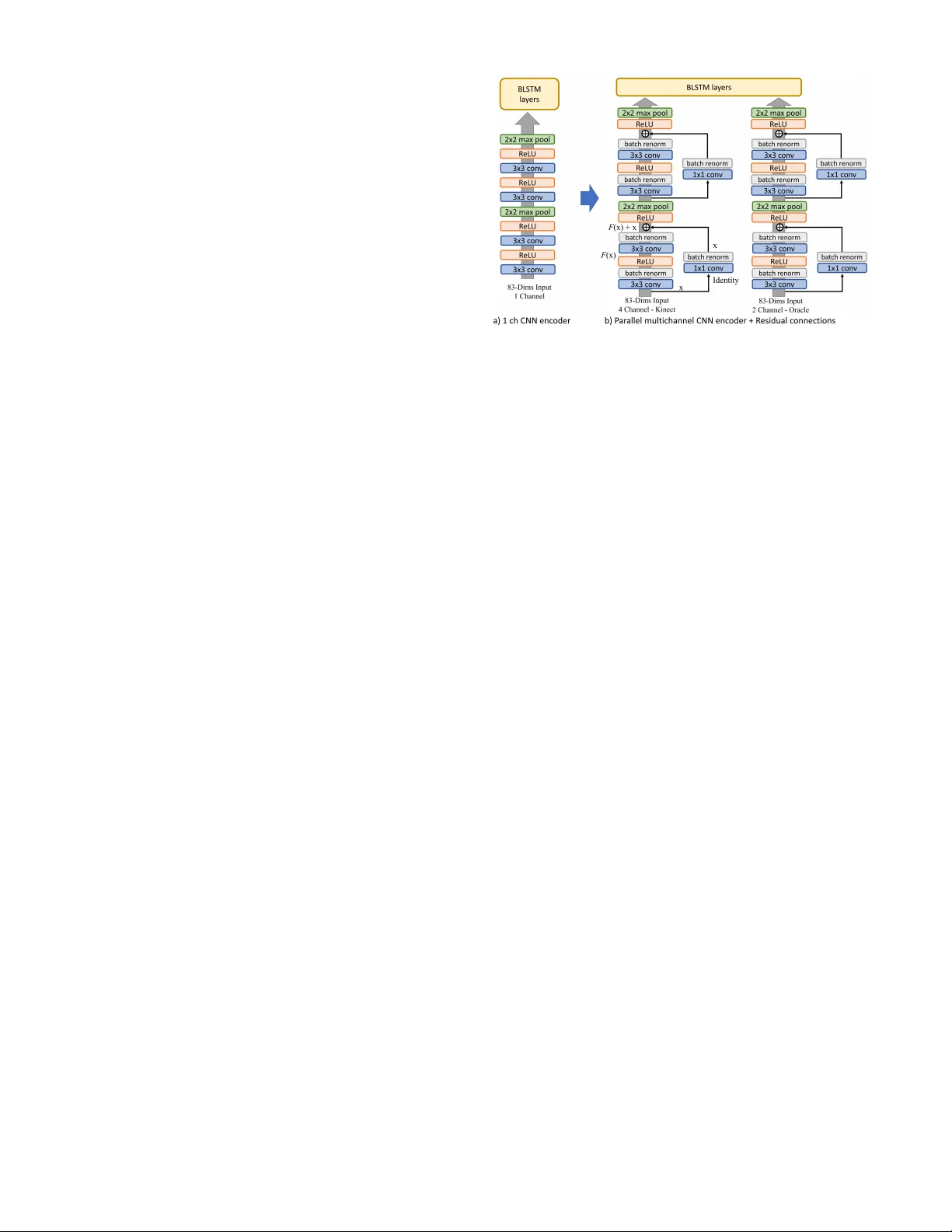
This paper has been accepted and will be presented at EUSIPCO 2019 CNN-based Multichannel End-to-End Speech Recognition for Ev eryday Home En vironments* Nelson Y alta 1 , Shinji W atanabe 2 , T akaaki Hori 3 , Kazuhiro Nakadai 4 , T etsuya Ogata 1 1 W aseda University , 2 Johns Hopkins Univer sity , 3 Mitsubishi Electric Resear ch Labor atories, 4 Honda Resear ch Institute J apan nelson.yalta@ruri.waseda.jp Abstract —Casual con versations in volving multiple speakers and noises from surrounding devices are common in everyday en vironments, which degrades the performances of automatic speech r ecognition systems. These challenging characteristics of en vironments ar e the target of the CHiME-5 challenge. By employing a convolutional neural network (CNN)-based multichannel end-to-end speech recognition system, this study attempts to over come the presents difficulties in ev eryday en vi- ronments. The system comprises of an attention-based encoder–decoder neural network that directly generates a text as an output from a sound input. The multichannel CNN encoder , which uses residual connections and batch renormalization, is trained with augmented data, including white noise injection. The experimental results show that the word error rate is reduced by 8.5% and 0.6% absolute from a single channel end- to-end and the best baseline (LF-MMI TDNN) on the CHiME-5 corpus, respectiv ely . Index T erms —End-to-end speech recognition, Multichannel, Residual networks I . I N T R O D U C T I O N Automatic speech recognition (ASR) enables the machines to understand human languages and follo w human v oice commands. Currently , the ASR system implemented with deep learning tech- niques improves its performance in near/far fields [1], [2] for diverse en vironmental conditions [3]. Recently , an ASR system implemented with end-to-end models (see e.g., [4], [5], [6], [7]) has gained atten- tion because unlike con ventional ASR system, end-to-end models learn to directly map character sequences from acoustic feature sequences without any intermediate modeling, such as the acoustic model, pronunciation lexicon, and language models based on deep learning [1], [8]. The two major approaches of end-to-end models, particularly connectionist temporal classification (CTC) [9], [10] and attention- based models [4], [11] have achie ved promising recognition results. CTC-based models [9] solve sequential learning problems based on Markov assumptions [10]. Whereas, attention-based models align between acoustic frames and decoded symbols by using an attention mechanism [4], [11]. Recent studies on end-to-end models hav e shown that compared to the individual performance of each approach, a joint CTC–attention model improves the recognition performance [6], [12]. The joint model trains an attention-based encoder with an attached CTC objecti ve for regularization. Furthermore, the CTC objectiv e is employed during the decoding phase to improve the model results [13]. Although end-to-end models are comparable or ev en more ad- vantageous than the conv entional ASR systems [6], [7], it is nev- ertheless challenging to rob ustly recognize speech signals in noisy en vironments and with lo w resources (i.e., CHiME-5 task [14]). The CHiME-5 task comprises the difficulties of casual con v ersion with The work has been supported by MEXT Grant-in-Aid for Scientific Re- search (A), No. 15H01710, except for the contribution of Mitsubishi Electric Research Laboratories (MERL). ov erlapped sentences or unfinished utterances, noises from home appliances at a signal-to-noise ratio (SNR) between 5 and 20 dB, distant microphone speech, and a small training dataset of 40 h (i.e., lo w resources). Most competitive systems, e xcept for [12], in the fifth CHiME challenge employ conv entional ASR methods with multichannel speech enhancement techniques [15], [16], [17], [18]. This study addresses the challenging characteristics of the CHiME- 5 challenge using an end-to-end ASR model. The challenge considers distant multi-microphone speech captured by four binaural micro- phone pairs and six Kinect microphone arrays and features two tracks, namely the single-array track and the multiple-array track. Herein, under the conditions mentioned earlier , we propose an extension of a joint CTC–attention model that uses residual connections for the CNN and accepts multichannel inputs to boost the speech recognition performance. In particular, our multichannel end-to-end approach focuses on a single-array track. First, we explore the use of multichannel inputs [19], [20] for noisy environments under the fifth CHiME challenge scenario [14] to train our model. Then, we boost the performance adapting the model to accept inputs with a different number of channels (binaural microphone and single array track), namely the parallel encoder . By doing this, the model has a larger training set with almost clean sound data provided by the binaural microphone that enriches possible input feature combinations. Finally , we ev aluate sev eral configurations for a joint CTC–attention model with an end-to-end toolkit called ESPnet [21]. This study presents e xtensions of a joint CTC–attention model. The performance was ev aluated and compared to that of a con v entional joint CTC–attention model. The introduced extensions are as follows: • Parallel CNN encoder with residual connections [22]. W e employed the data from both microphones (i.e., Kinect and binaural) to improve the performance for noisy speech recog- nition. Furthermore, we observed that augmenting the data on the binaural side with white noise reduced the absolute w ord error rate (WER) by 4%, and obtained better performance than employing dropouts in the CNN encoder . • Batch renormalization [23]. This normalization improves the training process for small mini-batches using the moving av er- ages of the mean and the variance during training and inference. • Multilevel language modeling (LM) [24]. This modeling tech- nique integrates the ability to model an open vocabulary ASR of a character-based LM with the strength to model large sequences of word-based LM. For the CHiME-5 corpus, the absolute WER of the proposed ex- tensions for joint CTC–attention model improved by 14% compared to that of a standard joint model. The extensions are additionally ev aluated in the AMI corpus [25]. This paper has been accepted and will be presented at EUSIPCO 2019 I I . E N D - T O - E N D A S R O V E RV I E W In this section, we give an overvie w of end-to-end ASR. The framew ork employs a joint CTC–attention model that processes the audio features and generates text as an output. A. Joint CTC–Attention Model The key idea of a joint CTC–attention model is to overcome 1) the conditional independence of the targets assumed in the CTC model and 2) the misalignments in the attention model caused by the noise in real-en vironment speech recognition tasks [26]. A joint CTC– attention model uses a shared encoder to train an attention model encoder with a CTC objecti v e function as an auxiliary task. This model uses the multi-task learning (MTL) frame work to achieve the desired training. For an audio input X of length N , CTC will generate and output a sequence of shorter length C = { c l ∈ S | l = 1 , ., L } for the L - length letter sequence with L ≤ N and a set of distinct characters S . CTC generates an intermediate ”blank” symbol, which represents the omission of the output label. This special symbol is introduced to generate a frame-wise letter sequence Z = { z t ∈ S ∪ blank | t = 1 , ..., T } . Assuming conditional independence between each output, CTC models the probability distrib utions over all possible label sequences to maximize p ( C | X ) as follows: p ctc ( C | X ) , p ( C | X ) ≈ X Z Y t p ( z t | z t − 1 , C ) p ( z t | X ) p ( C ) , (1) where p ( z t | z t − 1 , C ) and p ( C ) are the label prior distributions; p ( z t | X ) represents the frame-wise posterior distribution and is mod- eled using a deep encoder [13]. In contrast, an attention-based model does not assume any condi- tional independence assumptions for p ( C | X ) . The posterior proba- bility p ( C | X ) is directly estimated based on the chain rule: p att ( C | X ) , p ( C | X ) ≈ Y l p ( c l | c 1 , ..., c l − 1 , X ) , (2) where p ( c l | c 1 , ..., c l − 1 , X ) is represented as: p ( c l | c 1 , ..., c l − 1 , X ) = Decoder ( r l , q l − 1 , c l − 1 ) , (3) r l = X t a lt h t , (4) where Decoder( · ) , Softmax(Lin(LSTM( · ))) is a recurrent neural network (RNN) with a hidden vector q l − 1 , a previous output c l − 1 , and a letter-wise hidden vector r l ; a lt is the attention weight and represents a soft alignment obtained by a content-based attention mechanism with con volutional features [27]. The use of a joint CTC–attention model with MTL approach improv es the performance in the ASR task and reduces irregular alignments during training and inference. This MTL objective max- imizes the logarithmic linear combination of the CTC and attention objectiv es: L MTL = λ log p ctc ( C | X ) + (1 − λ ) log p att ( C | X ) , (5) where λ is a tunable parameter with values λ : 0 ≤ λ ≤ 1 . I I I . A D A P T A T I O N F O R M U LT I C H A N N E L A S R I N N O I S Y E N V I RO N M E N T S The idea of our model is to use a parallel deep CNN encoder with residual connections, batch renormalization, and a multile vel RNN- LM network as an extension for a joint CTC–attention end-to-end ASR with multichannel input. The following subsections describe each individual extension in detail. Fig. 1. P arallel Encoder: From a joint CTC/attention model implemented with a) 1 channel (ch) CNN encoder, this is replaced by b) the parallel encoder which accepts inputs with a different number of channels. A. P arallel Multichannel Encoder T o boost the accuracy of the joint CTC–attention model applied in the fifth CHiME challenge, we employed both Kinect and binaural microphone arrays supplied on the corpus during training using a parallel multichannel encoder (Fig. 1). The multichannel encoder comprises of two CNNs that process each array during a mini-batch step and uses the CNN encoder with Kinect array during decoding because the binaural array cannot be used for the distant ASR scenario. Unlike sole training with a single channel or multichannel from the Kinect array , using the binaural array enriches the possible input feature combinations and regularizes the network training, thereby improving the model performance. B. Residual Connections Using residual (i.e., skip) connections presents se veral benefits. They improve the back-propagation of the gradient to the bottom layers, thus easing the training on very deep networks [28]. In a neural network, studies hav e shown that residual or skip connections eliminate the overlaps, consistent deactiv ation, and linear dependence singularities of nodes [29]. Let H ( x ) be the learned mapping of a network. The network can then also learn H ( x ) − x mapping for a gi ven input x . Residual learning is then denoted as follows: H ( x ) := F ( x ) + x. (6) Residual learning is implemented in any feedforward neural net- work using a skip connection (Fig. 1), which is presented as an identity mapping. A network can be trained end-to-end with this implementation using any deep learning framework. In practice, this implementation improves model performance; thus, it increases the computing time. In this study , residual learning is implemented using three con v o- lutional layers, namely two con volutional layers with a kernel filter size of 3 × 3 for calculating F ( x ) and one with a kernel filter size of 1 × 1 , which is used as the skip connection. C. Batch Renormalization A recent technique, called batch normalization (BatchNorm) [30], has become the standard for the normalization process. BatchNorm computes the mean and v ariance of a mini-batch; furthermore, it normalizes the mini-batch with the computed values. In addition, the This paper has been accepted and will be presented at EUSIPCO 2019 mean and variance are computed over all the training data to employ them for inference. Howe v er , the use of the mean and variance has a significant drawback when mini-batches with fe w samples are employed [23]. Batch renormalization [23] proposes the application of a per- dimension affine transformation to the normalized acti vations. The statistic differences of a mini-batch are corrected by fixed parameters ensuring that the computed activ ations depend only on a single example; thus, the performance for models trained with small mini- batches is improved. Batch renormalization also employs the overall calculated mean and variance in the training process. During training, unlike batch normalization that uses the overall mean and v ariance only for inference, the above layers observe the same activ ations that would be generated for inference. W e boosted the accuracy of the joint model by implementing the model with batch renormalization in the CNN layers (Fig. 1). This implementation improved the performance of the proposed models, thus obtaining an additional absolute error rate reduction of 0.1% in the single-array track WER (T able IV). D. Multilevel RNN-LM Prior studies hav e shown that integrating the joint CTC–attention model with a character-based RNN-LM improves recognition accu- racy [13]. W ord-based LM suffers from the out-of-vocab ulary (OO V) problem, unlike the character-based LM that has the adv antage of open vocab ulary ASR [24]. Ho we ver , for the character-based LM, modeling linguistic constraints across a long sequence of characters is difficult. Pre viously , this problem was solved by implementing a multilev el LM and combining it with the decoder network [24]. Fist, the multile vel LM ranks the hypothesis using the character -based LM. Then, the word-based LM rescores known words. The OO V score is provided by the character-based LM. I V . E X P E R I M EN TA L S E T U P W e studied the effecti v eness of our proposed extensions using the ESPnet speech recognition toolkit, which is an end-to-end speech processing toolkit [21], with Chainer backend [31]. W e present experiments with models training on 40 h of CHiME-5 data [14] and 78 hours of AMI data [25]. The fifth CHiME challenge (CHiME-5) comprised tasks of con- versational ASR employing distant multi-microphones in real home en vironments [14]. The speech material captured natural and conv er- sational speeches. Six Kinect microphone arrays and four binaural microphone pairs were employed to record it. The speech material comprised a total of 40 h of training data, 4 h of de velopment data, and 5 h of ev aluation data. The corpus features two challenges, namely the single-array track and the multiple-array track. Herein, we considered the single-array track (i.e., SA T). The AMI dataset comprises tasks of speech recognition in meetings [25]. The speech material was captured with 8-channel circular microphones (i.e., multiple distant microphone (MDM)), and a head- set microphones (i.e., independent headset microphone (IHM)) and comprised approximately 78 h of training data and approximately 9 h of dev elopment and e valuation data. Unless otherwise indicated, the experiments were performed using the parameters described in T able I. W e tested several v alues combinations of λ for both training and decoding, where the values that are showed in T able I obtained lower WER. T ABLE I E X P ER I M E N TAL C O N FI GU R ATI O N Featur e Input stream (per channel) 80-dim fbank + 3-dim pitch Model CNN-encoder type VGG, Residual, Res+Batch Renorm. CNN-encoder layers VGG:4, Residual:6, Res+Batch Renorm: 6 RNN-encoder type BLSMTP RNN-encoder units 512 cells RNN-encoder layers 4 Attention Location-based [27] Decoder type 1-layer 300 cells LSTM CTC weight λ (train) CHiME-5:0.1, AMI:0.5 CTC weight λ (decode) CHiME-5:0.1, AMI:0.3 Optimization AdaDelta [32] Epochs 15 Character -based RNN-LM T ype 2-layers 650 cells LSTM Optimization AD AM [33] W ord-based RNN-LM T ype 1-layers 650 cells LSTM Optimization Adadelta V . E X P E R I M EN T S W e try to inv estigate the performance of each extension in the fol- lowing subsections. In these e xperiments, we only report the WER(%) results on the development set of CHiME-5 and on the development and ev aluation sets of AMI. Howev er , from Sections V -D, we only report the result for CHiME-5. A. Single Channel Input As a preliminary experiment, we explored the ASR performance of a CNN-based encoder for the single-channel input. This experiment allowed us to adjust the training parameters for the experiments that follow . T able II presents the resulting WER. A subset of 275K utterances was randomly selected from both Kinect and binaural arrays to train a single-channel input model with CHiME-5. The single channel model employs a joint CTC–attention with a VGG-BLSTMP encoder . Unless otherwise stated, we use a character-based RNN-LM for decoding in subsequent sections. The result obtained was then compared to that reported in [14]. The end- to-end baseline is a joint CTC–attention model implemented with a BLSMTP encoder and trained for 12 h. For AMI, the model was trained with each microphone array (i.e., IHM and MDM) separately . A single channel was synthesized using delay-and-sum beamforming [34] to train the model with the MDM array (i.e., AMI-MDM). Unless otherwise indicated, a word- based RNN-LM is employed at the decoding stage in the consequent sections. Furthermore, the results were compared to those found in the official webpage of ESPnet 1 . B. P arallel Encoder In the first set of e xperiments, we e xplored the performance of the proposed multichannel CNN-based parallel encoder , particularly the parallel encoder . In T able III, the WER for a single multichannel encoder (i.e., single encoder) and the parallel encoder are listed. W ith the parallel encoder, we can see a decrease in the WER on both datasets compared to that in the baseline single channel and the CNN- based encoder with a single-channel input. 1 https://github .com/espnet/espnet/blob/master/egs/ami/asr1/RESUL TS This paper has been accepted and will be presented at EUSIPCO 2019 T ABLE II W E R ( % ) C O M P A R I S ON F O R S Y S T E MS T R A I N ED W I T H A S I N GL E C H A NN E L I N P UT GMM [14] LF-MMI TDNN [14] CMU [12] End to End* CNN based Encoder CHiME-5 SA T 91.7 81.3 82.1 94.7 89.2 Binaural 72.8 47.9 - 67.2 61.1 AMI-IHM dev - - - 37.5 30.9 ev al - - - 38.5 32.8 AMI-MDM dev - - - - 50.6 ev al - - - - 54.8 *Baseline [14] T ABLE III W E R ( % ) C O M P A R I S ON F O R S Y S T E MS T R A I N ED W I T H M U LTI C H A N N E L I N P UT . Single Encoder Parallel Encoder CHiME-5 SA T 88.3 85.4 Binaural - 55.6 AMI-IHM dev - 29.4 ev al - 30.1 AMI-MDM dev 50.6 45.3 ev al 54.9 49.0 For CHiME-5, the single encoder emplo yed four channels a v ailable on the single-array track. The parallel encoder had an input configu- ration of 4 + 2 . Four channels were available at the single-array track, and two channels were from binaural. For AMI, the single encoder employed eight channels available on AMI-MDM. The parallel encoder had an input configuration of 8 + 1 . Eight channels were av ailable on AMI-MDM, and one channel was from AMI-IHM. C. Residual Connections and Batch Renormalization T able IV lists the WER for the CNN-based parallel encoder (CNN) added with residual connections (RES) and batch renormalization (ResBRN). For CHiME-5, the residual connections resulted in an additional absolute reduction of 0.3% in the single-array track WER. After training the residual connections with batch renormalization, the joint T ABLE IV W E R ( % ) C O M P A R I S ON F O R C N N - BA S E D A R C H I TE C T U R E S O F T H E P A R A L LE L E N C O DE R . CNN RES ResBRN CHiME-5 SA T 85.4 85.1 85.0 Binaural 55.6 55.8 54.4 AMI-IHM dev 29.4 28.1 29.5 ev al 30.1 29.1 29.8 AMI-MDM dev 45.3 43.7 43.2 ev al 49.0 47.6 46.9 T ABLE V W E R ( % ) C O M P A R I S ON F O R W H I T E N O I S E DAT A AU G M E N T A T IO N F O R B I NAU R A L M I C RO P H O NE . CNN RES RES +Dropouts ResBRN CHiME-5 SA T 81.4 81.3 83.8 80.8 Binaural 50.4 51.4 64.0 51.3 T ABLE VI W E R ( % ) C O M P A R I S ON F O R T H E E FF E C T I VE N E S S O F T H E M U LT I LE V E L L M . CNN RES ResBRN CHiME-5 SA T 81.5 81.2 80.7 Binaural 50.0 51.3 51.0 model provided additional reductions of 0.1% and 1.4% on the single- array track and binaural tasks, respectiv ely . For AMI, the residual connections provided at least a reduction of 1.6% of the WER. In addition, ResBRN reduced the WER by 0.5% absolute for AMI-MDM. D. Data P erturbation In addition to the abov ementioned results, we report herein the WER for a model with a parallel encoder trained with augmented data on CHiME-5. The augmented data were obtained by adding simulated white noise to the binaural array . The SNR ratio was randomly selected to range from 7 to 20 dB. T able V presents the resulting WER. ResBRN showed that the augmented data worked for the single-array track when noise was added to the binaural array . Adding dropouts in the residual connection led to a strong degradation because it affected both inputs of the parallel encoder , where the audio input from the single-array track was already degraded o wing to the en vironmental setup. E. Multilevel LM T able VI presents the WER for the multile vel LM used with a parallel encoder on CHiME-5. Using the parallel encoder resulted in the multilev el LM providing an additional 0.1% improvement. In general, our final model with the proposed extensions performed better , providing absolute WER improv ements of 14% and 11%, compared to the end-to-end and GMM baselines (T able II). The proposed extensions were able to overcome the results of the state- of-the-art lattice free MMI (LF-MMI) baseline without using any phonemic information or finite-state transducer decoding, and the results of the CMU proposal [12]. V I . C O N C L U S I O N S W e presented herein the extensions for a joint CTC–attention model based on residual learning, batch renormalization, and multi- lev el LM. W e applied a parallel encoder for multichannel input which accepts inputs with a dif ferent number of channels. T o improv e the processing of the audio features, we applied residual connections with batch renormalization. Then, we applied a multilevel LM which integrates the strength of a character -based LM and a word-based LM. Each extension improv ed the performance of the end-to-end models in e veryday-en vironment ASR with respect to the single channel model and the end-to-end model proposed in [14], resulting in a WER absolute reduction of 8.5% from the single channel end-to-end. Howe v er , it required the ov erall system to improv e the WER with respect to the best baseline (LF-MMI TDNN) and it only obtained the reduction of 0.6% absolute on the CHiME-5 corpus. The proposed model employed 6 CNN layers and 4 RNN layers with 512 cells; howe v er , due to the limitations of the GPU, very deep models were not possible to train without reducing the size of the mini-batch. The result obtained in training of deeper models and smaller mini-batch showed no improvement in the WER reduc- tion. Furthermore, a training longer than 15 epochs did not sho w improv ement on the accuracy or decreased the loss. The models This paper has been accepted and will be presented at EUSIPCO 2019 showed impro vements ov er the baseline e ven when no additional preprocessing, such as beamforming, was performed for the input. R E F E R E N C E S [1] G. Hinton, L. Deng, D. Y u, G. E. Dahl, and A. Mohamed et al. , “Deep neural networks for acoustic modeling in speech recognition: The shared views of four research groups, ” IEEE Signal Processing Magazine , vol. 29, no. 6, pp. 82–97, Nov 2012. [2] Y . Liu, P . Zhang, and T . Hain, “Using neural network front-ends on far field multiple microphones based speech recognition, ” in 2014 IEEE Int. Conf. on Acoustics, Speech and Signal Processing (ICASSP) , 2014, pp. 5542–5546. [3] M. Delcroix, T . Y oshioka, A. Ogawa, Y . Kubo, and M. Fujimoto et al. , “Linear prediction-based dere verberation with advanced speech enhancement and recognition technologies for the reverb challenge, ” in Pr oc. of REVERB challenge workshop , 2014. [4] J. Chorowski, D. Bahdanau, K. Cho, and Y . Bengio, “End-to-end continuous speech recognition using attention-based recurrent NN: First results, ” in NIPS W orkshop on Deep Learning , 2014. [5] D. Amodei, R. Anubhai, E. Battenber g, C. Case, and J. Casper et al. , “Deep speech 2: End-to-end speech recognition in english and mandarin, ” in Pr oc. of the 33rd Int. Conf. Mach. Learn. (ICML) , 2016, pp. 173–182. [6] S. W atanabe, T . Hori, S. Kim, J. R. Hershey , and T . Hayashi, “Hybrid CTC/attention architecture for end-to-end speech recognition, ” IEEE Journal of Selected T opics in Signal Pr ocessing , vol. 11, no. 8, pp. 1240– 1253, Dec 2017. [7] C. Chiu, T . N. Sainath, Y . W u, R. Prabhav alkar , and P . Nguyen et al. , “State-of-the-art speech recognition with sequence-to-sequence models, ” in 2018 IEEE Int. Conf. on Acoustics, Speech and Signal Processing (ICASSP) , 2018, pp. 4774–4778. [8] B. Li, T . Sainath, A. Narayanan, J. Caroselli, and M. Bacchiani et al. , “ Acoustic modeling for Google home, ” in Pr oc. INTERSPEECH , 2017. [9] A. Grav es, S. Fern ´ andez, F . Gomez, and J. Schmidhuber, “Connection- ist temporal classification: Labelling unsegmented sequence data with recurrent neural networks, ” in Pr oc. of the 23r d Int. Conf. Mach. Learn. (ICML) , 2006, pp. 369–376. [10] Y . Miao, M. Gow ayyed, and F . Metze, “EESEN: end-to-end speech recognition using deep RNN models and WFST-based decoding, ” 2015 IEEE W orkshop on Automatic Speech Recognition and Understanding (ASR U) , pp. 167–174, 2015. [11] L. Lu, X. Zhang, and S. Renals, “On training the recurrent neu- ral netw ork encoder -decoder for large vocabulary end-to-end speech recognition, ” 2016 IEEE Int. Conf. on Acoustics, Speech and Signal Pr ocessing (ICASSP) , pp. 5060–5064, 2016. [12] S. Dalmia, S. Kim, and F . Metze, “Situation informed end-to-end ASR for noisy environments, ” in The 5th Int. W orkshop on Speech Processing in Everyday Envir onments (CHiME 2018), Proc. INTERSPEECH , 2018. [13] T . Hori, S. W atanabe, Y . Zhang, and W . Chan, “ Advances in joint CTC- attention based end-to-end speech recognition with a deep CNN encoder and RNN-LM, ” in Proc. INTERSPEECH , 2017. [14] J. Barker , S. W atanabe, E. V incent, and J. Trmal, “The fifth ’CHiME’ speech separation and recognition challenge: Dataset, task and base- lines, ” in Proc. INTERSPEECH , 2018. [15] J. Du, T . Gao, L. Sun, F . Ma, and Y . Fang et al. , “The USTC-iFlytek systems for CHiME-5 challenge, ” in The 5th International W orkshop on Speech Pr ocessing in Everyday Envir onments (CHiME 2018), Proc. INTERSPEECH , 2018. [16] N. Kanda, R. Ikeshita, S. Horiguchi, Y . Fujita, and K. Nagamatsu et al. , “The Hitachi/JHU CHiME-5 system: Advances in speech recognition for ev eryday home environments using multiple microphone arrays, ” in The 5th International W orkshop on Speech Pr ocessing in Everyday En vir onments (CHiME 2018), Pr oc. INTERSPEECH , 2018. [17] I. Medennikov , I. Sorokin, A. Romanenko, D. Popov , and Y . Khokhlov1 et al. , “The STC system for the CHiME 2018 challenge, ” in The 5th International W orkshop on Speech Processing in Everyday Envir onments (CHiME 2018), Pr oc. INTERSPEECH , Sep 2018. [18] R. Doddipatla, T . Kagoshima, C. Do, P . Petko v , and C. Zorila et al. , “The T oshiba entry to the CHiME 2018 challenge, ” in The 5th International W orkshop on Speech Pr ocessing in Everyday En vir onments (CHiME 2018), Pr oc. INTERSPEECH , Sep 2018. [19] T . N. Sainath, R. J. W eiss, K. W . W ilson, B. Li, and A. Narayanan et al. , “Multichannel signal processing with deep neural netw orks for automatic speech recognition, ” IEEE/ACM T r ansactions on Audio, Speech, and Language Processing , vol. 25, no. 5, pp. 965–979, May 2017. [20] T . Ochiai, S. W atanabe, T . Hori, and J. R. Hershey , “Multichannel end- to-end speech recognition, ” in Pr oc. of the 34th Int. Conf. Mach. Learn. (ICML) , 2017, pp. 2632–2641. [21] S. W atanabe, T . Hori, S. Karita, T . Hayashi, and H. Nishitoba et al. , “ES- Pnet: End-to-end speech processing toolkit, ” in Proc. INTERSPEECH , 2018. [22] Y . Zhang, W . Chan, and N. Jaitly, “V ery deep conv olutional networks for end-to-end speech recognition, ” in 2017 IEEE Int. Conf. on Acoustics, Speech and Signal Processing (ICASSP) , March 2017, pp. 4845–4849. [23] S. Ioffe, “Batch renormalization: T owards reducing minibatch depen- dence in batch-normalized models, ” in NIPS , 2017, pp. 1945–1953. [24] T . Hori, S. W atanabe, and J. R. Hershey , “Multi-lev el language modeling and decoding for open vocabulary end-to-end speech recognition, ” 2017 IEEE Automatic Speech Recognition and Understanding W orkshop (ASR U) , pp. 287–293, 2017. [25] T . Hain, L. Burget, J. Dines, G. Garau, and V . W an et al. , “The AMI system for the transcription of speech in meetings, ” in 2007 IEEE Int. Conf. on Acoustics, Speech and Signal Processing (ICASSP) , 2007, pp. IV –357–IV –360. [26] S. Kim, T . Hori, and S. W atanabe, “Joint CTC-attention based end-to- end speech recognition using multi-task learning, ” in 2017 IEEE Int. Conf. on Acoustics, Speech and Signal Processing (ICASSP) , 2017, pp. 4835–4839. [27] J. Chorowski, D. Bahdanau, D. Serdyuk, K. Cho, and Y .a Bengio, “ Attention-based models for speech recognition, ” in NIPS , 2015, pp. 577–585. [28] K. He, X. Zhang, S. Ren, and J. Sun, “Deep residual learning for image recognition, ” in 2016 IEEE Conf. on Computer V ision and P attern Recognition (CVPR) , 2016, pp. 770–778. [29] A. E. Orhan, “Skip connections as effectiv e symmetry-breaking, ” CoRR , vol. abs/1701.09175, 2017. [30] S. Ioffe and C. Szegedy , “Batch normalization: Accelerating deep network training by reducing internal cov ariate shift, ” in Proc. of the 32nd Int. Conf. Mach. Learn. (ICML) , 2015, pp. 448–456. [31] S. T okui, K. Oono, S. Hido, and J. Clayton, “Chainer: a next-generation open source framework for deep learning, ” in Pr oc. of W orkshop on Machine Learning Systems (LearningSys), NIPS , 2015. [32] M. D. Zeiler , “AD ADEL T A: an adaptive learning rate method, ” CoRR , vol. abs/1212.5701, 2012. [33] D. P . Kingma and J. Ba, “ Adam: A method for stochastic optimization, ” in Int. Conf. on Learning Repr esentations (ICLR) , 2015. [34] X. Anguera, C. W ooters, and J. Hernando, “ Acoustic beamforming for speaker diarization of meetings, ” IEEE T ransactions on Audio, Speech, and Language Processing , vol. 15, no. 7, pp. 2011–2022, Sep. 2007.
Original Paper
Loading high-quality paper...
Comments & Academic Discussion
Loading comments...
Leave a Comment