Fundamental Limits of Invisible Flow Fingerprinting
Network flow fingerprinting can be used to de-anonymize communications on anonymity systems such as Tor by linking the ingress and egress segments of anonymized connections. Assume Alice and Bob have access to the input and the output links of an ano…
Authors: Ramin Soltani, Dennis Goeckel, Don Towsley
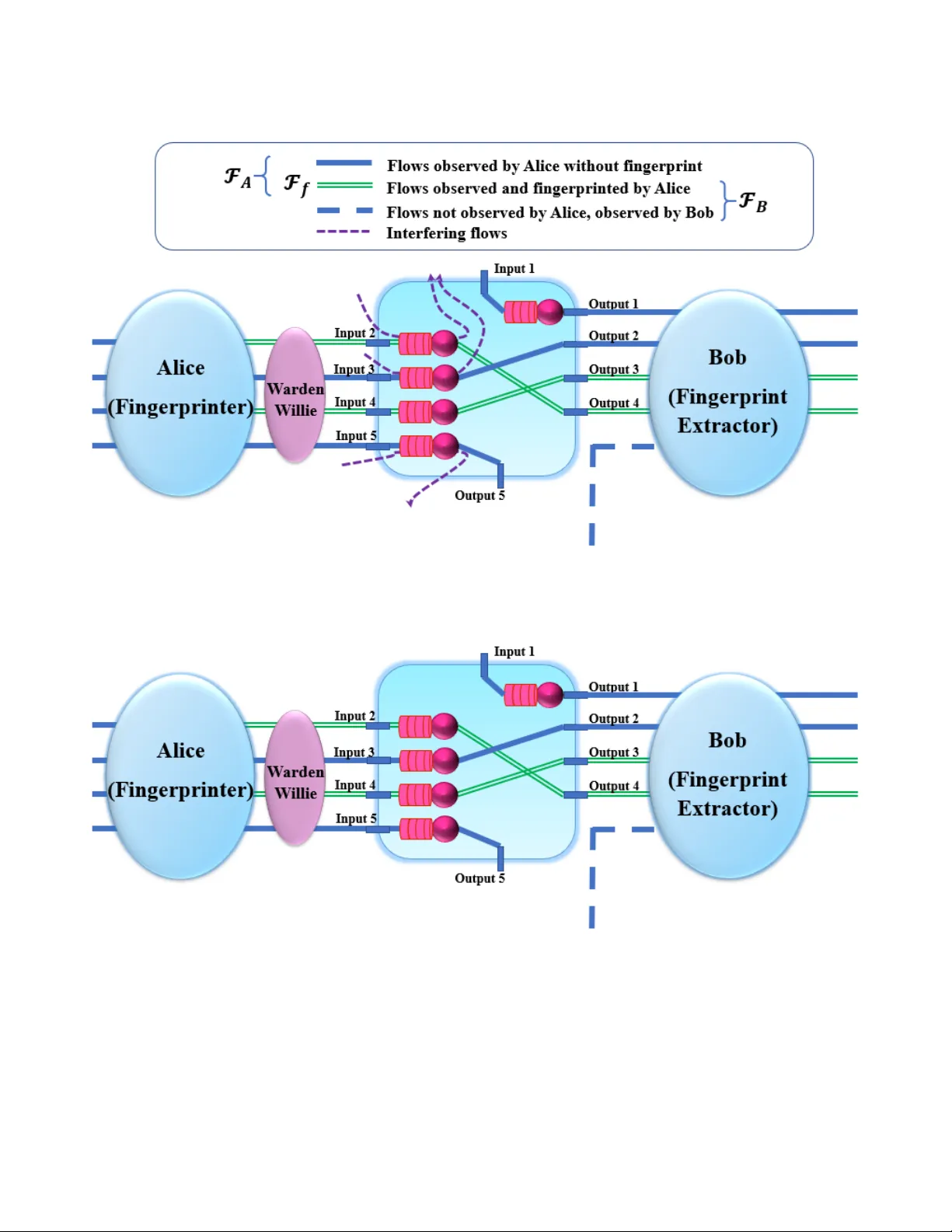
Fundamental Limits of In visible Flo w Fingerprinting Ramin Soltani ∗ , Dennis Goeckel ∗ , Don T o wsley † , and Amir Houmansadr † ∗ Electrical and Computer Engineering Department, Uni versity of Massachusetts, Amherst, { soltani, goeckel } @ecs.umass.edu † College of Information and Computer Sciences, Uni versity of Massachusetts, Amherst, { to wsley , amir } @cs.umass.edu Abstract Network flow fingerprinting can be used to de-anonymize communications on anonymity systems such as T or by linking the ingress and egress segments of anonymized connections. Assume Alice and Bob hav e access to the input and the output links of an anonymous network, respecti vely , and they wish to collaborati vely rev eal the connections between the input and the output links without being detected by W illie who protects the network. Alice generates a codebook of fingerprints, where each fingerprint corresponds to a unique sequence of inter- packet delays and shares it only with Bob . For each input flow , she selects a fingerprint from the codebook and embeds it in the flo w , i.e., changes the packet timings of the flow to follow the packet timings suggested by the fingerprint, and Bob extracts the fingerprints from the output flows. W e model the network as parallel M / M / 1 queues where each queue is shared by a flow from Alice to Bob and other flows independent of the flow from Alice to Bob . The timings of the flows are governed by independent Poisson point processes. Assuming all input flows have equal rates and that Bob observes only flows with fingerprints, we first present two scenarios: 1) Alice fingerprints all the flows; 2) Alice fingerprints a subset of the flows, unknown to W illie. Then, we extend the construction and analysis to the case where flow rates are arbitrary as well as the case where not all the flows that Bob observes have a fingerprint. For each scenario, we derive the number of flows that Alice can fingerprint and Bob can trace by fingerprinting. This work has been supported by the National Science Foundation under grants CNS-1564067 and CNS-1525642. The preliminary version of this work has been presented at the 51st Annual Asiloma r Conference on Signals, Systems, and Computers, November 2017 [1]. This work has been submitted to the IEEE for possible publication. Copyright may be transferred without notice, after which this version may no longer be accessible. 1 K eywords: Network De-anonymization, Flow Fingerprinting, Anonymity Networks, Priv acy and Se- curity , Queueing Theory , T iming Channel, Bits Through Queues, Covert Communication, Network Security , Information Theoretic Security , Covert Bits Through Queues. I . I N T R O D U C T I O N G IVEN the presence of communication systems in daily life and their rapid growth, e.g., cellular networks, internet of things, etc., security and pri vac y has emerged as a vital area of research and de velopment [2]–[9]. For ev ery communication system, security in volv es not only allowing authorized users to communicate a message in a way that the message content is protected from unauthorized users, but also pre venting access by malicious users. Hence, breaking the anonymity of users in an anonymous network such as T or , Bitblinder , and Darknet plays a major role in pre venting malicious use of technology . Even if the messages are encrypted, traf fic analysis can be used to infer sensitiv e information from the packet characteristics such as timing patterns, sizes, and packet rates. For instance, packet timings can rev eal information about passwords sent ov er SSH channels [10]. Also, traf fic analysis can discover stepping stone attacks where malicious users employ compromised computers to relay their traffic [11], [12]. Furthermore, it can be used to find correlations between input and output links of a network to re veal connections between the links [13]. Unlike passi ve traffic analysis which in volv es only recording traffic characteristics, such as packet timings, active traffic analysis in volv es both recording and modifying traf fic characteristics to embed information in them. For instance, in flow watermarking [14]–[16], watermarks are embedded into flows by changing their packet timings according to a unique secret pattern. Therefore, each flo w contains one bit of information indicating whether it contains the watermark. Howe ver , in flo w fingerprinting, the embedded patters are used to communicate information such as the identity of the party that performed fingerprinting [17], the location of the flow in the network where it was fingerprinted [1], and the time when the fingerprint was embedded. Thus necessarily this will con ve y more than one bit of information. Acti ve traf fic analysis has emerged as a vibrant area of research recently . In [18], the authors propose detecting stepping stones using flow watermarking. Peng et al. [19] sho w that this method is detectable and propose attacks on it. W ang et al. [20] show that the anonymity of V oIP calls made over an anonymity network can be broken using watermarking methods. Kiyav ash et al. [21] propose a multi- flo w attack on interv al-based watermarking methods, which delay packets of specific interv als based on the value of the watermarks. Houmansadr et al. propose RAINBOW watermarking [14] and SWIRL [15] which is a scalable traf fic analysis method resilient against aggregated-flo ws attacks. They also study the 2 capacity of flo w watermarking [22] and propose a flow fingerprinting scheme allowing fingerprinting of millions of flows by perturbing the packet timings of relativ ely short lengths of flows [23]. Rezaei et al. [24] introduce an acti ve fingerprinting method called T agIt that works by slightly delaying packets into secret time interv als. In [25], [26], the authors consider watermarking and analyze in visibility and error probability of watermarking schemes in practice. Pre vious acti ve traffic analysis methods do not offer theoretical guarantees on the trade-off between performance (number of the flows) and in visibility , i.e., altering the packet timings so that the outcome is statistically indistinguishable from intact packet timings. When the traf fic analyzer is the warden of the network who protects the links from being traced by anonymous users (e.g., for de-anonymization), in visibility of traffic analysis is important since attackers (anonymous users) can ev ade analysis if they are aw are of the fingerprinting process. Even when the traffic analyzer is not the network warden, the in visibility of the traffic analysis is crucial in order to hide from the network warden. In this paper , we consider in visible fingerprinting to trace the input and output links of a network in the presence of a network warden. Consider an anonymous network where connections between input and output links are unkno wn. W e model the network as M parallel work conserving queues with Poisson arriv als and exponential service times ( M / M / 1 queues) and First In First Out (FIFO) discipline. Queues are independent and each queue is shared by a flo w from the input of a network to the output of the network and other flows independent of the flow from Alice to Bob (see Fig. 1a). Alice has access to the input flo ws and she can buf fer and release packets when she desires. On the other side of the network, Bob has access to the output flows so he can read the packet timings of the flows. Alice and Bob wish to perform fingerprinting to infer the connections between input links and output links, without being detected by W illie whose goal is to discov er flow fingerprints. W e consider the following problem: in a time interv al of length T , can Alice and Bob perform fingerprinting to link input and output flows of the network without being detected by W illie, and if yes, ho w can they do so and what is the maximum number m of flo ws that they can link reliably? For the case where packet timings of each flo w is an independent instantiation of a Poisson process, we present the construction and analysis, and calculate the asymptotic expression for m as a function of T . W e first assume flow packet rates are equal and that Bob observes only flows with fingerprints and consider two main scenarios: 1) Alice fingerprints all flows she observes; 2) Alice fingerprints a subset of the flo ws, and the subset is unkno wn to W illie. Then, we present the extensions to arbitrary flow rates as well as the case where Bob observes a set of flo ws in which not all flows are fingerprinted. The contributions of this work relative to the conference version in [1] are: • For the case where Alice fingerprints all flows, we present more details of the analysis for both 3 (a) Setting 1: The network is modeled as independent parallel M / M / 1 queues where each queue is shared between a flo w from Alice to Bob (main flow) and other interfering flows that are independent of the main flow . (b) Setting 2: The network is modeled as independent parallel M / M / 1 queues with single input/output where each queue con veys a flow from Alice to Bob . Fig. 1: Alice may fingerprint the flows, and Bob receives the fingerprinted flow after they pass through the network which adds timing noise to the fingerprints. W illie who is warden of the network protects the links from being traced; he wishes to determine whether Alice has fingerprinted flows. 4 the reliability and the number of possible fingerprinted flows. • For the case where Alice fingerprints a subset of the flo ws, in [1, Theorem 2], we presented a scenario where Alice fingerprints each flo w independently with probability q . Here, we present a slightly dif ferent v ariation of this scheme where instead of a probabilistic selection of flows for fingerprinting, Alice fingerprints a subset of the flo ws which is known to both Alice and Bob (see Theorem 2). Furthermore, the results of [1, Theorem 2] were applicable only for specific values of q and the total number of flo ws that yield a close to a maximal number of traceable flows. Here, we present the results for arbitrary q and number of flows (see Theorem 4.3). • The extension to the case of arbitrary flow rates was discussed in [1, Section V .B] briefly . Here, we present the full construction and analysis (see Theorems 3.1 and 3.2). • W e analyze the case where Bob observes a set of flows in which some of them are not fingerprinted. W e present a construction where Bob uses a detector to determine if a flow is fingerprinted (see Theorems 4.1 and 4.2). • W e present simulation results for W illie’ s probability of error , the probability that Alice runs out of packets, Bob’ s probability of error , and robustness of our scheme against changes in processing time of queues. The remainder of the paper is or ganized as follo ws. W e present the system model, definitions, and in visibility and reliability metrics employed in this paper in Section II. Then, in Sections III and IV, we present constructions and analyses for the two main fingerprinting scenarios. In Section V, we present the extensions of the main scenarios to arbitrary flo w rates, and in Section VI, we present the extensions of the main scenarios to the case where Bob observes flows with and without fingerprints. Section VIII discusses the results, and Section IX discusses future work. W e conclude in Section X. I I . S Y S T E M M O D E L , D E FI N I T I O N S , A N D M E T R I C S A. System Model W e consider a set of M flows between M pairs of input and output links. W e assume the links are known but not the pairings. Also present are two parties Alice and Bob whose goal is to identify some or all of the pairings by fingerprinting, without a third party , W illie, detecting this identification. Moreov er, Alice and Bob wish to do so within the time interval [0 , T ] . Alice, Bob, and W illie kno w that all packet timings are gov erned by Poisson processes and they the rate of each flow that they observe. 5 Alice has access to a subset of the input links where each link con veys a packet flow f ( A ) i ∈ F A = { f ( A ) 1 , f ( A ) 2 , . . . , f ( A ) M } . She is allo wed to b uffer packets and release them from her buf fer b ut no other operations (e.g., inserting packets, changing packet ordering). W illie is located between Alice and the network, and he watchfully observes all of the input links accessed by Alice ( F A ) to detect whether or not Alice is fingerprinting flows (see Fig. 1). W illie is able to verify the sources and the order of the packets. Therefore, if Alice inserts a packet of her own or re-orders the packets on any of the links to transmit information to Bob, W illie will detect her immediately . Bob observes a subset of the output links where each link con ve ys a packet flow f ( B ) j ∈ F B = { f ( B ) 1 , f ( B ) 2 , . . . , f ( B ) M b } . He is only allo wed to observe the time of the arri v al of each of the packets in each flo w . Bob and W illie cannot manipulate the flows (e.g., change packet timings, remov e packets, insert packets, change packet ordering). Prior to fingerprinting, Alice generates a codebook of fingerprints and shares it with Bob . The codebook is secret, and thus W illie does not ha ve access to it. On the other side of the network, Bob uses the codebook to extract the fingerprints and identify the flows. Each fingerprint (code word) of the codebook corresponds to a sequence of inter-pack et delays, which plays the role of a unique flow identifier . Alice embeds a unique fingerprint in each flow , i.e., she buf fers packets of each flow and releases them according to timings associated with a fingerprint. W e denote by F f ⊂ F A the set of flo ws with fingerprints. In general, not e very fingerprinted flow is observed by Bob . Howe ver , since our goal is to calculate the maximum number of flo ws that can be traced by Alice and Bob, we assume Bob observes all fingerprinted flows, i.e., F f ⊂ F B . As W illie is only able to read the channel, he cannot change packet timings; howe ver , packet timings change after they pass through the network. Nev ertheless, we present a construction where Bob can successfully identify the flows. W e model the network as M parallel First In First Out (FIFO) queues with exponential service times ( M / M / 1 queues). W e consider two settings for the network: 1) Setting 1: each M / M / 1 queue is shared by the flow Alice and Bob are monitoring, which we refer to it as “main flow”, and other flows independent of the main flo w , which we refer to them as “interfering flows”. (see Fig. 1a). 2) Setting 2: each M / M / 1 queue con ve ys just the flow Alice and Bob are monitoring (see Fig. 1b). Denote by q i the i th queue, and by µ i , λ i , and λ 0 i the service rate, the input rate, and the sum of the rates of the interfering flows at q i , respectiv ely . W e term µ 0 i = µ i − λ 0 i the effecti ve service rate [27] of q i and we assume Alice knows the ef fecti ve service time of all queues q 1 , . . . , q M . The queues are stable, i.e., λ i + λ 0 i < µ i . First, we consider Setting 1 (sho wn in Fig. 1a). Assuming the flo w rates of the flows observ ed by Alice 6 and Bob are the same ( λ i = λ ) and that Bob observes only the set of fingerprinted flo ws ( F B = F f ), we present two scenarios: • Scenario 1 (analyzed in Section III): Alice fingerprints all flows to which she has access ( F f = F A ). • Scenario 2 (analyzed in Section IV): Alice fingerprints a subset of the flows to which she has access ( F f ⊂ F A ). Then, considering the same setting for the network (Setting 1 shown in Fig. 1a), we present Scenarios 3 and 4 which are extensions of Scenarios 1 and 2, respectiv ely , to the case that flow rates are arbitrary . Scenarios 3 and 4 are analyzed in Sections V -A and V -B, respecti vely . Next, we consider Setting 2 (shown in Fig. 1b) and present Scenarios 5 and 6, which are extensions of Scenarios 1 and 2, respecti vely , to the case that Bob observes fingerprinted flo ws as well as other flows that are not fingerprinted ( F f ⊂ F B ). If Bob observes a flow f ( B ) i that is not fingerprinted, the flo w can be either coming from Alice ( f ( B ) i ∈ F A ) or other inputs of the network ( f ( B ) i / ∈ F A ). Scenarios 5 and 6 are analyzed in Sections VI-A and VI-B, respecti vely . W e sho w that in each scenario Alice can fingerprint the flo ws in visible to W illie but distinguishable by Bob . In addition, we determine the number of flows that Alice and Bob can in visibly and reliably trace by fingerprinting. Next, we present definitions and describe in visibility and reliability metrics. B. Definitions W illie uses hypothesis testing to detect whether Alice is fingerprinting: • H 0 : Alice is not fingerprinting. • H 1 : Alice is fingerprinting. Denote P F A as the false alarm probability of rejecting H 0 when Alice is not fingerprinting (type I error), and P MD as the missed detection probability of rejecting H 1 when Alice is fingerprinting (type II error). T o gi ve more power to W illie, we assume he knows the probability that Alice is fingerprinting, P ( H 1 ) = 1 − P ( H 0 ) . Similar to the definition of cov ertness [28]–[32], we define in visibility [1]: Definition 1. (In visibility) Alice’ s fingerprinting is in visible (cov ert) if and only if she can lower bound W illie’ s probability of error , P (w) e = P F A + P MD 2 , by 1 2 − for any > 0 , as T → ∞ . W e term the in visibility parameter . Definition 2. (Reliability) Alice’ s fingerprinting is reliable if and only if for any ζ > 0 and any flow , the probability of the failure ev ent satisfies P f ≤ ζ as T → ∞ . W e term ζ the reliability parameter . For a flow with a fingerprint the failure event occurs when one of the follo wing ev ents occurs: 7 • Alice cannot successfully fingerprint the flow since she does not have a packet av ailable to release when she needs one. W e denote by P f 1 the probability of this ev ent. • Bob cannot extract the fingerprint successfully . W e denote by P f 2 the probability of this ev ent. For a flow without a fingerprint, the failure ev ent occurs when Bob detects a fingerprint. W e denote by P f 3 the probability of this ev ent. Note that both P f 3 and P F A refer to the (erroneous) detection of fingerprints when flo ws are not fingerprinted; howe ver , the former refers to detection by W illie after observing all the flows, and the latter refers to detection by Bob for each flow . Definition 3. (Lambert-W function) The Lambert-W function is the in verse function of f ( W ) = W e W . W e present results under the assumption that P ( H 0 ) = P ( H 1 ) = 1 / 2 . W e show in Appendix A that this results in in visibility for the general case where P ( H 0 ) 6 = P ( H 1 ) . In this paper , we use standard Big-O, Little-o, Big-Omega, little-omega, and Big-Theta notations [33, Ch. 3]. I I I . S C E N A R I O 1 : A L L FL O W S A R E FI N G E R P R I N T E D , S E T T I N G 1 Consider Scenario 1: Alice fingerprints all flo ws she observes ( F f = F A ), and Bob observes only the fingerprinted flows ( F B = F f ). All of flow rates are equal ( λ i = λ ). W e consider Setting 1 (see Fig. 1a), i.e., M parallel M / M / 1 queues where each queue is shared by a fingerprinted flow and other interfering flows independent of the fingerprinted flo w . Alice fingerprints the input flows during time interv al [0 , T ] , and Bob extracts the fingerprints from the flows on the output links of the network to infer the connections between input and output flows. Alice buf fers packets and releases them according to a fingerprint. She uses a secret codebook where each codeword (fingerprint) is a unique flow identifier consisting of a sequence of inter-packet delays. Because the timings of packets that Alice recei ves as well as the code words are random, Alice will face a causality problem: the need to send a packet before she receiv es it. W e giv e an example of when Alice cannot successfully fingerprint a flow in Fig. 2. Consider a flow and assume the inter-arri val times of this flow before Alice makes any changes are [10 µs, 2 µs . . . ] . Also assume Alice selects a fingerprint C ( W ) = [5 µs, 3 µs, . . . ] from her codebook. Note that the inter-arri val time between the first and second packets of the flow is 10 µs but Alice has to alter the packet timings of the flow to achiev e an inter-arri val of 5 µs between the first and the second packets. In other words, she has to send the second packet before she recei ves it. 8 Fig. 2: An example of when Alice cannot successfully fingerprint a flow: the packet timings of the flow receiv ed by Alice and the packet timings suggested by the selected fingerprint are [10 µs, 2 µs . . . ] and [5 µs, 3 µs, . . . ] , respectiv ely . Alice faces a causality problem when she needs to send the second packet since she has to send it before she receives it. T o account for this, prior to fingerprinting, Alice in visibly slows down the flow in order to buf fer packets [29, Section IV]. This ensures she will have a packet in her buf fer to transmit at the appropriate times and can fingerprint the flow successfully . W e calculate the number of flows m = M that Alice and Bob can trace by fingerprinting using this scheme, asymptotically as a function of T . Theorem 1. Consider Setting 1 (see F ig. 1a). If Alice fingerprints all M input flows ( F f = F A ) whose rates ar e equal ( λ ) and Bob only observes fingerprinted flows ( F B = F f ), then Alice and Bob can in visibly and reliably trace m = M = O ( T / log T ) flows in a time interval of length T . Proof. Construction : Per above, Alice uses a scheme consisting of two phases of lengths T 1 and T 2 , and employs a codebook of fingerprints to embed in the flows. The codebook construction is similar to the one adopted in [1], [29], [30]. In particular , Alice generates m independent instantiations of a Poisson process with parameter λT 2 , where T 2 is the length of the second phase, as follows. T o generate 9 Fig. 3: Alice’ s divides the time interval of length T into two phases: a buf fering phase of length T 1 where packets of each flow are slowed do wn, and a fingerprinting phase of length T 2 = T − T 1 where Alice fingerprints the flows. the l th code word ( 1 ≤ l ≤ m ), first a number n l is generated according to a Poisson distribution with mean λT 2 , and then n l points are distributed randomly and uniformly in a time interval of length T 2 [34] (see Fig. 4). Therefore, the codebook contains m fingerprints (code words) { C ( W l ) } l = m l =1 . Alice selects a fingerprint for each flow and applies the inter-pack et delays of the chosen fingerprint to the packets of the flow . The codebook is shared with Bob, not kno w to W illie. Alice divides the time interval of length T into two phases (see Fig. 3): • Phase 1 (buf fering phase) of length T 1 : Alice slows each flow from rate λ to rate λ − ∆ to buf fer packets, i.e., if she receives a packet at time τ , she transmits it at time τ λ λ − ∆ . This allows her to build up a backlog of packets in her buf fer which ensures that she will be able to fingerprint each flo w during the next phase successfully . • Phase 2 (fingerprinting phase) of length T 2 = T − T 1 : for each flow , she selects a fingerprint from her codebook and then alters the packet timings of the flo w according to the selected fingerprint. The lengths of the two phases are, T 1 = T mα 1 + mα , (1) T 2 = T − T 1 = T 1 + mα , (2) where α is a constant defined later , and m is the number of flows to be fingerprinted. Analysis : ( In visibility ) Similar to the analysis of covertness in [29, Theorem 2], we can show that Alice’ s fingerprinting is in visible. Consider the first phase. W e can show that for all ∈ (0 , 1 2 ) , Alice can slow down the flo ws from rate λ to rate λ − p 2 λ/mT 1 , and achiev e (see the proof in Appendix B) P (w) e > 1 2 − , (3) where P e is W illie’ s error probability . Thus, her buf fering is in visible. In the second phase, the packet timings for each flow is an instantiation of a Poisson process with rate λ and hence the traf fic pattern is indistinguishable from the pattern that Willie expects to observe. Hence, the scheme is in visible. 10 Fig. 4: Codebook generation: Alice generates a codebook whose code words (fingerprints) specify the sequence of inter-pack et delays to be embedded in the flows. Each codeword is an instantiation of a Poisson process of rate λ min = min( λ 1 , . . . , λ m ) in a time interv al of length T 2 . For each code word, first a random v ariable N is generated according to the Poisson distribution with parameter λT 2 . Then N points are placed uniformly and randomly in the time interval of length T 2 . The codebook is shared with Bob, but it is unknown to W illie. ( Reliability ) Now , we sho w that Alice’ s fingerprinting satisfies all of the conditions in Definition 2, and thus is reliable. Note that all flows hav e fingerprints. By the union bound: P f ≤ P f 1 + P f 2 . (4) Thus, to show the fingerprinting is reliable, it suf fices to show that P f 1 + P f 2 ≤ ζ for all ζ > 0 . First, we show that P f 2 → 0 as T → ∞ for each flo w , i.e., Bob can successfully extract a fingerprint from each flo w . Recall that Alice fingerprints all m flows that she observes and Bob observes only the flo ws fingerprinted by Alice ( F A = F f = F B ). Therefore, m = |F A | = |F f | = |F B | , where | · | denotes the cardinality of a set. W ithout loss of generality , we assume that flow f ( B ) i passes through the i th queue ( q i ). Denote by C i the capacity of q i for the transmission of information via packet timings. Recall that q i is an M / M / 1 queue with multiple inputs and outputs and that Alice establishes a timing channel on each input flow to send a fingerprint to Bob . Recall that q i is an M / M / 1 queue with multiple inputs and outputs and that Alice establishes a timing channel on each input flow to send a fingerprint to Bob . Therefore, we use the bound on the capacity of the timing channel for a shared M / M / 1 queue [27, Proposition 1]: C i ≥ λ log (( µ i − λ 0 i ) /λ ) , (5) where λ 0 i is the sum of rates of the interfering flows passing through q i , and µ i is the service rate of q i . Note that (5) implies that although q i changes the packet timings of the flow and thus the embedded 11 fingerprint, Bob is able to successfully decode at least C i nats/second bits from the packet timings of the flo w and thus extract Alice’ s fingerprint. From [34, Definition 1], the rate of the codebook is log m T 2 , and [34, Definition 2], (5) implies that all transmission rates smaller than λ log (( µ i − λ 0 i ) /λ ) result in a decoding error probability that tends to zero as T 2 → ∞ . Therefore, we require log m T 2 < λ log (( µ i − λ 0 i ) /λ ) (6) for Bob to successfully extract the fingerprint from f ( B ) i . Note that (6) holds for all 1 ≤ i ≤ m . Hence, as long as log m T 2 < C , (7) where C = λ log min i { µ i − λ 0 i } /λ , (8) for each flow P f 2 → 0 as T 2 → ∞ . Note that (2) implies that T 1 , T 2 → ∞ as T → ∞ . Therefore, P f 2 → 0 as T → ∞ . (9) Next, we sho w that P f 1 ≤ ζ , i.e., Alice can successfully fingerprint the flows. Recall that Alice accounts for the causality problem by buf fering packets before she starts fingerprinting. Since in the first phase Alice slows down the packet rate from rate λ to rate λ − p 2 λ/mT 1 , on average she can buf fer p 2 λT 1 /m packets. Consequently , we can apply the weak law of large numbers (WLLN) to sho w that the probability that Alice b uf fers more than p λT 1 /m packets tends to one, as T tends to infinity . Now , we hav e to answer this question: noting that Alice has p λT 1 /m packets in her buf fer , what is the probability that Alice cannot successfully fingerprint f ( A ) i ? Because Alice receiv es and transmits packets on each flow according to two independent Poisson processes of rate λ , and the Poisson process is memoryless, we model the process as a symmetric random walk on a 1-D grid to answer this question [29]. The location of the walker corresponds to the number of packets in Alice’ s b uffer . The walker goes from location z to z + 1 when Alice receiv es a packet, and goes from location z to z − 1 when Alice transmits a packet. Denote by P k,t the probability of the ev ent that the walker starting from the location z = k reaches the point z = 0 , at least once, during the time [0 , t ] . Then [29, Eq. (27)]: lim t →∞ P k,t ≤ 1 − lim t →∞ erf k √ 8 λt . (10) 12 Since Alice fingerprints the flows in the second phase, t = T 2 . Recall that the probability that Alice buf fers more than p λT 1 /m packets tends to one, as T → ∞ . Therefore, we let k = p λT 1 /m . By (10), the probability that Alice runs out of packets for flow f ( A ) i satisfies: lim T →∞ P f 1 ≤ 1 − lim T →∞ erf 2 r T 1 2 mT 2 ! = 1 − erf r α 8 . (11) where the equality holds since T 1 /T 2 = mα following from (1) and (2). Note that (11) is independent of i (index of the flow), and holds for all flows f ( A ) i , 1 ≤ i ≤ m . Let α = (8 / 2 )(erf − 1 (1 − ζ )) 2 . (12) By (12), (11) yields P f 1 ≤ ζ as T → ∞ . (13) Consequently , by (4), (9), (13), P f ≤ ζ for all ζ > 0 , when T → ∞ and thus Alice and Bob’ s fingerprinting is reliable. ( Number of flows ) By (7) and (2), we require log m T 2 = (1 + mα ) log m T < C . (14) as T 2 → ∞ ( T → ∞ ). In Appendix C we show that we can achie ve (14) as long as m = 1 2 min α − 1 T C W ( T C ) − 1 , T C W ( T C ) , (15) where W ( · ) is the Lambert-W function. Since for T > e , W ( T ) ≤ ln( T ) , Alice and Bob can invisibly and reliably pair the end points of ev ery flo w , and thus break the anonymity of a network (Setting 1 sho wn in Fig. 1a) with m = O ( T / log T ) flows. I V . S C E N A R I O 2 : A L I C E FI N G E R P R I N T A S U B S E T O F T H E FL O W S , S E T T I N G 1 In Scenario 1, W illie is certain that if H 1 is true, i.e., Alice fingerprints, then all flo ws are slowed do wn in the first phase. In Scenario 2, we add uncertainty to W illie’ s knowledge under H 1 : Alice fingerprints a subset F f of the flo ws, and F f is unknown to W illie. Therefore, W illie has to in vestigate a large set of flows to detect if some are slowed down in the first phase as required for fingerprinting. W e show that W illie’ s uncertainty allows Alice to fingerprint more flows without being visible. Alice fingerprints a subset of the flows she observes ( F f ⊂ F A ). For each flow , she selects a unique fingerprint from her codebook and alters the timings of that flow according it. Similar to Scenario 1, Alice has T units of time which she di vides into two phases: a buf fering phase of length T 1 , which 13 ensures Alice can successfully fingerprint, and a fingerprinting phase of length T 2 = T − T 1 . Bob, who has access to the fingerprint codebook and observes the set of fingerprinted flo ws ( F B = F f ), extracts the fingerprints from the flows. The fingerprint codebook is secret and W illie does not hav e access to it. The network is modeled by M parallel M / M / 1 queues with each queue shared by a flo w from Alice to Bob (main flo w) as well as other interfering flows independent of the main flow (Setting 1 sho wn in Fig. 1a). W e calculate the number of flo ws ( m ) that Alice can fingerprint using this scheme, asymptotically as a function of T . Theorem 2. Consider Setting 1 (see F ig. 1a). In a set F A containing M flows with equal rates ( λ ), if Bob observes only the fingerprinted flows ( F B = F f ), Alice and Bob can in visibly and r eliably trace m flows in a time interval of length T , wher e m = M , M = O (1) o (min { √ M , e T C 1 } ) , M = ω (1) & M = O ( e 2 T C ) Θ( e T C 2 ) , M = ω ( e 2 T C ) (16) C is given in (8) , and C 1 , C 2 ∈ (0 , C ) ar e arbitrary constants. A more accurate characterization of m with respect to M is presented in (26) in the proof below . Proof. Construction : The construction is similar to that of Scenario 1 except that Alice fingerprints a subset of the flows that she observes. Recall that all of flows observed by Bob are also observed by Alice ( F B ⊂ F A ). Alice knows which set of her flows will be observed by Bob, and chooses them for fingerprinting ( F f = F B ). Note that W illie does not know which subset of F A is F B . Alice generates a codebook of m fingerprints (similar to Scenario 1) and shares it with Bob prior to fingerprinting, where m is giv en in (16). Recall that we calculate the maximum number of flows that Alice and Bob can trace; therefore, we only consider the case |F B | = m which can be extended to |F B | ≤ m tri vially . Alice’ s scheme consists of two phases, a buf fering phase of length T 1 , and a fingerprinting phase of length T 2 = T − T 1 , where T 1 = T α 0 ln(1 + 2 M 2 m 2 ) + α 0 , (17) T 2 = T − T 1 = T 1 + α 0 / ln(1 + 2 M 2 m 2 ) , (18) α 0 = α 2 . (19) 14 Recall that α and C are giv en in (12) and (8), respectiv ely , and is the in visibility parameter . Alice generates fingerprints for her codebook analogous to Scenario 1. The number of fingerprints in her codebook is m . Analysis : ( In visibility ) For each phase, we show that all operations Alice performs on the flo ws are in visible. Consider the first phase [0 , T 1 ] where Alice slows down each flow from rate λ to rate λ − ∆ with ∆ = s λ T 1 ln 1 + 2 M 2 m 2 . (20) From W illie’ s perspecti ve, the number packets in time [0 , T 1 ] is a suf ficient statistic to detect Alice [29]. If Alice does not fingerprint ( H 0 ), then the joint probability density function (pdf) of W illie’ s observations is P 0 = Q M i =1 P λ ( n i ) where P λ ( n ) is the pdf of a Poisson random variable with mean λ . Note that W illie knows that m out of M flows observed by Alice is selected to be fingerprinted, but he does not kno w which set is selected. Therefore, from W illie’ s point of view , if Alice chooses to fingerprint flo ws ( H 1 ), then each flow will contain a fingerprint with probability p = m M . (21) Thus, the joint pdfs of W illie’ s observ ations when Alice fingerprints ( H 1 ) is P 1 = M Y i =1 ( p P λ − ∆ ( n i ) + (1 − p ) P λ ( n i )) , where ∆ is the change in flow rate. Note that the change of rate differs from the one in Scenario 1. Suppose that W illie applies an optimal hypothesis test to minimize his probability of error P (w) e . Then, we can obtain a lower bound on his probability of error [31, Eq.1]: P (w) e ≥ 1 2 − r 1 8 D ( P 1 || P 0 ) , (22) where D ( P 1 || P 0 ) is the Kullback–Leibler diver gence (relativ e entropy) between P 1 and P 0 . Alice’ s scheme is in visible as long as she can make W illie’ s detector operate as close as desired to the detector that disregards W illie’ s observ ations and results in P (w) e = 1 / 2 (see Definition 1). In Appendix D, we show that for > 0 , r 1 8 D ( P 1 || P 0 ) ≤ . (23) Thus, (22) yields P (w) e ≥ 1 2 − as T → ∞ , and thus Alice’ s buf fering is in visible. The second phase is in visible because the fingerprints are samples of Poisson processes with rate λ . Combined with the invisibility of the first phase, Alice and Bob’ s scheme is in visible. 15 ( Reliability ) The analysis is similar to that of Scenario 1. Since all flo ws observed by Bob are fingerprinted ( P f 3 = 0 ), to sho w Alice and Bob’ s scheme is reliable, it suffices to sho w that for each flo w P f 1 + P f 2 ≤ ζ for all ζ > 0 . Similar to Scenario 1, in Appendix E we show that P f 1 ≤ ζ as T → ∞ . (24) No w , consider Bob’ s decoding error for each flow , P f 2 . By (17) and (18), T 1 , T 2 → ∞ as T → ∞ . In order for Bob to be able to successfully extract the fingerprint from each flow , we require log m T 2 < C . (25) as T 2 → ∞ ( T → ∞ ). Substituting T 2 from (18) and re-arranging yields: m ≤ exp T C 1 + α 0 / ln(1 + 2 M 2 m 2 ) ! (26) W e show in Appendix F that (26) holds asymptotically as T → ∞ , giv en the v alue of m provided in (16). Consequently , P f 2 → 0 as T → ∞ . (27) By (4), (24), and (27), P f → 0 as T → ∞ . Thus, if M = ω (1) , Alice can invisibly and reliably fingerprint o min { √ M , e T C } flo ws in a time interval of length T , and Bob can successfully extract the fingerprints, where C is giv en in (8), and if M = O (1) , Alice can in visibly and reliably fingerprint all M flows in a time interval of length T , and Bob can successfully extract the fingerprints. In Scenario 2, we assumed that all flows observed by Bob are also observed by Alice and chosen for fingerprinting ( F f = F B ⊂ F A ). Although this is applicable in many schemes, we present results for the case where this assumption is relaxed in Section VI, i.e., Bob observes flows with and without fingerprints. V . E X T E N S I O N T O A R B I T R A RY R A T E S In this section, we extend Theorems 1 and 2 to the case that the flow rates are arbitrary . 16 A. Scenario 3: All flows ar e fingerprinted and flow rates ar e arbitrary , Setting 1 Consider Scenario 3, which is the extension of Scenario 1 to arbitrary rates: Alice fingerprints all of the flows she observes ( F f = F A ), and Bob observes only the fingerprinted flows ( F B = F f ). W e consider Setting 1 (see Fig. 1a), i.e., M parallel M / M / 1 queues with multiple inputs and outputs, where each queue is shared between a flo w from Alice to Bob (main flow) as well as other interfering flo ws independent of the main flow . Here the flo ws rates λ 1 , . . . , λ M can be arbitrary , and the main flow passing through the i th queue ( q i ) has the rate of λ i . Alice fingerprints the input flows of the network in the time interval [0 , T ] , and Bob extracts the fingerprints from the flows on the output links of the network to infer the connections between input and output flows. Similar to Scenario 1, for each flow Alice selects a code word (fingerprint) from her codebook and embeds it in the flo w by changing the packet timings of the flo w . She b uilds her codebook based on the minimum rate of the flows λ min = min( λ 1 , . . . , λ M ) , and to embed a fingerprint (of rate λ min ) in a flo w of rate λ i , she scales the fingerprint by a factor of λ min /λ i to obtain a modified fingerprint of rate λ i , and then embeds it in the flow . In addition, she uses a two-phase (buf fering-fingerprinting) scheme similar to those of Scenarios 1 and 2. W e calculate the number of flows ( m = M ) that Alice and Bob can trace by fingerprinting using this scheme, asymptotically as a function of T . Theorem 3.1. Consider Setting 1 (see F ig. 1a). If Alice fingerprints all M input flows ( F f = F A ) whose rates λ 1 , . . . , λ m ar e arbitrary and Bob observes only the set of fingerprinted flows ( F B = F f ), then Alice and Bob can in visibly and r eliably trace m = M = O ( T / log T ) flows in a time interval of length T . Proof. Construction : Per above, Alice employs a two-phase scheme: a buf fering phase of length T 1 and a fingerprinting phase of length T 2 = T − T 1 (see Fig. 3), where T 1 and T 2 are giv en in (1) and (2). The codebook construction is similar to Scenario 1, but the rate of the fingerprints (code words) is λ min = min( λ 1 , . . . , λ M ) . T o embed a fingerprint in a flow of rate λ i , Alice selects a fingerprint ( τ 1 , . . . , τ N ) and scales by a factor λ min /λ i to generate a modified fingerprint of rate λ i , ( λ min τ 1 λ i , . . . , λ min τ N λ i ) . Since fingerprints are instantiations of a Poisson process of parameter λ min (i.e., its inter-arri val times are instantiations of an exponential random v ariable of mean 1 /λ min ), the modified fingerprint is an instantiation of a Poisson process of parameters λ i . Next, Alice applies the inter-packet delays giv en by the modified fingerprint to each flow . Recall that Bob knows the rate of each flow . Upon observing f ( B ) i , the flow with packet timings ¯ t i = ( t (1) i , t (2) i , . . . , t ( N ) i ) and rate λ i , Bob seeks to answer the following question: 17 Question 1: Given that Alice used the codebook { C ( W l ) } l = m l =1 whose fingerprints ar e of rate λ min , what is the inde x of the fingerprint that was selected by Alice, scaled to rate λ i , and transmitted thr ough q i to pr oduce the output packet timings ¯ t i ? Analysis : ( In visibility ) Similar to Scenario 1, we analyze the in visibility of the first and second phases separately . In the first phase, Alice slows do wn each flow of rate λ i to rate λ i − p 2 λ i /mT 1 . Using arguments similar to that of Theorem 1, we can sho w that [29, Theorem 2]: P (w) e > 1 2 − , where P ( w ) e is W illie’ s error probability . Thus, this phase is in visible to W illie. In the second phase, since Alice embeds a modified fingerprint of rate λ i in a flow of rate λ i , the traffic pattern remains Poisson with rate λ i indistinguishable from the pattern that W illie expects to observe. Hence, the scheme is in visible. ( Reliability ) Similar to the reliability analysis in Scenario 1, we upper bound P f 1 + P f 2 by ζ , for all ζ > 0 . Recall that upon observing f ( B ) i , Bob seeks the answer to Question 1. Note that the answer to this question is the same as the answer to the following question: Question 2: Given that Alice used the codebook { C 0 ( W l ) } l = m l =1 = λ min λ i { C ( W l ) } l = m l =1 what is the index of the fingerprint that was selected by Alice and transmitted thr ough q i to pr oduce the output packet timings ¯ t i ? In other words, although Alice generates a codebook whose fingerprints are of rate λ min and then scales each fingerprint to adjust to rate λ i of the flow , Bob’ s decoding of each flo w is equiv alent to the case where Alice uses a codebook whose fingerprints are of rate λ i and she does not scale the fingerprints; the only differences are in the number of fingerprints (codewords) and the time to transmit the fingerprint, as we will explain later . Therefore, from (6), Bob can successfully extract the fingerprint from the flow of rate λ i as long as T 2 is large and log m T ( i ) 2 < λ i log (( µ i − λ 0 i ) /λ i ) , (28) where T ( i ) 2 = T 2 λ min /λ i is the time of the transmission of the fingerprint embedded in the flow of rate λ i . Therefore, log m T 2 < λ min log (( µ i − λ 0 i ) /λ i ) . (29) Since the size of the codebook is m , fingerprinting the flow f i corresponds to transmission of log m nats of information through the inter-pack et delays of the flow f i . Note that scaling a fingerprint of rate λ min to rate λ i results in transmission of log m nats of information at a higher rate but a shorter time. 18 Since (29) holds for all 1 ≤ i ≤ m , we require log m T 2 < C 0 , (30) where C 0 = λ min min i { log (( µ i − λ 0 i ) /λ i ) } , (31) to achie ve P f 2 → 0 as T 2 → ∞ for each flow . Note that (2) implies that T 1 , T 2 → ∞ as T → ∞ . Therefore, P f 2 → 0 as T → ∞ . (32) No w , consider P f 1 . In the second phase, on each link Alice recei ves and transmits the packets according to two independent Poisson processes of equal rate. Thus, we employ a random walk analysis similar to that of Scenario 1 to show that P f 1 ≤ 1 − erf 2 r T 1 2 mT 2 ! ≤ ζ as T → ∞ . (33) Consequently , by (4), (32) and (33), P f ≤ ζ for all ζ > 0 , and thus Alice and Bob’ s fingerprinting is reliable. ( Number of flows ) The analysis is similar to that of Scenario 1. As T → ∞ , we require log m T 2 = (1 + mα ) log m T < C 0 . (34) which we can achieve as long as m = 1 2 min α − 1 T C 0 W ( T C 0 ) − 1 , T C 0 W ( T C 0 ) , (35) Since for T > e , W ( T ) ≤ ln( T ) , Alice and Bob can invisibly and reliably break the anonymity of a network (Setting 1 shown in Fig. 1a) with m = O ( T / log T ) flows. B. Scenario 4: Alice fingerprints a subset of the flows, Setting 1 Consider Scenario 4, which is the extension of Scenario 2 to arbitrary rates: Alice fingerprints a subset F f of the flows, and F f is unknown to W illie. Similar to Scenario 2, since W illie has to in vestig ate a large set of flows to detect if some are slowed down in the first phase as required for fingerprinting, Alice can make more fingerprinted flows in visible. For each flow in F f , she selects a unique fingerprint from her codebook and alters the timings of that flow according to the fingerprint. W e consider Setting 1 (see Fig. 1a), i.e., M parallel M / M / 1 queues with multiple inputs and outputs, where each queue is shared between a flow from Alice to Bob 19 (main flow) as well as other interfering flo ws independent of the main flow . Flows rates are λ 1 , . . . , λ M , which can be arbitrary , and the main flow passing through the i th queue ( q i ) has the rate of λ i . Alice fingerprints the input flows of the network in the time interv al [0 , T ] , and Bob extracts the fingerprints from the flo ws on the output links of the network to infer the connections between input and output flo ws. For each selected flow Alice selects a code word from her codebook and embeds it in the flow by changing its packet timings according to the selected fingerprint. Since flow rates are arbitrary , similar to Scenario 3, she b uilds her codebook based on the minimum rate of the flo ws to be fingerprinted and scales each fingerprint based on the rate of the flo w to be fingerprinted. Also, she uses a two-phase (buf fering-fingerprinting) scheme. W e calculate the number of flo ws ( m ) in which Alice fingerprints using this scheme, asymptotically as a function of T . Theorem 3.2. Consider Setting 1 (see F ig. 1a). In a set F A containing M flows with rates λ 1 , . . . , λ M , if Bob observes only the fingerprinted flows ( F B = F f ), Alice and Bob can in visibly and r eliably trace m flows in a time interval of length T , wher e m is given in (16) , wher e C is r eplaced with C 0 which is given in (31) . Proof. The construction and analysis follow from those of Scenarios 2 with modifications due to arbitrary rates. The extension to arbitrary rates follows from that of Scenario 3. V I . M I X I N G FL O W S W I T H A N D W I T H O U T FI N G E R P R I N T S W e hav e previously assumed that Bob only observes the set of fingerprinted flows, i.e., F B = F f . But, in practice Bob might observe a set of flows in which some of the flows are not fingerprinted, and therefore, he must be able to detect if a flow contains a fingerprint. In this Section, we consider Setting 2 (see Fig. 1b) and we present Scenarios 5 and 6 which are extensions of Scenarios 1 and 2, respecti vely , to the case where Bob observes a set of flows in which some of them are not fingerprinted. W e present a detector for Bob that is able to detect if a flow is fingerprinted. A. Scenario 5: All flows ar e fingerprinted and Bob observes flows with and without fingerprints, Setting 2 Consider Scenario 5, which is the extension of Scenario 1 to the case where Bob observes flo ws with and without fingerprints ( F f ⊂ F B ): Alice fingerprints all of the flows she observes ( F f = F A ), flo w rates are equal ( λ ), and Bob observes flows with and without fingerprints. W e consider Setting 2 20 (see Fig. 1b), i.e., M parallel M / M / 1 queues with single input and output. Alice fingerprints the input flo ws of the network in the time interval [0 , T ] , and Bob extracts the fingerprints from the flo ws on the output links of the network to infer the connections between input and output flo ws. In contrast to Scenarios 1-4, Bob uses a detector to determine if a flo w is fingerprinted. W e calculate the number of flows ( m ) that Alice and Bob can trace by fingerprinting using this scheme, asymptotically as a function of T . Theorem 4.1. Consider Setting 2 (see F ig. 1b). If Alice fingerprints all M input flows ( F f = F A ) whose rates ar e equal ( λ ) and Bob observes a set of flows with and without fingerprints ( F f ⊂ F B ), then Alice and Bob can invisibly and r eliably trace m = M = O ( T / log T ) flows in a time interval of length T . Proof. Construction : The only dif ference between the construction of Scenarios 1 and 5 is that, for Scenario 5, Bob must use a detector which detects if a flow contains a fingerprint. Here, Bob’ s decoder is different from the maximum likelihood decoder proposed in [34, p. 9], which for each code word calculates the service times that yield ¯ D i , remov es the codewords that result in negati ve values of service times, and finally finds a unique codew ord that corresponds to the minimum sum of service times. Instead, Bob’ s decoder selects a threshold β = log ( µ i /λ ) , applies a function on each codew ord, and finds a unique codeword that generates an output for the function that is larger than β . Next, we describe Bob’ s decoder in detail [35, p. 12]. For ¯ x = ( x 1 , . . . , x n ) ∈ R n + and ¯ y = ( y 0 , y 1 , . . . , y n ) ∈ R n +1 + , if ¯ x is the sequence of packet timings before the flow passes through q i (inter-arri val times), then the pdf of the observed packet timings ¯ y (inter-departure times) is: P ( ¯ y | ¯ x ) = e µ − λ ( y 0 ) n Y k =1 ( y k − w k ) , where e u ( x ) = ue − ux is the exponential pdf with mean 1 /u , and w k = max { 0 , P k i =1 x i − P k − 1 i =0 y i } is the k th waiting time, the amount of time that the queue waits until it receiv es the k th packet. Since the packet timings of the fingerprinted flow is an instantiation of a Poisson process of rate λ , the joint pdf of the inter-arri val times is Q n k =1 e λ ( x k ) . Consequently , the pdf of ¯ y is: P ( ¯ y ) = Z R n + P ( ¯ y | ¯ x ) n Y k =1 e λ ( x k ) d ¯ x. (36) Bob’ s decoder finds a unique fingerprint (codew ord) W l from { W l } l = m l =1 that satisfies P ( ¯ y | W l ) P ( ¯ y ) > β ; if such a unique codew ord does not exist, it outputs flow not fingerprinted . Analysis : The analysis follows from that of Scenario 1. The only differences appear in the analysis of Bob’ s decoding error probability . The auxiliary threshold decoder used in the analysis of the mismatched 21 decoder in [35, p. 413-417] provides what we need for our application. If Bob uses this detector , the decoding error probability of a fingerprinted flow will be: P f 2 → 0 as T → ∞ , (37) which implies that if we generate m independent instantiations of a Poisson process of rate λ on a time interv al of length T 2 , W 1 , . . . , W m , we select one of them W l and send a packet stream whose packet timings follow W l ov er the network, then the probability that at least one W k 6 = W l satisfies P ( ¯ y | W l ) P ( ¯ y ) > β tends to zero, i.e., P ( ∃ W k 6 = l : P ( ¯ y | W k ) / P ( ¯ y ) > β | W l sent ) → 0 as T → ∞ . (38) Consider the case where Bob observes a flo w that is not fingerprinted. Recall that the packet timings of all the flo ws follow a Poisson process of rate λ . Denote by Z ? an instantiation of a Poisson process that corresponds to the packet timings of the this flow before it passes through the network. If Bob detects a fingerprint, it must be that one of the fingerprints W l in the codebook resulted in P ( ¯ y | W l ) P ( ¯ y ) > β . Hence, P f 3 = P ∃ W k : P ( ¯ y | W k ) P ( ¯ y ) > β Z ? sent (39) Recalling that W 1 , . . . , W m and Z ? are independent instantiations of a Poisson process of rate λ , (37) and (38) yield P f 3 → 0 as T → ∞ . Thus, Alice and Bob’ s fingerprinting is reliable. B. Scenario 6: Alice fingerprints a subset of the flows and Bob observes flows with and without fingerprints, Setting 2 Consider Scenario 6, which is the extension of Scenario 2 to the case where Bob observes flows with and without fingerprints ( F f ⊂ F B ): Alice fingerprints a subset of the flows she observes ( F f ⊂ F A ), flo w rates are equal ( λ ), and Bob observes flows with and without fingerprints. W e consider Setting 2 (see Fig. 1b), i.e., M parallel M / M / 1 queues with single input and output. Alice fingerprints the input flo ws of the network in the time interval [0 , T ] , and Bob extracts the fingerprints from the flo ws on the output links of the network to infer the connections between input and output flo ws. Similar to Scenario 5, Bob’ s detector is able to distinguish whether a flow is fingerprinted. W e calculate the number of flo ws ( m ) that Alice and Bob can trace by fingerprinting, asymptotically as a function of T . Theorem 4.2. Consider Setting 2 (see F ig. 1b). In a set F A containing M flows with equal rates ( λ ), if Bob observes flows with and without fingerprints ( F f ⊂ F B ), Alice and Bob can in visibly and r eliably trace m flows in a time interval of length T , wher e m is given in (16) , where C is r eplaced with C 00 = λ log min i { µ i } /λ , (40) 22 Note that the replacement of C with C 00 is necessary since here we consider Setting 1 which implies that the rates of interfering flows λ 0 i are zero. Proof. The construction and analysis follow from those of Scenarios 2 with modifications due to the change of Bob’ s detector to detect whether a flow is fingerprinted or not. In addition, Alice does not need to know which subset of the flows she observes are observed by Bob to fingerprint the. But, she chooses an arbitrary subset of flows and fingerprints them. In general, each fingerprinted flow will not be observed by Bob . Howe ver , since we determine the maximum number of flo ws that can be traced, we assume that each fingerprinted flow will be observed by Alice. The analysis for Bob’ s detector follo ws from that of Scenario 5. In Theorem 4.2, Alice’ s selection of subset might be due to the preference of Alice and Bob . But, if there is no such preference, Alice can choose the flows randomly and independently to fingerprint them. Next, we present Theorem 4.3 to address this case. Theorem 4.3. Consider Setting 2 (see F ig. 1b). In a set F A containing M flows, if Alice fingerprints each flow independently with pr obability q , each flow has rate λ , and Bob observes a set of flows that contains flows with and without fingerprints ( F f ⊂ F B ), then Alice and Bob can in visibly and r eliably trace m = O min ( M q , exp T C 1 + α 0 / ln(1 + 2 2 M q 2 ) !)! (41) flows in a time interval of length T , where is the in visibility parameter , and C 00 and α 0 ar e given in (19) and (40) , r espectively . Proof. The construction and analysis follo ws those of Theorem 4.2 with modifications due to the random selection of the flows. Alice builds a fingerprint codebook of size m , where m = exp T C 1 + α 0 / ln(1 + 2 2 M q 2 ) ! . (42) She selects the flow f ( A ) i ∈ F A to be fingerprinted with probability q , independent of other flo ws. For each flo w f ( A ) i she generates an independent Bernoulli random variable X i with P ( X i = 1) = q ; she selects a unique (unused) fingerprint from her codebook and embeds it in flow f ( A ) i if and only if X i = 1 . Similar to the analysis of Scenario 2, we can show that for reliable fingerprinting we require m ≤ exp T C 1 + α 0 / ln(1 + 2 2 M q 2 ) ! , (43) 23 which is satisfied by (42). Next, we show that N s = P M k =1 X i = O ( M q ) . Consider random variables Y i = X i /q , i = 1 , . . . , M . Since E [ Y i ] = E [ X i ] /q = 1 , the weak law of large numbers (WLLN) yields lim T →∞ P 1 M P M i =1 Y i > 1 / 2 = 1 . Let γ = 1 / 2 and X i = q Y i . Thus, lim T →∞ P P M i =1 X i > M q / 2 = 1 . Since Alice fingerprints min { m, N s } flo ws, the number of flo ws that Alice and Bob can in visible and reliably trace is (41). In [1, Theorem 2], we presented values of q and M that yield a close to a maximal number of flows that can be traced. V I I . S I M U L A T I O N R E S U LT S A. W illie’ s err or pr obability First, we consider Scenario 1 and present the results of the simulation for W illie’ s detection. Then, we discuss how similar results apply to all of the scenarios with slight modifications. Consider Scenario 1. Recall that when H 0 is true (Alice is not fingerprinting), W illie observes flows where each flow’ s packet timing is gov erned by a Poisson process of rate λ . When H 1 is true (Alice is fingerprinting), the packet timing of each flow observed by W illie is governed by a Poisson process of rate λ − p 2 λ/mT 1 in the first phase and a Poisson process of rate λ in the second phase. Since the statistical properties of the flows are the same for H 0 and H 1 in the second phase, he uses the information obtained from his observ ations in the first phase to test whether Alice is fingerprinting. Note that when H 1 is true, W illie observes m flo ws each of whose packet rates is λ − p 2 λ/mT 1 in the first phase. Similar to [29], we can show that a packet counter is an optimal detector for W illie. He counts the total number of packets S in the first phase for all m flows, and sets a threshold U . If S < λT m − U , he selects H 1 ; otherwise, he selects H 0 . W e consider P ( H 0 ) = P ( H 1 ) = 0 . 5 . The simulation parameters are λ = 7 . 36 packets/second, min i { µ i − λ 0 i } = 20 packets/second, C = 7 . 36 nats/second (see (8)), T = 3600 × 11 seconds, ζ = 0 . 01 , = 0 . 1 , m = 10 (see (15)), U ∈ [0 . 07 , 100] √ λmT ≈ [80 , 120000] . Alice reduces the rate of each packet stream from λ to λ − r p 2 λ/mT 1 , and we plot recei ver operating characteristic (R OC) curves for W illie for r ∈ [0 . 1 , 9] (see Fig. 5). Note that the x-axis and y-axis of this figure are W illie’ s probability of false-alarm ( P F A ) and true-detection (1- P MD ), respectiv ely . The number of trials is 8000 . According to Theorem 1, r = 1 corresponds to the case which yields cov ertness, as verified by the R OC curve. Note that large values for r , which corresponds to more slow down of the packets by Alice in the first phase, lead to detection by W illie with high probability . Next, we discuss why these results apply to other scenarios. Note that W illie’ s detection defers across scenarios since he observes a dif ferent number of flows. Ho we ver , in all scenarios W illie’ s optimal 24 Fig. 5: The receiver operating characteristic (ROC) curve for W illie’ s detection. Alice reduces the rate of each packet stream from λ to λ − r p 2 λ/mT 1 , and we draw R OC curves for r ∈ [0 . 1 , 9] . detector is a packet counter . Since all of the links are gov erned by independent Poisson processes and the sum of independent Poisson random v ariables (with distinct parameters) is another Poisson random v ariable, W illie’ s detection problem differs only slightly . B. Pr obability that Alice runs out of packets Recall that in all scenarios Alice slightly slo ws do wn the packet rate of each flow so as to buf fer packets. She does this to ensure that in the second phase, she does not run out of packets with high probability . W e denoted the probability that Alice runs out of packets by P f 1 , and recall we want to achie ve P f 1 < ζ . 25 W e consider a single link and plot the curve for the probability that Alice runs out of packets when she reduces the rate from λ to λ − r 0 p 2 λ/ ( mT 1 ) (see Fig. 6), where r 0 ∈ [0 , 0 . 5] is v ariable. W e term 100 r 0 the percentage of ideal rate reduction. According to Theorem 1, r 0 = 1 corresponds to the rate reduction that yields P f 1 < ζ . The simulation parameters are λ = 20 packets/second, min i { µ i − λ 0 i } = 25 packets/second, C = 4 . 46 nats/second (see (8)), T = 3600 × 2 seconds, ζ = 0 . 1 , = 0 . 1 , m = 9 (see (15)). The number of trials is 10 , 000 . As expected, larger values of r 0 yields a smaller probability of failure for Alice. Although only the value of m is tied to Scenario 1, this result applies to all scenarios with minor modifications. Note that the ideal reduced rate in the first phase ( λ − r 0 p 2 λ/ ( mT 1 ) with r 0 = 1 ) is expected to achie ve P f ≤ ζ = 0 . 1 . Although the simulation for r 0 ∈ [0 . 6 , 1] has not been done due to processing time limits, the Fig. 6 sho ws that e ven with less rate reduction ( r 0 = 0 . 5 ) and hence less buf fering, we achie ve a much smaller probability of failure ( P f 1 ≤ ζ = 2 × 10 − 4 ). So, our buf fering requirements are conserv ati ve rate reduction in the first phase is conservati ve. That leads to allocating a large portion of T to the first phase, and a small portion to the second phase. The plot shows that in practice we can reduce the rate in the first phase less, and allocate a smaller portion of T to the first phase. C. Bob’ s decoding err or pr obability W e consider a single link and plot Bob’ s error probability ( P f 2 ), i.e., the probability that Bob extracts a wrong fingerprint from the link. Although the simulation results presented here are according to the number of links m deri ved from Scenario 1, this result also applies to all scenarios with minor modifications. The simulation parameters are λ = 5 . 485 packets/second, min i { µ i − λ 0 i } = 5 . 5 packets/second, C = 0 . 015 nats/second (see (8)), T = 3600 × 40 seconds, ζ = 0 . 15 , = 0 . 1 , m = 13 (see (15)). The number of trials is 2 , 000 . The maximum allow able size of the codebook is m = 13 . For simulation, we let the size of the codebook be b r 00 × m c , where r 00 ∈ [0 . 002 , 1 . 2] (see Fig. 7). The x-axis is r 00 . According to Theorem 1, r 00 = 1 corresponds to the ideal codebook size that results arbitrarily small error probability for Bob . Note that the results of Theorem 1 is based on Shannon’ s random coding which relies on large T . If we consider larger values for T , we expect to see small error probabilities for Bob’ s decoding when the size of the codebook is ideal or smaller than that r 00 ≤ 1 . Currently , because of processing time limits, we observe P f 2 = 0 . 02 when r 00 = 1 . Although T = 3600 × 40 seconds, the length of the second phase is only 173 seconds. In other words, if Alice and Bob are gi ven 40 hours, they only use about 3 minutes of that time to embed and extract the fingerprints, and Alice uses the rest of the time to buf fer packets in the first phase to ensure 26 Fig. 6: The probability that Alice runs out of packets for a single link when, in the buf fering phase, she reduces the packet rate from λ to λ − r 0 p 2 λ/ ( mT 1 ) , where 100 r 0 is the percentage of ideal rate reduction. her fingerprinting will be successful. As stated in Section VII-B, this is because the parameters for packet buf fering are conserv ati ve. Improving the parameters and reducing the amount of time needed for buf fering lies beyond the scope of this work since our primary goal is to establish the fundamental limits. Noting that using only 3 minutes for embedding and extracting the fingerprints results in a decoding probability of error P f 2 = 0 . 02 , we can state that our current scheme is efficient in this way . D. Robustness against pr ocessing time of queues Bob’ s detector relies on the fact that the queues are M / M / 1 which implies the processing times of the queues are i.i.d exponential random variables. Here, we consider M /G/ 1 queues, whose processing times are i.i.d. samples of non-exponential random variables, and plot Bob’ s decoding error probability . 27 Fig. 7: The probability that Bob extracts a wrong fingerprint from a flow . Bob looks at the packet timings of the flow and extracts the fingerprint from it according to the codebook shared with Alice. The size of the codebook is r 00 × m , where m is the ideal codebook size according to Theorem 1. W e let the processing times of the queue be i.i.d. instantiations of a W eibull distrib ution with shape parameters 1 , 2 , 3 , 4 , with the same processing rate, mu . Note that the shape parameters 1 corresponds to an exponential random variable. Similar to Section VII-C, we consider a single link and plot Bob’ s error probability ( P f 2 ), i.e., the probability that Bob extracts a wrong fingerprint from the link (see Fig. 8). Although the simulation results presented here are according to the number of links m deri ved from Scenario 1, this result also applies to all scenarios with minor modifications. The simulation parameters are the same as those of 28 Fig. 8: The probability that Bob extracts a wrong fingerprint from a flow when the service times of the queue are i.i.d. instantiations of exponential distribution and W eibull distribution with shape parameters 2 , 3 , 4 . Bob looks at the packet timings of the flow and extracts the fingerprint from it according to the codebook shared with Alice. The size of the codebook is r 00 × m , where m is the ideal codebook size when the processing times are instantiations of an exponential random variable, according to Theorem 1. Section VII-C. According to Fig. 8, the change of distribution does not yield a major change in Bob’ s error probability , and thus Bob’ s decoder is robust against this change, i.d., if the distribution of the processing times of the queue changes from W eib ull with shape parameter 1 to W eibull with shape parameter 2 , 3 , 4 . 29 V I I I . D I S C U S S I O N A. Sour ce of the gain in Scenarios 2, 4, and 6 Comparing the results of Scenarios 1, 3, and 5 (Alice fingerprints all flo ws she observes) with those of Scenarios 2, 4, and 6 (Alice fingerprints a subset of flo ws she observes), we notice a large gain for the number of flows that can be fingerprinted when Alice fingerprints the flows with a small probability . Intuiti vely , if H 1 is true, in Scenarios 1, 3, and 5, W illie is certain that there is only one possibility: all flo ws are slowed down by Alice in the first phase. Howe ver , if H 1 is true, the number of possible sets of flows that might ha ve been slo wed down by Alice in the first phase is m M for Scenarios 2 and 4, and 2 M for Scenario 6, where sets whose cardinality is about M q are more probable. Since a small portion of the flows is fingerprinted in Scenarios 2, 4, and 6, W illie needs to in vestigate a large number of flo ws to look for the decreasing of flow rates of a relatively (very) small random subset of those flo ws. This makes in visibility much easier to achiev e and leads to the significant gains observed. B. Alternative char acterization of m with respect to M for Scenarios 2,4, and 6 Consider Scenario 2 (Theorem 2). An alternati ve way to sho w the relation between the maximum number of flows m that could be traced from a set of flows of size M observed by Alice is: • If there exists a constant ξ < C such that M = O ( e T ξ ) , then m = O ( √ M ) . • If for all ξ < C , M = ω ( e ξ T ) , then m = O ( e T C 5 √ M ) , for all C 5 ∈ (0 , C ) . This applies to Scenario 4 (Theorem 3.2) and Scenario 6 (Theorem 4.2), replacing C with C 0 and C 00 , respecti vely . C. Alice’ s knowledge about effective service times of the queues W e presented results assuming Alice knows the ef fecti ve service rates of the queues, i.e., µ i − λ 0 i for all 1 ≤ i ≤ M . W e can show that if Alice does not know the ef fecti ve service rates, b ut she kno ws a positi ve lo wer bound on each of them, then we achiev e the same big-O results for the number of flo ws that Alice and Bob can trace. Furthermore, if she does not kno w the lo wer bounds, our big-O results achie ved for Scenarios 1, 3, and 5 will change to Little-o results. D. Sharing the fingerprinting codebook The use of a secret pre-shared key has been largely addressed in security and cryptography [36], [37]. In practice, the distribution of secret ke ys can be done by face-to-f ace meeting, use of a trusted courier , or sending the key through an existing encryption channel. In many scenarios a secure low throughput 30 channel is av ailable that the parties can use to share the key . Also, Diffie-Hellman ke y exchange (DH) can be used for sharing such a key [38] over a public channel. E. Delay performance Our fingerprinting scheme requires that Alice first buf fers packets, which increases the end-to-end delay of the network. W e can sho w that the av erage packet delay in Scenarios 1, 3, and 5 is O ( √ log T ) , and in Scenarios 2, 4, and 6 is O ( √ T ) . W e hav e shown in the reliability analyses that the packet delay does not impact Bob’ s decoding, and he can extract fingerprints with arbitrarily small error probability . This is true because Bob extracts the fingerprints from inter-packet delays. Furthermore, it does not help W illie’ s detection. In other words, in the in visibility analysis we have shown that although packets experience delays, W illie cannot detect Alice and Bob’ s fingerprinting. This is true because W illie does not ha ve access to the original packet timings; rather , he only kno ws the statistics of the packet timings which change only slightly and are undetectable to him. Consider the users of the network. Although this delay is not tolerable in applications such as voice ov er IP , there are many applications such as file transfer that allow for this. F . Unwinding packets in Alice’ s buf fer Note that Alice’ s fingerprinting requires that she first buf fers packets. W e can show that Alice will hav e O ( √ T ) packets in her buf fer after the second phase ends at t = T . T o unwind the packets, after t = T , Alice relays all the flows she recei ves at the rate she receiv es them, and insert packets from her buf fer according to a Poisson process of rate ∆ . Similar to the arguments where we showed that the change of rate from λ − ∆ is undetectable to Willie, we sho w that the change of rate from λ to λ + ∆ is undetectable to W illie, and thus Alice’ s unwinding is in visible. Similar analyses has been addressed in our previous works [29], [30]. I X . F U T U R E W O R K The future work consists of alternati ve network models and extending the current network model. W e will consider the cases where 1) packets drop; 2) packets are duplicated; 3) the order of the packets change; 4) packets are fragmented; and 5) flo ws are re-packetized. In addition, we will apply the results of [30] to extend our results to G/ M / 1 queues and we will consider other queuing models. Furthermore, we will apply the work of [39] to consider a network of parallel links where each link contains a set of M / M / 1 single input/output queues in tandem, and then we will extend this to tandem queues shared between a flow between Alice and Bob (main flow) and independent interfering flows. Furthermore, we 31 will use [40, Corollary 3.3] to relax the condition of independent interference for queues on each route. Moreov er, we will extend our model to a feedforward multiclass product form network [41] containing parallel links where each link consists of multiple M / M / 1 queues in tandem shared between a flo w between Alice and Bob (main flow) as well as interfering flows. X . C O N C L U S I O N W e ha ve presented the construction and analysis for in visible fingerprinting of flows to infer the connections between input and output links of a network that is modeled as M independent, parallel, and work-conserving M / M / 1 queues with background traf fic. In a setting where flows whose packet timings are go verned by Poisson processes visit Alice, W illie, the network, and Bob respectiv ely , we ha ve presented a construction where Alice fingerprints flows in a time interval of length T by manipulating packet timing of the flows according to a fingerprint codebook shared with Bob and unknown to W illie. In particular , each code word (fingerprint) of the codebook is a unique flow identifier which corresponds to a sequence of inter-packet delays. If flo w rates are equal, Bob observes only flows with fingerprints, and Alice chooses to fingerprint all M input flo ws of the network that she observes, Alice and Bob can in visibly trace the fingerprinted flo ws as long as m = M = O ( T / log T ) . But, if she fingerprints a subset of the flows F f , Alice and Bob can in visibly trace the fingerprinted flows as long as m = |F f | = o (min { √ M , e T C 1 } ) , for all C 1 ∈ (0 , C ) , with more accurate characterizations of m with respect to M presented in (16) and (26). Similar results hold for arbitrary flo w rates as well as the case where Bob observes flows with and without fingerprints, with minor modifications. A P P E N D I X A. Applicability of cov ertness metric when P ( H 0 ) 6 = P ( H 1 ) : Definition 1 implies that when P ( H 0 ) = P ( H 1 ) = 1 / 2 , Alice can make W illie’ s detector operate as close as desired to a detector that disregards Willie’ s observation, e.g., tosses a fair coin to decide whether Alice is fingerprinting. For P ( H 0 ) 6 = P ( H 1 ) , if Alice’ s scheme satisfies the in visibility metric in Definition 1, she can also make W illie’ s detector operate as close as desired to a detector that disregards W illie’ s observations, as follo w . Recall that P (w) e = P F A + P MD 2 is W illie’ s error probability when prior probabilities are equal, P ( H 0 ) = P ( H 1 ) = 0 . 5 . Denote by P 0 (w) e W illie’ s error probability when prior probabilities are not equal. Then: P 0 (w) e = (1 − P ( H 1 )) P F A + P ( H 1 ) P MD , ≥ 2 min ( P ( H 1 ) , 1 − P ( H 1 )) P F A + P MD 2 , ≥ 2 min ( P ( H 1 ) , 1 − P ( H 1 )) P (w) e , (44) 32 By Definition 1, if Alice’ s fingerprinting is in visible, then for large enough T she can achie ve P (w) e > 1 2 − , for all > 0 . Hence, (44) yields: P 0 (w) e ≥ min ( P ( H 1 ) , 1 − P ( H 1 ))(1 − 2 ) , ≥ min ( P ( H 1 ) , 1 − P ( H 1 )) − 0 , (45) where 0 = 2 min ( P ( H 1 ) , 1 − P ( H 1 )) . Consider a detector that disregards W illie’ s observations: if P ( H 0 ) > 0 . 5 , W illie always decides that Alice is fingerprinting; otherwise, Willie decides that she is not. Using this detector , W illie achiev es P 0 (w) e = min( P ( H 1 ) , 1 − P ( H 1 )) . From (45), Alice can make W illie’ s detector operate as close as desired to this detector . B. Proof of (3) : Denote by P 0 the pdf for W illie’ s observ ations in the first phase under the null hypothesis H 0 (Alice is not fingerprinting), and by P 1 the joint pdf for corresponding observations under the hypothesis H 1 (Alice is fingerprinting) in the first phase. Note that under H 1 , Alice in the first phase slo ws down the flo w f i from rate λ i to λ i − ∆ i , for 1 ≤ i ≤ m . Since the number of observed packets for Poisson processes is a sufficient statistic for hypothesis testing [29], P 0 = m Y i =1 P λ i ( n i ) , P 1 = m Y i =1 P λ i − ∆ i ( n i ) , where P λ ( n ) is the probability mass function (pmf) of the number of packets in time T 1 for a flo w whose packet timings are governed by a Poisson process with rate λ , and T 1 is the length of the first phase. Observe D ( P λ i − ∆ i ( n i ) || P λ i ( n i )) = ∆ i T 1 − ( λ i − ∆ i ) T 1 log λ i λ i − ∆ i ≤ T 1 ∆ 2 i 2( λ i − ∆ i ) , (46) where the last steps follows from the inequality ln(1 + x ) ≥ x − x 2 / 2 for x ≥ 0 . Thus, D ( P 1 || P 0 ) = m X i =1 D ( P λ i − ∆ i ( n i ) || P λ i ( n i )) ≤ m X i =1 T 1 ∆ 2 i 2( λ i − ∆ i ) . Let ∆ i = q 2 λ i mT 1 , where > 0 . Therefore, D ( P 1 || P 0 ) ≤ 2 m P m i =1 λ i λ i − √ 2 λ i /T 1 . For large enough T 1 , λ i λ i − √ 2 λ i /T 1 ≤ 2 , and thus D ( P 1 || P 0 ) ≤ 2 2 as T 1 → ∞ . Combining with (22), P (w) e ≥ 1 2 − 2 ≥ 1 2 − . Consequently , the first phase is invisible. 33 C. Proof of (14) : Consider the following fact: F act 1. For x, y > 0 , if x < y /W ( y ) , then x log x < y . Proof . Assume x 0 = y /W ( y ) . First, we show that x 0 log x 0 = y . From the definition of the Lambert-W function, W ( y ) e W ( y ) = y . Therefore, W ( y ) = log y W ( y ) . Consequently , x 0 log x 0 = y W ( y ) log y W ( y ) = y W ( y ) W ( y ) = y . (47) Since x 0 = y /W ( y ) , x < y /W ( y ) implies that x < x 0 . Because x log x is an increasing function of x , x log x < x 0 log x 0 = y , and the proof is complete. Next, for both cases m ≥ 1 + mα and m < 1 + mα we sho w that T C > (1 + mα ) log m , which implies (14). Consider m ≥ 1 + mα . Note that (15) implies m < T C W ( T C ) . Therefore, Fact 1 yields: T C > m log m. Since m ≥ 1 + mα , T C > m log m > (1 + mα ) log m. No w , consider m < 1 + mα . Note that (15) implies that m < α − 1 T C W ( T C ) − 1 , which implies 1 + mα < T C W ( T C ) Hence, Fact 1 yields T C > (1 + mα ) log (1 + mα ) ≥ (1 + mα ) log m, where the last inequality follows from m < 1 + mα . Consequently , (15) satisfies (14). D. Proof of (23) : Observe: D ( P 1 || P 0 ) ( a ) = M D ( p P λ − ∆ ( n ) + (1 − p ) P λ ( n ) || P λ ( n )) , ( b ) = M E 1 ln p P λ − ∆ ( n ) + (1 − p ) P λ ( n ) P λ ( n ) , = M E 1 ln pe ∆ T 1 λ − ∆ λ n + (1 − p ) , ( c ) ≤ M p E 1 e ∆ T 1 λ − ∆ λ n − M p, ( d ) = M p 2 ( e ∆ 2 T 1 /λ − 1) ( e ) = 2 / 2 . (48) where ( a ) follows from the chain rule for relati ve entropy [42, Eq. (2.67)], E 1 [ · ] denotes expected v alue with respect to the pdf ( p P λ − ∆ ( n i ) + (1 − p ) P λ ( n i )) , ( b ) follo ws from the definition of the Kullback–Leibler di ver gence, ( c ) is true since ln(1 + x ) ≤ x , ( d ) is true since E 1 λ − ∆ λ n = e − ∆ T 1 pe ∆ 2 T 1 /λ + (1 − p ) , and ( e ) follows from substituting the values of ∆ , p , and T 1 gi ven in (20), (21), and (17) respectiv ely . 34 E. Proof of (24) : The first difference is in the number of packets that Alice can buf fer from each flow in the first phase. Here, since Alice slows down each flow from rate λ to λ − ∆ , where ∆ is gi ven in (20), the probability that Alice can buf fer more than ∆ T 1 / 2 packets in the second phase tends to one as T → ∞ . Therefore, letting t = T 1 and k = ∆ T 1 / 2 = q λT 1 ln 1 + 2 M 2 m 2 / 4 in (10) yields: lim T →∞ P f 1 ≤ 1 − lim T →∞ erf s T 1 ln 1 + 2 M 2 m 2 8 T 2 . (49) The second dif ference in the analysis of P f 1 is due to dif ferences in the expressions for T 1 and T 2 . By (17) and (18), T 1 /T 2 = α 0 / ln(1 + 2 M 2 m 2 ) . Therefore, (49) yields: lim T →∞ P f 1 ≤ 1 − erf r α 0 8 ! = 1 − erf r α 8 , (50) where the last step is true since α 0 = 2 α . By (12), F . Proof of (26) : If M = O (1) , by (16), the left hand side (LHS) of (26) is m = M = O (1) . No w , consider the right hand side (RHS) of (26). Since m = O (1) , there exists ρ such that for large enough T , m ≤ ρ . Consequently , the RHS of (26) is Ω( e T C 1+ ρ 0 ) , where ρ 0 = α 0 / ln(1 + 2 2 ρ ) . Thus, (26) is satisfied. If M = ω (1) and M = O ( e 2 T C ) , m = o (min √ M , e T C 1 ) , where C 1 ∈ (0 , C ) . Thus, the LHS of (26) is o ( e T C 1 ) . T o show (26) is satisfied, it suffices to show that there exists a constant C 0 1 ∈ ( C 1 , C ) such that makes the RHS of (26) Ω( e T C 0 1 ) , which is true since exp T C 1 + α 0 / ln(1 + 2 m 2 M 2 ) ! ≥ e T C 1 − α 0 / ln(1+ 2 M 2 m 2 ) (51) provided that 1 / (1 + x ) ≥ 1 − x for all x > 0 . Note that m = o (min √ M , e T C 1 ) implies that m ∈ o ( √ M ) , and thus α 0 / ln(1 + 2 M 2 m 2 ) in the RHS of (51) gets as small as desired. If M = ω ( e 2 T C ) , m = Θ( e T C 2 ) for any C 2 ∈ (0 , C ) , and thus the LHS of (26) is Θ( e T C 2 ) . Now , consider the RHS of (26). Since m = Θ( e T C 2 ) and M = ω ( e 2 T C ) , m = o ( √ M ) , and thus α 0 / ln(1 + 2 M 2 m 2 ) in the RHS of (51) gets as small as desired. Consequently , there exists a constant C 0 2 ∈ ( C 2 , C ) such that the RHS of (26) is Ω( e T C 0 2 ) . Hence, (26) is satisfied. 35 R E F E R E N C E S [1] R. Soltani, D. Goeckel, D. T owsle y , and A. Houmansadr, “T ow ards prov ably in visible network flow fingerprints, ” in 2017 51st Asilomar Confer ence on Signals, Systems, and Computers , pp. 258–262, Oct 2017. [2] J. L ´ opez and J. Zhou, W ireless sensor network security , vol. 1. Ios Press, 2008. [3] N. T akbiri, A. Houmansadr, D. L. Goeckel, and H. Pishro-Nik, “Limits of location priv acy under anonymization and obfuscation, ” in International Symposium on Information Theory (ISIT) , (Aachen, Germany), pp. 764–768, IEEE, 2017. [4] N. T akbiri, A. Houmansadr , D. L. Goeckel, and H. Pishro-Nik, “Priv acy against statistical matching: Inter- user correlation, ” in International Symposium on Information Theory (ISIT) , (V ail, Colorado, USA), 2018. [5] M. Hadian, X. Liang, T . Altuwaiyan, and M. M. Mahmoud, “Priv acy-preserving mhealth data release with pattern consistency , ” in Global Communications Confer ence (GLOBECOM), 2016 IEEE , pp. 1–6, IEEE, 2016. [6] N. T akbiri, R. Soltani, D. L. Goeckel, A. Houmansadr , and H. Pishro-Nik, “ Asymptotic loss in priv acy due to dependency in gaussian traces, ” arXiv pr eprint arXiv:1809.10289 , 2018. [7] M. Hadian, T . Altuwaiyan, X. Liang, and W . Li, “Pri vac y-preserving voice-based search over mhealth data, ” Smart Health , 2018. [8] R. K. Nichols, P . Lekkas, and P . C. Lekkas, W ir eless security . McGraw-Hill Professional Publishing, 2001. [9] A. Naghizadeh, S. Berenjian, E. Meamari, and R. E. Atani, “Structural-based tunneling: preserving mutual anonymity for circular p2p networks, ” International J ournal of Communication Systems , vol. 29, no. 3, pp. 602–619, 2016. [10] D. X. Song, D. W agner , and X. T ian, “Timing analysis of ke ystrokes and timing attacks on ssh., ” in USENIX Security Symposium , vol. 2001, 2001. [11] S. Staniford-Chen and L. T . Heberlein, “Holding intruders accountable on the internet, ” in Security and Privacy , 1995. Proceedings., 1995 IEEE Symposium on , pp. 39–49, IEEE, 1995. [12] Y . Zhang and V . Paxson, “Detecting stepping stones., ” in USENIX Security Symposium , vol. 171, p. 184, 2000. [13] P . Syverson, G. Tsudik, M. Reed, and C. Landwehr, “T o wards an analysis of onion routing security , ” in Designing Privacy Enhancing T echnologies , pp. 96–114, Springer , 2001. [14] A. Houmansadr , N. Kiyav ash, and N. Borisov , “Rainbow: A robust and in visible non-blind watermark for network flows., ” in NDSS , 2009. [15] A. Houmansadr and N. Borisov , “Swirl: A scalable watermark to detect correlated network flows., ” in NDSS , 2011. [16] A. Houmansadr, N. Kiyavash, and N. Borisov , “Multi-flow attack resistant watermarks for network flows, ” 2009. [17] A. Houmansadr , Design, analysis, and implementation of effective network flow watermarking schemes . PhD thesis, Uni versity of Illinois at Urbana-Champaign, 2012. [18] X. W ang and D. S. Reev es, “Robust correlation of encrypted attack traffic through stepping stones by manipulation of interpacket delays, ” in Pr oceedings of the 10th ACM confer ence on Computer and communications security , pp. 20–29, A CM, 2003. [19] P . Peng, P . Ning, and D. S. Ree ves, “On the secrecy of timing-based activ e watermarking trace-back techniques, ” in Security and Privacy , 2006 IEEE Symposium on , pp. 15–pp, IEEE, 2006. [20] X. W ang, S. Chen, and S. Jajodia, “Tracking anonymous peer-to-peer voip calls on the internet, ” in Pr oceedings of the 12th ACM confer ence on Computer and communications security , pp. 81–91, A CM, 2005. [21] N. Kiyav ash, A. Houmansadr , and N. Borisov , “Multi-flow attacks against network flow watermarking schemes., ” in USENIX security symposium , pp. 307–320, 2008. [22] A. Houmansadr, T . Coleman, N. Kiyav ash, and N. Borisov , “On the channel capacity of network flow watermarking, ” in Pr oceedings of 16th ACM conference on computer and communications security (CCS 09) , 2009. [23] A. Houmansadr and N. Borisov , “The need for flow fingerprints to link correlated network flo ws, ” in International Symposium on Privacy Enhancing T echnologies Symposium , pp. 205–224, Springer , 2013. [24] F . Rezaei and A. Houmansadr , “T agit: T agging network flows using blind fingerprints, ” Pr oceedings on Privacy Enhancing T echnologies , v ol. 2017, no. 4, pp. 290–307, 2017. 36 [25] X. W ang, S. Chen, and S. Jajodia, “Network flow watermarking attack on low-latency anonymous communication systems, ” in 2007 IEEE Symposium on Security and Privacy (SP , pp. 116–130, IEEE, 2007. [26] W . Y u, X. Fu, S. Graham, D. Xuan, and W . Zhao, “Dsss-based flow marking technique for invisible traceback, ” in Security and Privacy , 2007. SP’07. IEEE Symposium on , pp. 18–32, IEEE, 2007. [27] X. Liu and R. Srikant, “The timing capacity of single-server queues with multiple input and output terminals, ” [28] R. Soltani, B. Bash, D. Goeckel, S. Guha, and D. T owsle y , “Covert single-hop communication in a wireless network with distributed artificial noise generation, ” in Communication, Contr ol, and Computing (Allerton), 2014 52nd Annual Allerton Confer ence on , pp. 1078–1085, IEEE, 2014. [29] R. Soltani, D. Goeckel, D. T owsle y , and A. Houmansadr , “Covert communications on poisson packet channels, ” in 2015 53r d Annual Allerton Confer ence on Communication, Contr ol, and Computing (Allerton) , pp. 1046–1052, IEEE, 2015. [30] R. Soltani, D. Goeckel, D. T owsle y , and A. Houmansadr , “Covert communications on renewal packet channels, ” in 2016 54th Annual Allerton Confer ence on Communication, Contr ol, and Computing (Allerton) , IEEE, 2016. [31] R. Soltani, D. Goeckel, D. T owsle y , B. Bash, and S. Guha, “Covert wireless communication with artificial noise generation, ” IEEE T ransactions on W ireless Communications , pp. 1–1, 2018. [32] R. Soltani, D. Goeckel, D. T o wsley , and A. Houmansadr , “Fundamental limits of covert bit insertion in packets, ” in 2018 56th Annual Allerton Confer ence on Communication, Contr ol, and Computing (Allerton) , IEEE, 2018. [33] T . H. Cormen, Intr oduction to algorithms . MIT press, 2009. [34] V . Anantharam and S. V erdu, “Bits through queues, ” Information Theory , IEEE T ransactions on , vol. 42, no. 1, pp. 4–18, 1996. [35] R. Sundaresan and S. V erd ´ u, “Robust decoding for timing channels, ” IEEE T ransactions on information Theory , vol. 46, no. 2, pp. 405–419, 2000. [36] J. Katz, A. J. Menezes, P . C. V an Oorschot, and S. A. V anstone, Handbook of applied cryptogr aphy . CRC press, 1996. [37] D. R. Stinson, Cryptography: theory and practice . CRC press, 2005. [38] M. Steiner, G. Tsudik, and M. W aidner , “Diffie-hellman key distribution extended to group communication, ” in Pr oceedings of the 3r d A CM conference on Computer and communications security , pp. 31–37, ACM, 1996. [39] P . Mimcilovic, “Mismatch decoding of a compound timing channel, ” in F orty-F ourth Annual Allerton Conference on Communication, Contr ol, and Computing , 2006. [40] F . P . Kelly , Reversibility and stochastic networks . Cambridge Univ ersity Press, 2011. [41] F . Baskett, K. M. Chandy , R. R. Muntz, and F . G. Palacios, “Open, closed, and mixed networks of queues with different classes of customers, ” Journal of the ACM (JA CM) , vol. 22, no. 2, pp. 248–260, 1975. [42] T . M. Cover and J. A. Thomas, Elements of information theory . John Wile y & Sons, 2012. 37
Original Paper
Loading high-quality paper...
Comments & Academic Discussion
Loading comments...
Leave a Comment