The Electronics Design of Error Field Feedback Control System in KTX
KTX (Keda Tours eXperiment) is a new RFP (reversed field pinch) device at the University of Science and Technology of China. The unique double-C design of the KTX makes modifications and investigations of power and particle control easy, but the erro…
Authors: Tianbo Xu, Kezhu Song, Junfeng Yang
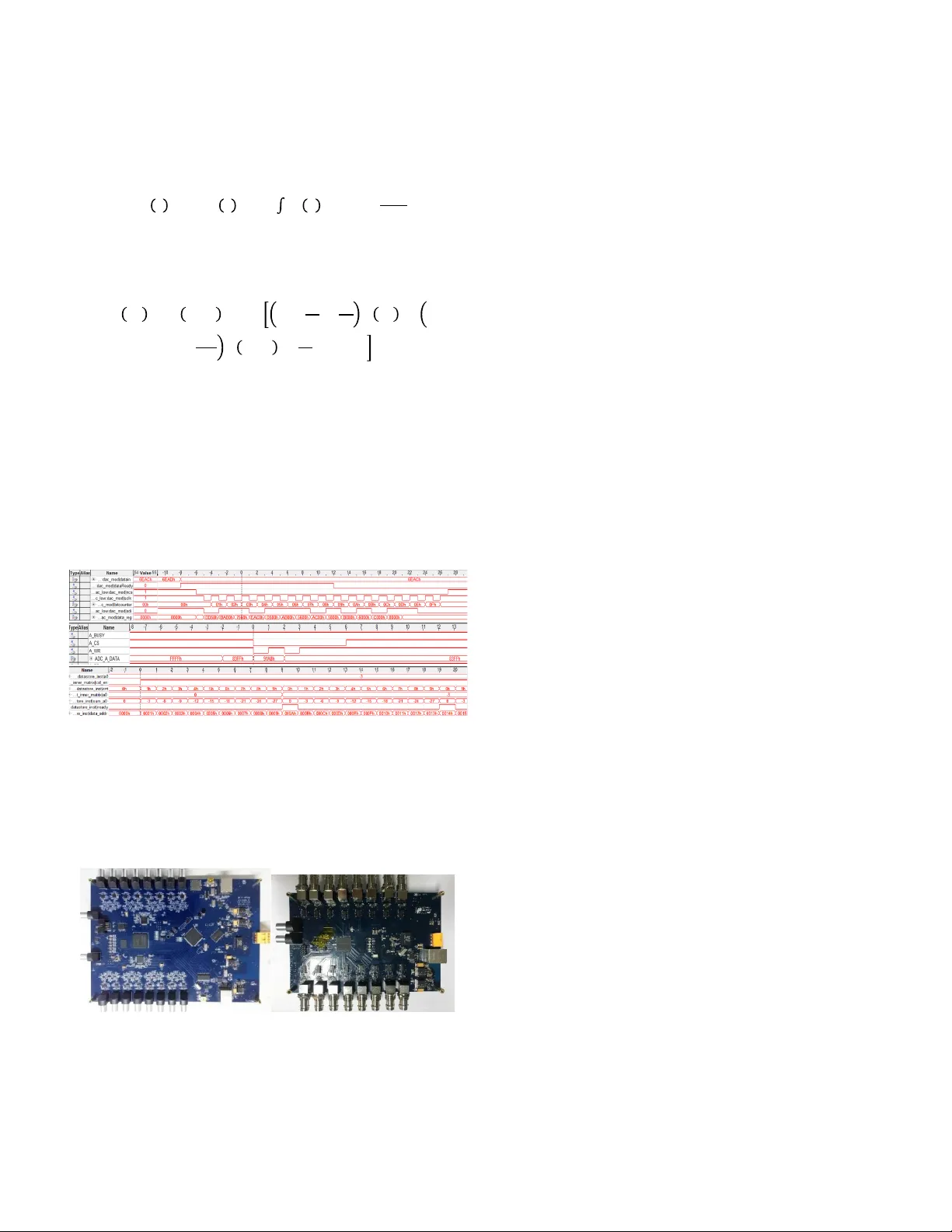
> REPLACE THIS LINE WIT H YOUR PAP ER I DENTI FICA TION NUMBER (DO UBLE - CLICK HERE TO EDI T) < 1 Abstract — KTX (Keda Tours eXperi ment) is a new RFP (reversed field pinch) device at the U niversity of Science and Technology of China. The unique double - C design of the KTX makes modi ficat ions and invest igati ons of powe r and parti cle control easy, but th e error fiel d of slit zone in the new design should not be neglected. The objective of this paper is t o introduce a new active feedback control system which can change the voltage between the unique double - C stru ctures to make t he to roidal field better. FPGA is the central part of the whole system to control all the process, because it c an manipulate and transmit the data from coils in real time. There are 2 high - sp eed 8 - channels ADC s in the system to convert the analog signa l from 16 Rogow ski coils w hich can detect dy namic eddy current of copper shells nea r the vertical gap. FPGA also control the external power amplifier to change the voltage between the unique double - C structures by commanding 16 high - speed D ACs to give the RFP device a feedback. Result indicated that the error field in KTX device was redu ced, and the system could successfully achieve fast matrix calculation with lower delay. Index Terms — feedback control, reversed field pinch, er ror field, KTX , FPGA I. I NTRODUCTION eversed fi eld pinch (RFP) device is a torus f usion device in which plasm a is produced b y external power supply system [1]. KTX (Keda Torus for eXperiment ) is a med ium size RFP (major rad ius R = 1.4 m, minor ra dius a = 0.4 m) [2, 3]. The vacuum vessel and the conducting shell in KTX device are m ounted on a movable platform, so that the two parts of the vacuum vessel can be m oved in opposite directions. This structure, called ‘double - C’, allows the machine to be opened easily without dissembling the poloi dal field windings around. However, the gap s and flanges on the reversed field pinch device can split the stable cop per s hell , w hich will cu t off and change the induced current path and form an error field. T he error f ield can reduce the length of the magnetic field connection, weaken the plasma confinement performance. I n addition, the error field m ay affect the quality of the plasma, reduce the dura tion o f the disc harge, and even directly cause “ mode - loc k". Due to Resonant F ield Amplif icat ion(R FA) , t he This work was support ed Universit y of Scie nce and Tec hnology of China Tianbo. Xu is with State Key Laboratory of Particle Detection and Electronics, Departmen t of Modern Physics, Univ ersity of Science and Technology of China, Hefei, China, 230026, (e - mail:xtb305@mail .ustc.edu .cn) . Kezhu. Song is wi th S tate Key Laboratory of Particl e Det ection and Electronics, Departmen t of Modern Physics, University of Science and Technology of China, Hefei, Chin a, 230026, (e - mail: skz@ustc.edu.cn,) . error field can also influence plasma stability more significantly in some special situation . [4] According to the simulati on, the error field of the vertical gap may lead to around one degree declination of signal - to - noise ratio, which cannot be tolerated. [5 ] In thi s article, a feedback control system to solve the error field problem is presented. It is extremely important to b uild up a feedback system for this new fusion device. The main part of the system is two different boards w ith their ind ependen t function m odu les. S ample module is used to acqu ire and to manipul ate th e data from Rogowski coils around the gap. Through the FPGA on the sample module, the module can do some complicated matrix algorithm includ ing PID co ntrol. After the calcu lati on of data , the sample module transmit s the result to the coil control module. Coil control modu le ge ts the data from sample module and gives a feedback signal to the active error field control power amplifier. FP GA is the core of both module, which can make a complicated matrix cal culation and control the whole module. Junfeng. Yang is with State Key Laboratory of Particle Detection and Electronics, Departmen t of Modern Physics, University of Science and Technology of China, Hefei, China, 230026, (e - mail: yangjf @ustc.edu .cn,). Tianbo Xu, Kezhu Song, Junfeng Yang The Electronics Design of Error Field Feedback Control System in KTX R Fig. 1 . Th e ‘d ou ble - C’ structu re > REPLACE THIS LINE WIT H YOUR PAP ER I DENTI FICA TION NUMBER (DOUB LE - CLICK HERE TO EDIT) < 2 II. H ARDWARE STRUCTURE OF SYSTEM A. KTX fusion de vice Accordi n g to the structure of the KTX , Rogow ski coils and power amplifiers have a long distance. A long - distance analog transmissio n can create a large a mount of noise , so the whole system has to be divided into two p arts to reduce the path of analog transmission. In the m eanwhile, two different parts can make t he p roces s mor e una mbiguo us, which is necess ary for the whole progr am. The system is composed of two differen t modules: the sample module and the coil con trol module. Samp le. The main structure of the error field feed back system is shown in figu re 2 B. SAM PLE MODULE The main task of the sample m odule is data sampli ng and data processing. Figure 3 shows the structure of the sample module. Accordi ng to the parame ter ment ioned , ADS8528 is a proper choice to fulfi ll the target . The ADS8528 contains eight low - power 16 - bit, successive approximati on register (SAR) based analog - to - digital converters (ADC s ) with true bipolar inputs. FPGA uses these high - speed ADCs to get the current signals which from 16 Rogow ski coils. D ue to the faintness of current si gnal, t he analog signal will go through two - stage amplifiers to m ake it fulfill the measuring range of AD Cs. Then FPGA would do some complicated matrix algorithm includi ng PID control. The RS - 485 is the prot ocol of transmission between two boards, which connects sample m odule with coil control module. RS - 485 is intended to 40Mbps, and it is convenient to set up. There i s also DDR2 and network interface in the samp le module to store and v erify the data f rom coils. C. COIL CONTROL MODULE In the coil control mod ule, FPGA g ets the processed data from RS - 485 interface. Network Interfa ce provides anothe r option for re c eiving data and gives the data back to the computer to record initial data. DAC8831 - EP is the DAC us ed in this mod ule. It features 1 6 - bit resolution and a standard high - speed (clock up to 50 MHz) SP I serial interface to communicate with FPGA, which assures high speed and proper accuracy of feedback signal . With the hel p of operational ampli fier, DAC is abl e to generate analog signal whose range is from - 5V to +5V. III. S YSTEM A RCHITECTURE There are tw o essen tial algo rithms in sample mo dule. One is mutual inductance correction , the other is PID co ntroller. It is obv ious th at the mutu al ind uctance matrix only h as thre e different parameters. So when F PGA gets a 12 - bit data from one path, the data will go through two different multiplier s which have signe d coeffic ient. After sampli ng and calculat ing of all data from 16 pa ths in a period, FPG A will do the addit ion algorithm based on the matrix m ultiplication rules. Then the PID c ontroller gets the data from mutual inductance correction. Ac cording to the discrete im plementation of PID controller, it has their adjustable parameters and three multipliers. The adjustable parameters w ill be clarified through the fundam ental test. A. Ind uctance correction The new des i gned feedback cont rol syste m is used in t he KTX tor oidal fi eld which had s ome di ffer ences fro m othe r fusion device. There are 16 Rogowski c oils a round th e gap from each side. A nd power am plifiers are installed in a powe r room. Accord ing to the simulation, the sig nal from Rogow ski co ils is a bipolar s ignal. The m utual induc tance betw een two coils should not be ignored. The mutual inductance function is: ! "#$ % &'( ) *&! +, ) - . / & 0 1 2 (1) ! "#$ , ! +, are the voltage of the input and output. And 3 is the reciproc al of ampl ification fa ctor of power amplifier. 0 1 & 456 &- . .are adjustab le paramete rs. ( is th e mutual inductance matri x, whi ch i s mea sured : M= 789 :; :<= 7; 9 > 9 :< = 7; :; :; 789 : ; :<= 7; ? 9 9 :< = 7; :<= 7; :; 789 : ; > 9 9 9 9 :< = 7; :; 789 > 9 9 9 @ @ @ @ > @ @ @ 9 9 9 9 > 789 : ; :<= 7; :<= 7; 9 9 9 > :; 789 : ; :; :<= 7; 9 9 >: <= 7; :; 789 AB The feature s above was the main reference of the feedback control system. These indispensable parameters were used as initialization pa rameters. B. Discrete PID co ntrol ler A PI D (prop orti onal – integral – derivative) c ontroller is a l oop feedback m echanism widely used in industrial control systems Fig .2 . the Simp li f ied A rch it ec tu re of th e f ee d ba c k s y ste m Ffi Fig. 3. t he Sim pl ifie d St ru ctu re o f Sa mp le Mo du le Fig. 4 . th e Simpli fied S truct ure of Coil Con trol Mod u le > REPLACE THIS LINE WIT H YOUR PAP ER I DENTI FICA TION NUMBER (DOUB LE - CLICK HERE TO EDIT) < 3 and a variety of other applicat ions. This algori thm continuously calculated an error value e(t) as the difference betw een a set point and a measured process variable and applied a correct ion based on three different terms (denoted P, I, and D respectively) whi ch gave the controll er its name [6 ]. Th e control functio n can be expressed mathemati cally as C D % & E F G D / & E H G I 6I / & E J JK *L 2 JL L 1 (2) Kp is the propor tiona l gain , Ki is t he inte g ral gain, K d is the derivative gai n. Approxi matio n wit h a sampli ng t ime △ t for the integra l part and derivative part can be repl aced as & C D M % C D M N O / E P < / QL $ R / $ S QL G D M / :< : T$ S QL G D M N O / $ S QL G *D M N T 2 !!!!!!!!!!!!!!!!!!!! (3) ! U + % E F VE + ,! U J % & E J VE F ! IV. TEST RESULT ALTERA Cyclone V is the core of both module s. ALTERA provides a debugging tool called SignalTap II that can be used to capture a nd display signals in re al time in F PGA d esign. Using SignalTap II can show the status of compone nt and so lve problem easil y. The Figure 6 show s the S ignalTap i i waveform of the DAC, the AD C an d the data transmission betw een th e two board s. The sam ple clock fo r the SignalT ap II is 20M Hz. From the figure, it can be concluded that both boards can work normall y. The system can sample the anal og signal and transmit a prope r feedback signa l to the power amp lifier to reduce the error field of vertical gap . The figure below is the photograph of both boards, and the still some need to be done soon. V. CONCLUSION This work focus on designi ng a f eedback s ystem to reduce the error field o f vertical gap . FPGA is the core of th e whole system. FPGA not only gathers and transm its data from rogovski coils, but also fu lfill the calculation of two different algorithms in real time. T he division of work is c lear for both modules . Re sult s in dicat ed t hat this syst em could s ucces sfull y realize mutual induc tance correction and PID controller in real time. RE FERENCE S [1] F. Gnesotto, P . Sonato, W . R. Baker, A . Doria , F . Elio, M . Fauri, P . Fiore ntin, G . Mar chi ori , G . Zoll ino,“The plasma system of RFX ”, Fusion Engine ering a nd Design 25 (1995) 335 - 372 [2] Wei Yo u, Hong Li, Min gsheng Tan , Min gjian Lu, Y anqi Wu, Wenz he M ao, Wei Bai , C ui Tu, Bing Lu o, Zichao Li, Yolbar sop Ad il , Jinto ng Hu, Yuntao Songb,Qingxi Yan, Ping Zhang, Ji nlin Xie, Tao Lan, Adi Liu, Weixing Din g , Chijin Xiao, W andong Liu “Design of a stab ili zing shell for KTX ” , Fusion Engi neering and Desi gn 108 (2016) 28 – 34 [3] ZHAN G Yong, X IAO B ingjia, Y UAN Q iping, ZH ANG Ruirui, YANG Fei , LI Shi, LI Hong, LIU Ahd i, LI U Wando ng, “Th e Desig n o f t he Pla sma Control Syste m i n KTX”, Pl asma Scie nce and Technology , Vol.17 ,No.4 ,Apr, 2015 [4] Teruo Tamano, Wayne D. Bard , Cheng Chu, Yoshiomi Kondoh, Rober t J La Haye, Paul S . Lee, Mil ton Saito, Micha e13. Sc haAer, and Pet er L. Taylor , “ Obser vati on of a New Tor oi dally Localize d Kink Mode and Its Role in Reverse - Fiel d — Pinch Plasmas ”, Ph ysics Re view Let ters 59 (1987) 13 [5]Chenguan g Li, Wandon g Liu, Hong Li, “ Sim ulation and design of feedback control on res istive wall modes in Keda To rus eXperimen t ” P hysics of P lasmas 21, 122506 (2014) [6 ] Karl J. Astr öm, Tore Häg glund “ PID Cont rollers : Theory, Design , and Tuni ng, Second Edit ion ” Figu re .5 Sign alTap II test result (a) !!!!!!!!!!!!!!!!!!!!!! !!!!!!!!!!!!!!!!!! !!!!! (b ) ! F igu re .6. th e p ho tog raph o f bo th bo ard s (a) Sam p le mo d ul e b o ard (b )c oi l co n tro l m o du le bo ard
Original Paper
Loading high-quality paper...
Comments & Academic Discussion
Loading comments...
Leave a Comment