Network-Connected UAV Communications: Potentials and Challenges
This article explores the use of network-connected unmanned aerial vehicle (UAV) communications as a compelling solution to achieve high-rate information transmission and support ultra-reliable UAV remote command and control. We first discuss the use…
Authors: Haichao Wang, Jinlong Wang, Jin Chen
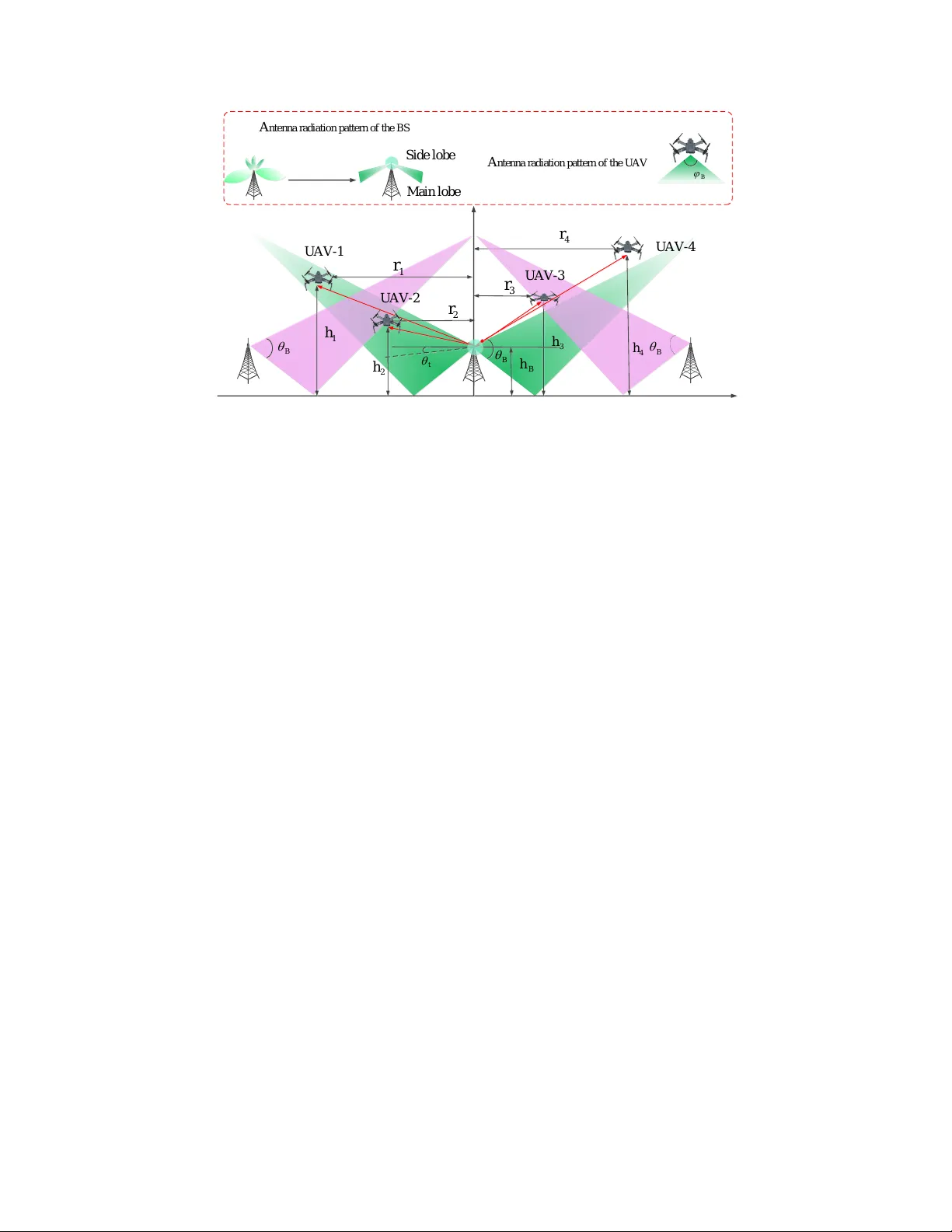
1 Network-Connected U A V Communications: Potentials and Challenges Haichao W ang, Jinlong W ang, Jin Chen, Y uping Gong, and Guoru Ding Abstract This article explores the use of network-connected unmanned aerial vehicle (U A V) communications as a compelling solution to achiev e high-rate information transmission and support ultra-reliable U A V remote command and control. W e first discuss the use cases of U A Vs and the resulting communication re- quirements, accompanied with a flexible architecture for network-connected U A V communications. Then, the signal transmission and interference characteristics are theoretically analyzed, and subsequently we highlight the design and optimization considerations, including antenna design, nonorthogonal multiple access communications, as well as network selection and association optimization. Finally , case studies are provided to show the feasibility of network-connected UA V communications. I . I N T RO D U C T I O N The dramatically gro wing demand for high-rate and ubiquitous wireless communication ser- vices has impelled the unmanned aerial vehicle (U A V) communications to be an activ e research area recently [1]–[5]. Benefiting from the high maneuv erability , the U A V can be quickly deplo yed to provide wireless services for some hotspots and in case of terrestrial base station (BS) failure. Besides, the fle xible location provides additional performance gains compared with fixed infrastructure based communications [6], [7]. Ho wev er , these advantages also suf fer from many challenges. In particular , e xisting U A V communication systems are mainly based on the This w ork has been accepted by China Communications. This work is supported by the National Natural Science Foundation of China (Grant No. 61501510), Natural Science Foundation of Jiangsu Province (Grant No. BK20150717), China Postdoctoral Science Funded Project, and Jiangsu Planned Projects for Postdoctoral Research Funds. The authors are with College of Communications Engineering, Army Engineering University of PLA, Nanjing 210007, China. G. Ding is also with National Mobile Communications Research Laboratory , Southeast Uni versity , Nanjing 210096, China (e- mail: dr .guoru.ding@ieee.org). 2 direct ground-to-U A V communications ov er the unlicensed spectrum or reuse the spectrum bands that ha ve been assigned for other particular applications [1], which results in limited data rate, unreliable connections, and insecure communications. In this conte xt, one challenging task is to establish high-rate and reliable communication links with U A Vs. Network-connected U A V communications, where UA Vs are connected to the terrestrial cel- lular and satellite networks, have receiv ed increasing research attention since today’ s cellular and satellite networks are almost ubiquitous accessibility worldwide [8]–[13]. Authors in [8] in vestig ate a joint time-frequency scheduling and power optimization, where multiple U A Vs are controlled by a terrestrial BS. In [9], to maintain reliable wireless connection with the cellular network by associating with one of the ground BSs, the U A V’ s trajectory optimization is studied. Additionally , the feasibility of using the existing cellular infrastructure for supporting U A V communications is analyzed in [10], [11]. Other studies include radio channel modeling for U A V communications over cellular networks [12], U A V -aided cellular offloading [13], to name just a fe w . The network-connected U A V communications, which are expected to achieve high-rate in- formation transmission and ultra-reliable U A V remote control, are of great importance b ut largely unexplored. This article aims to elaborate the design aspects and open issues in network- connected U A V communications. In particular, we first discuss the use cases of U A Vs and the resulting communication requirements. Then, we propose a flexible architecture for network- connected U A V communications. Further , the signal transmission and interference characteristics are theoretically analyzed, and subsequently we highlight the design and optimization consider- ations, including antenna design, nonorthogonal multiple access (NOMA) communications, as well as network selection and association optimization. Moreov er , case studies are provided to sho w the feasibility of network-connected U A V communications. I I . R E Q U I R E M E N T S A N D A R C H I T E C T U R E A. Use Cases and Requir ements U A Vs, also known as “drones”, vary significantly in size from small toys to large military aircrafts [14]. In this article, the focus is on the small U A Vs. As shown in Fig. 1, according to their use cases, U A Vs can be categorized into three groups: i) consumer U A Vs, where U A Vs are used mainly by individuals. A representativ e example is for aerial photography; ii) industrial U A Vs, where U A Vs are employed by enterprises or org anizations to perform specific tasks, such as 3 U A V s R e l i a b i l i t y A v a i l a b i l i t y D e l a y A c c u r a c y S e c u r i t y S i z e W e i g h t S p e e d E n d u r a n c e M o b i l i t y E n e r g y e f f i c i e n t L o a d H a r d w a r e S o f t w a r e P r e c i s i o n a g r i c u l t u r e A e r i a l p h o t o g r a p h y I n d u s t r i a l U A V s V o i l e n t U A V s C o n s u m e r U A V s M i l i t a r y C a r g o d e l i v e r y K e y R e q u i r e m e n t s S u p p o r t s M a s s i v e a c c e s s R e m o t e c o n t r o l M u l t i - U A V i n t e r c o n n e c t i o n … … Fig. 1: The key requirements for supporting various U A V use cases. cargo deli very , disaster relief, precision agriculture, engineering inspections, and communication relaying [15], to name a few; iii) v oilent U A Vs, where U A Vs are designed for police operations and military affairs. The myriad of possible scenarios in which the U A V plays an important role necessitates the dev elopment of U A V communications. In order to enable massi ve U A Vs to orderly flight in the sk y , the following ke y requirements must be satisfied. • Remote contr ol , where U A Vs can be commanded and controlled by remote users without the limitions of line-of-sight (LOS) operation range. In practice, it is not guaranteed that the U A V is always within the LOS range when performing any missions, such as cargo deli very . Achie ving remote command and control is the key to efficiently fulfill various tasks. • Massive access, where massiv e U A Vs are expected to access the network and be controlled simultaneously . It is predicted that more than 7 million consumer U A Vs will operate across Europe in 2050 [16]. Therefore, massiv e access for U A Vs must be supported, which is the foundation of U A V systems’ running. • Multi-U A V interconnection , where multiple U A Vs can exchange information by directly point-to-point communications or information relaying, so as to inform other U A Vs about their or network current status. When multiple U A Vs fly in the sky , they must plan their 4 C o r e n e t w o r k T y p e I T y p e I I S m a l l B S S m a l l B S S a t e l l i t e A e r i a l a c c e s s p o i n t M o b i l e r e l a y M a c r o B S Fig. 2: The networking architecture for network-connected U A V communications. trajectories in real time to a void collisions. In this process, one of extremely important issues is information exchange. Multi-U A V interconnection is the guarantee of realizing information exchange. T o support these stringent requirements, specific metrics are e xpected to be achie ved, as illustrated in Fig. 1. From the softw are perspecti ve, high data rate, lo w delay , high security , etc., should be considered. Meanwhile, the hardware techniques are required to be greatly dev eloped, such as high load, small size, and long endurance. B. Networking Ar c hitectur e Satisfying the aforementioned requirements is challenging due to the highly dynamic topology , the high speed of the U A V , and heterogeneous quality of service (QoS) requirements (e.g., the asymmetric QoS requirements for do wnlink and uplink communications). An adequate choice is inte grating U A Vs into the cellular (or long term e volution) and satellite networks to establish a reliable wireless connecti vity for U A V applications, also termed as network- connected U A V communications. In this paper , our focus is on the cellular netw ork-connected U A V communications. T o achie ve remote control, massi ve access and multi-U A V interconnection, the proposed networking architecture is shown in Fig. 2. First of all, there are two forms of communications for U A Vs to access the network. One is that each U A V directly communicates with the BS, i.e., type I in Fig. 2. The other is that the U A V is connected to the network through the aerial relays, i.e., type II in Fig. 2, where some U A Vs act as gate ways that perform direct 5 U A V -to-ground (ground-to-U A V) communications. Moreover , the networking architecture sho ws significant heterogeneity since the access points can be either macrocell BSs or smallcell BSs. The types of U A Vs are also div erse. As can be seen from Fig. 2, the key requirements can be ef fectiv ely achie ved by implementing network-connected U A V communications. Firstly , there are a lar ge number of BSs, especially in which ultra dense networks are deployed. These BSs can provide netw ork connections for massi ve U A Vs while serving ground users. Therefore, massi ve access for U A Vs can be sup- ported. Moreov er , ubiquitous BSs can be interconnected through the core network or other interfaces. This means that via accessing the network, a user can command and control a network- connected UA V that is far away from the user . This is no longer the traditional direct ground (or U A V)-to-U A V communications. It’ s the ground (or U A V)-to-network-to-U A V communications. Additionally , multiple U A Vs can also be interconnected effecti vely by two forms of commu- nications: U A V -to-U A V and U A V -to-network-to-U A V . The best strategy in choosing different models depends on man y factors, such as the locations of U A Vs, a vailable spectrum, on-board energy , and communication requirements, etc. For e xample, if there is spectrum a v ailable and the communication link between two U A Vs is of good quality , U A Vs can communicate directly without the assistance of network. When the U A V’ s transmit po wer is lo w due to lack of energy , the U A V can select nearby U A Vs or terrestrial networks to forward the information. The terrestrial communications in return can be empo wered by employing U A Vs. As an aerial access point, U A V can provide network access for ground users. As a mobile relay , the U A V can forward information among users without reliable direct links. Compared with traditional communications based on fixed infrastructure, U A V -assisted communications can achie ve additional performance gains by dynamically adjusting its locations [1], [3], [7]. At present, the U A Vs mainly can be classified two groups: tethered and untethered U A Vs. A tethered U A V is connected by a cable/wire with the ground control platform, thus it has stable po wer supply . In this case, U A Vs can work without interruption. On the other hand, the untethered U A V must rely on its on-board energy . The U A V must return for charging when insufficient energy is warned. Since there are multiple UA Vs, the system can successfully run if one of U A Vs runs out of power because it can be substituted by others. The de velopment of U A V communications relies hea vily on the advances in hardware technology . Because of the hardware limitations, U A Vs may not effecti vely e xert their performance in some harsh en vironments, such as strong winds and hail. Therefore, the terrestrial communication is an indispensable means. 6 I I I . S I G N A L T R A N S M I S S I O N A N D I N T E R F E R E N C E C H A R A C T E R I S T I C S The communication links in network-connected U A V communications consist of three kinds of channels: Ground-to-U A V , U A V -to-ground and U A V -to-U A V channels. All these channels sho w sev eral characteristics compared with the terrestrial communication channels. The U A V - to-ground and U A V -to-U A V channels have been discussed and studied in [1], [14]. The focus of this article is on the ground-to-U A V channel and associated signal transmission characteristics, based on which we will analyze the interference characteristics. A. Signal T ransmission Characteristics For an aerial U A V , the recei ved signal power is p r = p t g t g r g c with the transmit power p t , transmit antenna gain g t , receiv e antenna gain g r , and channel power gain g c between the ground BS and the U A V . The ground-to-U A V channel g c can be modeled by the LOS and non-line- of-sight (NLOS) links separately along with their probabilities of occurrence [10], [11], i.e., g c = P L G L d − α L + (1 − P L ) G N d − α N , where P L is probability of having LOS link, G L and G N are constants representing the path losses at the reference distance d 0 , α L and α N are the path loss exponents for the LOS and NLOS links, and d is the distance between the BS to the U A V . The probability of having LOS link between a BS with height h B S and a U A V with height h U A V is giv en by [10] P L = m Y n =0 1 − exp − h h B S − ( n +0 . 5)( h B S − h U AV ) m +1 i 2 2 c 2 , (1) where m = j r √ ab 1000 − 1 k , r is the horizontal distance between the BS and the U A V , a , b and c are parameters that characterize the en vironment. It can be seen from (1) that the probability not only relates to the en vironment, but also depends on the heights and horizontal distance of the U A V and BS. Increasing the U A V’ s height may acquire higher LOS probability . The LOS probability approaches 1 with sufficiently high altitude. On the other hand, this ine vitably results in more serious path loss since the distance becomes lar ger . The receiv ed po wer also relies on the antenna radiation patterns of BSs and the U A V , which results in dif ferent transmit antenna gains g t and recei ve antenna gains g r . W ithout loss of generality , consider that the antenna of the U A V is directional pointing directly do wnwards, and hence the antenna has a beamwidth of ϕ B , as shown in Fig. 3. It can be seen that the antenna is undirectional in the case of ϕ B = 180 o . Giv en the beamwidth, the recei ve antenna gain is about 7 3 h 2 r B h B t B 4 h 2 h 1 h 3 r 4 r B 1 r A n t e n n a r a d i a t i o n p a t t e r n o f t h e B S B A n t e n n a r a d i a t i o n p a t t e r n o f t h e U A V S i d e l o b e M a i n l o b e U A V - 1 U A V - 2 U A V - 3 U A V - 4 Fig. 3: Illustrations of the BS’ s antenna and interference cases. g r = 29000/ ϕ B 2 . Moreo ver , to recei ve the information signal from the BS, the horizontal distance r must satisfy r ≤ ( h U AV − h B S ) tan ( ϕ B /2) or written as r /( h U AV − h B S ) ≤ tan ( ϕ B /2) if h U AV > h B S and r /( h U AV − h B S ) > tan ( ϕ B /2) if h U AV < h B S , which indeed imposes restrictions on the U A V’ s locations with a gi ven BS’ s location. Generally speaking, the antenna gain of the BS is not isomorphic in the three-dimensional space. The antenna of the BS is ominidirectional in horizon while the v ertical antenna pattern of the BS is directional [10], [11]. The vertical antenna beamwidth and do wn-tilt angle of the BS are giv en as θ B and θ t , respectiv ely , as sho wn in Fig. 3. It can be observed that a U A V is served by either main lobe or side lobe of the antenna. The main lobe and side lobe gains of the antenna are denoted by g m and g s , respectiv ely . Then, we hav e g t = g m , r ∈ { r | h B S − r tan ( θ t + θ B /2) < h U AV < h B S − r tan ( θ t − θ B /2) } , g s , otherwise . (2) T ypically , the main lobe gain is much higher than the side lobe, i.e., g m g s . There are se veral dif ferences between the ground-to-U A V channel and U A V -to-ground channel, one of which results from the antenna radiation patterns of BSs and ground users. The ground users generally emplo y omnidirectional antennas due to hardware constraints. There is no obvious gap between the spatial signals from dif ferent directions. The BSs can support complex hardware setups, and thus the antenna is ominidirectional in horizon and directional in vertical, which causes main lobe and side lobe. When the U A V is served by a BS (as an aerial user experienced 8 the ground-to-U A V channel), it needs to distinguish the main lobe and the side lobe. In addition to the difference of antenna radiation patterns, as BSs are usually higher than terrestrial users, there are fe wer obstacles between the BS and U A Vs. Therefore, the probability of having LOS links in ground-to-U A V channel is greater . B. Interfer ence Char acteristics It can be seen from (1) and (2) that the receiv ed signal power of a U A V is tightly related to its location. The interference experienced by the U A V generally is more serious and complex than a ground node due to the signal transmission characteristics. In particular , the probability of having LOS interference link for the U A V is lar ger than a ground node since there are fewer obstacles in the sky . Because of the tremendous LOS interference, the number of BSs inducing interference to the U A V is also more. Therefore, the experienced interference will be more serious compared with ground nodes. According to the antenna characteristic of the BS, the interference can be classified into two types: Main lobe interference (e.g., U A V -2 and 3 in Fig. 3) and side lobe interference (e.g., U A V -1 and 4 in Fig. 3). It can be observed from Fig. 3 that a U A V (i.e., U A V -3 in Fig. 3) served by side lobe of a nearby BS is more lik ely to recei ve the main lobe interference from the remote BSs. In practice, it is desired that the U A V is served by the main lobe while interfered by side lobe. I V . D E S I G N A N D O P T I M I Z A T I O N C O N S I D E R A T I O N S This section focuses on the design and optimization considerations specifically for network- connected U A V communications, including antenna design, NOMA communications, as well as network selection and association optimization. A. Antenna Design Kno wn from the analysis in section III, the antenna radiation pattern of the BS is a crucial factor that influences the system performance. The existing antennas of BSs are primarily designed to serve the terrestrial users, or some users with a relati vely lo w altitude. Consequently , the angle of the antenna is inevitably downw ard. Howe ver , the U A V may be higher than the BS, which results in significant antenna gain reductions for the U A V . The antenna design must take into account both the ground user and the aerial U A V , whereas it is usually difficult to serve them both ef ficiently and fairly . 9 Antenna altitude: The receiv ed signal strength is closely related to the distance between the U A V and the BS, where the antenna altitude is a vital factor . Because it not only plays a primary role in the probability of having LOS link, b ut also determines the large-scale path loss. There are many factors to be considered in optimizing the antenna altitude, such as the height of the UA V . On one hand, U A Vs are served better with high altitude. Ho we ver , high altitude will cause great large-scale path loss to the ground users. Since the BS initially and mainly serves the terrestrial users, the antenna altitude must be designed considering the requirements of terrestrial users. Antenna beamwidth: The coverage of the BS, to a large extent, relies on the antenna beamwidth, i.e., the main lobe. Increasing the antenna beamwidth can enlarge the cov erage, b ut this would reduce the antenna gain of the main lobe. Moreov er , the antenna beamwidth also determines the type of interference. Although the coverage can be enhanced with larger antenna beamwidth, the U A V would e xperience more sev ere interference from main lobe. Antenna downtile: Antenna do wntile indicates the direction of antenna propagation. Similar with the antenna beamwidth, it also has a vital impact on the cov erage and interference. Besides the antenna of the BS, the antenna of the U A V should also be carefully designed. Specifically , the directional antenna of the U A V is also a factor that can be used to improve the system performance. For example, we can reduce the beamwidth to mitigate the receiv ed interference. B. NOMA for Network-Connected U A V Communications Although there are many challenges produced by the antenna characteristics of the BS, some opportunities can also be founded. One of them is the application of the promising multi-user access scheme, nonorthogonal multiple access (NOMA) with successi ve interference cancellation (SIC) [17]. Unlike traditional orthogonal multiple access (OMA) schemes that multiple users occupy orthogonal resource, such as time division multiple access (TDMA) and orthogonal frequency di vision multiple access (OFDMA), multiple users in NOMA technique can be assigned to the same frequency-time resource so as to impro ve the spectrum ef ficiency . Before decoding their own information, the users with better channel conditions first employ SIC technique to remo ve the information intended for other users in NOMA [18]. The basis of NOMA implementation relies on the difference of channel conditions among users. This dif ference is more remarkable in the three dimensional space for the network-connected U A V communications. For example, two nearby U A Vs may be within the coverage of the main lobe and side lobe, 10 respecti vely . Therefore, the channel conditions are distinctly different. Since NOMA technique enables multiple U A Vs to access the same time-frequency resource block simultaneously , it adv ances the realization of massi ve access. C. Network Selection and Association Optimization Multi-BS co verage provides additional opportunities for netw ork-connected U A V communi- cations, but also with challenges. Specifically , a U A V can be served by a nearby BS and may also be in the coverage of multiple distant BSs. The U A V can simply choose the nearest BS to access network. It can also compare the recei ved signal strength, and further select the BS that provides the strongest signal. This raises the network selection and U A V association issues that usually in volv e discrete variables. It is particularly dif ficult to be addressed considering that there are massi ve U A Vs, where the computational complexity will increase exponentially with the number of U A Vs. Moreover , in order to achie ve better performance, both of them are usually jointly optimized with other issues, such as po wer allocation. In the network-connected U A V communications, it also in volv es other controllable variables, such as the location and trajectory of the U A V . V . C A S E S T U D Y Under the proposed network-connected U A V communications frame work, many other prob- lems still need to be in vestigated, such as trajectory planning and energy efficienc y . In this section, we study two specific design cases for UA V association and energy ef ficiency optimization. A. Case Study I: Association Methods for Network-Connected U A V Communications Consider a 1000 × 1000 m 2 region, where a U A V is served by the terrestrial BS and in the cov erage of multiple BSs. The transmit power and height of the BS are -6 dBw and 30 m. The path losses at the reference distance d 0 = 1 m are G L = − 32 . 9 dB for the LOS link and G N = − 41 . 1 dB for the NLOS link. The path loss exponents are α L = 2 . 09 and α N = 3 . 75 , respecti vely . The environment parameters a = 0 . 3 , b = 500 , and c = 15 [10], [11]. W ithout other explanations, the beamwidth and downtitlt angle of the BS’ s antenna are θ B = 30 o and θ t = 8 o , respecti vely . The gains of main lobe and side lobe are g m = 10 and g s = 0 . 5 [10], [11]. For the association between the U A V and the BS, two methods are considered: Closest association and 11 0 50 100 150 200 250 300 −15 −10 −5 0 5 10 15 The height of the UAV (m) SINR (dB) Number of BSs = 5, closest association Number of BSs = 5, strongest association Number of BSs = 10, closest association Number of BSs = 10, strongest association (a) The SINR versus the height of the UA V 0 5 10 15 20 25 30 35 40 −40 −35 −30 −25 −20 −15 −10 −5 0 5 10 MSR (dB) SINR (dB) θ t =5 ° , closest association θ t =5 ° , strongest association θ t =8 ° , closest association θ t =8 ° , strongest association (b) The SINR versus the MSR Fig. 4: The SINR v ersus the height of the U A V and the MSR under dif ferent association methods. strongest association. In particular , the U A V is associated with the BS to which it is closest in closest association and from which it receiv es the strongest signal in strongest association. In Fig. 4(a), the signal to interference plus noise ratio (SINR) of the U A V under dif ferent association methods is plotted versus the height of the U A V . W e can find that it is not monotonous for the v ariation tendency between the SINR and the height of the U A V . The whole process can be di vided into three phases. The SINR first decreases as the height increases. This is because the UA V suffers sev ere main lobe interference introduced by other BSs. Moreov er , the number of BSs producing LOS interference to the U A V is also more. Then, as the height continues to increase, the main lobe interference becomes the side lobe interference, which impro ves the SINR. In the third phase, since the U A V is far away from the BS that serves it, the signal recei ved by the U A V is weak ened. Consequently , the SINR decreases in this case. In summary , the height of the U A V has an significant impact on the system performance, which needs to be carefully in vestigated. It can be also observ ed that the achiev ed results by two association methods are not always the same, which means that the BS providing the strongest signal is not always the one that is closest to the U A V . This is due to the reason that the signal received from the main lobe of a distant BS may be stronger than the signal recei ved from the side lobe of a nearby BS. Fig. 4(b) illustrates the SINR versus the main lobe to side lobe ratio (MSR), where the number of BSs is 10 and the height of the U A V h B S = 100 m. It is first observed that the SINR in closest association decreases as the MSR increases. This is due to the fact that the signal po wer receiv ed 12 20 25 30 35 40 45 50 55 60 50 100 150 200 250 300 The speed of the UAV (m/s) Delay (s) Number of nodes = 5 Number of nodes = 10 Number of nodes = 15 (a) Delay 20 25 30 35 40 45 50 55 60 10 20 30 40 50 60 70 80 90 100 110 The speed of the UAV (m/s) Energy efficiency (bps/Joule) Number of nodes = 5 Number of nodes = 10 Number of nodes = 15 (b) Energy efficienc y Fig. 5: The delay and energy ef ficiency versus the speed of the U A V . from the side lobe in closest association becomes smaller compared with the interference from the main lobe. Additionally , small do wntile angle θ t results in lo w SINR with a giv en beamwidth θ B . The reason is that the antennas of the BSs tend to point to the aerial U A V in the case of small downtile angle. Therefore, it causes more serious interference to the U A V . These results imply the necessity of implementing antenna optimization in order to realize the potentials of network-connected U A V communications. B. Case Study II: Ener gy Ef ficiency for Network-Connected U A V Communications Generally speaking, the signal receiv ed by the celledge user is weak, ho wev er , with serious interference, which results in lo w SINR. In this context, a U A V can serve the celledge user to enhance the terrestrial communications [13]. W e consider a U A V flies circularly abov e an area of 1000 m in radius, where ground nodes are equally distributed and communicate with the U A V in a cyclical time-di vision manner [19]. The U A V energy consumption with steady circular flight is gi ven by [20] E ( V ) = T " c 1 + c 2 g 2 r 2 ! V 3 + c 2 V # , (3) where g = 9 . 8 m / s 2 is the gravitational acceleration, c 1 = 9 . 26 ∗ 10 − 4 and c 2 = 2250 are parameters related to the U A V’ s weight, wing area, air density , etc., r is the flight radius, T is the flight time, and V is the U A V’ s speed. The height and transmit power of the U A V are 100 m and 30 dBm. 13 Fig. 5(a) illustrates the delay versus the speed of the U A V . The delay is defined as the longest time that the node is not served. It can be seen that higher speed and/or less number of ground nodes is benefical for reducing the delay . The energy ef ficiency versus the speed of the U A V is sho wn in 5(b), where the noise power is -174 dBm/Hz and the bandwidth is 1 MHz. The energy ef ficiency is defined as the achiev able throughput to consumed energy ratio. Notice that the communication-related energy is ignored since it is much smaller than that used to support the U A V’ s mobility [20]. It can be observed that, unlike delay , the ener gy efficienc y may decrease with an increasing speed. The reason is that the consumed energy dramatically increases with high speed. V I . C O N C L U S I O N S In this article, we studied the use of network-connected U A V communications as a compelling solution to achie ve high-capacity information transmission and ultra-reliable U A V remote com- mand and control. The aim was to elaborate the design aspects and open issues in network- connected U A V communications. In particular , we first discussed the use cases of U A Vs and the associated requirements. Then, we proposed a flexible architecture for network-connected U A V communications. Subsequently , the signal transmission and interference characteristics were theoretically analyzed. Further , we in vestigated the design and optimization considerations, including antenna design, NOMA communications, as well as network selection and association optimization. Finally , case studies were provided to sho w the feasibility of network-connected U A V communications. W e firmly belie ve this important area will be a fruitful research direction, and we have just touched the tip of the iceberg. W e hope this article will stimulate much more research interest. R E F E R E N C E S [1] Y . Zeng, R. Zhang, and T . J. Lim, “Wireless communications with unmanned aerial vehicles: Opportunities and challenges, ” IEEE Communications Magazine , vol. 54, no. 5, pp. 36-42, May 2016. [2] G. Ding, Q. W u, L. Zhang, Y . Lin, T . A. Tsiftsis, and Y . D. Y ao, “ An amateur drone surveillance system based on the cognitiv e Internet of Things, ” IEEE Communications Magazine , vol. 56, no. 1, pp. 29-35, Jan. 2018. [3] H. W ang, G. Ding, F . Gao, J. Chen, J. W ang, and L. W ang, “Po wer control in UA V -supported ultra dense networks: Communications, caching, and energy transfer , ” IEEE Communications Magazine , to be appeared, [Online]. A vailable: https://arxiv .org/abs/1712.05004. [4] M. Mozaf fari, W . Saad, M. Bennis, and M. Debbah, “Unmanned aerial v ehicle with underlaid device-to-device communi- cations: Performance and tradeoffs, ” IEEE T ransaction on W ir eless Communications , vol. 15, no. 6, pp. 3949-3963, Jun. 2016. 14 [5] M. Mozaffari, W . Saad, M. Bennis, and M. Debbah, “W ireless communication using unmanned aerial vehicles (UA Vs): Optimal transport theory for hover time optimization, ” IEEE T ransaction on W ireless Communications , v ol. 16, no. 12, pp. 8052-8066, Dec. 2017. [6] H. W ang, G. Ren, J. Chen, G. Ding, and Y . Y ang, “Unmanned aerial vehicle-aided communications: Joint transmit power and trajectory optimization, ” IEEE W ireless Communications Letters , doi: 10.1109/L WC.2018.2792435. [7] Q. W u, Y . Zeng, and R. Zhang, “Joint trajectory and communication design for multi-UA V enabled wireless networks, ” IEEE T ransaction on W ireless Communications , vol. 17, no. 3, pp. 2109-2121, Mar . 2018. [8] Z. Xue, J. W ang, Q. Shi, G. Ding, and Q. W u, “T ime-frequency scheduling and power optimization for reliable multiple U A V communications, ” IEEE Access , vol. 6, pp. 3992-4005, 2018. [9] S. Zhang, Y . Zeng, and R. Zhang, “Cellular-enabled U A V communication: T rajectory optimization under connecti vity constraint, ” [Online]. A vailable: https://arxiv .org/abs/1710.11619. [10] M. M. Azari, F . Rosas, A. Chiumento, and S. Pollin, “Coexistence of terrestrial and aerial users in cellular networks, ” IEEE Globecom W orkshops (GC Wkshps) , pp. 1-6, Dec. 2017. [11] M. M. Azari, F . Rosas, and S. Pollin, “Reshaping cellular networks for the sky: The major factors and feasibility , ” [Online]. A vailable: https://arxiv .org/abs/1710.11404. [12] R. Amorim, H. Nguyen, P . Mogensen, I. Z. Kov acs, J. W igard, and T . B. Sorensen, “Radio channel modeling for U A V communication over cellular networks, ” IEEE W ir eless Communications Letters , vol. 6, no. 4, pp. 514-517, Aug. 2017. [13] J. L yu, Y . Zeng, and R. Zhang, “U A V -aided cellular offloading: A potential solution to hot-spot issue in 5G, ” [Online]. A vailable: https://arxiv .org/abs/1705.09024. [14] W . Khawaja, I. Guvenc, D. Matolak, U. Fiebig, and N. Schneckenberger , “ A surve y of air-to-ground propagation channel modeling for unmanned aerial vehicles, ” [Online]. A vailable: https://arxiv .org/abs/1801.01656. [15] Y . Zeng, R. Zhang, and T . J. Lim, “Throughput maximization for UA V -enabled mobile relaying systems, ” IEEE T ransactions on Communications , vol. 64, no. 12, pp. 4983-4996, Dec. 2016. [16] SESAR Joint Undertaking (JU), “European Drones Outlook Study , ” 2016. [17] Z. Ding, P . Fan, and H. V . Poor, “Impact of user pairing on 5G nonorthogonal multiple-access downlink transmissions, ” IEEE T ransactions on V ehicular T echnology , vol. 65, no. 8, pp. 6010-6023, Aug. 2016. [18] A. Li, Y . Lan, X. Chen, and H. Jiang, “Non-orthogonal multiple access (NOMA) for future downlink radio access of 5G, ” China Communications, vol. 12, no. Supplement, pp. 28-37, Dec. 2015. [19] J. L yu, Y . Zeng, and R. Zhang, “Cyclical multiple access in U A V -aided communications: A throughput-delay tradeoff, ” IEEE W ireless Communications Letters , vol. 5, no. 6, pp. 600-603, Dec. 2016. [20] Y . Zeng and R. Zhang, “Energy-ef ficient UA V communication with trajectory optimization, ” IEEE T ransactions on W ireless Communications , vol. 16, no. 6, pp. 3747-3760, Jun. 2017.
Original Paper
Loading high-quality paper...
Comments & Academic Discussion
Loading comments...
Leave a Comment