Memristor-based Approximation of Gaussian Filter
A Gaussian filter is a filter with impulse response of Gaussian function. These filters are useful in image processing of 2D signals, as it removes unnecessary noise. Also, they could be helpful for data transmission (e.g. GMSK modulation). In practi…
Authors: Alex Pappachen James, Aidyn Zhambyl, Anju N
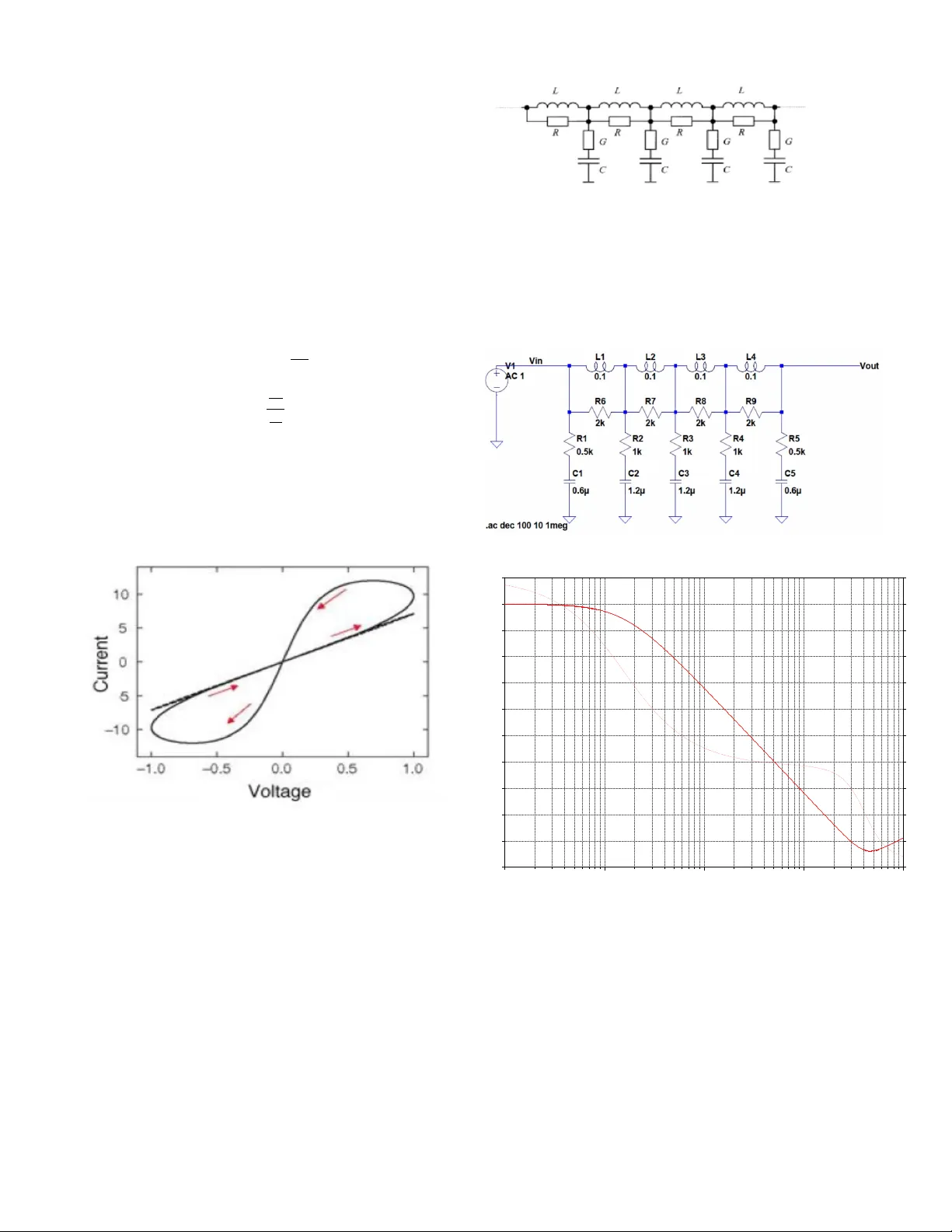
Memristor -based Approximation of Gaussian Filter Alex Pappachen James, Aidyn Zhambyl, Anju Nandakumar Electrical and Computer Engineering department Nazarbayev Uni versity School of Engineering Astana, Kazakhstan Email: alex.james@nu.edu.kz, aidyn.zhambyl@nu.edu.kz, anju.nandakumar@nu.edu.kz Abstract —Gaussian filter is a filter with impulse response of Gaussian function. These filters are useful in image processing of 2D signals, as it remo ves unnecessary noise. Also, they could be helpful for data transmission (e.g . GMSK modulation). In practice, the Gaussian filters could be approximately designed by several methods. One of these methods ar e to construct Gaussian-like filter with the help of memristors and RLC circuits. Theref ore, the objective of this project is to find and design appropriate model of Gaussian-like filter , by using mentioned devices. Finally , one possible model of Gaussian-like filter based on memristor designed and analysed in this paper . Index T erms —Gaussian filters, analog filter , memristor , func- tion approximation I . I N T RO D U C T I O N Gaussian filter in signal processing a filter with impulse response of Gaussian function. This type of filters has no ov ershoots to input of a step function while minimizing fall and rise time. Mathematically this filter applies con volution of input signal with Gaussian function. Gaussian filters used in image processing for two dimensional images and Gauss modulation [1]. These filters widely used to limit the spectral energy which are out of transmission band in digital communications. Therefore, this type of filter is usually implemented in digital domain. Howe ver , they are also used to model analog delays. Thus, Gaussian filters should be implemented in analog domain, which requires faithful approximation of the filter [2]. On the other hand, memristor (memory resistor) electronic device, which is kno wn as the fourth fundamental element after resistor , capacitor and inductor . Its resistance is known as memristance, which is the function of current passing through it and flux. Scientist argue that the use of memristor seems more beneficial, as it consumes less energy , produces less heat, do not consume power when idle and comfortable with CMOS interfaces [ ? ]. T oday , the implementation of memristors to electrical circuits of chips seem highly sensiti ve. The aim of this paper is to design a filter, which operate as Gaussian filter . The filter must be designed via using RLC devices and with the implementation of memristors to the designed circuit. In the second section of this paper backgrounds about Gaussian filter and memristors is going to be provided. The objecti ve of the third section is to find out appropriate model by simulating dif ferent circuits. Then in the fourth section some mathematical analysis will be pro vided to obtained results and finally the paper will be concluded by stating the result of the done work. I I . G AU S S I A N F I L T E R A N D M E M R I S T O R A. Gaussian F ilter Gaussian filter is such filter which con volv es the input signal with the impulse response of Gaussian function. In some sources this process is also known as the W eierstrass transform [2]. The Gaussian function is giv en as in equation 1, where µ is the time shift and σ is the scale. For input signal of x ( t ) the output is the con volution of x ( t ) with Gaussian, as shown in equation 2. f ( x ) = 1 σ √ 2 π exp − ( x − µ ) 2 2 σ 2 (1) Z ∞ −∞ x ( t ) f ( τ − t ) dτ (2) As a signal x ( t ) passes through a system H ( s ) , the impulse response is also H ( s ) . Hence, if this impulse response is a Gaussian function, then transfer function H ( s ) approxi- mates required Gaussian. Authors in the mentioned paper ([2]) mathematically solve for H ( s ) via using the technique known as Lev in 0 s t − tr ansf or m . This method finally gi ves equation 3 for transfer function of a fourth order Gaussian filter . Therefore, by inspecting, proper values for σ and µ could be selected such that H ( s ) approaches Gaussian. H ( s ) = a 3 s 3 + a 2 s 2 + a 1 s + a 0 b 4 s 4 + b 3 s 3 + b 2 s 2 + b 1 s + b 0 (3) B. Memristor Memristor (memory resistor) is an electrical device such as resistor, capacitor and inductor . The units of resistance of memristor is defined in ohms. It is a passiv e circuit element which mathematically could be defined as a relationship of the time integrals of current and voltage across two terminals of this device. Scientists in [5] states that the resistance of memristor change as the direction of current passing through it changes; namely: the resistance increases as the current flows in one direction and decreases as the current flows in opposite direction [10]. Furthermore, it is stated that memristor remembers the current that flo wed before through it. T o define memristance, equations 4-6 could be written. d Φ = M dq (4) φ ( t ) = Z t −∞ v ( τ ) dτ (5) q ( t ) = Z t −∞ i ( τ ) dτ (6) where φ ( t ) is flux linkage, q ( t ) is the amount of electric charge flowed through the memristor , v ( t ) is voltage and i ( t ) is current. Hence, the memristance of the de vice could be defined as shown in equations 7-8. M ( q ) = dφ dq (7) M ( q ( t )) = dφ dt dq dt = R M ( q ) (8) Finally , it could be concluded for memristance (equation 9): v ( t ) = M ( q ( t )) i ( t ) (9) Hence, I-V plot of memristor could be sketched (refer to figure 1). Fig. 1. Current-V oltage characteristics of a memristor (from [5]) In addition, scientists recommend to implement memristors to the design of filters, since they allow to create electronically adjustable filters [9]. I I I . S I M U L A T I O N S A N D M A T H E M A T I C A L A N A L Y S I S A. F irst Appr oach The first step was to find appropriate electrical circuit for a filter with transfer function of Gaussian. Initially , lumped- element ladder-netw ork approximation of the complete Gaus- sian transmission line (refer to figure 2) was considered. This circuit (figure 2) was constructed on Spice (figure 3) and simulated. The v alues for passiv e elements were selected approximately as follows: R 1 = R 5 = 0 . 5 k Ω , R 2 = R 3 = R 4 = 1 k Ω , R 6 = R 7 = R 8 = R 9 = 2 k Ω , Fig. 2. Lumped-element ladder-network approximation of the complete Gaussian transmission line (from [2]) C 1 = C 5 = 0 . 6 µF , C 2 = C 3 = C 4 = 1 . 2 µF , L 1 = L 2 = L 3 = L 4 = 0 . 1 H . The result of the simulation is shown in figure 4. Fig. 3. Constructed on Spice circuit of ladder-network 1Hz 10Hz 100Hz 1KHz 10KHz -400dB -360dB -320dB -280dB -240dB -200dB -160dB -120dB -80dB -40dB 0dB 40dB -1.1K° -1.0K° -0.9K° -0.8K° -0.7K° -0.6K° -0.5K° -0.4K° -0.3K° -0.2K° -0.1K° 0.0K° V(vout) --- D:\University materials\3rd year, Autumn semester\Digital Integrated Circuits\LTSPICE\Draft4.asc --- Fig. 4. Spice simulation of the ladder-network The sketched solid curve in figure 4 is a magnitude response of the designed filter . The behaviour of this curve is close to the behaviour of Gaussian. Howe ver , in this electrical circuit inductors were used [8]. It is recommended [7] to avoid the use of inductors for the design of electrical filters due to size, width, lack of isolation from environment, energy losses and magnetic field issues. Therefore, another design for the filer was considered. As it was mentioned before, the circuit shown in figure 3 was considered as the approximation of Gaussian-like filter . Here, input signal is V in and output signal - V out . The transfer function of the filter could be considered, since it provides an algebraic representation of L TI filter in the fre- quency domain. The formula for transfer function is gi ven as H ( z ) = Y ( z ) /X ( z ) , where Y ( z ) is output, X ( z ) is input and H ( z ) stands for transfer function, which is the z − tr ansf or m of the impulse response h ( n ) . On spice this result could be represented as the ratio of the output v oltage to the input voltage, i.e., V out /V in and the result is shown on figure 4. As can be seen above, the transfer function of the system considered hav e the properties akin to the properties of an ideal Gaussian filter . As it was expected, this filter operates as low-pass filter , since it attenuates high frequencies. The next step, it to find approximate equation for the obtained transfer function. This could be done via Excel, by inserting all data points and plotting. For simple approximation 20 data points in the of the transfer function is going to be considered. The collected data was reported to table 1 belo w . According to T ABLE I R E PO RT E D V A L U E S # Frequency ( H z ) Magnitude ( dB ) 1 10000 0.000 2 20000 0.136 3 40000 0.516 4 100000 2.496 5 174480 3.969 6 236560 2.585 7 297230 0.028 8 397630 -4.200 9 615770 -11.130 10 1000 -20.060 11 2000 -32.010 12 3000 -38.080 13 4000 -41.410 14 5000 -43.640 15 6000 -44.870 16 7000 -45.770 17 8000 -46.340 18 9000 -47.020 19 10000 -48.450 20 15000 -48.460 these data the mathematical equation (equation 10) has been obtained. y = − 9 . 087 ln ( x ) + 38 . 758 (10) In this equation x stands for the frequency and y stands for the magnitude in decibels. Howe ver , this approximation is not quite accurate. As the number of points considered increase, the accuracy of the obtained equation also increases. B. Second Appr oach The electrical circuit designed before was changed to the design, known as an 8-order Sallen-Ke y filter, which is consid- ered as the approximation to Gaussian filter . Then, all resistors were replaced with memristors and the resultant circuit is shown in figure 5. Fig. 5. 8-order memristor-based approximation to Gaussian filter I V . R E S U LT S The magnitude-frequency response of this designed filter is shown in figure 6. Fig. 6. Magnitude-frequency response of an 8-order Gaussian approximation filter The cutoff frequency is f c = 4 . 78 H z and phase shift is − 135 deg . This result satisfies to expected theoretical approaches. Now the transfer function of the filter could be determined according to the equation 3. Hence, the transfer function of this filter is: H ( s ) = 0 . 2 s 3 + 1 . 2 s 2 − 5 s + 40 2 . 9 s 4 + 12 s 3 + 27 . 4 s 2 + 34 s + 19 (11) . V . C O N C L U S I O N In this paper Gaussian analog filter based on memristor was approximated. Firstly , Gaussian-like filter was designed from lumped-element ladder-netw ork. Ho wever , due to the presence of inductors, this design was changed to Sallen-K ey filter design. Finally , an 8-order memristor -based Gaussian filter was designed and its parameters were determined. The advantages of this design are that this circuits does not contain inductors and could be constructed simply with RLC elements. Furthermore, the use of memristors significantly increases the sensitivity of this filter . Nev ertheless, not all aspects of mem- ristors were considered. For instance, since the resistance of a memristor changes according to input voltage, this filter should be simulated at dif ferent inputs. Hence, it is recommended to focus further studies on memristor’ s resistance to input voltage relation and its effect to cutoff frequency , because ability to adjust the cutoff frequency and gain are crucially important. R E F E R E N C E S [1] GUO Jian, ZHU Jie Design of Analog Gaussian F ilter Used in Roughness Measuring Instrument , Jul. 2010. [2] Goutham Makkena; Abhilash K. N.; Sriniv as, M. B.; Gaussian filter appr oximation using Levin’ s transform for implementation in analog domain , Dec. 2013. [3] Roberto Marani, Gennaro Gelao, Anna Gina Perri, A REVIEW ON MEMRISTOR APPLICA TIONS , Polytechnic Univ ersity of Bari, Nov . 2013. [4] Alon Ascoli; T etzlaff, R.; Memristor-based filtering applications , Apr . 2013. [5] T ian Xiao-Bo, Xu Hui, The design and simulation of a titanium oxide memristor-based pro grammable analog filter in a simulation pro gram with integr ated circuit emphasis , Dec. 2012 [6] Xiaoxu W ang, Y an Liang, Quan Pan, Chunhui Zhao, Gaussian filter for nonlinear systems with one-step randomly delayed measur ements , Feb . 2013. [7] Y ulong Huang, Y onggang Zhang, Xiaoxu W ang, Lin Zhao Gaussian filter for nonlinear systems with corr elated noises at the same epoc h , Jul. 2015. [8] Suayb Y aner, Hakan Kuntman A New CMOS Based Memristor Imple- mentation , Sept. 2012. [9] Y ibin Hong; A Memristor-Based Continuous-T ime Digital FIR Filter for Biomedical Signal Processing , May . 2015. [10] Hasan Szen, Uur am; On The Realization of Memristor Based RC High P ass Filter , Nov . 2013. [11] Irmanov a Aidana, and Alex Pappachen James. ”Multi-level Memristive Memory with Resistiv e Networks. ” arXi v preprint (2017) [12] Smagulov a, Kamilya, Olga Krestinskaya, and Alex Pappachen James. ”A memristor-based long short term memory circuit. ” Analog Integrated Circuits and Signal Processing (2018): 1-6.
Original Paper
Loading high-quality paper...
Comments & Academic Discussion
Loading comments...
Leave a Comment