Sensing Hidden Vehicles by Exploiting Multi-Path V2V Transmission
This paper presents a technology of sensing hidden vehicles by exploiting multi-path vehicle-to-vehicle (V2V) communication. This overcomes the limitation of existing RADAR technologies that requires line-of-sight (LoS), thereby enabling more intelli…
Authors: Kaifeng Han, Seung-Woo Ko, Hyukjin Chae
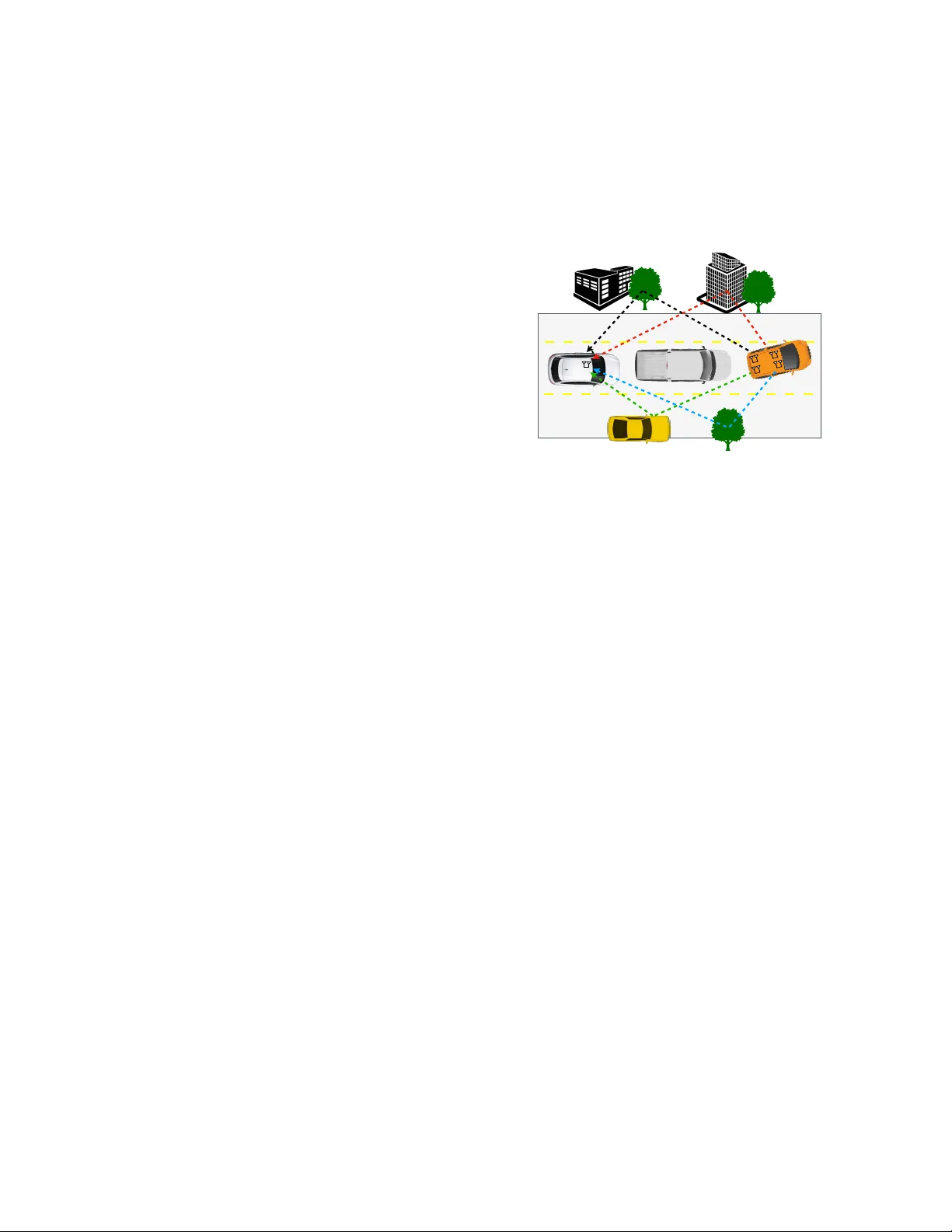
Sensing Hidden V ehicles by Exploiting Multi-P ath V2V T ransmission Kaifeng Han † , Seung-W oo K o † , Hyukjin Chae ‡ , Byoung-Hoon Kim ‡ , and Kaibin Huang † † Dept. of EEE, The Univ ersity of Hong K ong, Hong K ong ‡ LG Electronics, S. K orea Email: huangkb@eee.hku.hk Abstract —This paper presents a technology of sensing hidden vehicles by exploiting multi-path vehicle-to-v ehicle (V2V) com- munication. This over comes the limitation of existing RADAR technologies that requires line-of-sight (LoS), thereby enabling more intelligent manoeuvre in autonomous driving and improv- ing its safety . The proposed technology relies on transmission of orthogonal wa vef orms ov er different antennas at the target (hidden) v ehicle. Ev en without LoS, the resultant recei ved signal enables the sensing vehicle to detect the position, shape, and driving dir ection of the hidden vehicle by jointly analyzing the geometry (AoA/AoD/pr opagation distance) of indi vidual pr opaga- tion path. The accuracy of the proposed technique is validated by realistic simulation including both highway and rural scenarios. I . I N T RO D U C T I O N Autonomous driving (auto-driving) is a disrupti v e technol- ogy that will reduce car accidents, traf fic congestion, and greenhouse gas emissions by automating the transportation process. One primary operation of auto-driving is vehicular positioning , namely positioning nearby vehicles and even de- tecting their shapes [1]. The positioning includes both absolute and relative positioning and we focus on relativ e vehicular positioning in this work. Among others (e.g., cameras and ul- trasonic sensing), two existing technologies, namely RAD AR and LiD AR (Light Detection and Ranging), are capable of accurate vehicular positioning. RAD AR can localize objects as well as estimate their velocities via sending a designed wa veform and analyzing its reflection by the objects. Recent breakthroughs in millimeter-w av e radar [2] or multiple-input multiple-output (MIMO) radar [3] improves the positioning accuracy substaintially . On the other hand, a LiD AR [4] steers ultra-sharp laser beams to scan the surrounding en vironment and generate a high resolution three-dimensional (3D) map for navigation. Howe ver , RADAR and LiDAR share the common drawback that positioning requires the target vehicles to be visible with line-of-sight (LoS) since neither micro wa v e nor laser beams can penetrate a large solid object such as a truck. Furthermore, hostile weather conditions also af fect the effec- tiv eness of LiD AR as fog, sno w or rain can se verely attenuate a laser beam. On the other hand, detecting hidden vehicles with non-line-of-sight (NLoS) is important for intelligent auto- driving (e.g., overtaking) and accidence avoidance in complex scenarios such as Fig. 1. The drawback of existing solutions moti v ates the current work on developing a technology for sensing hidden vehi- cles. It relies on V2V transmission to alle viate the se vere signal attenuation due to round-trip propagation for RAD AR and LiD AR. By designing hidden vehicle sensing, we aim at tackling two main challenges: 1) the lack of LoS and synchronization between sensing and hidden vehicles and 2) Sensing vehicle Hidden vehicle Figure 1: Hidden vehicle scenario with multi-path NLoS channels. simultaneous detection of position, shape, and orientation of driving direction of hidden vehicles. While LiD AR research focuses on mapping, there e xist a rich set of signal processing techniques for positioning using RAD AR [5]. They can be largely separated into two themes. The first is time-based ranging by estimating time-of- arrival (T oA) or time-differ ence-of-arrival (TDoA) [6]. The time-based ranging detects distances but not positions. Most important, the techniques are ef fectiv e only if there exist LoS paths between sensing and target vehicles. The second theme is positioning using multi-antenna arrays via detecting angle-of-arrival (AoA) and angle-of-departur e (AoD) [7]. In addition, there also e xist hybrid designs such as jointly using T oA/AoA/AoD [8]. The techniques make the strong assumption that perfect synchronization between transmitters and recei vers, which limits their versatility in auto-driving. Furthermore, neither time-based ranging nor array-based po- sitioning is capable of additional geometric information on tar- get vehicles such as their shapes and orientation. In summary , prior designs are insufficient for tackling the said challenges which is the objecti v e of the current work. The paper presents a technology for hidden vehicle sensing by exploiting multi-path V2V transmission. The technology requires a hidden vehicle to be provision with an array with antennas distributed as multiple clusters ov er the vehicle body . Furthermore, the v ehicle transmits a set of orthogonal wa veforms over different antennas. Then by analyzing the multi-path signal observed from a receive array , the geometry (AoA/AoD/propagation distance) of indi vidual path is esti- mated at the sensing vehicle. Using optimization theory , novel technique is proposed to infer from the multi-path geometric information the position, shape, and orientation of the hidden vehicles. Comprehensiv e simulation is performed based on practical vehicular channel model including both highway and rural scenarios. Simulation results show the ef fectiv eness of the proposed technology in sensing hidden vehicles. I I . S Y S T E M M O D E L W e consider a tw o-vehicle system where a sensing vehicle (SV) attempts to detect the position, shape, and orientation of a hidden vehicle (HV) blocked by obstacles such as trucks or b uildings (see Fig. 1). F or the task of only detecting the position and orientation (see Section III), it is sufficient for HV to ha ve an array of collocated antennas (with ne gligible half-wa velength spacing). On the other hand, for the task of simultaneous detection of position, shape, and orientation (see Section IV), the antennas at the HV are assumed to be distributed as multiple clusters of collocated antennas over HV body . For simplicity , we consider 4 -cluster arrays with clusters at the vertices of a rectangle. Then sensing reduces to detect the positions and shape of the rectangle, thereby also yields the orientation of HV . The rele v ant technique can be easily extended to a general arrays topology . Last, the SV is provisioned with a 1 -cluster array . A. Multi-P ath NLoS Channel The channel between the SV and HV contains NLoS and multi-paths reflected by a set of scatterers. Following the typical assumption for V2V channels, only the receiv ed signal from paths with single-reflections is considered at the SV while higher order reflections are ne glected due to se vere attenuation [9]. Propagation is assumed to be constrained within the horizontal plane to simplify exposition. Consider a 2D Cartesian coordinate system where the SV array is located at the origin and the X -axis is aligned with the orientation of SV . Consider a typical 1 -cluster array at the HV . Each NLoS signal path from the HV antenna cluster to the SV array is characterized by the following fiv e parameters (see Fig. 2): the AoA at SV denoted by θ ; the AoD at HV denoted by ϕ ; the orientation of the HV denoted by ω ; and the propagation distance denoted by d which includes the propagation distance before refection, denoted by ν , and the remaining distance d − ν . The AoD and AoA are defined as azimuth angles relati ve to driving directions of HV and SV , respecti v ely . B. Hidden V ehicle T ransmission Each of 4 -cluster arrays of HV has M t antennas. The HV is assigned four sets of M t orthogonal wa veforms for transmission. Each set is transmitted using a corresponding antennas cluster where each antenna transmits an orthogonal wa veform. It is assumed that by network coordinated wa ve- form assignment, HV wa veform sets are known at the SV that can hence group the signal paths according their originating antennas clusters arrays. Let s m ( t ) be the continuous-time baseband wa veform assigned to the m -th HV antenna with the bandwidth B s . Then the waveform orthogonality is specified by R s m 1 ( t ) s ∗ m 2 ( t ) dt = δ ( m 1 − m 2 ) with the delta function δ ( x ) = 1 if x = 0 and 0 otherwise. The transmitted wa veform vector for the k -th array of HV antennas cluster is s ( k ) ( t ) = [ s ( k ) 1 ( t ) , · · · , s ( k ) M t ( t )] T . With the kno wledge of { s ( k ) ( t ) } , the SV with M r antennas scans and retrieves the receiv e signal due to the HV transmission. Consider a typical HV antennas cluster array . Based on the far -field propagation model [10] , the cluster response vector is represented as a function of AoD ϕ as a ( ϕ ) = [exp( j 2 π f c α 1 ( ϕ )) , · · · , exp( j 2 π f c α M t ( ϕ ))] T , (1) SV (0 , 0) Scatterer ! X Y AoA AoD Orientation ⌫ d ⌫ ' ✓ SV driving direction HV driving direction HV Figure 2: NLoS signal model. where f c denotes the carrier frequenc y and α m ( ϕ ) refers to the difference in propagation time to the corresponding scatterer between the m -th HV antenna and the 1 -st HV antenna in the same cluster, i.e., α 1 ( ϕ ) = 0 . Similarly , the response vector of SV array is expressed in terms of AoA θ as b ( θ ) = [exp( j 2 πf c β 1 ( θ )) , · · · , exp( j 2 π f c β M r ( θ ))] T , (2) where β m ( θ ) refers to the difference of propagation time from the scatterer to the m -th SV antenna than the 1 -st SV antenna. W e assume that SV has prior knowledge of the response functions a ( ϕ ) and b ( θ ) . This is feasible by standardizing the vehicular arrays’ topology . In addition, the Doppler effect is ignored based on the assumption that the Doppler frequency shift is much smaller than the waveform bandwidth and thus does not affect wa veform orthogonality . Let k with 1 ≤ k ≤ 4 denote the index of HV arrays and P ( k ) denote the number of recei ved paths originating from the k -th antennas cluster array . The total number of paths arriving at SV is P = P 4 k =1 P ( k ) . Represent the receiv ed signal vector at SV as r ( t ) = [ r 1 ( t ) , · · · , r M r ( t )] T . It can be expressed in terms of s ( t ) , a ( ϕ ) and b ( θ ) as r ( t ) = 4 X k =1 P ( k ) X p =1 γ ( k ) p b θ ( k ) p a T ϕ ( k ) p s t − λ ( k ) p + n ( t ) , where γ ( k ) p and λ ( k ) p respectiv ely denote the complex chan- nel coefficient and T oA of path p originating from the k - th HV array , and n ( t ) represents channel noise. Without synchronization between HV and SV , SV has no information of HV’ s transmission timing. Therefore, λ ( k ) p differs from the corresponding propag ation delay , denoted by τ ( k ) p , due unknown clock synchronization gap between HV and SV denoted by Γ . Consequently , τ ( k ) p = λ ( k ) p − Γ . C. Estimations of AoA, AoD, and T oA The sensing techniques in the sequel assume that the SV has the knowledge of AoA, AoD, and T oA of each receiv e NLoS signal path, say path p , denoted by { θ p , ϕ p , λ p } where p ∈ P = { 1 , 2 , · · · , P } . The knowledge can be acquired by applying classical parametric estimation techniques briefly sketched as follows. The estimation procedure comprises the following three steps. 1) Sampling : The received analog signal r ( t ) and the wa veform v ector s ( t ) are sampled at the Nyquist rate 2 B s to gi v e discrete-time signal vectors r [ n ] and s [ n ] , respecti v ely . 2) Matched filtering : The sequence of r [ n ] is matched-filtered using s [ n ] . The resultant M r × M t coefficient matrix y [ z ] is giv en by y [ z ] = P n r [ n ] s ∗ [ n − z ] . The sequence of T oAs { λ p } can be estimated by detecting peaks of the norm of y [ z ] , denoted by { z p } , which can be con verted into time by multiplying the time resolution 1 2 B s . 3) Estimations of AoA/AoD : Giv en { y [ z p ] } , AoAs and AoDs are jointly estimated using a 2D- multiple signal classification (MUSIC) algorithm [11]. The estimated AoA θ p , AoD ϕ p , T oA λ p jointly characterize the p -th NLoS path. D. Hidden V ehicle Sensing Pr oblem The SV attempts to sense the HV’ s position, shape, and orientation. The position and shape of HV can be obtained by using parameters of AoA θ , AoD ϕ , orientation ω , distances d and ν , length and width of configuration of 4 -cluster arrays denoted by L and W , respectiv ely . Noting the first two param- eters are obtained based on the estimations in Section II-C and the goal is to estimate the remaining fi v e parameters. I I I . S E N S I N G H I D D E N V E H I C L E S W I T H C O L O C A T E D A N T E N NA S Consider the case that the HV has an array with colocated antennas ( 1 -cluster array). SV is capable of detecting the HV position, specified by the coordinate p = ( x, y ) , and orientation, specified ω in Fig. 2. The prior knowledge that the SV has for sensing is the parameters of P NLoS paths estimated as described in Section II-C. Each path, say path p , is characterized by the parametric set { θ p , ϕ p , λ p } . Then the sensing pr oblem in the current case can be represented as [ p ∈P { θ p , ϕ p , λ p } ⇒ { p , ω } . (3) The problem is solv ed in the following subsections. A. Sensing F easibility Condition In this subsection, it is shown that for the sensing to be feasible, there should exist at least four NLoS paths. T o this end, based on the path geometry (see Fig. 2), we can obtain the following system of equations: x p = ν p cos( θ p ) − ( d p − ν p ) cos( ϕ p + ω ) = ν 1 cos( θ 1 ) − ( d 1 − ν 1 ) cos( ϕ 1 + ω ) , y p = ν p sin( θ p ) − ( d p − ν p ) sin( ϕ p + ω ) = ν 1 sin( θ 1 ) − ( d 1 − ν 1 ) sin( ϕ 1 + ω ) , p ∈ P . (P1) The number of equations in P1 is 2( P − 1) , and the above system of equations has a unique solution when the dimensions of unknown v ariables are less than 2( P − 1) . Since the AoAs { θ p } and AoDs { ϕ p } are known, the number of unknowns is (2 P + 1) including the propagation distances { d p } , { ν p } , and orientation ω . T o further reduce the number of unknowns, we use the propagation time difference between signal paths also known as TDoAs, denoted by { ρ p } , which can be obtained from the difference of T oAs as ρ p = λ p − λ 1 where ρ 1 = 0 . The propagation distance of signal path p , say d p , is then expressed in terms of d 1 and ρ p as d p = c ( λ p − Γ) = c ( λ 1 − Γ) + c ( λ p − λ 1 ) = d 1 + cρ p , (4) for p = { 2 , · · · , P } . Substituting the above ( P − 1) equations into P1 eliminates the unkno wns { d 2 , · · · , d P } and hence reduces the number of unkno wns from (2 P + 1) to ( P + 2) . As a result, P1 has a unique solution when 2( P − 1) ≥ P + 2 . Proposition 1 (Sensing feasibility condition) . T o sense the position and orientation of a HV with 1 -cluster array , at least four NLoS signal paths are required: P ≥ 4 . Remark 1 (Asynchronization and TDoA) . Recall that one sensing challenge is asynchronization between HV and SV represented by Γ , which is a latent variable we cannot observe explicitly . Considering TDoA helps solve the problem by av oiding the need of considering Γ by exploiting the fact that all NLoS paths e xperience the same synchronization gap. B. Hidden V ehicle Sensing without Noise Consider the case of a high recei ve signal-to-noise ratio (SNR) where noise can be neglected. Then the sensing prob- lem in (3) is translated to solve the system of equations in P1. One challenge is that the unknown orientation ω introduces nonlinear relations, namely cos( ϕ p + ω ) and sin( ϕ p + ω ) , in the equations. T o overcome the difficulty , we adopt the following two-step approach: 1) Estimate the correct orientation ω ∗ via its discriminant introduced in the sequel; 2) Gi v en ω ∗ , the equations becomes linear and thus can be solved via least- squar e (LS) estimator , giving the position p ∗ . T o this end, the equations in P1 can be arranged in a matrix form as A ( ω ) z = B ( ω ) , (P2) where z = ( v , d 1 ) T ∈ R ( P +1) × 1 and v = { ν 1 , · · · , ν P } . For matrix A ( ω ) , we have A ( ω ) = A (cos) ( ω ) A (sin) ( ω ) ∈ R 2( P − 1) × ( P +1) , (5) where A (cos) ( ω ) is a (cos) 1 − a (cos) 2 0 · · · 0 a (cos) 1 , 2 a (cos) 1 0 − a (cos) 3 · · · 0 a (cos) 1 , 3 . . . . . . . . . . . . . . . . . . a (cos) 1 0 0 · · · − a (cos) P a (cos) 1 ,P (6) with a (cos) p = cos( θ p ) + cos( ϕ p + ω ) and a (cos) 1 ,p = cos( ϕ p + ω ) − cos( ϕ 1 + ω ) , and A (sin) ( ω ) is obtained by replacing all cos operations in (6) with sin operations. Ne xt, B ( ω ) = B (cos) ( ω ) B (sin) ( ω ) ∈ R 2( P − 1) × 1 , (7) where B (cos) ( ω ) = cρ 2 cos( ϕ 2 + ω ) cρ 3 cos( ϕ 3 + ω ) . . . cρ P cos( ϕ P + ω ) , (8) and B (sin) ( ω ) is obtained by replacing all cos in (8) with sin . 1) Computing ω ∗ : Note that P2 becomes an over -determined linear system of equations if P ≥ 4 (see Proposition 1), providing the following discriminant of orientation ω . Since the equations in (5) are based on the geometry of multi-path propagation and HV orientation as illustrated in Fig. 2, there exists a unique solution for the equations. Then we can obtain from (5) the follo wing result useful for computing ω ∗ . Proposition 2 (Discriminant of orientation) . W ith P ≥ 4 , a unique ω ∗ exists when B ( ω ∗ ) is orthogonal to the null column space of A ( ω ∗ ) denoted by null ( A ( ω ∗ ) T ) ∈ R 2( P − 1) × ( P − 3) : null ( A ( ω ∗ ) T ) T B ( ω ∗ ) = 0 . (9) SV Scatterer HV NLoS signal path L W p (1) p (2) p (3) p (4) ! Figure 3: Rectangular configuration of 4 -cluster arrays at HV . Giv en this discriminant, a simple 1D search can be per - formed over the range [0 , 2 π ] to find ω ∗ . 2) Computing p ∗ : Giv en the ω ∗ , P2 can be solved by z ∗ = A ( ω ∗ ) T A ( ω ∗ ) − 1 A ( ω ∗ ) T B ( ω ∗ ) . (10) Then the estimated HV position p ∗ can be computed by substituting (9) and (10) into (4) and P1. C. Hidden V ehicle Sensing with Noise In the presence of significant channel noise, the estimated AoAs/AoDs/T oAs contain errors. Consequently , HV sensing is based on the noisy versions of matrix A ( ω ) and B ( ω ) , denoted by ˜ A ( ω ) and ˜ B ( ω ) , which do not satisfy the equations in P2 and (9). T o overcome the difficulty , we develop a sensing tech- nique by con verting the equations into minimization problems whose solutions are rob ust against noise. 1) Computing ω ∗ : Based on (9), we formulate the follo wing problem for finding the orientation ω : ω ∗ = arg min ω h null ( ˜ A ( ω ) T ) T ˜ B ( ω ) i . (11) Solving the problem relies on a 1D search over [0 , 2 π ] . 2) Computing p ∗ : Next, giv en ω ∗ , the optimal z ∗ can be deriv ed by using the LS estimator that minimizes the squared Euclidean distance as z ∗ = arg min z k ˜ A ( ω ∗ ) z − ˜ B ( ω ∗ ) k 2 = h ˜ A ( ω ∗ ) T ˜ A ( ω ∗ ) i − 1 ˜ A ( ω ∗ ) T ˜ B ( ω ∗ ) , (12) which has the same structure as (10). Last, the origins of all paths { ( x p , y p ) } p ∈P can be computed using the parameters { z ∗ , ω ∗ } as illustrated in P1. A veraging these origins gives the estimate of the HV position p ∗ = ( x ∗ , y ∗ ) with x ∗ = 1 P P P p =1 x p and y ∗ = 1 P P P p =1 y p . I V . S E N S I N G H I D D E N V E H I C L E S W I T H M U LT I - C L U S T E R A R R A Y S Consider the case that the HV arrays consists of four antenna clusters located at the vertices of a rectangle with length L and width W (see Fig. 3). The v ertex locations are represented as { p ( k ) = ( x ( k ) , y ( k ) ) T } 4 k =1 . Recall that the SV can dif ferentiate the origin from which signal is transmitted due to the usage of different orthogonal wav eform set for each array . Let each path be ordered based on HV arrays’ index such that P = {P (1) , P (2) , P (3) , P (4) } where P ( k ) represents the set of received signals from the k -th array . Note that the vertices determines the shape and their centroid of HV location. Therefore, the sensing problem is represented as [ 4 k =1 [ p ∈P ( k ) { θ p , ϕ p , λ p } ⇒ {{ p ( k ) } 4 k =1 , ω } . (13) Next, we present a sensing technique exploiting prior knowl- edge of the HV 4 -cluster arrays’ configuration, which is more ef ficient than separately estimating the four positions { p ( k ) } 4 k =1 using the technique in the preceding section. A. Sensing F easibility Condition Assume that P (1) is not empty and 1 ∈ P (1) without loss of generality . Based on the rectangular configuration of { p ( k ) } 4 k =1 (see Fig. 3), a system of equations is formed: ν p cos( θ p ) − ( d p − ν p ) cos( ϕ p + ω ) + η p ( ω , L, W ) = ν 1 cos( θ 1 ) − ( d 1 − ν 1 ) cos( ϕ 1 + ω ) , ν p sin( θ p ) − ( d p − ν p ) sin( ϕ p + ω ) + ζ p ( ω , L, W ) = ν 1 sin( θ 1 ) − ( d 1 − ν 1 ) sin( ϕ 1 + ω ) , (P3) where η p ( ω , L, W ) = 0 , p ∈ P (1) L · cos( ω ) , p ∈ P (2) L · cos( ω ) − W · sin( ω ) , p ∈ P (3) − W · sin( ω ) , p ∈ P (4) (14) and ζ p ( ω , L, W ) is obtained via replacing all cos and sin in (14) with sin and − cos , respecti vely . Recall P = |P | = P 4 k =1 |P ( k ) | . Compared with P1, the number of equations in P3 is the same as 2( P − 1) while the number of unknowns increases from P + 2 to P + 4 because L and W are also unkno wn. Consequently , P3 has a unique solution when 2( P − 1) ≥ P + 4 . Proposition 3 (Sensing feasibility condition) . T o sense the position, shape, and orientation of a HV with 4 -cluster arrays, at least six paths are required: P ≥ 6 . Remark 2 (Advantage of array-configuration kno wledge) . The separate positioning of individual HV 4 -cluster arrays requires at least 16 NLoS paths (see Proposition 1). On the other hand, the prior kno wledge of rectangular configuration of antenna clusters leads to the relation between their locations, reducing the number of required paths for sensing. B. Hidden V ehicle Sensing Consider the case that noise is neglected. P2 is rewritten to the following matrix form: ˆ A ( ω ) ˆ z = B ( ω ) , (P4) where ˆ z = ( v , d 1 , L, W ) T ∈ R ( P +3) × 1 with v follo wing the index ordering of P , and B ( ω ) is given in (7). For matrix ˆ A ( ω ) , we ha ve ˆ A ( ω ) = A ( ω ) L ( ω ) W ( ω ) ∈ R 2( P − 1) × ( P +3) . (15) Here, A ( ω ) is specified in (5) and L ( ω ) ∈ R 2( P − 1) × 1 is giv en as [ L (cos) ( ω ) , L (sin) ( ω )] T where L (cos) ( ω ) = [0 , · · · , 0 | {z } |P (1) |− 1 , − cos( ω ) , · · · , − cos( ω ) | {z } |P (2) | + |P (3) | , 0 , · · · , 0 | {z } |P (4) | ] T , and L (sin) ( ω ) is obtained by replacing all cos( ω ) in L (cos) ( ω ) with sin( ω ) . Similarly , W ( ω ) is gi ven as [ W (sin) ( ω ) , W (cos) ( ω )] T where W (sin) ( ω ) = [ 0 , · · · , 0 | {z } |P (1) | + |P (2) |− 1 , sin( ω ) , · · · , sin( ω ) | {z } |P (3) | + |P (4) | ] T , Number of NLoS paths 4 5 6 7 8 9 10 11 12 Average positioning error (meter) 1 2 3 4 5 Distance between HV and SV (meter) 10 20 30 40 50 60 70 80 90 100 Average error of positioning (meter) 0 1 2 3 4 5 Highway, 4-cluster arrays Rural, 4-cluster arrays Highway, 1-cluster array Rural, 1-cluster array Figure 4: Number of NLoS paths versus average positioning error . Distance between HV and SV (meter) 10 20 30 40 50 60 70 80 90 100 Average positioning error (meter) 0 1 2 3 4 5 Highway, 4-clusters arrays Rural, 4-clusters arrays Highway, 1-cluster array Rural, 1-cluster array Figure 5: SV -HV distance versus av erage positioning error . and W (cos) ( ω ) is obtained by replacing all sin in W (sin) ( ω ) with − cos . 1) Computing ω ∗ : Noting that P4 is o ver -determined when P ≥ 6 , the resultant discriminant of the orientation ω is similar to Proposition 2 and given as follows. Proposition 4 (Discriminant of orientation) . With P ≥ 6 , the unique ω ∗ exists when ˆ B ( ω ∗ ) is orthogonal to the null column space of ˆ A ( ω ∗ ) denoted by null ( ˆ A ( ω ∗ ) T ) ∈ R 2( P − 1) × ( P +1) : null ( ˆ A ( ω ∗ ) T ) T ˆ B ( ω ∗ ) = 0 . (16) Giv en this discriminant, a simple 1D search can be performed ov er the range [0 , 2 π ] to find ω ∗ . 2) Computing { p ( k ) } 4 k =1 : Given the ω ∗ , P4 can be solved by ˆ z ∗ = h ˆ A ( ω ∗ ) T ˆ A ( ω ∗ ) i − 1 ˆ A ( ω ∗ ) T ˆ B ( ω ∗ ) . (17) HV arrays’ positions { p ( k ) } 4 k =1 can be computed by substi- tuting (16) and (17) into (4) and P3. Extending the technique to the case with noise is omitted for bre vity because it is straightforward by modifying (16) to a minimization problem as in Sec. III-C. V . S I M U L AT I O N R E S U L T S The performance of the proposed technique is validated via realistic simulation. The performance metric for measuring positioning accuracy is defined as the average Euclidean squared distance of estimated arrays’ positions to their true locations: 1 4 P 4 k =1 k p ∗ ( k ) − p ( k ) k 2 , named aver age positioning err or . W e adopt the geometry-based stochastic channel model giv en in [12] for modelling the practical scatterers distribution and V2V propagation channels, which has been v alidated by real measurement data. T wo scenarios, highway and rural, are considered by following the settings in [12, T able 1]. W e set f c = 5 . 9 GHz, B s = 100 MHz, M r = M t = 20 , the per - antenna transmission power is 23 dBm. The size of HV is L × W = 3 × 6 m 2 and distance between SV and HV is 50 m. Fig. 4 shows the curves of average positioning error versus the number of NLoS paths P receiv ed at SV . It is observed that positioning via 1 and 4 -cluster arrays are feasible when the P ≥ 4 and P ≥ 6 , respecti vely , and receiving more paths can dramatically decrease the positioning error . The error for the 4 -cluster arrays is much larger . This is because more clusters results in more noise, which leads to noisy estimations of AoA/AoD/T oAs within signal detection procedure. Also, compared with 1 -cluster array , two more unknown parameters need to be jointly estimated in the case of 4 -cluster arrays, which impacts the positioning performance. Moreo ver , the positioning accurac y in the rural scenario is better than that in highway scenario. The reason is that the signal propagation loss in highway scenario is higher than that in rural scenario since the distance between vehicle and scatterers can be large, which adds the dif ficulty for signal detections. In Fig. 5, the distance between SV and HV versus average positioning error is plotted. It is shown that the positioning error increases when SV -HV distance keeps increasing because the accuracy of signal detection reduces when SV -HV distance becomes lar ger since higher signal propagation loss. The positioning accuracy in rural scenario is higher than that in highway . The reason is that more paths can be receiv ed at SV in rural case due to the denser scatterers exists, resulting in higher positioning accuracy as Fig. 4 displays. Moreov er , the error gap between highway and rural cases increases with SV - HV distance. This is because, as the SV -HV distance increases, the power of received signals in highway is weaker than those in rural due to larger propagation loss, leading to inaccurate signal detections. V I . C O N C L U S I O N R E M A R K S A novel and efficient technique has been proposed for sens- ing hidden vehicles. Presently , we are extending the technique to the case where the SV has no kno wledge of wa veform assignments to different HV arrays, and to 3D propagation. R E F E R E N C E S [1] N. Alam and A. Dempster, “Cooperative positioning for vehicular networks: Facts and future, ” IEEE T rans. Intell. Tr ansp. Syst. , vol. 14, pp. 1708–1717, Dec. 2013. [2] J. Choi and et al., “Millimeter-wa ve vehicular communication to support massiv e automotiv e sensing, ” IEEE Commun. Mag. , vol. 54, pp. 160– 167, Dec. 2016. [3] M. Rossi, A. Haimo vich, and Y . Eldar , “Spatial compressive sensing for mimo radar , ” IEEE T rans. Sig. Pr oc. , vol. 62, pp. 419–430, Jan. 2014. [4] B. Schwarz, “Lidar: Mapping the world in 3d, ” Nature Photonics , vol. 4, pp. 429–430, Jul. 2010. [5] S. Gezici and et al, “Localization via ultra-wideband radios: a look at positioning aspects for future sensor networks, ” IEEE Signal Pr oc. Mag. , vol. 22, pp. 70–84, Jul. 2005. [6] D.-H. Shin and T .-K. Sung, “Comparisons of error characteristics between toa and tdoa positioning, ” IEEE T rans Aer ospace Elec. Systems , vol. 38, pp. 307–311, Jan. 2002. [7] H. Miao, K. Y u, and M. J. Juntti, “Positioning for NLOS propagation: Algorithm deriv ations and Cramer-Rao bounds, ” IEEE Tr ans. V eh. T ech. , vol. 56, pp. 2568–2580, Sep. 2007. [8] A. Shahmansoori and et al, “Position and orientation estimation through millimeter-wa ve MIMO in 5G systems, ” IEEE T rans. W ireless Commun. , vol. 17, pp. 1822–1835, Mar . 2018. [9] L. Cheng, D. Stancil, and F . Bai, “ A roadside scattering model for the v ehicle-to-vehicle communication channel, ” IEEE J . Sel. Ar eas Commun. , vol. 31, pp. 449–459, Sep. 2013. [10] X. Cui, T . Gulliv er , J. Li, and H. Zhang, “V ehicle positioning using 5G Millimeter-wa ve systems, ” IEEE Access , vol. 4, pp. 6964–6973, Oct. 2016. [11] C. Mathews and M. Zoltowski, “Eigenstructure techniques for 2-D angle estimation with uniform circular arrays, ” IEEE T rans. Sig. Pr oc. , vol. 42, pp. 2395–2407, Sep. 1994. [12] J. Karedal and et al., “ A geometry-based stochastic MIMO model for vehicle-to-vehicle communications, ” IEEE T rans. W ireless Commun. , vol. 8, pp. 3646–3657, Jul. 2009.
Original Paper
Loading high-quality paper...
Comments & Academic Discussion
Loading comments...
Leave a Comment