Double Stage Delay Multiply and Sum Beamforming Algorithm Applied to Ultrasound Medical Imaging
In Ultrasound (US) imaging, Delay and Sum (DAS) is the most common beamformer, but it leads to low quality images. Delay Multiply and Sum (DMAS) was introduced to address this problem. However, the reconstructed images using DMAS still suffer from le…
Authors: Moein Mozaffarzadeh, Masume Sadeghi, Ali Mahloojifar
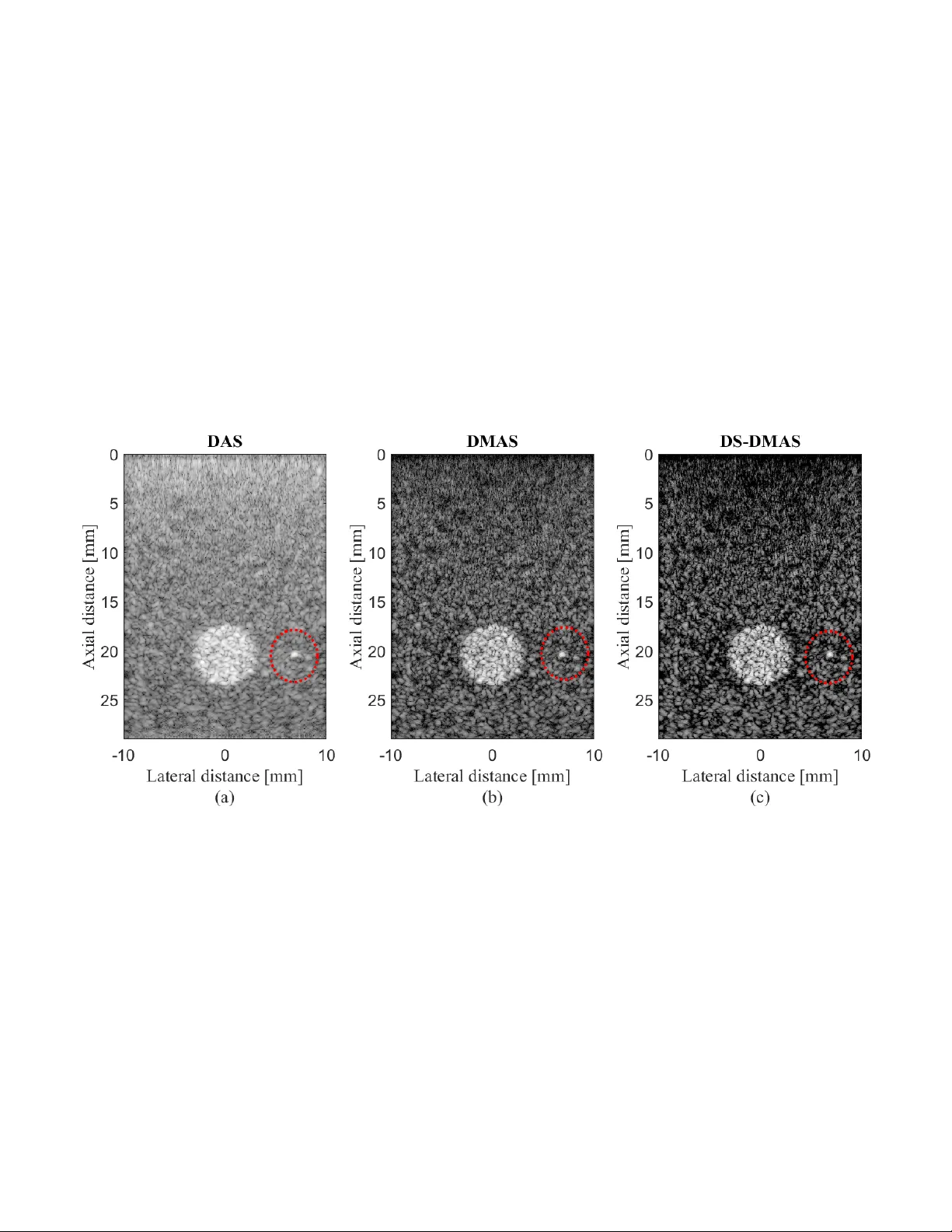
Double Stage Dela y Multiply and Sum Beamforming Algorithm Applied to Ultrasound Medical Imaging Mo ein Mozaffarzadeh a , Masume Sadeghi a , Ali Mahlo o jifar a, ∗ , Mahdi Oro o ji a a Dep artment of Biome dic al Engine ering, T arbiat Mo dar es University, T ehr an, Ir an Abstract In Ultrasound (US) imaging, Dela y and Sum (D AS) is the most common b eamformer, but it leads to low qualit y images. Dela y Multiply and Sum (DMAS) w as introduced to address this problem. How ev er, the reconstructed images using DMAS still suffer from level of sidelob es and low noise suppres- sion. In this pap er, a nov el beamforming algorithm is introduced based on the expansion of DMAS form ula. It is shown that there is a DAS algebra inside the expansion, and it is prop osed to use DMAS instead of the D AS algebra. The in tro duced metho d, namely Double Stage DMAS (DS-DMAS), is ev aluated numerically and experimentally . The quan titative results indi- cate that DS-DMAS results in ab out 25% lo wer lev el of sidelob es compared to DMAS. Moreov er, the in tro duced metho d leads to 23%, 22% and 43% impro vemen t in Signal-to-Noise Ratio, F ull-Width-Half-Maxim um and Con- trast Ratio, resp ectiv ely , in comparison with DMAS b eamformer. Keywor ds: Ultrasound Medical Imaging, b eamforming, Dela y Multiply and Sum, linear-array imaging, con trast impro vemen t, resolution enhancement ∗ Corresp onding Author: Ali Mahloo jifar; mahloo ji@modares.ac.ir; +98 21 82883304; © < 2017 > . This man uscript version is made a v ailable under the CC-BY-NC-ND 4.0 license Pr eprint submitte d to Ultr asound in Me dicine and Biolo gy January 18, 2018 2 In tro duction Ultrasound (US) imaging is one of the most common medical imaging mo dalities due to its low cost and high safet y (Hansen et al., 2014). The qualit y of US images highly dep ends on the beam properties. The presence of off-axis signals in the image reconstruction pro cedure leads to resolution and con trast degradation in the reconstructed images (Ranganathan and W alker, 2003). In US imaging, Dela y and Sum (D AS) is a common b eamforming algorithm due to its simple implementation and capabilit y of real time imag- ing. How ev er, it results in low resolution images, high lev el of sidelob es and limited off-axis signal rejection (Karaman et al., 1995). A v ariety of metho ds and algorithms are used to impro v e the p erformance of b eamforming in US imaging. One of the alternativ es for D AS is Minim um V ariance (MV) (Asl and Mahlo o jifar, 2009). Even though MV provides a higher resolution in comparison with D AS, it imposes a high computational burden. Moreo v er, MV leads to high level of sidelob es whic h degrades the qualit y of the recon- structed images. MV adaptive b eamformer has b een mo dified ov er the past few years in differen t asp ects suc h as computational burden reduction (Dey- lami and Asl, 2016; Bae et al., 2016). Phase screen ab erration correction has b een com bined with MV b eamforming algorithm in order to comp ensate the effects of the sound-v elo cit y heterogeneity which is a significant issue in med- ical US imaging (Ziksari and Asl, 2017). Another metho d for image quality enhancemen t is ap o dization which is a common w ay to control the sidelob es of the b eam pattern in cases where the imaging medium is considered to b e homogeneous, and sound velocity is assumed constant. Ho wev er, in practice, the sound v elo city ma y v ary for ab out 5%, which highly affects the b eam- 3 forming performance. An optimization problem robust to the sp eed v aria- tions w as used to minimize the sidelob e lev els while main taining the width of mainlob e (Gholampour et al., 2016). Pixel-based fo cusing technique has b een used in the US linear-array imaging based on restricting the n umber of differen t sub-ap erture p ositions. This metho d selects the b est-p ossible signal for data sup erp osition, and it leads to a higher image quality and resolution in comparison with DAS (Nguyen and Prager, 2016). The main problem with DAS algorithm is its blindness which can b e addressed by extension of the receiv e ap erture length in phased syn thetic ap erture imaging (Sadeghi and Mahlo o jifar, 2017). Recently , Delay and Standard Deviation (D ASD) b eamforming algorithm w as in tro duced in order to address the relativ ely p o or app earance of the interv en tional devices suc h as needles, guide wires, and catheters in the conv en tional US images (Bandaru et al., 2016). Three- dimensional US imaging is an emerging technique with a high accuracy in diagnosis. How ev er, it imp oses a high computational complexit y . More re- cen tly , a metho d w as prop osed based on decomp osing the dela y term in a w ay that it minimizes the ro ot-mean-square error caused b y the decomp osi- tion. It helps reduction of computational burden of Three-dimensional US imaging (Y ang et al., 2015). Beamforming in the F ourier domain can be used as a metho d for reducing the computational complexity , and ac hieving fast and accurate image reconstruction (Kruizinga et al., 2012). In 2015, Dela y-Multiply-and-Sum (DMAS) w as in tro duced for US imaging b y Matrone et al . (Matrone et al., 2015). This algorithm w as initially used as a reconstruction algorithm in confo cal microw a v e imaging for breast cancer detection (Lim et al., 2008). DMAS has been used with Multi-Line T ransmis- 4 sion (ML T) for high frame-rate US imaging (Matrone et al., 2016). The loss of brigh tness in DMAS was comp ensated using a particular implementation of syn thetic ap erture fo cusing technique, namely Synthetic T ransmit Ap erture (ST A), com bined with DMAS. The main enhancement gained by DMAS is the higher contrast and low er sidelob es. Although it leads to a higher resolu- tion compared to D AS, the resolution is not goo d enough in comparison with the resolution gained b y MV-based algorithms. Th us, MV beamformer has b een com bined with DMAS algorithm to improv e the resolution of DMAS (Mozaffarzadeh et al., 2017d,f,a,b). Moreov er, Coherence F actor (CF), as an effective weigh ting metho d for linear-arra y imaging, was improv ed in the terms of sidelob es and resolution (Mozaffarzadeh et al., 2017g,h). In the pre- vious publications of the authors, a no v el b eamforming algorithm based on the expansion of DMAS algebra, namely Double Stage DMAS (DS-DMAS) w as in tro duced, and applied on Photoacoustic imaging (Mozaffarzadeh et al., 2017e,c). In this paper, the p erformance of DS-DMAS algorithm is ev aluated in US imaging. It is shown that expanding DMAS algebra results in sum- mation of the multiple terms which can b e treated as a DAS. It is prop osed to use DMAS algorithm instead of the existing DAS inside the expansion. The results sho w that DS-DMAS outp erforms DAS in the linear-array US imaging, esp ecially at the presence of high lev el of the imaging noise and the off-axis signals. 5 Metho ds When US signals are detected b y linear-arra y of the US transducers, D AS can b e used to reconstruct the image from the detected US signals as follo ws: y DAS ( k ) = M X i =1 x i ( k − ∆ i ) , (1) where y DAS ( k ) is the output of the b eamformer, k is the time index, M is the num b er of the array elements, and x i ( k ) and ∆ i are the detected signals and the corresp onding time dela y for detector i , resp ectiv ely (Deylami and Asl, 2016). Consequen tly , DAS reconstructed images contain high lev el of sidelob es and a lo w resolution. DMAS was in tro duced to address the weak- nesses of D AS (Matrone et al., 2015). Similar to D AS, DMAS realigns the receiv ed RF signals by applying time dela ys, but the samples are multiplied b efore adding them up. The DMAS formula is giv en b y: y DM AS ( k ) = M − 1 X i =1 M X j = i +1 x i ( k − ∆ i ) x j ( k − ∆ j ) , (2) T o o v ercome the dimensionally squared problem in (2), the following mo di- fications were suggested (Matrone et al., 2015): χ ij ( k ) = sign[ x i ( k − ∆ i ) x j ( k − ∆ j )] q | x i ( k − ∆ i ) x j ( k − ∆ j ) | , for 1 6 i 6 j 6 M . (3) y DM AS ( k ) = M − 1 X i =1 M X j = i +1 χ ij ( k ) . (4) P erforming sign, absolute and square root after the coupling procedure in (3) and (4), whic h requires ( M 2 − M ) / 2 computations for eac h pixel, result in a 6 slo w imaging. Sometimes these library functions require many clo c k cycles, causing an improp er timing p erformance of DMAS algorithm. Applying the follo wing pro cedure to the receiv ed US signals reduces the computational load of the sign, absolute and square ro ot op erations to M for eac h pixel (P ark et al., 2016): x 0 i ( k ) = sign[ x i ( k )] p x i ( k ) , for 1 6 i 6 M . (5) χ ij ( k ) = x 0 i ( k ) x 0 j ( k ) , for 1 6 i 6 j 6 M . (6) A pro duct in the time domain is equiv alen t to the conv olution in the fre- quency domain. Consequen tly , new comp onents whic h cen tered at the zero and harmonic frequencies are app eared in the sp ectrum due to the similar range of frequencies for x i ( k − ∆ i ) and x j ( k − ∆ j ). A band-pass filter is applied to the b eamformed output signal to atten uate the DC and higher frequency comp onents. It should b e noticed that the algorithm is finally called Filtered-DMAS after applying the band-pass filter (Matrone et al., 2015). The output of DMAS b eamformer is the spatial coherence of the de- tected US signals, and the pro cedure of DMAS algorithm can b e considered as a correlation pro cess whic h uses the auto-correlation of the aperture. In this paper, it is prop osed to use DMAS b eamforming instead of the exist- ing DAS algorithm inside DMAS algebra. First, consider the expansion of 7 DMAS algorithm, whic h can b e written as follows: y DM AS ( k ) = M − 1 X i =1 M X j = i +1 x id ( k ) x j d ( k ) = x 1 d ( k ) h x 2 d ( k ) + x 3 d ( k ) + x 4 d ( k ) + ... + x M d ( k ) i + x 2 d ( k ) h x 3 d ( k ) + x 4 d ( k ) + ... + x M d ( k ) i + ... + x ( M − 2) d ( k ) h x ( M − 1) d ( k ) + x M d ( k ) i + h x ( M − 1) d ( k ) x M d ( k ) i , (7) where x id ( k ) and x j d ( k ) are the delay ed detected signals for the i th and j th elemen ts, resp ectively . According to (7), there is a DAS in each term of the expansion, which can b e used to generate DS-DMAS b eamformer as follo ws: y DM AS ( k ) = M − 1 X i =1 M X j = i +1 x id ( k ) x j d ( k ) = h x 1 d ( k ) x 2 d ( k ) + x 1 d ( k ) x 3 d ( k ) + ... + x 1 d ( k ) x M d ( k )) i | {z } the first term + h x 2 d ( k ) x 3 d ( k ) + x 2 d ( k ) x 4 d ( k ) + ... + x 2 d ( k ) x M d ( k )] | {z } the second term + ... + h x ( M − 2) d ( k ) x ( M − 1) d ( k ) + x ( M − 2) d ( k ) x M d ( k ) i | {z } (M-2)th term + h x ( M − 1) d ( k ) x M d ( k ) i | {z } (M-1)th term . (8) 8 DMAS algorithm is a correlation pro cess in whic h for eac h v oxel of the im- age, the calculated delays for eac h element of the arra y are combinatorially coupled and multiplied. In other w ords, the similarity of the samples are obtained. In (8), b et w een all the terms, there is a summation in terpreted as the DAS algebra . If the presence of the off-axis signals results in a high error in the correlation pro cess of DMAS, the summation of the calculated correlations leads to a summation of high range of errors. It is prop osed to use DMAS b eamformer b etw een each term of the expansion instead of DAS. T o put it more simply , the samples go through another correlation pro cedure. T o illustrate this, consider (9): y DS − DM AS ( k ) = M − 2 X i =1 M − 1 X j = i +1 x it ( k ) x j t ( k ) , (9) where x it and x j t are the i th and j th terms sho wn in (8), resp ectiv ely . The expansion of DS-DMAS b eamformer can b e written as: y DS − DM AS ( k ) = M − 2 X i =1 M − 1 X j = i +1 x it ( k ) x j t ( k ) = x 1 t ( k ) h x 2 t ( k ) + x 3 t ( k ) + x 4 t ( k ) + ... + x ( M − 1) t ( k ) i + x 2 t ( k ) h x 3 t ( k ) + x 4 t ( k ) + ... + x ( M − 1) t ( k ) i + ... + x ( M − 3) t ( k ) h x ( M − 2) t ( k ) + x ( M − 1) t ( k ) i + h x ( M − 2) t ( k ) x ( M − 1) t ( k ) i . (10) Since D AS is a non-adaptiv e b eamformer and considers all the calculated samples for eac h elemen t of the arra y iden tically , the acquired image b y ev ery 9 terms would blur the final reconstructed image. Using (10), the blurring w ould b e preven ted, and the effects of the noise in the reconstructed images w ould b e reduced. Of note, the same pro cedure in tro duced in (5) and (6), is used in DS-DMAS algorithm to sp eed up the image formation. Also, the necessary band-pass filter is applied to DS-DMAS algorithm to only pass the necessary comp onents generated after the non-linear op erations. Results and P erformance Assessmen t In this section, numerical and exp erimental results are presented to ev al- uate the p erformance of the prop osed algorithm in comparison with DMAS and DAS. Numeric al R esults Field I I simulator is used to generate the sim ulated signals (Jensen, 1996; Jensen and Svendsen, 1992). A linear-arra y transducer having 128 elements and a central frequency of 3 M H z is used. The sampling frequency is 100 M H z . The impulse resp onse consists of a tw o-cycle Hanning-weigh ted sin u- soidal w av eform, and the excitation pulse consists of a t wo-cycle sin usoidal w av eform. The sp eed of sound is considered 1540 ms − 1 . Dynamic transmit and receive focusing are syn thesized, then the b eamforming algorithms are applied to the recorded US signals. En velope detection, p erformed by means of the Hilb ert transform, has b een used at the end for all the presented im- ages. The obtained lines are normalized and then log-compressed to form the final image. 10 Wir e T ar gets Phantom Wires are p ositioned in pairs at the depths of 35 mm , 40 mm , 45 mm , 50 mm , 55 mm and 60 mm . Also, tw o wires are p ositioned at the depths of 32 mm and 63 mm . Gaussian noise is added to the detected signals, ha ving a S N R of 50 dB . As can b e seen in Figure 1, D AS leads to a lo w resolution image along with the high lev el of sidelob es degrading the quality of the reconstructed image. On the other hand, DMAS reduces the arti- facts and sidelob es caused b y D AS and impro ves the qualit y of the image. Moreo ver, the point targets are more distinguishable. As sho wn in Figure 1(c), DS-DMAS results in lo w er lev el of sidelob es and artifacts in comparison with DAS and DMAS. Apart from that, DS-DMAS improv es the resolution of the formed image and reduces the width of mainlob e. T o compare the b eamformers in details, the lateral v ariations at the t w o depths of imaging are sho wn in Figure 2. Clearly , DS-DMAS leads to lo w er level of sidelob es and lateral v alley at the b oth presented depths. Consider, in particular, the depth of 55 mm where the v alleys of the lateral v ariations for DAS, DMAS and DS-DMAS are ab out -37 dB , -51 dB and -70 dB , resp ectiv ely . In other w ords, DS-DMAS results in 33 dB and 19 dB impro vemen t, in the term of the level of lateral v alley , compared to D AS and DMAS, resp ectively . In addition, the level of sidelob es at the depth of 35 mm for DAS, DMAS and DS-DMAS are ab out -80 dB , -100 dB and -120 dB , resp ectiv ely . T o put it more simply , the level of sidelob es, b y DS-DMAS, are reduced for ab out 40 dB and 20 dB in comparison with DAS and DMAS, resp ectively . Moreo ver, the narro wer width of mainlob e obtained from DS-DMAS is obvious consid- ering the lateral v ariations. In order to compare the prop osed algorithm in 11 the term of noise reduction, Gaussian noise is added to the detected signals, ha ving a S N R of -10 dB . The reconstructed images are shown in Figure 3. Clearly , the effects of the added noise degrade the reconstructed image using D AS, and the quality of the image is degraded. DMAS reduces the effects, but the negativ e effects of noise still degrade the qualit y of the formed image, sho wn in Figure 3(b). DS-DMAS results in a higher lev el of noise reduction in comparison with D AS and DMAS, as can b e seen in Figure 3(c), and the qualit y of the reconstructed image is impro v ed. T o compare the beamform- ers in more details, lateral v ariations for all the b eamformers, at the t wo depths of imaging, are presented in Figure 4. As sho wn in b oth presented lateral v ariations, DS-DMAS leads to lo w er lev el of sidelob es and more dis- tinguishable p oin t targets in comparison with D AS and DMAS. Consider, in particular, the depth of 55 mm where the sidelob e lev els of D AS, DMAS and DS-DMAS are for ab out -50 dB , -70 dB and -90 dB , resp ectively . In the other w ords, DS-DMAS leads to 40 dB and 20 dB level of sidelob es reduc- tion compared to DAS and DMAS, resp ectiv ely . Moreo v er, the v alley of the lateral v ariations of DS-DMAS is reduced for ab out 15 dB and 30 dB in com- parison with DMAS and D AS, resp ectiv ely . T o ev aluate the prop osed metho d quan titatively , Signal-to-Noise ratio ( S N R ) and F ull-Width-Half-Maxim um ( F W H M ) metrics for eac h b eamformer are calculated. The p oin ts in the righ t side of the wire target phantoms (having a S N R of -10 dB ), are used to measure the S N R using the follo wing form ula: S N R = 20 log 10 P sig nal /P noise , (11) where P sig nal and P noise are the difference of the maxim um and minimum in tensity of eac h region, and standard deviation of the region, resp ectiv ely 12 ( ¨ Ust ¨ uner and Holley, 2003). T able 1 shows the calculated S N R s, and T able 2 presents the measured F W H M s. As can b e seen in T able 1, DS-DMAS outp erforms D AS and DMAS. Consider, in particular, the depth of 55 mm where S N R for DAS, DMAS and DS-DAMS is ab out 42.4 dB , 56.5 dB and 70.2 dB , resp ectively . In other w ords, DS-DMAS impro v es S N R for ab out 27.8 dB and 13.7 dB compared to D AS and DMAS, resp ectively . As shown in T able 2, DS-DMAS leads to lo wer F W H M in the all depths of imaging. Consider, in particular, the depth of 55 mm where F W H M for D AS, DMAS and DS-DMAS results in 1.0 mm , 0.8 mm and 0.6 mm , respectively . In other w ords, DS-DMAS leads to 0.4 mm and 0.2 mm improv emen t in the term of F W H M compared to DAS and DMAS, resp ectively . Cyst T ar gets Phantom T en cysts, ha ving 4 mm and 2.5 mm radius, are located in five depths of imaging to ev aluate the b eamformers under the cyst targets. The recon- structed images are sho wn in Figure 5. As can b e seen, the cyst targets are not w ell detected in the image generated by DAS. Moreo ver, the recon- structed image suffers from the effects of the noise. Ev en though DMAS leads to a higher qualit y image and more detectable cyst targets, in compar- ison with DAS, the effects of the added noise are still ob vious. On the other hand, DS-DMAS suppresses the effects of the noise further, as was sho wn in wire targets, and it results in a higher image quality compared to DAS and DMAS. It should b e noticed that the sp ec kle pattern using DAS seems more uniform since the resolution and sidelob es pro vided b y D AS are not go o d enough to separate the sp ec kles as they are. How ev er, the low sidelobes of DS-DMAS make the sp eckle pattern more distinguished. T o compare the re- 13 constructed images quan titatively , Con trast Ratio ( C R ) metric is calculated. The calculated C R s, for each b eamformer, using cysts ha ving 4 mm radius, are presented in T able 3. C R metric is calculated using following equation: C R = 20 log 10 µ cy st µ bck , (12) where µ cy st and µ bck are the means of image intensit y before the log compres- sion inside the y ello w and red dotted circle in Figure 5, respectively (Matrone et al., 2015). As can b e seen in T able 3, DS-DMAS b eamforming algorithm leads to a higher C R for all the depths of imaging in comparison with other b eamformers. Consider, in particular, the depth of 50 mm where C R is for ab out -10.9 dB , -28.1 dB and -41.6 dB for DAS, DMAS and DS-DMAS, resp ectiv ely . T o ev aluate the prop osed method in the term of artifacts and sidelob es suppression, and wire detection at the presence of sp eckle pattern, another simulation has b een conducted using a tumor-lik e ob ject along with a wire target. The reconstructed images are sho wn in Figure 6. As can b e seen, the prop osed metho d improv es the image quality and mak es the b oundaries of the tumor-lik e ob ject sharp er. Moreo v er, the small single wire target can b e detected in the reconstructed image using DS-DMAS, and is not hidden in the background sp ec kle. Exp erimental R esults Although the n umerical results w ere promising, the prop osed algorithm needs to b e ev aluated using exp erimental data. RF data from a heart phan- tom, and a phan tom including cysts and wires are used for further inv estiga- tion. This data w as obtained from the Biomedical Ultrasound Lab oratory , Univ ersity of Mic higan. Figure 7 shows the reconstructed images using the 14 RF data obtained from the phan tom containing cysts and wires. As can b e seen in Figure 7, reconstructed image using D AS contains high level of side- lob es and artifacts. Moreov er, the area inside the cysts is not clear enough. In Figure 7(b), the formed image using DMAS is shown, and its con trast is impro ved. By DMAS, although the artifacts inside the cysts are b etter reduced, compared to DAS, the reconstructed image is still degraded by the artifacts, esp ecially inside the cysts. DS-DMAS impro ves the contrast of the formed image, and sidelob es are reduced. Moreov er, the area inside the cysts is more clear in comparison with DAS and DMAS. T o ev aluate the exp erimen tal results quantitativ ely , C R s are presen ted in T able 4, for the t wo cysts in the reconstructed images in Figure 7. As can be seen, for b oth cyst targets, DS-DMAS outp erforms D AS and DMAS in the term of C R . Consider, for example, C R s for the cyst lo cated at the depth of 65 mm , where DS-DMAS leads to 26.3 dB and 14.4 dB improv emen t in comparison with D AS and DMAS, resp ectively . In Figure 8, the lateral v ariations for the cyst lo cated at the depth of 53 mm are presented. As shown, DS-DMAS al- gorithm outp erforms other concerned b eamformers. In another exp erimen t, the prop osed metho d is ev aluated using a heart phan tom. The reconstructed images using RF data obtained from the heart phan tom are shown in Figure 9 where artifacts and the high level of sidelob es degrade the qualit y of the formed image using D AS. On the other hand, DMAS improv es the quality of the reconstructed image b y reducing the lev el of sidelob es. DS-DMAS reduces the negativ e effects of the sidelob es more than DMAS and provides a higher qualit y . 15 Pr o c essing Complexity In order to compare the prop osed metho d with other b eamformers in the term of the computational burden, the num b er of op erations needed for eac h algorithm are presented in T able 5. As can b e seen, the order of the computational complexit y for DS-DMAS and DMAS is O ( M 2 ) whic h is ex- p onen tially more than O ( M ) for DAS. Of note, the ov erhead computational cost of DS-DMAS would linearly increased by increasing the n umber of em- plo yed elements of the transducer. Discussion The main impro vemen ts obtained by the prop osed algorithm are noise reduction and artifacts suppression. The most commonly used b eamforming algorithm in US imaging is D AS. Although it pro vides real time imaging, it results in low qualit y images. DAS algorithm leads to high level of sidelob es and low resolution images due to its non-adaptiveness and blindness. T o put it more simply , D AS considers all the calculated samples for each elemen ts of the arra y the same as each other. DMAS b eamformer, outp erforming D AS, was introduced in which the main enhancement was contrast improv e- men t. It impro ves the reconstructed image due to its correlation pro cess. In fact, DMAS do es not consider all the calculated samples for eac h p oin t of the reconstructed image the same. There is a weigh ting pro cedure in DMAS whic h mak es it differen t from DAS, and that is the reason why it outperforms D AS. Comparing Figure 1(a) and Figure 1(b) clearly demonstrates the im- pro vemen ts gained by DMAS. A t the presence of high levels of the imaging noise, D AS b eamformer causes a lo w quality image, suffering from the neg- 16 ativ e effects of the noise. DMAS reduces the negative effects of noise and impro ves the image qualit y due to its correlation pro cedure whic h mak es this b eamforming algorithm non-blind. In other w ords, eac h calculated samples is weigh ted based on other calculated samples, and the final formed image is enhanced. How ev er, it can b e p erceiv ed that the level of sidelob es and artifacts in DMAS are not satisfying y et, esp ecially at the presence of high lev el of noise, as can b e seen in Figure 3(b) and Figure 5(b). Indeed, the correlation pro cedure of DMAS is not able to suppress the high lev el of the off-axis signals and noise well enough. By expanding DMAS formula, it can b e seen that DMAS can b e written as the m ultiple summations of v arious terms. This pro cedure of summation can b e considered as a DAS algorithm. T o put it more simply , D AS algebra exists in the expansion of DMAS for- m ula, whic h can b e the source of the low noise and artifacts suppression of DMAS b eamformer. Since DMAS outp erforms D AS in the terms of lev el of sidelob es and artifacts, it is prop osed to use DMAS instead of the existing D AS algebra inside the expansion of DMAS. DS-DMAS leads to low er level of sidelob es and artifacts compared to D AS and DMAS, esp ecially at the presence of high level of the noise, as a result of double correlation pro ce- dure. In fact, in DS-DMAS b eamforming algorithm there are t wo pro cedures of w eighting. A t the presence of high lev el of the imaging noise and artifacts, the first weigh ting pro cedure is not able to suppress the negativ e effects in the formed images, but using t w o stages of the correlation process, the effects are well suppressed. Figure 2 and Figure 4 show the lateral v ariations of the b eamformers, and clearly DS-DMAS results in lo w er lev el of sidelob es and lateral v alley , and narrow er width of mainlob e in comparison with D AS and 17 DMAS. T able 1, T able 2 and T able 3 sho w the quan titativ e comparison of the b eamformers, which illustrate the sup eriority of DS-DMAS using merits of S N R , F W H M and C R . The prop osed metho d has b een ev aluated using exp erimen tal data. Clearly , DS-DMAS satisfies the exp ectations and results in the images having a higher contrast and lo w er levels of noise and artifacts. Of note, all the impro vemen ts of DS-DMAS are gained at the exp ense of the higher computational burden. How ev er, DS-DMAS is at the same order of DMAS. W e may assume to implemen t the algorithm on a FPGA device, e.g. on an Altera FPGA of the Stratix IV family (Altera Corp., San Jose, CA, USA). T o implement the floating-p oin t m ultiplication and the square ro ot op erations on double-precision op erands, b y the av ailable library mega- functions, a latency of 5 and 57 clo c k cycles would b e required to generate resp ectiv ely the m ultiplication and square ro ot outputs, with a maximum ac hiev able frequency of 255 M H z and 366 M H z respectively , as rep orted in the floating-p oint megafunctions datasheet. Beamforming plays a significant rule in diagnostic US imaging. In appli- cations in which phased (or micro-con v ex) arra ys are used, since a limited f-n umber w ould b e av ailable, DS-DMAS can pro vide a further improv emen t compared to DMAS. In small-parts and v ascular US imaging, for instance in vivo imaging of the carotid artery , where the resolution and specially side- lob es are of importance, DS-DMAS can b e used, providing higher con trast and noise suppression compared to DAS and DMAS. 18 Conclusions D AS b eamformer is the most common b eamfoaming algorithm in US imaging. Ev en though it pro vides a real time imaging, it is a blind b eam- former and results in low qualit y images. DMAS b eamforming algorithm leads to low er level of sidelob es and a higher resolution in comparison with D AS. How ev er, the off-axis signals and noise still degrade the reconstructed images b y DMAS. In this pap er, a nov el beamforming algorithm based on the expansion of DMAS form ula was in tro duced. It w as prop osed to use DMAS instead of D AS algebra inside the expansion of DMAS form ula. The prop osed metho d has been ev aluated numerically and exp erimen tally . The results sho wed that DS-DMAS leads to low er lev el of sidelob es of ab out 25% compared to DMAS. Moreov er, the prop osed metho d has b een quan titativ ely ev aluated, and in comparison with DMAS b eamformer, it w as sho wn that DS-DMAS results in 23%, 22% and 43% impro vemen t in the terms of S N R , F W H M and C R , resp ectively . 19 References Asl BM, Mahlo o jifar A. Minim um v ariance b eamforming com bined with adaptiv e coherence w eighting applied to medical ultrasound imaging. IEEE transactions on ultrasonics, ferro electrics, and frequency control, 2009;56. Bae M, Park SB, Kw on SJ. F ast minim um v ariance b eamforming based on legendre p olynomials. IEEE T ransactions on Ultrasonics, F erro electrics, and F requency Control, 2016;63:1422–1431. Bandaru RS, Sornes AR, Hermans J, Samset E, Dho oge J. Dela y and stan- dard deviation b eamforming to enhance sp ecular reflections in ultrasound imaging. IEEE T ransactions on Ultrasonics, F erro electrics, and F requency Con trol, 2016;63:2057–2068. Deylami AM, Asl BM. Lo w complex subspace minim um v ariance b eamformer for medical ultrasound imaging. Ultrasonics, 2016;66:43–53. Gholamp our A, Sakhaei SM, Andargoli SMH. A robust approach to ap o diza- tion design in phased arrays for ultrasound imaging. Ultrasonics, 2016. Hansen PM, Hemmsen M, Brandt A, Rasm ussen J, Lange T, Krohn PS, L¨ onn L, Jensen JA, Nielsen MB. Clinical ev aluation of synthetic ap erture sequen tial b eamforming ultrasound in patients with liv er tumors. Ultra- sound in medicine & biology , 2014;40:2805–2810. Jensen JA. Field: A program for simulating ultrasound systems. In: 10TH NORDICBAL TIC CONFERENCE ON BIOMEDICAL IMA GING, VOL. 4, SUPPLEMENT 1, P AR T 1: 351–353. Citeseer, 1996. 20 Jensen JA, Sv endsen NB. Calculation of pressure fields from arbitrarily shap ed, ap o dized, and excited ultrasound transducers. IEEE transactions on ultrasonics, ferro electrics, and frequency control, 1992;39:262–267. Karaman M, Li PC, O’Donnell M. Synthetic aperture imaging for small scale systems. IEEE transactions on ultrasonics, ferroelectrics, and frequency con trol, 1995;42:429–442. Kruizinga P , Mastik F, de Jong N, v an der Steen AF, v an So est G. Plane- w av e ultrasound b eamforming using a non uniform fast fourier transform. IEEE transactions on ultrasonics, ferro electrics, and frequency con trol, 2012;59:2684–2691. Lim HB, Nh ung NTT, Li EP , Thang ND. Confo cal microw av e imaging for breast cancer detection: Dela y-multiply-and-sum image reconstruction al- gorithm. IEEE T ransactions on Biomedical Engineering, 2008;55:1697– 1704. Matrone G, Ramalli A, Sav oia A, T ortoli P , Magenes G. High frame-rate, high resolution ultrasound imaging with m ulti-line transmission and filtered- dela y multiply and sum b eamforming. IEEE T ransactions on Medical Imaging, 2016. Matrone G, Sav oia AS, Caliano G, Magenes G. The dela y multiply and sum b eamforming algorithm in ultrasound b-mo de medical imaging. IEEE transactions on medical imaging, 2015;34:940–949. Mozaffarzadeh M, Av anji SAOI, Mahlo o jifar A, Oro o ji M. Photoacoustic imaging using com bination of eigenspace-based minim um v ariance and 21 dela y-multiply-and-sum b eamformers: Sim ulation study . arXiv preprin t arXiv:1709.06523, 2017a. Mozaffarzadeh M, Mahloo jifar A, Nasiria v anaki M, Oro o ji M. Eigenspace- based minim um v ariance adaptive b eamformer com bined with dela y m ulti- ply and sum: Exp erimental study . arXiv preprin t arXiv:1710.01767, 2017b. Mozaffarzadeh M, Mahlo o jifar A, Oro o ji M. Image enhancemen t and noise reduction using mo dified delay-m ultiply-and-sum b eamformer: Applica- tion to medical photoacoustic imaging. In: Electrical Engineering (ICEE), 2017 Iranian Conference on. IEEE, 2017c. pp. 65–69. Mozaffarzadeh M, Mahlo o jifar A, Oro o ji M. Medical photoacoustic b eam- forming using minim um v ariance-based dela y multiply and sum. In: SPIE Digital Optical T echnologies. In ternational So ciet y for Optics and Photon- ics, 2017d. pp. 1033522–1033522. Mozaffarzadeh M, Mahlo o jifar A, Oro o ji M, Adabi S, Nasiria v anaki M. Dou- ble stage delay multiply and sum b eamforming algorithm: Application to linear-array photoacoustic imaging. IEEE T ransactions on Biomedical Engineering, 2017e. Mozaffarzadeh M, Mahlo o jifar A, Oro o ji M, Adabi S, Nasiriav anaki M. Linear array photoacoustic imaging using minimum v ariance-based de- la y m ultiply and sum adaptiv e b eamforming algorithm. arXiv preprint arXiv:1709.07965, 2017f. Mozaffarzadeh M, Mehrmohammadi M, Makkiabadi B. Enhanced linear- 22 arra y photoacoustic b eamforming using modified coherence factor. arXiv preprin t arXiv:1710.00157, 2017g. Mozaffarzadeh M, Mehrmohammadi M, Makkiabadi B. Image impro vemen t in linear-arra y photoacoustic imaging using high resolution coherence fac- tor weigh ting tec hnique. arXiv preprint arXiv:1710.02751, 2017h. Nguy en NQ, Prager R W. High-resolution ultrasound imaging with uni- fied pixel-based b eamforming. IEEE transactions on medical imaging, 2016;35:98–108. P ark J, Jeon S, Meng J, Song L, Lee JS, Kim C. Dela y-m ultiply-and-sum- based synthetic ap erture fo cusing in photoacoustic microscop y . Journal of Biomedical Optics, 2016;21:036010–036010. Ranganathan K, W alk er WF. A no vel b eamformer design metho d for med- ical ultrasound. part i: Theory . IEEE T ransactions on ultrasonics, ferro- electrics, and frequency control, 2003;50:15–24. Sadeghi M, Mahlo o jifar A. Impro ving b eamforming performance b y phased syn thetic ap erture imaging in medical ultrasound. Journal of Medical Ul- trasonics, 2017;44:51–62. ¨ Ust ¨ uner KF, Holley GL. Ultrasound imaging system p erformance assessmen t. In: AAPM Annual Meeting, 2003. Y ang M, Sampson R, W ei S, W enisc h TF, Chakrabarti C. Separable b eam- forming for 3-d medical ultrasound imaging. IEEE T ransactions on Signal Pro cessing, 2015;63:279–290. 23 Ziksari MS, Asl BM. Combined phase screen ab erration correction and minim um v ariance b eamforming in medical ultrasound. Ultrasonics, 2017;75:71–79. 24 Figure Captions Figure 1: Images of the sim ulated wire targets phantom using a linear- arra y transducer. (a) DAS, (b) DMAS and (c) DS-DMAS. All images are shown with a dynamic range of 70 dB . Noise was added to the detected signals, ha ving a S N R of 50 dB . Figure 2: Lateral v ariations of D AS, DMAS and DS-DMAS at the depths of (a) 35 mm and (b) 55 mm . Noise was added to the detected signals, ha ving a S N R of 50 dB . Figure 3: Images of the sim ulated wire targets phantom using a linear- arra y transducer. (a) DAS, (b) DMAS and (c) DS-DMAS. All images are shown with a dynamic range of 70 dB . Noise was added to the detected signals, ha ving a S N R of -10 dB . Figure 4: Lateral v ariations of D AS, DMAS and DS-DMAS at the depths of (a) 35 mm and (b) 55 mm . Noise was added to the detected signals, ha ving a S N R of -10 dB . Figure 5: Images of the sim ulated cyst targets phan tom using a linear-arra y transducer. (a) D AS, (b) DMAS and (c) DS-DMAS. All images are sho wn with a dynamic range of 70 dB . Noise was added to the detected signals, having a S N R of 20 dB . Figure 6: Images of the sim ulated phantom (con taining a tumor-like ob ject along with a wire target) using a linear-array transducer. (a) DAS, (b) DMAS and (c) DS-DMAS. All images are shown with a dynamic range 25 of 70 dB . Noise was added to the detected signals, ha ving a S N R of 20 dB . Figure 7: Images of the experimental RF data detected b y a linear-arra y transducer (obtained with the wire and cyst targets phantom). (a) D AS, (b) DMAS and (c) DS-DMAS. All images are shown with a dy- namic range of 70 dB . Figure 8: Lateral v ariations of DAS, DMAS and DS-DMAS for the exp eri- men tal cyst lo cated at the depth of 53 mm in Figure 7. Figure 9: Images of the experimental RF data detected b y a linear-arra y transducer (obtained with the heart phan tom). (a) DAS, (b) DMAS and (c) DS-DMAS. All images are sho wn with a dynamic range of 70 dB . 26 T ables T able 1: S N R ( dB ) v alues for the simulated wire targets at the different depths of imaging. Depth ( mm ) D AS DMAS DS-DMAS 35 49.8 64.2 78.3 40 47.5 61.4 75.0 45 45.7 59.8 73.8 50 44.0 58.1 71.9 55 42.4 56.5 70.2 60 41.1 55.2 69.0 T able 2: F W H M ( mm ) v alues for the sim ulated wire targets at the differ- en t depths of imaging. Depth ( mm ) D AS DMAS DS-DMAS 35 0.6 0.5 0.4 40 0.7 0.5 0.4 45 0.8 0.6 0.5 50 0.9 0.7 0.5 55 1.0 0.8 0.6 60 1.1 0.9 0.7 T able 3: C R ( dB ) v alues for the sim ulated cyst targets at the different depths of imaging. 27 Depth ( mm ) D AS DMAS DS-DMAS 10 -26.4 -42.0 -58.2 20 -26.1 -41.8 -58.0 30 -19.7 -34.1 - 49.1 40 -18.2 -33.3 -48.7 50 -10.9 -28.1 -41.6 T able 4: C R ( dB ) v alues for the exp erimental cyst targets at the differen t depths of imaging. Depth ( mm ) D AS DMAS DS-DMAS 53 -16.2 -27.9 -41.4 65 -13.9 -25.8 -40.3 T able 5: Pro cessing complexity for the different b eamformers. Beamformer Num b er of Op erations D AS M DMAS M ( M − 1) 2 + 2( M − 1) DS-DMAS M ( M − 1) + 3( M − 1) 28 DAS Lateral distance [mm] (a) -10 0 10 Axial distance [mm] 30 35 40 45 50 55 60 65 DMAS Lateral distance [mm] (b) -10 0 10 Axial distance [mm] 30 35 40 45 50 55 60 65 DS-DMAS Lateral distance [mm] (c) -10 0 10 Axial distance [mm] 30 35 40 45 50 55 60 65 Lateral distance [mm] -10 -5 0 5 10 Power [dB] -120 -100 -80 -60 -40 -20 0 Depth= 35 mm DAS DMAS DS-DMAS Lateral distance [mm] -10 -5 0 5 10 Power [dB] -120 -100 -80 -60 -40 -20 0 Depth= 55 mm DAS DMAS DS-DMAS DAS Lateral distance [mm] (a) -10 0 10 Axial distance [mm] 30 35 40 45 50 55 60 65 DMAS Lateral distance [mm] (b) -10 0 10 Axial distance [mm] 30 35 40 45 50 55 60 65 DS-DMAS Lateral distance [mm] (c) -10 0 10 Axial distance [mm] 30 35 40 45 50 55 60 65 Lateral distance [mm] -10 -5 0 5 10 Power [dB] -120 -100 -80 -60 -40 -20 0 Depth= 35 mm DAS DMAS DS-DMAS Lateral distance [mm] -10 -5 0 5 10 Power [dB] -120 -100 -80 -60 -40 -20 0 Depth= 55 mm DAS DMAS DS-DMAS DAS Lateral distance [mm] (a) -10 0 10 Axial distance [mm] 0 10 20 30 40 50 DMAS Lateral distance [mm] (b) -10 0 10 Axial distance [mm] 0 10 20 30 40 50 DS-DMAS Lateral distance [mm] (c) -10 0 10 Axial distance [mm] 0 10 20 30 40 50 DAS Lateral distance [mm] (a) -20 -10 0 10 20 Axial distance [mm] 30 40 50 60 70 DMAS Lateral distance [mm] (b) -20 -10 0 10 20 Axial distance [mm] 30 40 50 60 70 DS-DMAS Lateral distance [mm] (c) -20 -10 0 10 20 Axial distance [mm] 30 40 50 60 70 Lateral distance [mm] 0 5 10 15 20 25 Power [dB] -80 -60 -40 -20 0 Depth= 53 mm DAS DMAS DS-DMAS DAS Lateral distance [mm] (a) -50 0 50 Axial distance [mm] 30 40 50 60 70 80 90 100 DMAS Lateral distance [mm] (b) -50 0 50 Axial distance [mm] 30 40 50 60 70 80 90 100 DS-DMAS Lateral distance [mm] (c) -50 0 50 Axial distance [mm] 30 40 50 60 70 80 90 100
Original Paper
Loading high-quality paper...
Comments & Academic Discussion
Loading comments...
Leave a Comment