High-Resolution Radar via Compressed Sensing
A stylized compressed sensing radar is proposed in which the time-frequency plane is discretized into an N by N grid. Assuming the number of targets K is small (i.e., K much less than N^2), then we can transmit a sufficiently "incoherent" pulse and e…
Authors: Matthew A. Herman, Thomas Strohmer
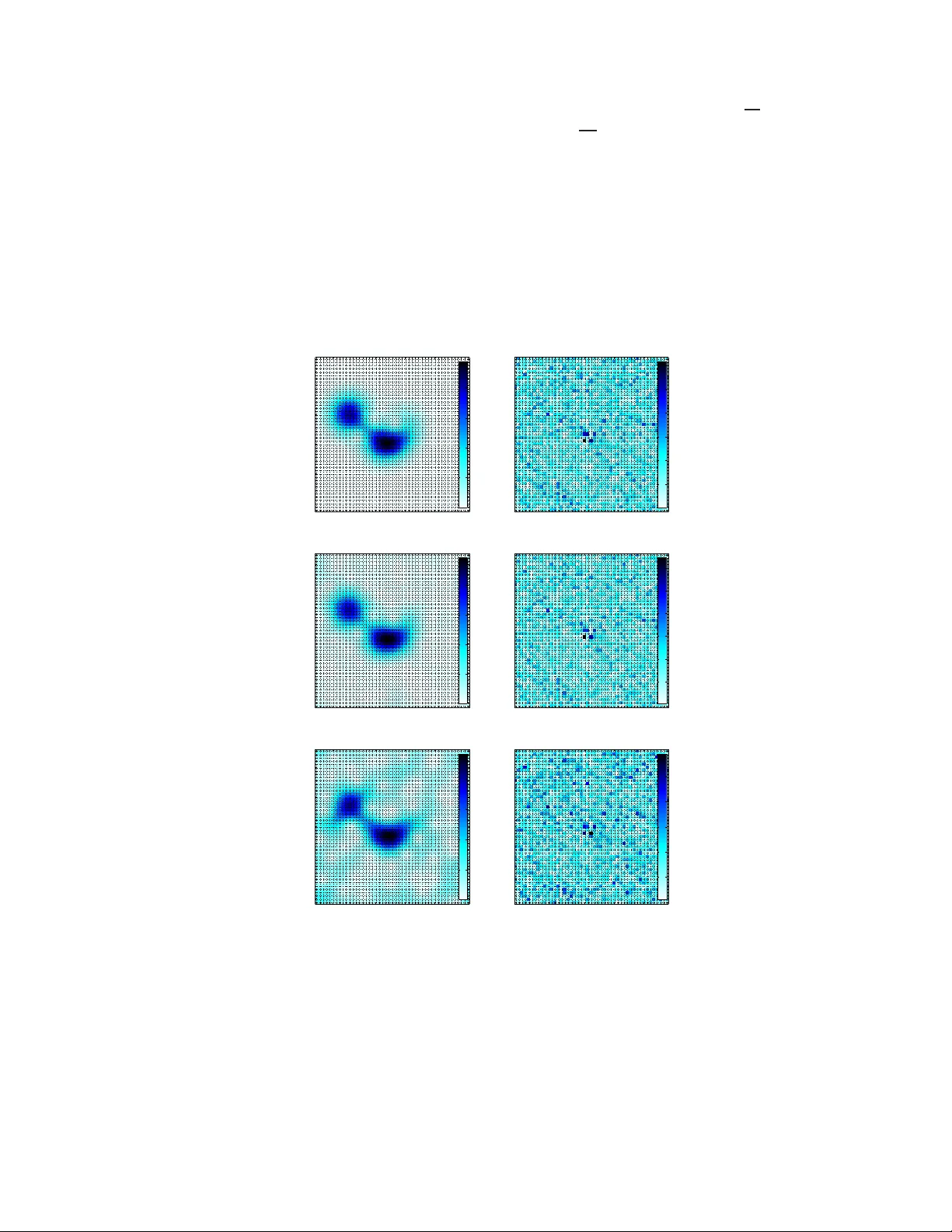
1 High-Resolution Radar via Compressed Sensing Matthew A. Herman and Thomas Strohmer Abstract A stylized co mpressed sensin g radar is propo sed in which th e time-freq uency plane is d iscretized in to an N × N grid. Assuming the n umber of targets K is small (i.e., K ≪ N 2 ), then we can transmit a sufficiently “incoherent” pulse a nd e mploy the techniqu es of com pressed sensing to reconstru ct the target scene. A theor etical up per bo und on the sparsity K is pre sented. Numer ical simulations verify th at even better performan ce can be achieved in practice. This novel com pressed sensing approach offers great potential for better reso lution over classical radar . Index T erms Compressed sensing, radar, sparse recovery , matr ix identification, Gabor analysis, Alltop seq uence. I . I N T R O D U C T I O N R AD AR, sonar and s imilar imaging systems are in h igh demand in many c i vilian, military , and biomed ical applications. Th e res olution of these sys tems is limited by c lassical time-frequency un certainty principles . Using the con cepts of compresse d se nsing, we propose a radically new approach to radar , which under ce rtain conditions provides better time-frequency resolution. In this simplified version of a mono static, single-pulse, far - field rada r system we assume that the targets are radially aligned with the transmitter a nd receiver . As such, we will only be conc erned with the range an d velocity of the tar ge ts. Future studies will include cross-range information. There are three key points to be aware of with this a pproach: (1) T he transmitted s ignal mu st b e sufficiently “incoheren t. ” Although our results rely o n the us e of a deterministic s ignal (the Alltop se quence ), trans mitting white noise would yield a s imilar outco me. (2) This approa ch does n ot u se a matched filter . (3) The tar get scene is recovered by exploiting the imposed sparsity constraints. This report is a first step in formalizing the theory of compressed sens ing rad ar and con tains many assumptions . In p articular , analog to digital (A/D) c on version an d related implementation details are ignored. Some o f thes e issues are discus sed in [1] whe re the potential to design simplified hardware is highlighted. The rest of this sec tion e stablishes notation and tools from time-frequency analysis, while Section II reviews the conc epts of sparse repres entations and compress ed se nsing. Our main contrib u tion can be foun d in Sec tions III and IV. Other applications are add ressed in Section V. A. Notation and T ools fr om T ime-F requency Analys is In this pape r boldface variables represe nt vectors and ma trices, wh ile non -boldface v ariables repres ent functions with a continuou s domain. Throughout this discuss ion we on ly consider functions with finite ene r gy , i.e., f ∈ L 2 ( R ) . For two functions f , g ∈ L 2 ( R ) , their cr oss-ambiguity function o f τ , ω ∈ R is de fined as [2] A f g ( τ , ω ) = Z R f ( t + τ / 2) g ( t − τ / 2) e − 2 π i ω t dt, (1) where · de notes complex conjug ation, and the upright Roman letter i = √ − 1 . The short-time F ourier trans form (STFT) of f with respect to g is V g f ( τ , ω ) = R R f ( t ) g ( t − τ ) e − 2 π i ω t dt. A simple cha nge of variable reveals that, within a complex f actor , the c ross-ambiguity function is equiv alen t to the STF T A f g ( τ , ω ) = e π i ω τ V g f ( τ , ω ) . (2) The authors are with the Department of Mathematics, Univ ersity of California, Davis, CA 95616-8633 , USA (e-mail: { mattyh, strohmer } @math.u cdavis.edu ). This work was partially supported by NSF Grant No. DMS- 051146 1 and NSF VIGRE Gr ant Nos. DMS-0135345, DMS-06362 97. 2 When f = g we have the (self) ambiguity function A f ( τ , ω ) . The s hape of the ambiguity surface |A f ( τ , ω ) | of f is bounde d above the time-frequency plane ( τ , ω ) by |A f ( τ , ω ) | ≤ A f (0 , 0 ) = k f k 2 2 . The radar uncertainty principle [3] states that if Z Z U |A f g ( τ , ω ) | 2 dτ dω ≥ (1 − ε ) k f k 2 2 k g k 2 2 (3) for some suppor t U ⊆ R 2 and ε ≥ 0 , then the area | U | ≥ (1 − ε ) . (4) Informally , this can be interpreted as saying that the size of an amb iguity function’ s “footprint” on the time-frequency plane can only be made so small. In c lassical radar , the ambiguity function of f is the ma in factor in determining the resolution b etween tar gets [4]. Therefore, the ability to identify two tar gets in the time-frequency p lane is limited by the e ssential supp ort of A f ( τ , ω ) as dictated by the radar unc ertainty p rinciple. T he primary result of this pap er is that, under certain conditions, compresse d sen sing radar achieves better tar get resolution than classical radar . I I . C O M P R E S S E D S E N S I N G Recently , the sign al proc essing/mathema tics community has seen a parad igmatic sh ift in the way information is represented , s tored, transmitted an d recovered [5]–[7]. This area is often referred to as Sparse Representations and Compressed Se nsing . Cons ider a discrete sign al s of length M . W e s ay that it is K - sparse if at mos t K ≪ M of its c oefficients are n onzero (perhaps und er some appropriate cha nge of basis). W ith this po int of view the true information conten t of s li ves in at mos t K dimen sions rather than M . In terms o f signal acquis ition it makes sense then that we sho uld only have to measure a sign al N ∼ K times ins tead of M . W e do this by making N non-adaptive, linear obs ervations in the form of y = Φ s where Φ is a d ictionary of size N × M . If Φ is sufficiently “incoheren t, ” then the information of s will be embedd ed in y such that it can be perfectly recovered with h igh probability . Current reconstruction methods include us ing gree dy algorithms such as orthogonal matching pursuit (OMP) [7], and solving the con vex problem: min k s ′ k 1 s.t. Φ s ′ = y . (5) The latter p rogram is often referred to as Ba sis Pursuit 1 (BP) [5], [6]. A new algorithm, r e gulariz ed o rthogonal matching pursuit (R OMP) [8] has rece ntly bee n propose d which co mbines the ad vantages of OMP with tho se o f BP . I I I . M A T R I X I D E N T I FI C AT I O N V I A C O M P R E S S E D S E N S I N G A. Pr ob lem F ormulation Consider an unknown matrix H ∈ C N × N ′ and an orthonormal basis (ONB) ( H i ) N N ′ − 1 i =0 for C N × N ′ . Note that there are nece ssarily N N ′ elements in this basis, and their ortho-normality is wi th r espec t to the inne r product deri ved from the Frobenius norm (i.e., h A , B i F = trace ( A ∗ B ) for any A , B ∈ C N × N ′ ). Th en there exist coefficients ( s i ) N N ′ − 1 i =0 such that H = N N ′ − 1 X i =0 s i H i . (6) Our g oal is to identify/discover the c oefficients ( s i ) N N ′ − 1 i =0 . Since the bas is elements are fi xed, identifying these c oef- ficients is tantamo unt to disc overing H . W e will do this by designing a tes t func tion f = ( f 0 , . . . , f N ′ − 1 ) T ∈ C N ′ and observing H f ∈ C N . Here, ( · ) T denotes the transpose of a vector or a matrix. Figure 1 depicts this from a systems point of view where H is an un known “b lock box. ” S ystems like this are ubiquitous in engine ering and the sc iences. For instance, H may represent an unknown c ommunication channe l which needs to be ide ntified for equalization purpose s. In ge neral, any linear time-varying (L TV) sy stem can be modeled by the basis of time- frequency shifts (described in the next sec tion). 1 When in the presence of additi ve noise e the measurements are of the form y = Φ s + e . If each element of t he noise obe ys | e n | ≤ ε , then BP can be reformulated as min k s ′ k 1 s.t. | ( Φ s ′ − y ) n | ≤ ε, n = 0 , . . . , N − 1 . 3 f − → H − → y = H f Black Box Fig. 1. Unkno wn system H with input probe f and output observ ation y . For simplicity , from no w on assume that N ′ = N . The obs ervation vector ca n be reformulated as y = N 2 − 1 X i =0 s i H i f = N 2 − 1 X i =0 s i ϕ i = Φ s , (7) where ϕ i = H i f ∈ C N (8) is t he i th atom , Φ = ( ϕ 0 | · · · | ϕ N 2 − 1 ) ∈ C N × N 2 is t he concatenation of the atoms, an d s = ( s 0 , · · · , s N 2 − 1 ) T ∈ C N 2 is the c oefficient vector . The sy stem of e quations in (7) is clearly h ighly unde rdetermined. If s is s ufficiently s parse , then the re is hop e of recovering s from y . T o use the recons truction methods of co mpressed sen sing we need to design f s o that the dictionary Φ is sufficiently inc oherent . B. The Coherence of a Dictionary W e are interested in how the atoms of a general d ictionary Φ = ( ϕ i ) i ∈ C N × M (with N ≤ M ) are “spread out” in C N . T his c an b e qua ntified by examining the magnitude of the inne r produ ct betwee n its atoms. T he coherence µ ( Φ ) is defi ned a s the ma ximum o f all of the distinct pairwise comparisons µ ( Φ ) = max i 6 = i ′ |h ϕ i , ϕ i ′ i| . Assuming that each k ϕ i k 2 = 1 the coheren ce is bo unded [9], [10] by s M − N N ( M − 1) ≤ µ ( Φ ) ≤ 1 . (9) When µ ( Φ ) = 1 we have two atoms whic h are aligned. This is the worst-case sce nario: ma ximal cohe r e nce . In the other extreme, wh en µ ( Φ ) = p ( M − N ) /N ( M − 1) we hav e the bes t-case scenario: maximal incoherence . Here the atoms can be thou ght of as being “sprea d out” in C N . When a dictionary ca n be expres sed a s the union of 2 or more ONBs, this lower bou nd becomes 1 / √ N [11]. C. The Basis of T ime-F r equenc y Shifts It is we ll-kno wn from pseudo -dif fere ntial o perator theory [12] that any ma trix can be repre sented by a bas is of time-fr e quency shifts . Let the N × N matrices T = 0 1 1 0 . . . . . . 0 1 0 , M = ω 0 N 0 ω 1 N . . . 0 ω N − 1 N respectively denote the unit-shift and modulation o perators where ω N = e 2 π i / N is the N th root of unity . The i th time-frequency ba sis element is defined as H i = M i mo d N · T ⌊ i/ N ⌋ , (10) where ⌊·⌋ is the fl oor func tion. A simple calcu lation s hows that the family ( H i ) N 2 − 1 i =0 forms an ONB with respect to the Frobenius inner produ ct. Further , under this b asis it is known that some practical systems H with meaningful applications have a sparse representation s [13]–[15 ]. Th is fact complemen ts the theorems developed in the subs equent sec tions. A finite collection of le ngth- N vectors which are time-f requency shifts o f a generating vector , an d wh ich spans the space C N is called a (discrete) Gabor frame [12]. Since ( H i ) N 2 − 1 i =0 is an ONB, it follo ws tha t our dictionary Φ 4 is a Gabor frame. W ithout loss of generality , as sume k f k 2 = 1 . Beca use ea ch H i is a unitary matrix we have from (8) that k ϕ i k 2 = 1 for i = 0 , . . . , N 2 − 1 . W e can a lso express Φ a s the conca tenation of N blocks Φ = Φ (0) | Φ (1) | · · · | Φ ( N − 1) , (11) where the k th block Φ ( k ) = D k · W N , with D k = diag { f k , . . . , f N − 1 , f 0 , . . . , f k − 1 } , and W N = ( ω pq N ) N − 1 p,q =0 . Here, Φ ( k ) , D k , a nd W N are a ll matrices o f size N × N . Essentially , the first column of Φ ( k ) consists o f the vector f shifted by k units in time (with n o modulation). The remaining N − 1 columns of Φ ( k ) consist of the N − 1 other possible modulations of this first co lumn. Since there a re N different mod ulates for eac h of the N time shifts, we have N 2 combinations of time-frequency s hifts, and these form the atoms of our dictionary . D. The Pr ob ing T est Fu nction f W e now introduce a ca ndidate p robe func tion f which results in remarkable incoherenc e properties for the dictionary Φ . Conside r the Alltop s equenc e f A = ( f n ) N − 1 n =0 for some prime N ≥ 5 , where [16] f n = 1 √ N e 2 π i n 3 / N . (12) This function has been proposed for use i n telecommunications ( CDMA, etc.), f or constructing the mutually unbiased bases (MUBs) use d in quantum physics and quan tum cryptograp hy [17], an d was made popular in the frames community in [18]. Let Φ A denote the Gabo r frame generated by the Alltop sequence (12). Since its atoms are already grouped into N × N blocks in (11), we will ma intain this s tructure by denoting the j th a tom of the k th block as ϕ ( k ) j . Note that k f A k 2 = 1 , so we have 0 ≤ |h ϕ ( k ) j , ϕ ( k ′ ) j ′ i| ≤ 1 for any j, j ′ , k, k ′ = 0 , . . . , N − 1 . W ithin the same block (i.e., k = k ′ ) we have Property 1: |h ϕ ( k ) j , ϕ ( k ) j ′ i| = ( 0 , if j 6 = j ′ 1 , if j = j ′ . Thus, each Φ ( k ) is an ONB for C N . Moreover , for dif ferent blocks (i.e., k 6 = k ′ ) we have Property 2: |h ϕ ( k ) j , ϕ ( k ′ ) j ′ i| = 1 √ N f or all j, j ′ = 0 , . . . , N − 1 . This means that there is a mutual incohe r ence betwee n the atoms of different blocks (equiv alen tly , the N b locks make up a se t of MUBs). Tr i vially , it follows that µ ( Φ A ) = 1 / √ N . Furthermore, with M = N 2 in (9) we s ee that the lower bo und of 1 / √ N + 1 is practically a ttained . Th ese amazing p roperties are due to the cubic pha se f actor in the Alltop seq uence (12 ), and the fact that N is prime. More details and proofs can be found in [16]. Remark . Actually , in theory the Alltop seque nce yields a s et of N + 1 MUBs. This can be achiev ed b y a djoining the N cano nical unit vectors to the N 2 time-frequency shifted Alltop seque nces. This results in a total of N 2 + N vectors (grouped in N + 1 MUBs) that still maintain Prop erties 1 a nd 2. Ho wev er , this last MUB is s imply the identity matrix. Since it po ssess es no intrinsic time-frequency structure, we do not se e how to use this fact to our advantage in the con text of rada r . Remark . By inspection of (9) we observe that t he smallest possible incoherence for M = N 2 vectors is 1 / √ N + 1 which is slightly s maller tha n the incoherenc e of the Gabor frame resulting from the Allt op sequenc e. If a set of vectors ob tains this optimal bound, it is a utomatically an equiangular tight frame, see [18 ]. It is conjectured that for any N there exists an (equiang ular tight) Gab or frame with N 2 elements which achiev es the bound 1 / √ N + 1 . Howe ver , explicit constructions are known only for a very few cas es, c f. [19]. The refore, and beca use the dif feren ce between 1 / √ N and 1 / √ N + 1 is negligible for large N , we will continue our in vestigation using Alltop seque nces. 5 E. Identifying Matrices via Compressed Sens ing: Theory Having e stablished the incoherence prop erties of the dictionary Φ A we can now move on to apply the concep ts and tech niques of compressed sens ing. It is worth pointing ou t that mo st comp ressed sen sing scenarios dea l with a K -sparse signa l s (for s ome fixe d K ), and one is tasked with determining how many o bservations are ne cessa ry to recover the signal. Our situation is markedly different. Due to the fact that Φ A is cons trained to be N × N 2 , we know y = Φ A s will c ontain exactly N observations. W ith N fixed, our compresse d se nsing dilemma is to determine how spa rse s should be such that it can be recovered from y . Therefore, with N measureme nts, we ca n only conside r rec overing signa ls which are less than N -sparse. Inde ed, we hope to recover any K -sparse signal s with K ≤ C · N / log N for s ome C > 0 . The followi ng theorems summarize the recovery of N × N matrices via c ompressed se nsing when identified w ith the Alltop sequen ce. Their proofs appea r in Appe ndix A. Assume throughout that prime N ≥ 5 . Theorem 1. Suppo se H = P i s i H i ∈ C N × N has a K -sparse r epresentation under the time-fr eque ncy ONB, with K < 1 2 ( √ N + 1) , and that we have obs erved y = H f A . The n we ar e gu aranteed to r ecover s either via BP or OMP . The spa rsity condition in The orem 1 is rather strict. Instead of the requirement of guarantee d perfect recovery , we ca n ask to achieve it with only h igh probabilit y . This more modes t expectation provides u s with a sp arsity condition which is more gene rous. Unless specifie d otherwise, a r andom signa l in this pa per refers to a vector wh ose no nzero (complex) c oefficients are inde penden t with a Gaus sian distrib ution of z ero me an a nd unit variance. 2 Further , these nonzero coe f ficients are uniformly distributed along the length o f the vector . Theorem 2 . Su ppose random s ∈ C N 2 is a K -sp arse ve ctor with K ≤ N / (16 lo g ( N/ε )) for some sufficiently small ε . Supp ose further that H = P i s i H i ∈ C N × N and tha t we hav e obser ved y = H f A . T hen BP will r ecover s with p r oba bility greater than 1 − 2 ε 2 − K − ϑ for some ϑ ≥ 1 s.t. p ϑ log N/ log ( N /ε ) ≤ c where c is an absolute cons tant. W ith Additive No ise. Theorems 1 and 2 can be extended to include the ca se o f noisy observed signals . Th is will o f c ourse have an ef fec t on the s parsity of the signal of interest. For instance, the value of K in Theo rem 1 is reduced from 1 2 ( √ N + 1) to 1 2 ( √ N + 1) / (1 + 2 εN/T ) as seen in the follo wing theorem. Theorem 3. Suppo se H = P i s i H i ∈ C N × N has a K -sparse r epresentation under the time-fr eque ncy ONB, with K < 1 2 ( √ N + 1) / (1 + 2 εN/T ) . S uppose fur ther that we hav e obs erved y = H f A + e , whe r e each element of the noise | e n | ≤ ε . Then the solution s ⋆ to BP exhibits stability k s − s ⋆ k 1 ≤ T . In a similar way , Theorem 2 can be rephrased to accoun t for obse rved signals which have been pe rturbed. F . Iden tifying Matrices via Compressed Sensing: Simulation Numerical simulations were performed and indicate that the theories above are actua lly so mewhat pess imistic. The simulations were conducted as follo ws. The values of p rime N ra nged from 5 to 127 , and the sparsity K ranged from 1 to N . For ea ch ordered p air ( N , K ) a complex-valued, K -sparse vector s of length N 2 was rando mly generated. W ith this random signal the observation y = Φ A s was g enerated. Then, y and Φ A were input to con vex optimization s oftware [21], [22] to implement BP (5). Denote s ⋆ as the so lution to the BP program. The rec overed vector was deemed succes sful if the error k s − s ⋆ k 2 ≤ 10 − 4 . T his procedure was repea ted 100 times for each ( N , K ) -pair; the total number of succe sses was recorded and then averaged. Figure 2 shows how the numerical simulations compare to Theo rems 1 and 2. The fraction of succe ssful BP recoveries as a function of ( N , K ) is s hown a s solid, gray-black con tour lines. Although the values of N used in the simulations were relativ ely small, we see from the se nu merical results wha t appea rs to be a trend. T he dashe d, red line repres ents K = N / (2 log N ) , and the zone of “perfect reconstruction” lies be low this line. In this region a 2 For comple x signals, each nonzero entry has real and imaginary parts which are independen t, Gaussian random variables with zero mean and a v ariance of 1 / 2 ; thus the unit variance of each nonzero coefficien t i s the r esult of the sum of the v ariances of its real and imaginary parts. From the rotational inv ariance of the Gaussian distribution it can be shown that the phase of each rando m coef ficient is circularly symmetric, i.e., its phase i s uniformly distributed on the interval [0 , 2 π ) . See Appen dix A of [20]. 6 random N × N matrix (i.e., H a s define d in Th eorem 2) with 1 ≤ K ≤ N/ (2 log N ) can be perfectly recovered with high probability by observing y = H f A . This is empirical e vidence that the denomina tor in the upper bo und of K in Theorem 2 can be relaxed from log ( N/ε ) to just log N , and that the propo rtionality con stant C = 1 / 2 . Howe ver , it is still an open mathematical problem to prove this for the Alltop sequenc e. Furthermore, the overly strict cons traint of Th eorem 1 can be seen by the lower da sh-dotted, blue line representing K = 1 2 ( √ N + 1) . 20 40 60 80 100 120 5 10 15 20 N K K = N /2log( N ) K = ( N 1/2 +1)/2 0.1 0.2 0.3 0.4 0.5 0.6 0.7 0.8 0.9 Fig. 2. Nume rical results from 100 indepen dent Matlab simulations implementing BP for different ( N , K ) -pairs. The solid, gray-black lines are contours whose values represent the fraction of successful recov eries vs. the N - K domain. The dashed, red line sho ws that Theorem 2 is ov erl y pessimistic. The region belo w this is the zone of “perfect reconstruction. ” T he lower dash-dotted, blue line illustrates that Theorem 1 is too st rict. I V . R A D A R A. Classical Radar Primer Consider the following simple (narro wba nd) 1-dimensional, monostatic, single-pulse, far -field ra dar model. Mono- static refers to the setup where the transmitter (Tx) and receiv er ( Rx) are collocated. The far -field a ssumption permits us to model the tar gets as point sources . Suppose a target located at range x is tra veling with constant velocity v and ha s reflection coe f ficient s xv . Figure 3 shows such a rada r with one target. After transmitting signa l f ( t ) , the receiv er ob serves the refl ected signal r ( t ) = s xv f ( t − τ x ) e 2 π i ω v t , (13) where τ x = 2 x/c is the round trip time of flight, c is the speed of light, ω v ≈ − 2 ω 0 v /c is the Dopp ler shift, and ω 0 is the carrier frequency . Th e basic idea is that the range-velocity information ( x, v ) of the target can be inferred from the obse rved time delay-Dopple r shift ( τ x , ω v ) of f in (13). Hence, a time-fr equency shift opera tor basis is a natural represen tation for radar s ystems [23]. | = f - - L r m m Tx/Rx T arget Fig. 3. Simplified radar model. Tx transmits signal f , and R x receiv es the reflected (or echoed) signal r according to (13). 7 Using a matched filter at the recei ver , the refle cted signal r is correlated with a time-f requency shifted version of the transmitted signa l f via the cross -ambiguity func tion (1) |A r f ( τ , ω ) | = Z R r ( t ) f ( t − τ ) e − 2 π i ω t dt = | s xv V f f ( τ − τ x , ω − ω v ) | = | s xv A f ( τ − τ x , ω − ω v ) | . (14) From this we se e that the time-frequency plane cons ists of the ambigu ity su rface of f cente r e d at the target’ s “location” ( τ x , ω v ) and scaled by its refl ection coe f ficient | s xv | . Exten ding (14) to includ e multiple targets is straightforward. Figure 4 illustrates an example of the time-frequency plane with five targets; two of these have overlapping uncertainty regions. The uncertainty region is a rou gh indication of the essen tial support of A f in (3). T argets which are too close will have overlapping ambiguity functions. This may blur the exac t location of a tar get, or ma ke uncertain how many tar ge ts are loca ted in a gi ven region in the time-frequency plane. Thus , the range-velocity res olution between targets of cla ssical radar is limited by the radar uncertainty principle. 0 N − 1 τ → N − 1 ω ↑ • • • • • ✚✙ ✛✘ ✚✙ ✛✘ ✚✙ ✛✘ ✚✙ ✛✘ ✚✙ ✛✘ Fig. 4. The time-frequen cy plane discretized into an N × N grid. Sho wn are fiv e targets with their associated uncertainty regions. Classical radar detection techniques may fail to resolve the two targets whose regions are intersecting. In contrast, compressed sensing radar will be able to distinguish them as long as the total number of targets is much less then N 2 . B. Compressed Sensing Radar W e now propo se our stylized compres sed sens ing rada r which under app ropriate con ditions can “bea t” the classical radar unc ertainty principle! Con sider K targets with unk nown range-velocities and c orresponding reflection coefficients. Next, d iscretize the time-frequency plan e into an N × N g rid as depicted in Figu re 4. Reco gnizing that each point on the grid represe nts a u nique time-frequen cy sh ift H i (10) (with a correspo nding reflection coefficient s i ), it is easy to se e that ev ery pos sible target sce ne can be represented by some matrix H (6). If the number of targets K ≪ N 2 , then the time-frequency grid will be s parsely populated . By “vectorizing” the grid, we can represent it as an N 2 × 1 s parse vector s . Assume that the Alltop sequ ence f A is sent by the transmitter 3 . The received s ignal now is of the form in (7). If the number of ta r gets obey the spa rsity co nstraints in Th eorems 1 -3 then we will be able to reconstruct the o riginal tar get sce ne using c ompresse d sen sing techniques. Moreover , the res olution of the recovered target scene is limit ed by how the time-frequency p lane is disc retized as d ictated by the N 2 unique time-frequency shifts. T hat is, mu ltiple tar gets located at ad jacent gr id points can be resolved due to the nature of compress ed sens ing reconstruction. The eff ect of discretization on the resolution is disc ussed in more detail in the next s ection. In reality , we are not actually “ beating” the class ical uncertainty principle as claimed a bove. Rather , we are just transferring to a different ma thematical perspective. The new compr essed se nsing uncertainty principle is dictated by the sparsity cons traints o f Theorems 1-3. 3 The transmitter in Fig. 3 sends analog signals. W e assume here that there exists a continuous signal which when discretized is the Allt op sequence (12). 8 It is interesting to note that Alltop spec ifically mentions the app licability of his sequ ence to spread-spe ctrum radar . The c ubic p hase in (12 ) is known in classical radar as a disc rete quadratic chirp, wh ich is similar to what bats use to “imag e” their en vironment (although b ats use a c ontinuous sona r ch irp). The use of a chirp is an ef fec ti ve way to transmit a wide-bandwidth signal over a relati vely sho rt time duration. Howe ver , here in c ompressed sensing radar we make use of the incoherenc e property of the Alltop s equenc e, which is due to s pecific p roperties of prime numbers. Recall the three key points of this n ovel approach: (1) the transmitted signal must be inco herent , (2) there is no matche d filter , (3) instead, compress ed se nsing techniqu es are used to recover the spar se tar ge t scene . C. Comparison of Resolution Limits In this section we ana lyze the resolution limit for c ompressed sensing radar and compare it to the resolution limit dictated by the radar unce rtainty p rinciple. Assume that the transmitted signal is bandlimited to [ − 1 2 B 1 , 1 2 B 1 ] . Actually , the receiv ed s ignal will have a somewhat larger bandwidth B > B 1 due to the Dopple r ef fect. Howe ver , in prac tice this increase in bandw idth is small, so we can as sume B ≈ B 1 . W e observe the s ignal over a du ration 4 T and for simplicity s ample it at the Nyquist rate B . That means we g ather N = B T many s amples during the observation interv a l. It is well-known that obs erving a signal over a duration pe riod T gives rise to a maximum freque ncy resolution of 1 /T . The time resolution is equal to the Nyq uist sampling rate, i.e., 1 /B . T he step -size for the discretization o f the time-fr equency plane is therefore limited to 1 /T and 1 /B , respectiv ely . If N ≥ 5 is prime then we can use the Alltop sequen ce a s described in the previous section and recover multiple tar gets with a reso lution of 1 / N . Otherwise, there exist other “inco herent” sequen ces which can p rovide similar results to The orems 1-3; and therefore, ca n also achieve a resolution of 1 / N . Thu s for fixed T and fix ed B , the smallest r ectangle in the time-fr eque ncy plane which can be r esolved with c ompressed se nsing rada r has size 1 /T × 1 / B = 1 / N . 5 Now consider the Heisenberg u ncertainty box associated with the rad ar uncertainty principle. When ε = 0 in (4) this box mu st have an ar e a of at least unity . This lo w er b ound determines the res olution limit of clas sical radar . Juxtapos e this with the resolution limit of c ompressed s ensing: we can easily make this box smaller by increasing the ob servation period T and /or the band width B . 6 Therefore, in theory , compres sed s ensing radar can ac hiev e better resolution than con ventiona l radar . Can we achieve an e ven b etter reso lution than 1 / N for fixed duration T and fixed bandwidth B with compress ed sensing radar? Not w ith the existing theory and the existing algorithms. T o achieve better resolution one might be tempted to increa se the s ampling rate. Howe ver , oversampling introduc es correlations between the samples, therefore it would not improv e the incohe rence of the columns o f Φ (in practice though we alw ays oversample signals, but for dif ferent reas ons). The lower limit of 1 / ( T B ) ap pears in o ther a reas of classica l radar as well, us ually in the context of “thumbtack” functions. A function is “thumbtack -like” if all of its values are close to zero except for a unique large spike. These wa veforms are also s ometimes referred to as “lo w-correlation” s equenc es. Du e to Properties 1 and 2 of the Alltop sequen ce i n Section III-D we see that its amb iguity surface actually has this thumbtack feature too. Other thumbtack- like ambiguity s urfaces include those ass ociated with the wa veforms which g enerate the equiangular line sets foun d in [24]. The crucial difference here is that, in gene ral, the lo wer res olution limit of 1 / ( T B ) can only be ac hiev ed in classica l radar if there is just one target . As s oon as several tar ge ts are clus tered together then interference from the no n-zero portions of the ambiguity func tion cause s false positi ves. This dictates the resolution limit, i.e., how close targets can be and s till be ab le to reliably distinguish the m. The next sec tion show computer simulations which demonstrate this. 4 W e assume a periodic model here which can be rel axed using standard zero-padding procedures. 5 Note that a precise analysis on the resolution limits of compressed sensing radar must also take into account approximating the co ntinuous- time, continuous-frequ ency , infinite-dimensional radar model by a discrete, finite-dimensional model. W e will report on this topic in a forthcoming paper . 6 There are, of course, practical considerations t hat prev ent implementing an e xtremely large observ ation period and/or bandwidth, which we ignore for the purpose of this paper . 9 D. Compressed Sens ing a nd Classical Radar Simulations Figures 5 an d 6 show the result of Matlab radar simulations. For purposes of no rmalization the grid spac ing in these figures is 1 / √ N . He nce, the numbers sh own on the axes repres ent multiples of 1 / √ N . A random time- frequency s cene with K = 8 targets an d N = 47 is prese nted in Figure 5(a). The compressed se nsing radar simulation used the Alltop s equenc e to identify the targets. In the noise-free case of Figure 5 (b) it is c lear tha t compresse d se nsing was able to p erfectly r e constru ct the target scene ( k s − s ⋆ k 2 ∼ 10 − 8 ). Moreover , it is o bvious that tar gets located at adjace nt grid points can be resolved, co nfirming the discussion of the last section. Figure 5(c) shows how co mpressed se nsing s tarts to s uf fer in the presenc e of additiv e white Gaussian noise (A WGN). Here the sign al-to-noise ratio (SNR) is 15 dB. Some faint false po siti ves have a ppeared , yet the tar get scene h as still bee n identified. The performance with 5 dB SNR is shown in Figure 5(d). One tar get was lost, many false pos iti ves have appea red, and the magnitudes o f the targets have b een s ignificantly reduc ed. Clearly , these are all undesirable e f fects. It remains an open prob lem in the compress ed sensing c ommunity how to de al with s uch noisy situations. τ ω (a) 10 20 30 40 10 20 30 40 0.2 0.4 0.6 0.8 1 τ ω (b) 10 20 30 40 10 20 30 40 0.2 0.4 0.6 0.8 1 τ ω (c) 10 20 30 40 10 20 30 40 0.2 0.4 0.6 0.8 1 τ ω (d) 10 20 30 40 10 20 30 40 0.1 0.2 0.3 0.4 Fig. 5. Rada r simulation with K = 8 targets on a 47 × 47 time-frequenc y grid. (a) Original tar get scene. Compressed sensing reconstruction of original target scene wi th SNR: (b) ∞ dB, (c) 15 dB, ( d) 5 dB. Notice i n (b) t hat compressed sensing perfectly recovers (a) in t he case of no noise. As a comparison to compress ed sensing Figure 6 prese nts class ical radar reco nstruction (which uses a matche d filter as de scribed in Section IV -A) with two dif fe rent transmitted pulse s. The ambigu ity surfaces associated with these two wa veforms demon strate, in some sense , t wo extremes of traditional radar performance . I n the fi rst case, the ambiguity surface is a relativ ely wide Gaussian pulse, whereas in the sec ond c ase the a mbiguity surface is a highly concen trated “thumbtac k” fun ction. W e stress that these are not ne cessa rily the final results of traditional target reconstruction, and are included only for rou gh comparison. In practice, radar en gineers use extremely advanced techniques to determine target range and velocity . Figures 6(a), 6(c), and 6 (e) show the original tar g et sce ne of Figure 5(a) recons tructed using a Gau ssian pulse. The (s elf) ambigu ity func tion ass ociated with a Gaussian pulse is a two-dimensional (2D) Gauss ian pulse a s a result of the STFT in (2). Therefore, according to (14) we see that the radar scene s in these figures co nsist o f a 2D Gaussian p ulse centered a t ea ch target in the time-fr equency plane. In eac h of these it is clear that the targets in the center are containe d within the Heisenberg boxes of its neighbors. Depending on the sop histication of subseq uent algorithms s ome of the tar ge ts ma y b e u nresolvable. It is a lso apparent that Figures 6(c) and 6(e) su f fer from added noise, and this compoun ds the p roblem of accurate resolution [4]. As a co nseque nce of the grid s pacing, the Heisenberg box a ssociated with the Gaussia n pulse’ s ambigu ity su rface has been normalized to a square of unit a rea. This roughly co rresponds to the suppo rt s ize of U in (4), and is 10 empirically verified in Figure 6(a) where we s ee tha t the d iameter o f the un certainty region around the isolated tar get a t ( τ , ω ) = (10 , 29 ) spans ap proximately seven grid points. Since the grid spacing is 1 / √ N w e confi rm that the base and height of the Heise nberg box are each approximately 7 / √ 47 ≈ 1 . Returning to the discus sion of the p re vious sec tion, it is c lear that the noise-free cases shown in Figures 5(b) and 6(a) experimentally confi rm tha t compress ed sensing radar can ac hiev e much h igher resolution than traditi onal techniques . 7 T o make the comparison fair , we are using the same numbe r of obse rv ations in the recovery for both compressed se nsing an d clas sical rad ar . In this sense, it be comes a pparent that we are leveraging the power of compres sed sensing theory in a different way than explained in Se ction II. The typical comp ressed s ensing application makes far fewer observations than necessary and still obtains perfect reconstruction of the data. Howe ver , in this mode l of compre ssed sensing radar we implicitly a ssume Nyquist s ampling of the ba seband signal. Therefore, with this setup, the b enefit of e mploying compresse d se nsing recovery man ifests itself as a drama tic increase in r esolution . τ ω (a) 10 20 30 40 10 20 30 40 0.2 0.4 0.6 0.8 τ ω (b) 10 20 30 40 10 20 30 40 0.2 0.4 0.6 0.8 1 1.2 τ ω (c) 10 20 30 40 10 20 30 40 0.2 0.4 0.6 0.8 τ ω (d) 10 20 30 40 10 20 30 40 0.2 0.4 0.6 0.8 1 1.2 τ ω (e) 10 20 30 40 10 20 30 40 0.2 0.4 0.6 0.8 τ ω (f) 10 20 30 40 10 20 30 40 0.2 0.4 0.6 0.8 1 Fig. 6. Trad itional radar reconstruction of Fig. 5(a)’ s original targe t scene. With no noise: (a) Gaussian pulse, (b) Alltop sequence. W ith SNR = 15 dB: (c) Gaussian pulse, (d) Alltop sequence. W ith SNR = 5 dB: (e) Gaussian pulse, (f) Alltop sequence. In contrast with a Gaussian puls e we now examine a waveform whose a ssociated ambiguity s urface is thumbtack - like. Figures 6(b), 6(d), and 6(f) depict the original tar g et scene traditionally r eco nstructed using the Alltop sequence . T ake note of the distinction with compressed sens ing radar presented in Section IV -B which also use s this function. Here, the clas sical approach transmits the Alltop s equenc e, and then us es a matched filter to correlate the rec eiv ed signal with a time-frequency shifted Alltop s equen ce as in (14). The radar scene will now consist of a thumbtack 7 There are many differe nt ways to determine resolution in classical radar . Moreo ver , i n the presence of noise, the S NR must also be incorporated. See [2], [4]. 11 function centered at each tar get. In theory , this radar would provide target reso lution s imilar to our compresse d sensing version (i.e., the tar get is represented a s a p oint source in time-frequency plane rather than a “sp read out” uncertainty region). Howe ver , the situation is not s o simple. Th e non-zero portions o f the ambiguity function can acc umulate to c reate undesirable effects. Th is is shown in Figure 6(b) where it is ap parent, even in the ideal case of no a dded noise , that there is a grea t deal of interference. Moreover , this type of “noise” is deterministic and c annot be remedied by averaging over multiple obse rv ations. No tice tha t the interference se ems to be distrib uted over a wide range of a mplitudes. In fact, referring to the original target s cene in Figure 5(a), it appears that s ome o f the we aker tar gets (i.e., the one s with the smallest reflec tion coefficient in magnitude) h av e been buri ed in this noise. Even if a reasonab le threshold co uld be determined, perhaps only a fe w of the stronge st tar gets would be de tected and many false pos iti ves would remain. This is a substan tial problem s ince the dynamic range of the tar gets can b e quite large. W e present these res ults to e mphasize tha t naive application of traditional radar technique s with the Alltop sequen ce will f ail if the radar scene contains mo re than just a fe w strong tar gets. The o utcome will be similar if other low-correlati on sequen ces a re used. Regardless of whether a transmitted waveform has an ambiguity surface which is spread or narrow , interference from adjacent targets will nec essarily oc cur in class ical radar , and this will resu lt in undes irable effects. In contrast, compresse d sens ing rada r d oes not experience this interference since it completely d ispense s with the need for a matched filter . Therefore, there are no issue s with the ambiguity fun ction of the transmitted signal. V . O T H E R A P P L I C A T I O N S Narr owband radar is by no mea ns the only a pplication to which the techniques pres ented he re can be used . W ideband radar systems admit a receiv ed s ignal which is of the form | r ( t ) | ∼ f t − a τ x a , a = 1 − 2 v /c. This shift-scaled signal is well-represe nted by a wavelet basis, and it seems fea sible to replace the time-frequency dictionary by a prope rly chosen time-scale dictionary . In a dif feren t direction, the method s introduced in this pape r can also be extended to multiple-i nput mu ltiple-output (MIMO) radar systems. Our a pproach can also be app lied, with suitable mo difications, to other applications tha t in volv e the identifica tion of a linear (time-v arying) system. For ins tance, a challenging task in underwater a coustic communication is the estimation of the acoustic propag ation c hannel. Unlike mobile rad io channe ls, u nderwater acous tic c hanne ls often exhibit large delay s preads with substan tial Do ppler shifts. Of course , the location of the sca tterers and the amount of Doppler shift are a priori n ot kn own. Ho wev er , it is kn own that underwater commu nication cha nnels do hav e a sparse representation in the time-fr equency domain, e.g., see [14]. T hus, there is a good c hance that our a pproach via compresse d sensing can lea d to a channel e stimation method tha t p rovides higher resolution than c on ventional methods. W e point ou t that in order to turn c ompresse d s ensing-bas ed un derwater acous tic channel estimation into a reliable metho d, one n eeds to ca refully incorporate various o ther properties o f underwater en vironments, e.g., whether we are dealing with a dee p s ea en vironme nt or a shallo w water e n vironmen t. Another ap plication where the p roposed compres sed se nsing approa ch s eems useful arises in high-resolution radar imag ing. For instance, when we con sider the imaging of (moving) point tar gets, one would ne ed to combine our time-frequency based approach with the Born approximation of He lmholtz’ s equation. This approa ch is a top ic of our current research. Other applications arise in blind sou rce sep aration [15], sonar , as well as u nderwater acous tic imaging based on matched field proces sing. V I . D I S C U S S I O N W e have provided a s ketch for a high-resolution radar system bas ed on c ompresse d s ensing. Assuming that the number of tar gets obey the s parsity cons traint in Theorem 2, the Alltop sequen ce can perfectly ide ntify the radar scene with high probability using compressed se nsing techniqu es. Numerical simulations co nfirm that this sp arsity constraint is too strict and ca n be relaxed to K ≤ N / (2 log N ) , although this has yet to be prov en mathematically . 12 It mu st be emphasize d that our model presents rada r in a rather simplified mann er . In rea lity , radar e ngineers employ h ighly sophisticated methods to identify targets. For example, rather than a sing le pulse , a signal with multiple pulses is often use d and information is av eraged over s everal observations. W e a lso did not a ddress how to discretize the analog sign als used in both compress ed se nsing and class ical rada r . A more detailed study covering these issues is the topic of ano ther paper . Related to the d iscretization issue is the fact that compres sed sensing radar does not use a match ed filter at the receiv er . This will directly impact A/D con version, and has the po tential to reduce the overall data rate an d to simplify hardware de sign. T hese matters are discussed in [1], a lthough it does not c onsider the case of moving tar gets. In our s tudy the major b enefit of relinquishing the matched filter is to av oid the target u ncertainty and interference resulting from the ambiguity function. Since many of the implementation details of ou r compre ssed sensing radar hav e y et to be determined, a nd since classical rad ar c an also be implemented in ma ny ways we we re only able to ma ke a rough comparison b etween their respective res olutions. Regar dles s, the radar un certainty principle lies at the c or e of traditi onal appr o aches and limits their pe rformance. W e contend that c ompresse d sens ing provides the potential to ac hieve h igher resolution between tar gets. The radar simulations pre sented c onfirm this claim. It must be stressed again that the s ucces s of this stylized compress ed sensing radar relied on the incoherence of the dictionary Φ A resulting from the Alltop sequen ce. There exist other probing functions with similar incoherenc e properties. Nu merical simulations w ith f as a ran dom Gaus sian signal, a s well as a con stant-en velope random-pha se signal indicate s imilar be havior to what we have reported for the Alltop sequ ence. At the time of writing this paper we be came aware of a similar study [25] where the properties of the se func tions are a nalyzed in the c ontext of abstract system identification using compress ed sensing. There is also the possibility of combining c lassical rad ar techniqu es with ℓ 1 recovery . Initial tests show that wh ile we g et good recon struction, the results are not guaranteed , ev en in the c ase o f no noise . Figure 7 shows a striking example. In this noise-free scena rio, a Gau ssian p ulse has been transmitted and recon struction is done u sing ℓ 1 minimization. Figure 7(a) shows a n o riginal radar scene with K = 3 tar gets. It is clea r from Figure 7(b) that non e of the tar g ets hav e been correctly rec overed. In co ntrast, Theorem 1 proves that we are gua ranteed to pe rfectly recover bo th of these target scenes whe n transmitting the Alltop se quence . (Note, in order to employ Theorem 1, we need to satisfy K < 1 2 ( √ N + 1) . W ith N = 47 we can only use K = 3 tar gets sinc e 3 < 1 2 ( √ 47 + 1) ≈ 3 . 93 .) τ ω (a) 10 20 30 40 10 20 30 40 0 0.2 0.4 0.6 0.8 τ ω (b) 10 20 30 40 10 20 30 40 0.1 0.2 0.3 Fig. 7. Radar si mulation with K = 3 targets on a 47 × 47 time-frequenc y grid. (a) Original t arget scene. (b) Traditional Gaussian pulse and reconstruction using ℓ 1 minimization (no noise). It is clear that con vention al radar wi th ℓ 1 minimization completely fails. Howe ver , Theorem 1 guarantees perfect recov ery in this case. A P P E N D I X A P R O O F O F T H E T H E O R E M S For notational simplicity denote the co herence of dictionary Φ as µ . W e need the following theo rems which deal with incoherent dictionaries such as Φ A ∈ C N × N 2 . Recall for Φ A that µ = 1 / √ N with prime N ≥ 5 . Proposition 1 ( [26], Theorem B) . Le t X be a random K -co lumn subdictionary of Φ (i.e, every K -column sub set of Φ has an equa l probabilit y of being chose n). The c ondition p µ 2 K log K · ϑ + K N 2 k Φ k 2 ≤ cδ with ϑ ≥ 1 implies that P {k X ∗ X − I k ≥ δ } ≤ K − ϑ where c is an absolute con stant. 13 Proposition 2 ( [26], T heorem 14) . S uppose rando m s ∈ C N 2 has support T , sparsene ss K = | T | , and no nzer o coefficients whos e pha ses are uniformly distributed on the interval [0 , 2 π ) . Set y = Φ s , and let Φ T be the submatrix consisting of the column s ϕ j of Φ for j ∈ T . Suppo se 8 µ 2 K ≤ 1 / log ( N 2 /ζ ) and that the least singular value σ min ( Φ T ) ≥ 1 / √ 2 . Then s is the unique solution to BP except with pr obability 2 ζ . Proposition 3 ( [27], Theorem 3) . Su ppose a noisy signal y = Φ s + e is cons tructed as a sparse combina tion of the columns o f dictionary Φ ∈ C N × N 2 with cohe r ence µ . Assume the sparsity of s obeys K < (1 + µ ) / (2 µ + 4 ε √ N /T ) , and the entries of the noise are bou nded | e n | ≤ ε . Th en the solution s ⋆ to BP exhibits stability k s − s ⋆ k 1 ≤ T . A. Theorem 1 Pr oo f: Theorem B in [7] (which incorporates results from [27], [28], and [29]) concludes for ge neral dictio- nary Φ that e very K -sparse signal s with K < 1 2 ( µ − 1 + 1) is the un ique sparse st representation, and is gua ranteed to be recovered by both BP and OMP when observing y = Φ s . Set Φ = Φ A and ass ume the hy pothesis of Theorem 1. Equation (7) provides y = H f A = Φ A s . The resu lt follows by substituting µ = 1 / √ N . B. Theorem 2 Pr oo f: Set Φ = Φ A . Let A d enote the event that k X ∗ X − I k < 1 2 , and let B repre sent the event that BP recovers random s from the observation y = H f A = Φ A s . Proposition 1 concerns P ( A ∁ ) where A ∁ is the complement of set A , and Proposition 2 a ddresse s P ( B | A ) . T o apply thes e propositions we need their cond itions to be satisfied simultaneously . Since Φ A is a unit-norm tight frame we know that k Φ A k 2 = N . W ith µ = 1 / √ N and taking δ = 1 2 the condition of Propos ition 1 is s K N log K · ϑ + K N ≤ c 2 . (15) Fix ζ = ε 2 for some s ufficiently small desired probability of error in Proposition 2. The sp arsity c ondition can n ow be rewr itten as K ≤ N/ (16 log ( N/ε )) . Su bstituting this into (15) the LHS is less than s ϑ 16 lo g ( N/ε ) log N 16 lo g ( N/ε ) + 1 16 lo g ( N /ε ) < s ϑ 16 lo g ( N /ε ) log N + s 1 16 lo g ( N /ε ) < 1 2 s ϑ log N log ( N /ε ) (since ϑ, log N ≥ 1 ) . (16) Choose ϑ ≥ 1 suc h that p ϑ log N / log ( N /ε ) ≤ c is satisfie d. Assume the o ther conditions of Proposition 2 (observe tha t ev ent A implies σ min ( Φ T ) ≥ 1 / √ 2 ), and let X = Φ T in Proposition 1. Then P ( B ) ≥ P ( B | A ) P ( A ) ≥ (1 − 2 ε 2 )(1 − K − ϑ ) > 1 − 2 ε 2 − K − ϑ (17) as desired. C. Theorem 3 Pr oo f: As in the p roof of Theorem 1, this follows immediately mutatis mu tandis . A C K N O W L E D G M E N T The authors would like to thank Roman V ershynin at UC Davis, Benjamin Friedlande r at UC Santa Cruz, Joel T rop p a t the California Institute of T echno logy , and J ared T anner at the Un i versity of Edinbur gh for many fruitful discuss ions. Additionally , the autho rs acknowledge and app reciate the useful comments and corrections from the anonymous re v iewers. 14 R E F E R E N C E S [1] R. Baraniuk and P . Steeghs, “Compressi ve radar imaging, ” P r oc. 2007 IEEE Radar Conf. , pp. 128– 133, Apr . 2007. [2] R. E. Blahut, “Theory of remote surveillance algorithms, ” in Radar and Sonar , P art I , ser . IMA V olumes in Mathematics and its Aplications, R. E. Blahut, W . Miller Jr., and C. H. W il cox, Eds. NY : Springer-V erlag, 1991, v ol. 32, pp. 1–65 . [3] K. Gr ¨ ochenig, “Uncertainty principles for time-frequency representations, ” in Advances in Gabor Analysis , ser . Applied and Numerical Harmonic Analysis, H. G. Feichtinger and T . Strohmer , Eds. Boston: Birkh ¨ auser , 200 3, pp. 11–30. [4] A. W . R ihaczek, High-Resolution Radar . Boston: Artech House, 199 6, (originally published: McGraw-Hill, NY , 1969). [5] D. L. Donoho, “Compressed sensing, ” IEE E T rans. Inf. T heory , vol. 52, no. 4, pp. 1289–130 6, 2006. [6] E. J. Cand ` es, J. Romberg, and T . T ao, “Robust uncertaitny principles: Exact signal reconstruction from highly incomplete frequency information, ” IEEE Tr ans. I nf. Theory , v ol. 52, no. 2, pp. 489–509, F eb . 2006 . [7] J. A. T ropp, “Greed is good: Algorithmic results for sparse approximation, ” IEEE Tr ans. Inf. Theory , vol. 50, no. 10, pp. 2231–22 42, Oct. 2004. [8] D. Needell and R. V ershynin, “Uniform uncertainty principle and signal recov ery via regularized orthogonal matching pursuit, ” July 2007, preprint. [9] R. A. Rankin, “T he closest packing of spherical caps in n dimensions, ” P r oc. Glasgow Math. Assoc. , vol. 2, pp. 139–1 44, 1955 . [10] L. R. W elch, “Lo wer bounds on t he maximum cross-correlation of signals, ” I EEE T rans. Inf. Theory , vol. 20, no. 3, pp. 397–399, 1974. [11] P . Delsarte, J. M. Goethals, and J. J. Seidel, “Bounds for systems of lines and Jacobi poynomials, ” Philips Res. Repts , vol. 30, no. 3, pp. 91 ∗ – 105 ∗ , 1975, issue in honour of C. J. Bouwkamp. [12] K. Gr ¨ ochenig, F oundations of time-fre quency analysis . Boston: Bi rkh ¨ auser , 200 1. [13] P . A. Bello, “Characterization of randomly time-variant linear chan nels, ” IEEE T rans. on Comm. , vol. 11, no. 4, pp. 360–393, Dec. 1963. [14] W . Li and J. C. Preisig, “Estimation and equalization of rapidly v arying sparse acoustic communication channels, ” Pr oc. IE EE OCEA NS 2006 , pp. 1–6, Sept. 2006. [15] Z. Shan, J. Swary , and S. A viyente, “Underdetermined source separation in the time-frequenc y domain, ” Proc. IE EE ICASSP 2007 , pp. 945–94 8, April 2007. [16] W . O. Al ltop, “Complex sequences with l o w periodic correlations, ” IEEE T rans. Inf. Theory , vol. 26, no. 3, pp. 350–354, May 1980. [17] M. Planat, H. C. Rosu, and S. Perrine, “ A surv ey of finite algebraic geometrical structures underlying mutually unbiase d quantum measurements, ” F oundations of Physics , vol. 36, no. 11, pp. 1662–16 80, Nov . 2006 . [18] T . Strohmer and R. H eath Jr ., “Grassmannian frames with applications to coding and commu nications, ” Appl. Comp. Harm. Anal. , vol. 14, no. 3, pp. 257 –275, 2003. [19] D. M. Appleb y , “Symmetric informationally complete–positi ve operator valued measures and the extended Clif ford grou p, ” J ournal Math. Phys. , vol. 46, 2005 , 052107. [20] D. Tse and P . V iswanath, Fundamentals of W ir eless Communication . Cambridge: Cambridge Uni versity Press, 2005 . [21] M. Grant, S. Boyd, and Y . Y e, “cv x: Matlab software for disciplined con vex programming. ” [Online]. A vailable: http://www.st anford.edu/ ∼ b oyd/cvx/ [22] MOSEK Optimization S oftware, ht tp://mosek.co m/ . [23] L. Auslander and R. T olimieri, “Radar ambiguity f unctions and group theory , ” SIAM Jou rnal on Mathematical Analysis , vol. 16, no. 3, pp. 577–601, 1985. [24] S. D. Howard , A. R. Calderbank, and W . Mo ran, “The finite Heisenberg-Weyl groups in radar and communications, ” EURASIP Journal on Applied Signa l P r ocessing , vol. 2006, pp. 1–12, article ID 856 85. [25] G. E. Pfander , H. Rauhut, and J. T anner , “Identification of matrices having a sparse representation, ” June 2007, preprint. [26] J. A. T ropp, “On the conditioning of random subdictionaries, ” Aug. 2007, preprint. [27] D. L. Donoho and M. Elad, “On the stability of the basis pursuit in the presence of noise, ” EURASIP Signal Pr ocessing Journal , vol. 86, no. 3, pp. 511 –532, Mar . 2006. [28] M. E lad and A. Bruckstein, “ A generalized uncertainty principle and sparse representation in pairs of bases, ” IE EE Tr ans. Inf. Theory , vol. 48, no. 9, pp. 255 8–2567, S ept. 2002. [29] R. Gribon v al and M. Ni elsen, “Sparse representations in union of bases, ” IEEE Tr ans. Inf. Theory , vol. 49, no. 12, pp. 3320–3325, Dec. 2003.
Original Paper
Loading high-quality paper...
Comments & Academic Discussion
Loading comments...
Leave a Comment