Robust Topological Feature Extraction for Mapping of Environments using Bio-Inspired Sensor Networks
In this paper, we exploit minimal sensing information gathered from biologically inspired sensor networks to perform exploration and mapping in an unknown environment. A probabilistic motion model of mobile sensing nodes, inspired by motion character…
Authors: Alireza Dirafzoon, Edgar Lobaton
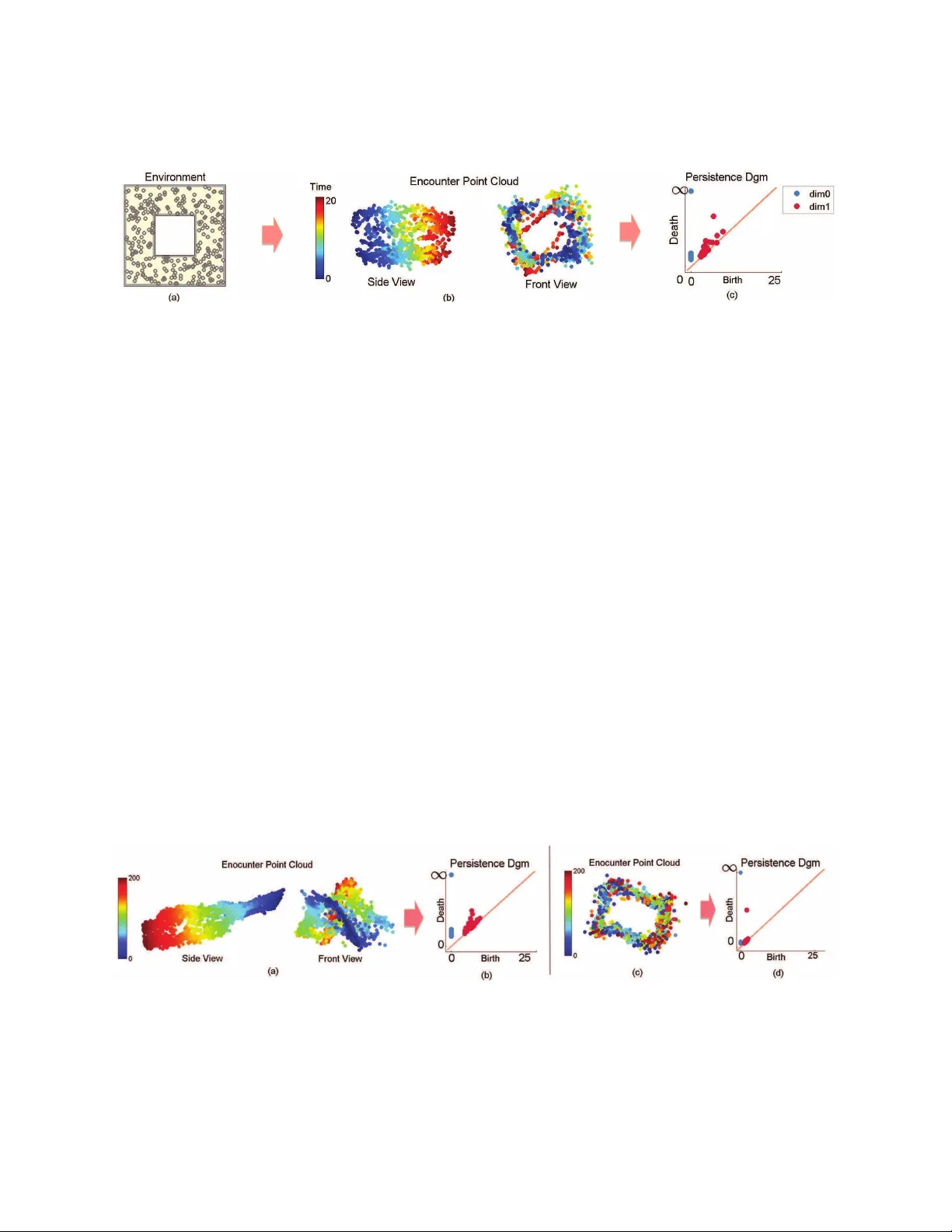
Robust T op ological F eature Extraction for Mapping of En vironmen ts using Bio-Inspired Sensor Net w orks Alireza Dirafzo on and Edgar Lobaton ∗ Abstract In this pap er, we exploit minimal sensing information gathered from biologically inspired sensor netw orks to p erform exploration and mapping in an unknown environmen t. A proba- bilistic motion mo del of mobile sensing nodes, inspired b y motion characteristics of cockroac hes, is utilized to extract w eak encounter information in order to build a top ological represen tation of the environmen t. Neigh bor to neighbor in teractions among the no des are exploited to build p oin t clouds representing spatial features of the manifold characterizing the environmen t based on the sampled data. T o extract dominan t features from sampled data, top ological data analy- sis is used to pro duce p ersistence interv als for features, to b e used for top ological mapping. In order to impro ve robustness characteristics of the sampled data with resp ect to outliers, density based subsampling algorithms are employ ed. Moreo v er, a robust scale-inv arian t classification algorithm for p ersistence diagrams is prop osed to provide a quantitativ e represen tation of de- sired features in the data. F urthermore, v arious strategies for defining encounter metrics with differen t degrees of information regarding agents’ motion are suggested to enhance the precision of the estimation and classification p erformance of the top ological metho d. ∗ Departmen t of Electrical Engineering, North Carolina State Universit y . Email: { adirafz, alp er.bozkurt, ejlo- bato } @ncsu.edu 1 1 In tro duction Sensor netw orks with their broad application in mapping and na vigation [1], habitat monitoring [2], exploration, and searc h and rescue [3], ha ve attracted a lot of atten tion in recent decades. Mobile sensor net works offer the flexibilit y to adapt with dynamic en vironments. As an example, sw arm rob otic systems, where mobilit y mo dels of agents are inspired by biological en tities, and eac h agen t is equipp ed with some type of sensing, are considered as mobile sensor net works whic h can p erform distributed sensing and estimation tasks. Emergen t b eha vior in animals such as formation[4], cov erage[5], and aggregation[6] hav e inspired scien tists to develop b eha vioral-based distributed systems. In some applications, ho wev er, the amoun t of information that could b e sensed or transferred b y the agen ts is limited. This motiv ates the design of distributed systems comp osed of simple agen ts with minimal sensing requiremen ts[7]. Consider for example a disaster zone resp onse scenario, where w e aim to p erform exploration and mapping of an unstructured and unkno wn en vironmen t using a mobile sensor net work. One may c ho ose to make use of a swarm of biologically inspired agen ts with minimal sensing capabilities to perform the task. How ev er, under suc h rough conditions of the terrain, lo calization information provided by the agen ts could b e very w eak and con tains a high amount of uncertain t y . Hence, traditional lo calization and mapping algorithms suc h as SLAM[8] would fail to p erform effectively . Metho ds from computational top ology , on the other hand, can provide to ols to extract top o- logical features from data sets without requiring co ordinate information. This makes them more suitable for scenarios in whic h weak or no localization is pro vided. T opological data analysis (TD A), in tro duced in [9], has been a new field of study whic h employs to ols from p ersisten t homology theory [10] to obtain a qualitative description of the top ological attributes and visualization of data sets sampled from high dimensional p oin t clouds. The p oin t cloud can b e though t of as finite samples tak en from a density map which ma y include noise. TD A represen ts the prominence of features in the p oin t cloud in terms of a compact representation of the multi-scale top ological structure called p ersistence diagrams[11]. It reduces the dimensions of data by construction of a filtration of com binatorial ob jects, which can represen t geometrical and topological features of the data set at Persistent Diag ra m 0 Birth Death (a) (b) (c) Figure 1: T op ologcal Mapping: (a) a physical environmen t with mobile sensing no des moving inspired by co c kroac hes, (b) an esimated p oin t cloud from co ordinate free information, (c) the corresp onding p ersistence diagram highlighting the features in dim 0 (blue dots) the features in dim 1 (red dots); significan t features can b e distinguished from noise using an appropriate threshhold. 2 sp ecific scales. T opological frameworks hav e b een used for c haracterization of cov erage and hole detection in sta- tionary sensor netw orks by using only proximit y information of the nodes within a neigh b orhoo d[12, 13]. Ho wev er, these studies mostly fo cused on netw orks with static nodes. Moreov er, they are mainly concerned ab out the co verage holes in the sensing domain of the netw ork rather than the top ology of the physical environmen t itself. Adding mobility to the no des in the netw ork makes the problem more c hallenging. One w ay to reduce such complexity is to lo ok for patterns created b y tracing the encounters of the no des instead of in vestigating the mobilit y data itself. W alk er [14] emplo yed p ersisten t homology to compute top ological in v arian ts from encounter data of the mobile no des in Mobile Ad-Hoc net works in order to infer global information regarding the top ology of a ph ysical en vironmen t, but the nodes are assumed to follow a simple mobilit y model on a graph. Con tribution: In this pap er, we aim to construct top ological maps of unknown environmen ts using bio-inspired mobile sensor net works under the constrain t of limited sensing information. In particular, w e consider agents whose mov emen t mo del is describ ed by the motion mo del of co c k- roac hes, which are experts to surviv e in harsh environmen ts. W e dev elop algorithms that do not dep end on any type of traditional lo calization schemes. Instead, we consider estimation of a topo- logical mo del for the environmen t based on limited information retrieved from the agen ts including their own status, and their encoun ters with other agents in their proximit y . W e prop ose v arious t yp es of metrics for the construction of p oin t clouds based on coordinate-free information that estimate top ological features of the environmen t. Moreov er, density based subsampling metho ds are used to deal with outliers pro duced as a result of uncertaint y in the estimated p oin t clouds. Computational top ology algorithms are used to extract dominance of these features in terms of p ersistence interv als. Ho wev er, suc h in terv als pro vide qualitativ e represen tation about lo w dimen- sional structures in the p oin t cloud. Hence, metho ds from machine learning and statistical data analysis recently hav e b een integrated with p ersistence analysis in order to mak e inference and in terpretation out of suc h interv als [15, 16]. In this study , we develop a density based classification algorithm to extract features from p ersistence interv als quantitativ ely in a robust manner to b e used in the construction of the topological map. The remainder of the pap er is organized as follows: A concise background on TDA is presented in section 2. Bio-inspired mobilit y mo del as well as sensing mo del for the no des are describ ed in section 3, follo w ed by a general ov erview of the prop osed mapping framework. Section 4 discusses the differen t metrics employ ed for construction of p oin t clouds. Subsampling techniques are described in section 5, and classification algorithm for dominan t features is prop osed in section 6. Finally , conclusion and future extensions of the presen ted w ork are discussed in Section 7. 2 Bac kground on TD A A brief in tro duction of some of the basic concepts in computational topology is presented here. A comprehensiv e review of the topic can b e found in [11]. One of the well-kno wn techniques widely used in top ological data analysis is p ersisten t homology , which deals with the wa y that ob jects are connected. T op ological structures of a space M are summarized as a compact representation in the form of so-called Betti n umbers, whic h are ranks of topological in v ariants, called homolo gy gr oups . The n -th Betti n umber, β n measures the num ber of n -dimensional cycles in the space (e.g. β 0 is 3 1 2 D e a t h B i r t h P e r s i s t e n t D i a g r a m 0 0 1 2 Figure 2: T op ological p ersistence: (a) An example of a topological space M with a sampled point cloud X , (b) a filtration of complexes ov er X , (c) the corresponding p ersistence diagram ( dgm 0 ( X ) in dark cyan and dgm 1 ( X ) in red) the n umber of connected comp onen ts and β 1 is the n umber of holes in the complex). The space M usually is not directly accessible but a sampled version of it, X , can b e used for computations. This sample is represented as a p oin t cloud, a finite set of p oin ts equipp ed with a metric, whic h can b e defined b y pairwise distances betw een the p oin ts. A standard method to analyze the top ological structure of a p oin t cloud is to map it in to com binatorial ob jects called simplicial c omplexes . One w a y to build these complexes is to select a scale , place balls of radius on each vertex, and construct simplices based on their pairwise distance relativ e to . A computationally efficient complex, called Vietoris-Rips complex [17] consists of simplices for whic h the distances b et ween each pair of its v ertices are at most . A sequence of complexes, called a filtration X ( ), then can b e obtained b y increasing ov er a range of interest, with the prop erty that if t < s then X ( t ) ⊂ X ( s ). P ersistent homology , computes the v alues for whic h the classes of top ological features appear ( b i n ) and disappear ( d i n ) during filtration, referred to as the birth and death v alues of the i -th class of features in dimension n . This information is enco ded into p ersistence interv als [ b i n , d i n ] or as a multiset of p oin ts ( b i n , d i n ), called a p ersistence diagram, dgm n ( X ). Algorithms for computation of p ersisten t homology can be found in [9, 18]. An example of a topological space M together with sampled data X and corresponding filtration o ver is sho wn in figure 2. The p ersisten t diagram infers the existence of one connected comp onent and one p ersisten t hole. 3 Problem F ormulation Consider a netw ork of mobile sensing agents in a b ounded environmen t D ∈ R d , eac h distinguished with their unique ID’s. W e assume that motion dynamics of the agen ts in a b ounded space mimic the mov emen ts of co c kroaches, as describ ed in the next subsection. Moreov er, we assume that the agen ts are provided with weak lo calization information, i.e. they can only identify the other agents within a certain radius, and no co ordination information is provided, which is describ ed in the follo wing subsection. 3.1 Bio-Inspired Mobilit y Mo del The mobilit y mo del is adopted from the probabilistic mo vemen t model of co c kroaches describ ed in [19]. Motion c haracteristics of the mobility model of the co ckroac hes can b e mainly describ ed by 4 their individual and group b eha viors. In this pap er, for the sak e of simplicit y , we skip the group b eha vior resulting from interactions among individuals. The individual behavior of cockroac hes dep ends on their relative distance to the boundaries of the arena. Specifically , when they are far from the b oundaries of the environmen t, their motion can be mo deled as a diffusiv e r andom walk (R W) with piecewise fixed orientation mov emen ts, c haracterized b y line segmen ts, in terrupted b y direction c hanges, and constant av erage v elo cit y of v c . The a v erage length of the line segmen ts l ∗ , is considered as the characteristic length of an exp onen tial distribution for the path lengths. As for angular reorien tation, w e assume an isotropic diffusion, where p ( θ new | θ current ) = p ( θ new ) characterized by a uniform distribution o v er (0 , 2 π ). When co c kroaches detect a part of the b oundary of D (through their antennas) they switch to a wal l fol lowing (WF) b eha vior with a constan t av erage velocity of v p . During wall follo wing, the agen ts might lea v e the b oundary to w ards the central partition randomly after a random time mo deled with an exp onen tial distribution with an a verage of τ exit seconds, and an angle of θ exit with resp ect to the tangen t vector to the b oundary distributed uniformly ov er [0 , π ]. Ho wev er, during their R W or WF mo vemen t, the agents probabilistically stop for some perio d of time and then contin ue their mo vemen t. The agents’ stopping behavior is modeled as a memory- less process describ ed b y an exponential distribution with a c haracteristic time τ stop , represen ting the av erage time elapsed b efore an agen t stops. Once an agent enters a stop mo de (S), it could either ha v e a short stop with a probability of p sh , or a long stop with the probabilit y of 1 − p sh . Each of these tw o stopping pro cesses are characterized b y exp onen tial distributions with characteristic times τ s and τ l , resp ectiv ely . More details on the probabilistic motion mo del and the parameters w e used can be found in [20]. 3.2 Sensing and Comm unication Lik ewise the mobilit y model, the sensing model is inspired b y limited sensing capabilities of co ck- roac hes combined with capacities added b y integration of wireless transmitter and receiver chips inserted in to their b o dy [21]. Sp ecifically , the no des can detect other agen ts as well as b oundaries of the en vironment within a detection radius of r d . Each agent is equipp ed with a unique ID and is able to record and transmit its o wn ID, the ID’s of the other agen ts in its detection neighborho o d, and corresp onding time of the o ccurrence of such encounters to the base station. F urthermore, the no des are able to report their status as b eing in a R W, WF, or S state. 3.3 Algorithm Ov erview The ov erall mapping algorithm is summarized as the following steps: Explor ation , Data Col le ction , Computing Enc ounter Metric , Subsampling , T op olo gic al Analysis and Visualization , and Classific a- tion . Exploration of the unkno wn en vironmen t is p erformed by the agen ts based on the probabilistic motion mo del describ ed in Subsection 3.1. Minimal sensing in the agents with no o dometry in- formation along with bandwidth and pow er constraints in harsh environmen ts, results in a lack of co ordinate information for the purp ose of environmen t mapping. How ever, for a co ordinate-free mobile netw ork, data asso ciated with the encoun ters b etw een agents can b e used instead of dealing directly with co ordinates of moving no des. Eac h agen t sends its lo cal encounter information to 5 (c) Figure 3: Construction of encounter complex: (a) Nodes (blue dots) mo ving on a circle S 1 and (b) their encoun ters ov er time (pink dots) in the encounter space (cylinder S 1 × R + ); (c) no des moving on an annulus and (c) their corresp onding encounter complex the base station, where this information is pro cessed to construct a metric, which we refer to as the estimated enc ounter metric , and the corresp onding enc ounter p oint cloud is built on the set of no des. The p oin t cloud is pro cessed to construct a filtration of simplicial complexes, denoted as enc ounter c omplexes . Figure 3 illustrates construction of encounter complex for a simplified motion of 8 agen ts o v er circular regions. Extracting top ological information from the whole p oin t cloud would b e computationally expen- siv e due to the large num b er of even ts that are created ov er time; hence a subsampling algorithm needs to b e used to reduce the computational complexity . A subset of the p oin t cloud is selected suc h that it p ossesses the same top ological prop erties as the original set, and exploited to construct a smaller filtration of complexes. P ersistent homology is then used to extract ordinary p ersistence in terv als for subsampled data. These interv als are then employ ed for feature extraction to wards building the en vironment map. W e used Rips complexes for construction of filtrations, and Diony- sus C++ library [22] for computation of persistent homology . Finally our prop osed densit y based classification tec hnique is used for robust feature extraction from the estimated p oin t cloud. F or visualization purposes, w e used Multi-Dimensional Scaling (MDS)[23] to obtain pro jections of the p oin t cloud on 3D Euclidean space. 4 Encoun ter Metric Let I denote the set of all of the IDs assigned to sensing nodes. F or moving no des in the netw ork, an enc ounter event E i o ccurs at time t i if ∃ I 1 i , I 2 i ∈ I suc h that k p ( I 1 i , t i ) − p ( I 2 i , t i ) k ≤ r d , where p : ( I , R ) 7→ R 2 is a co ordinate function suc h that p ( i, t ) is the p osition vector of the no de i at time t . The encoun ter E i is represented as a tuple E i = [ t i , I 1 i , I 2 i ] , (1) and its corresp onding ID set is defined as I i = { I 1 i , I 2 i } . T o build a distance metric on the set of encounter ev ents, w e construct an undirected w eighted graph G with v ertices corresp onding to the even ts E i , denoted as enc ounter gr aph . F or eac h t wo vertices E i and E j , they are considered connected if I i ∩ I j 6 = ∅ , and disconnected otherwise. The condition I i ∩ I j 6 = ∅ implies that there exist a no de k ∈ I which has encoun tered tw o other agents at times t i and t j at p ositions p i and p j , resp ectiv ely . Due to the sensing limitations, these co ordinates are not av ailable at the base station. Ho wev er, the Euclidean distance b et w een p i and p j is b ounded b y u ij = v m . | t i − t j | , where 6 sec Figure 4: (a) An environmen t with one hole, (b) the encounter p oin t cloud for data gathered ov er 20 seconds and (c) the p ersistence diagram v m = max ( v c , v p ). Therefore, one can assign a w eight prop ortional to u ij as a rough estimation of k p i − p j k to the undirected edge connecting E i and E j as w ij = ( | t i − t j | , if I i ∩ I j 6 = ∅ ∞ , otherwise . Now w e build a metric on G , denoted by D G , as [ D G ] i,j = d G ( E i , E j ) where d G ( E i , E j ) represen ts the length of the shortest path betw een nodes E i , E j in G . 4.1 Encoun ter T rac king Due to the fact that the agen ts can hav e probabilistic stops in our mo del, taking into accoun t every single encoun ter detection will result in redundant data. Therefore, we consider the encoun ters that tak e place only at the b eginning of a p erio d when t w o agen ts are in pro ximit y with each other for the whole interv al. Sp ecifically , the encoun ter ev ent E i o ccurs at time t i if (i) ∃ I 1 i , I 2 i ∈ I suc h that k p ( I 1 i , t i ) − p ( I 2 i , t i ) k ≤ r d , and (ii) ∃ t 0 ∈ [0 , t i ] such that k p ( I 1 i , t ) − p ( I 2 i , t ) k > r d for ∀ t ∈ [ t 0 , t i ). Figure 4 illustrates an example of a square en vironment with one hole inside on which 200 agen ts p erform exploration. The encoun ter p oint cloud, colored ov er time of sim ulation, (figure 4(b)) resem bles a noisy cylindrical tub e, and one can easily distinguish the hole in the corresp onding dgm 1 ( X ) (figure 4(c)). How ev er, as w e con tinue data collection for a longer time in terv al, the cycles in its t wo ends tend to get deformed and the p oin t cloud loses its cylindrical shap e (figure 5(a)). In this case, the hole is not distinguishable from noise in the corresp onding dgm 1 ( X ) (figure 5(b)). W e can justify this due to the accumulation of the errors in the encoun ter metric b ecause of the Figure 5: Comparison of the p oin t clouds obtained from encoun ter data collected ov er 200 seconds using (a) encoun ter metric in the mobile net work, (c) using con tracted metric on the h ybrid net work, and their corresp onding p ersistence interv als in (b) and (d), resp ectiv ely . 7 uncertain ty in pairwise distances o v er a long p erio d of time, which mak es the estimated p oin t cloud gradually lose the top ological structure existing in the real en vironment. Note that as it could be observ ed from figure 3(b), these encounters pro duce sampled p oin ts in the space of D × [0 , t f ], and collecting more observ ation ov er time do es not help the estimation of D but it makes it w orst. One solution to this problem w ould b e to consider p oin t clouds obtained from information o ver a shorter time frame that is still long enough to capture the correct structure. How ever, in practice, this w ould impose the requiremen t of tuning another parameter. In the following w e will sho w that b y adding an extra piece of information one can build more precise c ontr acte d p oin t clouds that carry correct top ological information without w orrying ab out time frames. 4.2 Con tracted Encoun ter Metric T o increase the precision of estimated pairwise distances in our metric, w e consider the fact that the agents stop probabilistically for some time in terv als, and keep trac k of stopp ed no des in the net work by asking the agen ts to transmit their change of moving status (R W, WF, or S). If tw o no des meet the third one during one of its stop interv als, w e infer the corresponding encoun ters ha v e o ccurred at the same lo cation. Hence we use this observ ation and improv e the metric as follows: Let T k = { T 1 k , T 2 k , . . . } b e the set of stop in terv als for agen t k , meaning that agent k has b een in S mo de for ∀ t ∈ T l k , ∀ l . F or t wo ev ents E i and E j , if I i ∩ I j = k and t i , t j ∈ T l k for some l , then we set w ij = 0 . W e refer to this metric as a c ontr acte d enc ounter metric as it con tracts the space of the corresp onding encoun ter p oin t cloud from D × [0 , t f ] to the low er dimension space of D . W e observ ed that con tracting the point cloud improv es the p erformance of the estimation in terms of more persistence features, but it still is not a complete embedding into a low er dimensional space as a result of the probabilistic nature of stop interv als of the agents. 4.3 A Hybrid Net w ork W e can also make further impro vemen ts ov er the estimated metric by incorp orating a few p ercen tage of static no des in the netw ork, whic h we refer to it as a hybrid network . The exploration task initiates with all no des starting in a R W status, and after a while, when the no des are disp ersed enough in the en vironment, a few p ercentage of them are commanded to stop as static no des. Now, let S ∈ I b e the set of indices for these static no des. Then w e mo dify the corresp onding w eights for t wo encoun ter ev ents E i and E j in case that I i ∩ I j 6 = ∅ as w ij = ( k t i − t j k , if I i ∩ I j / ∈ S 0 , if I i ∩ I j ∈ S . This configuration can b e used in case that the natural stop interv als of agen ts are not long enough to con tract the p oin t cloud space in to a prop er lo w er dimensional space. The resulting con tracted p oin t cloud and p ersistence diagrams for a hybrid netw ork with only %5 of static no des are sho wn in figure 4(c) and (d), which nicely infer the existence of the environmen t by a m uc h b etter separation b et w een the p ersisten t feature and the noise 8 (a) (b) (c) 0 2 4 6 8 10 Power Performance measure of subsampling methods 0 50 100 150 200 250 SNR P S P N Maxmin Prob. Maxmin KNN Filtr. (d) Maxmin Probabilistic Maxmin Death 0 Death Maxmin after KNN filtration Death Birth Birth Birth 0 0 0 Figure 6: Comparison of (a) standard maxmin subsampling, (b) maxmin ov er pre-filtered data, and (c) probablistic maxmin algorithm, and (d) their SNR p erformance for 100 independent runs 5 Subsampling In [20], w e used the well-kno wn maxmin landmark selection algorithm [24] for selecting a subset of p oin t cloud on which the complexes are built. Unfortunately , maxmin filtration is very sensitive to outliers as they are distant from the other p oin ts in the set and very prone to b e selected as the maximizers of the distance to the set of previously selected samples. Dealing with the outliers in real-w orld data analysis is of high imp ortance. One of the causes of the app earance of outliers in the estimated data sets is due to the estimation uncertain ties. In our problem, they o ccur as a result of inaccuracies in the estimation of encounter metric, which can b e observed in figures 4 and 5. W e propose t wo approaches to ov ercome this issue and impro ve the robustness of our mapping algorithm by enhanced filtration of the p oin t cloud. 5.1 KNN filtering In [25] nearest neigh b or densit y estimation is used for pre-filtration of the p oin t cloud. In our first approac h, we employ a k-nearest neighbors (KNN) filtration follow ed by a maxmin subsampling algorithm to select a subsample of p oin t cloud whic h preserves the top ological information of the actual space and is robust to outliers. Sp ecifically , for a point x i ∈ X , let d k ( x i ) denote the distance b et w een x i and it’s k-nearest neigh b or, and d k ( x i ) be the av erage distance to its k-nearest neighbors (in versely prop ortional to the local densit y of the point cloud around x i ). W e consider the densit y of all av erage distances o ver X as ρ k ( X ) and select the threshold τ q ,k to b e q -quantile of ρ k ( X ). Then we select a subset V of points v i suc h that d k ( v i ) < τ q ,k , ∀ v i ∈ V , which will remo v e outliers of X to a large exten t. Finally , w e apply the maxmin algorithm on the pre-filtered point cloud V to obtain a smaller subset V s for p ersistence analysis. 5.2 Probabilistic maxmin In the second approac h, we prop ose a single stage sequential probabilistic subsampling metho d, where the lo cal densities of the p oin t cloud are taken into account directly in sequen tial sample selection procedure rather than in a separate pre-filtration pro cess. W e select the first sample 9 x 1 ∈ X randomly; Then at each iteration, if L is the set of the previously selected landmarks, find a p oint l k ∈ X suc h that it maximizes α ( d ( l k , L ) , ρ k ( l k )), where α ( u, v ) is a scalar con tinuous function with the prop erties: α (0 , 0) = 0, and α ( u, . ) is an increasing function of u for a fixed v , α ( ., v ) is an increasing function of v for a fixed u . An appropriate example of such a function for our application is α ( u, v ) = u + ω v where ω is a constan t scalar. Figure 6(a-c) sho ws the subsampled point clouds of 150 p oints for a con tracted data set in along with their p ersistence diagrams with parameters q = 0 . 9 and k = 10. It confirms that the one dimensional feature is more p ersisten t using KNN filtration or our probabilistic maxmin subsampling than the standard maxmin approac h. As another example, a subsampled p oin t cloud from encoun ter information ov er a 2-hole square environmen t pro jected on 2D space is shown in figure 1. The p oints are colored according to the real p ositions of encoun ters in the en vironment, confirming that it nicely represen ts the structure of the en vironmen t. In order to compare the p erformance of landmark selection algorithms in presence of noise, we use a signal to noise ratio (SNR) measure as follo ws: F or a p oin t ( b i n , d i n ) in dgm, let l i n = [ b i n , d i n ] be the corresponding p ersistence interv al. Then | l i n | represen ts the vertical distance of the p oin t to the diagonal of dgm , and can b e considered as a rough measure of significance or noisiness of features. In other w ords, features with small v alues of | l i n | can b e considered as noise and the ones with larger v alues as signals, with some lev el of confidence [16]. Let L n = {| l 1 n | , ..., | l m n |} b e the set of all interv al lengths in dimension n sorted in non-decreasing order. Define the signal set as S n = {| l i n | ∈ L n | i < β n + 1 } and the noise set as the set difference N n = L n \S n . Then their corresp onding av erage pow ers can b e defined as P S n = P S n | l i n | 2 |S n | and P N n = P N n | l j n | 2 |N n | , and the signal to noise ratio as S N R = P S n P N n . A n umber of N indep endent subsampling runs can then be p erformed ov er the point cloud, and the a verage SNR can b e used as the p erformance measure of the subsampling metho d. The av erage SNR measure for the scenario in figure 4 after 100 runs is shown in figure 6(d)exp osing a great impro vemen t of SNR for these approaches ov er the standard maxmin algorithm. 6 Robust Classification of P ersistence In terv als Betti num bers summarize top ological features of a space M as num b ers. Ho wev er, for a sampled p oin t cloud X out of M , one usually constructs a filtration of simplicial complexes on X and analyzes v arying homology ov er a scale space. F or a dense enough sampled data, one can find a range of scales for which the homology of simplicial complexes is equal to the one for M [16]. Nonetheless, p ersistence interv als do not provide a quan titative represen tation of the top ology of the real space but only birth and death of the features ov er the scale space. F urthermore, we are in terested in feature extraction algorithms that are robust to scaling and outliers. In the following part, we prop ose a densit y based classification algorithm for p ersistence interv als with the purp ose of a scale inv arient and robust feature extraction metho d for sampled data sets. Consider again the p ersistence interv al lengths | l i n | . W e are interested in finding a threshold for dimension n , τ n suc h that all of the features with the prop ert y that | l i n | > τ n can b e considered as signals (see figure 7(d-e)). T o make the approac h scale in v arian t, we consider the densit y of in terv al lengths scaled by a q n quan tile, ρ q n ( l n ), and define the n -th Betti function as ˆ β n ( q n , ∆ n , τ n ) = P i 1 R + l i n l q n +∆ n − τ n , where l q n is the q n -quan tile of the density , ∆ n has b een added for dealing 10 0 1 2 3 0.5 0.75 1 # of holes SE Robustness to change in # of features 0.75 1 1.25 0.5 0.75 1 Scale SE Robustness to Scaling 0 3 6 9 0 20 40 Birth Death 0 25 0 ∞ Dgm ρ ( l 1 ) l 1 (c) Density of dgm 1 (d) (e) τ 1 (b) (a) Figure 7: Robust Classification of p ersistence interv als: (a) A 2-hole environmen t, (b) the extracted p ersistence diagram, (c) density of p ersistence in terv als with the appropriate threshold, (d) robustness of classification algorithm to scaling, and (e) to change in the num b er of features with singularities, and 1 R + ( . ) is the indicator function of R + . Let M = { M 1 , . . . , M m } denote a set of random spaces that hav e the same top ological c haracteristics as M , and X = { X 1 , . . . , X m } represen t the corresp onding set of sampled point clouds. Define the ( n, k )-th Betti function as ˆ β k n (Θ n ) = X i 1 R + l i,k n l k q n + ∆ n − τ n ! , and its corresp onding error function as e k n (Θ n ) = | ˆ β k n ( q n , ∆ n , τ n ) − β n | , where Θ n = ( q n , δ n , τ n ) defines the parameter space. Now our classification problem reduces to p erform an optimization algorithm to find the minimum of the cost functional F (Θ n ) = [ e 1 n (Θ n ) , ..., e m n (Θ n )] T 1 /m , i.e. the optimal parameter set is Θ ∗ n = arg min Θ n F (Θ n ). T o make the cost functional smooth for optimization purp oses, one can replace the indicator function 1 ( . ) with a sigmoid function σ α,l i n ( . ) where σ α,x 0 ( x ) = 1 1+ e − α ( x − x 0 ) . W e p erformed classification for dimension 1 interv als on a training data set consisting of 100 v ariations of the space sho wn in figure 7(a) with random placements of the tw o square holes in the space. Persistence diagram and the corresp onding density of in terv al lengths for one of the en vironments is shown in figure 7(b) and (c), resp ectively . The optimization process resulted in a minim um of F (Θ ∗ 1 ) = 0 . 03 with Θ ∗ 1 = (0 . 5 , 0 . 7 , 3 . 7). This result is not surprising as the 0 . 5-quantile of the density , which is the median of dataset, is kno wn to b e robust to outliers. T o in vestigate the p erformance of our classifier, we ev aluated F (Θ ∗ 1 ) for a v ariety of test sets X i , each containing 100 p oin t clouds with random feature placemen ts, with each test set differing in e ither scale of the en vironment and features or the num b er of features (holes). T o in vestigate the p erformance, w e used the sensitivity measure for classification, S E = T P / ( T P + F N ), where T P and F N denote the n um b er of true p ositiv es and false negatives, resp ectiv ely . The sensitivit y performance for these scenarios is summarized in figure 7 (d) and (e) for scaled environmen ts, and environmen ts with differen t num b ers of holes but the same scale, respectively . Note that w e ha ve ev aluated this measure for the whole mapping algorithm and not just for the classification part, which can justify the degradation in the p erformance for the 3-hole case, as w e observed that in 15% of the cases, the third hole could not b e retrieved from the p oin t cloud data. 11 7 Conclusion W e in tro duced encounter metrics for the construction of p oin t clouds that represent top ological features of unkno wn environmen ts based on minimal encoun ter information of mobile no des in a sensor netw orks whose mobility is inspired b y insects. W e enhanced the accuracy of the estimation with incorp orating differen t pieces of information in the construction of the metric. Moreo ver, w e emplo yed density based subsampling approaches to cop e with the outliers emerging due to uncertain ties in the p oin t cloud, and prop osed a classification for robust feature extraction out of p ersistence diagrams. F uture w ork includes v alidation of the proposed algorithms on sw arm robotic and biob otic systems as well as the quan tification of uncertain ties in top ological estimation. W e are also working on ho w one can extract features other than connected com ponents and holes from the encounter p oin t cloud can be exploited for a more precise mapping tec hnique. References [1] K. Kotay , R. Peterson, and D. Rus, “Experiments with rob ots and sensor net w orks for mapping and na vigation,” in Field and Servic e R ob otics , v ol. 25 of Springer T r acts in A dvanc e d R ob otics , pp. 243–254, 2006. [2] A. Main waring, D. Culler, J. P olastre, R. Szewczyk, and J. Anderson, “Wireless sensor net- w orks for habitat monitoring,” Pr o c e e dings of the 1st ACM international workshop on Wir eless sensor networks and applic ations - WSNA ’02 , pp. 88–97, 2002. [3] G. A. Kantor, S. Singh, R. Peterson, D. Rus, A. Das, V. Kumar, G. P ereira, and J. Splet- zer, “Distributed search and rescue with rob ot and sensor teams,” in The 4th International Confer enc e on Field and Servic e R ob otics , July 2003. [4] T. Balch and R. Arkin, “Behavior-based formation control for multirobot teams,” R ob otics and A utomation, IEEE T r ansactions on , v ol. 14, no. 6, pp. 926–939, 1998. [5] J. Cortes, S. Martinez, T. Karatas, and F. Bullo, “Cov erage con trol for mobile sensing net- w orks,” R ob otics and Automation, IEEE T r ansactions on , vol. 20, no. 2, pp. 243–255, 2004. [6] V. Gazi, “Sw arm aggregations using artificial p oten tials and sliding mode con trol,” in De cision and Contr ol, 2003. Pr o c e e dings. 42nd IEEE Confer enc e on , v ol. 2, pp. 2041–2046 V ol.2, 2003. [7] S. Gandhi, R. Kumar, and S. Suri, “T arget counting under minimal sensing: Complexit y and appro ximations,” in Algorithmic Asp e cts of Wir eless Sensor Networks (S. F ekete, ed.), v ol. 5389 of L e ctur e Notes in Computer Scienc e , pp. 30–42, Springer Berlin Heidelberg, 2008. [8] J. Aulinas, Y. Petillot, J. Salvi, and X. Llad´ o, “The slam problem: a survey ,” in Pr o c e e dings of the 2008 c onfer enc e on Artificial Intel ligenc e R ese ar ch and Development , pp. 363–371, 2008. [9] Edelsbrunner H., D. Letsc her, and A. Zomoro dian, “T op ological p ersistence and simplifica- tion,” Pr o c e e dings 41st Annual Symp osium on F oundations of Computer Scienc e , 2000. 12 [10] H. Edelsbrunner and J. Harer, “Persisten t homology-a survey,” Contemp or ary mathematics , v ol. 0000, pp. 1–26, 2008. [11] H. Edelsbrunner and J. Harer, Computational T op olo gy - an Intr o duction . American Mathe- matical So ciety , 2010. [12] R. Ghrist and a. Muhammad, “Cov erage and hole-detection in sensor net works via homology,” IPSN 2005. F ourth International Symp osium on Information Pr o c essing in Sensor Networks, 2005. , no. 1, pp. 254–260. [13] V. de Silv a and R. Ghrist, “Co verage in sensor net w orks via p ersisten t homology,” A lgebr aic & Ge ometric T op olo gy , vol. 7, pp. 339–358, 2007. [14] B. W alk er, “Using p ersistent homology to recov er spatial information from encoun ter traces,” in Pr o c e e dings of the 9th ACM international symp osium on Mobile ad ho c networking and c omputing, MobiHo c ’08 , p. 371, A CM Press, Ma y 2008. [15] E. Munch, P . Bendich, and K. T urner, “Probabilistic F r \ ’ { e } chet Means and Statistics on Viney ards,” arXiv pr eprint arXiv:1307.6530 , pp. 1–25, 2013. [16] S. Balakrishnan, B. F asy , and F. Lecci, “Statistical Inference F or P ersistent Homology,” arXiv pr eprint arXiv:1303.7117v1 , 2013. [17] E. Chambers, V. Silv a, J. Eric kson, and R. Ghrist, “Vietorisrips complexes of planar p oin t sets,” Discr ete and Computational Ge ometry , v ol. 44, no. 1, pp. 75–90, 2010. [18] A. Zomorodian and G. Carlsson, “Computing p ersisten t homology ,” Pr o c e e dings of the twen- tieth annual symp osium on Computational ge ometry - SoCG ’04 , p. 347, 2004. [19] R. Jeanson, C. Riv ault, J.-L. Deneubourg, S. Blanco, R. F ournier, C. Jost, and G. Theraulaz, “Self-organized aggregation in cockroac hes,” A nimal Behaviour , vol. 69, pp. 169–180, Jan. 2005. [20] A. Dirafzo on and E. Lobaton, “T op ological Mapping of Unknown En vironments using an Unlo calized Rob otic Sw arm,” in International Confer enc e on Intel ligent R ob ots and Systems (IR OS) , 2013, T o appear. [21] T. Latif and A. Bozkurt, “Line following terrestrial insect biob ots,” Engine ering in Me dicine and Biolo gy So ciety (EMBC), 2012 A nnual International Confer enc e of the IEEE , pp. 972–975, Aug. 2012. [22] D. Morozo v, “Dionysus library for p ersisten t homology .” Soft w are a v ailable at http://mrzv. org/software/dionysus . [23] T. F. C. M. Co x, Multidimensional Sc aling . Chapman and Hall / CRC, 2nd ed., 2000. [24] V. D. Silv a and G. Carlsson, “T op ological estimation using witness complexes,” Pr o c. Symp os. Point-Base d Gr aphics , 2004. 13 [25] G. Carlsson, T. Ishkhanov, V. Silv a, and A. Zomoro dian, “On the Lo cal Behavior of Spaces of Natural Images,” International Journal of Computer Vision , v ol. 76, pp. 1–12, June 2007. 14
Original Paper
Loading high-quality paper...
Comments & Academic Discussion
Loading comments...
Leave a Comment