Minimum-Time Quantum Transport with Bounded Trap Velocity
We formulate the problem of efficient transport of a quantum particle trapped in a harmonic potential which can move with a bounded velocity, as a minimum-time problem on a linear system with bounded input. We completely solve the corresponding optim…
Authors: Dionisis Stefanatos, Jr-Shin Li
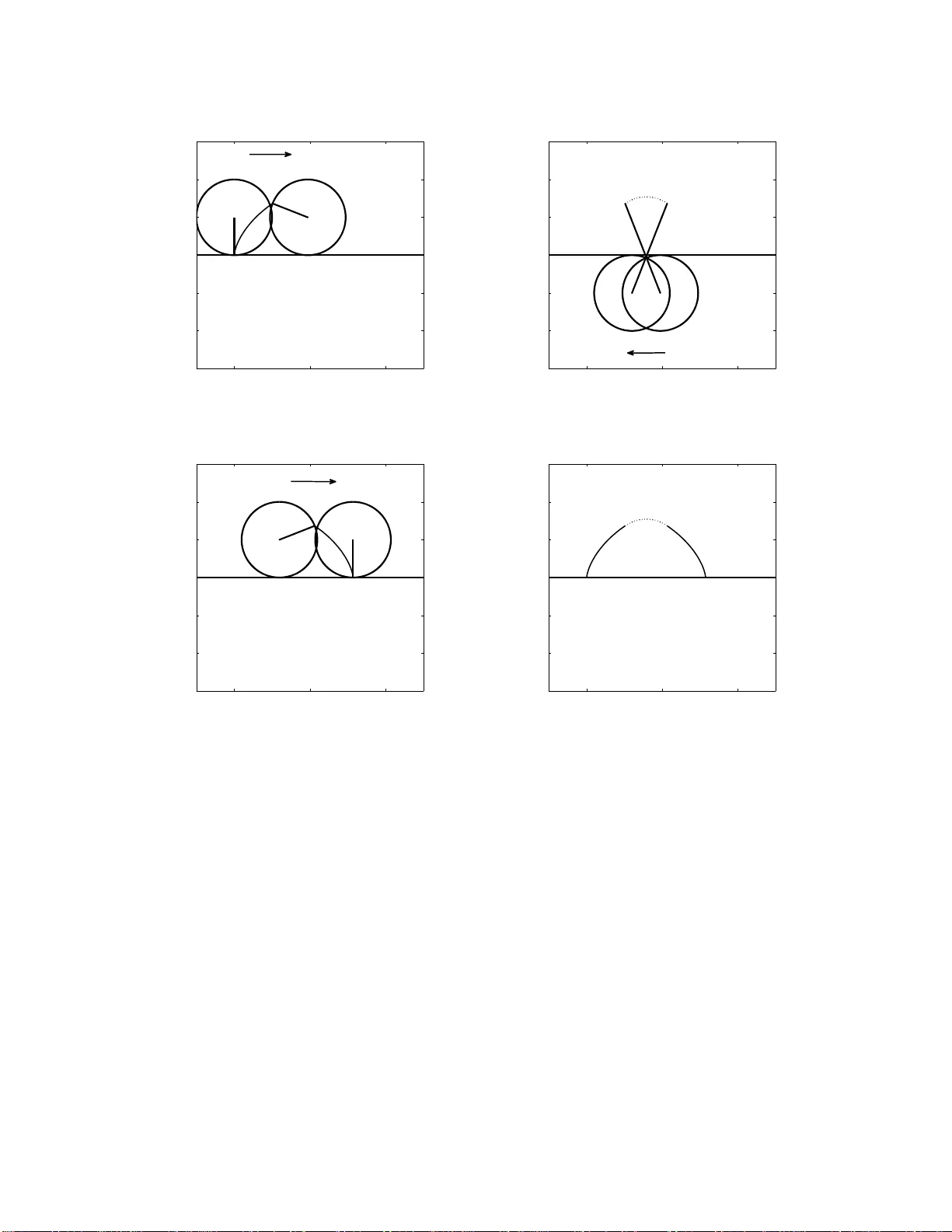
SUBMITTED TO IEEE TRANSA CTIONS ON A UTOMA TIC CONTR OL 1 Minimum-T ime Quantum T ransport with Bounded T rap V elocity Dionisis Stefanatos, Member , IEEE, and Jr -Shin Li, Member , IEEE, Abstract W e for mulate the problem of efficient transport of a quantum particle trapped in a harmonic potential which can m ove with a b ounded velocity , as a min imum-time pro blem o n a linear system with boun ded input. W e com pletely solve the cor respondin g optimal control prob lem and o btain an interesting bang- bang solu tion. These results are expected to fin d app lications in quantu m inform ation pro cessing, where quantum transpor t between the storage and pro cessing units o f a quantu m co mputer is an essential step. They can also be extend ed to the efficient transport of Bose-Einstein cond ensates, where the ability to control them is cr ucial for their poten tial use as interfer ometric sensors. Index T erms Quantum contro l, q uantum transport, linear systems, time- optimal control I . I N T R O D U C T I O N During the last decades, a w ealth of analytical and numerical tool s from control theory and opt imization hav e been successfull y employed to analyze and control the performance of quantum mechanical systems, adv ancing quantum technology in area s as diverse as physical chemistry , metrology , and quantum information processing [1]. Althou gh measurement-based feedback control [2], [3] and the promisin g cohere nt feedback control [4]–[6] have gained considerable attent ion, op en-loop control has been prov en qu ite effecti ve since it does no t require any quantum measurement, av oiding the ass ociated problems . Controllabil ity results for finite- and infini te-dimensional quantum mechanical s ystems have been obtained, clarifying the control D. St efanato s and J.- S. Li are wit h the Department of Electrical and Systems Engineering, W ashington Univ ersi ty , St. Louis, MO, 63130 US A, e-mail: dionisis@seas.wustl.edu, jsli@seas.wustl.edu. Nov ember 8, 2018 DRAFT SUBMITTED TO IEEE TRANSA CTIONS ON A UTOMA TIC CONTR OL 2 limits on these systems [7]–[9]. Some analytical solut ions for opt imal control probl ems defined on l ow- dimensi onal systems have been deriv ed, yielding novel pulse sequences with unexpected gains compared wit h those traditionall y us ed [10]–[23]. Numerical optimization methods, based on gradient algo rithms or d irect app roaches, h a ve als o been us ed intensively to address m ore complex tasks and to mini mize the effect of t he ubiqui tous experimental imperfections [24]–[31]. At the core of modern quantum technology l ies the problem of transfering trapped quantu m particles between operational s ites by moving the trapping po tential. For example, most of t he suggested architectures for the i mplementation of a q uantum comput er employ the t ransport of qubits from the st orage to the processor unit and back, s ee [32]. The transpo rt should be fast and “faithfull”, i.e., the final quantum state shou ld be equivalent to t he initial one up to a global phase factor . Ideally , the absence of the vibrational excitations at th e final site i s required. The high-fidelity transport that satisfies this no-heating condition i s characterized as frictionless . Note that frictionless quant um transp ort can be achiev ed by moving t he trapping potential sl owly in an adiabatic manner , where t he syst em foll ows th e inst antaneous eigen values and eigenstates of the t ime-dependent Hamilt onian. The drawback of th is method is the long necessary times which may render it impractical. A way to bypass this problem i s to prepare the same final states and energies as with the adiabatic process at a giv en final tim e, wi thout n ecessarily fol lowing the instant aneous eigenstates at each mo ment. The resultin g final state is faithfull while the intermediate states are not. This no nadiabatic regime, leading to sh orter transport times [33], provides a privile ged area for applying optimal control techniqu es. Numerical optimization methods have been us ed to calculate the optimal currents in a segmented Paul t rap for fast transport of ion s while sup- pressing vibrational heatin g [34], [35]. Fast quantum transport using optical t weezers, where the acceleration is altered in a bang-bang manner , has been demonstrated experimentally [36] and studied theoretically [37]. For a m oving harmonic potenti al, the li mits of faithfull transport with var ious types of imperfect controls ha ve bee n e valuated [38 ], while an in verse engineering method using Le wis-Riesenfeld in variants has been employed to achieve ef ficient quantum transp ort in short times [37 ]. In t he present article, we stud y the problem of m inimizing th e time of frictionless quantum transport in the case of a harmonic trap moving with a bounded velocity . This is di f ferent from the case examined in [36], where the acceleration rather than t he velocity is b ounded. A ph ysical Nov ember 8, 2018 DRAFT SUBMITTED TO IEE E TRANSACTIONS ON A UTOMA TIC CONTROL 3 system which can be modeled as a moving potenti al wi th bounded speed is the “magnetic con veyor belt” [39]. In this system, time-dependent currents in a lith ographic conductor pattern create a m oving chain of potential wells ; atoms are transported in these wells while remaining confined in all three di mensions. The speed of displacement can be contro lled by adjusti ng t he frequencies of t he modulating currents. In the next section we formu late the quantum transp ort with limi ted trap speed as a ti me-optimal control problem for a three-dimensional linear syst em with bounded i nput. Note that m ost of th e examples presented in the li terature are usually limited to two-dimensional systems, which allo w the vi sualization of the optimal sy nthesis on th e plane. The problem is completely solved in s ection III, where an interesti ng bang-bang sol ution is obtained. The present study complements our previous work on mi nimum-tim e frictio nless cooling of a quantum particle in a harmo nic potenti al [23 ]. I I . O P T I M A L C O N T RO L F O R M U L A T I O N O F T H E Q UA N T U M T R A N S P O RT P R O B L E M The ev olution of t he wa vefunction ψ ( x, t ) of a particle in a one-dimensional parabolic t rapping potential centered aroun d the moving point s ( t ) is given by the Schr ¨ odinger equati on [40] i ~ ∂ ψ ∂ t = − ~ 2 2 m ∂ 2 ∂ x 2 + mω 2 2 ( x − s ) 2 ψ , (1) where m is the particle mass and ~ is Planck’ s constant; x is a scalar that varies on some compact interval and ψ i s a s quare-integrable function on that interval. W e assume t hat the experimental setup is such th at there are essenti ally no spatial restrictions due to geom etrical constraints, for example the system is placed in the middle of a l ar ge enough vacuum chamb er . When s ( t ) = 0 , the above equation can be so lved by separation of variables and th e soluti on is ψ ( x, t ) = ∞ X n =0 c n e − iE n t/ ~ Ψ n ( x ) , (2) where E n = n + 1 2 ~ ω , n = 0 , 1 , . . . (3) are the eigenv alues and Ψ n ( x ) = 1 √ 2 n n ! mω π ~ 1 / 4 exp − mω 2 ~ x 2 H n r mω ~ x (4) are the eigenfun ctions of the corresponding tim e-independent equation − ~ 2 2 m d 2 dx 2 + mω 2 2 x 2 Ψ n = E n Ψ n . (5) Nov ember 8, 2018 DRAFT SUBMITTED TO IEE E TRANSACTIONS ON A UTOMA TIC CONTROL 4 x 0 d |c n (0)| 2 =|c n (T)| 2 Fig. 1. Schematic representation of the frictionless atomic transport. The harmonic trapping potential is displaced by d , while the populations of all t he oscillator lev els n = 0 , 1 , 2 , . . . at the final time are equal to the ones at the initial time. T he coefficients c n should be i ndepend ent of the spatial coordinate x . Here H n in (4) is the Hermite polynom ial of degree n . The coefficients c n in (2) can be fou nd from the in itial conditi on c n = Z ∞ −∞ ψ ( x, 0)Ψ n ( x ) dx. Consider now t he case where the trap is moving with a bounded velocity v ( t ) ∈ [ − V , V ] , V > 0 , ˙ s = v ( t ) . (6) If s (0) = 0 and s ( T ) = d , it corresponds to a displacement d of the syst em i n t he time interval [0 , T ] , see Fig. 1. For frictionless transport (no vibrational heating), the path s ( t ) sh ould be chosen so th at the popul ations of all the oscillator levels n = 0 , 1 , 2 , . . . for t = T are equal to the ones at t = 0 . In other words, if ψ ( x, 0) = ∞ X n =0 c n (0)Ψ n ( x ) , and ψ ( x, T ) = ∞ X n =0 c n ( T )Ψ n ( x − d ) , then frictionless t ransport is achieve d when | c n ( T ) | 2 = | c n (0) | 2 , n = 0 , 1 , 2 , . . . (7) Nov ember 8, 2018 DRAFT SUBMITTED TO IEE E TRANSACTIONS ON A UTOMA TIC CONTROL 5 This is shown schematically i n Fig. 1. W e em phasize that the coefficients c n should be inde- pendent of the spatial coordinate x . Among all the path s s ( t ) that result in (7), we would li ke to find the one that achieves frictionl ess transp ort in minimum t ime T . In the fol lowing we provide a s uf ficient conditi on on s ( t ) for frictionless transport and we use it to formulate the corresponding tim e-optimal cont rol problem . Pr opos ition 1: If s ( t ) , with s (0) = 0 and s ( T ) = d , is such that the equation ¨ a + ω 2 ( a − s ) = 0 (8) has a solution a ( t ) with a (0) = 0 , ˙ a (0) = 0 and a ( T ) = d, ˙ a ( T ) = 0 , then condition (7) for frictionless transport is satisfied. Pr oof : W i thout l oss of g enerality we assum e t hat the ini tial state is the eigenfunction corresponding to the n -th lev el ψ ( x, 0 ) = Ψ n ( x ) . W e will show that when the hypotheses of Propositio n 1 h old then ψ ( x, T ) = e iφ n ( T ) Ψ n ( x − d ) , where φ n ( T ) is a global (independent of the spatial coo rdinate x ) phase factor . This and the linearity of (1) im ply th at if ψ ( x, 0) = P ∞ n =0 c n (0)Ψ n ( x ) t hen ψ ( x, T ) = P ∞ n =0 c n (0) e iφ n ( T ) Ψ n ( x − d ) , thus condition (7) is satisfied. W e follow Leach [40] and consider th e “ansatz” ψ ( x, t ) = e i ( m ˙ a ~ x + φ n ) Ψ n ( x − a ) , (9) where a ( t ) satisfies (8) and t he accompanying boundary conditions, while φ n ( t ) is a functio n of time to be determin ed, with φ n (0) = 0 . Observe that (9) corresponds to a wav efunction centered around the moving point x = a ( t ) . The choice of a phase linearly dependent on the spatial coo rdinate becomes physically transparent i f we recall that th e m omentum operator is ˆ p = ( ~ /i ) ∂ /∂ x [41], so the phase f actor in (9) giv es rise to an av erage momentum h p i = m ˙ a . Note that because of the boundary cond itions, we hav e ψ ( x, 0) = Ψ n ( x ) and ψ ( x, T ) = e iφ n ( T ) Ψ n ( x − d ) for t = 0 and t = T , respectiv ely , therefore i t suffic es to show that (9) satisfies (1). Plugging (9) into (1), we obtain − ( m ¨ ax + ~ ˙ φ n )Ψ n ( χ ) = m ˙ a 2 2 − ~ 2 2 m ∂ 2 ∂ χ 2 + mω 2 2 ( x − s ) 2 Ψ n ( χ ) , (10) where χ = x − a . Since ( x − s ) 2 = χ 2 + 2( a − s ) x + s 2 − a 2 , (11) Nov ember 8, 2018 DRAFT SUBMITTED TO IEE E TRANSACTIONS ON A UTOMA TIC CONTROL 6 (10) becomes m [¨ a + ω 2 ( a − s )] x + ~ ˙ φ n − ~ 2 2 m ∂ 2 ∂ χ 2 + mω 2 2 χ 2 + m 2 [ ˙ a 2 + ω 2 ( s 2 − a 2 )] Ψ n ( χ ) = 0 . (12) The coefficient of x is zero because of (8). If we addit ionally use (5), then (12) becomes n ~ ˙ φ n + E n + m 2 [ ˙ a 2 + ω 2 ( s 2 − a 2 )] o Ψ n ( χ ) = 0 . (13) The following choice of φ n φ n ( t ) = − 1 ~ E n t + m 2 Z t 0 [ ˙ a 2 + ω 2 ( s 2 − a 2 )] dt (14) assures that (13 ) is satis fied, so (9) i s a solut ion of (1). W e express now the problem of mini mum-tim e friction less transp ort usi ng the language of optimal control. If we s et (recall that V is t he maxim um trap velocity) x 1 = ω V a, x 2 = ˙ a V , x 3 = ω V s, u ( t ) = v V , (15) and rescale time according to t new = ω t old , we obtain the following linear system w ith bou nded control, equiv alent to (6) and (8), ˙ x = Ax + u ( t ) b, (16) where now x = ( x 1 , x 2 , x 3 ) T and A = 0 1 0 − 1 0 1 0 0 0 , b = 0 0 1 . (17) The origin al transport problem i s transformed to the following t ime-optimal control probl em: Pr obl em 1: Find the control u ( t ) , | u | ≤ 1 , which driv es system (16) from (0 , 0 , 0) to ( γ , 0 , γ ) , γ = ω d/V > 0 , in minimu m tim e. The boundary cond itions on x are derive d from tho se on a (see propositi on 1) and s . Nov ember 8, 2018 DRAFT SUBMITTED TO IEE E TRANSACTIONS ON A UTOMA TIC CONTROL 7 I I I . T I M E - O P T I M A L S O L U T I O N A N D E X A M P L E S Before solvin g the optimal control problem , we establish the existence and uniqueness of the optimal solution using well k nown results for l inear time-optim al processes. The following two theorems refer t o the general linear syst em ˙ x = Ax + B u ( t ) , (18) where x ∈ R n , u ∈ U ⊆ R m , A ∈ R n × n , and B = [ b 1 | b 2 | . . . | b m ] ∈ R n × m ( b i ∈ R n ). Theor em 1 (Contr ollabil ity of li near systems with bounded contr ols): Suppose t hat A is s uch that all its eigen values have real parts equal to zero. Let U be any cont rol s et that is a neigh- borhood o f th e orig in in R m . Then the linear control s ystem wi th control s in U is con trollable whenev er S n − 1 k =0 { A k b j , j = 1 , . . . , m } spans R n (theorem 6, chapter 5 in [42]). Note that for the single-input case m = 1 , like th e system t hat we study in this article, the above theorem can be directly derived from the null controllabili ty conditions . Recall that the suffi cient conditions to be able to bring any initi al state of a single-in put linear system to zero (null controllabilit y) are that the Kalman matrix has rank n , t he control u = 0 belongs to the interior o f the control set, and the eigen values of matrix A satisfy Re ( λ i ) ≤ 0 [43]. The full controllabilit y requi res addition ally the null controllabil ity for the system wi th matrix − A , i.e., Re ( λ i ) ≥ 0 , so that the original sys tem with matrix A can be driven from zero to any final state. The requirements o f theorem 1, and especially that for Re ( λ i ) = 0 , are now obvious. Definition 1 (General posi tion condition): Let the control s et U be a conv ex, closed, and bounded p olyhedron i n R m . The matri ces A, B , and the set U satisfy t he general posit ion condition if for ev ery vector w , which has the di rection of one of th e edges of U , the vector B w has the pro perty that it does not belong to any proper subs pace of R n which is inv ariant under the operator A ; i.e., t he vectors B w , AB w , . . . , A n − 1 B w are li nearly independent. Theor em 2 (Existence and uniqueness for linear time-optimal pr ocesses): Let the control s et U be a con vex, closed, and bounded polyhedron in R m satisfying, along with mat rices A and B , the general po sition condition. If there exists at least one control which transfers the state o f the syst em between t wo point s, there als o exists a unique opti mal control t hat accomplis hes the same transfer (theorems 13 and 11 in [44 ]). Pr opos ition 2 (Existence and uniq ueness of the solution for problem 1): Problem 1 has a unique optimal soluti on. Nov ember 8, 2018 DRAFT SUBMITTED TO IEE E TRANSACTIONS ON A UTOMA TIC CONTROL 8 Pr oof : Matrix A in (1 7) has eigen values ± i, 0 wi th zero real parts , while span { b, Ab, A 2 b } = span { e 3 , e 2 , e 1 } = R 3 , where e i are the obviously defined unit vectors. Addit ionally , the control set U = [ − 1 , 1] contains the origi n. From theorem 1 we deduce that sys tem (16) with u ∈ U is control lable. So, there exists at least one control which drives t he system from t he initial to t he final point. The g eneral posi tion condi tion is equiv alent to the l inear in dependence of v ectors b, Ab, A 2 b , which is true. From theorem 2 we conclude that there e xists a uniq ue optimal control that accomplishes this transfer . Ha ving establ ished the existence and uni queness of a sol ution, we move to solve problem 1. For a constant λ 0 and a row vector λ ∈ ( R 3 ) ∗ the cont rol Hami ltonian for the s ingle-input linear system (16) is defined as H = H ( λ 0 , λ, x, u ) = λ 0 + λ ( Ax + ub ) . Pontryagin’ s Maximum Principle [44] provides the following necessary condit ions for optimality : Theor em 3 (Maximum pri nciple for lin ear time-optimal pr ocesses): Let ( x ∗ ( t ) , u ∗ ( t )) be a time- optimal cont rolled trajectory that transfers th e initi al cond ition x (0) = x 0 of syst em (16) i nto the terminal state x ( T ) = x T . Then it is a necessary conditi on for optimality that there exists a constant λ 0 ≤ 0 and nonzero, abso lutely continu ous ro w vector function λ ( t ) s uch that: 1) λ satisfies t he so-called adjoin t equation ˙ λ = − ∂ H ∂ x = − λA. 2) For 0 ≤ t ≤ T the function u 7→ H ( λ 0 , λ ( t ) , x ∗ ( t ) , u ) attains its maximum over t he control set U at u = u ∗ ( t ) . 3) H ( λ 0 , λ ( t ) , x ∗ ( t ) , u ∗ ( t )) ≡ 0 . Definition 2: A control u : [0 , T ] → [ − 1 , 1] is s aid to be a bang con trol if u ( t ) = +1 on [0 , T ] or u ( t ) = − 1 on [0 , T ] . A finit e concatenation of bang cont rols is called a bang-bang control . Pr opos ition 3: For problem 1 extremal controls are bang or bang-bang. The latter controls are 2 π -periodic. Pr oof : For system (16) with coefficients give n by (17) we hav e H ( λ 0 , λ, x, u ) = λ 0 + λ 1 x 2 + λ 2 ( x 3 − x 1 ) + λ 3 u, (19) Nov ember 8, 2018 DRAFT SUBMITTED TO IEE E TRANSACTIONS ON A UTOMA TIC CONTROL 9 and thus ˙ λ 1 = λ 2 , (20) ˙ λ 2 = − λ 1 , (21) ˙ λ 3 = − λ 2 . (22) Observe that H is a linear function of the bounded control variable u . The coefficient o f u in H is Φ = λ 3 , the so-called switching function . According to the m aximum principle, point 2 above, the opt imal control is given by u = si gn Φ , i f Φ 6 = 0 . From (20) and (22) we obtain λ 1 + λ 3 = c , a constant, so Φ = λ 3 = c − λ 1 . Also , from (20) and (21) we get ¨ λ 1 + λ 1 = 0 (harmonic oscillator), and then λ 1 ( t ) = A sin( t + θ ) , where A and θ are constants. Thus Φ( t ) = c − A sin ( t + θ ) . (23) The constants A and c cannot be sim ultaneously equal to zero since A = 0 im plies λ 1 = λ 2 = 0 and c = λ 1 = 0 im plies λ 3 = 0 , in contradictio n with maximum principl e which requires λ = ( λ 1 , λ 2 , λ 3 ) 6 = 0 . Thus th e extremal controls are obviously bang or bang-bang, with the latter being 2 π -periodic. There is a si mple way to visual ize the extremal t rajectories i n two dim ensions. It is based on the observation th at the projections of th ese trajectories on t he x 1 x 2 -plane are concatenations o f tr ochoids . Recall that a trocho id is the locus of a point at som e fixed dis tance from the center of a circle rolling on a fixed line. Indeed, if we set y 1 = x 1 − x 3 , y 2 = x 2 ∓ 1 , for u = ± 1 , then we find y 2 1 + y 2 2 = constant , for each tim e interval where the control is constant, and ˙ y 1 = y 2 , (24) ˙ y 2 = − y 1 . (25) From the last equ ations we find that t he angular velocity of the rollin g circle is ω c = 1 . The center of the circle is ( x 3 , ± 1) , so th e ho rizontal velocity is v c = | ˙ x 3 | = | u | = 1 and the radius is R c = v c /ω c = 1 . The circle rolls without slipping o n t he line x 2 = 0 . In Fig. 2 we pl ot an Nov ember 8, 2018 DRAFT SUBMITTED TO IEE E TRANSACTIONS ON A UTOMA TIC CONTROL 10 0 2 4 −3 −2 −1 0 1 2 3 x 1 x 2 O A (a) Fi rst part 0 2 4 −3 −2 −1 0 1 2 3 x 1 x 2 A B (b) Second part 0 2 4 −3 −2 −1 0 1 2 3 x 1 x 2 B C (c) Third part 0 2 4 −3 −2 −1 0 1 2 3 x 1 x 2 O A C B (d) T otal trajectory Fig. 2. Projection of the optimal trajectory on the x 1 x 2 -plane for γ = π . The circles with center ( x 3 , ± 1) that generate this projection by rolling on the line x 2 = 0 with velocity ˙ x 3 = u = ± 1 are also shown (a) The fi rst part O A is a cycloid (b) The second part AB is a prolate trochoid, since A lies outside the rolling disc (c) The last part B C is symmetric to t he first one (d) T otal trajectory . extremal trajectory with two s witchings, along w ith the rol ling circles th at generate it. The first part of th e trajectory , O A in Fig. 2(a), is a cycloid, since y 2 1 + y 2 2 = 1 = R 2 c . The circle generating this part has center ( x 3 , 1) and rolls to the righ t since ˙ x 3 = u = 1 > 0 . When the control s witches to u = − 1 , the center of the generating circle b ecomes ( x 3 , − 1) and it moves to the left, Fig. 2(b), since now ˙ x 3 = u = − 1 < 0 . The corresponding t rajectory part AB is a prolate t rochoid, since the m oving point lies o utside the roll ing disc. After the second switching, the center of Nov ember 8, 2018 DRAFT SUBMITTED TO IEE E TRANSACTIONS ON A UTOMA TIC CONTROL 11 the generating ci rcle becomes again ( x 3 , 1) and it rolls to the right, Fig. 2(c), generating again a cycloid B C . The total trajectory O AB C i s shown in Fig. 2(d). The t rochoids which compos e it are synchronized such that the center of the circle and th e po int ( x 1 , x 2 ) arriv e simult aneously at the poin ts ( γ , 1) and ( γ , 0) , respectively , so the final point in R 3 is ( γ , 0 , γ ) . Note that t here is a symm etry b etween the ini tial and the final part. As we shall see later , t his observation is the key for the optim al solution. In the ne xt proposition, we use the geometric in tuition developed abo ve to calcul ate the s ystem e volution under an extremal input. Lemma 1 (Main technical p oint): Let 0 = t 0 < t 1 < t 2 < · · · < t n = T . The alternating control input u ( t ) = ( − 1) j − 1 , t j − 1 < t < t j , j = 1 , . . . , n (26) driv es system (16) from the origi n x (0) = 0 to the point x ( t n ) with coordinates x 1 ( t n ) − x 3 ( t n ) = − sin( t n ) + 2 n − 1 X j =1 ( − 1) j − 1 sin( t n − t j ) (27) x 2 ( t n ) − ( − 1) n − 1 = − cos( t n ) + 2 n − 1 X j =1 ( − 1) j − 1 cos( t n − t j ) (28) x 3 ( t n ) = n X j =1 ( − 1) j − 1 ( t j − t j − 1 ) (29) The control − u ( t ) drives the sys tem to the sym metric point − x ( t n ) . Pr oof : Note first that sin ce ˙ x 3 = u , (29) is obvious for the input (26). In order to prove (27) and (28), we use the attached to t he rollin g circles “moving” coordinates y = ( y 1 , y 2 ) T , where y 1 = x 1 − x 3 , (30) y 2 = x 2 − ( − 1) j − 1 , (31) for t j − 1 < t < t j , j = 1 , . . . , n . Observe that in each ti me int erv al, y 1 and y 2 satisfy t he equ ations (24) and (25) of the harmonic oscill ator , so y ( t − j ) = R ( t j − t j − 1 ) y ( t + j − 1 ) , (32) where R ( τ ) is t he rotation matrix R ( τ ) = cos τ sin τ − sin τ cos τ . (33) Nov ember 8, 2018 DRAFT SUBMITTED TO IEE E TRANSACTIONS ON A UTOMA TIC CONTROL 12 When the control switches, there i s a discontinuit y in y 2 y ( t + j ) = y ( t − j ) + ( − 1) j − 1 0 2 , j = 1 , . . . , n − 1 (34) expressing th e change in the center o f the g enerating circle, ( x 3 , ± 1) → ( x 3 , ∓ 1) . Note that y (0 + ) = 0 − 1 (35) from the definiti on (30), (31) of y and the initial conditi on x (0) = 0 . For n = 1 we find from (32), (33) and (35 ) y ( t − 1 ) = R ( t 1 − t 0 ) y ( t + 0 ) = R ( t 1 ) y (0 + ) = − sin( t 1 ) − cos( t 1 ) , thus (27) and (28) hold. Now suppo se that they hold for n even (odd), so y ( t − n ) = − sin( t n ) + 2 P n − 1 j =1 ( − 1) j − 1 sin( t n − t j ) − cos( t n ) + 2 P n − 1 j =1 ( − 1) j − 1 cos( t n − t j ) . (36) But y ( t + n ) = y ( t − n ) + ( − 1) n − 1 0 2 = y ( t − n ) ∓ 0 2 , (37) where the m inus (plus) si gn in (37) correspon ds to n ev en (odd), and y ( t − n +1 ) = R ( t n +1 − t n ) y ( t + n ) . (38) Using (36), (37) and (33) in (38) we find y 1 ( t − n +1 ) = − sin( t n +1 − t n ) cos( t n ) − cos( t n +1 − t n ) sin( t n )+ 2 {∓ sin( t n +1 − t n ) + n − 1 X j =1 ( − 1) j − 1 [sin( t n +1 − t n ) cos( t n − t j ) + cos( t n +1 − t n ) sin( t n − t j )] } = − sin( t n +1 ) + 2[( − 1) n − 1 sin( t n +1 − t n ) + n − 1 X j =1 ( − 1) j − 1 sin( t n +1 − t j )] = − sin( t n +1 ) + 2 n X j =1 ( − 1) j − 1 sin( t n +1 − t j ) . Nov ember 8, 2018 DRAFT SUBMITTED TO IEE E TRANSACTIONS ON A UTOMA TIC CONTROL 13 and y 2 ( t − n +1 ) = sin( t n +1 − t n ) sin( t n ) − cos( t n +1 − t n ) cos( t n )+ 2 {∓ cos( t n +1 − t n ) + n − 1 X j =1 ( − 1) j − 1 [cos( t n +1 − t n ) cos( t n − t j ) − sin( t n +1 − t n ) sin( t n − t j )] } = − cos ( t n +1 ) + 2[( − 1) n − 1 cos( t n +1 − t n ) + n − 1 X j =1 ( − 1) j − 1 cos( t n +1 − t j )] = − cos ( t n +1 ) + 2 n X j =1 ( − 1) j − 1 cos( t n +1 − t j ) . The induction step has been proved. T o prov e the last statement in the lemma we use the variation of constants formula [45] for the linear s ystem (16), which for x (0) = 0 gives x ( t ) = Z t 0 u ( σ ) e A ( t − σ ) b dσ. Obviously , the control − u ( t ) driv es the system to the symm etric point − x ( t n ) . Theor em 4 (Optimal sol ution): For the final poin t ( γ , 0 , γ ) , with 2( ρ − 1 ) π < γ < 2 ρπ , ρ = 1 , 2 , . . . , problem 1 has a un ique optimal soluti on with 2 ρ swit chings u ( t ) = ( − 1) j − 1 , t j − 1 < t < t j , j = 1 , . . . , 2 ρ + 1 , (39) where the constant cont rol time interv als τ j = t j − t j − 1 are such that the i nitial and final intervals are equal τ 1 = τ 2 ρ +1 = τ and are gi ven by the s olution of the following transcendental equatio n 2 τ + 2( ρ − 1 ) π − γ 2 ρ − 1 = 2 tan − 1 sin τ 2 ρ − cos τ , (40) while the i ntermediate intervals are τ 2 k = 2 τ + 2( ρ − 1) π − γ 2 ρ − 1 , k = 1 , . . . , ρ (41) and τ 2 k + 1 = 2 π − τ 2 k + 2 = 2 ρπ − 2 τ + γ 2 ρ − 1 , k = 1 , . . . , ρ − 1 . (42) The total m inimum transfer tim e is t 2 ρ +1 = 4 ρ [ τ + ( ρ − 1) π ] − γ 2 ρ − 1 . (43) For γ = 2 ρπ the optim al control is u ( t ) = 1 and t 2 ρ +1 = 2 ρπ . Nov ember 8, 2018 DRAFT SUBMITTED TO IEE E TRANSACTIONS ON A UTOMA TIC CONTROL 14 Pr oof : W e st udy first the bang-bang e xtremals. Consider an e xtremal control of the form ( 26) with 2 ρ switchings. From lem ma 1 we hav e that the final st ate satisfies the t erminal condi tion x ( t 2 ρ +1 ) = ( γ , 0 , γ ) T when − sin( t 2 ρ +1 ) + 2 2 ρ X j =1 ( − 1) j − 1 sin( t 2 ρ +1 − t j ) = 0 , (44) − cos( t 2 ρ +1 ) + 2 2 ρ X j =1 ( − 1) j − 1 cos( t 2 ρ +1 − t j ) + 1 = 0 , (45) 2 ρ +1 X j =1 ( − 1) j − 1 ( t j − t j − 1 ) = γ . (46) If we mu ltiply (44) by i = √ − 1 and add (45) we o btain − e it 2 ρ +1 + 2 2 ρ X j =1 ( − 1) j − 1 e i ( t 2 ρ +1 − t j ) + 1 = 0 . (47) W e express t his relation using the const ant control time intervals τ k = t k − t k − 1 . Due to the sinusoidal form wit h period 2 π of the switching functio n (23), for a bang-bang control it is 0 < τ k < 2 π , k = 1 , . . . , 2 ρ + 1 , as well as τ k + τ k +1 = 2 π for k = 2 , 3 , . . . , 2 ρ − 1 and ρ ≥ 2 . Also τ 2 k are equal for k = 1 , 2 , . . . , ρ and ρ ≥ 2 , whi le τ 2 k + 1 are equal for k = 1 , 2 , . . . , ρ − 1 and ρ ≥ 3 . Using these relations, the tim es appearing in (47 ) can be expressed as follows t 2 ρ +1 = 2 ρ +1 X k =1 ( t k − t k − 1 ) = 2 ρ +1 X k =1 τ k = τ 1 + 2( ρ − 1) π + τ 2 ρ + τ 2 ρ +1 (48) and t 2 ρ +1 − t j = 2 ρ +1 X k >j ( t k − t k − 1 ) = 2 ρ +1 X k >j τ k = (2 ρ − j − 1) π + τ 2 ρ + τ 2 ρ +1 , j odd (2 ρ − j ) π + τ 2 ρ +1 , j ev en . (49) Using (48) and (49) in (47) we obtain − e i ( τ 1 + τ 2 ρ + τ 2 ρ +1 ) + 2 ρe i ( τ 2 ρ + τ 2 ρ +1 ) − 2 ρe iτ 2 ρ +1 + 1 = 0 , which leads t o e iτ 2 ρ = 2 ρ − e − iτ 2 ρ +1 2 ρ − e iτ 1 . (50) By taking th e absolute value on both sides in the above equation we ob tain cos τ 1 = cos τ 2 ρ +1 ⇒ τ 1 = τ 2 ρ +1 or τ 1 = 2 π − τ 2 ρ +1 . Nov ember 8, 2018 DRAFT SUBMITTED TO IEE E TRANSACTIONS ON A UTOMA TIC CONTROL 15 Under the second choice, (50) takes the form e iτ 2 ρ = 1 which has no solut ion in (0 , 2 π ) . So τ 1 = τ 2 ρ +1 , τ , 0 < τ < 2 π . (51) Using (51), (50) becomes e iτ 2 ρ = e i 2 φ , φ = ta n − 1 sin τ 2 ρ − cos τ , (52) where the range of tan − 1 is taken to be ( − π / 2 , π / 2) . For 0 < τ 2 ρ < 2 π , (52) implies τ 2 ρ = 2 φ, 0 < τ < π ( φ > 0) τ 2 ρ = 2 π + 2 φ , π ≤ τ < 2 π ( φ ≤ 0 ) . (53) By expressing (46) in terms of τ k and using (51 ) and th e other relation s for th ese time int erv als we obtain 2 ρ +1 X k =1 ( − 1) k − 1 ( t k − t k − 1 ) = 2 ρ +1 X k =1 ( − 1) k − 1 τ k = 2 τ − ρτ 2 ρ + ( ρ − 1 )(2 π − τ 2 ρ ) = γ , so τ 2 ρ = 2 τ + 2( ρ − 1 ) π − γ 2 ρ − 1 . (54) Using (52) and (54), (53) becomes f ρ ( τ ) = 0 , 0 < τ < π f ρ ( τ ) − 2 π = 0 , π ≤ τ < 2 π , (55) where f ρ ( τ ) = 2 τ + 2( ρ − 1 ) π − γ 2 ρ − 1 − 2 tan − 1 sin τ 2 ρ − cos τ . (56) It is f ′ ρ ( τ ) = 2 1 2 ρ − 1 − 2 ρ cos τ − 1 4 ρ 2 − 4 ρ cos τ + 1 > f ′ ρ (0) = 0 , 0 < τ < 2 π . (57) Note that the above deriv ative attains its minim um value when the s econd fraction in t he parenthesis is maximi zed. This happens for cos τ = 1 , wh ich maximizes the numerator and minimizes the deno minator . From the abov e i nequality we conclud e that f ρ ( τ ) is mo notonically increasing in the interval (0 , 2 π ) . Since, additionall y , f ρ (0) = 2( ρ − 1) π − γ 2 ρ − 1 , f ρ ( π ) = 2 ρπ − γ 2 ρ − 1 Nov ember 8, 2018 DRAFT SUBMITTED TO IEE E TRANSACTIONS ON A UTOMA TIC CONTROL 16 we observe that for 2( ρ − 1 ) π < γ < 2 ρπ , ρ = 1 , 2 , . . . , t he equation f ρ ( τ ) = 0 has a unique solution in (0 , π ) . On the other hand, f ρ ( π ) − 2 π = 2(1 − ρ ) π − γ 2 ρ − 1 , f ρ (2 π ) − 2 π = 2(2 − ρ ) π − γ 2 ρ − 1 . Note that f ρ ( π ) − 2 π < 0 for ρ = 1 , 2 , . . . and γ > 0 , whi le f ρ (2 π ) − 2 π < 0 for ρ = 2 , 3 , . . . and γ > 0 . Only for ρ = 1 and 0 < γ < 2 π it is f 1 (2 π ) − 2 π > 0 and then equation f 1 ( τ ) − 2 π = 0 has a solutio n in ( π , 2 π ) . Comparing this with the solut ion of f 1 ( τ ) = 0 for 0 < γ < 2 π and using (48), (51) and (54), we find that in bot h cases the total time is 4 τ − γ so the latter solutio n, which lies in (0 , π ) , corresponds t o a s horter path. Now consider an extremal control of the form (26) with 2 ρ − 1 s witchings. W orking as above we find − e it 2 ρ + 2 2 ρ − 1 X j =1 ( − 1) j − 1 e i ( t 2 ρ − t j ) − 1 = 0 , (58) where now t 2 ρ = 2 ρ X k =1 ( t k − t k − 1 ) = 2 ρ X k =1 τ k = τ 1 + 2( ρ − 1) π + τ 2 ρ (59) and t 2 ρ − t j = 2 ρ X k >j ( t k − t k − 1 ) = 2 ρ X k >j τ k = (2 ρ − j − 1) π + τ 2 ρ , j odd (2 ρ − j − 2) π + τ 2 ρ − 1 + τ 2 ρ , j ev en . (60) Using (59) and (60), (58) becomes − e i ( τ 1 + τ 2 ρ ) + 2 ρe iτ 2 ρ − 2( ρ − 1) e i ( τ 2 ρ − 1 + τ 2 ρ ) − 1 = 0 , which leads t o e iτ 1 + 2( ρ − 1) e iτ 2 ρ − 1 + e − iτ 2 ρ = 2 ρ. (61) Observe that this equality hol ds only if the tim e i nterva ls τ 1 , τ 2 ρ and τ 2 ρ − 1 are integer multiples of 2 π , w hich is n ot the case since they take values in the interval (0 , 2 π ) . Next we consid er the e xt remal control − u ( t ) , where u ( t ) is of the form (26) with 2 ρ swit chings and 0 < τ k < 2 π , k = 1 , . . . , 2 ρ + 1 . It is not hard to check that (50)-(53) remain va lid, but now 2 ρ +1 X k =1 ( − 1) k − 1 ( t k − t k − 1 ) = 2 ρ +1 X k =1 ( − 1) k − 1 τ k = 2 τ − ρτ 2 ρ + ( ρ − 1 )(2 π − τ 2 ρ ) = − γ , Nov ember 8, 2018 DRAFT SUBMITTED TO IEE E TRANSACTIONS ON A UTOMA TIC CONTROL 17 and hence τ 2 ρ = 2 τ + 2( ρ − 1 ) π + γ 2 ρ − 1 . (62) Using (52) and (62), (53) becomes g ρ ( τ ) = 0 , 0 < τ < π g ρ ( τ ) − 2 π = 0 , π ≤ τ < 2 π , (63) where g ρ ( τ ) = 2 τ + 2( ρ − 1 ) π + γ 2 ρ − 1 − 2 tan − 1 sin τ 2 ρ − cos τ . (64) Since g ′ ρ ( τ ) = f ′ ρ ( τ ) > 0 , 0 < τ < 2 π , (65) g ρ ( τ ) is monoto nically increasing in the i nterva l (0 , 2 π ) . Howe ver , since γ > 0 , it i s also g ρ (0) = 2( ρ − 1) π + γ 2 ρ − 1 > 0 , g ρ ( π ) = 2 ρπ + γ 2 ρ − 1 > 0 and the equation g ρ ( τ ) = 0 has no solut ion in (0 , π ) . On the other hand, if τ is a sol ution of the equation g ρ ( τ ) − 2 π = 0 , π ≤ τ < 2 π , t hen τ 2 ρ + τ 2 ρ +1 = 2 τ + 2( ρ − 1 ) π + γ 2 ρ − 1 + τ = (2 ρ + 1) τ + 2( ρ − 1) π + γ 2 ρ − 1 ≥ (2 ρ + 1) π + 2( ρ − 1) π + γ 2 ρ − 1 = (4 ρ − 1) π + γ 2 ρ − 1 > (4 ρ − 1) π 2 ρ − 1 > (4 ρ − 2) π 2 ρ − 1 = 2 π , and the resulting control does n ot correspond to an extremal since it should be τ 2 ρ + τ 2 ρ +1 ≤ 2 π . For an e xtremal control − u ( t ) , where u ( t ) of the form (26), with 2 ρ − 1 switchings and 0 < τ k < 2 π , k = 1 , . . . , 2 ρ , it is not hard to check that (61) remains valid, s o there is no extremal control sequence of this form. Finally we study the bang extremals. Th e constant control u ( t ) = 1 drives the system to the points (2 ρπ , 0 , 2 ρπ ) at t = 2 ρπ , ρ = 1 , 2 , . . . It is the only extremal control that achie ves this transfer , thus it is time optimal. Note t hat u ( t ) = − 1 dri ves the system to the points ( − 2 ρπ , 0 , − 2 ρπ ) at t = 2 ρπ , ρ = 1 , 2 , . . . The proof of the theorem is now comp lete. Relations (41) and (42) are deri ved using (54), while (43) is easily obtained from (48) using (51) and (54). Nov ember 8, 2018 DRAFT SUBMITTED TO IEE E TRANSACTIONS ON A UTOMA TIC CONTROL 18 0 2 4 6 0 0.2 0.4 0.6 0.8 1 x 1 x 2 (a) Four swit chings 0 5 10 0 0.5 1 1.5 x 1 x 2 (b) S ix switchings Fig. 3. Projections of the optimal trajectories on the x 1 x 2 -plane for (a) γ = 2 . 4 π and (b) γ = 4 . 4 π . Solid (dotted) line corresponds to u = 1 ( u = − 1 ). 0 10 20 30 0 5 10 15 20 25 30 γ t 2 ρ +1 (a) 0 2 4 6 0 1 2 3 4 5 6 γ t 2 ρ +1 (b) Fig. 4. (a) Minimum time t 2 ρ +1 as a function of γ ∈ [0 , 10 π ] (b) ¯ t 2 ρ +1 = t 2 ρ +1 − 2( ρ − 1) π as a function of ¯ γ = γ − 2( ρ − 1) π , ¯ γ ∈ [0 , 2 π ] , where dashed (solid) line correspond s to ρ = 1 ( ρ → ∞ ). In Fig. 3 we plot the projections of the optim al trajectories on the x 1 x 2 -plane for γ = 2 . 4 π and γ = 4 . 4 π . In Fig. 4(a) we plot the m inimum ti me to reach the final point ( γ , 0 , γ ) as a function of γ ∈ [0 , 10 π ] . It is tempti ng to think t hat t he plot segments for 2( ρ − 1) π < γ < 2 ρπ are translations of the initial segment ( 0 < γ < 2 π ) by 2 ( ρ − 1) π in both axes. But t his is not Nov ember 8, 2018 DRAFT SUBMITTED TO IEE E TRANSACTIONS ON A UTOMA TIC CONTROL 19 the case, as we sh all immediately see. Let ¯ γ = γ − 2( ρ − 1) π , (66) ¯ t 2 ρ +1 = t 2 ρ +1 − 2( ρ − 1) π . (67) The transcendental equati on (40) can be expressed as τ − ¯ γ / 2 2 ρ − 1 − ta n − 1 sin τ 2 ρ − cos τ = 0 , (68) while (43) gives ¯ t 2 ρ +1 = 4 ρτ − ¯ γ 2 ρ − 1 . (69) In the lim it ρ → ∞ , (68) becomes τ − sin τ − ¯ γ / 2 = 0 , (70) and ¯ t 2 ρ +1 → 2 τ . (71) In Fig. 4(b) we plot ¯ t 2 ρ +1 as a function of ¯ γ ∈ [0 , 2 π ] for ρ = 1 (dashed line) and for ρ → ∞ (solid line). The segments in Fig. 4(a) approach the limiti ng case as ρ increases. I V . C O N C L U S I O N In this article, we formulated the problem of effic ient transport o f a quantum particle trapped in a harmonic potential moving with a bounded sp eed, as a m inimum-t ime probl em on a linear syst em wi th bounded inpu t. W e completely solved the correspondi ng optimal control problem, obtaining an interesting bang-bang solution. Similar app roach can b e followed for the problem of atom stoppi ng or launching. Additional restrictions on the control, reflecting possible experimental lim itations, can be in corporated in the current analysis. The compl exity of the result ing opti mal control problems, which may increase t he difficulty of the anal ytical s tudy , can be overcome by using a powerful state of the art numerical optimi zation method based on pseudospectral approxim ations [26], [29], [30]. The results obtained h ere are expected to find application in quant um informati on processi ng, where quantum transpo rt bet ween operational sites i s an indisp ensable s tep. They can also be immediately e xtended to the efficient transp ort of Bose-Einstei n condensat es [46], where the ability to control the condensates is crucial for their potent ial use as interferometric sensors [47], [48]. Nov ember 8, 2018 DRAFT SUBMITTED TO IEE E TRANSACTIONS ON A UTOMA TIC CONTROL 20 A C K N OW L E D G M E N T The authors would l ike to th ank Prof. J. G. Muga, for bringi ng the problem of quant um trans- port in their attention, and Prof. H. Schaettler , for numerous va luable comments and especially for poin ting out that there must be an elegant proof, based on g eometric intuit ion, of propositi on 1. R E F E R E N C E S [1] H. Mabuchi and N. Khaneja, “Principles and applications of control in quantum systems”, Int. J. Robust Nonlinear Contr ol , vol. 15, pp. 647–667 , 2005. [2] H. M. Wiseman and G. J. Milb urn, “Quantum theory of optical feedbac k via homodyne detection”, Phys. Rev . Lett. , v ol. 70, pp. 548–551, 1993. [3] A. C. Doherty , S. Habib, K. Jacobs, H. Mabuchi, and S. M. T an, “Quantum feedback control and classical control theory”, Phys. Rev . A , vol. 62, 012105, 2000 . [4] H. M. Wiseman and G. J. Milburn , “ All-optical ve rsus electro-optical quantum-limited feedba ck”, P hys. Rev . A , v ol. 49, pp. 4110–4125, 1994 . [5] S . Lloyd, “Coherent quantum feedback”, Phys. Rev . A , vol. 62, 022108, 2000. [6] M. R. James, H. I. Nurdin, and I . R. Petersen, “ H ∞ control of linear qua ntum stochastic systems”, IEEE T rans. Autom. Contr ol , vo l. 53, no. 8, pp. 1787– 1803, Sep. 2008. [7] G. M. Huang, T . J. T arn, and J. W . Clark, “On the controllability of quan tum-mechanical systems”, J. Math. Phys. , vol. 24, pp. 2608–2618, 1983. [8] J. -S. Li and N. Khaneja, “Ensemble control of B loch equations”, IEEE T rans. Autom. C ontr ol , vol. 54, no. 3, pp. 528–536, Mar . 2009. [9] A. M. Bloch, R. W . Brockett, and C. Rangan, “Fi nite controllability of infinite-dimensional quantum systems, IEEE Tr ans. Autom. Contr ol , vo l. 55, no. 8, pp. 1797–1 805, Aug. 2010. [10] D. D’Alessandro and M. Dahleh, “Optimal control of two-le vel quantum systems”, IE EE Tr ans. Autom. Control , vol. 46, no. 6, pp. 866–876 , Jun. 20 01. [11] N. Khaneja, R. B rocke tt, and S. J. Gl aser , “T i me optimal control in spin systems”, Phys. Rev . A , vol. 63, 032308, 2001. [12] U. Boscain, G. Charlot, J.-P . Gauthier , S. Guerin, and H.-R. Jauslin, “Optimal control in laser-induced population transfer for two- and three-le vel quantum systems”, J . Math. Phys. , vol. 43, pp. 2107–2132, 2002. [13] S. E. Sklarz, D. J. T annor , and N. Khaneja, “Optimal control of quantum dissipativ e dynamics: Analytic solution for cooling the three-le vel Λ system”, Phys. Rev . A , vol. 69, 053408, 2004. [14] D. Stefanatos, N. Khaneja, and S. J. Glaser , “Optimal control of coupled spins in the presence of longitudinal and transverse relaxation”, Phys. Rev . A , v ol. 69, 022 319, 2004. [15] D. Stefanatos, S . J. Glaser , and N. Khaneja, “Relaxation-optimized tr ansfer of spin order in Ising spin chains”, Phys. Rev . A , vol. 72, 062320, 2005. [16] U. Boscain and P . Mason, “Time minimal trajectories for a spin-1/2 particle in a magnetic field”, J. Math. Phys. , vol. 47, 062101 , 2006. Nov ember 8, 2018 DRAFT SUBMITTED TO IEE E TRANSACTIONS ON A UTOMA TIC CONTROL 21 [17] B. Bonnard, M. Chyba, D. Sugny , “T ime-minimal control of dissipativ e two-lev el quantum systems: The generic case”, IEEE T rans. Autom. Contr ol , vol. 54, no. 11, pp. 2598–2610, Nov . 2009. [18] R. Fisher, H. Y uan, A. Sp ¨ orl, and S. J. Glaser , “Time-optimal generation of cluster states”, Phys. Rev . A , vol. 79, 042304, 2009. [19] D. Stefanatos, “Optimal design of minimum-energy pulses for Bloch equations in the case of dominant transverse relaxation”, Phys. Rev . A , v ol. 80, 045 401, 2009. [20] M. Lapert, Y . Zhang, M. Br aun, S. J. Glaser, and D. Sugny , “S ingular extremals for the time-optimal control of dissipative spin 1/2 particles”, Phys. Rev . Lett. , vol. 104, 0830 01, 2010. [21] B. Bonnard, O. Cots, N. Shcherbak ov a, and D. Sugny , “The energy minimization problem for two-le vel dissipativ e quantum systems”, J. Math. P hys. , vol. 51, 092705 , 2010. [22] D. S tefanatos and J.-S. Li, “Constrained minimum-energy optimal control of t he dissipative Bloch equations”, Syst. C ontr ol Lett. , vol. 59, pp. 601–6 07, 2010. [23] D. Stefanatos, H. Schaettler , and J.-S . Li, “Minimum-time frictionless atom cooling i n harmonic traps”, SIAM J . Contr ol Optim. , pp., 2011 . [24] A. P eirce, M. Dahleh, and H. Rabitz, “Optimal control of quantum mechanical systems: Existence, numerical approxima- tions, and applications”, Phys. Rev . A , vol. 37, pp. 4950–4964, 1988 . [25] N. Khaneja, T . Reiss, C . Keh let, T . Schulte-Herbr ¨ uggen, and S. J. Glaser , “Optimal control of coupled spin dynamics: Design of NMR pulse sequences by gradient ascent algorithms”, J. Magn. Reson. , v ol. 172, pp. 296–305, 2005. [26] J.-S . Li, J. Ruths, and D. Stefana tos, “ A pseud ospectral method f or optimal control of open quantum systems”, J . Chem. Phys. , vol. 131, 164 110, 2009 . [27] T . Schulte-Herbr ¨ uggen , S . J. Glaser , G. Dirr, and U. Helmke, “Gradient flows for optimization in quantum i nformation and quantum dyn amics: Foun dations and applications”, Rev . Math. P hys. , vol. 22, pp. 597–667 , 2010. [28] I. I. Maximov , J. S alomon, G. Tu rinici, and N. C. Nielsen, “ A smoothing monotonic con vergent optimal control algorithm for nuclear magnetic resonance pulse sequence design”, J. Chem. Phys. , v ol. 132, 084107, 2010. [29] J.-S . Li, J . Ruths, T .-Y . Y u, H. Arthanari, and G. W agner , “Optimal pulse design in quan tum control: A unified comp utational method”, Pro c. Natl . Acad. Sci. U .S.A. , vol. 108, no. 5, pp. 1879–1884, 2011 . [30] J. Ruths and J.-S. Li, “ A multidimensional pseudospectral method for optimal control of quantum ensembles”, J . Chem. Phys. , vol. 134, 044 128, 2011 . [31] P . Doria, T . Calarco, and S. Montangero, “Optimal control technique for many-body quantum dynamics”, Phys. Rev . L ett. , vol. 106, 19050 1, 2011. [32] J. I. C irac and P . Zoller, “New frontiers in quantum information with atoms and ions”, Physics T oday , vol. 57, pp. 38-44, 2004. [33] S. Masuda and K. Nakamura, “Fast-forward of adiabatic dynamics in quantum mechanics”, Pr oc. R. Soc. A , vol. 466, pp. 1135–1154, 2010 . [34] S. Schulz, U. Poschinger , K. Si nger , and F . Schmidt-Kaler , “Optimization of segmented linear Paul traps and transport of stored particles”, F ortsc hr . Phys. , vo l. 54, pp. 648–6 65, 2006 [35] R. Reichle, D. Leibfried, R. B. Blakestad, J. Britton, J. D. Jost, E. Knill, C. Langer , R. Ozeri, S. Seidelin, and D. J. W ineland, “T r ansport dynamics of single ions in segmented microstructured Paul trap arrays”, F ortschr . P hys. , vol. 54, pp. 666–685, 200 6 Nov ember 8, 2018 DRAFT SUBMITTED TO IEE E TRANSACTIONS ON A UTOMA TIC CONTROL 22 [36] A. Couvert, T . Kawalec, G. Reinaudi and D. Gury-Odelin, “Optimal transport of ultracold atoms in the non-adiabatic regime”, Eur ophys. Lett . , vol. 83, 1300 1, 2008 . [37] E. T orrontegui, S. Ib ´ a ˜ nez, X. C hen, A. Ruschhaupt, D. Gury-Odelin, and J. G. Muga, “Fast atomic transport without vibrational heating”, Phys. R ev . A , vol. 83, 013415, 201 1. [38] M. Murphy , L . Jiang, N. Khaneja, and T . Calarco, “High-fidelity fast quantum transport with imperfect controls”, Phys. Rev . A , vol. 79, 020301(R), 200 9. [39] W . H ¨ ansel, J. Reichel, P . Hommelhof f, and T . W . H ¨ ansch, “Magnetic Con veyor Belt for T ransporting and Merging Trapped Atom Clouds”, P hys. Rev . Lett. , vol. 86, pp. 608–611, 2001. [40] P . G. L. L each, “Inv ariants and wa vefunctions for some time-depe ndent harmonic oscillator-type Hamiltonians”, J. Math. Phys. , vol. 18, pp. 1902– 1907, 1977. [41] E. Merzbache r , Quantum Mechanics , 3rd ed. Ne w Y ork: John Wile y and Sons, 1998. [42] V . Jurdjevic, Geometric Control Theory . Camb ridge: Cambridge University Press, 1997. [43] E. B. Lee and L. Markus, F oundations of Optimal Contro l T heory . New Y ork: W iley , 1967. [44] L. S. Pontryagin, V . G. Boltyanskii, R. V . Gamkrelidze, and E. F . Mishchenko , The Mathematical T heory of Optimal Pr ocesses . New Y ork: Interscience Publishers, 1962. [45] R. W . Brockett, F inite Dimensional Linear Systems . New Y ork: John W i ley and S ons, 1970. [46] E. T orronteg ui, X. Chen, M. Modugno, S. Schmidt, A. Ruschhaupt, and J. G. Muga, “Fast transport of Bose-Einstein condensates” , e-print arXi v:1103.253 2 . [47] W . H ¨ ansel, P . Hommelhoff, T . W . H ¨ ansch, and J. Reichel, “Bose-Einstein condensation on a microelectronic chip”, Natur e , vol. 413, pp. 498-501, 2001. [48] W . H ¨ ansel, J. Reichel, P . Hommelhof f, and T . W . H ¨ ansch, “T rapped-atom interferometer in a magnetic microtrap”, Phys. Rev . A , vol. 64, 063607, 2001. PLA CE PHO TO HERE Dionisis St efanatos (M’11 ) received in 2005 t he PhD in Engineering Sci ences fr om Harvard Univ ersity , where he was a co-recipient of the El i Jury award and a postdoctoral fellow the next year . Currently is a postdoctoral associate i n W ashington Univ ersity St. Louis. His research is focused on the study of control systems that arise from physical problems and especially qua ntum mech anical applications. Nov ember 8, 2018 DRAFT SUBMITTED TO IEE E TRANSACTIONS ON A UTOMA TIC CONTROL 23 PLA CE PHO TO HERE Jr -S hin Li (M’06) received his BS and MS degrees from National T aiwan Univ ersity , and his P hD degree in Applied Mathema tics from Harvard University in 2006. He is currently an Assistant Professor in t he Department of Electrical and Systems Engineering with a joint appointment in the Division of Biology & Biomedical Sciences at W ashington Univ ersity in S t. Louis. His research i nterests lie in the areas of control theory and optimization. His current work is on the control of complex systems w ith applications ranging from quantum mechanics and neuroscience to bioinformatics. He is a recipient of the NSF Career A ward in 2007 as well as the AF OSR Y oung Inv esti gator A ward in 2009. Nov ember 8, 2018 DRAFT
Original Paper
Loading high-quality paper...
Comments & Academic Discussion
Loading comments...
Leave a Comment