Simple techniques for likelihood analysis of univariate and multivariate stable distributions: with extensions to multivariate stochastic volatility and dynamic factor models
In this paper we consider a variety of procedures for numerical statistical inference in the family of univariate and multivariate stable distributions. In connection with univariate distributions (i) we provide approximations by finite location-scal…
Authors: Efthymios G. Tsionas
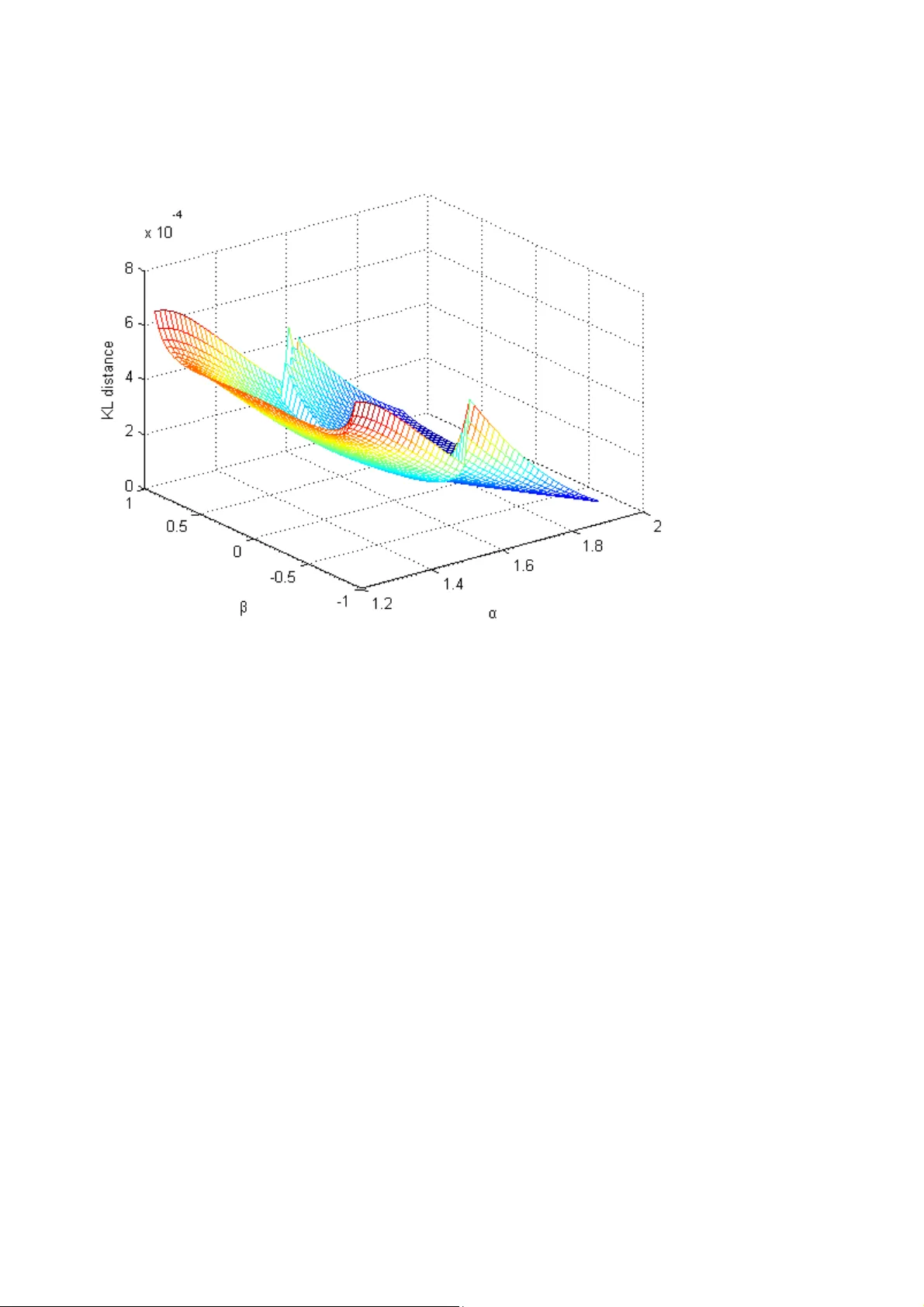
Simple Simple Simple Simple t echniques techniques techniques techniques for lik elihood for likelihood for likelihood for likelihood analysis analysis analysis analysis of of of of uni variate and multivariate univariate and multivariate univariate and multivariate univariate and multivariate stabl e stable stable stable distribution distribution distribution distributions: s: s: s: with extensions to multi variate stochastic volatili ty and dynamic factor models with extensions to multivariate stochastic volatility an d dynamic factor models with extensions to multivariate stochastic volatility an d dynamic factor models with extensions to multivariate stochastic volatility an d dynamic factor models Efthymios G. Tsionas Department of E conomics, Athens University of Econo mics and Business , 76 Pa tission Street, 1 04 34 Athens, Greece Tel.: (++30 210) 820 3 338, Fax: (++30 210) 82 03 301, email: tsionas @aueb.gr Abstract Abstract Abstract Abstract In this paper we consider a v ariety of pro cedures fo r numerical sta tistical i nference in the family o f univar iate and multivaria te stable distributions. In connection with u nivaria te distributio ns (i) w e provide approxima tions by finite location - sc ale mixtures and (ii) versions of appro ximate Ba yesian computation (ABC) us ing the characteris tic function and the asymptotic fo rm of the likelihoo d function. In the contex t o f mult ivariate stable distribu tions we propose several ways to perform s tatistical inferen ce and obtain the spec tral meas ure assoc iated with the distributions, a qua ntity tha t has bee n a major im pediment in using t hem in applied wor k. We exte nd the techniques to ha ndle univ ariate and m ultivariate s tochas tic volatility mo dels, static and dynam ic factor mode ls with disturbances and factors from general stable distributions , a novel way to mo del mult ivariate stochastic vo latility through ti me - var ying spec tral measures and a novel way to multivariate stable distribu tions through copulae. The new tec hniques are applied to artificial as well as real data (ten major c urrencies , SP1 00 and ind ividual returns). In connection with ABC spec ial attention is paid to c rafting well - performing pro posal distributions for MC MC and extensive numerical experi ments a re conducted to provide critical values of the “ closeness ” pa rameter that ca n be useful for fur ther applied ec onometric w ork. Key words Key words Key words Key words : Univar iate and multivar iate s table distributions, MCMC, Appro ximate Bayesian Computation, Characteris tic function. JEL clas sifications JEL clas sifications JEL clas sifications JEL clas sifications : C11, C13. Acknowle dgemen ts Acknowle dgemen ts Acknowle dgemen ts Acknowle dgemen ts: The a uthor wishes to thank se mina r pa rticipants at the Depa rtment o f Eco nomics, Univer sity o f Leicester, a nd seminar pa rticipants of CRETE 201 2 at Milos, Gre ece. 1 1. 1. 1. 1. Introduction Introduction Introduction Introduction Univariate sta ble distribu tions ha ve been tho roughly studied in eco nometrics , statistics and finance over the past few decades (Samoro dnitsky and Taqqu, 1994). Their empirical application is still ha mpered by the fact that their density is not available in closed form, despite a dvance s in Bayesia n computation using MCMC. Buckle (1995) and Tsionas (199 9) provided G ibbs sampling sche mes for general and sym metric stable dis tributions, respec tively . T he problem is that t he co nditiona l poster ior dis tributions of certa in latent v ariables are cumbersome to deal with and require ca reful tuning. The analog ous problem in the multivariate c ase is exc eedingly difficult although a few attempts have been m ade to so lve it. The impedi ment is tha t mult ivariate stable distrib utions, unlike the univariate case, are defined thro ugh their spectra l meas ure whic h, in practice, is unknow n. Ravishanker and Q iou (1999 ) for example, pro posed an EM algorithm based on B uckle (19 95) in the case of sy mmetric iso tropic stable distr ibutions but this class is too narr ow to be of empir ical importance. It is defined by t he transformation µ Σ ξ 1/ 2 = + X , where ξ is a v ector of independent random va riables eac h one dis tributed as s tandard symmetric stable, µ is a vecto r of loca tion parameters , Σ ′ = C C is a sca le matrix, and C denotes its Cho lesky deco mposition. The idea of the paper is t hat Approx imate Bayes ian Computatio n (ABC) c an be imp lemented easily in connection with univariate or multivariate stable distributions since it ca n be tailored to use the chara cteristic function, which summarizes fully all sampling empirical evidence which is availa ble through the likelihood fu nction. Although ABC has not have found many a pplication s in econome trics, there ar e many in the statistica l litera ture (for example Wilkinson, 2008 ). ABC is a technique that can be used when the dens ity of obse rvation s is not available in closed form o r when the model is im plicitly defined (such models are known as “ co mputer code models ” ). It is related to calibration in the sense that in its simplest version, a draw of par ameters is made from the prior, a set of mome nts are selected and simulated moment s are compared to empirical counterparts. If a measure of “ closeness ” is “ small ” then the draw is accepted. Finding suc h m oments can be difficult, especially in stable distributions, wher e t he moments that should be ma tched can be non-int uitive. Measur es o f “ clo seness ” are also ha rd to formula te and given such a measure, an appropria te definitio n of “ close ” can be hard. In the context of A BC it is clear that whe never possible the char acteristic fu nction ca n be used since it is equi valent to the dens ity functi on. For stable distrib utions, at least in the univariate ca se, it is well known that the character istic function has a very simple closed form. In u nivariate s table P aretian d istributions , imp lementation of ABC is concept ually straig htforwar d altho ugh certain p roblems remain open a nd must be addr essed: F irst, the choice of a pro posal distribution for the par ameters and, second, the choic e of a meas ure of “ closeness ” between t he theoretical and empirical chara cteristic func tions. The t hird problem is the number an d co nfiguration of gr id poin ts fo r the co mput ation of the c harac teristic f unctions which remains ope n and unsettled i n the statis tics and econometrics literature for many deca des. In co nnection with multivaria te stable Par etian distributions, even the co mputation of th e char acteristic f unctions beco mes com plicated because they are only defined through their spectral meas ure, an object tha t is needed to r etain the equiva lence between t he density a nd the char acteristic f unction. T he estima tion o f the spec tral mea sure i tself has proved itself to be quite c umberso me even for bivaria te distr ibutions. We exam ine severa l existing approx imations to the spectral measure for use with ABC for Bayesian inference, and propose a new one based on a multivariate normal approximation which, alon g with another tec hnique k nown a s method of principa l directions (Meersc haert and Scheffler, 1999 ), are fo und to pe rform well. Specifically, the method of principal directions is found to perform extremely well in disco vering and appr oximating the “ impor tant ” linear combina tions of stable var iates that can be used to configure the g rid points for evaluation of the multiva riate characteris tic function. We co nsider this feature very important a s it can facilitate consider ably joint like lihood analysis in multivaria te sta ble distribu tions for a ll parameters , including the g rid configura tion and the pl acement of g rid points for the char acteristic functio n. Joint inferenc es for the spectr al mea sure and the configura tion o f the grid for the evalua tion of the c haracteris tic functions are provided using we ll-crafted propo sal distributions for use with A BC in the context of mult ivaria te stable P aretian distribution s. Moreover , we show how another smoo th appro ximation to the spectral measur e, the so called spherical harmo nic analys is (Piv ato, 2001 , P ivato and Seco, 200 3) can be implemente d in ABC along with the asymptot ic no rmal for m of the likelihood function. Since Bayesian inferen ce for multivaria te distrib utions is found q uite simple to implement and perform well, we generalize the stable Paretian distribut ions in two important directions. First, in the co ntext of univariate and multivariate stoc hastic volatility and seco nd, in connectio n with static and dynamic facto r models, inclu ding a new factor model that uses a Mar kov model for the fundamental parameters of the model. In addi tion, we pro pose a new stoc hastic volati lity mo del, that is more appr opria te for multivaria te stable variates. Clearly, the techniques develo ped can be use d to obtain statistical in ferences for multivaria te vo latility models base d o n the nor mal distribution, wit h o r without jumps and le verage e ffects. Their application is , naturally, simpler when compa red to their stable Paretian c oun terparts. However, the techniques remain simple a nd efficient even in hig h-dimensional multivaria te stable distri butio ns. The approximation o f univar iate stable distributio ns by finite mixtures o f normal distributions s hould not be discounted given the main emphasis of the paper on the multivariate case which, undoub tedly, imposed so many difficulties and obstac les so far. For univariate stable distributions we a pply ABC inference in detail, sho wing how well-crafted proposa l distributions can be cons tructed and used in ar tificial a nd rea l data, base d on t he c haracteris tic function. Bayes ian inferenc es org anized around the us ag e of finite mixtures of normal distribu tions are found to be quite close to those provided either by AB C or the exac t a pproach based on the fast Fourier transform to c ompute the stable Pa retian densi ties. Since the finite m ixtures of normals approxima tion depend o n results that can b e easily be tabulated (as in this paper) the ro utine applica tion of Bay esian infere nce for linea r regre ssion with stable disturbaces o r factor analysis based on stable distr ibutions, becomes po ssible almos t effortlessly. This work falls squarely within recent advances in the econo metrics of stable distributions. Dominicy and Ver edas (2012) propose a method of quantiles to fit symmetr ic stable distributions. Since the quantiles are no t available in closed form they ar e ob tained usi ng simu lation resul ting in the method of simula ted quan tiles or MSQ. Hallin, Swa n, Verdebout and Veredas (2012) propos e an easy-to-implement R-estimation pro cedure which remains n -consistent 2 contrary to least squares w ith stable disturbances. Broda, Haas , Krause, Paolella and Steude (2 012) propose a new stable mixture G ARCH model th at encompasses several alternatives and can be extended easily to the multiva riate asset returns ca se using i ndependent compo nents a nalysis. Og ata (201 2) uses a discre te approximat ion to t he spectral measure o f mul tivaria te stable distributions a nd pr oposes estimating the par ameters by equati ng the theoretical and e mpirical cha racteris tic function in a gene ralized empirica l likelihoo d / GMM framewo rk. Rela tive to this work, ( i ) we sho w how to implemen t Bayes ian infe rence for multivaria te stable distributions by trea ting t he grid points of the cha racteristi c function and t he suppor t of the spectra l measure a s parame ters. Moreo ver, ( ii ) we generalize the model to multivariate stochas tic volatility and factor models, and ( iii ) we provide alternatives to the discretization o f t he spectra l measur e that are ea sier to compute and perform bet ter in a rtificial as we ll as rea l data. Regarding (Ba yesian) indi rect inference for the parameter s of univar iate stab le distributions, we prov ide useful results that can be used to implement MCMC for any data set when dra ws fro m t he pos terior distribution o f normal mixtures a re available. Classical indirect inference has been examined by Garcia, Renault and Veredas (201 1) among others, using the s kewed S tudent- t as a uxiliary model. As the authors mention this “ appears as a good candidat e since it has the same number of parameters as the α -stable distribution, wit h each paramete r playing a simil ar role ” . Lo mbardi and Vere das (2007) used a multivariate Student-t to per form indirect esti mation for for elliptica l stable distributio ns based o n the same a rgument. To s ummarize, in this paper, we break new ground alo ng the following directions. In connection with univariate stable distribu tions we pro pose, first , a mixture of normals appro ximation with few components. The approximatio n is obta ined thro ugh mini mizing the K ullback – Leibler distance between stable and mixture-of-normals distributions and can be used to perform efficient Bayesian in ference us ing MCMC. Second , w e exa mine Approximate Bayesian Computation ( ABC) whic h relies o nly on the theoretic al and empir ical chara cteristic functio ns. Third , we provide several c omputational appro aches to sta tistical inference in multivar iate, genera l stable distrib utions using ABC . Fourth , we provide a new co pula – based approach for mult ivariate, genera l stable distributions. Fifth , we consider extensions to multivariate s tochastic vola tility and static a nd dynamic factor models who se factors and dist urbanc es are members of the m ultivaria te stable family. All tech niques are applied to exc hange rate and s tock return data a nd are supplemente d by Monte Carlo simulations. 2. 2. 2. 2. Univariate Univariate Univariate Univariate G G G G eneral eneral eneral eneral Stable Stable Stable Stable D D D Distributions istributions istributions istributions A random var iable X is called (strictly ) stable if for all n , 1 D n i n i X c X = = ∑ , for some co nstant n c , where 1 , ..., n X X ar e independently distributed wit h the same distribut ion a s X . It is known that t he only possible choice is t o have 1/ n c n α = , for some (0 , 2] α ∈ . General n on-symmetric stable distributions ar e defined via the log character istic function whic h is given by the followi ng expres sion (Samoro dnitsky and Ta qqu, 19 94, and Z olotarev, 1986 ): ( ) ( ) 2 2 1 sgn( ) tan , 1 , log log exp 1 sgn( ) log , 1 , X α α πα π ιµτ σ τ ιβ τ α ϕ τ ιτ ιµτ σ τ ιβ τ τ α − − ≠ = − + = E (1) for any τ ∈ , where µ and σ are the location and sca le parameters of the distribution, respe ctively, and 1 ι = − . We denote a general stable rando m variable by: ( ) , ~ , X α β µ σ f . The density is given by ( ) ( ) ( ) 1 2 exp f x x d π ιτ ϕ τ τ ∞ −∞ = − ∫ . (2) The density is not a vailable in clo sed for m mak ing it difficult to implemen t ma ximum likelihood or Bayesia n MCMC procedures . Buckle (1 995) and Ts ionas (19 99) considered sc ale mixture repr esentation of stable distributions for Bayesian analys is in t he general and symme tric class respe ctively. Tsionas (199 9) exploited the fact that for symmetric laws, that is ( ) ,0 ~ , X S α µ σ we have: 1/2 X W Z = , where ( ) ~ 0 , 1 Z N , and independently ( ) 2 ,1 ~ 0 , 1 W S α . Since this is a scale mixture of norma l distributions, Ba yesian numerical proc edures ar e greatly facilitated. B uckle (1995) us ed another r epresentation due to Zolota rev (1986 , pp. 65-66): ( ) ( ) ( ) 1 / 1/ cos 1 sin cos U U X E U α α α α α α − − = , for 1 α ≠ , where U is uniformly distributed in 2 2 , π π − , and E is standa rd exponential 1 . Approximate computation o f the general stable densi ties is fac ilitated by the Fast Fou rier Trans form (FFT), see Mitt nik, Dogano glu, and Chenya o (1999) and Mittnik, Rachev, Doganog lu, and Chenyao (1999) 2 . The integral representation in (2) is computed at N 1 Where not ne eded, we pre sent results fo r the “ focal ” case α ≠ 1. 2 See als o Matsui a nd Takemura (200 6). 3 equally s paced po ints w ith distance h, that is ( ) 2 1 N k x k h = − − , 1 , ... , k N = . If 2 τ πω = , the integral become s ( ) ( ) ( ) 2 2 1 2 exp 2 1 N N f k h k h d ϕ π ω ι πω ω ∞ −∞ − − = − − − ∫ which can be approximate d using the r ectangle rule as: ( ) ( ) ( ) ( ) ( ) ( ) ( ) 2 1 1 1 2 2 1 1 1 1 2 1 / exp 2 1 ) 1 / N N k n N N hN n f k h n h N n k N ϕ π ι π − − − = − − ≈ − − − − − − − ∑ . (3) In turn, this is equivalent to performing a FFT to the sequence: ( ) ( ) 1 2 1 2 1 / n N n h N ϕ π − − − − , 1 , ..., n N = . A fairly accurate pro cedure res ults when 16 2 N = , and 4 10 h − = . Accuracy of t he FFT ha s been examined in detail by Tsio nas (2012a ) in a different co ntext. In t he ca se o f symme tric stable dis tribut ions, ( ) ,0 , α µ σ f , McCulloc h (1998) developed a more efficient pr ocedure without s acrificin g ac curacy. 3. 3. 3. 3. Approximate Approximate Approximate Approximate r epresentation by mixtures of representation by mixtures of representation by mixtures of representation by mixtures of normal normal norm al normal The stable distribution with density ( ) f u is amenable to a pproximation by families of distribu tions for which Bayesia n inference is tractable. One such family is the finite mixture o f normal 3 : ( ) ( ) θ 2 1 ; ; , M m N m m m p u f u π µ σ = = ∑ , (4) where ( ) 2 ; , N f u µ σ denotes t he density of a no rmal distribu tion with mea n µ and var iance 2 σ , and θ π µ σ , , ′ ′ ′ ′ = in obvious notation. To determine the par ameters θ * w e use the Kullback- Leibler distance: ( ) ( ) ( ) ( ) θ || l og ; f u KL f p f u du p u = ∫ . The range of in tegration i s truncated to 12 , 1 2 E = − . Part of the pr oblem is to determine the optima l n umber of componen ts, M . Initial experimentations indicated that the num ber of components is quite small ( 3 o r 4) by fitting gene ral mixtures of up to M=15 com ponents: Severa l pro babiliti es we re practically zero so we consi dered a pproximations by m ixtures of lower dimensions. These appr oximations are shown in Fig ure 1 for M=2, 3, and 4. The approximatio n for M=4 is indistinguishable from the true density while M=3 performs well 4 . T he compariso n o f the density with the mix ture of normals is pr esented in Figure 1 a nd t he Kullback-Leibler distance a s a function of the num ber of co mponents (M) is presented in Figure 2. Suppose a sca le mixture of norma ls with M compon ents is fitted to the data using MCMC. Denote the draws by ( ) ( ) ( ) , s s s A σ π ′ ′ ′ = , 1 , ..., s S = . To tran sform to dra ws from a symmetr ic stable distr ibution ( ) ( ) ( ) ( ) , , s s s s θ µ δ α = whose c haracteris tic functio n is ( ) exp α ϕ τ ιµτ δ τ = − , consider the chara cteristic f unction of the approximati ng normal mixture: ( ) ( ) 2 2 1 2 1 exp M N m m m ϕ τ π σ τ = = − ∑ . Given the parameter s of the mixture in ( ) s A we consider the o ptimization p roblem: ( ) ( ) ( ) 2 1 min : s I i N i i θ ϕ τ ϕ τ = − ∑ , where ( ) , 1 , ..., i i I τ = is a gr id of points. The optimization pr oblem was found to be very easy to solve and 10,000 draws were obtained in less than a mi nute. In Fig ure 1 we pr esent t he ma rgina l po sterior densities of α fr om an “ exact ” Metr opolis MCMC and two mixture approximations with M= 3 a nd M=5 c omponents. We have c onstructed an artificial data se t with n=1,5 00 observa tions, μ =0, δ = 1, and α =1.40 . With M=5 components the mixture approximation and the “ ex act ” poster ior ar e indistinguishable 5 . 3 As far as we know the only other r elevant wor k is Georg iadis and Mulgr ew (2001) who used a mixture o f Cauchy and normal. 4 P lot of the K L criterio n at the optimum indicate that the fit with two or mor e compo nents is a pproximately constant. We cons idered fin ite scale mixtur es with M= 2 up to M=1 5 compo nents. 5 We hav e tried to fit mixtures wit h M > 5 co mponent s but the o ptimization failed because many σ ’ s and π ’ s are actually zer o in the optimal appro ximation using the K L cr iterion. 4 Turning attention to the more g eneral non-s ymmetric stable distri butions, a f amily which is a simple reparame trization of the a bove and is continuous with respect to the parameter s is the follow ing (Nolan, 19 97): ( ) 1 2 2 1 sgn( ) tan 1 , 1 , log 1 sgn( ) log , 1. t α α α πα π ιµτ σ τ ιβ τ σ τ α ϕ ιµτ σ τ ιβ τ τ α − − − − ≠ = − + = (5) Critical values (9 0%) of th e D statistic in the case of non-symmetric sta ble distr ibutions are pro vided in T able 1b. The critical value s vary li ttle depending on sam ple size, n , as well as the i mportant parameters α and β . This fact will be o f co nsiderable inter est in the next sectio n w here we take up Bayesia n infer ence using Appr oximate Ba yesian Computation (AB C). 4. 4. 4. 4. Approximate Bayesian Comput ation Approximate Bayesian Comput ation Approximate Bayesian Comput ation Approximate Bayesian Comput ation ABC is a way to perform Bayes ian inference in comp lex models whose likelihood is not availa ble in close d fo rm. Developed by Mar joram, Molitor, Plagno l, and T avare (200 3) it gained wide acceptance in the s tatistical communi ty (Toni et al., 2 009). Sup pose the obser ved da ta, d ∈ X { } , 1 , ..., t t T = = X X has been gene rated fro m a distr ibution ( ) θ ; F ⋅ , wher e θ is a pa rameter vector. When the likeliho od function is not a vailable, ABC i n its orig inal form generates θ from the prior , and artificial data { } ( ) θ θ θ , , 1 , ..., ~ ; t t T F = = ⋅ X X . If θ = X X then the para meter is accepted. S ince the equalit y θ = X X has mea sure zero, the ABC method has been modified as follows. Suppose ( ) S X is a vecto r of summary statistics, : d s → S and ( ) θ S X is the sa me set computed from t he artificial data. Again, a par ameter vector θ is genera ted from the prio r, and it is a ccepted i f ( ) ( ) ( ) θ , D ε ≤ S X S X , where D is a certain dis tance func tion and 0 ε > is a cons tant. To avoid dra wing fro m the pr ior the following Metropo lized version o f ABC is often u sed (Plagno l and Tavar e, 2004 ): Suppose ( ) θ θ ~ ; o Q ⋅ , where θ o denotes the curren tly available draw. If ( ) ( ) ( ) θ , D ε ≤ S X S X then accept the draw with pr obability ( ) ( ) ( ) ( ) ( ) θ θ θ θ θ θ θ θ ; , min 1 , ; o o o o p q A p q = , where q is the density a ssociated with the measur e Q . The problem in ABC is to selec t the summa ry statis tics and the consta nt ε . In c omplex mode ls the choice of summary statistics is ad hoc to a certain exte nt a nd i t is bas ed on whatev er is known abo ut the m odel. As Wilkinson (20 08) arg ues: “ It canno t be known whethe r these s ummaries are sufficient for the data, a nd so in mo st cases the use of summar ies me ans that t here is another laye r of a pproximation . ” However, Wilkinso n (2008) als o shows that w hen the summar ies are sufficient s tatis tics then ABC provides exact results. See also Wegmann, Leuenberger, and Exco ffier (2009). In the context of stable distributions the natural set of sufficient statistics is the characteris tic function , defined by ( ) ( ) ( ) exp y f y dy ϕ τ ιτ = ∫ , whe re 1 ι = − , τ ∈ . The em piric al characteristic fu nctio n is defi ned as ( ) ( ) 1 1 ˆ exp n t t n y ϕ τ ιτ − = = ∑ . For any s imulated data set ( ) ( ) ( ) , 1 , ..., t Y y t n θ θ = = , the empirical character istic function can be computed as ( ) ( ) ( ) 1 1 exp n t t n y ϕ τ ιτ θ − = = ∑ . I n t he simplest c ase the c hara cteristic function of the symmetric stable distributi ons is ( ) exp α ϕ τ τ = − , where (0 , 2] α ∈ is the char acteristic expo nent. Clearly we accept a pa rameter dr aw θ from the pr ior if a mea sure of dista nce ( ) ˆ , d ϕ ϕ ε ≤ . Var ious mea sures are availa ble, for example the L ∞ -distance betwee n the log characteris tic functions , ( ) ( ) ( ) ( ) , 1, ..., ˆ ˆ , max log log i i i i I d τ ϕ ϕ ϕ τ ϕ τ = = − . Since the function ϕ completely characterize s the dis tribution we have in fact a com plete set of sufficient sta tistics. In the more g eneral case with a location ( µ ) and sca le pa rameter ( σ ) the log char acteristic function o f symmetric stable distribu tions is: ( ) log α ϕ τ ιµτ σ τ = − , for all τ ∈ . 5 Suppose we propose a draw for θ , , , α β µ σ ′ = . In standard M CMC, the draw should be a ccepted with probability: ( ) ( ) ( ) ( ) ( ) θ θ θ θ θ θ θ θ | ; , min 1 , | ; o o o o p q A p q = Y Y , where ( ) ( ) ( ) θ θ 1 | ; , , , T t t p p f y α β µ σ = ∝ ∏ Y , ( ) ; , , t f y α µ σ denotes th e density of sta ble laws, ( ) , , α β µ σ f , and ( ) θ θ ~ ; o Q ⋅ . Clearly, t he obstacle is that the de nsity is no t availa ble in closed form. However , the cha racteristic fu nction is av ailable in closed for m and it c an b e compute d easily, wh ile si mulating random var iables ( ) , ~ , Y S α β µ σ is straightforwar d (Chambers, Ma llows, and Stuck, 19 76, but see als o Modarres and Nolan, 1 994, a nd Weron, 1996 ). 5. 5. 5. 5. Mul tivariate stable distributi ons Multivariate stable distributions Multivariate stable distributions Multivariate stable distributions Suppose d ∈ X is a vecto r of mul tivariate α -stable ra ndom var iables, with c haracteris tic exponent 0 2 α < ≤ . Its character istic function i s ( ) ( ) ( ) ( ) τ Χ τ τ µ τ E exp , exp , I ϕ ι ι = = − + X X , where , ′ = a b a b denotes the inner product, and ( ) ( ) ( ) τ τ S 1 , d I d α ψ − = Γ ∫ X s s , (6) where d S is the boundary o f the unit sphere in d » , { } : 1 d d = ∈ = u u » S , Γ is a finite Borel measure of the vector X , called the spectr al measur e, µ is a parameter vector , and the function ψ is defined as follows: ( ) ( ) ( ) 2 2 1 sgn( ) tan , 1 , 1 sg n( ) lo g , 1. u u u u u u α πα α π ι α ψ ι α − ≠ = + = (7) Press (1972) attempted to define a multivar iate α -stable distribu tion without using the spectral mea sure Γ . Later on Paulauskas (1976) prov ided s ome corrections as not all α -stable distribution can be represented using Press ’ (1972 ) characteristic function. Chen and Rache v (1995) in an interesting pa per provided estimates o f α and the spectra l mea sure as well as applica tions to stable portfolia. It is notable that the pro jection of X on τ , viz. τ , X has a univariate sta ble distribution whose char acteristic function is ( ) ( ) ( ) Χ τ τ E exp , exp u I u ι = − X . Suppose now that the spect ral meas ure is approxima ted by a disc rete measur e, ( ) { } ( ) 1 j J j j d γ δ = Γ = ∑ s s s , (8) where 0 j γ > , S 1 d j − ∈ s , 1 , ... , j J = , and δ deno tes Dira c ’ s delta . Since ( ) ( ) ( ) τ τ S 1 exp , d d α ϕ ψ − = − Γ ∫ X s s we obtain ( ) ( ) τ τ 1 exp , J j j j α ϕ γ ψ = = − ∑ X s . (9) In this c ase, for 1 α ≠ , it ca n be shown that 1/ 1 d J j j j j α γ = = ∑ X s Z , where ( ) ,1 ~ 0 , 1 j iid α f Z , 1 , ... , j J = , see Modarres and Nolan (1994). The interpretatio n is that a multivariate α -stable random vec tor can be represented as a finite mixture of u nivariate α -stable v ariates which ar e totally skewed to the rig ht (that is, they have skewnes s coefficients β =1). For α =1 we have ( ) 1/ 2 1 log d J j j j j j α π γ γ = = + ∑ X s Z . T o proceed, it is clear that if the spectral measure is discrete, we have: ( ) ( ) τ τ 1 exp , J j j j α ϕ γ ψ = = − ∑ X s and therefore : ( ) ( ) τ τ 1 log , J j j j j α ϕ γ ψ = − = ∑ X s , 1 , ..., j J = , from which we o btain the f ollowing s ystem of linear equations: Φγ = I , where ( ) ( ) ( ) ( ) τ τ τ τ 1 1 1 log , ... , log , ..., J I I ϕ ϕ ′ ′ = − − X X X X I , Φ ij = Φ , ( ) τ ij i j α ψ ′ Φ = s , , 1 , ..., i j J = , and γ 1 , ..., J γ γ = . One ca n then obta in γ Φ 1 − = I . In practice, the system of equations s uffers fro m singular ities 6 and the e stimates of γ a re not a lways nonnegative. Mc Culloch has propose d t he us e of q uadratic progr amming imposing the non negativity and repo rts that, at lea st in small dimensio ns, the pr ocedure wo rks well. 6. 6. 6. 6. Asymptotic Normal Form Asymptotic Normal Form Asymptotic Normal Form Asymptotic Normal Form Q Q Q Qua si uasi uasi uasi - - - - Likelihoods Likelihoods Likeli hoods Likelihoods 6.1 6.1 6.1 6.1 Introd uction Introduction Introduction Introduction Feuerverge r and Mur eika (1977 ) a nd Feuer verger and McDunnoug h (1 981a ,b) pioneer ed the so called Asymptotically Nor mal Form (ANF) for stable laws 6 . Give n the char acteristic fu nction ( ) ; exp α ϕ τ θ ιµτ σ τ = − , where the parameter vector is θ , , µ σ α ′ = , a nd its empir ical counterpar t, ( ) ( ) θ 1 1 ˆ ; exp n t t n u ϕ τ ιτ − = = ∑ , with ( ) / t t u Y µ σ = − , de fine ( ) ( ) ( ) ; ; z τ τ ϕ τ θ θ = θ R I , w here R denotes the real part, I denotes th e imaginary part of a complex number, a lso ( ) ( ) ( ) ˆ ; ˆ ˆ ; z ϕ τ τ ϕ τ θ θ = θ R I . Since ( ) ( ) ( ) ( ) θ θ 1/2 ˆ ; ; n τ ϕ τ ϕ τ Ψ = − is asymptotically nor mal at a finite number of points 7 ( ) τ , 1 , . .., i i I τ = = its covariance matrix is ( ) ( ) ( ) ( ) ( ) Σ τ τ τ τ τ cov ϕ ϕ ϕ ′ ′ = Ψ = − − . This expression can be written i n a simpler form. If Σ = A B B C , then we ha ve: ( ) ( ) ( ) ( ) 1 2 ϕ τ τ ϕ τ τ ϕ τ ϕ τ ′ ′ ′ = ℜ − + ℜ + − ℜ ℜ A , ( ) ( ) ( ) ( ) 1 2 ϕ τ τ ϕ τ τ ϕ τ ϕ τ ′ ′ ′ = − + + − B I I R I , (10) ( ) ( ) ( ) ( ) 1 2 ϕ τ τ ϕ τ τ ϕ τ ϕ τ ′ ′ ′ = − − + − C I I I I . Apparently, ma trix θ Σ Σ = depend s on the par ameter vec tor θ . The ANF o f the log likelih ood is: ( ) ( ) ( ) ( ) ( ) ( ) θ θ θ θ θ θ Σ τ τ Σ τ τ 1 1 2 2 ˆ ˆ ln ln n L z z z z − ′ = − − − − . (11) Concentration with respect to Σ θ is not possible. The substantive issue in max imization of the ANF (o r just the second term, a proce dure kno wn as min-Q) is the selection of the g rid ( ) τ , 1 , ..., i i I τ = = . Koutr ouvelis (1 980) and subsequen tly Po urahmadi (19 87) fav or a grid of the for m / 25 k k τ π = for 0 , 1 , ..., k K = ± ± . Based o n simulations by Koutrouveli s (1980) it seems that the optimal va lue of K is 1 0 to 15 as α decreases from 1.9 to 1.1. Pourahma di (1987) sho wed that for a dis tribution who se suppor t is ( ) , − Λ Λ the rule / k k τ π = Λ , 0 , 1 , ..., k K = ± ± , is optimal in the sense tha t all other va lues of the chara cteristic function can be r econstructed (Po urahmad i, 1987, Theorem 4 .3, p. 355 ). In this sense Koutrouvelis (1980) ass umes that Λ =25 for all stable laws 8 . When the distrib ution is no t bounded the pro blem reduces to finding the per iod of t he function ( ) ˆ ; ϕ τ θ , τ −∞ < < ∞ . The period is shown to be 1 1 1 2 2 / n t t p n Y H π π − − = ≈ ∑ , when { } , 1 , ..., t Y t n = is a r andom sample and H is the harmonic mean of the o bservations. The n, for a given one may set 2 / 2 K H = Λ ≥ , and denotes the integer part. Another approach is to set / K A π = Λ , w here A is the first positive ze ro of th e character istic function : ( ) { } ˆ inf : 0 A τ ϕ τ = = , and the empirical chara cteristic function ( ) ˆ ϕ τ doe s no t depend on other para meters. 6 For a mo re rece nt survey, see Yu (20 04). 7 See als o Knight and Yu (2 002) a nd Xu and Knight ( 201 0, proposition 2 , p. 28). 8 Madan and Seneta (1987 ) also favour values of τ concentra ted around the origin which, in the case of character istic functions, is crucial for determining tail b ehavior . 7 The proble m of choosing a grid can be bypassed i f one uses a co ntinuum o f mo ments. Lei tch an d Pa ulson (1975) were the first to propose the following estimat ion pr ocedure: ( ) ( ) ( ) θ θ 2 2 ˆ min : ; exp / 2 d ϕ τ ϕ τ τ τ ∞ −∞ − − ∫ , whic h can be solved using Hermitian quadrature. Tran (1998) use d the second term i n the ANF to es timate a mixture of normal distributions . Give n the endpoint of the gri d for τ , T ran (1998 ) cho se the uni form stepsize (say Δ ) which minimizes the determinant of the asymp totic co varia nce ma trix. Many a uthors , and more recently Carrasc o and Florens (2002 ) noted that the covar iance matrix θ Σ bec omes singular as the grid becomes fine and exte nded, a condition w hich is neces sary in order for the ANF to get a rbitrarily close to the Cramer-Ra o bound. The idea of Carra sco and Florens (2000, 20 02) was to consider continuous va lues o f τ as in Le itch and P aulson (19 75) and solve ( ) ( ) ( ) θ θ 2 ˆ min : ; g d ϕ τ ϕ τ τ τ ∞ −∞ − ∫ , w here ( ) g τ is a continuous w eighting function or alterna tively follow Feuerverg er and Mure ika (1977) and F euerverg er and McDunnou gh (1981a,b) and solve ( ) ( ) ( ) ( ) θ ˆ ; 0 w d τ ϕ τ ϕ τ τ ∞ −∞ − = ∫ , w here ( ) w τ is also a weighting function. Feuerverger and McDunnough (1981a) show that the optimal weight function is ( ) ( ) ( ) log ; * 1 2 exp f Y w Y dY π θ τ ι τ ∞ ∂ θ ∂ −∞ = − ∫ . Since th e densi ty, f , is unknown, Carras co and Florens (2002 ) propose the use of GMM with a conti nuum o f moments whose ker nel is ( ) ( ) ( ) ( ) , , g s s s τ ϕ τ ϕ τ ϕ = − , as one wo uld expect from the asymptotic cov ariance of the ANF procedure 9 . From the ANF, c onsider th e likelihood func tion: ( ) ( ) ( ) ( ) ( ) ( ) ( ) θ τ θ θ θ τ θ θ θ τ Σ τ τ Σ τ τ 1/2 1 , , 2 ˆ ˆ ; , exp n L z z z z − − ′ = − − − Y , (12 ) where 1 , ..., n Y Y ′ = Y denotes the data a nd τ Σ , θ makes explicit the dependence o f the covaria nce matrix o n the grid. For a fixed grid one can consider various MCMC me thods to derive dependent draws that converge in distribution to the posterior, whose kernel is g iven by ( ) ( ) ( ) θ θ θ | ; p L p ∝ Y Y , where ( ) θ p denotes the prior. T his poster ior does not overco me the problems as sociated with t he choice o f grid. Suppo se, in fact, we ha ve a pr ior ove r the grid, so that the joint prior is ( ) ( ) ( ) θ τ θ τ , p p p = . Then the new poster ior beco mes: ( ) ( ) ( ) ( ) θ τ θ τ θ τ , | ; , p L p p ∝ Y Y . Clearly, if we think of the prior ( ) τ p as a weight function then ( ) ( ) ( ) ( ) ( ) θ θ τ τ θ θ τ τ τ | , | ; , p p d p L p d = = ∫ ∫ Y Y Y . Assuming that ( ) ( ) θ θ I p = ∈ Θ , where Θ is the parameter space, then ( ) ( ) ( ) θ θ τ τ τ | ; , p L p d = ∫ Y Y , that is the integr al of the ANF likelih ood with respect to the “ weig ht function ” , ( ) τ p . Of course the grid has to satisfy some a prior i reaso nable properties. O ne of them is that 0 is a point in the g rid, that the g rid is sy mmetric and theref ore we can set { } τ 1 0 , , ..., K τ τ = ± ± , with 1 ... K τ τ < < . In this s tudy it is de sirable to remov e the a ssumptio n that the po ints of the gr id are equispace d and o f course we do not wish to impose a priori the assump tion of a fixed number of g rid points, K . Treating 1 0 τ > as parameter, we set 2 1 j j j h τ τ − = + , 2 , ..., j K = , where ( ) 2 , ..., K K h h ′ = h is a vector of K-1 free para meters. Of co urse we can also defi ne 2 1 j j j h τ τ − = + , 1 , 2 , ..., j K = , with 0 0 τ = , and ( ) 1 , ..., K K h h ′ = h , with 1 0 h = . Then we can place a pr ior on the free parameters ( ) θ 1 , , K τ ′ ′ h . 9 Xu and K night (2010) apply the continuous vers ion of Leitc h and P aulson (197 5) using a weig hting function which has the form exp(-b 2 /2), see p. 2 8, under the name CE CF. The authors a pply t he pro cedure to es timation o f finite mixture of normals and find that the o ptimal b r anges from 1.22 to 2.1 5, see Table 2b. 8 Treating the pro blem in this ma nner, it then becomes clear that the grid points τ can be treated as latent variables and in that sense the posterior distribution is augmented using these grid points, in the sense of Tanner and Wong (19 87) 10 . The prior is specified as follows: ( ) ( ) ( ) ( ) ( ) ( ) ( ) θ θ 1 1 , , , | K K p K p p p K p K τ τ ∝ h h , (13) where ( ) ( ) ( ) θ I 1 , , 0 2 , 1 1 p p µ σ α σ α β − = ∝ < ≤ − ≤ ≤ , ( ) 1 1 1 p τ τ − ∝ , ( ) ( ) 2 1 1 1 ~ , K K K K ω − − − h 0 I a , and ( ) p K denotes the prio r o n the number of grid points (ass uming the first one is always zero). Follo wing Koutrouvelis (1980) it seem s a priori reasonable to cent er the grid points a round / k k τ π = Λ , for 1 , ..., k K = . The points o f t he g rid a re equispac ed wit h le ngth / π ∆ = Λ . With Λ =25 (typical for stable laws with α g reat than 1.1) this suggests uniform length about ∆ =0.12. Therefor e, a prior with ω =0 .24 would be r elatively uninfor mative relative to the likeli hood. R egarding the number o f gr id points, K , a unifor m prior over the set of intege rs { } 1 , ..., 50 covers well the optimal values r eported by Ko utrouvelis (19 80) and sugg ested by P ourahmadi (198 7). An alternative is a Poisso n dist ribution wit h parameter 15 λ = , based a gain on the results o f K outrouvelis (1 980, 1 981) and Feuerverg er and Mc Dunnough (19 81a,b). As repo rted by other au thors the ma in problem with the ANF is the bad conditioning o f the matr ix θ τ Σ , . To overco me t he p roblem we first regularize the ma trix using θ τ θ τ Σ Σ , , 2 1 K ε + = + I , where ε is a small co nstant. Sec ond, we consider the sing ular value decompos ition θ τ Σ , ′ = USV , where S is a diagonal ma trix with the singular va lues, , 1 , ..., 2 1 i s i K = + , alo ng its diagonal. If any element is zero it is r eplace d by 1 0 -6 . T hen, the in verse matrix is θ τ Σ 1 1 , − − = VS U , and 1 2 1 1 / , 1 , ... , 2 1 i K diag s i K − + = = + S I . More over, θ τ Σ 2 1 , 1 ln log K i i s + = = ∑ . The singula r va lue decomposition wa s proved extr emely fast, reliable and efficient in co mputing v alues of the log posterior without numerical pro blems. 6. 6. 6. 6. 2 2 2 2 Refinements of the A symptotic Normal For m Refinements of the A symptotic Normal Form Refinements of the A symptotic Normal Form Refinements of the A symptotic Normal Form The AN F has an asympro tic justifica tion and can be used profitably in “ lar ge samples ” . Of co urse the notion of “ large samples ” is related both to t he sample size a s well as t he information from pa rticular sa mples. Consider the ANF of the like lihood in (12 ). Following the litera ture (Ko hn, Li, and Villani, 2 010) it is po ssible to use ref inements based on mixture s of multi varia te Student – t distributions: ( ) ( ) ( ) ( ) ( ) ( ) ( ) ( ) θ τ θ θ θ τ θ θ θ τ Σ τ τ Σ τ τ 2 1/2 /2 1 , , 2 /2 1 2 ˆ ˆ ; , 1 2 p g g g g G p St g g h p g g g p L h z z z z ν ν ν π ν πν + − − − − = + Γ ′ = + − − Γ ∑ Y , (14) where g π ar e mixing pro babili ties, G denotes the number of gro ups, p denotes the dimensio nality o f the parameter vector, g ν a re group-specific degre es of freedom, and g h a re different scaling co nstants of the “ basic ” s cale matrix , θ τ Σ . We call this the Asy mptotic Asy mptotic Asy mptotic Asy mptotic Stude nt Student Student Student - - - - t Mixture Form t Mixture Form t Mixture Form t Mixture Form (AtMF). Ano ther po ssibility is, of co urse, a n Asymp totic Nor mal Mixture Fo rm Asymp totic Nor mal Mixture Fo rm Asymp totic Nor mal Mixture Fo rm Asymp totic Nor mal Mixture Fo rm (ANMF): ( ) ( ) ( ) ( ) ( ) ( ) ( ) θ τ θ θ θ τ θ θ θ τ Σ τ τ Σ τ τ 1/2 /2 1 , , 2 1 ˆ ˆ ; , e xp g G p n N g g h g L h z z z z π − − − = ′ = − − − ∑ Y , (15) where ( ) θ τ ; , N L Y denotes the “ refi ned ” norma l – mixture likeliho od and, a gain, the basic s cale matrix of the A NF is multiplied by the constants g h , 1 , .. ., g G = . 10 Consider ( ) ( ) ( ) θ θ θ ˆ ; ; ; ϕ τ ϕ τ ε τ = + , ( ) ( ) ( ) θ θ Σ ; ~ 0 , N ε τ τ . This formul ation, can be considered as a Gaussian process , ( ) ( ) ( ) ( ) θ θ θ Σ ˆ ; ~ ; , ϕ τ ϕ τ τ G , where ( ) θ ˆ ; ϕ τ is the me an function, a nd ( ) θ Σ τ is the cov aria nce matrix o f the process. It is not clear how this idea ca n be used to facilitate Bayesian analysis unless the investigator is willing to assume that her data is “ close ” to a stable law but not exactly s o. 9 To determine the usefulnes s o f this approach we consider va rious sample size s (n=5 0, 200, 500 and 2,000 and 5000) and various values of the characteristic exp onents ( α =1.10, and 1.50). In the table below we report the modal v alues o f G , the a verag e va lues of scaling cons tants g h for fixed grids and optimal grids. We have examin ed 1,000 data sets for stable distributio ns with 1.10 α = and α =1.50 and a cas e with β =-0.20 and α =1.50 (which is empirically relevant in ma ny applications). For each of the 1 ,000 data sets we ha ve implemented the ANF pro cedure with var ious number s o f components ( G ) letting the configuration of the gr id ( τ ) and their number be pa rameters 11 (along with the degrees of f reedom of the Student- t , viz. g ν ) deter mined through MCMC. Fo r each va lue of G the marginal likeliho od has be en computed 12 and the op timal G as well as the values of the scaling constants ( g h , 1 , .. ., g G = ) were computed and saved. The optimal value o f G was selected to maximize the marg inal likeliho od. Finally, the mo dal values of G and the medians of the sc aling consta nts were co mputed and repor ted in Table 1 . Table Table Table Table 1 1 1 1 . . . . Optimal values of G, a nd scaling c onstants of the ANF for nor mal and Studen t Optimal values of G, a nd scaling co nstants of the ANF for norma l and Studen t Optimal values of G, a nd scaling co nstants of the ANF for norma l and Studen t Optimal values of G, a nd scaling co nstants of the ANF for norma l and Studen t - - - - t t t t mixtures mixtures mixture s mixtures Modal G (normal mixture ) Values of h g Modal G (Student- t mixture) Values of h g Characteris tic exponent, α =1.10 , skewness β =0 n=50 3 0.73 1 .08 1.78 3 0.35 1 .14 2.12 n=200 2 0.81 1 .45 3 0 .65 1.2 1 1.65 n=500 1 0.87 1 .21 2 0.63 1 .45 n=2000 1 1.12 1 1.43 n=5000 1 1.04 1 1.12 Characteris tic exponent, α =1.50 , skewness β =0 n=50 3 0.83 1 .08 1.65 3 0.65 1 .12 1.77 n=200 2 0.85 1 .35 3 0 .88 1.0 9 1.32 n=500 1 0.91 1 .21 2 0.83 1 .12 n=2000 1 1.07 1 1.15 n=5000 1 1.01 1 1.07 Characteris tic exponent, α =1.50 , skewness β =-0.20 n=50 4 0.4 3 0.80 1.0 8 1.65 4 0.3 5 0.72 1.4 2 2.11 n=200 3 0.45 1.3 5 2.22 3 0.38 1.21 1.85 n=500 1 1.25 2 0.33 1.45 n=2000 1 1.12 1 1.48 n=5000 1 1.05 1 1.12 The messa ge is that for “ large ” sample sizes (typically, 500 n ≥ ) one component of t he A NF in no rmal o r Stude nt- t mixtures turns out t o be o ptimal and the scaling co nstants ( g h ) a pproach unity quickly especially in sa mples close to 2,00 0 observatio ns. 6. 6. 6. 6. 3 3 3 3 The project The project The project The project ion method ion method ion method ion method Given d ∈ τ S , we ca n consider the pro jections τ τ , ′ = X X when X follows a multivaria te stable distribution. Its char acteris tic function is ( ) ( ) ( ) τ τ E exp , exp u I u ι = − X X . T he linear projection will be u nivariate stable with t he same characteristic exponen t, α , and t he scale, skewness and lo cation parameters ar e give n by the following (Zolo tarev, 1 986, p.20, Cambanis and Miller, 198 1 or Nagaev, 2000): ( ) ( ) ( ) , d I d α α σ τ = ℜ τ = τ Γ ∫ X s s S , (16a) ( ) ( ) ( ) ( ) ( ) ( ) ( ) τ τ τ τ τ τ S 2 , sgn , Im / ta n d d I α α α πα β σ σ − − = Γ = − ∫ X s s s (for 1 α ≠ ), (16b) and ( ) τ 0 µ = for 1 α ≠ . (16c) Suppose we h ave a r andom s ample 1 , ..., d n ∈ X X , and ( ) 1 , ..., n n d × = X X X . McCulloch (19 94) sugg ests to use a g rid τ τ S 1 , ..., d n ∈ to defi ne the o ne – dimensional da ta s et τ τ τ 1 2 , , , , ... , , i i i n X X X for each 1 , ... , i N = . Scale ( ) τ i σ and ( ) τ i β can be estimated using an estimate of ( ) τ I X , as ( ) ( ) ( ) ( ) τ τ τ 2 ˆ ˆ ˆ 1 tan i i i I α πα σ ιβ = − X , for 1 α ≠ . 11 To minimize co mputation al costs the ANF is analyze d firs t and the optimal valu es of τ , a re deter mined. The n we proceed a s if the configura tion of the grid is kno wn for the refined ANFs. 12 The mar ginal likelihoo d is computed usi ng the Lapla ce a pproximation ba sed on the AN F (DiCiccio et al , 1997 ). 10 Since there is als o a vailable an estimate ( ) τ ˆ i α in each direction, McCulloch (1994 ) sugg ests the me an, ( ) 1 1 ˆ ˆ N i i N α α − = = ∑ τ as an overall estima te o f t he characteristic exponent. As N is likely to be small th e properties o f this estimator in finite sam ples are unclear. Since the projections τ , i t X , are univariate stable and τ τ S 1 , ..., d N ∈ , we have th at τ i i z X is an 1 n × vector (for each 1 , ... , i N = ) co nsisting of realizations o f inde pendent univaria te s table va riates. They have scale ( ) τ i σ , skewness ( ) τ i β and location ( ) τ τ µ , i i µ = , where µ d ∈ is the vec tor of location parameter s of each multivaria te stable t X , 1 , .. ., t n = . There is a variety o f methods to esti mate location, skewness and sca le parameters for each linear pr ojection. Part of the problem is that t he information that α is the same for all projections is not taken into account. To impleme nt a n ABC a pproa ch, we first consider the τ i s a s fixed to form t he c haracteris tic function of the sample i z , 1 , ... , i N = , given by ( ) ( ) ( ) τ exp i i u I u ϕ = − X , u ∈ . The empirical equivalent is ( ) ( ) ( ) τ 1 1 ˆ exp t n i i t u n I u ϕ − = = − ∑ X , for eac h 1 , ... , i N = . (17) Since the i z s a re independent it follows that the chara cteristic function of 1 , ..., N z z is ( ) ( ) ( ) τ 1 exp N i i u I u ϕ = = − ∑ X , and the empir ical equivalen t is ( ) ( ) ( ) ( ) τ 1 1 1 1 ˆ ˆ exp t N n n i i i t i u n I u u ϕ ϕ − = = = = − = ∑ ∑ ∑ X . (18) Then we can follo w precise ly the same ABC methods that we have deve loped in connectio n with u nivariate stable distributions. Nex t, the t he τ i s and their weights, can be treated a s latent variables in ABC. The “ prio r ” of the latent para meters is a ssumed to be uniform over the sphere S d . For each τ i there is an asso ciated po int mass since ( ) ( ) τ 1 t N t t d γ δ = Γ ∑ s i . Drawing the latent variables is facilitated by us ing a Hit-and-Run algorithm (Belisle, Romeijn , and Smit h, 1993 ) which is (a nd also turne d ou t to be) idea lly suited for th is type of pro blem. T here is another useful approach that can be used in this problem. For ea ch linear pr ojection we clea rly have: ( ) ( ) ( ) τ τ 1 1 i i i d n µ × × = + X u , 1 , ... , i N = , (1 9) where each component of i u follows a univar iate stable d istribution with zero location, and scale and ske wness given by ( ) τ i σ , and ( ) τ i β . In t his representation th e adva ntage is that we can trea t exp licitly the τ i s as ra ndom coefficients, wi th pro bability ma ss i γ . This sugg ests that factor models can be profitably used in co nnection with multivaria te stable distribu tions 13 , an issue that we take up forma lly in section 10 for both static and dyna mic factor models. The likeliho od and the p osterior are easy to derive, although they de pend on computing n different univariate general s table distribu tions wit h the same exponent α but dif ferent skewness par ameters. Posterior inference is possible usin g Buckle ’ s (1995) MCM C scheme which depends on the representation o f sta ble distributions as mixtures (s ee als o Ts ionas, 1999). Buckle ’ s (1995) a pproach has to be mo dified to accommod ate t he different skewness paramete rs, but a ccommodation o f differen t location a nd scale par ameters is trivial. A certain approximation results if we assume that i u can be appro ximated by a finite mixture of normals. Then B ayesian inference vi a MCMC is straightforwar d. The pr oblem is that the scale and skewnes s coefficients of each ele ment o f i u are different, and that t he appr oximating fini te mix ture par ameters will depen d t hemselves on the grid points, τ i . If we we re, in a ddition, to as sume that the measur e Γ has finite s upport with unit masses at τ S d i ∈ a nd weig hts i γ , then the pro blem wo uld a dmit an e asy solution. The procedure would dir ectly produce certain appro ximations τ ˆ i and also ˆ i γ . An alternative approach is to use the ANF i n conne ction with the multiva riate stable distribu tions. The approach has the advanta ge that it extends it self in a straig htforward manner fro m u nivariate to multiva riate stable distributions. One may pr ocee d e ither directly from the join t c haracteris tic function o f the sa mple or explicitly consider the char acteristic function of linear projections o f multivariate s table ra ndom varia bles. Since th ere are explicit expressio ns for bot h representatio ns, impleme ntation of ABC along with the ANF pr ocedure is q uite feasible and no mor e difficult than ABC-AN F in the univar iate case, where we ha ve s hown that t he pr ocedure performs very well. 13 This idea has been tak en up by Bro da et al (2 012) with the dif ference that the y used Indepe ndent Compone nts Analysis. 11 6. 6. 6. 6. 4 4 4 4 Gaussian approximation Gaussian approximation Gaussian approximation Gaussian approximation of the measure of the measure of the measure of the measure Instead of discretizing the measure ( ) d Γ s , we can certainly use o ther approximations. The most prominent is a multiva riate norma l distribut ion in whic h case ( ) ( ) ( ) τ τ S 1 , d I d α ψ − = Γ ∫ X s s can be i nterpreted a s the exp ectation of ( ) τ , α ψ s , when ( ) S 2 ~ , | d d N ω ∈ s 0 I s , and ω is a parameter. Part o f the attraction o f the Gauss ian approximation is that we c an avoid s ampling the r elatively t roublesome parameters , i i γ s , 1 , ... , i N = , and o f co urse N itself. Given the Gaussian approximation it is s traightfor ward to compute ( ) ( ) ( ) τ τ E , d I α ψ Γ ≈ X s s , where the expectation ( ) E d Γ s denotes an ex pectation taken with r espect to ( ) S 2 ~ , | d d N ω ∈ s 0 I s , giv en the para meter ω . In Table 2 below we report the re quired number of dra ws (with ω =1) so that we get the (abso lute value of the) expectation (a comp lex v alued f unction) to within 3 10 − for random linear combinations of s and τ . We have examined 1,000 ra ndom directions τ in the interval [-1, 1]. Since the dr aws for s a re heavily concentra ted in the unit hyper sphere a s the dimensionality (d) of the problem incre ases beyond a ce rtain point we do not need as many draws as in lower dimensio ns. For the empirica lly re levant values o f α (in excess of, say, 1 .50) no more tha n 1 00 draws wo uld be quite suffici ent in most di mensions. Table Table Table Table 2 2 2 2 . Number . Number . Number . Number o f draws requ ired to g et the ex of draws required to get the ex of draws required to get the ex of draws required to get the ex p p p pec tation to precision 1 0 ectation to precision 10 ectation to precision 10 ectation to precision 10 - - - - 3 3 3 3 . . . . Α d=2 d=5 d=20 d=50 d=200 d=1,000 1.10 222 3,418 4,92 2 12,248 3,41 8 1,9 78 1.30 222 89 460 552 1,373 21 1.50 107 35 52 25 6 2 2 1 1.70 107 36 52 25 3 6 3 6 1.90 52 36 52 25 36 36 12 6. 6. 6. 6. 5 5 5 5 Spherical Harmonic Spherical Harmonic Spherical Harmonic Spherical Harmonic A A A An alysis nalysis nalysis nalysis an d measure approximation and measure approx imation and measure approx imation and measure approx imation Pivato (2001) and Piva to and Sec o (20 03) pr oposed an a pproach that can be u sed to obtain a smo oth est imate o f the spectral mea sure. Fro m the log cha racteristic function one c an obtain the co nvolution: ( ) ( ) τ S 1 1 * , d d α ψ ψ − − Γ = Γ ∫ s s . (20) In dime nsions d=2 or 4, 1 d − S is a topo logical group and the convo lution is well defined but u nfortunately this is not so in other dimensions. First, the lo g c haracteris tic fun ction is expressed a s a spherical Four ier s eries and s econd, to obtain the spec tral meas ure one divides the spherical Fourier coefficients by ce rtain c onstants n A . Indeed, we have 1 0 1 n n n n n I A γ γ ∞ ∞ = = = ∑ ∑ , ( ) ( ) ( ) 1 1 * n n n A ψ ζ ζ = e e , (21) Z * n n I I , S C Z 1 : d n − → , ( ) ( ) ( ) Z , , n n n e σ ζ ζ σ = ⋅ s s . Moreover , S C 1 : d n ζ − → , ar e so called zonal harmo nic polyno mials. The eigenfunctions of the Lapla cian o perator are functions ( ) ( ) ι exp 2 , n π = ⋅ ⋅ x n x E , where [0 , 1 ) d ∈ x , n is a d-dimensional vector of integer s, and ι is a vector in C d whos e elements are all equal to ι . For the unit circle, S 1 , suppos e pola r c oordinates are denoted by ( ) sin , cos θ θ , ( ) 0 , 2 θ π ∈ . For a ny complex va lued function, f , we have 14 S 1 2 2 f f θ ∂ ∆ = ∂ . In higher dimensio ns, ( ) S S 1 2 2 2 1 1 cot sin d d f f d f φ φ θ φ φ − ∂ ∂ ∆ = + − + ∆ ∂ ∂ , given the di ffeomorphism ( ) ( ) , cos , sin φ ϕ φ → ⋅ s s . A complex nu mber λ is called an e igenvalue of the L aplacia n if f f λ ∆ = − fo r any complex, in finitely differentiab le function f . The eigenf unctions of the Laplacian on S 1 d − a re called spher ical harmonics. The zonal eig enfunctions ( ) ζ x can be defined through Gegenbeua er po lynomials of the form 15 ( ) ( ) ( ) ( ) /2 2 2 , 0 1 2 N n N n N n N N n n C x c x ν ν − − = = − ∑ , where ( ) ( ) ( ) ( ) , ! 2 ! N n n N c n N n ν ν ν Γ + − = Γ − , and 2 1 d ν = − . Then ( ) ( ) ( ) 1 , / N N N C x K ν ν ζ = x , and ( ) ( ) , 2 N N K C x ν ν = for which there is a n ana lytical expr ession (Proposition 11 in P ivato and Zeco, 2003 ; Abramo witz and Stegun, 1 965, ch. 22, p. 7 73). The deconvolution 1 n n γ γ ∞ = = ∑ is valid under the as sumption that ( ) ( ) S 1 2 d dV γ − < ∞ ∫ s s , where V s is the standard volume meas ure, as suming ( ) S 1 1 d dV − = ∫ s . Notice that the decomposition is or thogonal since the eigenvalues o f the Laplacian form a n orthonor mal system. The essential req uirement of the sp herical deco nvolution is to com pute the co nvoluti on with Gegenbauer p olyno mials, which involves an in tegration over S 1 d − . The pro blem has been consi dered by ma ny author s including Roose and De Doncker (198 1) who pro posed a tra pezoidal r ule after a cer tain tra nsformation. Therefore, such in tegrals can be e valuated accurately a nd effortlessly. We also re fer to the informative paper of Baza nt and Oh (19 86). 14 See also Gautier and Kitamura (2 011), lemma 2.1 a nd subsequent discussio n. Deconvolution on spher es arises naturally in the co ntext of nonopar ametric estima tion of a random coefficient binary choice mo del. 15 The expre ssions a re valid for d ≥ 4. 13 6. 6. 6. 6. 6 6 6 6 A more expli cit representation A more expl icit representation A more expl icit representation A more expl icit representation Cheng and Rac hev (1995 ) show that: ( ) ( ) ( ) ( ) ( ) ( ) τ τ τ τ τ µ τ E 2 2 0 0 0 log exp , ... cos , 1 sgn cos , tan , I d π π π α α πα ι ϑ ι ϑ ϑ ι = = − − Γ + ∫ ∫ ∫ X X , (22) d θ ∈ » , for 1 α ≠ , wher e ( ) τ 1 1 1 cos , sin sin cos c os d i i i ϑ φ ϑ φ ϑ = = + ∏ , a nd τ 1 1 1 1 1 sin ... , sin ... cos , ..., cos d d ρ φ φ ρ φ φ ρ φ − − = . Denoting ρ = X , and 1 1 , ..., d ϑ ϑ − ′ Θ = , Cheng and Ra chev (1995 ) show that the no rmalized spec tral m easure has density: ( ) ( ) I 1 1: 1 , n n t t n k n t k γ ϑ ϑ ρ ρ − − + = = Θ ≤ ≥ ∑ , (23) where : k n ρ denotes the k -th order statistic o f ( ) 1 , ..., n ρ ρ . Since the va lue of k is unkno wn Cheng and Rachev (1 995) recommend the value 57 0 which roughly corr esponds to α = 1.57. Clear ly, it would be bes t for k to be a s larg e as possible ( 1 k n ≤ ≤ ) since o therwise we disca rd a lot of infor mation in the data. For almo st sure converge nce of ( ) n γ θ , we need / log k n → ∞ by their Lem ma 2.1 (B). The simple form of ( ) n γ ϑ sugg ests that for a given v alue of k and given ρ it wo uld be possible to sa mple directly fro m the spectral measure as follo ws: Suppose 1 : t n k n ρ ρ − + ≥ , and max Θ is the coor dinate - wise maximum o f { } , 1 , .., t t n Θ = . Then ϑ has a uniform distribution in the s et ( ) { } 1 max 0 , : d ϑ ϑ π ϑ − = ∈ ≥ Θ G , viz. i ϑ is uni form in max , π Θ , for all 1 , ..., 1 i d = − . The value o f d ϑ is obtained in the obvious wa y. Suppose a s ample ( ) { } , 1 , ..., s s S ϑ = is ava ilable. Then, ( ) ( ) ( ) ( ) ( ) ( ) ( ) ( ) ( ) ( ) τ τ τ τ µ τ 1 2 1 tan cos , 1 sgn cos , , S s s s s s s s I S α α πα ϑ ι ϑ ι − = ≈ − − + ∑ X , (24) is an esti mate of the log cha racteristic function an d ca n be used to co mpare direc tly with the em pirical char acteristic function, and pe rform ABC inference. Since the value of k is unknown this procedure has either to be repea ted for different values o f k or treat it as a parameter . Su ppose ( ) / 0 , 1 k n κ = ∈ is the fraction of the sa mple that we use for tail estima tion of the sp ectral meas ure. To examine whether this p rocedur e is re asonable the follo wing comp utational exper iment is used. Fix the dimension, d , and suppose the spectral meas ure, ( ) ϑ Γ , is discrete with point masse s 0.25 at 0 o , 45 o , 180 o and 225 o degrees 16 as in Byczo wski, Nolan, and Rajput (1993, p. 29). Let ( ) 1 3 2 2 ~ , Be κ . What would be the finite sa mple properties o f the pos terior mea n of α , for differe nt valu es of the s ample s ize and what is approximately the poster ior distribution of κ ? We have c onsidered 1,00 0 different data sets from the multiva riate stable distributio n w ith the specified measure in di mensio ns d =2, 5 and 10 and v alues of α =1.10, 1. 50 and 1.75. We run the MC MC procedure for 60,000 iterations the fir st 1 0,000 of which were disca rded, s tarting from t he true va lues of the para meters. In Table 3 we report the pos terior mean of α and the pos terior mean of κ . The procedure is clear ly bias ed towa rds larger values of α . When α =1.50, f or example, the r esults ar e close to normality and the poster ior means of α range fro m 1.912 to 1.965 for d=10 a nd across sample sizes. As the sample s ize increases the pro cedure seems to perform s lightly wor se, so we decided no t to use it fur ther as it did not seem to be reliable. In addition we did observe that, approximatel y , k seems to sca le as ( ) 2 1.3 log n . In this sense, B ayesian inferen ce seems to scale k so that the basic relation / log k n → ∞ i s satisfied but other than that estimating correctly the character istic exponent does no t seem pos sible. 16 We remind that degree s are ra dians multiplied by 18 0/ π . 14 Table Table Table Table 3 3 3 3 . Simulation means of pos terior means o f . Simulation mea ns of pos terior means of . Simulation mea ns of pos terior means of . Simulation mea ns of pos terior means of α and and and and κ . . . . α n=100 n=500 n=1,0 00 n=2,00 0 1.10 d=2 d=5 d=10 1.365 0.30 1.378 0.32 1.555 0.33 1.316 0.12 1.400 0.11 1.415 0.12 1.362 0.08 1.345 0.09 1.413 0.10 1.377 0.05 1.372 0.08 1.516 0.07 1.50 d=2 d=5 d=10 1.801 0.28 1.820 0.29 1.912 0.21 1.840 0.15 1.810 0.12 1.904 0.12 1.828 0.10 1.825 0.09 1.911 0.04 1.712 0.04 1.815 0.04 1.965 0.04 1.75 d=2 d=5 d=10 1.981 0.34 1.980 0.32 1.997 0.30 1.982 0.34 1.990 0.34 1.991 0.33 1.981 0.07 1.993 0.06 1.997 0.06 1.981 0.06 1.992 0.05 1.996 0.05 6. 6. 6. 6. 7 7 7 7 Copula approach Copula approach Copula approach Copula approach Given a random vector d ∈ y , if all margina l distributio ns ar e know n to be stable with dif ferent sca le, location and skewness para meters it is re asonable to use a copula appro ach to obtain an approximation to the multivaria te distribution. A multivariate fu nction : 0 , 1 0 , 1 d C → is ca lled a copula i f it is a continuo us distribution function with uniform ma rginal, viz. ( ) ( ) 1 1 1 , ..., Pr , ..., d d d C u u U u U u = ≤ ≤ . The idea is that one can specify the marginal distri butions, for exa mple a ll of them c an be genera l stable with the same parame ters α and β , and then a co pula functio n can be used to “ combine ” the marg inals into a joint multiva riate distribu tion. While there are many copula functions (Frees and V aldez, 19 98) 17 , only a few can be used easily in high dimensional pr oblems. The Gaussia n (Song, 20 00) an d Student- t copulae (Demarta and Mc Neil, 2 005) see m to be the most useful in applied work. Pitt, Chan and Ko hn (20 06) pro posed the multiva riate nor mal copula, given by: ( ) ( ) ( ) ( ) 1 1 1 , ..., d d C u u u − − = Φ Φ Φ , where Φ de notes the un ivariate standa rd normal distribution functio n a nd d Φ is the distribu tion function of a d- dimensional normal, viz. ( ) ξ ~ 0 , d N C , with density ( ) ξ ξ 1/2 1 1 2 exp d − − ′ − − C C I ; ( ) ; i i i i F y ξ θ = , 1..., i d = , ξ 1 , ..., d ξ ξ ′ = , C is a correlation matrix, and i θ is a vector of pa rameters. For the observ ations { } , 1 , ..., t t n = y , d t ∈ y , the copula mo del is ( ) ( ) 1 ; ti i ti i y F ξ θ − = Φ , 1 , ... , i d = , (25) where ( ) ; i i F θ ⋅ denotes the distribution function o f the i th co mponent, in our cas e a me mber o f ( ) , , i i i i α β µ σ f . T he structural par ameters ar e , , , i i i i i θ α β µ σ ′ = , 1 , ..., i d = , which we denote collec tively as 1 , ..., d θ θ θ ′ = . Suppose also that ( ) ; i ti i f y θ denotes densities in ( ) , , i i i i α β µ σ f , 1 , ..., i d = . 17 For intro ductions, see J oe (1997) and Nelsen (200 6). 15 The MCMC scheme involv es three steps of random dra wings: ( i ) From the posterio r conditional distr ibution of | , θ C Y , ( ii ) from ξ | , , θ C Y , and ( iii ) from ξ | , , θ C Y . The prior for i θ is uniform in ( ( ) 0 , 2 1 , 1 + × − × × . For the corr elation matrix, ′ = C D D , where ij d = D is a lower triangular matrix we a ssume that its elements have a prior ( ) const . ij p d ∝ , i j ≥ . Step (i). Rando m number generatio n for i θ . Since ( ) ( ) 1 ti i ti u F y − = Φ , the likelihood fu nction is ( ) ( ) ( ) ξ ξ /2 1 1 2 1 1 , ; exp ; n d n t t i ti i t i f y θ θ − − = = ′ = − − ∏ ∏ C Y C C I _ , (26) with ( ) ( ) 1 ; ti i ti i F y ξ θ − = Φ . Sampling from the posterior conditiona l distribution ( ) | , i p θ C Y does not reduce to sampling from ( ) ( ) ξ 1 | , , ; n i i ti i t p f y θ θ = ∝ ∏ C Y , for 1 , ..., i d = since ( ) ; ti i ti i u F y θ = . The simplification would, i ndeed, be possible when drawing from ( ) ξ | , , i p θ C Y but as argued c onvincingly in Pitt, Chan , and Ko hn (2006) co nvergence of MCMC woul d have been significantly s lower. Step (ii). Ran dom number generatio n for the latent v ariables. This step is str aightforwar d since give n i θ , we simply set ( ) ( ) 1 ; ti i ti i F y ξ θ − = Φ . Step (iii). Ran dom number gener ation for the corre lation matrix, C C C C . Here, we follow a dif ferent appro ach than Pitt, C han, and Koh n (2006). Since ′ = C D D , w here ij d = D is a lower tria ngular matrix, we ca n draw the elemen ts ij d , i j ≥ using a ra ndom walk Metrop olis – Has tings algo rithm. Using a multivariate normal proposal for the eleme nts ij d is pa rticularly convenient pr ovided C is a cor relation matrix. The required restri ctions are 2 1 1 g = , 2 2 2 3 1 g g + = , 2 2 2 4 5 6 1 g g g + + = , etc ., where j g are elements of a vector which is the vectoriz ation o f the nonzero ij g s. E quivalently, the rows of D have unit norm, a restriction that can be imposed very easily. 16 7. 7. 7. 7. Re sults Results Results Results Figure 1. Marg inal posterior distrib Figure 1. Marg inal posterior distrib Figure 1. Marg inal posterior distrib Figure 1. Marg inal posterior distrib utions of utions o f utions of utions o f α and mixture approxi mations and mixture approxi mations and mixture approxi mations and mixture approxi mations The figure pr esents the marginal posterio r distributions of the characteris tic exponent, α , r esulting from three approximations in the context o f an artificial exp eriment with 1,50 0 observ ations. The straight line labeled “ Metropolis ” represents the “ exact ” marginal posterior resulting from a Metropolis alg orithm. The other two corres pond to finite scale mixtures of nor mal with M =3 and M =5 co mponents. 1.15 1. 2 1. 25 1. 3 1. 35 1 . 4 1. 45 1.5 1.55 1.6 0 2 4 6 8 10 12 α de n s it y Mar gin al post e r io r dis t ribu tion of α Met ro p olis M= 3 M= 5 Figure Figure F igure Figure 2 2 2 2 . Scale mixt ure parame ters a s functions o f . Scale mixt ure parame ters as funct ions o f . Scale mixt ure parame ters as funct ions o f . Scale mixt ure parame ters as funct ions o f α , wit h M=3 , wit h M=3 , with M=3 , wit h M=3 1 1.1 1.2 1. 3 1.4 1 .5 1. 6 1.7 1.8 1.9 2 0 1 2 3 4 5 6 7 α σ Scale mix ture para meters, σ , M= 3 σ 1 σ 2 σ 3 1 1.1 1.2 1. 3 1.4 1 .5 1. 6 1.7 1.8 1.9 2 0 0.2 0.4 0.6 0.8 1 α π Scale mix ture para meters, π , M=3 π 1 π 2 π 3 17 Figure Figure F igure Figure 3 3 3 3 . Various symmetric stabl e distri butions a nd their a pproximations with norma l scale m . Various symmetric stabl e distri butions and their a pproximations w ith norma l scale m . Various symmetric stabl e distri butions and their a pproximations w ith norma l scale m . Various symmetric stabl e distri butions and their a pproximations w ith norma l scale m ixt ures with M=3 ixtures with M=3 ixtures with M=3 ixtures with M=3 componen ts. componen ts. components. componen ts. For better visua lization t he r ange of or dinates is tru ncated. The orig inal range used for fitti ng the sc ale mixt ures by the KL criterio n wa s [-16, 16] for α =1.1 a nd 1.3 and [-10, 1 0] for α =1.5 and 1.7. The tr uncation do es no t affect the tail behavior of the appro ximation. -8 -6 -4 -2 0 2 4 6 8 0 0.05 0.1 0.15 0.2 0.25 0.3 0.35 ordina te, x density α = 1.1 exact appr oximate -5 -4 -3 -2 -1 0 1 2 3 4 5 0 0.05 0.1 0.15 0.2 0.25 0.3 0.35 or dinate, x density α = 1.3 exact app roximate -5 -4 -3 -2 -1 0 1 2 3 4 0 0.05 0.1 0.15 0.2 0.25 0.3 0.35 ordina te, x density α = 1.5 exact appr oximate -5 -4 -3 -2 -1 0 1 2 3 4 0 0.05 0.1 0.15 0.2 0.25 0.3 0.35 or dinate, x density α = 1.7 exact app roximate Figure Figure F igure Figure 4 4 4 4 . Critical v alues of t he maxi mum absolu te differenc e betwee n the empir ical and theoretical character istic . Critical va lues of the maximum a bsolute di fference betwee n the empirica l and theoretical cha racterist ic . Critical va lues of the maximum a bsolute di fference betwee n the empirica l and theoretical cha racterist ic . Critical va lues of the maximum a bsolute di fference betwee n the empirica l and theoretical cha racterist ic function s caled by n function s caled by n function s caled by n function s caled by n 1/2 1/2 1/2 1/2 . . . . We co nsider the sta tistic ( ) ( ) ( ) , 1 ,..., ˆ max i i i i I D τ ϕ τ ϕ τ = = − , wher e ( ) ( ) 1 1 ˆ exp n t t n Y ϕ τ ιτ − = = ∑ , a nd ( ) ϕ τ is the theoretical character istic functio n, ( ) exp α ϕ τ ιµτ σ τ = − . T he figur e provides plo ts of t he 90% cri tical values of t he statis tic 1/2 n D − for 20 va lues of α in the interv al 1.1 to 1 .9. 10,0 00 simulations ar e used to o btain the c ritical values. The character istic functions a re computed using I=10 equally spac ed points in the i nterva l [-0.5, 0.5]. . 000 . 002 . 004 . 006 . 008 . 010 . 012 1. 0 1. 2 1. 4 1. 6 1. 8 2. 0 alph a n= 100 n= 150 n= 200 n= 250 n= 500 n= 100 0 n= 150 0 n= 200 0 n= 250 0 n= 500 0 18 Table Table Table Table 4 4 4 4 a. Critical values of the maximum absolu te di fference between the em pirical and theoretical charac teristic a. C ritical values of the maximum absolu te di fference between the em pirical and theoretical charac teristic a. C ritical values of the maximum absolu te di fference between the em pirical and theoretical charac teristic a. C ritical values of the maximum absolu te di fference between the em pirical and theoretical charac teristic function o f symmetric stable. function o f symmetric stable. function o f symmetric stable. function o f symmetric stable. N=100 n=1 000 n=5000 α =1.1 0.114 0 .0359 0.016 2 α =1.5 0.100 0 .0320 0.014 2 α =1.7 0.095 0 .0304 0.013 5 α =1.9 0.094 0 .0295 0.013 3 Notes Notes Notes Notes : The table reports a few (unscaled ) 90% cr itical values of the maximu m a bsolute difference between the empirical and theoretical characteris tic function for symmetr ic stab le la ws ( D sta tistic). The ge neration of unscaled critical values is descr ibed in the construct ion of Figur e 1. Table Table Table Table 4 4 4 4 b. Cr itical v alues of the maxim um abs olute difference betwee n the em pirical an d theo retical characteristi b. Cri tical va lues o f the maxim um a bsolute differenc e betwee n the empir ical an d theor etical characteristi b. Cri tical va lues o f the maxim um a bsolute differenc e betwee n the empir ical an d theor etical characteristi b. Cri tical va lues o f the maxim um a bsolute differenc e betwee n the empir ical an d theor etical characteristi c c c c function o f general stable. function o f general stable. function o f general stable. function o f general stable. β =-0.9 β =-0.5 β =0.5 β =0.9 α =1.1 n=100 n=500 n=1000 0.114 0.051 0.016 0.115 0.051 0.016 0.114 0.051 0.016 0.113 0.051 0.016 α =1.5 n=100 n=500 n=1000 0.102 0.045 0.014 0.100 0.045 0.014 0.102 0.045 0.015 0.101 0.045 0.014 α =1.7 n=100 n=500 n=1000 0.096 0.043 0.014 0.097 0.043 0.014 0.096 0.043 0.014 0.097 0.043 0.014 α =1.9 n= 100 n=500 n=1000 0.093 0.042 0.013 0.095 0.042 0.013 0.094 0.041 0.013 0.094 0.042 0.013 Notes : The ta ble reports a few (unscaled) 90% critical values of the maximum absolu te difference between the empir ical and theoretical characteristic fun ction for non-symmetric stable la ws ( D statistic). The g eneration of unscaled critical valu es is described in the construction of Figure 1. 19 Figure Figure F igure Figure 5 5 5 5 a. Marginal posterior distribut ion a. Marginal po sterior distributio n a. Marginal poster ior distrib ution a. Marginal po sterior distributio ns of para meters, n=1 50 s of para meters, n=1 50 s of para meters, n=1 50 s of para meters, n=1 50 The f igure presents marginal po sterior distributions of parameters ( µ , σ and α ) from a random s ample of symmetric stable distribu tion with µ = 0, σ =1 and α =1 .40. The s olid line r epresents marg inal poster ior distributions o f parameters derive d from a Metro polis – Ha stings algorithm and is considered t o b e “ exa ct ” . The dot ted l ine presents marginal pos terior distributions o f parameters fro m ABC. For ABC we have used 50,0 00 simulations using a rejection Metropolis algorithm (see ma in tex t) usin g a s summa ry s tatistic the ma ximum absolute di fference D between the e mpirical an d theor etical chara cteristic fu nction. For the Metro polis – Hastings alg orithm we have used 520,000 the first 20,0 00 are discarded a nd the remaini ng a re thinned every 10 th draw. -0 .8 -0 .6 -0 . 4 - 0.2 0 0. 2 0.4 0.6 0 2 4 µ de nsi ty Mar gin al post e r io r dis t ribu tion of µ Met ro p olis A B C 0.8 1 1.2 1. 4 1. 6 1.8 2 0 5 σ de nsi ty Mar gin al post e r io r dis t ribu tion of σ Met ro p olis A B C 0.8 0.9 1 1.1 1.2 1. 3 1 . 4 1.5 1.6 1. 7 1. 8 0 2 4 α de nsi t y Mar gin al post e r io r dis t ribu tion of α Met ro p olis A B C 20 Figure Figure F igure Figure 5 5 5 5 b. Margina l posterior distribut ions of pa rameters, n=1500 b. Marginal posterior distribut ions of par ameters, n= 1500 b. Marginal posterior distribut ions of par ameters, n= 1500 b. Marginal posterior distribut ions of par ameters, n= 1500 For details see description of Figure 4 a. -0.15 -0.1 -0.05 0 0.05 0.1 0. 15 0.2 0 5 10 15 µ density Margin al posterior distribution of µ Metropolis AB C 0.85 0.9 0.95 1 1.05 1.1 1.15 1.2 1.25 0 5 10 15 σ den sit y Margin al posterior distribution of σ Metropolis AB C 1.25 1.3 1.35 1.4 1.45 1. 5 1.55 1.6 0 5 10 15 α density Margin al posterior distribution of α Metropolis AB C In Figure 6a we present mar ginal poster ior distributio ns of all fo ur parameter s ( µ , σ , α , β ) in an ar tificial exp eriment. The true values of the pa rameters are µ =0, σ =1, α =1.7, β =-0.4, and th e sample size is n =150. For both MCMC an d AB C 25 0,000 passes have bee n used, the first 50 ,000 of which are discar ded and thinning every other tenth draw. Figure 6a. Figure 6a. Fig ure 6a . Figure 6a. -0.4 -0.3 -0.2 -0.1 0 0.1 0.2 0.3 0.4 0 0.5 1 1.5 2 2.5 3 3.5 4 µ density Margin al post erio r dist ribution of µ 0.7 0.8 0.9 1 1.1 1.2 1.3 1.4 0 0.5 1 1.5 2 2.5 3 3.5 4 σ density Margin al posterior distribution of σ 1.1 1.2 1.3 1.4 1.5 1 .6 1.7 1.8 1.9 2 0 0.5 1 1.5 2 2.5 3 3.5 α density Margin al post erio r dist ribution of α -0.8 -0.6 - 0.4 -0.2 0 0.2 0. 4 0.6 0 0.5 1 1.5 2 2.5 3 3.5 β density Margin al posterior distribution of β Exac t (MCMC) ABC Exac t (MCMC) AB C Exac t (MCMC) AB C Exac t (MCMC) AB C In Figure 6b we exami ne sensitivi ty wit h r espect to number of po ints and en dpoints for the g rid o f the char acteristic function, when n=15 0. Left c olumn has 5 points in 2 ± . Center column has 20 points. The rig ht column has 5 points in 0.5 ± . 21 Figure 6b. Figure 6b. Figure 6b. Figure 6b. -0.6 -0 .4 -0.2 0 0 .2 0.4 0 1 2 3 4 µ density Margin al posterior distributions of µ MCMC AB C -0 .6 -0.4 -0.2 0 0. 2 0. 4 0 1 2 3 4 µ density Margin al posterior distributions of σ MCMC AB C -0 .6 - 0.4 -0.2 0 0.2 0.4 0 1 2 3 4 µ density Margin al posterior distributions of α MCMC AB C 0.7 0. 8 0.9 1 1.1 1. 2 1. 3 0 2 4 6 σ den sit y Margin al posterior distributions of σ MCMC AB C 0.7 0.8 0.9 1 1 .1 1.2 1.3 0 2 4 6 σ den sit y Margin al posterior distributions of σ MCMC AB C 0.7 0.8 0.9 1 1 .1 1.2 1.3 0 2 4 6 σ den sit y Margin al posterior distributions of σ MCMC AB C 1.3 1. 4 1.5 1.6 1.7 1.8 1.9 0 1 2 3 4 5 α density Margin al posterior distributions of α MCMC ABC 1.3 1.4 1.5 1.6 1.7 1.8 1.9 0 1 2 3 4 5 α density Margin al posterior distributions of α MCMC AB C 1.3 1.4 1.5 1.6 1.7 1.8 1.9 0 1 2 3 4 5 α density Margin al posterior distributions of α MCMC ABC In Figure 6c we present ma rginal posterior distributions of all three parameters ( µ , σ , α ) of symmetric stable laws in an artificial e xperiment . The tr ue values o f the parameters are µ =0, σ =1, α =1.7, a nd the sa mple sizes are n =150 and n =1500. For both MCMC and ABC 250 ,000 passe s have been used, the first 50,0 00 of which are discar ded and thinning every other tenth draw. Figure 6c. Figure 6c. Figure 6c. Figure 6c. -0.6 -0 .4 -0.2 0 0 .2 0.4 0 0.5 1 1.5 2 2.5 3 3.5 4 µ density Margina l post erior dist ribution of µ , n= 150 MCMC AB C 0.7 0.8 0.9 1 1 .1 1.2 1.3 0 1 2 3 4 5 6 σ density Margin al post erio r dist ribution of σ , n=150 MCMC AB C 1.3 1.4 1.5 1.6 1.7 1.8 1.9 0 1 2 3 4 5 α density Margin al post erio r dist ribution of α , n=150 MCMC AB C -0.1 0 0.1 0.2 0. 3 0 2 4 6 8 10 12 µ density Margin al post erio r dist ribution of µ , n= 150 0 MCMC AB C 0.9 0.95 1 1.05 1.1 1.15 0 5 10 15 20 σ density Margin al post erio r dist ribution of σ , n=1500 MCMC AB C 1.6 1.7 1.8 1.9 2 0 2 4 6 8 10 12 14 α density Margin al post erio r dist ribution of α , n=1500 MCMC AB C Although some s tudies ex amined the c hoice of grid points, viz. their number and placement, through minimizing the determi nant o f the cov ariance matrix in the ANF, they are not ex tremely r elevant w hen the questio n is ho w to choos e the configur ation in order for the pos terior mean to perfor m well or to facilitate ABC i nference using the ANF. In “ large samples ” , these s tudies p rovide, of co urse, useful in formatio n but we do not k now whether we ar e indeed in a “ larg e sample ” situation for which the con figuration of the grid ca n be determined fro m asymptotic theory . Another rela ted question is whether the AN F can be used profitably in finite samples. Finite s ample proper ties o f Bayesian poste Finite s ample proper ties o f Bayesian poste F inite sample propert ies of Bayesia n poste Finite s ample proper ties o f Bayesian poste rio r means using the ANF, rior mea ns using t he ANF, rior mea ns using t he ANF, rior mea ns using t he ANF, ( ) ,0 , α µ σ f In Table 5 r eported a re M SEs for the para meters o f a symmetric s table distributio n with parameters , µ σ and α . The posterio r means are obtained throug h MCMC us ing the AN F. The sample size is n , G is the number of grid points i n t he i nterval [-a, a]. The sam pling ex periment is bas ed on 10,0 00 replicati ons for the give n pa rameter va lues ( , , µ σ α ). MCMC is based on 150,0 00 draws the first 50,000 of which ar e disc arded and we thin ev ery other 10 th draw. 22 Table 5 . Table 5 . Table 5. Table 5 . Α =1.70 ( µ = 0, σ =1 ) n=50 n=100 n=50 0 n=1,000 n=5 ,000 a=5 G=5 8.16 10 4 15.9 0.160 8.59 10 4 3.43 0.165 273. 0.894 0.0773 2.35 10 3 2.13 0.0759 1.39 0.0511 0.0783 a=5 G= 20 0.558 0.0301 0.0548 0.164 0.00976 0.0504 0.0266 0.00207 0.0466 0.0196 0.00110 0.0491 0.0126 0.000214 0.0491 a=0.5 G=5 0.224 0.0313 0.0677 0.0477 0.0177 0.0545 0.0146 0.0104 0.0490 0.00949 0.00899 0.0495 0.00534 0.00863 0.0508 a=0.5 G=20 0.139 0.0323 0.0614 0.0310 0.0214 0.0528 0.0134 0.0138 0.0498 0.00821 0.0121 0.0497 0.00447 0.0117 0.0508 a=0.5 G=10 0.142 0.0302 0.0606 0.0330 0.0201 0.0534 0.0131 0.0127 0.0503 0.00807 0.0111 0.0506 0.00456 0.0107 0.0514 a=0.5 G=15 0.143 0.0319 0.0612 0.0309 0.0209 0.0529 0.0135 0.0132 0.0493 0.00818 0.0118 0.0499 0.00453 0.0113 0.0509 a=2.5 G=5 6.71 0.0674 0.158 3.80 0.0158 0.144 1.48 0.00425 0.0856 0.919 0.00224 0.0728 0.252 0.000980 0.0474 a=2.5 G=10 0.803 0.0275 0.0623 0.1 96 0.00960 0.0540 0.0258 0.00205 0.0469 0.0190 0.00109 0.0495 0.0120 0.000222 0.0499 a=2.5 G=20 0.662 0.0271 0.0613 0.202 0.00936 0.0528 0.0311 0.00212 0.0440 0.0227 0.00108 0.0469 0.0149 0.000214 0.0461 Since ano ther r elated que stion is whether the ANF can be used profitably in fin ite samples we report below a typical situation when the true val ues are µ =0, σ =1, α =1.40. H ere, Exact (MCM C) is based on the exa ct density, ANF- ABC is fr om ABC inferenc e and ANF-MCMC is MCMC based dire ctly o n the char acteristic function. We have a “ small sample ” ( n =100) a nd a typically “ large sa mple ” in eco nomics and finance ( n =2,000 ). It seems that in small samples, ANF-MC MC ha s fat tails and may, as a re sult, behave er ratically. As the sample size increases this phenomenon dis appears. Figure Figure Fig ure Figure 7 7 7 7 . Typical ma rginal posterio r dis tributions. . Typical mar ginal posterior distribu tions. . Typical mar ginal posterior distribu tions. . Typical mar ginal posterior distribu tions. 0 0.2 0.4 0. 6 0.8 1 1.2 1.4 1. 6 1.8 2 0 0.5 1 1.5 2 2.5 3 α density Margin al posterior distributions of α , n = 100 Exac t (MCMC) ANF-ABC ANF-MCMC 1.15 1.2 1 .25 1.3 1. 35 1.4 1. 45 1.5 1.55 1. 6 0 2 4 6 8 10 12 14 α density Margin al post erio r dist ributions of α , n = 2, 000 Exac t (MCMC) ANF-ABC ANF-MCMC 7.2 7.2 7.2 7.2 Approximation of general stable distributions Approximation of general stable distributions Approximation of general stable distributi ons Approximation of general stable distributions To approximate ge neral standard stable distrib utions, ( ) , 0 , 1 α β f us ing finite mixtures of nor mals we use a 51 × 51 gr id for , α β . The values of α range from 1.20 to 1.9 0 with step size 0.014 and the values of β are fro m -0.90 to 0.90 with step size 0.036. For the FFT we use n =16 and h=0.0 005 yielding 2 n po ints at whic h the densit y is computed. We approxima te with a location – scale mixture of norma ls with M=5 co mponents which was found quite adequate, using 200 from the 2 n points at which the density wa s co mputed. Using mor e than M components indicated that the extra compo nents have practically zero mixing probabilities, v iz. less than about 10 -5 and the K L criterion ca nnot be i mprov ed, as in the case of symm etric stable distributions . We s hould note that we also tried Student- t loc ation – sc ale mix tures wi th 3 , 5 and 10 components. It turned out tha t at the (global) minim um of the KL criterion th e approxima ting mixture had always problems a pproximat ing the de nsity at t he tails pr oducing multimodal distribut ions. We ha ve a lso been unable to find be tter fi t by using a norma l mixture with 1 M − nor mal 23 components and o ne com ponent that is Cauchy (stable with α =1, β =0). Ther efore, f or practical purposes, the use of normal mixtures is re commended. Figure Figure Fig ure Figure 8 8 8 8 . KL distanc e between g eneral s tandard stable distr ibutions, . KL distance between g eneral stan dard s table distribu tions, . KL distance between g eneral stan dard s table distribu tions, . KL distance between g eneral stan dard s table distribu tions, ( ) , 0 , 1 α β f , and ap proximating lo cation and appr oximating lo cation and appr oximating lo cation and appr oximating lo cation – scale scale scale scale normal m ixtures. normal m ixtures. normal m ixtures. normal m ixtures. In Figure 9, we plot typical exact and approxima te log densities. 24 Figure Figure F igure Figure 9 9 9 9 . Exact and . Exact a nd . Exact and . Exact a nd approximate log densit ies, approximate log densit ies, approximate log densit ies, approximate log densit ies, ( ) , 0 , 1 α β f . -15 -1 0 -5 0 5 10 1 5 -8 -6 -4 -2 0 x log density α = 1. 2, β = 0. 2 Exac t Mixt ure (M=5) -15 -1 0 -5 0 5 10 1 5 -1 0 -8 -6 -4 -2 0 x log density α = 1. 7, β = 0. 9 Exac t Mixt ure (M=5) -15 -1 0 -5 0 5 10 1 5 -8 -6 -4 -2 0 x log density α = 1.5, β = -0.5 Exac t Mixt ure (M=5) In Figure 10 we sho w the parameters o f the a pproximating lo cation – sca le mixture wit h M=5 components fo r β =- 0.5 ( left colu mn) a nd β =0.2 (rig ht colum n). The curves as a f unction of α , ar e rea sonably smo oth a nd it has been found that the same is true in the ( , α β ) space. Minor discontinuities shown in the g raph a re c orrected befor e performing empir ical analys is. Figure Figure Fig ure Figure 10 10 10 10 . Para meters of the a pproxima ting normal . Parameters of the appro ximating no rmal . Parameters of the appro ximating no rmal . Parameters of the appro ximating no rmal mixture, mixture, mixture, mixture, ( ) , 0 , 1 α β f . 1.1 1.2 1.3 1.4 1. 5 1.6 1.7 1.8 1.9 -4 -2 0 2 means of normal mixt ure α β = -0.5 1 2 3 4 5 1.1 1.2 1.3 1.4 1. 5 1.6 1.7 1.8 1.9 0 2 4 6 8 s. d. of normal mix ture α β = -0.5 1.1 1.2 1.3 1.4 1. 5 1.6 1.7 1.8 1.9 0 0.1 0.2 0.3 0.4 0.5 prob abilities of normal mix ture α β = -0.5 1.1 1.2 1.3 1.4 1.5 1.6 1.7 1.8 1.9 -4 -2 0 2 means of normal mixt ure α β = 0.2 1.1 1.2 1.3 1.4 1.5 1.6 1.7 1.8 1.9 0 2 4 6 8 s. d. of normal mix ture α β = 0.2 1.1 1.2 1.3 1.4 1.5 1.6 1.7 1.8 1.9 0 0.2 0.4 0.6 0.8 prob abilities of normal mix ture α β = 0.2 Table 6 . Table 6 . Table 6 . Table 6 . Critical va lues for ABC analysis for gener al stable distr ibutions , Critical values for ABC a nalysis for genera l stable distrib utions, Critical values for ABC a nalysis for genera l stable distrib utions, Critical values for ABC a nalysis for genera l stable distrib utions, ( ) , 0 , 1 α β f . Reported i n the table a re 5% a nd 10 % critical values o f the absolu te differ ence bet ween the theoretica l and empirical character istic function for representative values of α and β for a g eneral stable distribution and sa mple sizes n =500 and n =1500 . The critical values were obtained u sing 10,0 00 simulations. The t heoretical a nd empirical char acteristic function were computed o n a grid of 20 points in the interval 2 ± . N α β 5% 10% 5% 10% 5% 10% 5% 10% 500 1.10 -0.90 1.8 42 1.870 -0.50 1.8 39 1.868 -0.25 1.8 36 1.872 0.2 5 1.837 1.860 0.5 0 1.838 1.856 0.9 0 1.833 1.855 1 .70 -0.90 1.9 58 1.964 -0.50 1.9 59 1.965 -0.25 1.9 60 1.965 25 0.2 5 1.961 1.964 0.5 0 1.961 1.964 0.9 0 1.961 1.963 1500 1.10 -0.90 1.8 38 1.836 -0.50 1.836 1.834 -0.25 1.833 1.833 0.25 1.833 1.8 42 0.50 1.831 1.8 38 0.90 1.832 1.8 38 1.7 0 -0.90 1.95 5 1.955 -0.50 1.958 1.956 -0.25 1.958 1.956 0.25 1.957 1.9 57 0.50 1.958 1.9 57 0.90 1.958 1.9 57 8. 8. 8. 8. Empirical Empirical Empirical Empirical Appli cation Application Application Application We app ly the genera l stab le distribution to data for the Ge neral Electric stock price (Januar y 2 200 7 thro ugh March 3 1 2 012) for a total o f 1,36 4 o bservations. We have used MCMC using t he densi ty o btained fr om the FFT (n=16, h=0.001 ), ABC using the ANF an d MCMC using the approximating mixture. Three techniques are considered. First, “ exact ” inference using M CMC ba sed on the de nsity obtained through the FFT. Second, ABC inference using the ANF and the empirical characteristic function, and third, i nference using the appro ximating mixture with M=5 co mponents. Th is is done in two steps . First, a Gibbs sampler has been used to pro vide inferences for the par ameters of the general dis tribution. Second, the mixt ure draws a re converted to a pproximate draws from the pos terior distribution of the stab le model using mul tivariate spline interpola tion fro m ( μ , σ , π ) to ( , , , α β µ σ ). In pr actice, it is po ssible to use the draws of ( μ , σ , π ) and obtain draws for ( , , , α β µ σ ) by minimiz ing the K L distance. This avoids the us e o f spline interpola tion at the co st of perfo rming a huge num ber of opti mizatio ns to solve the K L problem. For all simulations we have used 120,000 pa sses the first 20,00 0 of which are disca rded to mitigate sta rt up effects and we thin ever y o ther 10 th iteratio n, so we would have to s olve 10,000 optimization problems. We hav e exper imented with solving the problem at a sma ller scale (1,000 problems) and it has been found that the spline procedure is extreme ly acc urate. This procedure, of cour se, overcomes an important impediment posed by indirect inference in that the parameters of the stable dis tribution and the appr oximating indirec t mo del must have a one-to-o ne corr espondence to allow a homotopy between the parameter spaces of the two models (Lombardi and C alzolari, 2008 , 2009, and Lo mbardi and Veredas, 2009 ). Figure Figure Fig ure Figure 11 11 11 11 . Marginal posterior distribut ions of . Marginal pos terior distrib utions of . Marginal poster ior distrib utions o f . Marginal pos terior distrib utions of α and and an d and β , Genera l Electric returns , Genera l Electric returns , Genera l Electric returns , Genera l Electric returns 1.25 1.3 1. 35 1.4 1.45 1. 5 1.55 1. 6 1 . 65 0 5 10 α de nsi ty Ex a c t (FFT ) AB C- ANF Mix t u r e -0 .4 -0 .3 -0 . 2 - 0.1 0 0. 1 0.2 0.3 0 2 4 6 8 β de n s it y Ex a c t (FFT ) AB C- ANF Mix t u r e 26 T T T T able able a ble able 7 7 7 7 . Posterior statistics for the Gener al Electric returns using GARC H and S V models and vario us . Posterior statistics for the Genera l Electric r eturns using GARC H and SV models a nd vario us . Posterior statistics for the Genera l Electric r eturns using GARC H and SV models a nd vario us . Posterior statistics for the Genera l Electric r eturns using GARC H and SV models a nd vario us approxi mations to MC MC approxi mations to MC MC approxi mations to MC MC approxi mations to MC MC The G ARCH model is ( ) | ~ , t t t X h h µ , ( ) 2 0 1 1 2 1 t t t h X h α α µ α − − = + − + , where µ is location parameter (not reported). The distrib ution of t X is either nor mal or stable with para meters α and β . The SV model is 2 2 log log t t t X h ε = + ( ) 1 1 t t t h h v γ ρ ρ − = − + + , where t ε is either ( ) 0 , 1 N or standard sta ble with parameters α and β , and ( ) 2 ~ 0 , t v iid σ N . All mo dels a re fitted using Bay esian method s (exa ct, ABC o r mixtures ) using 120 ,000 iterations th e f irst 2 0,000 of which are discar ded and are thinned every other 10 th draw . The GARCH – normal a nd GARCH – s table 18 (MCM C) models are estimated usi ng a Metr opolis / Gibbs s ampler whose acceptanc e r ate is targeted at 25%. The SV – normal is estimated using a standard Gibbs s ampler using the Kalman filter. T he SV – stable (MCMC) mo del is e stimated using the Gibbs sa mpler. Model 1 α 2 α α β GARCH – norma l 0.0785 (0.010) 0.914 (0.009) GARCH – s table (ABC) 0.143 (0.025) 0.857 (0.014) 1.751 (0.122) -0.013 (0.141) GARCH – stable (mixture) 0.140 (0.023) 0.858 (0.014) 1.751 (0.120) -0.011 (0.143) GARCH – stable (MCMC) 0.143 (0.025) 0.857 (0.015) 1.751 (0.122) -0.013 (0.141) γ ρ SV – normal -0.117 (0.124) 0.950 (0.015) SV – stable (ABC ) -0.089 (0.085) 0.832 (0.011) 1.572 (0.11) -0.16 (0.015) SV – stable (mix ture) -0.090 (0.083) 0.830 (0.012) 1.570 (0.12) -0.17 (0.016) SV – stable (MCM C) -0.090 (0.081) 0.830 (0.011) 1.550 (0.11) -0.17 (0.015) Note : Standar d error s appear in pa rentheses. Now we pro vide so me detai ls on the results of impleme nting AB C using the ANF. The poster ior results are provided in Figure 12. The top left plot pr ovides the marginal pos terior distribution of the optimal number of points, k . Given t he posterior we select t he draws for which k =5, 15 and 2 5. For each k , the posterior means of the opti mal grid ar e reported in the o ther three plots. Figure Figure F igure Figure 1 2 12 12 12 . Posterio r dis . Posterior dis . Posterior dis . Posterior dis tribution of n umber of points, tribution of n umber of points, tribution of n umber of points, tribution of n umber of points, k , in AN F and the o ptimal place ment of t he grid po ints. , in AN F and the o ptimal place ment of t he grid po ints. , in AN F and the o ptimal place ment of t he grid po ints. , in AN F and the o ptimal place ment of t he grid po ints. Genera l Electric s tock returns. Genera l Electric s tock returns. Genera l Electric s tock returns. Genera l Electric s tock returns. 0 5 10 15 20 25 30 35 40 0 5 10 15 20 numbe r of po ints, k posterior, % Margin al post erio r dist ribution of k -4 -3 -2 -1 0 1 2 3 4 0 20 40 60 80 100 k posterior, % Plac ement of points, k= 5 -5 -4 -3 -2 -1 0 1 2 3 4 5 0 10 20 30 40 50 k posterior, % Placement of p oints, k=15 -4 -3 -2 -1 0 1 2 3 4 0 5 10 15 20 25 k posterior, % Placement of points, k= 25 18 The GARCH- stable mode l seems to have been pr oposed by Liu and Brorse n (1995). 27 Figure Figure F igure Figure 1 3 13 13 13 . Margi . Margi . Margi . Margi nal poster ior distrib ution o f grid points a nd posterior mean nor malized spectral mea sures. nal posterio r distrib ution of g rid points and po sterior mean norma lized spec tral measur es. nal posterio r distrib ution of g rid points and po sterior mean norma lized spec tral measur es. nal posterio r distrib ution of g rid points and po sterior mean norma lized spec tral measur es. 0 5 10 15 20 25 30 0 5 10 15 20 25 30 35 40 number of gr id points, k posterior, % Margina l post erior , number of grid points 0 1 2 3 4 5 6 7 0 0.2 0.4 0.6 0.8 1 ra dians cumulativ e s pectral measure Cumulativ e s pectral measures Projecti on I Projrction II Mult. Normal Sph. Harmonic Figure Figure F igure Figure 1 4 14 14 14 . Multivaria te Stab le distribu tion: Marg inal posterio r distrib utions o f . Multivariate S table dis tribution: Marginal posterior distributio ns of . Multivariate S table dis tribution: Marginal posterior distributio ns of . Multivariate S table dis tribution: Marginal posterior distributio ns of α and and and and β 1.5 1. 55 1.6 1. 65 1.7 1 . 75 1.8 1. 85 1. 9 1.95 2 0 5 10 15 20 α de nsit y Mult iv ar iate S t a ble: Mar gin al post e r io rs of α Proje c t i on I Proje c t i on I I Mult . No r mal Sph. Ha rmo nic C op u la -0 .5 -0 .4 -0 . 3 - 0.2 - 0 . 1 0 0.1 0.2 0 5 10 β de nsi t y Mult iv ar iate S t a ble: Mar gin al post e r io rs of β Proje c t i on I Proje c t i on I I Mult . No r mal Sph. Ha rmo nic C op u la 28 9 9 9 9 . . . . Stochasti Stochasti Stochasti Stochastic volatility c volatility c v olatility c volatility 9.1 Introduction 9.1 Introduction 9.1 Introduction 9.1 Introduction Consider a stochastic v olatility model o f the form: ( ) exp / 2 t t t Y h ε = , (27) where ( ) , ~ 0 , 1 t iid α β ε f , and 1 t t t h h v δ ρ − = + + , ( ) 2 ~ 0 , t v iidN ω . Following Kim, Shep hard and Chib (1998) 19 we have: 2 2 log lo g t t t Y h ε = + . (28) The distribu tion of 2 log ε when ( ) , ~ 0 , 1 iid α β ε f is not kno wn in clo sed for m. It ca n be a pproximate d, howev er, using a finite mix ture of no rmals. We proc eed using t he char acteristic funct ions. The char acteristic func tion of t he nor mal mixture is: ( ) ( ) 2 2 1 2 1 exp M N m m m m ϕ τ π ιµ τ σ τ = = − ∑ . The cha racteristic function of 2 log ε is obtained by obtaining a lar ge sample ( ) ( ) , ~ 0 , 1 s iid α β ε f , set ( ) ( ) 2 log s s u ε = , and approximating the charac teristic function using ( ) ( ) ( ) 1 1 exp S s s S u ϕ τ ιτ − = ≈ ∑ . If ( ) ( ) ( ) ( ) ( ) N N d ϕ τ ϕ τ τ ϕ τ ϕ τ − = − R R I I , we choo se the par ameters o f the approx imating normal mixture by minimizing : ( ) 2 1 I i d ι τ = ∑ . The need for approximati ng the char acteristic func tion numeric ally is that t he integral: ( ) ( ) ( ) ( ) ( ) ( ) 2 1 2 2 exp log exp exp i f d f d ζ ϕ τ τ ε ε ε ιτ ζ ζ ∞ ∞ −∞ −∞ = = + ∫ ∫ (29) cannot be o btained i n closed form, where ( ) f deno tes the de nsity o f sta ble la ws, ( ) , 0 , 1 α β f . This is unlike the situation in Kim , Shephar d, and Chib (1993, sectio n 3) where t t ε σ ξ = , ( ) ~ 0 , 1 t iid ξ N and thus ( ) 2 2 ~ 1 t iid ξ χ . Although the distributio n of 2 t ξ is not co nvenien t for MCMC simulation purposes, its density is available in c losed form and thus it is possible to appro ximate by a mixture o f normals directly in the space of densities. In our appro ximation we use 100 , 000 S = and for τ we use a g rid of 10 0 equally spaced p oints in the interval [- 0.5, 0.5]. Low or der approx imations (M= 2 o r 3) beha ve quite well and mor e pre cision o f the o rder 1 0 -6 can be obtained using M=10. The approxima tions ar e convenient in t he sense that most o f the mixtur e pro babilities are equal. Table Table Table Table 8 8 8 8 . Approxima ting norma l mixture paramet ers to the dis tributio n of log . Approxima ting normal mixture pa rameter s to the distr ibution o f log . Approxima ting normal mixture pa rameter s to the distr ibution o f log . Approxima ting normal mixture pa rameter s to the distr ibution o f log ε 2 2 2 2 , , , , Μ =10 =10 =10 =10 co mponents. components. componen ts. components. β =-0.9 β =-0.5 β =- 0.25 β =0.2 5 β =0.5 β =0.9 α =1.1 2.42 0.780 0.0835 2.80 0.512 0.0984 3.63 0.0515 0.103 3.61 0.177 0.103 2.29 3.93 0.102 1.59 0.860 0.100 3.67 0.167 0.103 3.62 0.0954 0.103 3.37 0.191 0.103 3.68 0.108 0.103 1.29 0.869 0.136 1.54 0.490 0.0553 2.53 0.0519 0.136 2.45 0.192 0.0559 1.56 4.16 0.136 0.625 0.865 0.118 3.22 0.189 0.137 2.66 0.0976 0.010 7 1.85 0.192 0.0989 3.46 0.114 0.116 0.297 0.946 0.214 1.03 0.493 0.0481 1.44 0.0519 0.116 2.10 0.193 0.0119 0.708 4.19 0.214 -0.406 1.13 0.137 3.00 0.202 0.179 2.60 0.0976 0.005 45 1.01 0.193 0.0674 3.04 0.115 0.0075 7 0.293 0.949 0.214 1.03 0.493 0.0479 1.44 0.0519 0.116 2.10 0.193 0.0119 0.694 4.20 0.214 -0.411 1.13 0.137 2.99 0.202 0.179 2.60 0.0976 0.005 45 1.01 0.193 0.0671 3.04 0.115 0.0075 6 1.30 1.18 0.214 1.20 0.515 0.0635 2.40 0.0520 0.199 2.22 0.193 0.0325 1.55 4.16 0.137 0.0138 1.23 0.013 6 3.34 0.189 0.215 2.65 0.0976 0.013 0 1.30 0.195 0.0787 3.10 0.115 0.0333 2.36 1.26 0.228 1.44 0.523 0.0102 3.48 0.0519 0.242 2.46 0.193 0.0292 2.27 4.29 0.0788 0.0346 1.27 0.004 93 3.78 0.183 0.244 2.75 0.0976 0.019 6 1.62 0.195 0.0121 3.36 0.114 0.131 α =1.3 - 0.267 4.11 0.151 1.18 0.580 0.0153 0.484 0.0522 0.12 1 2.28 0.196 0.0145 1.90 1.21 0.171 -0.490 1.40 0.238 1.88 0.199 0.251 2.67 0.0977 0.015 8 1.37 0.198 0.0099 6 2.40 0.114 0.0124 - 0.667 4.03 0.227 1.15 0.589 0.0136 -0.0631 0.0 522 0.155 2.27 0.196 0.0082 8 1.46 1.56 0.101 -1.19 1.08 0.224 1.84 0.207 0.248 2.67 0.0978 0.007 67 1.35 0.199 0.0081 6 2.40 0.115 0.0075 8 - 0.874 4.08 0.254 1.13 0.592 0.0101 -0.401 0.0522 0.152 2.27 0.196 0.0061 1 1.35 1.87 0.0569 -1.63 1.01 0.249 1.81 0.210 0.254 2.67 0.0978 0.005 82 1.34 0.199 0.0064 2 2.40 0.115 0.0057 2 - 0.866 4.08 0.256 1.13 0.592 0.0101 -0.385 0.0522 0.149 2.27 0.196 0.0060 7 1.35 1.88 0.0558 -1.64 1.05 0.250 1.78 0.210 0.255 2.67 0.0978 0.005 76 1.34 0.199 0.0064 4 2.40 0.115 0.0056 8 - 0.611 3.92 0.242 1.14 0.590 0.0140 -0.0705 0.0 522 0.161 2.27 0.196 0.0078 5 1.37 1.62 0.0921 -1.11 1.05 0.218 1.87 0.207 0.242 2.66 0.0978 0.007 25 1.35 0.199 0.0082 7 2.40 0.115 0.0072 2 - 0.187 3.98 0.176 1.22 0.590 0.0325 0.571 0.0523 0.15 4 2.27 0.195 0.0230 1.32 0.653 0.187 -0.757 1.20 0.186 2.44 0.193 0.187 2.62 0.0976 0.018 6 1.41 0.199 0.0160 2.39 0.114 0.0198 α =1.5 - 1.42 3.83 0.195 1.12 0.597 0.0212 - 1.54 3.97 0.200 1.09 0.600 0.0151 - 1.57 4.01 0.203 1.09 0.600 0.0131 - 1.65 4.05 0.203 1.09 0.600 0.0131 - 1.55 3.99 0.200 1.09 0.599 0.0150 - 1.38 3.82 0.195 1.10 0.597 0.0213 19 See als o Durbin and Ko opman (20 00). 29 - 0.137 0.0524 0.167 2.21 0.195 0.0085 3 0.692 0.737 0.193 -1.60 1.09 0.195 2.08 0.194 0.195 2.58 0.0976 0.006 63 1.36 0.199 0.0109 2.34 0.114 0.0076 0 - 0.443 0.0524 0.165 2.21 0.196 0.0065 6 0.449 0.793 0.195 -2.01 1.08 0.200 2.03 0.195 0.199 2.58 0.0976 0.005 32 1.35 0.199 0.0084 0 2.34 0.114 0.0059 5 - 0.572 0.0524 0.164 2.21 0.196 0.0059 2 0.342 0.819 0.195 -2.20 1.09 0.203 2.01 0.195 0.199 2.58 0.0976 0.004 88 1.35 0.199 0.0075 4 2.34 0.114 0.0054 1 - 0.564 0.0524 0.163 2.21 0.196 0.0059 5 0.349 0.817 0.195 -2.19 1.10 0.203 2.01 0.195 0.199 2.58 0.0976 0.004 89 1.35 0.199 0.0075 8 2.34 0.114 0.0054 3 - 0.440 0.0524 0.164 2.21 0.196 0.0064 8 0.447 0.790 0.195 -2.03 1.11 0.200 2.02 0.195 0.199 2.58 0.0976 0.005 26 1.35 0.199 0.0083 7 2.34 0.114 0.0058 9 - 0.146 0.0524 0.1 68 2.21 0.195 0.0083 0 0.694 0.736 0.194 -1.62 1.09 0.195 2.07 0.194 0.195 2.57 0.0976 0.006 48 1.35 0.199 0.0109 2.33 0.114 0.0074 1 α =1.7 - 2.30 3.89 0.160 1.07 0.537 0.130 -0.717 0.0529 0.140 2.00 0.193 0.0202 1.41 0.786 0.147 -2.72 0.135 0.162 0.237 0.143 0.155 2.32 0.0973 0.006 48 1.35 0.197 0.0644 2.11 0.114 0.0140 - 2.22 3.86 0.165 1.05 0.541 0.125 -0.756 0.0529 0.143 2.00 0.193 0.0187 1.41 0.816 0.146 -2.85 0.135 0.166 0.196 0.143 0.158 2.32 0.0973 0.006 35 1.34 0.197 0.0571 2.11 0.114 0.0132 - 2.33 3.79 0.172 0.981 0.552 0.119 -0.500 0.0529 0.140 2.02 0.193 0.0169 1.49 0.986 0.148 -2.80 0.137 0.173 0.163 0.142 0.165 2.33 0.0973 0.006 40 1.31 0.198 0.0475 2.13 0.114 0.0124 - 2.28 3.78 0.173 0.958 0.546 0.120 -0.446 0.0528 0.139 2.02 0.193 0.0162 1.48 1.00 0.147 -2.85 0.137 0.173 0.181 0.142 0.166 2.33 0.0973 0.006 23 1.29 0.198 0.0471 2.13 0.114 0.0119 - 2.41 3.80 0.170 0.996 0.554 0.122 -0.506 0.0529 0.139 2.02 0.193 0.0176 1.50 0.979 0.149 -2.74 0.137 0.171 0.167 0.142 0.163 2.34 0.0973 0.006 54 1.32 0.198 0.0493 2.14 0.114 0.0128 - 2.30 3.79 0.165 0.986 0.544 0.129 -0.418 0.0529 0.138 2.02 0.193 0.0179 1.47 0.947 0.149 -2.74 0.137 0.166 0.228 0.142 0.161 2.33 0.0973 0.006 42 1.30 0.197 0.0551 2.13 0.114 0.0129 α =1.9 - 2.92 3.66 0.141 1.01 0.521 0.137 -0.829 0.0529 0.150 1.94 0.192 0.0168 1.15 0.605 0.143 -2.90 0.134 0.167 0.229 0.143 0.162 2.28 0.0973 0.005 40 1.33 0.196 0.0662 2.06 0.114 0.0116 - 2.99 3.71 0.138 1.01 0.520 0.137 -0.858 0.0529 0.151 1.94 0.192 0.0168 1.14 0.600 0.143 -2.91 0.134 0.168 0.231 0.144 0.162 2.28 0.0973 0.005 37 1.33 0.196 0.0661 2.06 0.114 0.0115 - 3.02 3.77 0.133 1.01 0.517 0.138 -0.879 0.0530 0.153 1.94 0.192 0.0167 1.14 0.595 0.144 -2.95 0.133 0.169 0.237 0.144 0.164 2.28 0.0972 0.005 34 1.33 0.196 0.0664 2.06 0.114 0.0115 - 2.96 3.70 0.137 1.01 0.521 0.137 -0.853 0.0529 0.152 1.94 0.192 0.0168 1.14 0.603 0.143 -2.95 0.134 0.168 0.225 0.144 0.163 2.28 0.0973 0.005 39 1.33 0.196 0.0658 2.06 0.114 0.0116 - 2 .99 3.81 0.126 1.00 0.515 0.139 -0.883 0.0530 0.154 1.93 0.192 0.0166 1.13 0.591 0.145 -3.03 0.133 0.171 0.241 0.144 0.165 2.28 0.0972 0.005 33 1.32 0.196 0.0666 2.06 0.114 0.0114 - 2.86 3.62 0.144 0.996 0.525 0.137 -0.787 0.0529 0.150 1.95 0.192 0.0169 1.14 0.614 0.143 -2.94 0.134 0.165 0.208 0.143 0.161 2.29 0.0973 0.005 45 1.32 0.196 0.0661 2.07 0.114 0.0117 Notes : A quasi-Newton a lgorithm was used to fi t the normal mixture cha racteristic fu nction to the chara cteristic function o f stable laws. Th e o bjective functions were of the order 10 -6 and the maximum a bsolute error was of the order 10 -5 . Table Table Table Table 9 9 9 9 . Approxima ting norma l mixture paramet ers to the dis tributio n of log . Approxima ting normal mixture pa rameter s to the distr ibution o f log . Approxima ting normal mixture pa rameter s to the distr ibution o f log . Approxima ting normal mixture pa rameter s to the distr ibution o f log ε 2 2 2 2 , , , , Μ =2 =2 = 2 =2 compo nents. components. componen ts. components. β =-0.9 β =-0.5 β =- 0.25 β =0.2 5 β =0.5 β =0.9 α =1.1 2.18 3.46 0.146 3.24 0.612 0.854 1.45 3.73 0.182 2.22 0.935 0.818 0.591 4.03 0.234 1.18 1.37 0.766 0.580 4.02 0.237 1.17 1.36 0.763 1.42 3.74 0.184 2.22 0.934 0.816 2.15 3.51 0.139 3.23 0.647 0.861 α =1.3 -0.287 3.51 0.243 1.19 1.15 0.757 -0.753 3.75 0.268 0.627 1.46 0.732 -1.01 3.86 0.273 0.258 1.73 0.727 -0.993 3.82 0.289 0.269 1.70 0.711 -0.714 3.73 0.267 0.612 1.47 0.733 -0.272 3.49 0.252 1.20 1.13 0.748 α =1.5 -1.72 3.47 0.221 0.513 1.46 0.779 -1.89 3.57 0.224 0.257 1.63 0.776 -1.93 3.58 0.230 0.149 1.70 0.770 -2.01 3.63 0.229 0.153 1.69 0.771 -1.86 3.56 0.234 0.265 1.61 0.766 -1.65 3.44 0.226 0.506 1.45 0.774 α =1.7 -3.30 3.06 0.159 0.210 1.56 0.841 -3.29 3.00 0.164 0.145 1.61 0.836 -3.29 3.05 0.168 0.121 1.62 0.832 -3.29 2.99 0.171 0.133 1.62 0.829 -3.29 3.11 0.166 0.142 1.61 0.834 -3.29 2.99 0.164 0.223 1.55 0.836 α =1.9 -3.29 2.77 0.192 0.148 1.41 0.808 -3.39 2.80 0.185 0.130 1.42 0.815 -3.39 2.82 0.185 0.124 1.43 0.815 -3.39 2.76 0.187 0.135 1.42 0.813 -3.31 2.76 0.191 0.139 1.42 0.809 -3.31 2.71 0.194 0.162 1.40 0.806 Notes : A quasi-Newton a lgorithm was used to fi t the normal mixture cha racteristic fu nction to the chara cteristic function of stable laws. The objective func tions and the maximum a bsolute err ors were o f the order 10 -4 . 30 Figure Figure Fig ure Figure 15 15 15 15 . Compa rison of exact and a pproximate ( finite normal mixture ) densities of log . Compariso n of exact an d approx imate (finite no rmal mix ture) densi ties of lo g . Compariso n of exact an d approx imate (finite no rmal mix ture) densi ties of lo g . Compariso n of exact an d approx imate (finite no rmal mix ture) densi ties of lo g ε 2 2 2 2 , M=2 componen ts , M=2 componen ts , M=2 componen ts , M=2 componen ts The “ exact ” densities were computed usi ng kernel estimatio n ba sed on the sa mple of stable random numbers tha t were used to match the cha racteris tic functions. -20 -1 5 -1 0 -5 0 5 10 15 0 0.05 0.1 0.15 0.2 0.25 or dinate, l og ε 2 density α = 1.30, β = -0.25 Exac t Approximate -2 0 -15 -1 0 - 5 0 5 10 15 0 0.05 0.1 0.15 0.2 ordina te, l og ε 2 density α = 1.30, β = 0.25 Ex act Approximate -20 -15 -10 -5 0 5 10 0 0.05 0.1 0.15 0.2 0.25 or dinate, l og ε 2 density α = 1.70, β = -0.25 Exac t Approximate -2 5 -20 -1 5 -1 0 -5 0 5 10 0 0.05 0.1 0.15 0.2 0.25 ordina te, l og ε 2 density α = 1.70, β = 0.25 Exac t Appr oximat e 9.2 9.2 9.2 9.2 Exact methods Exact methods Exact methods Exact methods de Vries (1991) noted, for the first time, the relationships betwe en GARCH proces ses and stable distributions. Meintanis a nd Ta ufel (2012) pro pose a cha racteristic f unction – based proce dure for c onditionally stable – distributed r eturns whose scale follo ws an autoregr essive scheme with stable in novations. Before pr oceeding , it is important to mention that despite the fact th at the density o f 2 1 log χ is not convenient for ML or MCMC i t, nevertheless, has a particula rly convenient for m of the cha racteristic function. Fo r ex ample, K night et al (20 02), a nd Yu (2004) s how that for the following model with leve rag e: 2 2 log lo g t t t t X Y h ε = + , ( ) ~ 0 , 1 t iid ε N (30) 1 t t t h h v δ ρ − = + + , ( ) 2 ~ 0 , t v iid ω N , and ( ) 2 , t t Cov v ε ψ ω = , the joint char acteristic func tion of 1 1 , , ..., t t t k X X X + + − is given by the following e xpression (se e also Yu, 2004): ( ) ( ) ( ) ( ) ( ) ( ) 1 2 2 2 1 2 1 2 3 2 1 2 2 2 1 1 1 1 1 1,2 2 2 1 2 2 1 , , ..., exp 1 2 2 1 2 , , , 2 k k k k k j j k A j j j k j A A A F A ι σ ψ ιδ ω ϕ ϕ τ τ τ ρ ρ ιτ ω ψ τ = − = − = = − − ⋅ − − Γ + + − Γ ∏ ∏ τ (31) where 1 1 k k j j A τ = = ∑ , 2 2 1 k k j k j j A τ ρ − = = ∑ , 2 3 1 2 k k j l k k j l j l A τ ρ − + − = = = ∑ ∑ , and 1 1 F denotes the hyperg eometric function . In practice, one ha s to choose the length, 1 k > , of th e moving block s of data which a ffects dire ctly the dim ensiona lity of the characteristic func tion, but otherwise the char acter istic function is quite eas y to work with. Moreover, the presence o f a leverage effect ( 0 ψ ≠ ) does not co mplicate the character istic function. 9. 9. 9. 9. Mul tivariate Stochastic volatility Multivariate Stochastic volatility Multivariate Stochastic volatility Multivariate Stochastic volatility 9.1 Basic models 9.1 Basic models 9.1 Basic models 9.1 Basic models Multivaria te Stochastic Volatility (MSV) models are quite difficult to work with a nd pose a significant impe diment for applied wor k. To introduce the MS V model, suppose 1 , ..., t t td y y ′ = y is a vector o f returns in d (Chib, O mori, and Asai, 20 09): 31 1/2 t t t = y V u , 1 , .. ., t n = , ( ) 1 t t t + = + − + h h µ Φ µ ε ,(32 ) ( ) ( ) 1/2 1 exp / 2 , ..., exp / 2 t t td diag h h = V , 1 , ..., t t td h h ′ = h , where d ∈ µ is a vector of parameters , and ( ) 2 | ~ , t t d t N u h 0 Σ ε , where = ′ uu εε Σ Ψ Σ Ψ Σ . For normaliza tion purposes, the dia gonal elements of uu Σ are set to unity so that it is a correla tion matrix . Usually the off-d iagonal elements of Φ are set to zero to simplify the a nalysis, s o 11 , ..., dd diag φ φ = Φ . As explained in the e xcellen t review o f Chib, O mori, and Asai (20 09) all approac hes linearize the model using log s of squared returns and apply different procedures to obtain draws from the co nditional distributions of t h . One prominent procedure is due t o Smith and Pitts (2 006) who propo sed to s ample in blocks and then use a Metropo lis – H astings procedur e a s in C hib a nd Greenberg (199 4, 1 995). Wong , Ca rter and K ohn (20 03) pro pose a r eparametrization and a prior for Σ in which the Metropolis – Hastings a lgorithm can be us ed to o btain random draws for each element in the repara metrizatio n. To reduce further the curs e o f dimensionali ty, fac tor m odels have been propose d (Chib, Na rdari a nd She phard, 200 6, and Harvey , Ruiz and She phard, 1 994 among others). To extend the MSV mod el to the stable distributio ns, it is possible to ass ume that th e elements of t u follow standa rd ( ) , 0 , 1 α β f distributions. If we linearize the model, we obtain: t t t = + X h ξ , where 2 2 1 log , ..., log t t td y y ′ = X , and the eleme nts of t ξ are independently d istributed a s 2 log u , where ( ) , ~ 0 , 1 u α β f . In fact, the linea rizatio n is not necessary if we adopt the fo llowing pro cedure: Multiva riate Asym ptotic No rmal For m (MANF ) Multiva riate Asym ptotic No rmal For m (MANF ) Multivariate Asym ptotic Normal For m (MA NF) Multiva riate Asym ptotic No rmal For m (MANF ) For a fixed value of k , consider a fixed set of d k × matrices ( ) ( ) { } 1 , ..., G = T T T . 1. Given the data { } , 1 , ..., t t n = = y Y compute the empirica l characteristic f unction: ( ) ( ) ( ) ( ) ( ) ( ) 1 1 , 1 ˆ 1 exp n k g g t k t n k ϕ ι − + − = = − + ∑ T Y T , where ( ) 1 1 , , , ..., t t t k t k + + − = Y y y y , Let ( ) ( ) ( ) ( ) ( ) ( ) ( ) ( ) ˆ ˆ ˆ g g g g g ϕ ϕ = T z T T e \ . 2. Denot e the parameter vector by { } , , , , α β = θ µ Φ Σ . Draw a parameter vector θ . 3. Simul ate a rtificial d ata ( ) { } , , , 1 , ..., ; 1 , ..., t s t s t n s S ≡ = = y y θ , and compute the characteristic function ( ) ( ) ( ) ( ) ( ) ( ) ( ) 1 1 , , 1 1 exp n k g g s t k s t n k ϕ ι − + − = = − + ∑ T Y T , where ( ) , 1 , 1 , , , , , . .., t s t s t k s t k s + + − = Y y y y , and T is d k × a matrix. 4. Defin e ( ) ( ) ( ) ( ) ( ) ( ) ( ) ( ) ( ) ( ) ( ) 1 1 1 1 g S S s g g s g s s s S S ϕ ϕ − − = = = ∑ ∑ T z T z T T e \ , 1 , .. ., g G = . 5. Compu te ( ) ( ) ( ) ( ) ( ) ( ) ˆ , cov , g g ′ = z T z T T Ω θ , , 1 , ..., g g G ′ = , and cov denotes the empirical covariance of ( ) ( ) ( ) g s z T , an approximation to the optimal covariance matrix of the MANF. 6. Defin e the likelihood function of the MANF: ( ) ( ) ( ) ( ) ( ) ( ) ( ) ( ) ( ) ( ) ( ) 1/2 1 2 ˆ ˆ ˆ ˆ , exp , , , n MANF s s L − − ′ ∝ − − − z z z z T T T T T T θ Ω θ θ Ω θ θ 32 Given a prior ( ) p θ , one can de fine the po sterior ( ) ( ) ( ) | , ; , MANF MANF p L p ∝ Y T Y T θ θ θ and app ly a ny MCMC procedure to draw. An alternative is to consider ABC infere nce based on the co mparison of the empirical and simulated – theoretical c hara cteristic function . This ca n be a ccomplished either usi ng cr itical values 20 or se lecting the parameter ε so that a pproximately 50% of the proposed draws are accepted. The proposal distribution for ABC inference was a simpli fied form of t he MANF usi ng ( ) ˆ , = I T Ω θ . The major pro blem i n the im plementation of MANF is the choice of t he set of d k × matrices ( ) ( ) { } 1 , ..., G = T T T . Ea ch row of the matrix co rrespo nds to k e lements of the moving blocks of the data, and each column corresponds to ea ch one o f the d varia bles. In addition we need G such matric es exactly as we need G g rid points in the univariate cha racteristic function. For empirical purposes we prefer to work with a fixed set T , where each elem ent ( ) g T is a rando m draw from a standar d multivaria te normal distribu tion, and the matrix is no rmalized to unity in the 2 L norm, viz. ( ) g ij τ = T , ( ) ~ 0 , 1 IID ij N τ , subject to 1 1 1 d k ij i j τ = = = ∑ ∑ . The other choices we have to mak e are: G (the number of matrices o r the size of the grid in d k × , the size o f the mo ving blo cks, k , the number of simulations, S , to obtain the simulated – theoretical characteristic function and the cova riance ( ) ˆ , T Ω θ of t he M ANF. In artific ial exper iments we have found that 500 S ≈ is acceptable for α =1.50 and β = -0.50 and in their vicini ty ( 0.2 ± ). For the o ther parameter s it is prefer able to conduct sensitiv ity analysis with actual data to unders tand what v alues ar e plausible. It is impor tant to mention that we leave the pa ramete rs of Φ unrestricted so u nlike previo us studies we do not assume that this matrix is diagonal. Moreo ver, we allow for a g eneral Ψ matrix, allowing for general patterns of leve rage. The priors of the parameters are as follows. For the parameter s of Φ we have: ( ) ( ) , 1 d ij i j p p φ = = ∏ Φ , ( ) 2 ~ 0.50 , 0.2 ii N φ , 1 , ... , i d = , ( ) 2 ~ 0 , 0.1 ij N φ , , 1 , ..., , i j d i j = ≠ . (33) Matrix Σ is repa rametrized as ′ = C C Σ , where C is a lower triangular ma trix whose elements ( ) ~ 0 , 1 IID ij c N , subject to the r estriction t hat the diag onal elements of uu Σ are unity. 9 9 9 9. . . . 2 2 2 2 Mu ltivariate Stochastic Multivariate Stocha stic Multivariate Stocha stic Multivariate Stocha stic V V V Vol atility and th e Spectral Measure olatility and th e Spectral Measure olatility and th e Spectral Measure olatility and th e Spectral Measure For stable dis tributions it is somewhat unnatura l to pr oceed a s in the previous sectio n because t he formal definition of mul tivariate s table distributio ns involves the spectral meas ure. This does not, of course, preclude the empirical validi ty of the model we have propo sed but we feel it is more natural to proc eed through t he formal spectral measure in the case of multivariate stable distributio ns. There is an additi onal motivation to do so, in that through the spectr al measu re the MSV pr oblem c an be reduce d to a univa riate stoc hastic vola tility problem . Given d t ∈ X , the negative lo g char acteristic functio n is ( ) ( ) ( ) log , t t t I ϕ ι − = − X X X τ τ τ µ τ M , where ( ) ( ) ( ) 1 , t d t I d α ψ − = Γ ∫ X s s S τ τ . (34) Suppose we us e a discr ete approxima tion to the spectr al mea sure, so that ( ) ( ) { } ( ) , 1 i N t i t i d γ δ = Γ = ∑ s s s , (35) where ( ) , i t γ ar e time - va rying weights, for a ll 1 , .. ., t n = , and fixed 1 d i − ∈ s S , 1 , ... , i N = . If we ma ke use of the normal a pproximation then ( ) ( ) ( ) ( ) , t t d I α ψ Γ ≈ X s s E τ τ , (36) where ( ) d Γ s E denotes expec tation tak en with respec t to ( ) ( ) ( ) 2 ~ , | t t d d t ω ∈ s 0 I s S N , given the time - v arying parameters 2 t ω , 1 , .. ., t n = . In the discret e case, we assume ( ) ( ) ( ) 1 log log t t t − = + + γ δ ∆ γ ε , (37) 20 90% cr itical values hav e been c omputed for dif ferent sample sizes ra nging from n= 100 to 5,0 00, values of α and β in [1 .10, 1.90]x[-0.90, 0.90] and var ious combinations of the T T T T matrices. There is only slight depe ndence of the critical values on T T T T. W e have considered dimensions d=2, 5, 10 and 5 0. The results are a vailable on reques t but are not reported to save space. 33 where ( ) ( ) ( ) 1 , , , ..., t t N t γ γ ′ = γ , δ and ∆ are 1 N × and N N × para meters, a nd ( ) ( ) ~ , N t 0 ε Φ N . In th e norma l approximation, we assume 2 2 1 log l og t t t ω δ ω ε − = + ∆ + , w here ( ) ~ 0 , t ε Φ N , 0 Φ > . We us e the follo wing ABC procedure: • Propose draws for the parameters , , , α β µ σ and ( ) , , δ ∆ Φ in the discrete case or ( ) , , δ ∆ Φ in th e normal approximation. • Simulate artificial data for ( ) t γ or 2 t ω using parameters ( ) , , δ ∆ Φ or ( ) , , δ ∆ Φ . • Compute the spectral measure ( ) ( ) { } ( ) , 1 i N t i t i d γ δ = Γ = ∑ s s s and ( ) ( ) ( ) , 1 , t N i i t i I α ψ γ = = ∑ X s τ τ in t he discrete case, and ( ) ( ) ( ) ( ) , t t d I α ψ Γ = X s s E τ τ , wher e ( ) d Γ s E denotes expectation taken with respect t o ( ) ( ) ( ) 2 ~ , | t t d d t ω ∈ s 0 I s S N , given the time-varying parameters 2 t ω in the normal case. • Compute ( ) ( ) ( ) log , t t t I ϕ ι − = − X X X τ τ τ µ τ M and the empirical equivalent ( ) ( ) 1 1 ˆ log exp , n t t n ι − = = − ∑ X τ τ M or the moving-blocks approximation. • Accept the draw if ( ) 1 ˆ t n t ε = − ≤ ∑ X τ M M , for some constant 0 ε > . There are two problems to address. First, how to propo se draws for the parame ters and second, how to determine ε . The second problem c an a lways be ha ndled using adaptation so that the ove rall acceptance rate o f the ABC pro cedure is clos e to about 50 %. To address the first problem we use a well - crafted pro posal distribution. The construction o f the proposa l is a s follows. • We par tition the sample into P subsamples of approximately equal si ze, say o n . Denote each partition by ( ) { } , 1 , ..., p t o t n = X , 1 , ..., p P = . • For each subsample obtain ( ) ( ) p d Γ s using either the normal or the d iscrete approximation. A s a result we have estimates of the stable distribution parameters ( ) ( ) ( ) ( ) ( ) ˆ ˆ ˆ ˆ ˆ , , , p p p p p θ α β µ σ ′ = , along with ( ) p γ in the discrete case or ( ) p ω in the normal approximation case. The estimates are obtained using ABC-ANF for each subsample when γ or ω are fixed. • Use least s quares to fit ( ) ( ) ( ) 2, 2, 1 ˆ ˆ log log p p p ω δ ω ε − = + ∆ + or ( ) ( ) ( ) 1 ˆ ˆ log log p p p − = + + γ δ ∆ γ ε , 2 , ... , p P = , where ( ) 2, o ω and ( ) o γ are ob tained from ABC-ANF for the entire sample, a nd ( ) ˆ p ε = Φ V , ( ) ˆ p = V ε Φ , where V denotes the empirical (co)variance, ( ) ( ) 1 1 n i i i n − = ′ = − − ∑ x x x x x V . • Set ( ) 1 1 ˆ ˆ P p p P θ − = = ∑ θ , ( ) ( ) 1 1 ˆ ˆ ˆ P p p P θ θ θ − = = − ∑ V , and for ( ) ˆ ˆ ˆ , ζ δ = ∆ or ( ) ˆ ˆ ˆ , = ζ δ ∆ denote by ˆ ζ V the least squares quantities. • The proposal is ˆ ˆ , ˆ ˆ s θ ζ V O O V θ ζ N , where 2 4 s N N = + + for the discrete measure, and 6 s = for the normal approximation. The proposals for the sc ale parameters are ( ) ( ) 2 ~ ˆ p P ε χ Φ V , and ( ) ( ) ( ) ˆ ~ , 1 , p P N N + V Φ ε W , a Wishart distribution. Appar ently, unless we ha ve ( ) 1 P N N > + this procedure canno t work. If we assume that ∆ is diagonal we need 2 P N > so with 20 p artitions we ca nnot hav e mor e than 1 0 po ints in t he sup port o f the spe ctral measure. The normal approximation, on the other hand, is not s ubject to this “ curse of dimensionality ” and can be applied easily. We call these procedure s “ spectral ” be cause they re ly explici tly on the spec tral measure. We have respectively the Spec tral Spec tral Spec tral Spec tral - Discrete Discrete Discrete Discrete ( SD SD SD SD ) and the Spec tral Spec tral Spec tral Spec tral - Normal Normal Normal Normal procedures ( SN SN SN SN ). 34 10.2 10.2 10.2 10.2 An alternative approac h: Princi pal Direc tions An alternative a pproach: P rincipa l Directions An alternative a pproach: P rincipa l Directions An alternative a pproach: P rincipa l Directions In a relatively unno ticed but very important paper , Meerschaert and Scheffler (1 999) showed that the uncentered s ample mo ment matrix, the familia r ′ X X , co ntains useful information about tail behavio ur as we ll as dependence. As t hey noted “ [t]he eigenvec tors indicate a set of ma rginals which completely determine t he moment behavior o f the da ta, and the eigenva lues can be use d to estimate the tail th ickness of each margina l ” . This, of course, stands in sharp contrast to methods that estimate the tail beha vior or the cha racteristic exponent for each time series individ ually (Hil l, 197 5, McCulloch, 1 997). Meerschaer t and Scheff ler (1999) showed th at if X is a r andom variable in k which belongs to the domain of attrac tion of stable laws, then there exist scalars 0 2 j α < ≤ , 1 , .. ., j k = , such that j X α < ∞ E for j α α > , j X α = ∞ E for 0 j α α < < , and mor eover: Fo r any unit ve ctor θ , , θ < ∞ X E , for ( ) 0 α α θ < < , , θ = ∞ X E if ( ) α α θ > , ( ) ( ) { } min : , 0 j j i α θ α θ θ θ ≡ ≠ . Since we allo w for “ time - changing ” tail in dices the following definitions a re necessary: Let 1 2 , , , . .. X X X be iid random va riables in k . Then X belongs to the domain of attra ction of the k-dimensional random var iable Y if there exis t k k × linear oper ators n A and constant vecto rs k n a ∈ , such that 1 D n n t n t A X a Y = + → ∑ (Meerschae rt a nd Scheffler, 2 001). Notic e that Y is oper ator - stable w ith matrix exponent B, whic h means that i f 1 2 , , ... Y Y are iid with Y , fo r every n t here exists d n b ∈ such that 1 D n B t n t n Y b Y − = − = ∑ , and ( ) exp l og B n B n − = − . For more details s ee the exc ellent s urvey paper by Meers chaert an d Scheffler (200 3). Let , 1 , ..., t t n ′ = = x X be t he n k × ma trix of observatio ns on a k-variate process , a nd ′ X X is the k k × uncentered sa mple mo ment ma trix. Su ppose no w 1 , ..., n nk λ λ denote the eig envalue s of n ′ = M X X . Then 2 log / log nj j n λ α → , in proba bility for a ll 1 , ..., j k = . Conve rgence is almost sur e if 2 X < ∞ E (so that co nditions of the clas sical central li mit theor em apply) an d a ll eigenvalues a re distinct. Estimation ca n be also bas ed on 1 n − ′ X X or the centered matr ix, see Me erschaer t and Scheffler (1999). The pro cedure yields a c oordinate sy stem in which the margina l distributions deter mine completel y the tail behavio ur, as well as a tail thickness estimate for each marg inal, that is for ea ch time series. Ta il behaviour in a ny direction is determined by the hea viest tail marginal which ha s a non-va nishing component i n this direc tion. The coo rdinate vector s are the eig envectors of ′ X X . Eigenvector, say min p and max p corresponding to t he minimum and ma ximum eigenvalue, provide directions for the multivaria te distribution in whic h the tails are lig htest and heavies t, respectively. Consider ing i t ′ p x ( min, m ax i = ) is important in order to understand the temporal movemen ts in the tail b ehaviour of the multivaria te distribution. In connection with multivariate stable distributions this approach is important because it does not o nly yield us eful e stimates of the tail in dices but it also provides useful e stimates of the pr incipal dir ections. Preliminary work in the context o f ex change rates (Tsionas, 2012) has sho wn t hat only few currenc ies “ load ” in the principal directions ( two or three) and the coefficie nts have an easy interpretation. The following procedur e can be used to cra ft a propo sal distribution using this approa ch. • Use the method of Meerschaert and Scheffler ( 2003) t o estimate principal direct ions in the direction of heaviest tails, max p . As in Tsionas (2012) this can be applied 21 in P subsamples to obtain an estimate ˆ τ . • For each su bsample the method of Meerschaert a nd Scheffler (2003) also yields estimates ( ) ˆ p α , 1 , ..., p P = , from which the empirical covariance ( ) ˆ ˆ ˆ ˆ , , , α µ σ V τ can be obtained. • In the case of general (non-symmetric) multivariate stable distributions the samples ( ) , ~ 0 , 1 t α β ′ X f τ , so est imates ( ) ( ) ˆ ˆ , p p α β , 1 , ..., p P = can be obtained alo ng with ( ) ˆ ˆ ˆ ˆ ˆ ˆ , , , , ζ α β µ σ τ and ˆ ζ V . From this point o nwards, we can follow two routes. First , since we have accurate estimates of the st able parameters a nd t he princi pal directions, it is straig htforward to use AB C or ABC-ANF using a s propo sal a 21 Since both τ a nd – τ are directions we impose the restriction that dia gonal ele ments ar e positive, for identifica tion purposes. The restriction is standard in fa ctor ana lysis (Geweke and Zho u, 1997 ). 35 multivaria te no rmal ( ) ( ) 4 ˆ ˆ ˆ ˆ ˆ ˆ , , , , , d ζ α β µ σ + V τ N . Second , t his procedure is n ot explicitly based on t he spectral measure so it canno t provide es timates of it. However, it is simple, in t his cas e, to invert ( ) ( ) ( ) 1 , t d t I d α ψ − = Γ ∫ X s s S τ τ when ( ) ( ) { } ( ) , 1 i N t i t i d γ δ = Γ = ∑ s s s and obtain estima tes of the spe ctral mea sure since t he pri ncipal directio ns are kno wn. This ca n be appl ied in ea ch of t he P subsa mples to o btain ( ) ˆ ˆ ˆ ˆ ˆ ˆ ˆ , , , , , ζ α β µ σ τ γ along with the empirical cova riance ˆ ζ V . Notice that in this ca se, the estimates i nclude no t only the pr incipal directions but also the weigh ts of t he spec tral mea sure . Again, we ca n use as proposa l a multivaria te normal ( ) 4 ˆ ˆ , d ζ ζ + V N in connection wit h ABC or ABC-ANF pro cedures. To cr aft a proposal for ( ) , , δ ∆ Φ in the dis crete ca se o r ( ) , , δ ∆ Φ in the no rmal approximation we c an f ollow the same least squa res procedure as before. We call these procedures “ Princ ipal Princ ipal Princ ipal Princ ipal - - - - Directions Directions Dir ections Directions - - - - Based Based Based Based ” ( PD PD PD PD ) depending on whether s imple ABC or AB C in the context of t he A NF is used. Mor eover, the pr oce dures differ in terms of whether a discrete or a nor mal approximation is used for the spectra l measure. Before proceeding, it should be mentioned that the discrete spectral mea sure procedures can, in fact, be used to estimate the par ameters ( ) , , δ ∆ Φ in the normal approximatio n. This is us eful in its o wn right bu t also becaus e we need a common “ benc hmark ” to co mpare the differen t procedures in the same model below, wher e we cons ider a Monte Ca rlo experiment. Since para meters ( ) , , δ ∆ Φ ar e not comparable to ( ) , , δ ∆ Φ beca use they des cribe the time - varying process of spectral weig hts but not the time - var ying pr ocess o f the vo latility in the normal case, we pro ceed as follows . • Given parameters ( ) , , δ ∆ Φ compute the discrete approximation to the spectral measure for all subsamples through ( ) ( ) , p s γ , 1 , ..., p P = . • Compute ( ) ( ) ( ) 2 2, 1 N p p i i i s s ω γ = = − ∑ , ( ) 1 N p i i i s s γ = = ∑ , for each 1 , ..., p P = . • Use LS fit to obtain ( ) ( ) ( ) 2, 2, 1 ˆ ˆ log log p p p ω δ ω ε − = + ∆ + , ( ) ˆ ˆ p ε = Φ V . • Use ( ) ˆ ˆ ˆ , , δ ∆ Φ and ( ) ˆ ˆ ˆ , , δ ∆ Φ V to formulate a multivariate normal proposal for ABC or ANF. Part of the attraction of the procedure of Meerschaert and Scheffler (199 9) is that the principal directio ns are easy t o compute so efficient MC MC propos als can be employ ed to prov ide full Bay esian infer ence for these parameters . The question is how this approa ch co mpares w ith the “ e xplicit ” a pproa ch ba sed o n the spectral mea sure. To examine the issues we use the follo wing Monte Ca rlo experiment. Given the dimensionality d w e assume that the norma l appro ximation to the s pectral measure is, in, fact, exact and 2 2 1 /2 1 log log t t t ω δ ω ξ − = + ∆ + Φ , w here ( ) ~ 0 , 1 IID t ξ N , 2 0 log 1 ω = − , 1 , .. ., t n = , 0.1 , 0.9 , 0 .01 δ = − ∆ = Φ = where n is the sample s ize. Mor eover, the points of the support of the spectral measure ( ) ( ) ( ) 2 ~ , | t t d d t ω ∈ s 0 I s S N , given the t ime - vary ing parameters 2 t ω , 1 , ..., t n = . We fix t he sample size to 1500 n = w hich is typical for mos t a pplications of the u nivariate stocha stic volatility model. For the Mo nte Ca rlo experiment a different set o f ( ) ( ) ( ) 2 ~ , | t t d d t ω ∈ s 0 I s S N ha s been used. The experiment is ba sed on 1,00 0 replications to minimize compu tational costs. MCMC is based on 120,0 00 draws the first 10,000 of which are discarded and we thin every other 10 th draw. This finally produces 10,000 draws per replication. Table Table Table Table 1 0 10 10 10 . Results o f . Results of . Results of . Results of Mon te Carlo experime nt, symmetric case, Monte Ca rlo exper iment, sym metric cas e, Monte Ca rlo exper iment, sym metric cas e, Monte Ca rlo exper iment, sym metric cas e, α =1.75, =1.75, =1.75 , =1.75, β =0 =0 =0 =0 δ ∆ 1/2 Φ α β dimensionality, 2 d = Spectral - Discrete -0.11 (0.016) 0.91 (0.020) 0.12 (0.010) 1.76 (0.012) -0.015 (0.070) Spectral - Norma l -0.11 (0.014) 0.93 (0.015) 0.12 (0.016) 1.75 (0.013) -0.013 (0.061) PD-ABC - discre te -0.13 (0.019) 0.94 (0.022) 0.11 (0.015) 1.77 (0.013) -0.018 (0.072) PD-ABC - norma l -0.11 (0.011) 0.94 (0.019) 0.14 (0.013) 1.74 (0.013) -0.015 (0.072) PD-ANF - discr ete -0.11 (0.015) 0.93 (0.020) 0.12 (0.015) 1.76 (0.011) -0.017 (0.071) 36 PD-ANF - nor mal -0.12 (0.015) 0.92 (0.011) 0.13 (0.013) 1.76 (0.023) -0.012 (0.085) PDS-ANF - discre te -0.14 (0.021) 0.85 (0.032) 0.16 (0.022) 1.81 (0.043) --- PDS-ANF - nor mal -0.14 (0.015) 0.92 (0.021) 0.11 (0.012) 1.77 (0.013) --- dimensionality, 5 d = Spectral - Discrete -0.15 (0.032) 0.95 (0.044) 0.15 (0.035) 1.79 (0.041) 0.12 (0.091) Spectral - Norma l -0.15 (0.011) 0.95 (0.012) 0.15 (0.011) 1.79 (0.012) -0.07 (0.031) PD-ABC - discre te -0.13 (0.041) 0.92 (0.043) 0.12 (0.053) 1.72 (0.025) 0.03 (0.028) PD-ABC - norma l -0.11 (0.013) 0.90 (0.011) 0.11 (0.010) 1.74 (0.011) 0.02 (0.024) PD-ANF - discr ete -0.12 (0.043) 0.91 (0.031) 0.12 (0.030) 1.75 (0.021) 0.02 (0.022) PD-ANF - nor mal -0.11 (0.011) 0.90 (0.012) 0.10 (0.012) 1.76 (0.010) 0.015 (0.022) PDS-ANF - discre te -0.12 (0.041) 0.91 (0.035) 0.12 (0.022) 1.76 (0.032) --- PDS-ANF - nor mal -0.11 (0.012) 0.92 (0.014) 0.11 (0.007) 1.75 (0.008) --- dimensionality, 10 d = Spectral - Discrete -0.24 (0.065) 0.77 (0.076) 0.22 (0.067) 1.63 (0.077) 0.24 (0.034) Spectral - Norma l -0.11 (0.007) 0.93 (0.008) 0.10 (0.003) 1.75 (0.006) -0.012 (0.011) PD-ABC - discre te -0.11 (0.066) 0.93 (0.078) 0.10 (0.082) 1.75 (0.078) -0.012 (0.044) PD-ABC - norma l -0.12 (0.004) 0.91 (0.003) 0.11 (0.001) 1.73 (0.002) 0.012 (0.011) PD-ANF - discr ete -0.10 (0.071) 0.90 (0.066) 0.12 (0.035) 1.73 (0.067) 0.012 (0.046) PD-ANF - nor mal -0.10 (0.003) 0.90 (0.005) 0.11 (0.001) 1.75 (0.002) 0.012 (0.011) PDS-ANF - discre te -0.11 (0.077) 0.90 (0.067) 0.12 (0.082) 1.74 (0.071) --- PDS-ANF - nor mal -0.11 (0.004) 0.90 (0.003) 0.10 (0.002) 1.75 (0.002) --- Notes : PDS stands for the Principal Directio ns Method when a symmetry assumption is explicitly made. T he table reports s ampling ave rages of posterior means and sampling s tandard devia tions in parentheses. All discrete procedures use 10 N = points in th e suppo rt o f the spec tral measur e. In all approa ches we keep the same number of subsamples ( 10 P = ) of equal s ize ( 150 o n = ) to have a common ground for comparison of estimates and standard deviations. From the Monte Carlo exper iment, the main mes sage is that the performanc e of the Spectral - Discr ete procedure deteriora tes rapidly as the dimensionali ty of the problem increases fro m 2 to 10. The performance of the Spectral - Norma l pro cedure r emains r obust a nd compar es fav orably with the much simpler co mputation ally P D procedures. We ha ve failed to docume nt any s ignificant differences between the ABC and ANF in this setup a nd it seems that they be have similarly although ANF is s lightly better. The disc rete a pproximations to the spectral measure pro vide relatively accur ate para meter as the dimensionality increase s but from the repor ted standar d err ors it seems that their quali ty deteriorates fast. O f course the fa ct that they remain unbiased is of li ttle use when the standard er rors increa se rapidly relative to the other approximatio ns. Since the spec tral measur es a re of independe nt interes t, in Figure 16 we report sa mpling expec tations (acr oss all 1 0,000 replications) of the spectral measure as es timated by different proced ures in four different time periods (10 th , 100 th , 500 th , and 1000 th ). Fo r visual purpo ses we report the true mea sure and two appro ximations: The first is based on the Spec tral - Discr ete appro ach and the se cond on the P D-ANF proce dure. 37 Figure Figure F igure Figure 1 6 16 16 16 . True and estimate d spectral mea sures, . True and e stimated spectr al measur es, . True and e stimated spectr al measur es, . True and e stimated spectr al measur es, 10 d = , , , , Multiva riate Stochas tic Volati lity Stable Model. Multiva riate Stochas tic Volati lity Stable Model. Multiva riate Stochas tic Volati lity Stable Model. Multiva riate Stochas tic Volati lity Stable Model. Notes : PD-A NF deno tes the ANF p rocedure in conjun ction w ith the P rincipal Directions techn ique. SD denotes the Spectral-Discrete approach. The SD appro ach uses 10 points in t he support of the spectra l measure. 0 1 2 3 4 5 6 7 0 0.2 0.4 0.6 0.8 1 radian s spect ral measure Period 10 0 1 2 3 4 5 6 7 0 0.2 0.4 0.6 0.8 1 ra dians spect ral measure Period 10 0 0 1 2 3 4 5 6 7 0 0.2 0.4 0.6 0.8 1 radian s spect ral measure Period 50 0 0 1 2 3 4 5 6 7 0 0.2 0.4 0.6 0.8 1 ra dians spect ral measure Period 10 00 T ru e SD PD-ANF T rue SD PD-ANF T ru e SD PD-ANF T ru e SD PD-ANF Apparently, the PD ap proach wor ks much be tter and pro vides a close appro ximation to the true measur e (which was computed usi ng the exa ct pa rameter values for the mul tivariate volatility proces s) while the S D procedure seems to overestimate heavily the spectral measure at lo w “ frequencies ” and undere stimate the m hea vily at high “ frequencies ” . Resul ts (not reported here to sa ve spa ce) show clearly that the SD approach performs much better when 2 d = but begins to deterior ate as s hown in the Figure above in higher dime nsions. 9 9 9 9. 3 .3 .3 .3 Direct Mult ivariate Stochastic Volatilit y Stable Models Direct Multi variate Stochastic Volatility Stabl e Models Direct Multi variate Stochastic Volatility Stabl e Models Direct Multi variate Stochastic Volatility Stabl e Models In the con text of multivariate s table distri butions we descr ibed above what we believe to be a reas onable approach to stochas tic volatility, viz. either stable models whose spectr al weights ev olve ove r time or normal spectral measures whose scale parameter follows a univaria te stochastic volatili ty process. We have described nu merical MCMC procedures which w ere s hown to perfo rm well and appear quite rea sonable in the c ontext of a ctual dat a. Next, we consider an alternative or direct model for multivariate stable distribut ions wi th stocha stic volatility. The idea is that we can keep the s pectral mea sure time - invaria nt (eit her discrete or normal) and model directly the sca le parameter s of the stable distributions. As before, we can use the follow ing model: 1/2 t t t t = + y V u ξ , 1 , ..., t n = , ( ) 1 t t t + = + − + h h µ Φ µ ε , ( ) ( ) 1/2 1 exp / 2 , ..., exp / 2 t t td diag h h = V , 1 , ..., t t td h h ′ = h , where d ∈ µ is a ve ctor of parameters, and ( ) 2 ~ , t d t 0 ε Σ ξ N . Usually the off-diago nal elements o f Φ ar e set to zero to s implify the analysis , so 11 , ..., dd diag φ φ = Φ but here we leav e this ma trix unrestricted. Mo reover t u follows a standard multivariate stable distribution with spectral measure ( ) d Γ s which implies that the negative log character istic function is ( ) ( ) ( ) log t t t I ϕ − = u u u τ τ τ M , where ( ) ( ) ( ) 1 , t d t I d α ψ − = Γ ∫ u s s S τ τ . Notice that in this model the de pendence betwee n er rors in the mean and volatility is captured by the c orrela tion betw een the additional norma l erro r term t ξ and the vola tility error , t ε . As we mentioned, it ca n be shown that 1/ 1 D N t j j j j α γ = = ∑ u s Z , where ( ) * ,1 ~ , 1 j iid α µ f Z , 1 , ..., j N = , see Modarres and Nolan (1994). T he in terpreta tion is that a mu ltivariate α -stable random v ector can be represented as a finite mixt ure of univariate α -stable va riates which are totally sk ewed to the r ight (that is, they have ske wness coefficients 1 β = ). For 1 α = we have ( ) 1/ 2 1 log D N t j j j j j α π γ γ = = + ∑ u s Z . 38 Suppose we use a discrete a pproximation to the spec tral measure, so that ( ) { } ( ) 1 i N i i d γ δ = Γ = ∑ s s s , where i γ are weights, 1 , ..., i n = , and fixed 1 d i − ∈ s S , 1 , ..., i N = . The parameters of the model are ( ) , , , , α = ζ µ Φ Σ γ . Unlike the case with the s tochastic vola tility stable models in the previous section there is no curse of dimensionality in terms of γ although there is o ne in terms of Φ . The major impediment in existing MCMC analysis of the MSV model is drawing the latent states { } , 1 , ..., t t n = h . Once a well - crafted pro posal can be constructed for ζ this is no longer a problem for ABC - type infer ence. • Draw parameters ( ) , , , , α = ζ µ Φ Σ γ from a proposal distribution. • Simulate artificial data ( ) { } , 1 , ..., t t n = y ζ , fix the length, B , of moving blocks, and let ( ) ( 1) 1 : i i B iB − + = Y y ζ , 1 , ..., / i n B = . • Compute the simulated log characteristic function ( ) ( ) log i ϕ Y ζ τ and the empirical characteristic function ( ) ˆ log i ϕ Y τ , where ( 1) 1 : i B iB i − + = Y y , 1 , ..., / i n B = , is the moving blocks in the data. • Accept the draw using th e ABC or ANF criteria. The τ s can either be fixed i n advance o r can be made parameters to draw in t he context o f MCMC. They can be fixed at the Princip al Dire ction estimates whic h as we showed pr oduce ver y a ccurate estimates. If they are treated as parameters , to dr aw them we ca n still us e t he Principal Direction es timates a nd their empir ical c ovaria nce to cr aft a reasona ble pro posal distribution, sa y ( ) Q τ . There re mains the problem to craft a proposal for ( ) , , , , α = ζ µ Φ Σ γ . A proposal f or ( ) , , diag dia g µ Φ Σ can be obta ined fro m the univa riate log -square d-return proce sses which can be estimated using a normal mixture appro ximation for their error ter ms. Unfortunate ly this procedure is not capable of pr oviding a reasonable a pproximation to a sca le matrix that can be us ed to cons truct a rela tively a ccurate proposa l. For this reason, it is applied in P subsamples of the original data set fro m which their empirica l covaria nce can be o btained and used as a scale matrix. To the same s ubsamples we fit multivaria te α -stable distributions from wh ich estimates and the empi rical c ovaria nce of ( ) , α γ can be co nstructed. Give n t his construction th e pro duct mea sure ( ) ( ) ( ) , , , Q Q Q α × × τ µ Φ Σ γ is used a s a pro posa l distribution to im plement a n efficient Metro polis-Hastin gs algo rithm for ABC or ANF. Fo r the non- diagonal ele ments of , Φ Σ (for the en tire matrices, to be more precise ) the require d proposa l is based on the esti mates an d the empirica l covaria nce fro m the subsamples wher e the univa riate log-squared- return processes are estimated. An alternative propo sal can be constructe d if we procee d in a somewhat di fferent way. The lo g-squar ed- return proces ses are estimated in t heir multivar iate form us ing a normal approx imation for the err or terms. Using MCMC we obtain posterio r mea ns and the pos terior co variance o f para meters ( ) , , µ Φ Σ . The joint pr oposal for ( ) , , α τ γ is obtained fro m PD analy sis in the entire s ample and their cova riance is obtained from the P subsamples. Due to the dimensio nality of the pro blem and t he large number of parameters it is not pos sible to provide critical values for the dista nce be tween the sim ulated and the empiric al cha racteristic func tion that can be useful for further re search. Ther efore, we dec ided to impleme nt the ABC and ANF pro cedures by t uning the various co nstants so that the acceptance rate is not too high or too low (90% and 1 0% respectively). Without any adjustments we were able to obtain ac ceptance ra tes between 60% and 75% both in artificial a nd real data . 9 9 9 9. 4 .4 .4 .4 Empirical results Empirical results Empirical results Empirical results We use two data sets, one fo r 100 stocks of the Standa rd & Poor ’ s index (mi nute data, 23 -29/10/20 09) 22 and ten ma jor currencies. The stock data have been used in Plataniotis a nd D ellaporta s (2012). The exchange rate data is daily, agains t the US d ollar over the perio d July 3 1996 to May 21 2 012. The currencies are Canadia n dolla r, Euro, Japanese yen, Britis h pound, Swiss franc, Aus tralian dollar, Ho ng-Kong dollar , New Z ealand dollar, So uth Korea n won and Mexic an peso. In Figure 1 7 we r eport histog rams o f posterio r means of pa rameters ( ) 1/2 , , , δ α ∆ Φ from the a pproximating univariate sta ble – stocha stic volatility mo dels. 22 I wish to thank P. Dellap ortas and A. Plata niotis for providing the data of their study. 39 Figure Figure F igure Figure 1 7 17 17 17 . Histogr am . Histogra m . Histogra m . Histogra ms of posterior means of pa rameters from the approxima ting univ ariate s table s of posterior means o f parameters from t he approxima ting un ivariate stable s of posterior means o f parameters from t he approxima ting un ivariate stable s of posterior means o f parameters from t he approxima ting un ivariate stable – stocha stic stocha stic stocha stic stocha stic volatility models volatility models volatility models volatility models - 9 - 8 .5 -8 -7 . 5 -7 - 6 .5 - 6 0 2 0 4 0 δ P o s ter ior m ea n s o f δ 0 . 05 0. 1 0. 15 0 . 2 0 . 25 0. 3 0 1 0 2 0 ∆ P os t e rior me a ns o f ∆ 1.95 2 2. 05 2. 1 2. 15 2. 2 2. 25 2 . 3 2. 35 0 2 0 4 0 Φ 1/2 P os t e rio r mea n s o f Φ 1/2 1 . 3 1. 35 1. 4 1.45 1.5 1. 5 5 1. 6 1 . 65 1. 7 1. 75 0 2 0 4 0 P os t e rior me a ns o f α α d e n s i t y Typical marg inal posterior distributions o f the autoreg ressive v olatility parame ter are r eported in Figure 18 , for 20 stocks o f the SP100. 40 Figure Figure Fig ure Figure 18 18 18 18 . Marginal posterior distribut ions of . Marginal pos terior distrib utions of . Marginal poster ior distrib utions o f . Marginal pos terior distrib utions of Δ -0 .1 0 0.1 0.2 0. 3 0.4 0.5 0. 6 0 5 10 15 ∆ de nsit y In Figure 19a we pr esent plots of the posterior means of directions resulting fr om the ANF a nd the proposa l based on PD for both the SP100 data (left) a nd the ten ma jor exchang e ra tes (right). We sho uld no te that for the SP100 da ta, 20 stock s a ccount for almost 50 % of the variation i n all 100 stoc ks (bas ed on the eigenv alues of the cros s-product matrix o f the data scale d by the grand media n). For the exch ange rates, 30% of the variation is explained by nine exchange r ates. For the SP100 poster ior directions show that at most five are needed . Depe ndence is sig nificant as can be s een from Figure 19b. We have also found t hat this dependence is not due to specific stocks , at least for the most part. Fro m posterior dir ections (no t reported as they form a 100 × 100 matr ix) only 22 sto cks “ load ” on other s ( by mo re than two s.d.) and only 9 times o ut o f 10 0 a sto ck “ l oads ” on all o thers (this is stock number 100 ). Stocks 32 and 94 lo ad on 8 o ther while stocks 5 9,60,76,78,88 on 7 others. 41 Figure Figure F igure Figure 1 9a 19a 19a 19a . Poster ior means o f directions . Posterio r means of dir ections . Posterio r means of dir ections . Posterio r means of dir ections Figure Figure F igure Figure 1 9b 19b 19b 19b . Posterio r means o f . Posterior means of . Posterior means of . Posterior means of α from AN F and the PD propos al, SP10 0 from ANF a nd the PD pr oposal, SP 100 from ANF a nd the PD pr oposal, SP 100 from ANF a nd the PD pr oposal, SP 100 1.1 1. 2 1.3 1.4 1.5 1.6 1.7 1. 8 1.9 2 1.1 1.2 1.3 1.4 1.5 1.6 1.7 1.8 1.9 2 po s t er ior mean s , A NF po s t er ior mean s , P D 42 Figure Figure F igure Figure 2 0 20 20 20 . Marginal posterior distribut ions of . Marginal pos terior distrib utions of . Marginal poster ior distrib utions o f . Marginal pos terior distrib utions of α , Exchang e Rates , Exchange Rates , Exchange Rates , Exchange Rates 0.8 1 1.2 1. 4 1.6 1.8 2 0.8 1 1.2 1.4 1.6 1.8 2 po s t er ior mean s , A NF po s t er ior mean s , P D The margina l posterior distributions of α and β are reported in Fig ure 21. Figure Figure F igure Figure 2 1 21 21 21 . Marginal . Marginal . Ma rginal . Marginal posterior distribut ions of posterior distributio ns of pos terior distrib utions of posterior distributio ns of α and and an d and β , SP1 00 , SP1 00 , SP1 00 , SP1 00 1.58 1.59 1.6 1.61 1.62 1.63 1.64 1.65 1.66 1.67 -0 .3 -0.28 -0.26 -0.24 -0 .22 -0 .2 -0.18 -0.16 -0.14 0 0.2 0.4 0.6 0.8 1 α β 0 . 1 0 . 1 0 . 1 0 . 1 0 . 1 0 . 2 0 . 2 0 . 2 0 . 2 0 . 3 0. 3 0 . 3 0 . 3 0 . 4 0 . 4 0 . 4 0 . 5 0 . 5 0 . 5 0 . 6 0 . 6 0 . 6 0 . 7 0 . 7 0 . 8 0 . 8 0 . 9 α β 1.59 1. 6 1. 61 1.62 1. 63 1.64 1.65 -0.26 -0.25 -0.24 -0.23 -0.22 -0.21 -0.2 -0.19 -0.18 -0.17 -0.16 43 Table Table Table Table 1 1 11 11 11 . Computa tional efficienc y and converge nce, SP100 data . Computationa l efficiency a nd conv ergence, SP 100 da ta . Computationa l efficiency a nd conv ergence, SP 100 da ta . Computationa l efficiency a nd conv ergence, SP 100 da ta RNE PD ANF CD PD ANF Max autoco rrelation at lag 10 PD ANF α 0.33 0.12 0.43 1.3 2 0.5 1 0.12 β 0.21 0.35 1.12 1.2 0 0.3 5 0.17 τ 0.41-1 .35 0.45-0.72 0.86-1.71 0 .61-1.28 -0.12-0.61 -0.17-0.62 δ 0.37 0.40 1.33 0.9 3 0.4 0 0.21 Δ 0.45 0.45 0.16 1.1 5 0.3 2 0.11 Φ 0.32 0.55 1.11 0.3 2 0.4 5 0.21 Notes : RNE is relative numerical efficiency. CD is the absolute value of the convergence diagn ostic. For the directions, τ , the statistics reported are minimum and maxi mum. PD stands for “ Principal Directions ” and ANF for “ Asymptotic Normal Form ” . The CD is a t -statistic computed for the means of the first 50% and last 25% of the final draws. Figure Figure F igure Figure 2 2 22 22 22 . . . . M M M Ma rginal posterio r distrib utions o f arginal poster ior distrib utions o f arginal poster ior distrib utions o f arginal poster ior distrib utions o f α and and and and β . . . . 1.54 1. 56 1. 58 1.6 1.62 1.64 1.66 1 . 68 1.7 0 10 20 30 40 α de nsi ty A N F P D A BC -0 .5 -0.45 -0 .4 -0.35 - 0.3 - 0.25 -0.2 -0.15 -0 . 1 - 0.05 0 5 10 15 β de n s it y A NF P D A B C 44 Figure Figure F igure Figure 2 3 23 23 23 . Median a bsolute autoco rrelation functions of . Median abso lute autocorr elation func tions of . Median abso lute autocorr elation func tions of . Median abso lute autocorr elation func tions of τ 0 2 4 6 8 10 12 14 16 18 20 0 0.1 0.2 0.3 0.4 0.5 0.6 0.7 0.8 0.9 lag acf A NF P D A B C Figure Figure F igure Figure 2 4 24 24 24 . Rank correlations fr om the Co pula mo del and median absolu te acf of dr aws, Ex change ra te data . Rank corre lations from t he Copu la model a nd median a bsolute acf of draws , Exchang e rate da ta . Rank corre lations from t he Copu la model a nd median a bsolute acf of draws , Exchang e rate da ta . Rank corre lations from t he Copu la model a nd median a bsolute acf of draws , Exchang e rate da ta -0 .04 -0 .02 0 0.02 0. 04 0.06 0.08 0 5 10 ra n k c o rr ela t ion 0 10 20 30 40 50 60 70 80 90 1 00 0.8 0.85 0.9 0.95 1 lag acf 45 Figure Figure F igure Figure 2 5 25 25 25 . Marginal posterior distribu . Marginal pos terior distrib u . Ma rginal posterio r distribu . Marginal pos terior distrib u tions o f tions o f t ions o f tions o f α and and an d and β , Copu la appr oach, Exc hange Rate data. , Copu la appr oach, Exc hange Rate data. , Copu la appro ach, Excha nge Rate da ta. , Copu la appr oach, Exc hange Rate data. Rows repres ent exchange r ates, columns ar e for α (left) and β (right). Stra ight lines represent ANF posteriors. Dotted lines r epresent post eriors from the co pula approach. 1.3 1.35 1.4 1.45 1. 5 1.55 1.6 1.65 1.7 1.75 1.8 0 20 40 α -0.5 -0.4 -0.3 -0.2 -0.1 0 0. 1 0.2 0.3 0.4 0 5 10 β 1.5 1. 55 1.6 1.65 1.7 1.75 1. 8 0 10 20 α -0.5 -0.4 - 0.3 -0.2 -0.1 0 0. 1 0.2 0 5 10 β 1.3 1.4 1.5 1.6 1.7 1.8 1. 9 2 0 20 40 α -0.4 -0.3 - 0.2 -0.1 0 0.1 0. 2 0.3 0 10 20 β 1.5 1.55 1.6 1.65 1.7 1. 75 1.8 1.85 1.9 0 10 20 α -0.15 -0.1 -0.05 0 0.05 0.1 0.15 0.2 0. 25 0 5 10 β 1.4 1.5 1.6 1.7 1.8 1.9 2 0 20 40 α -0.7 -0.6 -0.5 -0.4 -0.3 -0.2 -0.1 0 0. 1 0 5 10 β 1.25 1 .3 1. 35 1. 4 1. 45 1 .5 1.55 1.6 1.65 1.7 0 20 40 α -0.35 -0.3 -0.25 -0.2 -0.15 -0.1 -0.05 0 0.05 0.1 0 5 10 β 46 1 1 1 1 0 0 0 0. Stable Factor . Stable Factor . Stable Factor . Stable Factor M M M Mo dels odels odels odels 1 1 1 10 0 0 0. 1 Static factor mod els .1 Static factor models .1 Static factor models .1 Static factor models Given that many financ ial time s eries are asymmetric and heavy - tailed, in t his section we take up the problem of Ba yesian inferen ce in facto r models fro m the s table family of distrib utions. Consider the fac tor model t t t = + + y f u µ Λ , 1 , .. ., t n = , (38) where t y is the 1 d × v ector of observed data, 1 , ..., t t tk f f ′ = f is the 1 k × v ector o f fa ctors, with k d ≤ , Λ is a d k × vector of loading s, µ is a 1 d × vec tor of location par ameters, and t u is a 1 d × vector of error terms. In classical fac tor analysis one assumes that ( ) ~ , t k d iid f 0 I N , and ( ) ~ , t d iid u 0 Σ N independen tly of t f , so that ( ) t Cov ′ = + y ΛΛ Σ , where ( ) 2 2 1 , ..., d diag σ σ = Σ . There are various way s to gener alize the factor model in the stable family of distr ibutions. The most genera l is to assume that ( ) , ~ , d t α β u 0 f Γ , and independently the factors are ( ) , 0 , 1 i i iid α β f , for 1 , ..., i k = . In t his setup, the factors are distributed as standard multivariate s table, with di fferent shape par ameters , i i α β and the errors follow a multivar iate sta ble distri bution wi th spectra l measu re Γ . In classical factor analysis one assumes th at the t u s are independent so that the corr elation of the observ ed data ar ises so lely from the co mmon facto rs. I n that case it wo uld be rea sonable to ex tend t his assumptio n as: 1 , ..., t t td u u ′ = u , and ( ) 2 , ~ 0 , ti i u iid α β σ ′ ′ f , where 2 i σ de notes t he sca le parameter, for all 1 , ..., i d = , and , α β ′ ′ denote the shape par ameters of the stable distributions f or the factor s. Let us denote this d istribution by ( ) , , ~ , t d α β ′ ′ u 0 f Σ . In c lassical factor a nalysis there ar e v arious identification problems. For any k k × orthonormal matrix P if we define * ′ = P Λ Λ and * t t = f P f then the mode l is not identi fied by the co var iance matrix. Wit h ( ) ( ) , , α β α β ′ ′ ≠ this condition can no lo nger be used for identification and it ca nnot be used even when the equality holds since the covaria nce doe s not exis t and a non-Gaussian distribution is involved 23 . However , it is quite unlikely that the distributional assumptions can aid in significan tly mi tiga ting the identification pr oblem. We use the traditional zero upper-triangular par ametrization of Λ to de fine identifia ble models, the par ametr ization in which the firs t k variable have “ distinguis hed status ” (Geweke and Zhou, 1996, Aguilar and West, 200 0, Lopes and West, 2003). See also Gewek e and Singleton (1980) for rank deficiency p roblems with t his matrix. It is clea r that ( ) , , | , , , , , ~ , t t d t α β α β ′ ′ ′ ′ + y f f f µ Λ Ω µ Λ Σ , (39) ( ) , , | , , , ~ , t k k k α β α β f 0 f Σ Ι , 1 , ..., t n = . (40) The kernel po sterior dis tribution is ( ) ( ) ( ) /2 , , 1 1 1 , , | , d n d n ti i i t i ti i t i i y p k f f f p k α β α β µ σ σ − ′ ′ = = = ′ − − ∝ ∏ ∏ ∏ f f Y λ ζ ζ , (41 ) where ( ) , , = ζ µ Λ Σ is the vec tor of p arameters , and 1 , ..., d ′ ′ ′ = Λ λ λ , where i λ is the 1 k × vector o f e lements in the i th row of Λ . As in the main text, ( ) , f α β ⋅ denotes the density o f dis tributions ( ) , 0 , 1 α β ′ ′ f . We deno te ( ) ( ) ( ) , , | , , | p k k p ∝ f Y f Y ζ ζ ζ _ by Bayes ’ theor em. Following Geweke and Zhou (19 96, pp. 56 5-566 ) we assume for identification purposes that is a lower tria ngular matrix whose diag onal elements a re strictly positive ( ) 2 0 ~ 0 , ij C Λ N , for i j ≠ , and ( ) 2 0 ~ 0 , | 0 ii ii C Λ Λ ≥ N , where 24 0 C is a large po sitive co nstant which here we take equal t o 1 0. For 23 The point is also made in L iu, Xiu an d Chu (2 004) and Vir oli (2009 ) who used a mixture of normal dis trib utions for the factor s. 24 We keep the positivity res triction despi te the fact t hat the model does no t suffer from no n-identificat ion of the signs of the fa ctors when at lea st one factor o r er ror ter m is s trictly non-symmetr ic stable. The r eason is that the signs could be poorly identified whe n all distrib utions are close t o symmetr y. Moreover the varia nces a re ordered in 47 the s cale parameters, ( ) 2 2 , ~ / 2 , / 2 i i IG q σ ω ν ν , w here the hy perpara meters 2.2 ν = and 0.1 q = . Fo r , α β and , α β ′ ′ we use a uniform prio r in the allowable r ange (0 , 2] 1 , 1 × − . For the number of fac tors we assume the prio r ( ) ( ) exp p k k ∝ − , 1 , 2, ... k = , a P oisson r estricted to pos itive integers. Integrating out the matrix of facto rs, f , from (A.4) is impossible unlike the case of normal factor analysis . Analytical integra tion is also impossible when at least one of t f or t u is stable no n-Gaussian. We consider the follo wing ABC scheme. To st art with, co mpute the empirical character istic function ( ) ( ) 1 1 ˆ exp , n t t n ϕ ι − = = ∑ y τ τ . • Fit the normal k- factor model using MCMC 25 to obtain posterior draws for { } ( ) , , , 1 , .. ., , t t n = = f ζ µ Λ Σ , for 1 , 2 , . .., k k = , where k is an a priori known bo und on k . For ( ) , , , α β ′ ′ = θ µ Σ estimate univariate stabl e ( ) 2 , , i i α β µ σ ′ ′ f distributions for each time series 1 , ... , i d = . Ta ke as proposal a multivariate Student- t (s ee be low) base d on maximum likelihood estimation 26 with mean 1 1 ˆ d i i d − = = ∑ θ θ , ( ) 2 ˆ ˆ ˆ ˆ ˆ , , , i i i i i α β µ σ ′ ′ θ , and covariance 27 ( ) ( ) 1 1 2 1 ˆ ˆ ˆ d k i i i i d − = ′ ≡ = + − − ∑ V V V θ θ θ θ , where ˆ ˆ , i i V θ denote the ML q uantities. For ( ) , α β take the sa me proposal independently of ( ) , , , α β ′ ′ µ Σ . • Use a multivariate Stude nt- t proposal for ζ , with the stated parameters. The degrees of freedom, n p ν = − , where p is the number of parameters. • Draw a candidat e parameter vector ζ from the proposal and simulate model (39)-(40) to obtain artificial data ( ) ( ) ( ) , 1 , ... , t t n = = Y y ζ ζ . Compute the simulated characteristic function ( ) ( ) ( ) 1 1 ; exp , n t t n ϕ ι − = = ∑ y τ ζ τ ζ . • If ( ) ( ) ˆ ; ϕ ϕ ε − ≤ τ ζ τ , for some positive constant ε , accept the draw with probability. • Use (4 1) a nd the Laplace approximation to obtain t he log-marginal lik elihood fo r 1 , ..., k k = , and draw a value for k . If th e log-marginal likelihood is d enoted by k l , the pr obability of m odel k is 28 ( ) ( ) 1 exp / exp k k k m m p l k l m = = − − ∑ , 1 , ..., k k = . It is well know n 29 that ( ) ( ) ( ) ( ) 1 1 1 2 2 1 log , , | log S s p k k k s l S k − − = ′ + + − − ∑ f Y V V ζ ζ ζ ζ ζ _ , (42) where ( ) { } , 1 , ..., s s S = f denotes dr aws for t he common factors from distribution ( ) , , , k k α β 0 f Ι as in (39). The first term accounts for appro ximate integra tion of the poste rior kernel in (41 ) with respect to f . increasing order to avoid a “ labelling ” problem. Notice that the lower triangular ity with strictly positive diago nal elements guara ntees full ra nk of Λ and avo ids the problems discusse d in Geweke and Sing leton (1980 ). 25 See Geweke and Zhou (1 996), equa tions (15)-(17 ) and their Ap pendix. 26 Maximum likeli hood es timation is implemente d using the FFT transfor m. 27 This estimate is a n equally we ighted avera ge of the ML estima tes for time series i a nd the cross- sectional covaria nce matrix o f individual estimates. 28 It is i mportant to note that this s tep must be ac tually per formed firs t, preceding ever y other MCM C comp utation to guara ntee that this “ collapsed ” Gibbs step guara ntees c onvergence to the correct poster ior distribution. 29 See DiCiccio, Ka ss, Raftery a nd Wasserman (1 997). As discussed in t his paper ex treme draws ha ve to be avoided to ensure numerical s tability: One way to ma ke it s ure is to us e the dra ws fo r which the qua dratic for m in the second term o f (A.5) is less than 0 .05 or 0 .10. Here, w e have used 5 %. The likeli hood is co mputed using the FFT via interpolation fro m 2 16 base points. 48 In t he following Table A1, we r eport 90% critical values of the distrib ution o f ( ) ( ) ˆ ; D ϕ ϕ = − τ ζ τ , for di fferent sample sizes n as well as dimensionality d , the n umber of factors, k , and parameter s , α β . F irst, for each value of { } , , t f µ Σ we consider S=1,000 Monte Carlo simulations whe re diff erent data sets are generated a ccording to ( 39) and (40) an d D is computed a nd recorded to find t he 90% cr itical value of D . To ma ke these cri tical values usef ul for prac titioners it is neces sary to take into a ccount their de pendence o n { } , , t f µ Σ . Ther efore, to provide a rough idea about this depen dence we consider for all S=1,000 simulations, 1,0 00 different va lues of the par ameters generated a s ( ) ~ , d d 0 I µ N , ( ) ~ 0 , 1 i σ U , the standard unifor m distribu tion, and ( ) , , | , , , ~ , t k k k α β α β f 0 f Σ Ι . In Table A .1 r eported are ( i ) the media n of the 90% cr itical v alues of D , and ( ii ) the 9 0% confidence interval o f the 90% critica l values o f D . The va lues of i µ and i σ should be appr opriate for most financia l time se ries, at le ast a fter the usual tr ansformations employe d in pra ctice. Thes e va lues should be use ful in c hoosing a reas onable value of ε or adjusting this co nstant aro und these va lues to pro vide rea sonable a cceptance rates, sa y close to 50% 30 . Table A1 . Critical va lues of D Table A1 . Critical va lues of D Table A1 . Critical va lues of D Table A1 . Critical va lues of D I II III IV α =1.70, β =-0.20 α =1.20, β =-0.80 α =1.20, β =0.80 α =1.70, β =0.20 d=5, k=2 d=5, k=2 d=5, k=2 d=5, k=2 n=100 0.372 0.246 – 0.617 0.345 0.217 – 0.610 0.343 0.220 – 0.606 0.373 0.240 – 0.613 n=500 0.359 0.209 – 0.581 0.309 0.184 – 0.557 0.306 0.180 -0 .558 0.358 0.210 – 0.584 n=1,000 0.35 7 0.213 – 0.601 0.322 0.178 – 0.593 0.319 0.174 – 0.606 0.357 0.211 – 0.601 n=2,000 0.35 2 0.207 – 0.579 0.303 0.171 – 0.556 0.303 0.171 – 0.556 0.354 0.206 – 0.578 d=10, k= 4 d=10, k= 4 d=10, k= 4 d=10, k= 4 n=100 0.224 0.167 – 0.352 0.194 0.151 – 0.291 0.195 0.147 – 0.283 0.227 0.166 – 0.353 n=500 0.164 0.099 – 0.310 0.112 0.079 – 0.189 0.111 0.080 – 0.193 0.165 0.098 – 0.308 n=1,000 0.15 0 0.083 – 0.307 0.095 0.063 – 0.179 0.095 0.064 – 0.181 0.154 0.084 – 0.305 n=2,000 0.15 4 0.080 – 0.322 0.087 0.053 – 0.177 0.087 0.054 – 0.176 0.154 0.079 – 0.321 d=20, k= 8 d=20, k= 8 d=20, k= 8 d=20, k= 8 n=100 0.180 0.136 – 0.265 0.176 0.137 – 0.252 0.172 0.135 – 0.252 0.181 0.138 – 0.262 n=500 0.081 0.064 – 0.120 0.077 0.060 – 0.113 0.080 0.062 – 0.114 0.082 0.063 – 0.118 n=1,000 0.05 9 0.046 – 0.085 0.055 0.043 – 0.079 0.056 0.043 – 0.081 0.059 0.046 – 0.088 n=2,000 0.04 4 0.033 – 0.065 0.040 0.031 – 0.058 0.041 0.031 – 0.058 0.044 0.033 – 0.067 d=100, k=2 d=100, k=2 d= 100, k =2 d=100, k=2 n=1,000 0.31 1 0.201 – 0.440 0.086 0.063 – 0.124 0.083 0.062 – 0.123 0.309 0.201 – 0.439 n=3,000 0.30 9 0.203 – 0.437 0.069 0.050 – 0.111 0.070 0.050 – 0.110 0.308 0.206 – 0.436 Notes : The table reports medians of the 90% critical va lues of the maximum a bsolute difference between the empirica l and simulated characteristic function ( D ). The median is computed across 1,000 different parameter s ets. The interval b elow the reported median is the 90% interval of th e distribution of D across the 1,000 different parameter sets. Stable Factor Analysis has been im plemented for the SP100 data set using t he MCMC procedure described previously using 120,000 itera tions the first 20,0 00 o f w hich are disca rded and the remaining ar e thinned every o ther 10 th dra w. Roug h va lues o f the consta nt ε wer e obta ined by extrapola tion fro m Table A1 when 100 d = and 1 k = . 30 Another tuning c onstant may be i ntroduce d which multiplies the covaria nce matr ix of the proposal distributions . After a djusting ε this is, usua lly, not neces sary as we have found in experime nts with artificial data to validate and debug the numer ical proce dures. 49 The constant was adapted during the “ burn in ” p hase to a chieve a target ac ceptance rate of 50 % and the final acceptance ra te was 3 0%. Initially w e set 20 k = but a fter th e “ burn in ” phase the results indica ted that 7 k = was enough so we set 10 k = to be on the safe side a nd minimize somewhat t he computatio nal co st. Poster ior re sults are reported in Figur es A1 thr ough A3. T he poster ior me an model probabilities repor ted in Figure A1 ind icate clearly the prese nce o f a single common fac tor. I mplementati on of a normal factor model using MCMC is quite ea sy a nd the posterior means of common facto rs are reported in F igure A2. Evidently, the resu lts fro m Stable Factor Anal ysis are quite d ifferent and slightly neg atively correlated from thos e obtained from Factor Analysis under the assumption of normality. Finally, marg inal pos terior distributions of the shape parameter s a re reported in Figure A3. Three models are allowed: First , a genera l Stable Factor Ana lysis allo wing for different shape parameter s in the factors and t he data. Second , a model with common shape pa rameters and third , a symmetric sta ble model with different t ail index for the factor s and the data . Figure Figure F igure Figure 2 6 26 26 26 . Posterio r proba bility of num ber of factor s . Posterior probability of n umber of factors . Posterior probability of n umber of factors . Posterior probability of n umber of factors 1 2 3 4 5 6 7 8 9 10 0 0.1 0.2 0.3 0.4 0.5 0.6 0.7 nu mbe r of f a c t or s , k pr o ba b ili ty Pos t er ior pro ba bili t y of numb er o f f act ors, k 50 Figure Figure F igure Figure 2 7 27 27 27 . Compa rison of posterio r means of the firs t com . Compariso n of posterior means of the first com . Compariso n of posterior means of the first com . Compariso n of posterior means of the first com mon factor from no rmal and g eneral sta ble factor analysis mon factor from normal and genera l stab le factor a nalysis mon factor from normal and genera l stab le factor a nalysis mon factor from normal and genera l stab le factor a nalysis The straight line denotes th e 45 o line. -0 .4 -0.3 -0 .2 -0 . 1 0 0 . 1 0. 2 0. 3 0. 4 0.5 -0 .4 -0 .2 0 0.2 0.4 0.6 0.8 1 1.2 Pos t er ior m ean s, no r malit y Pos t er ior m ean s, s t able P ost erior m ea ns o f no r mal v er s us st able fa ct o r ana ly s i s Figure Figure F igure Figure 2 8 28 28 28 . Marginal posterior distribut ions of . Marginal pos terior distrib utions of . Marginal poster ior distrib utions o f . Marginal pos terior distrib utions of α and and an d and β in S table Fac tor Analysis in Sta ble Facto r Analysis in Stable Fac tor Analysis in Sta ble Facto r Analysis The curves labelled α and α ′ denote marginal po sterior distributio ns of α and α ′ respectiv ely. The curves la belle d β and β ′ denote marginal posterior distributions of β and β ′ respectively. “ Common , α β ” denotes t he marginal posterior of α (upper pa nel) or β (bottom panel) when α α ′ = and β β ′ = . “ Symmetric stabl e ” denotes the marginal posterior of β when 0 β = . 1.4 1.45 1.5 1.55 1.6 1.65 1. 7 1.75 1. 8 1.85 1.9 0 5 10 15 20 α density α Common α , β Sym metric s table α , -0.5 - 0.4 -0.3 -0.2 -0 .1 0 0.1 0. 2 0 5 10 15 β density β Common α , β β , 51 1 1 1 10 0 0 0. 2 .2 .2 .2 A Markov Stab le Factor model A Markov Stab le Factor model A Markov Stable Fa ctor model A Markov Stab le Factor model Modelling financial time s eries as realizations from factor models may be too simplistic in practice when regime - switching is pos sible. Here we consider an extensio n of the Stable Factor Model to allow for regime chang es when the reg ime can be de scribed by the state { } 0 , 1 t ∈ Y of the random variable ( ) , α β whose state space is ( ) 0 1 0 1 , , , α α β β in ( ( ) 2 2 0 , 2 1 , 1 × − for the co mmon facto rs. The state e volves acco rding to a Markov chain with transition pro babilities ( ) 1 | t t ij j i π + = = = Y Y P , { } , 0 , 1 i j ∈ . (43) The random variable { } ( ) , , , , 1 , ..., i i i d α β µ σ ′ ′ = = θ fo r the data or the disturbances evo lves a ccording to a Markov chain with transiti on proba bilities ( ) ( ) 1 | , ij m t t t j i m π + = = = = W W Y P , { } , , 0 , 1 i j m ∈ . (4 4) The state space is { } 0 1 , θ θ . In this model, a Mar kov chain determines first t he state o f t he stable shape parameters of the facto rs and, conditio nal on that sta te, the s tate of the s hape, location and scale parameters o f the data is determined. I t is more flexible t han a two - state Mark ov cha in that would a ttempt to exhaust the descri ption of time - varying behaviour in the entire s tate space ( ) , t t Y W . The parameter s of the Ma rkov cha in are ( ) ( ) ( ) ( ) 0 0 1 1 00 11 00 11 00 11 , , , , , π π π π π π ′ = π . Denote ( ) , γ α β = and ( ) , γ α β ′ ′ ′ = , the s hape parameters for the fac tors and the dis turbances r espectively. Their states are { } 0 1 , γ γ and { } 0 1 , γ γ ′ ′ respectively. The model is a s follows. ( ) , | , , , , , , ~ , im t t t t d im m t im m i γ γ ′ ′ = = + y f f Y W f µ Λ Ω µ Λ Σ , { } , 0 , 1 i m ∈ , (45) ( ) , | , , , ~ , m t t k k k m γ γ = f 0 Y f Σ Ι , 1 , .. ., t n = , { } 0 , 1 m ∈ . (46) and (43), (44). Depending on the state o f the fac tors ( m ) and the state o f the dis turbance ( i ) the da ta, fro m (43) , have different lo cation, sca le and shape parameter s. For s implicity it is assumed that 0 1 m m m = = Λ Λ Λ , { } 0 , 1 m ∈ . The kernel po sterior in (41) has to be modified as follows. ( ) ( ) ( ) { } ( ) ( ) { } { } ( ) 0 1 0 1 ,0 0 , 1 1 /2 0 1 0 1 1 1 1 . 0, 1 0 , 1 ,0 ,1 , , | , d n d m m ti i i t ti i i t n i i i i ti i ti i t i i m i i i y y p k f f f f f f p k γ γ γ γ µ µ σ π π π π σ σ − ′ ′ = = = ∈ ∈ ′ ′ − − − − ∝ + + ∑ ∑ ∏ ∏∏ f f f Y λ λ ζ ζ (47) where the para meter vecto r ( ) { } , 0, 1 , , , , , im im m m m i m γ γ ∈ ′ = ζ µ Σ Λ π . We assume that the scale parameters are ordered 0,0 1,0 σ σ ≤ , 0, 1 1 ,1 σ σ ≤ , the initial state ( ) 0 0 0 , = ] Y W , is unk nown and t heir point probability is ( ) 0 s s q = = ] P , { } 00 , 01 , 10 , 11 s ∈ which introd uces three a dditional par ameters 00 01 11 , , q q q . Table A2 . Poster ior statistics for the Markov Stable model Table A2 . Poster ior statistics for the Markov Stable model Table A2 . Poster ior statistics for the Markov Stable model Table A2 . Poster ior statistics for the Markov Stable model Po sterior mean (posterior s.d.) RNE CD NSE 0 µ , state factor 0 0.0012 (0.015) 0.353 - 1.212 0.0027 0 µ , state factor 1 - 0.0027 (0.022) 0.451 - 1.555 0.0041 1 µ , state factor 0 - 0.0021 (0.017) 0.810 1.356 0.0045 1 µ , state factor 0 - 0.0034 (0.027) 0.766 1.212 0.0013 0 σ , state factor 0 0.015 (0.0017) 0.561 0.897 0.00045 0 σ , state factor 1 0.171 (0.055) 0.212 1.245 0.0061 1 σ , state factor 0 0.027 (0.016) 0.353 - 1.451 0.0034 1 σ , state factor 0 0.188 (0.044) 0.477 0.56 1 0.0054 , α β , factor sta te 0 1.971 0.012 0.671 0.446 0.0034 0.0011 52 (0.022) (0.033) , α β , factor sta te 1 1.712 - 0.012 (0.015) (0.041) 0.566 - 1.391 0.0034 0.0037 , α β ′ ′ , factor sta te 0 1.989 0.0034 (0.011) (0.0025) 0.345 0.556 0.0045 0.0037 , α β ′ ′ , factor sta te 1 1.560 - 0.21 (0.014) (0.022) 0.444 0.812 0.0022 0.0039 00 π 0.273 (0.015) 0.819 - 1.210 0.0012 11 π 0.612 (0.017) 0.710 1.337 0.0025 ( ) 00 , 0 m m π = 0.115 0.055 (0.035) (0.012) 0.650 1.215 1.122 0.0031 0.001 ( ) 11 , 0 m m π = 0.122 0.031 (0.021) ( 0.011) 0.710 0.717 1.341 - 1.22 0.0027 0.002 00 01 11 , , q q q 0.035 0.712 0.021 (0.017) (0.022) (0.026) 0.610 - 1.320 0.0021 Notes : R NE is relative numerical efficiency, CD is Geweke ’ s (199 4) convergence diagnostic, an d NSE is the numerical standa rd erro r. 1 1 1 10 0 0 0. 3 .3 .3 .3 General Dynamic S General Dynamic S General Dynamic S General Dynamic S table Factor model table Factor model table Factor model table Factor model Important generalizatio n o f the mode l c an be intro duced along two dimensions: First, generalizing the disturbance structure so tha t the error s a re no t neces sarily independe nt an d s econd, by i ntroducing dynamic s. In the normal factor model one ca n a ssume ( ) ~ , t d iid u 0 Σ N w here matrix Σ is not nece ssarily diag onal. This is called the gener alized factor mode l (Forni and Li ppi, 2 001, Forni, Hallin, Lippi an d Reic hlin, 200 0, 2 005). The mo del is a s follows. ( ) , , | , , , , , ~ , , t t d t α β α β ′ ′ ′ ′ + Γ y f f f µ Λ Ω µ Λ Σ , (48) ( ) ( ) 1 , , , | , , , ~ , t k t t t k k k α β α β − = − + + f I f 0 f ∆ δ ∆ ε ε Σ Ι , 1 , ..., t n = , (49) where ( ) d Γ = Γ s denotes t he spec tral measure defined over the boundary o f the unit hyper- ball in 1 d − , and ∆ is a k k × matrix. We mainta in the ass umption tha t Σ is diago nal s o ( ) 2 2 1 , ..., d diag σ σ = Σ and the ass umption th at Λ is lower triangular with strictly positive dia gonal elemen ts and ( ) 1 , ..., k diag δ δ = ∆ . A similar mo del, under norma lity, has been pr oposed by Geweke (197 7), Sargent a nd Sims (197 7) and Eng le and Watson (1 981). A v ariation of the model for possibly non - sta tionary times would be : 1 t t t − = + + f f δ ∆ ε . A mo del encompass ing (48) – (49) is the so called factor augme nting vecto r autore gressio n where , t t y f ar e allowed to intera ct, see Stock and Watson (2005 ) and Bernanke, Boivin, a nd El iasz (2005). The metho ds de veloped her e ca n be easily adapted to ha ndle suc h mo dels s o further analysis will not be undertaken her e. The main co mplication in (48) – (49) is the fac t that we have to use the s pectral mea sure and es timate it along with the other para meters of the model. Cond itional on the laten t dyna mic factors, (48) is a multivariate regres sion model whose disturbances belong to t he most general multivariate stable distribution. As with other multivaria te s table distributions , the spec tral measur e can be a pproximated using either a discrete measure or the normal distribution over the unit hyper-spher e. Relative to o ther models based on the multivariate stable distribution, the comp licatio n is t hat t he nu mber of fa ctors is unknown and a “ collapsed ” Gibbs step has to be used based on a pproximations of the log- marginal lik elihood. A third i mpedimen t is that s ampling the late nt factor s is not easy. Under no rmality and static factors ( , k k k × = = 0 O δ ∆ ) it can be shown t hat the conditional posterior distribution of la tent factor s is nor mal with moments ( ) ( ) ( ) 1 | , , , , t t k − ′ ′ = + − f Y y E µ Λ Σ Λ ΛΛ Σ µ , (50) ( ) ( ) 1 | , , , , t k Cov k − ′ ′ = − + f Y I µ Λ Σ Λ ΛΛ Σ Λ . (51) If t here does not exist “ too much ” pers istence we ca n us e these moments to formulate a multivar iate Student- t proposa l distribution wit h degrees o f freedom ν (a para meter to be determined ) or use o ur previous Principal - Directio ns (PD) based sampling scheme. A third a lternative is to us e a proposal based o n simulating (A.12) a s we d id before in the case of static stable factor mo dels. Fo r a no rmal dynamic factor model the latent factors ca n be sampled inde pendently a s: ( ) ( ) | , , , , ~ , t k t k k ′ − − f Y A y I AQA µ Λ Σ µ N , 1 , ..., t n = . (52) 53 where ′ = + Q ΛΛ Σ , and 1 − ′ = A Q Λ , see Aguilar and West (200 0, Appen dix B). W ith hea vy - taile d dis tributions it is not c lear how useful the se express ions can be although they a re, certainly, ex tremely convenie nt. O ne approa ch that has proved us eful in connection with ar tificial data is to use a mixture of PD and (A.15) – specific ally the proposa l for the factor s is s et initially to a 50:5 0 mixture o f PD an d (A.15) an d it is adapted d uring t he “ burn i n ” phase so that the acceptance r ate is close to 50 %. The final pro portion wa s, approxima tely, 73:2 7, sho wing once more the useful ness of the P D construction. Aspects of posterio r analysis for the factor models ar e reported in Figures A4 thr ough A6. In Figure A4 we report marg inal posterior p robabilities for the number of factors in the gener alized static factor model (left panel) and the g eneralized dyna mic fa ctor model (right pa nel) for the SP1 00 data. In the static model two facto rs are favored whereas in t he dyn amic fac tor mo del, the posterior evidence in fav or of a single factor are overwhelming. In Figure A5 , repo rted ar e p osterior mean estimates of the norma lized spectra l measures for the generaliz ed s tatic factor model (left panel) and the generalized dynamic factor model (righ t p anel). Two approxima tions to the spectral measure are used, the discrete approxima tion (contin uous li ne, which in fa ct repr esents a s tep functi on) and the normal distribu tion appro ximation ov er the bo undary o f the d-dime nsional unit hyper -ball. T he nor mal approximation is q uite clo se to the discrete counterp art s uggesting its usef ulness in con nection with mul tivar iate general sta ble distributions . In Figur e A6, repo rted ar e marginal pos terior distri butions of the tail index and the skewness parameter s of the multivariate genera l stable distributions for the dyna mic factor model. We remind that , α β ′ ′ denote the parameters of the factors and , α β denote the parameters of the dis turbances or the data. From the res ults it is evident that the factor is stable distributed with shape c lose to 1.75 a nd ske wness -0.1 while the disturbances are likely to be symmetric and there is considerable evidence that they are, in fact, normally distributed. In that sense t he non-Ga ussianity o f stoc k r eturns co mes fro m the co mmon factor s a nd conditio nal o n them, the data are likely to be nor mal. Figure Figure F igure Figure 2 9 29 29 29 . Posterio r proba bility of num ber of factor s in gener alized sta tic and dy namic s table factor models, SP1 00 . Posterior probability of n umber of factors in genera lized sta tic and dyna mic stable factor mode ls, SP100 . Posterior probability of n umber of factors in genera lized sta tic and dyna mic stable factor mode ls, SP100 . Posterior probability of n umber of factors in genera lized sta tic and dyna mic stable factor mode ls, SP100 data data da ta data 1 2 3 4 5 0 0.1 0.2 0.3 0.4 0.5 0.6 0.7 number o f f actors, k prob ability Gener alized St able Factor Model 1 2 3 4 5 0 0.1 0.2 0.3 0.4 0.5 0.6 0.7 0.8 0.9 1 numbe r of f actors, k prob ability Gener alized Dynamic St able Fact or Model 54 Figure Figure F igure Figure 3 0 30 30 30 . Posterio r mean norma lized spectr al measur es, SP10 0 data . Posterior mean normalize d spectral measures, SP100 data . Posterior mean normalize d spectral measures, SP100 data . Posterior mean normalize d spectral measures, SP100 data 0 1 2 3 4 5 6 7 0 0.1 0.2 0.3 0.4 0.5 0.6 0.7 0.8 0.9 1 radian s spect ral measure Gener alized St able Factor Model Disc rete Nor mal 0 1 2 3 4 5 6 7 0 0.1 0.2 0.3 0.4 0.5 0.6 0.7 0.8 0.9 1 ra dians spect ral measure Gener alized Dynamic St able Fact or Model Discrete Nor mal Figure Figure F igure Figure 3 1 31 31 31 . Marginal posterior densities . Marginal pos terior densi ties . Ma rginal posterio r densities . Marginal pos terior densi ties of stable sha pe paramet ers, Gener alized Dynamic Sta ble Factor Model, of stable sha pe paramet ers, Gener alized Dynamic Sta ble Factor Model, of stable sha pe paramet ers, Gener alized Dynamic Sta ble Factor Model, of stable sha pe paramet ers, Gener alized Dynamic Sta ble Factor Model, SP100 data SP100 data SP100 data SP100 data 1.65 1.7 1. 75 1.8 1.85 1.9 1.95 2 0 2 4 6 8 10 12 14 α density α , α -0.2 -0.15 -0.1 -0.05 0 0.05 0.1 0.15 0 5 10 15 20 25 β density β , β In Figure A7, we repo rt t he histogra m of the posterio r mea ns o f the loa dings in ( ) 1 d × Λ . It turns o ut that most loadi ngs are clo se to zero and o nly a few stand out. 55 Figure Figure F igure Figure 3 2 32 32 32 . Factor loadings in the Gener alized Dynamic Stable Fa ctor Model , SP100 . Factor loading s in the Ge neralize d Dynamic S table Factor Model , SP100 . Factor loading s in the Ge neralize d Dynamic S table Factor Model , SP100 . Factor loading s in the Ge neralize d Dynamic S table Factor Model , SP100 -0.6 -0.4 -0.2 0 0. 2 0.4 0.6 0.8 0 10 20 30 40 50 60 70 80 loading s Λ Post erior means of factor loadings, Λ -0.6 -0.4 -0.2 0 0.2 0.4 0.6 0.8 1 0 1 2 3 4 5 6 7 x 10 5 load ings Λ Dra ws of fa ctor loadings, Λ Figure Figure F igure Figure 3 3 33 33 33 . Maximum a utocor relations for the Sta tic and Dyna mic factor models . Maximum au tocorr elations for the Static a nd Dyna mic factor mo dels . Maximum au tocorr elations for the Static a nd Dyna mic factor mo dels . Maximum au tocorr elations for the Static a nd Dyna mic factor mo dels 1 2 3 4 5 6 7 8 9 10 0.05 0.1 0.15 0.2 0.25 0.3 0.35 0.4 0.45 lag acf Max. ACF of draw s for Stati c and Dynamic Generalized Stable Fac tor Model Stati c Dynamic Concluding remarks Concluding remarks Concluding remarks Concluding remarks In this paper we hav e presented t he applica tion of several tailored applica tions of ABC in ference in univariate and multivaria te stable P aretian models, alo ng with their ex tension to mul tivariate stoc hastic vol atility, as well as static a nd dynamic factor models. In conn ection with univariate stable distributions ABC along with the asymptotic normal form likelihoo d is an extremely goo d c ompetitor to exact inference us ing the fast Fourier transform. Approximatio n o f gener al sta ble dis tributions by scale mix tures of normal distributions perfor m equally well, and the optimal number of co mponents is quite small. In t he case o f mul tivar iate stable distribu tions we ha ve proposed and explor ed the per formance of several methods to per form s tatistical inferences for the associated spectral measure of the distributio ns which has been, so far, the major impediment in th e development of empirical 56 models for sta ble d istributio ns. Statistical infer ences are also made for the grid points of the char acteristic function, thus removing a ma jor obsta cle for t he econometri c impleme ntation o f stable distributions. In that way full likelihood inference is possi ble, unconditional on the n umber or c onfiguration o f the grid. A par ticular form of ABC along with the method o f pr incipal dir ections or a multi variate normal approximation for the spec tral measure we re fou nd t o per form well in applicatio ns to exchange r ates (ten majo r currencies and sto cks o f SP100). The techniques are well suited to handle mult ivar iate sta ble with s tochastically – varying spectral meas ure and stochastic vola tility t hus exte nding stable Pa retian distributions i n an e mpirically important wa y that it w ill, hopefully , find o ther ap plications in econo metrics. Moreov er, multivaria te stable P ar etian models have been ge neralize d in the context of static a nd dynamic factor models, who se disturbances and facto rs are distributed acco rding to stable dis tributions, thus removing the a ssumption o f normality from such mo dels. The proposed me thods were fou nd, aga in, to perform well in high-dime nsional data sets. We h ave also provided cr itical values to guide practitioners in imp lementation of efficient ABC inference in connection with stable distributio ns, and conducted Monte Carlo e xperiment s to e xamine the perfor mance of Bayesian techniques from the sampling-theo ry viewpoint. In multivaria te distribu tions we feel that the method of principal dir ections holds grea t potential f or im plementa tion of likelihood inferenc e in stable distributions and o pens the way for r outine estimation o f com plicated models i n sta ble, a nd si milar, distributions. In particular , t he met hod seems very ca pable of providing inferences for the tail and ske wness parameters that ar e clo se to inferences from ABC and rela ted “ exact ” Monte Carlo models. References References References References Abramowitz, M., and I.A. Stegun, 196 5, Handbook o f Ma thematical Fu nctions w ith Formu las, Gra phs, and Mathematica l Tables , New Yo rk: Dover. Aguilar, O. and M. Wes t, 200 0, Bayesian dynamic fac tor models and va riance matrix disco unting for portfolio allo cation, Journal o f Business a nd Econo mic Statistics , 18, 3 38-357. Bazant, Z.P., a nd B. H. Oh, 19 86, Efficient n umerical integration on the surface of a s phere, Zeitschr ift f ü r Angewandte Mathematik u nd Mechanik 1, 37 -49. Belisle, C., H. Romei jn, and R. Smith, R., 19 93, Hit and run algorithms for gener ating multivariate distributions, Mathematics of O perations Re search 18, 255-266 . Bernanke, B., J. Bo ivin a nd P.S. E liasz, 2005 , Measur ing the effects o f monetar y policy: A factor-a ugmented vector a utoregressive (FAVAR) approac h, Quarterly Journal of Econo mics , 12 0, 120, 120 , 120, 387 -422. Broda, S.A., Haas, M., Krause, J., Paolella, M.S., and S.C. Steu de, 2012, Stable mixture GARCH models, Journal o f Econo metrics , in press. Buckle, D.J., 19 95, Bayesian inference for stable distributio ns, Journal of the Amer ican S tatistical Association 90, 6 05-613. Byczowski, T., J.P. Nolan, and B. Rajput, 1 993, Approximation o f multidime nsional stable distribu tions, Journal o f Multivariate An alysis 46, 13-31 . Cambanis, S., and G. Miller, 198 1, Linear problems in p th order and stable proc esses, SIAM Journal of Applied Mathe matics 41, 4 3-69. Carra sco, M., and J . F lorens, 20 00, Generalization of GMM to a contin uum of mome nt co nditions , Econometric Theory 16, 797 – 8 34. Carra sco, M., and J . Flor ens, J., 20 02, Efficient GMM estimation using the empirica l cha racteristic function. Working P aper; Departmen t of Eco nomics: University of Roc hester. Chambers, J.M., C.L. Mall ows, and B. W. Stuck, 1976 , A method for simulati ng stable random variables , Journal o f the American St atistical Asso ciation 71, 3 40-344 . Cheng, B.N., an d S.T. Rac hev, 199 5, Multivaria te stable futures prices, Mathematica l Finance 5, 13 3-153. Chib, S. and Greenberg, E. (1994): Bayes inference for regressio n models with ARMA( p, q ) errors . Journal of Econo metrics 64, 183 – 206. Chib, S., Nardari, F. an d Shephard, N. (2006 ): Analysis of high dimensio nal multivar iate stochastic volatility models. Journal o f Econo metrics 134, 341 – 371. Chib, S., Y. Omori, and M. Asai, 2009 , Multivariate Stochastic Vola tility, in T.G. Anderso n et al (eds), Handbook o f Financial Ti me Ser ies , Springer Ver lag, Heidelberg . Demarta, S. and A.J. McNeil, 2 005, The t-c opula and rela ted copulas, Internationa l Statistica l Review , 73, 111-129 . DiCiccio, T. J ., R .E. Kass, A. Ra ftery, and L. Wasserman, 1997 , Co mputing B ayes factors by combining simulation and a symptotic approxima tion, Journal o f the American Stat istical As socia tion 92, 903-91 5. Dominicy, Y., a nd D. Vere das, 20 12, The method o f simulated qua ntiles, Journal o f Econo metrics , in press. Durbin, J . and S. J. Koop man, 2000 , Time series ana lysis o f non-Ga ussian observa tions ba sed o n state spac e models from both classica l and Bay esian perspectives (with discussion), J ournal o f the Royal Statistical Society B 62, 3-56 . Engle, R., and R. Watso n, 198 1, A o ne - factor multiva riate time series model of metropolitan wag e rates, Journal o f the American St atistical Asso ciation 76, 7 74-781 . Feuerverge r, A., and P. Mc Dunnough, 198 1a, O n efficient inference in symmetric s table laws and proce sses, in M. Csorg o, ed., Statistics a nd Related Topics . New Yo rk: North-Holla nd, pp. 10 9 – 122. Feuerverge r, A., and P. McDunnough, 19 81b, O n some Fourier methods for inference, Journal o f the American Stat istical Assoc iation 76, 3 79 – 387. Feuerverge r, A. and R. A . Mureika , 1977 , The empiri cal character istic functio n a nd its ap plications, An nals of Statistics 5, 8 8-97 . Forni, M., a nd M. Lippi, 2001 , The genera lized dynamic facto r model: Re presen tation theo ry, Econometric Theory 17, 111 3-1141. 57 Forni, M., M. Hallin, M. L ippi and L. Reichlin, 2 005, The g eneralized dynamic fa ctor model: Identifica tion and estimation, Review of Econo mics and Statistics 82, 5 40-554 . Forni, M., M. Halli n, M. Lippi a nd L. Reichl in, 2005, The g eneralized dyna mic factor model: One-sided estimation and forecas ting, Journal o f the American St atistical Asso ciation 100, 830-840. Frees, E.W. a nd E.A. Valdez, 19 98), Understandi ng Re lationships Using Co pulas, North Amer ican Act uarial Journal 2, 1- 25 . Garcia, R., E. Re nault, and D. Veredas, 2011, Estimation of stable distributions by indirect inference, Journal o f Econo metrics 161, 325-337. Gautier, E., and Y. Kitam ura, 2011 , Nonparametr ic estimation in random coeffic ient binary choice mo dels, http://ar xiv.org/pdf/09 07.2451 .pdf Georgiadis , A.T., and B . Mulgrew, 200 1, Adaptive B ayesian decision feedback equaliser for alpha -stable noise enviro nments, Signal Proces sing 81, 1603-1623 . Geweke, J.F. and K.J. Singleton, 1 980, Interpreting the likelihood ratio statistic in factor models when sample size is small, Journal of the Americ an Statistica l Asso ciation , 75, 1 33-137. Geweke, J. F., 1 977, The Dyna mic Fac tor Analysis of Economic Time Ser ies Mo dels,” in Latent Variables in Socioecono mic Models , ed. by D. Aigner, and A. Go ldberger , pp. 365 -383. North-Holland. Geweke, J.F. and G. Zho u, G., 199 6, Measuring the pricing error of the arbitrag e pricing theor y, The Review of Financia l Studies , 9, 557- 587. Econometric s , in press. Hallin, M., Swan, Y. , Verdebout, T., and D. Veredas , 2012, O ne-step R-estimation in linea r models wi th stable erro rs, Journal o f Econometrics , in press. Harvey, A. C., E . Ruiz, and N. Shepha rd, N., 1994 , Mul tivariate stochastic v aria nce models. Review of Economic Studies 61, 24 7 – 264. Joe, H., 19 97, Multivariate Models a nd Dependence Co ncepts , Chapma n and Hall. Kim, S., N. Shephard and S. Chib, 1998, Stochastic volatility: Likelihood infere nce and compar ison wi th ARCH models, Review of E cono mic Studies , 65, 3 61-393. Knight, J. L ., S.E. Satche ll, a nd J. Yu, 20 02, Es timation of the stochastic v olatili ty model by the em pirical character istic function met hod, Australian & New Zeala nd Journal of Statistics 44, 3 19 – 335. Knight, J. L., and J. Yu, J., 2002, The empir ical char acteristic function in time series es timation, Econometric Theory 18:691 – 72 1. Koutrouvelis , I. A., 1980, Reg ression- type estimation of the par ameters of stable law s, Journal of the American Stat istical Assoc iation 75, 9 18 – 928. Koutrouvelis , I. A. , 198 1, An itera tive proc edure for estimation of the pa rameters of sta ble laws, Communicatio ns in Statisti stcs - Simulation and Com putation 10, 1 7 – 28. Li, F., M. Villani, and R. Ko hn, 201 0, Flexi ble Modeling of Co nditional D istributions Using S mooth Mixtures of Asym metric S tudent T Densities, Journal o f Statistical Pla nning a nd Inference 140, 3638-3654. Liu, S.-M., a nd B.W . Brors en , 1995 , Maximum l ikelihoo d estimation o f a G ARCH – stable model, Journal of Applied Econo metrics 10 , 273-285 . Liu, Z.-Y., K.-C. Chiu, a nd L. Xu, 2004, Investigations o n non-Gaussian facto r analysis, IEEE Sig nal Proces sing Letters 11, 597-600 . Lombardi, M. J., and G. Calzolari, 2009, Indire ct Estimation of α -Stable S tocha stic Volatili ty Models , Computationa l Statistics an d Data Ana lysis 53, 22 98-2308. Lombardi, M. J., and G. Calzolar i, 2008, Indirect Estimation of α -Stable Dis tributions and Proc esses, Econometrics Journ al 11, 19 3-208. Lombardi, M. J., and D. Veredas, 2007, Indirect es timation of elli ptical stable distributions, Computatio nal Statistics and Data Analysi s 53, 2309-2324. Lopes, H.F., and M. West, 2004 , Bayesian Model assessment in factor ana lysis, Statistica Sinica 14, 4 1-67. Madan, D.B., and E. Seneta, 19 87, Simulation of E stimates Using the Empir ical Character istic Function, International S tatistical Re view 55, 1 53-161. Marjoram, P., J. Mo litor, V. Plagnol, and S. Tavare, 2003, Mar kov Chain Mo nte Ca rlo without likelihoo ds, Procee dings of the Natio nal Academy o f Sciences 100, 15324- 15328. Matsui, M., and A. Takemur a, 2006, Some improvements in numeric al evaluation of symmetric stable density and i ts derivatives, Communicatio ns in Statisti cs – Theory and Methods 35, 1 49-172. McCulloch, J. H., 1986, Simple consistent estimators of stable distributio n para meters, Co mmunications in Statistics - Sim ulation and Computation 15, 11 09-1136. McCulloch, J. H. , 1 994, Estimation of bivar iate stable spectral densities, Techni cal Report, Departmen t of Economics, Ohio State Uni versity. McCulloch, J. H., 1 998, Numerical Approximation of the Sy mmetric S table Distribution and De nsity, in R. Adler, R. Feldman, a nd M. Ta qqu (eds), A prac tical g uide to heavy tails: Statis tical techniques for ana lyzing heavy tailed data , Boston, B irkhauser, 489-500 . Meerschaer t, M.M., and H.-P. Scheffler, 1999 , Moment estimator for r andom ve ctors with hea vy tails, Journal o f Multivariate An alysis 71, 145-1 59. Meerschaer t, M.M., and H.P. Scheffler, 2 001, Limit Distributions for Sums o f I ndependent Ra ndom Vecto rs: Heavy Tails in Theory and Pra ctice . Wiley & Sons , New York, 2 001. Meerschaer t, M.M., and H.P. Scheffler, 2003, Portfolio modeling with heavy tailed ra ndom vectors, Handbook of Heav y-Tailed Distributions i n Finance , pp. 595-6 40, S. T. Ra chev, Ed., Elsev ier North-Holla nd, New York. Meintanis, S.G., and E. Taufer, 201 2, Inference procedures for stable-P aretian stochastic vola tility models , Mathematica l and Compu ter Mo delling 25, 1 199-1212. Mittnik, S., T. Doganoglu, and D. Chenyao, 1 999, Computing the probability density functio n o f t he stable Paretian distribution, Mathematica l and Compu ter Modelling 29, 2 35-240 . 58 Mittnik, S ., S.T. Ra chev, T. Dog anoglu, and D. Che nyao, 1999, Maximum likelihood estimation of s table Paretian models, Mathematica l and Computer Mo delli ng 29, 275 -293. Modarres , R. a nd J. P . Nolan, 19 94, A method for simulating stable rand om vectors. Computationa l Statistics 9, 11 -19. Nagaev, A., 2 000, On non-para metric estimation of the Poisson spectr al measure of a s table law, Journal of Mathematica l Sciences 106, 2854-2 859. Nelsen, R., 200 6, An Introduction to Copulas , 2nd ed., New York: NY, S pringer. Nolan, J ., 1 997, Numerical ca lculation of stable densities and distr ibution functions, Com munications in Statistics – Stocha stic Mod els 1 3, 759-774 . Nolan, J. P., 1998 , Multivar iate stable distrib utions: approxima tion, estimation, s imulation an d identification. In R. J. Adle r, R. E. Feldman, a nd M. S. Taqqu (Eds.), A Practica l Guide to Hea vy Tails: St atistical techniques for analyzing heavy ta iled data , pp. 509- 526. Boston: Bir khauser. Nolan, J . P., A. Panors ka, and J. H. McCul loch, 2 001, E stimation of stable spectr al measures , Mathematical and Computer Modelling 34, 1 113-1122 . Nolan, J. P. a nd B. Rajp ut, 1995, C alculation of multidimensional stable de nsities, Commun ications in Statistics - Sim ulation 24, 5 51-556 . Ogata, H., 2012 , Estimatio n for multivariate stable distributio ns with gener alized empirica l lik elihood, Journal o f Econo metrics , in press. Paulauska s, V. I., 197 6, Some rema rks on mul tivariate stable dis tributions. Journ al of Multiva riate A nalysis 6, 356-3 68. Pitt, M., D. Chan, a nd R. K ohn, 2006 , Efficient Baye sian inference for Ga ussian co pula regr ession models, Biometrika 93, 5 37-554. Pivato, M., 2001, Analytica l methods for multivariate stable probability distributions. Ph. D. thesis, University of To ronto, Dep artment of Mathe matics. Pivato, M. and L. Seco , 2 003, Estimating the s pectr al meas ure of a multiva riate stable distribution via spherical ha rmonic ana lysis, Journal o f Multivariate An alysis 87, 219-2 40. Plagnol V., and S. Tava re, 2004, Approximate Bayesian Computation a nd MCM C, in H. Niederreiter (ed) Procee dings of the MCQ MC20 02 , Springer. Pourahma di, M., 1 987, Some proper ties o f emp irical cha racteristic functions viewed a s harmo nizable processes , Journal of Statist ical Pla nning and Inference 17, 345 -359. Press, S. J., 1972 , Estimation in univa riate and multi variate stable distrib utions, Journal o f the America n Statistical Ass ociation 67, 842 -846. Ravishanker , N., and Z. Qiou, 1999, Monte Carlo EM es timation for multivar iate stable dis tributions, Statistics & P robability Let ters 45, 335 -340. Roose, D., a nd E. De Doncke r, 19 81, Automatic integra tion ove r a sphere, Jo urnal of Computationa l and Applied Mathe matics 7, 20 3-224. Samorodnitsky, G., and M. S. Taqqu, 19 94, Stable non -Gaussia n random processe s , Chapman an d Hall, New York. Sargent, T. J., a nd C. Sims, 1977, B usiness Cycle Modelling wit hout Pretending to have too much a-pr iori Economic Theory,” in New Methods in Business Cycle Research , e d. b y C. Si ms. F edera l Reser ve Bank of Minneapolis. Smith, M. and Pit ts, A. (20 06): For eign excha nge intervention by the Bank of Japa n: Bayesia n analysis using a biva riate stoc hastic vola tility model. Econometr ic Reviews 25, 425 – 451. Song, P., 2000, Multivariate Dispersio n Models Generated from Gaussian Copula , Scandinavian Jo urnal of Statistics , 27, 3 05-320. Stock J.H. , a nd M. W. Watson, 2 005, Implications of dynamic factor models for V AR analys is, NBER Working P aper, no. 11467 Tanner, M.A., and W.H. Wong, 1987, The calculation of posterior distributions by data augmentation, Journal o f the American St atistical Asso ciation 82, 5 28-540 . Toni, T., D. Welch, N. Strelkowa, A. Ipsen, and M.P. H. Stumpf, 2 009, Ap proximate Ba yesian Co mputation scheme for parameter infer ence and model selection in dynamical systems, Journal o f the Ro yal Statistical Society Interface 31, 1 87-202. Tran, K. C., 1998, Estimating mixtures o f normal distributions via empirical charac teristic function, Econometric Reviews 17, 167 – 83. Tsionas, E.G., 199 9, Mo nte Ca rlo inference in eco nometric models wi th sy mmetric stable dist urbances, Journal o f Econo metrics 88, 365 -401. Tsionas, E .G., 20 12a, Maximum likeli hood es timation of stochas tic frontier model s by the Four ier trans form, Journal o f Econo metrics 170, 234-248. Tsionas, E.G., 2012 b, Estima ting tail indices and prin cipal directions easily, Statis tics & Pr obability Letters , in print. Zolotare v, V.M., 1986, One-dimensional stable distributions , AM S Tra nslatio ns of Mathematica l Monogra phs, vol. 6 5, AMS, Pro vidence, Long Island. Wegmann, D., C. Leuenb erger , and L. Excoffier, 2009, Efficient Appro ximate Bay esian Computation Coupled With Markov Chain Monte Ca rlo Witho ut Likelihoo d, Genetics 182, 1207-1218. Weron, R., 19 95, Per formance of t he estimator s of stable la w para meters, Hug o Steinhaus Center for Stochastic Metho ds, Resear ch Report HSC / 95/1 . Weron, R., 1996, On the Cha mbers-Mallo ws-Stuck method for simula ting skewed stable random var iables, Statistics & P robability Let ters 28, 165 -171. Wilkinson, R .D., 2008 , Approx imate Ba yesian Computation (ABC) g ives exact results under the assumption of model err or, Biometrika , 1-13. Wong, F., Carter, C. and Ko hn, R. (2 003): Efficient estimation o f cova riance matrix selection models, Biometrika 90, 809 – 830. Viroli, C., 20 09, Ba yesian inference in no n-Gaussian factor a nalysis, Statistics and Computing 19, 4 51-463. 59 de Vries, C., 19 91, On the relation betwee n GARCH a nd stable pro cesses, Journal of Econo metrics 48 , 31 3- 324. Xu, D., and J. Knigh t, 2010, Continuous empirica l character istic function es tima tion of mixtures of normal parameters , Econometric Reviews 30, 25- 50. Yu, J., 200 7, Empirica l characteristic funct ion and its applications, Econometric Reviews 23, 9 3-123.
Original Paper
Loading high-quality paper...
Comments & Academic Discussion
Loading comments...
Leave a Comment