Distributed Lossy Source Coding Using Real-Number Codes
We show how real-number codes can be used to compress correlated sources, and establish a new framework for lossy distributed source coding, in which we quantize compressed sources instead of compressing quantized sources. This change in the order of…
Authors: Mojtaba Vaezi, Fabrice Labeau
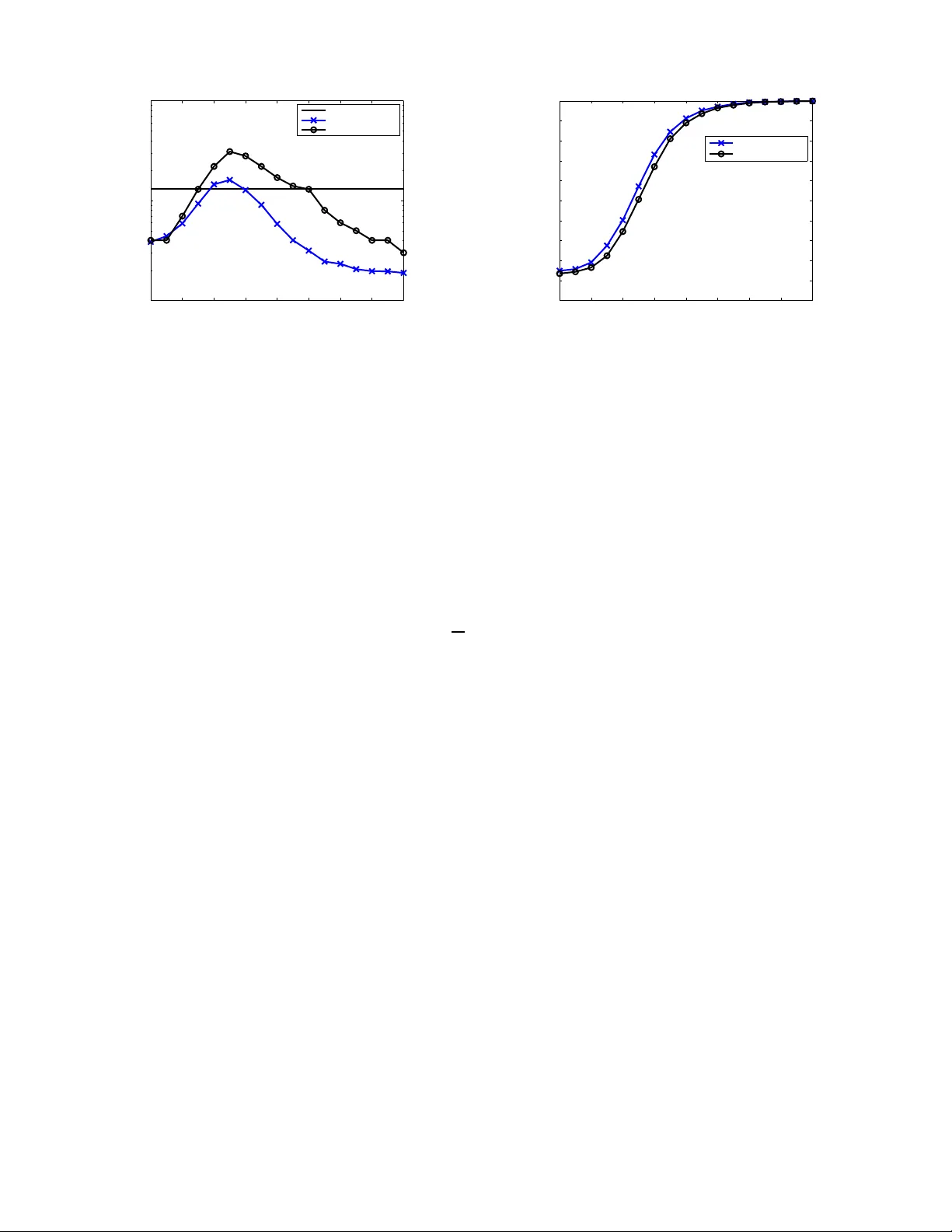
1 Distrib uted Lossy Source Coding Using Real-Number Codes Mojtaba V aezi and Fabrice Labeau Department of Electrical and Comp uter Engineering McGill Univ ersity , Montreal, Quebe c H3 A 2A7, Canada Email: mojtaba.vaezi@mail.mcgill.ca, fabrice.labe au@mcgill.ca Abstract —W e show how re al-number codes can be u sed to compress correla ted sources, and establ ish a new framework for distributed lossy source coding, in wh ich we quanti ze compressed sources in stead of compressing quantized sources. Th is change in the order of binn ing and quantization blocks makes it possible to model correlation between continuous-valued sources more realistically and correct quantization error when th e sources are completely correla ted. The encoding and decoding procedures are described in detail, for discrete Fourier transf orm (DFT) codes. Reconstructed signal, in the mean-squared error sense, is seen to be better than or close to quantization erro r level in the con ventional approach. Index T erms —Distributed source coding, real-number codes, BCH-DFT codes, channel coding, Wyner -Ziv coding. I . I N T R O D U C T I O N The distributed source coding (DSC) deals with compres- sion of correlated sources w hich do n ot com municate with each o ther [1]. Lossless DSC (Slepian-W olf c oding) , has been realized b y d ifferent binary ch annel co des, including LDPC [2] and turbo codes [3]. The W yner-Ziv codin g prob lem [ 4], deals with lossy da ta compression with side info rmation at the d ecoder, under a fidelity criterion. Cur rent approach in the DSC of a con tinuous- valued sour ce is to first convert it to a discrete-valued source using qua ntization, an d the n to apply Slepian-W olf coding in the binary field. Similar ly , a practical W yner-Ziv en coder is r ealized by cascad ing a quantizer an d Slepian-W olf en coder [5], [6]. In other words, the quan tized sou rce is comp ressed. There are, h ence, sou rce coding (or quantizatio n) loss and ch annel codin g (or binn ing) loss. This approa ch is based on the assumption that there is s till correlation remaining in the quantized version of correlated sources. In this pap er , we estab lish a new framework for th e W yn er- Ziv co ding. W e p ropose to first compr ess the c ontinuo us- valued s ource and then quantize it, as oppo sed to the con- ventional appr oach. The com pression is thus in the real field, aiming at repr esenting the sou rce with fe wer samples. T o d o comp ression, we g enerate either syndrom e o r parity samples of the input sequence using a real-numb er channe l code, similar to what is done to comp ress a binar y sequen ce This work was supported by Hydro-Qu ´ ebec, t he Natural Sciences a nd Engineeri ng Research Council of Canada and McGill Uni versi ty in the frame work of the NSE RC/Hydro-Qu´ ebec/McGill Industri al Research Chair in Interac ti ve Information Infrastructure for the Power Grid. of data using binary channel codes. Then, we quantize these syndrom e or p arity samples and transm it them. There are still co ding (binn ing) and q uantization losses; howe ver, since coding is perform ed bef ore quantization, error correction is in the real field an d qu antization error can b e corr ected when two sources are completely correlated over a b lock of co de. A second and mor e im portant advantage of this ap proach is the fact that the correlation channel model can be more realistic, as it cap tures the correlation b etween co ntinuou s-valued sources rather than quantize d source s. In the con ventional appro ach, it is implicitly assume d that quantizatio n of correlate d signals results in correlate d sequences in the discre te do main which is not necessarily co rrect d ue to nonlinear ity o f quan tization operation . I n addition, most of previous w orks assume that this correlatio n, in the binary field, can be mo deled by a binar y symmetric channe l (BSC) with a known c rossover probab ility . T o av o id the loss due to in accuracy of cor relation m odel, we exploit correla tion between continuo us-valued sources before quantization . Specifically , we use real BCH-DFT codes [7], fo r comp res- sion in the re al field. Owing to the DFT codes, the loss due to q uantization can be decreased by a factor of k/n for an ( n, k ) DFT code [ 8], [ 9]. Ad ditionally , if the two sou rces are perfectly cor related over one code vector , reconstructio n loss vanishes. Th is is achieved in view o f mo deling the correlation between th e two sou rces in the contin uous dom ain. Finally , the proposed scheme seems more suitable fo r low-delay com- munication becau se using sh ort DFT codes a r econstructio n error better than quantiza tion err or is achiev able . The re st of this p aper is organized as fo llows. In Section I I, we mo tiv ate and introdu ce a new framework for lossy DSC. In Section III, we briefly revie w enco ding an d decodin g in real DFT code s. Then in Section IV, we p resent the DFT encoder and decoder for the propo sed system, both in the s yndrom e and parity appr oaches. Th ese two approach es are also compared in this section . Section V discusses the simulatio n results. Section VI provide s our concludin g remark s. I I . P R O P O S E D S Y S T E M A N D M OT I V AT I O N S W e in troduce the use of real-nu mber codes in lossy com - pression of corre lated signals. Specifically , we use DFT cod es [7], a class of real Bose-Chaudhu ri-Hocq uenghem (BCH) codes, to p reform comp ression. Similar to err or correction in 2 E n coder D e coder X ˆ X Slepian-W olf Encoder Q Q − 1 Slepian-W olf Decoder Y Fig. 1. The W yner-Zi v coding using real-number codes. finite fields, the basic ide a of error correcting codes in the real field is to insert redu ndancy to a message vector of k samples to co n vert it to a codevector of n sam ples ( n > k ) [7]. But unlike that, the insertion of redu ndancy in th e re al field is p erform ed before q uantization and entropy coding . The in sertion of soft r edunda ncy in the real-numb er co des has advantages over hard redundancy in th e binary field. By usin g soft redundancy , o ne can go beyond quantizatio n erro r , an d thus recon struct continu ous-valued signals more accur ately . This makes real-number codes more suitable than binary codes for lossy distributed sou rce coding. The prop osed system is depicted in Fig. 1. Although it con- sists of the same block s as existing practical W yner-Zi v coding scheme [5], [6], the order of these blocks is changed here. That is, we perfor m Slepian-W olf cod ing befor e quantizatio n. This change in the o rder of the DSC and quan tization blocks bring s some advantages as describ ed in th e following. • Rea listic co rrelation model: In th e existing fram ew o rk for lossy DSC, c orrelation between two sou rces is mod- eled after quantizatio n, i.e., in the bina ry d omain. More precisely , cor relation b etween qu antized so urces is usu- ally mod eled as a BSC, m ostly with k nown crossover probab ility . Adm ittedly th ough, due to nonlin earity of quantization operatio n, c orrelation between the qu antized signals is not kn own accur ately e ven if it is known in the contin uous domain. This motiv ates in vestigating a method th at exploits correlatio n between continuo us- valued sources to per form DSC. • Alleviat ing quantization error: In lossy data co mpres- sion with side info rmation at the decoder, soft r edun- dancy , added by DFT codes, can be u sed to correct both quantization er rors and (corr elation) chann el error s. The loss due to quantization er ror thu s can be recovered, at least p artly if n ot who lly . More precisely , if the two sources are exactly the same over a co devector , q uanti- zation erro r c an be corre cted completely . T hat is, p erfect reconstruc tion is achie ved over corresponding samples. The loss due to quantization error is decreased ev e n if correlation is no t perf ect, i.e., when (correlation ) ch annel errors exist. • Low-delay communicatio n: If commun ication is sub ject to low-delay con straints, we can not use tu rbo o r LDPC codes, as their perfo rmance is n ot satisfactory for shor t code leng th. Whether low-delay req uiremen t exists or not depend s on the specific applications. Ho wever , ev en in the applications that lo w-delay transmission is not impera- ti ve, it is sometim es useful to consider low-dimensional systems for their low comp utational complexity . I I I . E N C O D I N G A N D D E C O D I N G W I T H B C H - D F T C O D E S Real BCH-DFT cod es, a subset of complex BCH codes [7], are linear block codes over the real field . Any BCH-DFT co de satisfies two pro perties. First, as a DFT cod e, its par ity-check matrix is defined based on the DFT matrix. Second , similar to other BCH codes, the spectru m of any codevector is zero in a block o f d − 1 cyclically adjacen t com ponen ts, where d is the designed distance of that co de [10]. A real BCH-DFT codes, in addition, has a generator matrix with real entries, as described below . A. Encod ing An ( n, k ) rea l BCH-DFT code is defined by its g enerator and parity-c heck matrices. The gen erator matrix is giv en by G = r n k W H n Σ W k , (1) in which W k and W H n respectively a re the DFT and IDFT matrices of size k and n , an d Σ is an n × k matrix with n − k zero rows [11]–[14]. Particularly , fo r odd k , Σ h as exactly k nonzer o elem ents giv en as Σ 00 = 1 , Σ i,i = Σ n − i,k − i = 1 , i = 1 : k − 1 2 [11], [12]. Th is guaran tees the spectrum of any codeword to have n − k con secutive zeros, wh ich is required for any BCH co de [1 0]. Th e parity- check matrix H , o n the other hand, is constructed by using th e n − k colum ns of W H n correspo nding to th e n − k zer o rows of Σ . Theref ore, due to unitary proper ty of W H n , H G = 0 . In the rest of this p aper, we use the term DFT code in lieu o f real BCH-DFT co de. Besides, we only co nsider od d numbe rs for k an d n ; thu s, the erro r co rrection capa bility o f the co de is t = ⌊ n − k 2 ⌋ = n − k 2 . B. Decodin g For decod ing, we use th e extension o f the well-kn own Peterson-Gor enstein-Zierler ( PGZ) algorithm to the real field [10]. Th is algo rithm, aimed at detecting, localizin g, and e s- timating errors, w orks based on the syndrome of e rror . W e summarize the main steps of this algorithm , adap ted for a DFT code of length n , in th e f ollowing. 1) Com pute vector of syn drome samp les 2) Deter mine the nu mber o f err ors ν by con structing a syndrom e matrix and finding its ran k 3) Find c oefficients Λ 1 , . . . , Λ ν of err or-locating polyno- mial Λ( x ) = Q ν i =1 (1 − xX i ) whose r oots are th e inverse of error locations 4) Find the zero s X − 1 1 , . . . , X − 1 ν of Λ( x ) ; the err ors are then in location s i 1 , . . . , i ν where X 1 = α i 1 , . . . , X ν = α i ν and α = e − j 2 π n 5) Fina lly , deter mine error mag nitudes b y solving a set of linear equations whose con stants c oefficients are powers of X i . As mention ed, th e PGZ algorithm works based on the syndrom e o f error, which is the synd rome of the received codevector , neglecting quantization. Let r = y + e be the received vector , then s = H r = H ( y + e ) = H e , (2) 3 where s = [ s 1 , s 2 , . . . , s 2 t ] T is a comp lex vecto r o f len gth n − k . In practice howev e r , the received vecto r is distorted by quantization ( r = ˆ y + e , ˆ y = y + q ) and its syn drome is no longer equal to the synd rome o f error because ˜ s = H r = H ( y + q + e ) = s q + s e , (3) where s q ≡ H q and s e ≡ H e . While the “exact” value of e rrors is determined neglecting quan tization, the decod ing becomes an estimation problem in th e p resence of quantiza- tion. Then, it is impe rativ e to mo dify the PGZ algorithm to detect erro rs reliably [10]–[13]. Erro r detectio n, localization, and also estimation can be lar gely i mproved using least squares methods [14]. C. P erformance Compa r ed to Bina ry Code s DFT c odes by con struction are capable o f dec reasing quan - tization err or . When there is no erro r , an ( n, k ) DFT code brings d own the mean-sq uared error ( MSE), be low the level of quantization er ror, with a factor of R c = k / n [8] , [ 9]. This is also shown to be valid for chann el err ors, as long as channel can be m odeled as by additive noise. T o appreciate this, o ne can consider the generator m atrix o f a DFT co de as a tigh t frame [ 9]; it is known that f rames are r esilient to any additive noise, and tight fram es redu ce the MSE k/n times [15]. Hence, DFT codes can result in a MSE even b etter than quantization error lev el wher eas the best possible MSE in a binary code is o bviously lower-bounded by quantization error lev e l. I V . W Y N E R - Z I V C O D I N G U S I N G D F T C O D E S The concep t of lossy DSC and W yner-Ziv codin g in the real field was described in Section II. In this section, we use DFT co des, as a specific me ans, to do W yner-Zi v codin g in the r eal field. This is accomp lished by u sing DFT codes for binning , and tran smitting compr essed signal, in the form of either syndro me or par ity samples. Let x b e a sequen ce of i.i.d r andom variables x 1 x 2 . . . x n , and y be a noisy v ersion of x such that y i = x i + e i , where e i is continuo us, i.i.d., and indepen dent of x i . Since e is continu ous, this mo del precisely captu res any variation of x , so it can model correlation between x an d y accu rately . For exam ple, the Gaussian, Gaussian Bern oulli-Gaussian, and Gaussian- Erasure correlation chan nels can be mo deled using this model [16]. These corre lation models are practically impo rtant in video co ders that exploit W yner-Ziv c oncepts, e. g., when the decoder builds side information via extrapolation of pre v iously decoded frames or interpolation of key f rames [16]. I n th is paper, th e virtual c orrelation channel is assumed to be a Bernoulli-Gau ssian channel, inserting at most t ra ndom errors in each codeword; thus, e is a spar se vector . A. Synd r ome Ap pr oach 1) Enco ding: Giv en H , to co mpress an arbitrary sequence of data samples, we mu ltiply it with H to find the corre- sponding syndro me samp les s x = H x . The syndr ome is then quantized ( ˆ s x = s x + q ) , an d transmitted over a n oiseless digital commu nication system, as shown in Fig. 2. Note that s x , ˆ s x are both complex vectors of length n − k . E n coder x n s x n − k ˆ s x n − k ˆ x n y n H Q Deco der Correlatio n Channel Fig. 2. The W yner-Zi v coding using DFT codes: Syndrome approach. 2) Decoding: The deco der estimates the input sequenc e from the received synd rome and side in formatio n y . T o this end, it needs to e valuate the syn drome of ch annel (c orrelation ) errors. This can be simply done by sub tracting the received syndrom e from syndr ome of side inf ormation . Then, neglect- ing quantizatio n, we obtain , s e = s y − s x , (4) and s e can be used to pre cisely estimate the e rror vector , as described in Section III-B. In practice, howev er , the decod er knows ˆ s x = s x + q rather than s x . Therefore , only a distorted syndrom e of error is av a ilable, i.e., ˜ s e = s y − ˆ s x = s e − q . (5) Hence, using the PGZ a lgorithm, error corr ection is accom- plished based on (5). Note that, ha vin g computed the syndr ome of er ror, de coding alg orithm in DSC using DFT codes is exactly th e sam e as that in th e chann el codin g problem. T his is different f rom DSC techniques in the binary field which usually r equire a slight modification in th e correspond ing channel coding algorithm to custom ize for DSC. B. P arity App r oach Syndro me-based W y ner-Zi v coding is straightforward b ut not very efficient because, in a re al DFT code, syndro me samples are complex number s. Th is means that to tran smit each sample we need to send two r eal numb ers, one fo r the real part and one for the imaginary part. Thus, the compression ratio, u sing an ( n, k ) DFT code, is n 2( n − k ) whereas it is n n − k for a similar binary code. Th is also imposes a constraint o n the rate of cod e, i.e., n < 2 k o r R c > 1 2 , since otherwise there is no compr ession. In the sequel, we explore parity-based approa ch to the W yner-Ziv coding . 1) Encodin g: T o comp ress x , the encod er generates the correspo nding parity sequen ce p with n − k samples. The parity is then qu antized and transmitted, as shown in Fig. 3, instead of transmitting th e inpu t data. Th e first step in parity- based system is to find th e system atic gener ator matrix, as G in (1) is n ot in the systematic form. Let H be partitio ned as H = [ H 1 | H 2 ] , where H 1 is a ma trix o f size n − k × k , and H 2 is a squ are matrix of size n − k . Since H 2 is a V and ermond e m atrix, H − 1 2 exist an d we can write H sys = H − 1 2 H = [ P | I 2 t ] , (6) in wh ich P = H − 1 2 H 1 is an ( n − k ) × k matrix, and I 2 t is an identity matrix of size 2 t . 4 E n coder x k p n − k ˆ p n − k ˆ x k y k G sys Q Deco der Correlatio n Channel Fig. 3. The W yner-Zi v coding using DFT codes: Parity approach. The systematic generato r m atrix cor respond ing to H sys is giv en by G sys = I k − P = I k − H − 1 2 H 1 . (7) Clearly , H sys G sys = 0 . It is also ea sy to check th at H G sys = 0 . (8) Therefo re, we do not need to calculate H sys and the same parity-ch eck matrix H can be used for decod ing in the parity approa ch. An ev e n easier way to come up with systematic gene rator matrix is to partition G as G 1 G 2 where G 1 is a square matrix of size k . The n, from H G = 0 and the fact tha t H 2 is in vertib le one can see G 2 = − H − 1 2 H 1 G 1 ; thus, we have G = G 1 G 2 = I k − H − 1 2 H 1 G 1 . (9) Note that G 1 is inv ertible because using (1) any k × k sub- matrix of G can be rep resented as produc t o f a V ande rmond e matrix and the DFT matrix W k . This is also p roven using a different approac h in [9], where it is sh own that a ny subframe of G is a fr ame an d its rank is equal to k . Hence, since G 1 is in vertib le, the systematic gen erator matrix is giv en by G sys = G G − 1 1 . (10) Again H G sys = 0 because H G = 0 . Therefo re, the s ame parity-ch eck matrix H can be used for decod ing in the parity approa ch. It is also easy to see that G sys is a real matrix. The question that rem ains to be answered is wheth er G sys correspo nds to a BCH code? T o gen erate a BCH code, G sys must have n − k co nsecutive zeros in the transform domain. W n G sys = ( W n G ) G − 1 1 , the Fourier transfo rm o f this matrix satisfies this con dition because W n G , th e Fourier tra nsform of original matrix , satisfies that. Note that, since parity samples, u nlike syndrome samples, are real nu mbers, u sing an ( n, k ) DFT code a compression ratio of k n − k is achieved. Obviously , a compression ratio of n n − k is achiev ab le if we u se a (2 n − k , n ) DFT code. 2) Decod ing: A parity decoder estimates the inp ut se- quence from th e recei ved p arity a nd side inf ormation y . Similar to the syndrom e approach , at the d ecoder, we need to find the syndrome of channel ( correlation ) errors. T o do this, we app end the parity to the side infor mation and f orm a vector o f length n whose syndro me, neglecting quan tization, is equal to the syndr ome o f e rror . That is, z = y p = x p + e k 0 = G sys x + e n , (11) hence, s z = s e . (12) Similarly , when q uantization is in volved ( ˆ p = p + q ), we get ˜ z = y ˆ p = z + 0 q = G sys x + e n + q n , (13) and s ˜ z = s e + s q , (14) in which, s q ≡ H q n . Therefo re, we obta in a distorted version of err or synd rome. In both cases, the rest of the algorithm, which is based on the syn drome of error, is similar to that in the channel codin g pr oblem using DFT co des. C. Comparison Between the T wo Appr oaches As we saw earlier, using an ( n, k ) code the compression ratio in the synd rome and parity ap proache s, respectively , is n 2( n − k ) and k n − k . Hence, the parity approach is 2 k / n = 2 R c > 1 times more efficient than the syn drome app roach. Con versely , we c an find two d ifferent codes that result in same com pression ratio, say n n − k . W e k now that in the pa rity approa ch, a (2 n − k, n ) code can be used f or this matter . It is also easy to verify that, in the synd rome appro ach, a code with rate R c = n + k 2 n results in the same compression. For odd n and k , the ( n, n + k 2 ) DFT code giv es the desired comp ression ratio. Thus, fo r a giv en compression ratio the parity app roach implies a code with smaller rate co mpared to the code requir ed in the syndro me appro ach. V . S I M U L AT I O N R E S U LT S W e ev aluate the per forman ce of the prop osed systems using a Gauss-Markov sou rce with zero mean, unit v ariance, and correlation coefficient 0.9; th e effecti ve ran ge of the inpu t sequences is thus [ − 4 , 4] . The sources sequences ar e b inned using a (7 , 5) DFT code. The co mpressed vector , either syndrom e or parity , is then quantized with a 6-bit un iform quantizer, and tran smitted over a noiseless co mmunica tion media. The corr elation chan nel r andomly inserts one err or ( t = 1) , generated by a Gaussian distribution. The d ecoder localizes and decod es e rrors. W e comp are th e MSE between transmitted and r econstructed codevectors, to measurers end to end distortion . In all simulatio ns, we use 20,000 input fram es for each channel- error-to-quan tization-noise ra tio (CEQNR). W e vary the CEQNR and plot th e resulting MSE. The result are pr esented in Fig. 4, and co mpared again st the quan tization error lev e l in the existing lossy DSC meth ods. It can be observed that the MSE in the syn drome appr oach is lower than quantizatio n er ror except for a small ran ge of CEQNR. Similarly , in the parity app roach, the MSE is less than qu antization err or fo r a wide rang e of CEQNR. Note that in lossy DSC using binary cod es, th e MSE can be eq ual 5 −10 0 10 20 30 40 50 60 70 10 −4 10 −3 10 −2 channel error to quantization noise ratio (dB) MSE Quantization error Syndrome approach Parity approach Fig. 4. Reconstr uction error in the syndrome and parity approaches, using a (7 , 5) DFT code in Fig. 2, 3. For both schemes, the virtual correlation chann el inserts one error at each channel error to quantiz ation noise ratio. to quantization er ror only if the pr obability of err or is zero. The perfo rmance o f both alg orithms improves as CEQNR is very high. This improvement is due to better error localization , since the hig her th e CEQNR the better the err or localization, as shown in Fig. 5 and [1 1]. At very lo w CEQNRs, although error localization is p oor, the MSE is still very low because, compare d to quan tization err or, the erro rs ar e so small that the algorithm may localize an d correct some of quan tization errors instead. Ad ditionally , recon struction error is alw ays red uced with a factor o f R c = k /n , in an ( n, k ) DFT co de. In te rms of co mpression, the par ity ap proach is 2 R c = 10 7 times more efficient than the syn drome a pproac h, as discussed earlier in Section IV -C . No t su rprisingly th ough, th e per- forman ce of the parity appro ach is not as good as that of the sy ndrom e approach , bec ause it contains f ewer r edund ant samples. On to p of that, in this simu lation, 1 / 5 of sam ples are corrup ted in th e pa rity app roach while this figu re is 1 / 7 f or the synd rome a pproach . The par ity appro ach, however , suffers from the fact th at dynamic rang e of par ity samples, g enerated by (10), could b e much h igher than that of synd rome samples as t incr eases. Th is implies m ore pr ecision bits to achieve the same accuracy . Finally , it is worth men tioning that when data and side in formation are the same over a block o f code, reconstruc tion error becom es zero in both ap proach es. V I . C O N C L U S I O N S W e have intr oduced a new fram ew o rk fo r distributed lossy source coding in general, and W yner-Ziv coding specifically . The idea is to do binn ing be fore quantizing the continuo us- valued signa l, a s opposed to the con ventional appr oach where binning is don e after quantization. By doing binning in the real field, the virtu al correlation channel can be m odeled more accurately , and qu antization error c an be corrected when the re is no error . I n the new parad igm, W yner-Ziv coding is r ealized by cascad ing a Slepian-W olf enco der with a qu antizer . W e employ real BCH-DFT co des to d o the Slepian -W olf in th e real field. At the d ecoder, by in troducin g both syndr ome- based and p arity-based systems, w e adapt th e PGZ d ecoding algorithm acco rdingly . From simulation r esults, we c onclude −10 0 10 20 30 40 50 60 70 0 0.1 0.2 0.3 0.4 0.5 0.6 0.7 0.8 0.9 1 channel error to quantization noise ratio (dB) probability of correct localization Syndrome approach Parity approach Fig. 5. Relat i ve frequency of correc t localizat ion of correl ation chann el error in the s yndrome and parity approach es, using a (7 , 5) DFT code. that our systems, specifically with short codes, can improve the reconstruc tion error, so that th ey may becom e viable in real- world scenario s, where low-delay com municatio n is requ ired. R E F E R E N C E S [1] D. Slepia n and J. K. W olf, “Noiseless coding of correlate d informat ion sources, ” IEE E T ransactions on Information Theory , vol. IT -19, pp. 471 – 480, J uly 1973. [2] A. D. Liv eris, Z. Xiong, and C. N. Georghiade s , “Compression of binary sources with side information at the decode r using LDPC codes, ” IEE E Communicat ions Letters , vol. 6, pp. 440–442, Oct. 2002. [3] A. Aaron and B. Girod, “Compression with side informa tion using turbo codes, ” in Proc. IEEE Data Compression Confer ence , pp. 252–261, 2002. [4] A. D. W yner and J. Z i v , “The rate-di stortion function for source coding with side information at the decoder , ” IEEE T ransact ions on Information Theory , vol. 22, pp. 1–10, Jan. 1976. [5] B. Girod, A. M. Aaron, S. Rane, and D. Rebollo-Monede ro, “Distrib uted video coding, ” Pr oceedings of the IEEE , vol. 93, pp. 71–83, Jan. 2005. [6] Z. Xiong, A. D. Li ver is, and S. Cheng, “Distrib uted source coding for sensor networks, ” IEEE Signal Proce s sing Magazine , vol. 21, pp. 80–94, Sept. 2004. [7] T . Marshall Jr ., “Coding of real-number sequences for error correct ion: A digital signal processing proble m, ” IEEE J ournal on Selec ted Areas in Communicat ions , vo l. 2, pp. 381–392, March 1984. [8] V . K. Goyal, J. Kov ae vic, and J. A. Kelner , “Quanti zed frame ex pansions with erasures, ” Applied and Computatio nal Harmonic Analysis , vo l. 10, no. 3, pp. 203–233, 2001. [9] G. Rath and C. Guille mot, “Frame -theore tic analysis of D FT codes with erasures, ” IEEE T ransactions on Signal Pr ocessing , vol. 52, pp. 447– 460, Feb. 2004. [10] R. E. Blahut, A lgeb raic Codes for Data T ransmission . Ne w Y ork: Cambridge U ni v . Press, 2003. [11] G. Rath and C. Guillemot, “Subspace -based error and erasure correction with DFT codes for wireless channe ls, ” IEEE T ransacti ons on Signal Pr ocessing , vol. 52, pp. 3241–3252, Nov . 2004. [12] G. T akos and C. N. Hadji costis, “Determina tion of the number of errors in DFT codes subje ct to lo w-le vel quanti zati on noise, ” IEEE T ransacti ons on Signal Proc essing , vol. 56, pp. 1043–1054, March 2008. [13] A. Gabay , M. Kief fer, and P . Duhamel, “Joint source-channel coding using real BC H code s for robu st image t ransmission, ” IEE E T ransactions on Imag e Pr ocessing , vol. 16, pp. 1568–1583, June 2007. [14] M. V aezi and F . Labeau, “Least squares solution for error correction on the real field using quant ized DFT codes, ” to appear in E USIPCO 2012. [15] J. Ko vace vic and A. Chebira, An intr oduction to frames . Now Publishe rs, 2008. [16] F . Bassi, M. Kief fer , and C. W eidmann, “Source coding with inte r- mittent and deg raded side information at the decoder , ” in Pro c. IEEE Internati onal Confer ence on Acoustics, Speec h and Signal Pr ocessing (ICASSP) , pp. 2941–2944 , 2008.
Original Paper
Loading high-quality paper...
Comments & Academic Discussion
Loading comments...
Leave a Comment