A Dynamic Framework of Reputation Systems for an Agent Mediated e-market
The success of an agent mediated e-market system lies in the underlying reputation management system to improve the quality of services in an information asymmetric e-market. Reputation provides an operatable metric for establishing trustworthiness b…
Authors: Vibha Gaur, Neeraj Kumar Sharma
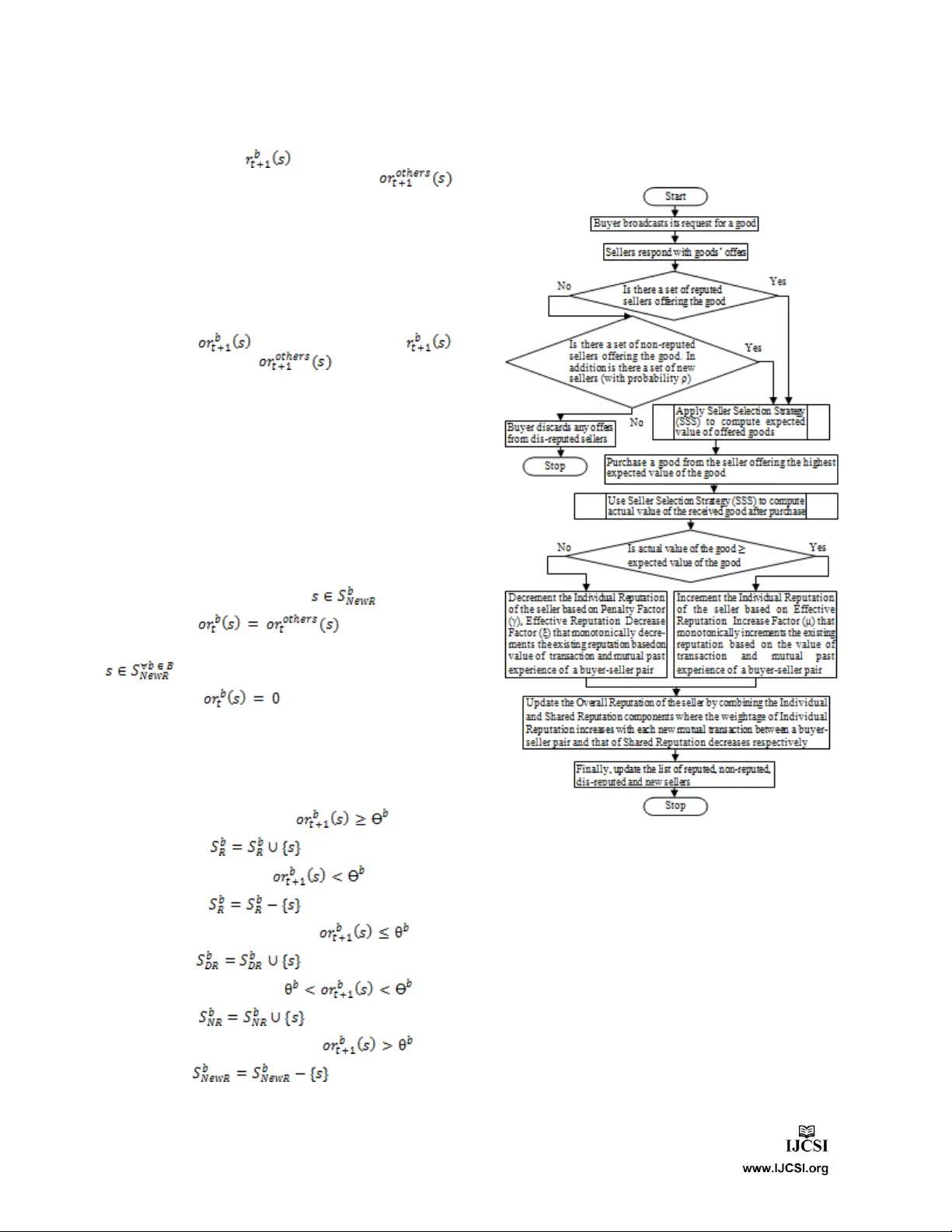
I JCSI Inter national Journal of Computer Science I ssues , V ol . 8 , Issue 4, July 2011 I SSN (Online): 1694 - 0814 ww w.I JCSI .or g 1 A D y n a m i c F r a m e w o r k o f R e p u t a t i o n S y s t e m s f o r an A g e n t M e d i a t e d e - m a r k e t Vibh a Gaur 1 , Neeraj Kum ar Sh arm a 2 1 Departm ent of Com puter Science, Unive rsity of Delhi Delhi , Ind ia 3.vibha@gm ail.com 2 Departm ent of Com puter Science, Unive rsity of Delhi Delhi, Ind ia neerajraj100@ gmail.com Abstract The success of an ag ent mediated e-ma rket sy stem lies in the underlying rep utation managem ent system to improve the qu ality of services in an information asym me tric e-market. Reputation provides an operatable metric for establishing trustworthiness between m utually unknown online entities. Reputation system s encourage ho nest behaviour and discourage ma licious behaviour of participating agents in the e-m arket. A dynamic reputation model would provide virtually instantaneous knowledge about the changing e- market environment and would u tilise Internets’ capacity for conti nuous interactivity for repu tation computation . This paper prop oses a dy namic reputation fram ework using reinforcem ent learning and fuzzy set th eory that ensures judicious u se of information sharing for inter-agent coo peration. This fra mew ork is sensitive to the changing parameters of e- mark et like the value of tran saction and th e varying experience of agents with the p urpose of improving inbuilt defense me chanism of the repu tation system against various attacks so that e-mark et reaches an equilibrium state and disho nest agents are wee ded o ut of the marke t. Keywords: Reputation , Reinforcement Learning , Fuzzy attribute weigh ts , e-market. 1. Introduction With the growing popularity of e-commerce and amount of inform ation on W EB, users expect automated techniques to assure the trustworthiness of information available o n internet. Softw are agents offer a promise to change e - comm erce trading by helping internet traders to p urchase products from o nline distributed r esources based on their interests and pr eferences [1 6]. Assu ring the trustw orthiness of web products and services in such an environm ent wh ere ac tual traders may never meet each ot her is a challenging task performed by reputation sy stem s. Reputation sy stems h ave a high utility in those environm ents where entities are lo ng lived, feedback abo ut the current interactions is captured and d istributed, and past feedback/experience guides buyer decisions [22] . These systems are oriented to develop trustworthiness or the degree to which one agent has confidence in another with in the context of a given purpose or d ecision. The definition and meanin g of reputation varies with applications and contexts. From an objective view, reputation is expressed as “a quantity derived from th e underlyin g so cial netw ork wh ich is globally visible to all mem bers of the network” [2 5] or, “a perce ption that an agent has of another’ s in tentions and norm s” [17] . Reputation and Trust are often used in complementary fashion as an agent expects positive outcomes w hen interacting with another agent that has a reputation for being trustw orthy [8]. So me system s are described as trust system s as therein agents determine whether another agent will do wh at it says it w ill, w hereas others are b est described as reputation sys tems because therein agents compute and propagate their beliefs about other agents. The e-market environment in which these agents oper ate is generally open, that means agents can join or leave the marketplace at any time; uncertain, i.e. the true worth of a good can b e judged only after its p urchase; and un -trusted, that is the e-market co mprises of honest and dishonest agents. The e-market is populated with self interested buyer and seller agents that try to max imise their respective gains. The e -market environment is itself dynam ic in nature as it undergoes continuous changes with different agents j oining and leaving the e-market at will. The p ower of a r eputation system in an agent mediated e- comm erce can be realized to the op timu m if different process models inherent to the e -transactions like deciding about pricing of goods, computing and distrib uting reputation o f particip ants and selection o f a selle r for purchasing a good are also dynam ic [29] . A truly dynam ic model must be sensitive to the changing e -m arket I JCSI Inter national Journal of Computer Science I ssues , V ol . 8 , Issue 4 , July 2011 I SSN (Online): 1694 - 0814 ww w.I JCSI.org 2 environm ent and must adap t to changing experience of buyer/seller agents with each transaction. Dynam ic e- market models would pro vide virtually instantaneous know ledge about the changing e-market environment and would utilise Internets’ capacity for continuous interactivity . Design ing efficient and robust reputation system s that satisfy both the buy ers as well as sellers is a challenge for the research comm unity . The o bjective of this paper is to prop ose a fram ework for a dynam ic reputation system that is sensitive to the changing parameters of the dynam ic e-market environment like the experience of agents involved in transactions, value of a transaction and num ber of transactions between the same buyer-seller pair. In the prop osed model, each of the individual p rocess m odel of the dyn amic reputation framew ork is its elf dy namic as s election of a seller for buyin g a good depends on the chan ging exper ience between a buyer-seller p air; computing sellers’ r eputation by a buyer depend on the experience o f an agent in the e- market, mutu al exper ience of a buyer-seller pair and the value of transaction. Further, incorpo rating value of transaction in rep utation computation affects the amount o f reputation that is to be enh anced or reduced after each transaction. This makes the reward/penalty pro portional to the size of the transaction in which honest/dishonest behavior is exhibited b y seller agents, and negates any benefit of a Value Imbalance attack where a seller agent gains r eputation by showin g honesty for small value transactions and then cheats for a large value transaction. Making the reputation updation dependent o n the experience of agents, by varying the w eightag e of individual experience and shared opinion from others, reduces the effect of Ballot Stuffin g attac k where a number of malicious agents artificially enhance o r reduce the reputation of another agent. Also, by making the reputation updation sensitive to th e fact that w hether reputation is earned from a single buyer or multiple buyers min imizes the eff ect of collusion between a buy er-seller pair. The proposed framework employ s judicious use of information sharing and thus reduces the associated cost by using effective inter-agen t comm unication. The re putation computation strategy propo sed in this paper uses reinforcemen t learning (RL) techniques wh ich provide a general framew ork for seq uential d ecision making problems [ 10 ]. RL deals with w hat an agent should do in every state that it can be and how to map situations to action, in order to maximize the long term r eward. T he learner mus t discover w hich actio ns yield the maximu m reward by tr yin g them. Sometim es , ac tions may affect not only the immediate reward, but also all subsequent rewards. Hence, trial-and-error search and delayed reward are the two m ost important distingu ishing f eatures of RL. In the proposed strategy, for purchasing a good, the buyer chooses a seller offering the high est expect ed value of the good i.e. good with highest expec ted utility for the buyer . Expected buyers’ req uirement from a good constitutes buyers’ estimation of goods’ attributes and is subjective and fuzzy in nature. It is subjective as relative priority o f attributes o f a good would vary with each goo d and with each buyer. It is fuzzy as generally buyers’ expectations of a particular attribute are specified in fuzzy terms like “low ” or “high”. Sim ilarly, a buy er has to m ap linguistic assessm ent of goods being offered by different sellers based on their attrib utes to the fuzzy scale. Hence this paper uses fuzzy set theory to allow a b uy er agent to compute attr ibute w eights of a good and to select a seller that offers the good w ith highest ex pected value. The rest of this paper is organ ized as follow s. Various reputation models from literature and in comm ercial use are introduced in section 2. Section 3 presents the proposed dy nam ic rep utation framew o rk. T o ad dress existing problems, sectio n 4 illustrates the performance of the proposed system against known attacks. A case study is presented in section 5. Section 6 co ncludes the paper. 2. Related Work Reputation models ar e an important component of e - market, help b uilding trust and elicit co operation among loosely connected and geographically dispersed economic agents [1 2]. A num ber o f reputation models describ ed in literature are discussed below. The evidential model [2 , 3 ] for rep utation computation assum es a d istributed reputation environment and is based on Dam pster Shafer Theory. An agent finds the trustw orthiness of another agent [3] based on its direct interaction and testimonies of other trustw orthy ag ents. Some rep utation models [2 1, 26 ] from literature employ reinforcement learning and are based o n individual experience o nly. In rep utation model for increasing user satisfaction [26], seller agents adjust the price and quality of goods to maxim ise their p rofit. A multi-facet reputation model [21] involv es reputation co mputation of b oth b uy er and seller agents using quality , price and delivery tim e of goods. But, these system s [21, 26] suff er heavily from re - entry and multi-identity attacks as these use negative reputation and new sellers do not start from minim um reputation. TRAVOS [ 15] employ s Bayesian probabil ity analysis and computes trust of an agent by taking into account past experience between two agents, and in case of lack of past experience, this model utilizes the in formation collected I JCSI Inter national Journal of Computer Science I ssues , V ol . 8 , Issue 4 , July 2011 I SSN (Online): 1694 - 0814 ww w.I JCSI.org 3 from third parties. T o filter out unfair opinions, TRAVOS uses an endogenous approach to filter out unfair opinions. PeerT rust [19 ] is a rep utation model that uses techniques for resilient r eputation m anagem ent against vu lnerabilities like feedback sparsity and feedback manipulation. It talks about dynamism in electronic comm unities from the perspective of honest and dishonest behaviour of actors. Reputation in Gregarious societies (REGRET) [16, 17] employ s fuzzy r ules to f ind reliab ility o f witness agents based on their r elationship with the target agent. REGRET is a mu l ti -facet reputation m echanism that models the reliability of reputation based o n the num ber of interactions of w itness agents w ith the target agent. Another m odel “Trunits” [24] is based on accumulation of trust units (trun its). A seller must possess sufficien t number of trunits before executing a transaction. To engage in a transaction, seller m ust risk a particular quantity of trunits wh ich is put into an escro w w ith the market oper ator. After a transaction, if b uy er is satisfied, seller gets more tr units, otherwise it loses risked ones. Broker assis ting T RS [4] is a flexible m odel based on Artificial Neural Networks (ANN) that employ s backpropagation algor ithm . Use o f ANN helps to r educe noise d ata and supports incremental training, so ea ch agent reque st s for information only from those having a similar reputation evaluation criterion. In Reputation Dynamics and Convergence [8] , authors formalize the desiderata that from a dynamic sy stems’ perspective a rep utation sy stem should have the properties of Mo notonicity and Accuracy. As an example of Monotonicity, agents who provide high quality goo ds at low price should acquire better reputation and, in systems with focus on Accuracy, the buyer should q uickly learn the accurate reputation value for the sell er. T he Dynamic Framew ork proposed in this paper incorporates Monotonicity as the process of seller selection and also updation of reputation are based on the presence of favourable goo ds’ attrib ute like low price and high quality. Further, a fraudulent seller is p enalised imm ediately to keep the reputation estimate accurate. The P4P (Pervasive Platform for Privacy Preferences) [ 20] system concentrates on privacy control in case of e- transactions. The p aper acknowledges the p roperty of e - market environment being dy namic and , the need that the existing systems in this environment should also be dynam ic. It emphasizes importance of r eputation b y allowing the clients, the freedo m to not disclose personal data accord ing to the level of reputation. A number of sim ple online rep utation systems are in comm ercial use. eB ay [14] is the most popular auction site that has feedback forum as a reputation system in wh ich after ea ch transaction, a b uy er rates a seller as po sitive, negative or neutral i.e. +1, -1 o r 0 resp ectively. T he reputation of a user is computed by subtracting total num ber of negative feedbacks f rom the total number of positive feedbacks ob tained from distinct users [23] . Am azon [ 13] is America’s largest online retailer w here reviews include star r atings from 1 to 5 and a pr ose text. Average of all ratings is u sed to assign reputation. A limitation of the existing system s from literature [1, 3, 4, 8, 15, 16, 19, 20, 21] is that, during the process of computing or updating of rep utation values, these do not take into consideration the changing parameters of dynam ic e-market environment like the varying experience of agents and the value of a transaction which mak e them vulnerable to different attacks. T he proposed rep utation framew ork incorp orates value of a transaction in the strategy of reputation computation to r emove the problem of Value I mbalance attack and, v aries the weightag e of individual and shared reputation comp onents with changing experience of agents to m inim ise the effect of Ballot Stuffing attack. 3. Dynamic Reputation System Fr amework Reputation sy stems are oriented to encourage trustw orthy behaviour, in crease u ser satisfaction and deter dishonest participants by p roviding means through w hich reputation could be computed and disseminated [22] . T he e-market environm ent in which reputation system s oper ate is dynam ic as it changes continuous ly in terms of agents freely entering/exitin g the market and also with the varying experience o f agents. T herefore, as a b uyer gains experience of a seller s’ behaviour w ith each repea ted transaction, the weightage of the individual experience of a buyer-seller p air should increase as compared to the opinion shared by other buyer agents. Moreover, economic worth o f being honest or dishonest in a transact ion cannot be judged w ithout taking into account the value o f a transaction as honest behaviou r in a large transaction is more im portant than in a small transaction. A dynam ic reputation framew o rk should base the reputation computation methodology itself o n the dynam ics o f the e -market environment to infuse some inbuilt defense capability against possible attacks. In order to have a robust and high utility reputation sy stem, different activities belo nging to reputation computation methodology it should be adap tive to the changing environm ent and the experience o f agents involved in a transaction. The next section describes the proposed I JCSI Inter national Journal of Computer Science I ssues , V ol . 8 , Issue 4 , July 2011 I SSN (Online): 1694 - 0814 ww w.I JCSI.org 4 dynam ic rep utation computation strategy that employs reinforcement learnin g and fuzzy set theory. 3.1 Buyers’ Strategy for Reputation Computation The proposed buy ers’ strategy is based on the e -market model having a set of b uy ers and sellers. In this model, sellers are divided into four ca tegories, namely, reputed, non-reputed, dis-reputed and new sellers. The reputation of seller s b eing computed b y buyer b is composed of two components: individual reputation and shared reputation. These tw o components ar e combined to represent overall reputation of a seller agent. In this m odel, B r epresents the set of buyers, S represents the set of sellers and, G the set o f good s. Let [0,1) represents individual reputation (IR) component, [0,1) rep resents shared reputation ( SR) i.e. the opinion o f other buyers for seller s , and [0,1) represents overall rep utation of seller s at time t, for the buyer b . At time t+1, b uy er b stores/remembers the overall reputation of all sellers , with whom buyer b has interacted at time t in the past. Each buyer maintains four categories of sellers as defined belo w . (i) : Sellers in the rep uted list of buyer b , i.e. , w here , is the reputation threshold of buyer b and . (ii) : Sellers in the non-reputed list of b uyer b , i.e. wh ere . (iii) : Sellers in the dis-reputed list of buyer b , i.e. , where , is the dis- reputation threshold and . (iv) : Seller s that are new to buyer b in the market, initially A new seller s remains in this list until its rep utation crosses the dis -reputation threshold . Before crossin g , if a seller cheats than it is moved to the list of dis-reputed sellers and is never considered again for business. The process o f choo sing a seller for purchasin g a good based on its expected value uses three important algebraic operations on fuzzy num bers: inverse, addition and m ulti- plication. If and are tw o p ositive trapez oidal fuzzy num bers then, the fuzzy addition of and is given in (1) and inverse o f a fuzzy num ber represented as is show n in (2) below. (1 ) (2) Unlike addition and subtraction, product o f two trapezoidal fuzzy numbers may not result into a trapezoidal number [6, 7] . Therefore, this paper uses an approximation of the product of two tr apezoidal fuzz y numbers to a new trapezoidal fuzzy nu mber [7] . The product of two trapezoidal fuzzy num bers, A and B given abo ve is approximated b y the tr apezoidal fuzzy num ber as propo sed in [6, 7] wh ere, , , , (3) For defuzzifying , Centre O f Area (COA) or Centroid method is used. Fo r a fuzzy number , its COA is com puted as: . The pro posed rep utation co mputation methodology based on the concept of reinforcement learning and fuzzy set theory is divided into three phases. In P hase I, a buyer expresses its willingness to buy a good and the set of sellers’ w ho respond for selling that goo d are elicited and a seller selection methodology using fuzzy arithm etic is applied to select a seller for purchasing that good . Phase II includes reputation computation u sing rein forcement learning. It begins after purchasing the goo d, w here th e buyer upd ates the sellers’ reputation based on the experience of the current transaction and the opinion from others. Finally in P hase I II, the buyer updates its list of reputed, non-reputed, dis-reputed and new sellers. A detailed descriptio n of this m ethodology d ivided into Phase I, Phase II and Phase III is given below. Phase I: 1. The p rocess of buyin g and selling starts with a buyer b announcing the need to buy a good g by sending broadcast request to all sellers. Those sellers w ho are willi ng to sell good g respond by submitting their bids. At any given time, buyer b pr eferably purchases a good from a reputed seller. If no seller from the reputed list o ffers goo d g then the buyer b selects a seller from the set of non-reputed sellers but in no case the buyer would choose a dis-reputed seller [2 7]. In addition, w ith a s mall probability ρ, buy er b w ould choose a seller from the list of new sellers’ i.e. . Initially the value of ρ is 1 and it decreases over tim e to some m inim um v alue defined by buy er b . I JCSI Inter national Journal of Computer Science I ssues , V ol . 8 , Issue 4 , July 2011 I SSN (Online): 1694 - 0814 ww w.I JCSI.org 5 2. After receiving sellers’ bids for good g , buyer b first computes the expected value of good g ’s offer from each seller and then selects a seller s that is offering good g with highest expected value i.e. max. based o n the following strategy by co mputin g goods’ attribute weights using extent analysis method [5 , 28] and combining it with fuzzy AHP technique. i. Obtain the buyers’ assessment of pair w ise comparison o f different attr ibutes of a good in linguistic ter ms like Eq ually important (E), Moderately Important (M) , Highly Important (H), Very Highly Important (VH) or Extremely Important (EI) as illustrated in Fig. 1. Fig. 1 Fuzz y Scal e for Rel ative I mportance of Attributes Using fuzzy scale of Fig. 1, ma p these linguistic terms to trapez oidal fuzzy values. For example, Highly Important (H) is mapped to trap ezoidal fuzzy num ber (3, 5,5,7). ii. Compute subjective fuzzy w eights o f diff erent attributes o f good g from the buyer’s per spective b y combining extent an alysis meth od [5] with f uzzy AHP. Let (Fuzzy Pairwise Matrix) represents the fuzzy recipro cal n x n matrix representing all pairwise comparisons for all as illustrated in Eq (4) belo w . (4) Where and all and their inverse are trapezoidal fuzzy num bers. T he subjective weig ht co mputation of attribute denoted as is given in Eq. (5). (5) Further, compute for i = 1,2 ..., n, i.e. for all attributes o f a good represented b y is shown in Eq. (6) . (6) iii. Compute the empirical weight co mponent , i.e . the average o f fuzzy w eight of each attrib ute, for i = 1, 2 ,..., n, in a maxim um o f k number of previous transactions by the same buyer for the same goo d represented by below . (7) iv. Obtain the overall fuzzy attrib ute weight of a good by using Eq. (8) given below. (8) Similarly , co mpute for i = 1, 2, .. ,n, represented by as show n in Eq. (9). (9) I n Eq. (8 ), the value of δ is zero in the ca se of a buyer purchasing a good for the first tim e. With each subsequent purchase of the same good b y a buyer, the value of δ increases by a sm all fraction . This ensures that initially w hen a buyer has no experience of buying a good, the o verall weight of a goods’ attr ibutes dep ends only on subjective weight component of each attribute of the good i.e., . As buyer gains exper ience b y buyin g a good repeatedly, the importance of its empirical weight component i.e . increases and the importance of subjective weight component i.e. d ecreases propor tionately. This means that after p articipating in sufficiently large number of transactions, say k =100 transactions for an δ increment rate of 0 .01, by the same buyer for a par ticular good, it is not necessary for a buyer to incur the overhead of computing the subjective weights of the goods’ attributes and instead utilise the previous transactions w eight inform ation. v. Sol icit the buyers’ assessmen t of each seller’s offer for the good in linguis tic terms like Poor (P), Average (A), High (H), Very High (VH) or Excellent (EX) based on trapezoidal fuzzy scale of Fig. 2. I JCSI Inter national Journal of Computer Science I ssues , V ol . 8 , Issue 4 , July 2011 I SSN (Online): 1694 - 0814 ww w.I JCSI.org 6 Fig. 2 Fuzz y Scale for L inguistic Performance of Se llers vi. Using fuzzy scale of Fig . 2, m ap these linguistic terms into fuzzy performance ratings of good g’s offers by different sellers. Let represents fuzzy performance ratings of seller i for attribute j. Fuzzy performance o f ea ch seller i, for i = 1,2 ..,m and for each attribute j, for j = 1 ,2,..,n is represented by fuzzy attribute performance matrix in Eq. (10). (10) As per Fig. 3, if seller 1’s goo ds’ performance for attri bute 2 is “VH” then its fuzzy performance rating as per Eq. (10) is . vii. Compute the fuzzy value of the seller i’s good as: . T he fuzzy value matrix of each seller i’s good, for i = 1, 2, .. ., m represented by is show n in Eq. (11 ) below. (11) vii i. viii. Perform defu zzification on the fuzzy matrix to obtain crisp value matrix CVS using Centre of Area approach (COA). CVS contains the crisp expe cted value i.e. of good g’s offer from each seller. ix. Select the seller s with the highest cr isp expected value i.e. max. of the good g for placing purchase order for the good g . Phase II: 3. Once the buyer receives a good after purchase, it computes the actual value o f that goo d i.e . , reflecting wheth er the received good is satisfactory or not as per the buyers’ assessment of the actual good by again using step 2 of Phase I. 4. After computing the ac tual value o f a good, buyer updates the individual rep utation of seller by first computing the diff erence betw een the actual value and the expected value of the good as given in Eq. (12 ) below. Δ = (12) 5. If Δ > 0, then using reinforcement learning technique, buyer b updates reputation of the seller s at time t+1 i.e . with a value greater than its current value as show n in Eq. (13) below. (13) Where μ rep resents effective reputation value increase factor as shown in Eq. (1 4). (14) and, (15) Eq. (15) is used to map the value of a transaction x in the r ange from 0 to 1 wh ich in case o f a single good being purchased is equal to the p rice p of the good g. Also λ is a constant in the range 0 to 1, and e is a constant with a value of 1.01. The function to co mpute η in Eq . (15) ensures that the value of μ in Eq. (14 ) and hence the reputation increases monotonically with the value of tr ansaction. In Eq . (14), β is a constant with initial value 0 and its value increases by a small factor , say 0.0 01, with each successive transaction betw een th e sam e buyer seller pair. This ensures that w ith increase in mu tual exp erience of a buyer-seller pair, reputation valu e i.e. increases at a relatively smaller rate for the sam e value transaction acco rding to the convention that reputation earned from different buyers is more important than the reputation earned from large num ber of repeated transactions with the same buyer as show n in T able 1 below. Table 1: Monotonic Increase of Reputation with value of transaction but discou nted with increase in nu mber of transactions betwee n the same buyer- selle r pair (For pre vious reputation i.e. = 0.3 7) Value of Transaction ( x ) For β = 0 For β = 0.5 μ Updated Reputa- tion % increase in Reputation μ Updated Reputa- tio n % increase in Reputation 100 0.001 0.371 0.169 0.00 07 0.37 0.113 500 0.005 0.373 0.845 0.003 0.372 0.563 2000 0.02 0.3824 3.355 0.013 0.378 2.237 5000 0.049 0.401 8.264 0.032 0.39 5.509 10000 0.095 0.429 7 16.12 7 0.063 0.409 8 10.751 20000 0.18 0.483 7 30.726 0.12 0.446 20.484 It can also b e observed from Eq. (1 3) that individual reputation at time t+1 is based o n overall rep utation at time t to impress upon the fact that in the next I JCSI Inter national Journal of Computer Science I ssues , V ol . 8 , Issue 4 , July 2011 I SSN (Online): 1694 - 0814 ww w.I JCSI.org 7 transaction, the overall reputation of a seller computed by a buyer at the end of previous transaction becomes the individual experience o f that buyer agent. On comparing the relative increase in p ercentage of reputation in case o f a buyer-seller pair having no previous transaction rep resented by β = 0 and after gaining ex perience of 500 transactions rep resented by β = 0.5, it is found that relative increase in reputation is less in case of β = 0.5 as compared to the situation wh ere β = 0 as illustrated in Fig. 3 . Fig. 3 Monotonic increase of reputation with value of transaction but thi s increase is discoun ted/reduced with increase in number of transactions b etwe en the same buye r-selle r pair to mini mise the effe ct of collusion betwe en a particular buyer and seller 6. If Δ < 0, which rep resents the fact that the purchased good g has not b een satisfactory as per buyer b ’s assessm ent, then using reinforcement lear ning, buyer b updates the rep utation of the seller s at time t+1 i.e. by a value less than its current value as described b y Eq. (16). (16) Where ξ repr esents effective reputation value decrease factor due to unsatisfactory or dishonest behaviou r o f a seller agent and is illustrated in Eq. (1 7) belo w . (17) Where γ is the Penalty Facto r and value of γ is kep t greater than 1 to ensure that reputation decr eases at a faster pace as compared to the rate of its increase. This property is based on the co nvention that reputation is difficult to build but easy to tear do wn . T he underlying purpose is to discourage dishonest behavior of seller agents in e-market by slapp ing a high er penalty on fraudulent sellers. Like μ , ξ is also dependent on the value of a transaction and the nu mber o f past transactions betw een a particular buyer-seller p air. Hence there is steep rep utation drop for a large value transaction as compared to a small value transaction as described in Ta ble 2. Table 2: Monotonic Decre ase of R eputation with value of a transaction but discoun ted with increase in number of transactions betwe en the same buyer-se lle r (Previo us reputation, = 0.37 ) Value of Transaction ( x ) For β = 0 , γ = 2 For β = 0.5, γ = 2 μ Updated Reputa- tion % increase in Reputation μ Updated Reputa- tion % increase in Reputation 100 0.002 0.3687 - 0.339 0.0013 0.369 2 -0.226 500 0.01 0.3637 -1.69 0.006 0.3658 -1.127 2000 0.039 0.345 2 -6.71 0.026 0.3534 -4.473 5000 0.0 97 0.3088 -16.53 0.064 0.3292 -11.02 10000 0.189 0.250 7 -32.25 0.126 0.2904 -21.5 20000 0.361 0.1426 -61.45 0.24 0.2184 -40.97 The use o f the penalty factor γ = 2 applied during reputation computation ensures that the rep utation drops at twice the rate as compared to the corresponding rate of its increase for the same value transaction. Comparison of relative increase and decrease in reputation corresponding to the changes in the value of transaction and num ber of transactions between a particular buyer-seller pair is shown in Fig. 4 below. Fig. 4 Reputation drops faster tha n its increase to discourage dishonest sellers 7. After co mputin g the individual rep utation of a seller, this model co mbines it w ith the shared reputation ab out the seller s from other buyers to compute the overall reputation of the seller agent s . The equation to compute overall reputation function is given below in Eq. (18) . (18) Where is the individual reputation of seller s that is computed by th e buyer b itself and is the aggregate of the r eputation rating of seller s that is received from other buyer agents. Further, α is the experience gain factor and . T he initial value of α b efore the first transaction between a buy er -seller pair is 0 and with each successive transaction, it is incremented by a small factor of say 0. 01 to ensure I JCSI Inter national Journal of Computer Science I ssues , V ol . 8 , Issue 4 , July 2011 I SSN (Online): 1694 - 0814 ww w.I JCSI.org 8 that with each successiv e tr ansaction between a buyer- seller pair, relative weight o f Individual Reputation (IR) component i.e. increases and that of Shared Reputation (SR) co mponent i.e. decreases. T his implements the d yn amic property that with increasing m utual transactional experience, a particular buyer-seller pair would depend more on their past mutual experience and less on the op inion from other agents. T he actual rate at which the value of α should increa se depends on the good to be purchased and is to be d ecided by domain experts. After sufficien tly lar ge num ber o f transactions, as value of α approaches 1, w ould depend only on and the w eightage of would effectively become zero. T his ensures that initially when a buyer agent has no experience of a seller, its dependence is greater o n the opinion from other buyers although it means incurring some comm unication overhead. O nce a buyer gains suff icient experience o f past transactions with a particular buyer, it can avoid the overhead of inter-agent co mm unication as the computation of overall reputation depends o nly on the in dividual reputation component. Hence, this framework employs judicious use of information sharing and thus reduces its cost with effective inter-agen t comm unication. If a seller is new to a buy er b i.e . then, (19) An d, if a seller is new in the marketplace, i.e. then, (20) Phase III: 8. Finally, on the basis of the overall reputation rating o f a seller s , sets of reputed, non-reputed , dis-reputed and new sellers i.e. S R , S NR , S DR and S NewR are updated as: If s is not a reputed seller, and , then . (21) If s is a reputed seller, and , then . (22) If s is not a dis-reputed seller, and , then . (23) If s is not non-reputed, and , . (24) Finally, if s is a new seller, and, if , then . (25) To summ arize, the main functions of dynam ic rep utation framew ork ar e illustrated using flowcharts in Fig. 5 and Fig. 6. Fig. 5 Dy namic Reputati on Frame wor k for Reputation System The flowchart summ arizing the algorithm of seller selection strateg y for co mputin g expected/actual value a product is given in Fig. 6 ahead. I JCSI Inter national Journal of Computer Science I ssues , V ol . 8 , Issue 4 , July 2011 I SSN (Online): 1694 - 0814 ww w.I JCSI.org 9 Fig. 6 Sell er Se lection Strategy (SSS) fo r computing expected / actual value of a goo d 4. Comm on Attacks and Proposed De fense Reputation sy stems are different from general trust based system s in a way that they include self interested actor s or agents wh o cheat and effectiv ely launch various attacks to defeat these system s . T he impact of attacks against reputation systems is much more than the manipulation of re putation values as these result into money fraudulently lost and r uined business reputations. This section discusses different type o f attac ks classified in literature [2 , 3, 18, 22, 24] and p resents a comparative performance analysis of the defense ca pability of the propo sed system against these attacks. In Ballot Stuff ing (B S), a group of agents collude to rate a particular agent with ab normally high ratings, wh ereas in Badmouthing (BM) an agent is rated ab normally low. In this attack, colluding agents participate in events that lead to allocation of reputation or feedback about that age nt. Re -ENtry (REN) is a n attack where a lo w rated agent exits the market and re-enters with a new identity. This attack is facilitated by the availability of cheap pseudonyms in the online environm ent. The reputation system s with negative feedback are esp ecially vu lnerable to REN. An attack in w hich two agents mutually rate each o ther with abnormally high ratings is called RECiprocity (REC) wh ereas in RET aliation (RET ) bo th the agents rate each other with abnormally low ratings. Reputation-Lag (RL) takes advantage of the lag i.e. time gap, before cheating results in reduced reputation. During this p eriod, an agent gets unlimited oppor tunities to cheat before other agents become aware of its loss of reputation due to malicious behaviour. In Value-IMbalance (VI M) attack, reputation earned o r lost during a transaction is not related to value of a transaction. T he effect of show ing honest behaviour by selling a large num ber of high quality but low value goods and, d ishonest behaviour by selling a sm all num ber of low quality but high value goo ds does not result into any significan t loss in r eputation score. This helps a malicious seller who b ehaves honestly for small transactions to gain reputation and then cheats in large transactions. If a seller agent has no further utility of good reputation, it utilises its entire reputation to cheat and exits from e- market. This attack is called Sudden-Exit (SE). In Multiple-Identity (MI) or Sybil Attack, a seller is able to open multiple accounts thereby increasing its proba bility to sell a goo d. It continues selling the goo ds honestly through some and dishonestly through others without facing any significan t penalty. I t exits from the ac count with a lo w reputation and opens another account. Sometim es, a num ber of attackers employ a combination of strategies to launch a multifaceted and coordinated attack. This is known as Orchestrated (ORC) attack [18] . Attackers change their behaviour overtime and divide thems elves into sub-groups wh ere each group plays a different role at different time. 4.1 Comparative Perform ance Analysis Reputation system s seek to generate an accurate assessm ent of participants’ behaviour in potentially adversarial environm ents [18 ]. In uncertain and un-trusted agent based environment of e -market, where the actual buyers and sellers may never meet, absence of such system s m ay lead to rampant cheating, fraud, mistrust and eventual system failure. Hence, the success of a reputation system is measured by the accuracy of computed reputation that predicts the quality of futu re interactions in an environment where a participant may try to exploit the system to its o wn advantage. T his section highlights the performance of dynamic reputation framew ork based on its relative strength as com pared to other models fro m the literature in Tab le 3. I JCSI Inter national Journal of Computer Science I ssues , V ol . 8 , Issue 4 , July 2011 I SSN (Online): 1694 - 0814 ww w.I JCSI.org 10 Table 3: Qualitative analy sis of Dynamic Reputation System (DRS) based on known attacks/p roblems and defense mechanisms Ty pe of Attack / Prob lem Defense Mechanism s in proposed Dynamic Reputation Framew ork Defense Mechanisms in Other Models Value Imbalance (VIM) VIM is resolved as th e amount of change in reputation is monotonically related to the value of a transaction. No model except Truntis deals with this prob lem. Reputation Lag (RL ) RL is reduced as with increase in the mutual experience of a buyer-seller pair, weig htage of shared reputation reduces and finally becom es negligible after large number of transactions. Models based o nly on ind ividual repu- ta tion [2 1, 24, 26] do not suffe r from RL , other models have no solution . Reciprocity (REC) and Retaliation (RET) Its effe ct is minimise d as reputation earned b y a seller in lieu of repeated transactions with the same buy er is discounted with each su ccessive transaction. Effect of REC/RET is also limited by the value of transaction. Comm ercial models like eBay have a strong presence of this attack as 98% of the eBay ratings are positive due to the fear of RET. Re -entry (REN) REN attack is partially resolved as to re-enter, an agent must lose existing reputation and re- start with minim um reputation. e-Bay a nd Truntis deal with this problem with partial success. Sudden Exit (SE) Prob ability of SE attack is reduced. As reputation earned is proportio nal to value of transaction, so to cheat and exit from e- m arket, an agent has to first earn suff icient reputation by being honest for both large value and large number of tran- sactions. Losing hard earned reputation is n ot viable unless transaction value is very high. No feasible solution in any of the propo sed model so far. Multiple- Identity (MI) No inbuil t feasible solution. No feasible solution provided. Ballot Stuffing (BS)/ Bad- mouthing (BM) The eff ect of BS/BM reduces with each successive transacti on between a buyer-seller pair as weightage of shared reputation decreases and becomes negligible when an agent gains sufficient ex perience of other trader agent. Evidential model, TRAVOS, REGRET and Broker-Assisting TRS try to deal with this attack with vary ing success. Orchestrated (ORC) Only partial solution to a subset of attacks is possible as dealing multiple attacks w ith actors changing roles is very dif ficult. No known solution for this type of multifac eted attacks. Reputation systems foster good behaviour, punish bad behaviour when it occurs, and r educes the r isk of being harmed by o thers’ bad behaviour. Strengths and weak nesses of reputation system s are assessed qualitatively on the basis o f their ability to convert the exp erience o f buyer and seller agents into a r eputation metric that correctly r eflect the behaviour of participants and their capability to with stand different type o f attacks launched by dishonest agents. Therefore, a good r eputation system mus t incorporate som e inbuilt d efense mechanism s to ensure that honest participants are rewarded with economic gains and cheaters are penalised with eco nomic loss. T he proposed strategy incorpo rates inbuilt defense cap ability in the reputation computation methodology itself by increasing its resilience against various attac ks especially Value Imbalance and Ballo t Stuffing. It also discourages fraudulent behaviour b y slapp ing a higher penalty on dishonest sellers than the corr esponding reward for honest behaviour. 5. Case Study To illustrate the app lication of pro posed reputation framew ork, a case study was conducted by simu lating an electronic marketplace with four users as buyers and six users as sellers, i.e. B = { b i where i = 1...4} and S = { s j wh ere j = 1…6}, where B is the set of buye rs and S is the set of sellers in th e marketplace for good g . Some scenarios in the mark etplace are shown below. Scenario 1: A situation was investigated where buyer b 3 wan ted to buy a goo d g . T he sellers s 1 to s 6 were know n to buyer b 3 , although only thre e sellers w ere in its overall reputed list i.e. = { s j wh ere j = 3, 4,5}. Further, =0.45, =0.15, e = 1.01, α increm ental rate of 0.01 and β incremental rate of 0.001 per transaction. Based on buyer b 3 ’s experience, existing overall reputation of each seller is depicted in Table 4. Table 4: I ndividual reputation rati ngs of differe nt seller s to buye r b 3 s j s 1 s 2 s 3 s 4 s 5 s 6 0.25 0.48 0.50 0.37 0.57 0.20 The buyer b 3 specified the pairwise importance of different attributes of good g i.e. of Price (P), Quality (Q), Delivery Period (DP) and Service Offered (SO) in linguis tic terms. Their equivalent fuzzy values based on the fuzzy scale of Fig. 2 are shown as Fuzzy Pairwise Matrix ( ) in (26). The average of th e w eights in th e previous transactions were = (0.0 405,0.1 15,0 .115,0. 2435), = (0.11,0 .46,0 .46,0.8 7) , = (0.074,0.1 96,0.19 6,0.443 ) I JCSI Inter national Journal of Computer Science I ssues , V ol . 8 , Issue 4 , July 2011 I SSN (Online): 1694 - 0814 ww w.I JCSI.org 11 and, = (0.0 875,0.3 67,0.36 7,0.718 ). Hence, SW , EW, and W of d ifferent attributes o f the good g as computed in MATLAB w it h δ = 0.2 7 are illustrated in Fig. 5 below. Fig. 5 Overal l we ight computati on of attributes of good g by buye r b Sellers s 1 , s 3 , s 4 , s 6, responded to sell good g to buyer b 1 . Now, b uyer b 1 computed the expected value of the pro duct being offered by the four sellers as explained below. After taking b uyers’ assessment of each s eller’s pro duct offer for the attributes Pr ice (P), Quality (Q), Delivery Period (DP) and Service Offered (SO) in linguis tic terms, the equivalent fuzzy performance matrix representing fuzzy p erformance of various sellers’ offer for good g is show n in (27). Using (1 1), was computed as, and after d efuzzify ing the resultant crisp expected value (CVS) representing the expected value of goo d g for each seller , as computed using MATLAB is illustrated in Fig. 6. Fig. 6 Fuzz y (F VS) and Crisp (CVS) values of Sell ers’ o ffers Based on Fig. 6, seller with the highest expected value of the good g as 1 2.2319 is selected by b uy er b 3 for purchase. Also, as b uyer b 3 had 79 previous transactions with the seller s 5 , therefore α = 0. 79 and β = 0. 079. T he price of good g by seller s 5 was 1500, so x = 1500. After purchasing, and rec eiving the good g , buyer b 3 co mputed the actual value of the good g by again using step 2, Phase I of Section 3 as = 13.346 . Using (12) , ∆ = 13 .146-12 .2319 = 0.9141 > 0. (28) As ∆ > 0 , buyer b 3 incremented the individual reputation of seller s 5 as show n below. = 1 – (1.0 1) -0.001*1500 = 0.014 815 ( 29) and μ = = 0.013 73 (3 0) Using ( 13 ), =0.57+0 .01373*(1 -0.57)=0.57 6. (3 1) The aggregated shared r eputation value for seller s 5 was 0.56. Therefore, b 3 computed overall rating of seller s 5 by combining with using Eq. ( 18 ) as: = 0.7 9*0.576+(1 -0.79)*0.56 = 0.5 72. (32) Scenario 2: Another situation was in vestigated w here buyer b 2 wanted to buy good g . Sellers s 1 to s 4 and s 6 were know n to buyer b 2 , whereas seller s s 3 and s 6 were in its overall reputed list, i.e. = { s j wh ere j = 3,6 }. Mo reover, =0.5, =0 .25 , γ = 3, e = 1.01, α incremental rate of 0.01 per transaction and β incremental rate of 0 .001 per transaction. After previous transaction of buyer b 2 , overall reputation ratings for each seller are given in Table 5 . Table 5: Reputation rating s of differe nt seller s in buyer b 2 ’s memory s j s 1 s 2 s 3 s 4 s 6 0.312 0.43 0.51 0.39 0.53 Using step 2 , Phase I of section 3, the expected value of the good g equivalent to 11. 65 was co mputed to be the maxim um for seller s 3 so the b uyer b 2 chose seller s 3 to buy good g. Also, buyer b 2 had 45 previous transactions with the seller s 3 , therefore α = 0.45 and β = 0.04 5. As seller s 3 offered the goo d g at a price of 6750, so x = 675 0. After purchasing, by again u sing s tep 2 of Phase I, buy er b 2 computed the actual value of goo d g , i.e. as 10.87. Using ( 12 ), ∆ = 10 .87 – 11.65 = - 0.78 < 0. ( 33) As ∆ < 0, buyer b 2 decremented the individual reputation of seller s 5 as show n below. = 1 – (1.0 1) -0.001*6750 = 0.064 959 (34) ξ = γ = 0.18 649 (35) Using (16), =0. 51-0.1864 9 (1 -0.51 ))=0.418 6. (3 6) I JCSI Inter national Journal of Computer Science I ssues , V ol . 8 , Issue 4 , July 2011 I SSN (Online): 1694 - 0814 ww w.I JCSI.org 12 Further, the aggregated shared rep utation value for seller s 3 was 0.54. Therefore, b 2 finally computed overall rating o f seller s 3 by combining its individual rating of s 3 with using Eq. (18) as shown below in Eq. (37). =0.45 * 0.41862 + (1 - 0.45 )*0.54=0.485 4 (3 7) Scenario 3 : I n another case involving Ballot Stuffing attack, buyer b 4 needed a g ood g . The sellers s 1 to s 6 were know n to buyer b 3 wh ere s 1, s 2 and s 4 are in its reputed list. Further, =0.4, =0.18, e = 1.0 1, α incremental rate of 0.01 and β in cremental rate of 0.00 1 p er transaction. A num ber of successiv e transactions between the buyer b 4 and seller s 2 were obser ved where B allot Stuffing attack was launched on buyer b 4 after 20, 50, 75, 95 and 100 transactions between buyer b 4 and seller s 2 . It was seen that the increase in rep utation due to BS r educed w ith th e increase in num ber of transactions as show n in Table 6 . Table 6: Effe ct of BS reduces with increase in number of transactions betwe en buyer b 4 and seller s 2 Number of Tran- sactions Value of Tran- saction Effe ct of BS in % Change of Reputation 0.47 20 12000 0.528 0.94 0.858 62.29 0.44 50 1500 0.448 0.93 0.689 53.83 0.48 75 5300 0.505 0.95 0.616 22.01 0.51 95 3000 0.523 0.94 0.565 3.98 0.46 100 2700 0.473 0.95 0.473 0 It was also observed that the effect of B admouthin g would also be reduced due to r educed weightage of shared reputation w ith the increase in transactional experience of a buyer-seller pair. 6. Conclusions This pap er p roposed a framew ork for a d ynam ic reputation system that is sensitive to the changing p arameters of e- market environm ent like experience of agents and the value of a transaction in e-market environment. T he proposed system has improved inbuilt d efense mechanism s against various attacks especially against Ballot Stuffing and Value Im balance. In this framework, increase in transactional experience leads to increased w eightage of individual reputation and honesty in a large transaction leads to a greater increase in reputation as compared to a small transaction. Further, non- satisfactory or fraudulent sellers are p enalized with relatively large drop of reputation resulting into reduced futu re busin ess opportunities. T he proposed fram ework makes judicious use of information sharing by adap ting to the changing e- market env ironment. References [1] A. Josang, R. Is mail, and C. Boyd, “A survey of Trust and Reputation Syste ms for Online service provision”, Decision Suppo rt System s, vol. 43, no . 2, 618 -644, (200 7). [2] B. Yu, M.P . S ingh, “Detecting Deception in Reputatio n Managem ent”, In Pro ceedings of 2nd Int. J oint Conf. on Autonomous Agents & Multiagent System s, 73-80 , (2003). [3] B. Yu, M.P. Singh, “A n evidential m odel of Distributed Reputation managem ent”, AAMAS’02, New Yo rk: ACM Press, 294 -301, (2 002). [4] B. Zo ng, F . Xu, J. Jiao, J. Lv , “A Broker -Assisting Trust and Reputatio n System Based on Artificial Neural Network”, IEEE, (2009). [5] Chang, D.- Y., “Application of extent analysis method on fuzzy AHP”, European Journal of Operations resea rch, Vol. 9 5, pp. 6 49-5 5, 2006 . [6] Chng-Hsing Yeh, Yu - Hern Chang, “Modelling subjective evaluation for fuzzy group multi- criteria decision making”, European Journal of Operational Resea rch, pp. 464-47 3, 2009. [7] Chou, C.C., “The representation of multiplication operation on fuzzy numbers and application to solving fuzzy multiple criteria d ecision making problems”, In Yang, Q., Webb, G. (ed s.), LNCS (LNAI), vol. 4 099, pp. 1 61 -169 , Springer – Heidelberg (20 06). [8] Christopher J. Hazard, M.P . Singh, “Reputation Dynamics and Co nvergence: A Basis for Evaluating Reputatio n System s”. [9] E. Shakshuki, S.A. Draz, “Agent -Mediated e-Comm erce System ”, Proceedings of th e 1 9th Int. Conference on Advanced Information Networking and Application , vol. 2, 739 – 744, (2005). [10] G eorge Bou lougaris, Kostas Ko lomvatsos, and Stathes, “ Building the Kno wledge Base of a Buy er Agent Using Reinforcem ent Learning Techniques” , WCCI 201 0 IEEE World Congress on Computational Intelligence, July, 18 - 23, 20 10 - CCIB, S pain. [11] H. Huang, G. Zhu , S. Jin, “Revisitin g Trust and Reputation in Multi- Agent System s”, Proceedings of ISECS International Colloquium on Computing, Communications, Control, and Manageme nt, 424 -429 , (2008 ). [12] H. Huang, G. Zhu, S. Jin, “Revisiting Trust and Reputation in Multi - Agent Sy stems”, In Proceedings of ISECS Int. Colloquiu m o n Computing, Communications, Control, and Managem ent, 424 -429, (2 008). [13] http ://www .am azon.com/. [14] http ://www .ebay .com/. [15] J. P atel, W.T.L . Teacy , N.R. Jennin gs, M. Luck, “A Prob abilistic Trust Model for Handling In accurate Reputation Sources”, Sprin ger -Verlag 20 05, LNCS 37 7, 193 -209, (2 005). [16] J. Sabater, C. Sierra, “REGRET: Reputation in Gre garious garious Societies”, P roceedings of the Fifth Int. con ference on Autonomous Agents, Canada, 194 -1 95. [17] J. Sabater, C. Sierra, Repu tation and Social Network Analy sis in MAS, AAMA S’02, Bologna, Italy, (2002 ). [18] Kevin Ho ffm an, Dav id Zage, and Cristina Nita- Rotaru, “A Survey of Attack and Defence Techniques for Rep utation System s”, ACM Comp uting Su rvey s, Vo l. 42 , Issue 1, March 2010. I JCSI Inter national Journal of Computer Science I ssues , V ol . 8 , Issue 4 , July 2011 I SSN (Online): 1694 - 0814 ww w.I JCSI.org 13 [19 ] Li Ziong and lin g Liu, “PeerTrust: Suppo rting Reputaito n - Based Trust for P2P Electronic Communities”, IEEE Transactions on Kowledge and Data En ineering, V ol. 16, No. 7, 20 04. [20 ] Ohbyung Kwon, “A P ervasive P 3P based negotiatio n mechanism for p rivacy -aware pervasiv e e- commerc e”, Decision Suppo rt System s 50, 213 -22 1 (2011 ). [21 ] Omid Roozmand, Mohammad Ali Bematbakshsh, Ahmad Barrani, “ An Electron ic marketplace b ased on Reputational and Learning ” , Jo urnal of Theorotical and Applied Electronic Commerce Researc h, ISSN 0718 - 1876 Electronic Version , VOL2/ISSUE 1/APRIL 200 7/1 - 17. [22] P. Resnick, R. Zeckhakuser R., E. Friedman, K. Kuwabara, “Reputation Systems: Facilitating Trust in Internet Interact ions”, Comm. A CM 43 -1 2, pp. 4 5-48 , 2000 . [23] P . Resnick, R. Zeckhausser, J. S wanson, “Trust among strangers in Internet Tra nsactions: Em pirical Analy sis of ebay’s Reputation System ”, The Economics of the Internet and E-Co mm erce, Advances in Applied microecon omics, vol. 11, Elsevier Science, (200 2). [24] R. Kerr, R. Cohen, Modelling trust using transactional, numerical Units, P roceedings o f the conference on P rivacy, Security and Trust, Markham, Canada, (2006) . [25] T. Tran, and R. Cohen, “A Learning A lgorith m for Buying and Selling Agents in Electronic Marketplaces” Advances in AI, LNCS, Vol. 23 38, 31 -43, S pringer-Verlag (200 2). [26] T. Tran, and R. Cohen , “Improving user satisfaction in agent-based e lectronic m arketplaces b y reputation modelli ng and adju stable product quality”, AAMAS’04, pp. 82 8-835 (2 004). [27] Vibha Gaur, Neeraj Kumar Sharma, Pu nam Bedi, “Evaluat - ing Reputation System s for Agent Mediated e- Co mm erce”, ACEEE conference “International Conference on Advances in Computer Scienc e”, ACS 201 0, Kerala, In dia, December 2010. [28] Vibha Gaur, Neeraj Kumar Sharma , P unam Bedi, “A Dynam ic Learning Strategy of Reputation Systems for Agent Mediated e- Co mm erce”, Int. J. on Recent Trends in Engineering & Technology, Vol. 05, No. 01, Mar 2 011. [29] Vibha Gaur, Neeraj Kumar Sharma, “A Dynamic Seller Seller Selection Mo del for Agent Mediated e - marke t”, Springer confere nce “International Co nference on Advances in Computing and Communication”, ACC 2011, Kochi, India, 2011. Vibha Gaur: She is PhD from the department of Computer Science, Delhi University. She is w orking as Read er in Delhi Un iversity and has a teaching exper ience of about 12 years. She has authored m ore t han 18 papers in various international conferences and journals. Her current research interests include artificial intelligence, inf ormation s ystems and s oftware engineering . Neeraj Kumar Sharma: PhD student at Delhi University. He is also working as A ssistant Professor in Delhi University and has a teaching experience of about 8 years. He has published two booklets pertainin g to MCA sylla bus of IGNOU in the subjects Artificial Intelligence and Algorithms . He has presented two papers in international conferences by A CEEE (ACS 2010) and Springer (ACC 2011). He has also published a paper in International Journal on Recent Trends in Engineer ing & Technology.
Original Paper
Loading high-quality paper...
Comments & Academic Discussion
Loading comments...
Leave a Comment