Moderate Growth Time Series for Dynamic Combinatorics Modelisation
Here, we present a family of time series with a simple growth constraint. This family can be the basis of a model to apply to emerging computation in business and micro-economy where global functions can be expressed from local rules. We explicit a d…
Authors: ** *제공되지 않음* (논문에 저자 정보가 명시되지 않았습니다.) **
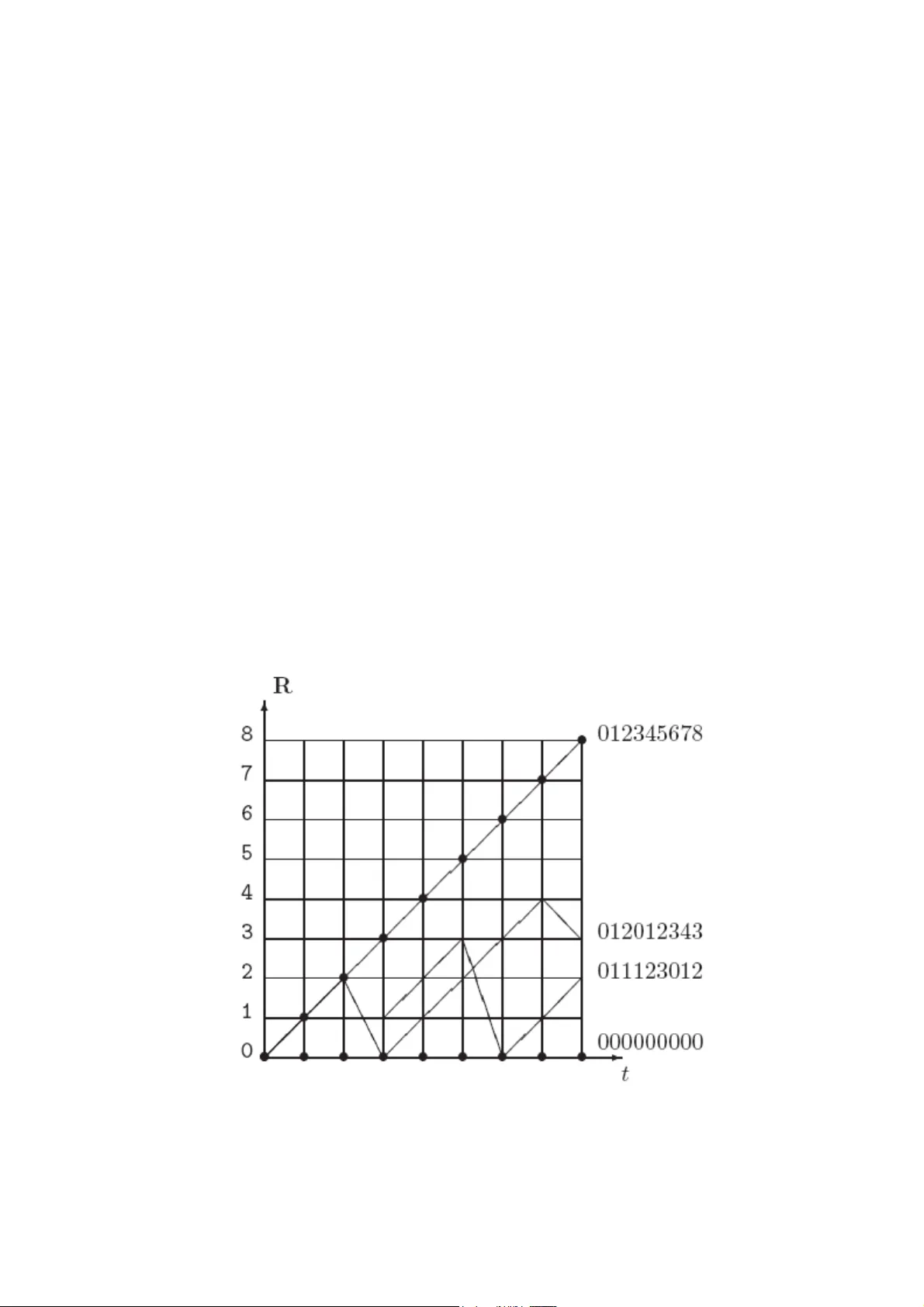
MODERATE GROWTH TIME SERIES FOR DYNAMIC COMBINATORICS MODELISATION Luaï JAFF, Gérard H.E. DUCHAMP, LIPN, Paris XIII University 99, avenue Jean-Baptiste Clément 93430 Villetaneuse, France luai.jaff@gmail.com, gheduchamp@gmail.com Hatem HADJ KACEM , MIRACL, Sfax University Route de l’Aérodrome - BP 559 3029 Sfax, Tunisia hatem.hadjkacem@fsegs.rnu.tn Cyrille BERTELLE , LITIS, Le Havre University 25 rue Ph. Lebon - BP 540 76058 Le Havre Cedex, France cyrille.bertelle@univ-lehavre.fr Abstract Here, we present a family of time series with a simple growth constraint. This family can be the basis of a model to a pply to emerging computation in business and micro-economy where global functions can be expressed from local rules. We explicit a double statistics on these seri es which allows to establish a one-to- one correspondence between three ot her ballot-like strunctures. Keywords: Time series, Complex system, Growth constraint, local rules, Dyck words, Permutations, Codes. 1. Introduction In this paper, we are interested with time series with mo derate growth but possibly sudden decay. We will focus oursel ves on a very simple model (a “toy model” as physicists ma y say), the co mbinatorics of which is completely mastered. This feature is important as one may use simulations and estimates over “all the possible configurations”, as it is the case, for example, for other combinatorial models (Cox-Ross-Rubinste in , for instance). The model is that of sequences with integer values and gr owth bounded by a unit (local rule). Surprisingly, there is one-to-one correspondences between the possible configurations and planar combinator ial objects which are endowed with a special dynamics which we describe here . The structure of the paper is the following. Section 2 presents an applic ative economic problem which leads to generate the studied growth time series from local rules. On section 3, we propose a non exhaustive review concer ning emerging computation in economic domain and how our work relates corre sponding of this body of knowledge. Section 4 develops the dynamic combin atorics computation which leads to establish one-to-one correspondences between three other ballot-like structures. We conclude on section 5. 2. From Micro-Economy Local Ru les To Dynamic Combinatorics Our aim is to describe here a toy-model of the benefit in the following situation. A capital owner possesse s two accounts, say P and R , P is the account where the principal (untouched) capital is deposi ted. This capital produces a constant return (one unit per unit of time) which is sent to a reserve R . From the account R can be with drawn arbitrary amounts of money and the account m ust stay positive. The possible configurations are desc ribed the sequences such that • 0 1 = a • 1 1 + ≤ + i i a a Figure 1: Maximal, minimal (dotted) an d two intermediate trajectories. Their codes are on the right In this paper, we build combinatorial struc tures that allow to m odelize and to compute the global behavior of the reserve R by some specific functions. We can consider this result as an emerge nt function from the basic local rules. 3. Emerging Computations Emerging computation is nowadays a thrilling topic which concerns many developments in complex systems mode ling. A brief review can allow to classify these emerging computations con cerning economic domains in 3 spaces. The first space is composed of emerging computations which lead to some universal laws. Per Bak’s sand pile is c oncerned by this class [6]. In such model called Self-Organized Criticality, the ph enomenon is crossed by transformation which make it evolve by avalanche. The Coton market trade follows such a law. For 1000 small price variations, there ar e only 100 middle price variations and only 10 major price variations. The ge neral law which characterize such criticality phenomena is an exponential law. The second space of emerging computati on leads to some pattern formations without a complete knowledge of any l aw. Thomas Schelling’s segregation model for urban development is concerned by this class [7]. In such model some local interactionbetween neighbours can lead to self-organized patterns which emerge from the whole interaction syste ms. Some areas become specialized to some people categories while other ar eas are devoted to others ones. The third space of emerging computation described here, leads to some global functions expressions. It is typically what we will describe in our problem. The local rules concerned by the proposed ec onomic toy-m odel will lead to define combinatorics structures allowing to co mpute a functional global approach. The detailed computation is desc ribe in the following 4. Dynamics Combinatorics Computation 4.1 Trajectories and Codes We can define the trajectories of our model by sequences (codes) 123 n aa a a ... such that • 1 1 = a • 1 1 + ≤ + j j a a Example : For n = 4, we have 14 codes as described in the following table. numbers codes 1 1111 2 1112 3 1121 4 1122 5 1123 6 1211 7 1212 8 1221 9 1222 10 1223 11 1231 12 1232 13 1233 14 1234 We remark that we have 5 codes whic h end by 1 or 2, 3 codes ending by 3 and one code ending by 4. Now if one sets ) , ( k n l to be the number of codes ending by 1 − k , one can check that • ) 1 ( 0 ) , 0 ( ) 0 , ( ≥ ∀ = = n n l n l • 1 ) 0 , 0 ( = l (the void sequence) • ∑ + ≥ − = 1 ) , 1 ( ) , ( k j j n l k n l whence the easy computed table of the first values N\k 0 1 2 3 4 5 6 7 0 1 0 0 0 0 0 0 0 1 0 1 0 0 0 0 0 0 2 0 1 1 0 0 0 0 0 3 0 2 2 1 0 0 0 0 4 0 5 5 3 1 0 0 0 5 0 14 14 9 4 1 0 0 6 0 42 42 28 14 5 1 0 7 0 132 132 90 48 20 6 1 The values for 1 , ≥ k n can be even more easily co mputed with the (subdiagonal) local rule described by West + North = result . For instance, we remark that 9 + 5 = 14. 1 0 0 0 0 0 0 1 1 0 0 0 0 0 1 2 2 0 0 0 0 1 3 5 5 0 0 0 1 4 9 14 14 0 0 1 5 14 28 42 42 0 Remark that the preceding table gives the mirror images of the lines of the previous double statistics. 4.2 Permutations We say that a permutation π of n letters has an increasing subsequences of length k if there are positions 12 3 1 k ii i i n ≤ < < < ... < ≤ such that 12 3 () ( ) ( ) ( ) k ii i i π ππ π < < < ... < For example 12345 5341 2 π ⎛⎞ = ⎜⎟ ⎝⎠ has increasing subsequences of length 2, at points {2 3 } , as well as at positions {4 5 } , . Let 2 () n π be the number of permutations of n letters that have no increasing subsequences of length 2 > . By direct enumeration we obtain the following table. n 0 1 2 3 4 5 6 7 8 2 () n π 1 1 2 5 14 42 132 429 1430 Proposition 1. 2 () n nC π || = , where 2 () n π the number of permutations of n letters that have no increasing subsequences of length 2 > and n C is the n-th Catalan number. 2 1 1 n n C n n ⎛⎞ = ⎜⎟ + ⎝⎠ 4. 3 Young Tableaux Definition 1. A partition of n, written n > λ , is a sequence, 12 3 () k λ λλ λ λ = , , , ..., such that the i λ are decreasing (weakly) and 1 k i i n λ = = ∑ . Let n n > ) ,..., , ( 2 1 λ λ λ λ = . Then the Ferrers diagram , or shape , of λ is an ar ra y of n-squares into k left-j ustified rows with row i containing i λ squares for 1 ik ≤≤ . For example, the partition (4,3,1) Let λ be as above. A Young tableau of shape λ , is an array obtained by replacing the squares of the shape of λ by a bijection with the numbers 1,2,...,n. A tableau T is said to be a standard Young tableau if the rows and columns are increasing sequences. For example below the tableau is standard 1235 467 8 A standard Young tableau of two lines is of the shape n l l > ) , ( 2 1 λ where 12 0 ll ≥> . Let 12 () ll f , be the number of standard ta bleaux of two lines. We have 12 12 () 12 1 1 1 1 ll ll ll f l l ⎛⎞ ⎜⎟ , ⎜⎟ ⎜⎟ ⎜⎟ ⎝⎠ + −+ = + Proposition 2. If l 12 l = then 11 1 () 1 1 2 1 1 ll l f l l ⎛⎞ ⎜⎟ , ⎜⎟ ⎜⎟ ⎜⎟ ⎝⎠ = + which is th n-th Catalan number n C . In general, we can represent a Young tabl eaux of two (equal) lines as follows : . . . . 2n 1 . . . k Then 2 nk h − = will be the second parameter of the tableau. Example : A Young tableau of size six and height two 3 5 6 1 2 4 Then 64 2 − = we remark that 2 is the last letter of 2 (3 ) 312 σ = 4.4 Dyck Words and Dyck Paths Let w be a word and a a letter, the length of w will be denoted by w || , and the number of occurrences of a in w by a w | | . We denote the empty word by ε . If w = uv , then u is a prefix of w . Definition 2. A Dyck word w is a word over the alphabet {0 1 } =, ∑ with the following properties : • For each prefix of u of w , 10 uu | |≥ | | • 10 ww || = || A Dyck path is a path in the first quadrant, which begins at the origin (0 0) , , ends at (2 0 ) n , . A Dyck path consists North-east and South-east steps. The number of Dyck paths of length 2n is the Catalan number 2 1 1 n n C n n ⎛⎞ = ⎜⎟ + ⎝⎠ and thus, 0 11 4 2 n n n x Cx x ≥ −− = ∑ Now, we can refine the number of Dyck words with respect to a parameter like k which is the number of factors in Dyck words. The number of Dyck words of length 2n which decompose into k (irreducible Dyck) factors is exactly () ln k , and their sum (over k ) equal to the Catalan numbers. For example aaaabbbb is a Dyck word of length 4 which has one factor. 4.5 Bijections In this chapter we will describe the li nks between some co mbinatorial famillies and we try to give certain properties that help us to understand the connection. 2 () Codes n Y oungtableaux Dyck words σ ↔↔ ↔ Theorem 1. Let {} a + Φ= ∪ Φ be a data structure with a bi-variate statistics 2 lN :Φ → () ( ) sl s n k →= , such that () lN N ++ Φ ⊂× Suppose that We suppose that there exist a function d + :Φ → Φ such that 1. 1 nn d − :Φ → Φ ( 1 1 () ( ) n p rl n − Φ= o ) 2. 1 nn N φ + − :Φ → Φ × (( ) ) sd s k →, is injective 3. define 2 p rl π = o . For all s ∈ Φ we define his code by 12 () ( ( () ) ( () ) ( () ) () ) nn sd s d s d s s χπ π π π −− =, , , L then χ is injective. For example to pass a code 11 2 2 to 2 (4 ) σ , (4 4) f , and Dyck word of length 8 which decompose into one factor. 2 (2 ) 1 12 312 3 412 σ :→ → → Dyck word : ab Æ aabb Æ abaabb Æ aabaabbb Figure 2: Young tableau 5. Conclusion We have presented an toy-model econom ic behaviour based on local rules and we propose some global function expressi on which can be also described by three combinatorics structur es. By this application, we point out a one-to-one correspondence between three other ballot-like structur es. The innovative aspect of this paper deals with a constructive de velopment of the involved bijections. References [1] B.E. Sagan, The symmetric group , 1991 . [2] C. Schensted, Longest increasing and decreasing subsequences , Canad.J.Math, 13( 1961), 179-191. [3] M.P. Schützenberger, Quelques remarques sur une construction de Schensted , Math. Scand., 12(1963), 117-128. [4] Herbert S. Wilf, Ascending subsequences of permutations and the shape of tableaux , Journal of Combin. theory, series A 60(1992), 155-157. [5] Herbert S. Wilf, The computer-aided discovery of a theorem about Young tableaux , J. Symbolic Computation, series 20 (1995), 731-735. [6] Per Bak, How nature works - the scien ce of self-organized criticality , Springer Verlag, 1996. [7] Thomas Schelling, Dynamic models of segregation , J. of Math. Sociology, vol. 1, 1971.
Original Paper
Loading high-quality paper...
Comments & Academic Discussion
Loading comments...
Leave a Comment